down to earth

  • Home
  • About Us
  • Down To Earth Book
  • Privacy Policy
Carrying on from the post on sowing seeds yesterday, I'd like to add the following vital information.  While the seed is still covered with soil, it does not need anything other than moisture and warmth to make it grow.  However, when the seed germinates and sends up green shoots, it will need bright light as well.  When it gets a little bigger, the plant will need food; the energy in the seed will be exhausted.  Then you should start your fertilising schedule.  When you plant the seedlings out, there should be abundant food in the soil in the form of compost, manures and castings, or whatever it is you've decided to use on your plants.  That should be in the soil.  While the seedling is still in the tray, you'll need to feed it - there is very little nutrient in seed raising mix, sand or vermiculite.
The ultimate prize - homemade tomato relish.

We only ever use organic fertilisers here - either bought from the nursery or homemade.  Generally when our seedlings are still in their trays, we fertilise them with weak fish emulsion, weak liquid blood and bone OR weak comfrey or worm tea (homemade). Not all of them, choose one.  Comfrey or worm tea is an excellent choice for both leafy green vegies and for fruiting ones, like cucumbers and capsicums/peppers. Fish emulsion and liquid blood and bone will put on healthy growth on your green leafy vegetables.  I never go by the container recommendations on the fertiliser, I make up a 50% solution and apply it twice as often.  For instance, if your fertiliser instructions recommend making up a 10 litre/quart watering can with two caps of fertiliser concentrate and apply it fortnightly, I would make up a watering can with one cap full of concentrate and apply it weekly.
A tray of tomato seedlings, newly emerged.  At this stage they need no fertiliser but strong light.  Enough light so a shadow is cast.
So, now on to tomatoes.  Forget what I said above about fertilisers, tomatoes are different.  I picked up this way of growing tomatoes from Peter Cundall, surely Australia's master vegetable gardener.  I plant the seeds as normal and wait for germination.  When the plant has grown to be about two inches above the top of the soil, I transplant it to a slightly bigger pot, fertilising with comfrey and a pinch of sulphate of potash (it's organic).  Each time I transplant, I also water the plants with seaweed tea - this helps significantly with translpant shock. I wait again and when it grows another inch or two, I transplant it again to a larger pot - each time I remove the bottom leaves and bury the plant deep, and water with seaweed tea  You can do this with very few plants, it would kill most of them.  But tomatoes have the ability to produce more roots along their main stem and the more roots you have on a tomatoes, if you grow a healthy plant, the more fruit it will produce.  Tomatoes also like being slightly root bound.

When they're a little bigger, transplant to a larger pot.

You keep your tomatoes seedlings going like this until they're strong and healthy and when they flower, you plant them in the garden - again, deep in the soil into which a pinch of sulphate of potash has been added.  You might even bury half the stem and have the top half of the tomatoes about the soil.  Put the stakes in before you plant the seedlings so you don't damage the roots by doing it later.  If the plant is big enough, tie it to the stake straight away.  Remove any axis shoots because if you allow them to grow, they'll make a very bushy plant and you'll get fewer tomatoes.
 When you transplant again to a larger pot, pinch or cut off the lower leaves.

Once you've planted the tomatoes out and tied them to their stakes, mulch heavily with straw or hay, packing it in around the stem and up about three inches.  Again, most plants would hate this but tomatoes thrive with this treatment. Water the mulch well without watering the tomatoes leaves.  Always water tomatoes from below, never over the top of the plant. Splashing mud onto leaves with the hose will encourage disease.  If you mulch well, the tomatoes will send more roots out into the mulch.  Do not over fertilise tomatoes with nitrogen, it will make the bush grow like mad but you'll get almost no tomatoes.  Make sure you keep staking and keep the branches off the ground.  When the tomatoes are big enough, pick them still green, and ripen them in the house, out of the sun.  They will develop their full flavour that way and be out of harm's way.
All the while, they'll need strong light while being protected from the harsh weather.

Tomatoes suffer from a disease called blossom end rot which is caused by inconsistent watering, resulting in a lack of calcium in the plants.  You'll see a big circle that runs around the blossom end of the fruit.  To avoid this, set up a watering schedule so your plants get consistent watering and don't suffer periods of dry.
When they're at this size and start flowering, plant them in the garden.

So, my friends, that's one of many ways of growing tomatoes.  I'm sure you won't be disappointed if you try it.  Just think of all those delicious tomato sandwiches and jars of tomato relish standing like jewels in your cupboard.  Mmmmm.  If you're growing heirlooms this year, don't forget to keep your very best tomato to save seeds from.  Yes, I know it's a huge sacrifice to save THE best, but you want to pass on THE best seeds.
In my opinion the best tomato for flavour - the pink Brandywine.

If I were a betting woman, which I'm not, I'd bet that almost all our gardeners here would be growing tomatoes at some times during the season.  Who will be growing tomatoes and what varieties are you growing?
We've been slowed down by the rain but it's not stopped us, nothing can.  We're now in our planting season, getting our new season garden going for the year ahead, and seeds need to be planted.  Hanno started this season off by enriching the soil with cow manure, worm castings and compost.  He does it every year and often between crops as well by digging out a hole and replacing the soil with a rich mix of compost and aged manure.  In the world of the vegetable seedling, nothing helps them more than good soil.  If you're gardening for the first time this year, or the hundredth, that is your starting point.


There are many seeds you can plant straight into the soil, but others benefit from being grown in a container in sheltered conditions, and then being planted as a seedling.  The main one of these is the tomato.  You will get more tomatoes if you plant them as seedlings and I'll show you how to do that later.  Root vegetables like carrots, radishes, parsnips, turnips and legumes - peas and beans, are best planted directed into the soil.  For the rest of  your seeds, be guided by the instructions on the seed packet and if you're an experienced gardener, by your own experience.  We prefer to raise lettuce, capsicum, cabbage, leek, cucumber and celery seeds in trays and plant them out when they're ready.  We over-plant seeds so we can choose the strongest looking seedling and discard the weak ones. If you want a very orderly garden, you'll benefit from planting seedlings rather than seeds in the garden because with seeds you either over or under plant, and some seeds don't germinate and you're left with an empty space.  Planting from a seedling tray will allow you to plant out the garden exactly to your liking.

When planting seeds in trays, use a good quality potting mix, not potting or garden soil.  You need a mix that is open and drains perfectly, with no lumps of bark or charcoal that will stop a tiny seedling from emerging.  It's quite easy to make your own seed raising mix, but I prefer to buy mine already made. Fill the trays, poke your finger into each cell to flatten the soil slightly, then top up the cell with the mix again.  Plant according to the instructions on the packet.  Generally, the rule of thumb is the larger the seed the deeper it's planted.  So for a seed that is tiny, you'd only have to place them on the top of the soil and scatter seed rasing mix over the top to cover them and pat down.  For a larger seed, plant it at twice its size - so a seed that is ½ mm would be planted 1 mm deep and a 1 mm seed would be planted 2mm deep.  Pat the soil down over the top so the seed stays where it is planted, then gently water in.  Don't do that with the hose, it's too forceful, get yourself a plastic spray bottle and use that.  It will take a while to completely wet the soil, but that's what it takes - gardening will help you slow down.  The seed and all the soil in the cell needs to be saturated, and then the water should freely drain away, leaving a moist seed and cell.  The water is what causes the seed to germinate.

Once the tray has been planted up, you must keep it moist. Seedlings don't cope well if you let them dry out.  Give them a good spray of water every day.  Seeds contain everything, except water, to make them grow, they don't need fertiliser.  Once the true leaves appear, you can gently fertilise them, but not before.

If you're using new seeds, you should be fine as long as you checked the use by date on them.  If you're using older seeds that you've had for a while, or those given to you by a friend or seed swapper. you can test them for viability before you plant them to make sure they'll germinate.  I wrote about how to do that two years ago, here.

If you plant by the moon, and that really does work and make sense, there are moon phase calendars to be guided by, just google "moon phases London" or wherever you are and you'll find a moon calendar to help with your planting.  In Australia, the planting time for March will start next week with the new moon on Monday 15 March.  Here is a moon planting guide.

When planting seeds directly into the garden, most seeds can be planted, in dry soil, watered in and then left to be watered again each day until the seedling emerges.  The seeds of legumes need to be treated a bit differently. When planting peas or beans, water the ground well before you plant the seeds.  Then, planting according to the spacing on the seed packet, place the seeds into the moist soil.  Don't water again until you see the new shoot emerge.
When you plant as many seeds as you need and have some left over, most seeds can be kept for another time.  Wrap them up again in the packaging they came in, making sure they can't fall from their packets, and put them in a glass jar - recycled of course - and put the jar in the fridge.  Seeds stored in the way will last a few years.

This post is getting too long so I'll write about tomato seeds and seedlings tomorrow.  We all still have a week before we need to plant according to the moon.  I have a very good Australian gardening book by Lyn Bagnell what speaks of moon planting.  If you can get a copy, it's worth the read.  I believe Lyn's book to be the best Australian vegetable gardening book.  Lyn has her own   informative blog as well, you can find her here.

This week will be an excellent time to plan, collect and prepare your seeds.  If you're a new gardener, it would be a good idea for you to draw a garden plan.  Don't be too ambitious in your first year - there is hard work ahead.  We mindful of the time you have and don't make the task to difficult for yourself.  Gardening can be a wonderful and creative use of your time, but overdoing it will make you resent the first time you picked up a spade.
Even without the overcast sky I think it would have been cooler this weekend.  We've passed through the time when hot turns to warm and now we're getting closer to when warm becomes cool.  Perfect!  I want it to be March and April all year.  Hanno and I had a traditional, for us, Sunday.  He ventured out to the wet and squelchy garden to put up trellises for the cucumbers, I baked and did some sewing.  All in all it was a lovely day.

I had been meaning to use up some of the delicious chocolate the people at Green and Black sent me before Christmas.  I'd already given some to Shane and Kerry, and made some chocolate mousse, then forgot to take photos of it. Yesterday, in my celebration of quiet domestic Australian Sunday, I made choc chip biscuits.  It was an easy task because I already had the cookie dough made and frozen, all I had to do was defrost and chop.


The cookie dough I used is the cheap and easy recipe I found at the down to earth forum which I think is an old Australian recipe from many moons ago. When I make this recipe I always halve it and have the second half in the freezer for a month or so:

CHEAP AND EASY BISCUITS
Makes 7-8 dozen, cook for 10 minutes in a preheated oven at 180C

500 grams butter (approx 1.1 lb)
1 can condensed milk (390-400 gram) - my homemade condensed milk recipe is here.
1 cup sugar
5 cups self raising flour (or all purpose flour and baking powder)

With the dough already in hand, it was simply a matter of chopping the chocolate - I used the deliciously bitter sweet 70 percent dark chocolate with a small hand full of mixed nuts - brazils, hazels, almonds, cashews, macadamias.  Mixed together and flattened out with my hands on the kitchen bench, it only took a few minutes and they were in the oven.

Ten minutes later the house filled with the aroma of freshly made biscuits and Sunday was smelling the way it should smell.  There are two aromas that make a real domestic Sunday - baking biscuits or cake and roasting meat.  We had roast chicken for dinner.  Lunch was a tuna, tomato and onion pumpernickel sandwich and a still warm from the oven biscuit and black tea.  Delicious! 


Just after lunch, I planted some vegetable seeds and looked around my bush house where I put sick plants to recover, grow my orchids, and keep new seedlings.  There has been so much rain, moss is growing on the benches and all my watering containers were full of rain water.  Not that I needed to use them with the plants still saturated and growing wildly.  It was a real treat to be surrounded by new growth and the promise of new life.  So many things are made possible with abundant water.  I checked all the water containers and found cane toad tadpoles in one so I tipped them out and made a mental note to return before the week was up to use the water before mosquitoes have the chance to hatch.  This year has been the worst one yet for mosquitoes.


All in all it was a lazy day with things being done when I felt like doing them. The bed was made in the afternoon when I started to think about sleeping in an unmade bed, no floors were swept and the laundry stayed unwashed for another day.  In the afternoon, while the chicken started roasting, we watched a documentary about happiness.  Bliss!  I hope you enjoyed your weekend and that the week ahead is a productive and rewarding one for all of us.
Today's we are in Mrs Mac's kitchen in North Idaho.  She writes:

"Enclosed are a few pictures of my kitchen.  We built our home from the ground up and moved into it three years ago.  It was a giant undertaking but worth the effort in the end.  Our kitchen is open to the great room and includes a dining area; all of which are the 'hub' of our home.

The built in spice cabinet is actually a vintage ironing board cupboard that I refurbished with paint, new hardware, and glass shelves.  It's perfect for storing large jars by freeing up valuable pantry/cupboard space, all the while keeping the spices cool.  Living in North Idaho, USA, we often have moose and other wild game to view while we enjoy our meals at the kitchen table.  Keeping the critters out of my garden is a non-stop effort! "

The Thrifty Garden/Home and
Whatever Happened to ...


Please don't forget to comment. A comment is like payment for the time taken to post, and in this case in sending in the photos.  Many of us were enthusiastic about this series, so make sure all the photos get a good number of comments.  I don't want any of the people sending in photos to regret joining in.  Thank you friends.
Today's kitchen is in South Australia and it's Sue Joy's.  She writes:

"We built this kitchen onto our house around 7 years ago. I designed it and I love it probably more today than I did back then. On my sink is my first knitted dishcloth (I am the world's slowest knitter) and the produce plucked from our garden this morning; chillies and heirloom tomatoes to go into pasta sauce and a basket full of eggs that my daughter takes up to the chook house every day.
My collection of cows sit happily above the sink as a reminder of where I grew up on a dairy farm. We do not have a dishwasher, I love to do the dishes by hand looking out over parkland and tree tops as we live high on a hill.
I use our island bench for all of my chopping, mixing etc. From this view I get to see who is running up the passage-way and in the dining come sewing room, my vintage and antique furniture (the meatsafe on the left is from the late 1800's), and my beautiful puppy Heidi the Pug. What you can't see in the photo is Sophie's handmade wooden kitchen sink and oven behind the bench, so we really have 2 sinks in our kitchen.

Our kitchen is definately the heart of our home, there's always someone in it ready for a chat. This room makes me smile and I am always comfortable and happy here.

I have 2 blogs, the first being for all of my crafty obsessions at www.suejoy.blogspot.com and for health, home and garden, www.sue-brown.blogspot.com"
 
Please don't forget to comment. A comment is like payment for the time taken to post, and in this case in sending in the photos.  Many of us were enthusiastic about this series, so make sure all the photos get a good number of comments.  I don't want any of the people sending in photos to regret joining in.  Thank you friends.
If I could, I would send all of you the magic words that would change your life to what you wish it to be.  I don't have those magic powers, all I can do is write what I know and hope that the way you understand those words helps you towards a better life.  The best I can do today is to say: slow down.   I received an email from a reader saying that she wanted the kind of life I'm living but doesn't know how to go about it. I wrote back to ask if she'd read the 2007 parts of the blog where I write about budgeting, paying down debt, housework, gardening, slowing down and being at home.  That explains how I came to this life and the closest thing I've written to the kind of guide she was looking for.  She wrote back asking if I could condense it for her.

No, I can't.

Everyone who reads here can take what they need from what I write, but what I hope everyone gets is that we all have to take the time to slow down and at every opportunity, add value to our day.  I add value to my hours by knitting, gardening, reading, sitting, talking, listening, watching and being still.  We can all carry out the tasks of a simple home and live a more simple life by cooking from scratch, sewing and mending, making green cleaners, baking and gardening.  That's the easy bit, although it takes persistence and the energy to do it every day.  The more difficult bit is to connect the dots and to make those simple tasks mean something to you so you enjoy doing those tasks on a daily basis.  The way I do that is to slow down, think about why I'm working in a particular way and to consciously enjoy what I'm doing.  Sewing isn't just sewing, cooking isn't just combining ingredients in a pan, I think about why I'm sewing, who I'm sewing for and how I can make it special, not just for them but for me too.  I feel the fabric, admire the colour combinations and take my time.  I don't want to rush anything.  I want the act of sewing to add value to my day.

There are no condensed versions of a slower and simpler life.  You have to live the full measure of it.  It is a life long process  - a journey with no end.  If you look for short cuts you will short change yourself because the point is not to get to the end fast or with more chickens or loaves of bread baked, it's to enjoy the journey.


Hello everyone!  Today's kitchen belongs to Jen who lives in Michigan.  She has added a nice touch that I've never seen in any other kitchen.  Well done, Jen!

She writes:
"I'm really excited to share my photos as we recently did a little fixing up of our kitchen. Ours is a small space, about 9'x11', so it is difficult to get good pictures of it, but I hope these will work for you.

The first picture shows the kitchen sink, and the main part of the kitchen. The cabinets in this area are original to the house (1950's) and are metal. I love them. With so little storage space, many of my cooking utensils are out in the open and easy to grab. The red skillet hanging above the stove is cast iron. I am just learning to cook with cast iron.

The cabinets and countertop next to the refrigerator are new; we installed them ourselves. Unfortunately, it was impossible to find metal cabinets to match the originals. These were stock, unfinished cabinets from Home Depot and I painted them the same color as the old ones and hope they blend OK. We used to have open shelving in this area and it was difficult to keep things looking neat. I am happy that things are contained now and that I have a bit more counterspace.  We were unable to match the cabinet hardware on our old cabinets, so we decided to upgrade all the cabinet hardware so it would match. I love the new knobs and pulls - it is surprising how it modernized and pulled the space together.

The magnetic spice containers on the fridge were a Christmas gift and allowed me to free up a lot of space in one of my cabinets - important in such a small kitchen. You can see my apron hanging on the side of the fridge. You can also see from the picture that yes,  I have a chandelier in my kitchen. :) I think it is a fun and unexpected addition to a hard-working space."

Please don't forget to comment. A comment is like payment for the time taken to post, and in this case in sending in the photos.  Many of us were enthusiastic about this series, so make sure all the photos get a good number of comments.  I don't want any of the people sending in photos to regret joining in.  Thank you friends.


I think most of us become more selective as we age.  When I was younger I wanted to experience everything I could so I would know rather than surmise. I'm happy enough now to leave things I'm not interested in.  The ability and the sense to do that came to me with age, although I think many people are like that all through life.  Now, at this point in life I know that it would have been prudent to choose a husband who possessed skills that would compliment, and not duplicate, mine.  If I were looking for a husband now, the colour of his eyes wouldn't matter, I would want to know if he could successfully raise an organic vegetable garden.  Hindsight is a wonderful thing but the truth is I was rarely prudent in my younger years and when Hanno wandered into my life I never once thought of any of those practical considerations, I just loved him.  I was more concerned with what was in his heart rather than in his bank account.

When I hang clothes or towels, the frame sits on its own legs.  When I have sheets on the line, we use a little steel support to hold the line up a bit.

Now it's a bonus to me that he is multiskilled.  Not only does he possess the skills of his former trade - mechanics, he can turn his hand to most things in the home.  He can make furniture, repair the roof, rewire a lamp, unblock the plumbing, fix the car and cook delicious potato pancakes.  I think I hit the jackpot.
It just pulls down from the roof where it sits when not in use.

A while ago, I asked Hanno to make me an all weather washing line.  I wanted something better than the rope line we had strung up on the back verandah.  I wanted a line that I could use when it was raining, that was ready to go all the time but would be out of the way.  I needed a line that I could reach without stretching and one that would hold a full load of washing.  That was the brief - it's been delivered.
When the washing is dry, the frame is lifted up to the roof again, out of the way.

Even though it was some time ago that I asked for this washing line, Hanno did start working on it almost immediately.  We settled on a steel frame that would be able to hold a full wash and last a long time but we had no way of welding the pieces together.  Luckily for us, our neighbour John just bought a new welder. Hanno and John put the line together on the weekend and the ideal testing weather promptly arrived soon after.  Five inches of rain fell yesterday, much less that what was predicted - 12 inches, but a real soaking nonetheless.  I pulled the line down from where it is safely tucked away, pegged on the laundry and stood back to admire the scene.  There are a few things that really improve with age, a capable husband is one of them.  Thank you Hanno (and John).
Newer Posts Older Posts Home


My books were all published by Pengiun, and are available at Amazon US, Amazon UK and Amazon Au

Search here

Total Pageviews

Translate


I'm Rhonda Hetzel and I've been writing my Down to Earth blog since 2007. Although I write the occasional philosophical post, my main topics include home cooking, happiness and gardening as well as budgeting, baking, ageing, generosity, mending and handmade crafts. I hope you enjoy your time here.

MY FAVOURITE PLACES

  • Grandma Donna's Place
  • Grandma Donna's YouTube
  • Grandma Donna's Instagram
  • This Simple Day
  • Nicole's Instagram

Give More

Give More

Popular posts last year

Making ginger beer from scratch

We had a nice supply of ginger beer going over Christmas. It's a delicious soft drink for young and old, although there is an alcoholic version that can be made with a slight variation on the recipe. Ginger beer is a naturally fermented drink that is easy to make - with ginger beer you make a starter called a ginger beer plant and after it has fermented, you add that to sweet water and lemon juice. Like sourdough, it must ferment to give it that sharp fizz. To make a ginger beer plant you'll need ginger - either the powdered dry variety or fresh ginger, sugar, rainwater or tap water that has stood for 24 hours to allow the chlorine to evaporate off. You'll also need clean plastic bottles that have been scrubbed with soap, hot water and a bottle brush and then rinsed with hot water. I never sterilise my bottles and I haven't had any problems. If you intend to keep the ginger beer for a long time, I'd suggest you sterilise your bottles. MAKING THE STARTER In a...
Image

NOT the last post

This will be my last post here.  I've been writing my blog for 18 years and now is the time to step back. I’ve stopped writing the blog and come back a couple of times because so many people wanted it, but that won’t happen again, I won’t be back.  I’ll continue on instagram to remain connected but I don’t know how frequent that will be. I know some of you will be interested to know the blog's statistics. 
Image

How to make cold process soap

I'm sure many of you are wondering: "Why make soap when I can buy it cheaply at the supermarket?" My cold process soap is made with vegetable oils and when it is made and cured, it contains no harsh chemicals or dyes. Often commercial soap is made with tallow (animal fat) and contains synthetic fragrance and dye and retains almost no glycerin. Glycerin is a natural emollient that helps with the lather and moisturises the skin. The makers of commercial soaps extract the glycerin and sell it as a separate product as it's more valuable than the soap. Then they add chemicals to make the soap lather. Crazy. Making your own soap allows you to add whatever you want to add. If you want a plain and pure soap, as I do, you can have that, or you can start with the plain soap and add colour, herbs and fragrance. The choice is yours. I want to add a little about animal and bird fat. I know Kirsty makes her soap with duck fat and I think that's great. I think t...
Image

Preserving food in a traditional way - pickling beetroot

I've had a number of emails from readers who want to start preserving food in jars but don't know where to start or what equipment to buy.  Leading on from yesterday's post, let's just say up front - don't buy any equipment. Once you know what you're doing and that you enjoy preserving, then you can decide whether or not to buy extra equipment. Food is preserved effectively without refrigeration by a variety of different methods. A few of the traditional methods are drying, fermentation, smoking, salting or by adding vinegar and sugar to the food - pickling. This last method is what we're talking about today. Vinegar and sugar are natural preservatives and adding one or both to food sets up an environment that bacteria and yeasts can't grow in. If you make the vinegar and sugar mix palatable, you can put up jars of vegetables or fruit that enhance the flavour of the food and can be stored in a cupboard or fridge for months. Other traditional w...
Image

Cleaning mould from walls and fabrics

With all this rain around we've developed a mould problem in our home. Usually we have the front and back doors open and that good ventilation stops most moulds from establishing. However, with the house locked up for the past week, the high humidity and the rain, mould is now growing on the wooden walls near our front door and on the lower parts of cupboards in the kitchen. Most of us will find mould growing in our homes at some point. Either in the bathroom or, in humid climates, on the walls, like we have now. You'll need a safe and effective remedy at some point, so I hope one of these methods works well for you. Mould is not only ugly to look at, it can cause health problems so if you see mould growing, do something about it straight away. The longer you leave the problem, the harder it will be to get rid of it effectively. If you have asthma or any allergies, you should do this type of cleaning with a face mask on so you don't breathe in any spores. Many peopl...
Image

Five minute bread

Bread is one of those foods that, when made with your own hands, gives a great deal of satisfaction and delight. It's only flour and water but it symbolises so much. I bake bread most days and use a variety of flours that I buy in bulk. Often I make a sandwich loaf because we use most of our bread for lunchtime sandwiches and for toast. Every so often I branch out to make a different type of loaf. I have tried sour dough in the past but I've not been happy with any of them. I'll continue to experiment with sour dough because I like the idea of using wild yeasts and saving the starter over a number of years to develop the flavour and become a part of the family. However, the loaf I've been branching out to most often is just a plain old five minute bread. By five minutes I mean it takes about five minutes actual work to prepare but it's the easiest of all bread to make and to get consistently good loaves from. If you're having people around for lunch or...
Image

This is my last post.

I have known for a while that this post was coming, but I didn't know when. This is my last post. I'm closing my blog, for good, and I'm not coming back like I have in the past.  I've been writing here for 16 years and my blog has been many things to me. It helped me change my life, it introduced me to so many good people, it became a wonderful record of my family life, it helped me get a book contract with Penguin, and monthly columns with The Australian Women's Weekly and Burke's Backyard . But in the past few months, it's become a burden. In April, I'll be 75 years old and I hope I've got another ten years ahead. However, each year I'll probably get weaker and although I'm fairly healthy, I do have a benign brain tumour and that could start growing. There are so many things I want to do and with time running out, leaving the blog behind gives me time to do the things that give me pleasure. On the day the blog started I felt a wonderful, h...
Image

What is the role of the homemaker in later years?

An email came from a US reader, Abby, who asked about being a homemaker in later years. This is part of what she wrote: "I am a stay-at-home mum to 4 children, ages 9-16. I do have a variety of "odd jobs" that I enjoy - I run a small "before-school" morning drop-off daycare from my home, I am a writing tutor, and I work a few hours a week at a local children's bookstore. But mostly, I cherish my blissful days at home - cooking, cleaning (with homemade cleaners), taking care of our children and chickens and goats, baking, meal-planning, etc. This "career" at home is not at all what I imagined during my ambitious years at university, but it is far more enriching. I notice, though, that my day is often planned around the needs of my family members. Of course, with 4 active kids and a husband, this is natural. I do the shopping, plan my meals, cook dinner - generally in anticipation of my family reconnecting in the evening.  I can't h...
Image

Every morning at home

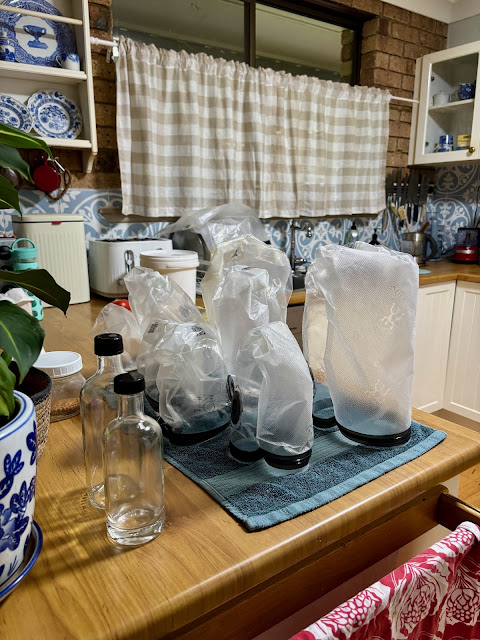
Every morning when I walk into my kitchen it looks tidy and ready for a day's work. Not so on this morning (above), I saw this when I walked in. Late the previous afternoon when I was looking for something, I came across my rolled up Zwilling vacuum bags and decided they had to be washed and dried. So I did that and although I usually put them outside on the verandah to dry it was dark by then. I turned the just-washed bags inside out and left them like this on a towel. It worked well and now the bags are ready to use when I bring home root vegetables, cabbages or whatever I buy that I want to last four or five weeks.
Image

You’ll save money by going back to basics

When I was doing the workshops and solo sessions, I had a couple of people whose main focus was on creating the fastest way to set up a simple life. You can't create a simple life fast, it's the opposite of that It's not one single thing either - it's a number of smaller, simpler activities that combine to create a life that reflects your values; and that takes a long to come together. When I first started living simply I took an entire year to work out our food - buying it, storing it, cooking it, preserving, baking, freezing, and growing it in the backyard. This is change that will transform how you live and it can't be rushed.  
Image


Trending Articles

NOT the last post

This will be my last post here.  I've been writing my blog for 18 years and now is the time to step back. I’ve stopped writing the blog and come back a couple of times because so many people wanted it, but that won’t happen again, I won’t be back.  I’ll continue on instagram to remain connected but I don’t know how frequent that will be. I know some of you will be interested to know the blog's statistics. 
Image

Every morning at home

Every morning when I walk into my kitchen it looks tidy and ready for a day's work. Not so on this morning (above), I saw this when I walked in. Late the previous afternoon when I was looking for something, I came across my rolled up Zwilling vacuum bags and decided they had to be washed and dried. So I did that and although I usually put them outside on the verandah to dry it was dark by then. I turned the just-washed bags inside out and left them like this on a towel. It worked well and now the bags are ready to use when I bring home root vegetables, cabbages or whatever I buy that I want to last four or five weeks.
Image

You’ll save money by going back to basics

When I was doing the workshops and solo sessions, I had a couple of people whose main focus was on creating the fastest way to set up a simple life. You can't create a simple life fast, it's the opposite of that It's not one single thing either - it's a number of smaller, simpler activities that combine to create a life that reflects your values; and that takes a long to come together. When I first started living simply I took an entire year to work out our food - buying it, storing it, cooking it, preserving, baking, freezing, and growing it in the backyard. This is change that will transform how you live and it can't be rushed.  
Image

Creating a home you'll love forever

Living simply is the answer to just about everything. It reduces the cost of living; it keeps you focused on being careful with resources such as water and electricity; it reminds you to not waste food; it encourages you to store food so you don't waste it and doing all those things brings routine and rhythm to your daily life. Consciously connecting every day with the activities and tasks that create simple life reminds you to look for the meaning and beauty that normal daily life holds.  It's all there in your home if you look for it. Seemingly mundane tasks like cleaning and cooking help you with that connection for without those tasks, the home you want to live in won't exist in the way you want it to.  Creating a home you love will make you happy and satisfied.
Image

Time changes everything

I've been spending time in the backyard lately creating a contained herb and vegetable garden. My aim is to develop a comfortable place to spend time, relax, increase biodiversity and encourage more animals, birds and insects to live here or visit. Of course I'd prefer my old garden which was put together by Hanno with ease and German precision. Together, we created a space bursting at the seams with herbs, vegetables and fruity goodness ready to eat and share throughout the year. But time changes everything. What I'm planning on doing now, is a brilliant opportunity for an almost 80 year old with balance issues. In my new garden I'll be able to do a wide range of challenging or easy work, depending on how I feel each day. It’s a daily opportunity to push myself or sit back, watch what's happening around me and be captivated by memories or the scope of what's yet to come.
Image

It's the old ways I love the most

I'm a practical woman who lives in a 1980’s brick slab house. There are verandahs front and back so I have places to sit outside when it's hot or cold. Those verandahs tend to make the house darker than it would be but they're been a great investment over time because they made the house more liveable. My home is not a romantic cottage, nor a minimalist modern home, it's a 1980’s brick slab house. And yet when people visit me here they tell me how warm and cosy my home is and that they feel comforted by being here. I've thought about that over the years and I'm convinced now that the style of a home isn't what appeals to people. What they love is the feeling within that home and whether it's nurturing the people who live there.
Image

Making ginger beer from scratch

We had a nice supply of ginger beer going over Christmas. It's a delicious soft drink for young and old, although there is an alcoholic version that can be made with a slight variation on the recipe. Ginger beer is a naturally fermented drink that is easy to make - with ginger beer you make a starter called a ginger beer plant and after it has fermented, you add that to sweet water and lemon juice. Like sourdough, it must ferment to give it that sharp fizz. To make a ginger beer plant you'll need ginger - either the powdered dry variety or fresh ginger, sugar, rainwater or tap water that has stood for 24 hours to allow the chlorine to evaporate off. You'll also need clean plastic bottles that have been scrubbed with soap, hot water and a bottle brush and then rinsed with hot water. I never sterilise my bottles and I haven't had any problems. If you intend to keep the ginger beer for a long time, I'd suggest you sterilise your bottles. MAKING THE STARTER In a...
Image

An authentic look at daily life here — unstaged and real

Most days Hanno was outside happily working in the fresh air. It may surprise you to know that I started reading my book,  Down to Earth , yesterday - the first time since I wrote it 13 years ago.  I had lent it to my neighbor, and when she returned it, I started reading, expecting to find surprises. Instead, I realised the words were still familiar—as if they were etched into my memory. As I flipped through the pages, I was reminded of how important it was for me to share that knowledge with others. The principles in Down to Earth changed my life, and I truly believed they could do the same for others. After just 30 minutes of reading, I put the book down, reassured that its message still holds true: we can slow down and reshape our lives, one step at a time.
Image