down to earth

  • Home
  • About Us
  • Down To Earth Book
  • Privacy Policy
The weather at the moment is wet and grey and even though I have knitted my way through spring and summer, the cooler weather, with rain falling constantly, is made for knitting.  I was at work yesterday and each time I looked out the window at the sodden gardens and water running down pathways, I wished I had brought my knitting with me.  I think it's something like the instinct to nest - when the weather is cooler, knitters knit.
These are Tricia's gloves.  It's simply a rectangle of stocking stitch knitting, with rib stitch at both ends.  I have lined this pair with flannel for extra warmth.  If you can knit and purl, you can make these.  When the rectangle is complete, you stitch the side up, leaving a space for the thumb.

The last thing off my needles was a pair of fingerless gloves for my sister Tricia. I'm lining them with a flannel fabric for extra warmth because Tricia lives in the Blue Mountains, not quite on the snow line, but where the winters are frosty and hands get cold.  I love the idea of fingerless gloves/mittens because they allow you to work while covering your hands.  Quite a number of times during winter, I can be seen here, at my computer, typing away with my fingerless gloves on.  The pair I made for Tricia are longer than usual so she will be assured of complete coverage between hand and arm. They are just a long tube, knitted in rib - K2, P2, top and bottom.  The bulk of the knitting is stocking stitch, which is knit one row and purl one row, then keep repeating those rows.  Honestly, this is very basic knitting and even if you're a new knitter, you'll get good results if you watch your tension and take it slow.  These basic projects are great after you've mastered the dishcloth, you've supplied yourself and almost everyone you know with dishcloths and you want to move on to something else. ; - )   For Tricia's mittens I used a machine washable 8 ply pure wool on US size 6 needles.
They aren't worn with the cuff  flipped over, that is just to show the lining.

There is a lovely fingerless glove pattern for experienced knitters here.  I also like these arm warmers.  A simple pattern for self striping mittens here.  A pattern for beginners is here, but I would recommend you make them much longer than these.  The ones I made have 7½ inches/19 cm of stocking stitch between both ends of rib stitch.
The beginnings of Hanno's jumper/sweater.  This will be my main project now until it's finished.

I'm now going to concentrate on getting Hanno's jumper/sweater ready for winter.  Again I'm using an 8ply Superwash pure wool that will make the jumper warm and cosy but also easy to keep clean.  I've only done about one third of the back so far but as that's the largest part of the jumper, I feel I'm making progress.  I have my knitting set up in a 1940s vintage knitting basket Tricia gave me for my 60th birthday.  It's full of various knitting projects, there is always a dishcloth on needles in there somewhere, as well as tiny scissors, darning and wool needles, needle gauges and little bits of paper that I've written certain patterns on.  

I have fond memories of my mother knitting by the fire in my childhood home and maybe that is where my feelings of being nurtured come from when I'm knitting. On those nights when mum would check our spelling for school the next day, dad made up a tray full of bread to be toasted by the fire, tomatoes and roast lamb leftover from that day's Sunday lunch, with black coffee for mum, tea for himself and milky tea for Tricia and I.  We would have had an early bath and be firmly wrapped up in our flannel PJs and woollen dressing gowns, sitting by the fire on the floor while mum clicked away with her needles, our spelling books on her lap, asking us to spell this word and that.  We would hear dad preparing the tray in the kitchen, then the door would open and in he walked, proudly, with that tray laden with good simple food.  I don't want to mythologise my childhood, the truth is times were tough, but those nights with food on a tray, a fire crackling in the open fireplace and mum clicking away with her knitting needles prepared me in many ways for this life I live now, and I am sure ignited the knitting flame within me.

What or who brought knitting into your life?

I have a wonderful life.  I work in my community and am praised by one and all for doing it.  The truth is I get a lot more out of it than I give.  I am suited to the welfare sector.  These are my people, this is familiar territory. I grew up working class and I have gone back to being working class after living my middle years cashed up and spending. Now I'm back where I belong and I'm loving it.  But if my truth is fairly told, despite the fact that I love my voluntary work, I prefer being at home.  I might work harder and smarter at work and meet some very interesting people, but home is where my heart is.

Here at home I can potter around and work to my own rhythm.  What I do here is not decided by who walks through the door, or by a committee, a deadline or what day it is.  Here my work plans are my own invention; here I do what I want to do and juggle the tasks of my day to suit myself.  There is a lot to be said for carrying out daily tasks according to a rhythm rather than working to a strict plan.  While I've been at home since Friday, I've had a loose idea of what needed doing in my head and have accomplished it all with time left over to watch a movie I recorded (How to Make an American Quilt) and several much needed sleeps in "my" chair in the loungeroom.  
Poor man's bread - scones for lunch.

So what did I do?  I got through all my household chores like baking bread, making the bed, cleaning, cooking and washing the floor.  I forgot the bread once or twice and we ended up having poor man's bread (scones) for lunch.  When I'm properly in my rhythm, the bread making just follows what comes before it and leads on to what comes after it but I've been so haphazard with the bread lately, not being here on my regular days, that it is forgotten about until it's too late.  That is why a regular rhythm works so well, it doesn't have to be thought about, it just happens.
I tested making the soap in different containers.

In addition to the normal daily tasks, I made more liquid soap and I have to tell you it was much easier the second time around.  I used this recipe from here and it made about two litres/quarts of soap.  I use this for shampoo, hand wash, stain remover and washing dishes. It does an excellent job without making my hands feel dry and itchy.  When I made the soap this time I experimented on which container was the best - a saucepan, and a different oil.  I used mainly rice bran oil with a cup of coconut oil.  Next time I make it, I'll look for different recipes and start modifying so I get a soap that suits us well and uses the oils I usually have here at home.   And next time I'll take photos so I can write a tutorial on liquid soap making.
 Liquid soap being sequestered before being bottled and used.

But I do not work alone, this is a two person operation.  Looking out into the backyard while I wash the dishes I see a vegetable garden starting again almost from scratch.  That is Hanno's pride and joy and one of the important home-based projects that sustain us in a very thrifty manner.  Working on those tasks that support and feed us is a great way to spend our time.  We feel capable and independent looking after ourselves, our days are spent in a productive and enriching way and we know that what we do with our time results in us eating organic food that we probably wouldn't be able to afford otherwise.

When family and friends phone us and ask about what we've been doing, I usually say: "oh, we're just pottering around the place." And that is exactly what we're doing but it means so much more than that.  It means we decide what we'll do each day, no other person tells us how to spend out time, and that we work here together for the benefit of us both, which forges stronger bonds that are now impossible to break.
Floors were washed.

As I work in my home I often think about all of us working towards the common goal  of simplifying our lives.  Being part of this large group makes me feel connected, even though we're all vast distances apart.  We probably won't ever sit down and have morning tea together, but I know I can come in here and tell you about my day, and learn about yours.  Clicking on links takes me to far off places, shows me how similar and different we all are and make me feel exactly how I want to feel - independent and connected.
We have an Australian kitchen with a twist today, it's in Japan.  Adele has sent her photos in and she writes:
"I am an Aussie trying to live a simpler life amongst the hustle and bustle of Japan. I am also a stay at home mum to three children under the age of five. While the Japanese are over consumers there is also a new shift towards thriftiness and frugal living.
 
In all honesty my kitchen sink is never empty like this but I wanted to show you how big the kitchen sinks are in Japan. My five year old daughter could actually take a bath in it it's that big!! I still haven't figured out why they are so big when the rest of the house is so compact!
 
The other photo shows as much of my kitchen that I could get into the frame. I am lucky to have a system kitchen, while it is a bit dull it is just the right size and very functional. My rice cooker and bread-maker sit side by side and they both get a daily workout, sort of east meets west. Like the majority of Japanese homes there is no oven but I have learned to cook in a microwave convection, I've been promised a real oven one day. There is also no pantry/large cupboard in Japanese kitchens but to offset this there is storage under the kitchen floor, you can see a square on the floor in front of my stove. We put things there that we don't use so often and it is a great place to leave the pickles when they are maturing.
 
Thankyou for letting all of us partake in this series, it really is a look in to the heart of peoples homes."

Adele's blog is here.


Today's kitchen sink is from Lisa in Germany.  It's very familiar to me as I lived in Hamburg for two years when Hanno and I first married.

Lisa writes:
"I discovered your blog a few weeks ago, and I really love it! I check it almost every day :) what I found really interesting are the kitchensink-photos you post on tuesdays.
I study anthropology and what really catches my interest is everydays ordinary culture. what I noticed in the pictures you already posted, is that the sink is always in front of a window, 
so while washing the dishes you can look outside - I like that! in germany where I live, the sink is usually facing a wall. I also noticed, that most of the pictures were from america, so now, here are some from europe :)
In the pictures you can see the sink and part of the kitchen. I'm a university student and I live in a really big and old apartment with seven other people. You can see our cruchet-washingcloth hanging over the sink and next to the sink our red water carbonator that we use to turn our tapwater into sparkling water."

Please don't forget to comment. A comment is like payment for the time taken to post, and in this case in sending in the photos.  Many of us were enthusiastic about this series, so make sure all the photos get a good number of comments.  I don't want any of the people sending in photos to regret joining in.  Thank you friends.

Officially, there are two days left before Autumn arrives in Australia.  The Autumn equinox is actually March 21,so we have a few hot days yet to come, nevertheless, we have begun our major planting of the year.  Where we live, it is much easier to garden organically during the cooler months.  Summer's heat brings many insects and diseases that we don't see when it's cooler.  Generally, we plant for nine months of the year, we harvest during Summer, and start all over again in Autumn.
Starting over again always means ripping out the most of the plants still producing, like eggplant (aubergine) and pumpkins, and working around those that will continue on, like the capsicums (peppers) and sweet potato.   Hanno has worked hard on adding cow manure, compost and worm castings to the garden beds, it's been raining on and off for a couple of weeks, so the beds have settled again nicely, and now it's time for the first plants.
Bok choy is a staple here.  We use it in various stirfries and casseroles but the chooks eat most of it.
Further over in the part of the garden that will get sun all day we have cucumbers and lettuce.  The cucumbers, when they grow on their trellis, will partially shade the lettuce.

Most gardening books will tell you to rotate vegetables and plant those with the same requirements for water and feed in the same plot and although that is how we started out, that is not how we garden now.  We found long ago that if we are to produce food year round, many of the guidelines in gardening books don't mean much.  They are written for short season gardens.  We start off in a very organised way, but as soon as the first crops are harvested, and they don't often ripen at the same time, we fill in the empty spaces with other crops.  So where we started with, for instance, a row of tomatoes, we might end up with lettuces or radishes in the spaces when the tomatoes finish.  
These pumpkins and eggplant have been growing over Summer and will soon be pulled out and composted.
We planted sweet potato late last year.  This will grow for another couple of months.

There are only a few real rules we go by: we always grow the vegetables in excellent soil that is rejuvenated every year, they always have adequate sunlight, and we are very careful not to plant members of the solanacae family - tomatoes, eggplant, potatoes, capsicum (peppers), in the same soil two years in a row.  We also tend to keep these vegetables in groups and don't fill small spaces with one tomato or one potato.  If we keep them in groups, we know where they've been grown recently.  This family of vegetables are notorious for wilt diseases and soil nematodes and we need to plant them carefully to avoid problems.
Capsicums (peppers) don't need to be replanted each year here, they will grow for three or four years and still produce well. Our capsicums are here with Welsh onions, the new pasley, tomatoes and garlic.

A couple of weeks ago I wrote about soil improvement  and when we improved our soil here we also started to sow seeds and plant cuttings.  Of course, this is an ongoing task throughout the year, but these and seedlings bought at the market, are what started our garden again. This year I have turmeric and ginger growing from tubers planted a few weeks ago.  They'll be planted out soon.  We also have seedlings of tomato, beans, cabbage, cucumber and bok choy, as well as new parsley, lemon mint, and coriander.
So our garden is planted again, albeit, with only a few seedlings, but it feels like we're back on track again.  In the coming weeks, the empty spaces will disappear and greenery will grow tall and overflow.  Trellises and climbing frames will be secured in the soil for cucumbers and peas; stakes will hold tomatoes steady and firm.  There will be all sorts of lettuces, ruby red tomatoes and radishes, dark purple cabbages and beetroot.  Soon we'll plant potatoes, carrots and baby cauliflowers for our Winter soups and vegetables.  Soon we'll be back to normal.
Today's photo is the last of the original batch. It's Krystal's kitchen in Nova Scotia in Canada.

She writes:
"We moved into this house a couple years ago and I have been slowly doing different renos along the way. I painted the kitchen walls and ceiling, put up the panels/rod on the sliding door. Just need to fix the other panel and make it into a topper above the sink. We changed out the old lighting and my pride and joy is the backsplash. I did that all by my little lonesome. I like to think it ain't bad.

 
The china cabinet next to my table was my moms. She bought new ones so I took this one and I love it.  I think it was meant to go with my table. 

Still dreaming and making changes as the funds will allow.. Saving now for a new sink and taps. We have really hard water and these taps are ready to explode. Lets hope they don't.

If you would like your kitchen sink to be featured in the current batch of photos, send two photos, reduced in size to about 30 percent, to  rhondahetzel at gmail dot com.

Please don't forget to comment. A comment is like payment for the time taken to post, and in this case in sending in the photos.  Many of us were enthusiastic about this series, so make sure all the photos get a good number of comments.  I don't want any of the people sending in photos to regret joining in.  Thank you friends.
Thank you for the kind thoughts for Bernadette.  We went to chemo yesterday and I'm happy to tell you she was pain-free all day.  Maybe it was your prayers and good thoughts that helped that along.  On the way home we picked up her daughter from the airport and they collected Flora McDonald on their way home.  Hanno drove them home from here because I was tired and needed a short sleep.  What a lovely thing it is to sleep during the day.  I never liked to in years gone by but now I sleep whenever I feel like it and I am better for it.
After my nap I checked the forum, talked to Hanno, and did a few odds and ends.  I bought a large dish drainer yesterday as the one I had doesn't handle our dishes and all the bottles, jars, funnels and spoons I usually have when washing up.  I reorganised the kitchen sink to accommodate the new addition, washed the lunch dishes and the bits and pieces sitting on the kitchen bench, then stood back to admire my new drainer.  LOL!  I am amused by simple sights now - a dish drainer full of drying dishes pleases me as much as anything finer would.  I am looking forward to tomorrow when I can get stuck into the kitchen and give it a good tidy up.

When I'm doing that tidy up, I'll also make some soap.  I gave four bars to Kerry when he was here last week so we only have a few bars left.  I also want to make more liquid soap, and try to perfect my method of doing that.  It will only be my second lot of liquid soap so I still have much to learn, but the product itself is so lovely, I doubt I'll ever be without it again.  I've been using it for shampoo, removing stains, washing dishes, spraying on bugs in the garden and adding a little to my bucket of vinegar water when I mop the floors.  It's a full day job though, with lots of sitting and waiting, so I'll have to start that early tomorrow.

Many of the long term readers here will probably remember that Autumn is my favourite season, so as the days shorten and the strength of light changes, I look forward to those coming  cooler months when we have our vegetable garden back to full production.  Hanno started the planting  (I will do a post on that later in the week) but just seeing him out there in the garden in the late afternoon, reminds me that most beautiful time of the year will be here very soon.  And when I can eat home-grown heirloom tomatoes again and don't have to rely on the insipid pretenders we buy at the shop, I'll be one happy gal.

Growing a vegetable garden gives us such a sense of empowerment.  Those vegetables, along with all the skills we've learnt along the way, help us survive as independently as possible and if there was, heaven forbid, a local disaster, or a transport or oil strike, or problems further afield that stopped the production or movement of oil, we  know we would be fine here for a long time.  I guess we're preparing for the future by relying on the past.

I am going to work today and will be presenting one of my Frugal Home workshops.  I always enjoy them even though it's a bit of a rush in the morning to set up and organise food for lunch as well talk to people as they come in.   But it will be a good day, of that I have no doubt, and the incidentals of the day will be forgotten  to be replaced by the pleasure of sharing what I know with others who are keen to learn.  Sharing knowledge, passing on information, and encouraging those younger used to be a normal part of life, but it doesn't seem to happen much nowadays.  I love the point in the workshop when people realise they really can change the way they live and still be happy and fulfilled.  There is always a point when they see the payoff for taking the time to come along to the workshop.  They have the printed information in their hands but the thing that surprises them is the stirrings of motivation to change.  That is  what I strive to give them.  Information without the motivation to use it is worthless. The quiet people who walk in change into a little group motivated towards change.  When they leave, they hug and thank me.  Often they make plans to come back - sometimes to volunteer, sometimes to attend another workshop or take a bus trip, or to learn how to sew and mend at our sewing circle.  I feel very fortunate to be part of it.

Hanno with Flora McDonald. Flora is Bernadette's little dog, we are looking after her for a few days.

I have always loved books and learned early in my life that books were entertaining, explanatory, trustworthy, and a dependable companion both in my home and when travelling around.  Books are where I go to for my information, even now in the age of the internet, my first port of call when I want to learn something is the library.  I used to buy all the books I read but now that I have reduced the amount I spend, books are a shared experience with others using my local library.  Sometimes though, I'm lucky enough to gather enough points on my Amazon widget to buy a few books, and that is exactly what I did just after Christmas.  Of the three books I bought then, I want to write about A Well-Kept Home by Laura Fronty and Yves Duronsoy.

This is a book that will serve to give you those hints, tips and recipes that you'll never find in a modern magazine or most books on household tips.  This is a gentle look at how we can use old-fashioned methods in our modern homes.  
 Click to enlarge.

This book is familiar to me, it's how I am living.  Some recipes and hints are old favourites, some are totally new to me. There are little treasures in the book like these:

LEMON
If only a few drops are required, prick the lemon with a toothpick, press it, then put the toothpick back like a cork! To extract all of its juice without a lemon squeezer, cut in half, push in a fork and turn it vigorously around in the pulp. If you only use half, the other half can be kept under a glass turned upside down on a saucer.

RETURNING THE SHINE TO GLASSES, BOTTLES AND PITCHERS
6 egg shells
Juice of two lemons or ½ glass of vinegar.
  • Break the egg shells in tiny pieces and put them in the glass items that require cleaning.
  • Pour in the lemon juice or vinegar and shake.
  • Leave overnight, so the shell dissolve, If necessary, use a bottle brush to clean the dirtiest areas. Empty out the solution.
  • Rinse in very hot water.
ONIONS
If onions sprout, do not throw away the green stalk as they can be used in salads or other dishes.  You will be positively glad of sprouting onions in winter, when chives are rare and expensive.  In order to make an onion sprout, put one atop a flared neck jug, filled with water. In less than ten days, you will have many fresh and delicious green sprouts.

This onion tip will also work by piercing the onion with two toothpicks on either side of the onion. That will allow you to suspend the onion over a glass of water.

And here is a lovely old fashioned recipe from my CWA (Country Women's Association) cook book:

TOMATO JAM
Take tomatoes not quite ripe, the green ones are best; wipe with a cloth and take off the stems. Put into a preserving kettle, allowing ½ lb (250 grams) white sugar for every pound of fruit. Add a little water for syrup. Slice 1 lemon for every 2 lbs fruit, and add.  Boil until thoroughly done, and the syrup is thick.  Do not put much water in at first, as it may be added easily.

CWA cookbooks are available from most CWA branches.  Mine is about 40 years old but it says inside the cover it's available from The Secretary, Soldier's Memorial Hall Committee, Tandunda SA 5352.  If it's still available, it's a fine book.  There are no photographs in it, which was the custom in those days, just old-fashioned recipes.

BUTTERMILK APPLE CAKE
And finally today, the recipe for my Buttermilk Apple Cake that a few people have asked for.


Make the topping first, then set to one side.

Topping
1/3 cup plain (all purpose) flour
1/3 cup brown sugar
1/3 cup chopped nuts - walnuts or pecans would do nicely
1 teaspoon cinnamon
¼ cup soft butter 
 
Mix all the ingredients together.

Cake Batter
2 cups plain (all purpose) flour
2 teaspoons baking powder
¼ cup butter
½ cup white or raw sugar
¼ cup brown sugar
1 large egg
½ cup buttermilk (or plain yoghurt)
2 apples - cored, peeled and sliced finely
1 teaspoon grated lemon zest
1 teaspoon cinnamon.
  1. Turn on your oven 190 C (375F). Grease a 9 inch baking tin/pan.
  2. Cream the butter and both sugars, when it's light and fluffy, add the egg and mix in.
  3. In another bowl, mix together the sifted plain flour and baking powder.
  4. Add buttermilk and flour mixture alternately, mixing as you go. Add lemon zest.
  5. Add half the batter to the baking tin and spread on a layer of the thinly slices apples. Sprinkle cinnamon over the apples. Add the other half of the batter.
  6. Sprinkle on the topping.   
  7. Bake 35 to 40 minutes or until toothpick inserted in centre comes out clean.
This is a moist cake suitable for a lunch box, morning tea or dessert, with custard or a little cream. 
 
Newer Posts Older Posts Home


My books were all published by Pengiun, and are available at Amazon US, Amazon UK and Amazon Au

Search here

Total Pageviews

Translate


I'm Rhonda Hetzel and I've been writing my Down to Earth blog since 2007. Although I write the occasional philosophical post, my main topics include home cooking, happiness and gardening as well as budgeting, baking, ageing, generosity, mending and handmade crafts. I hope you enjoy your time here.

MY FAVOURITE PLACES

  • Grandma Donna's Place
  • Grandma Donna's YouTube
  • Grandma Donna's Instagram
  • This Simple Day
  • Nicole's Instagram

Give More

Give More

Popular posts last year

Making ginger beer from scratch

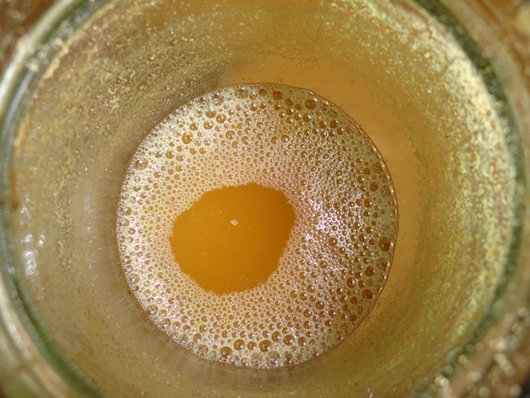
We had a nice supply of ginger beer going over Christmas. It's a delicious soft drink for young and old, although there is an alcoholic version that can be made with a slight variation on the recipe. Ginger beer is a naturally fermented drink that is easy to make - with ginger beer you make a starter called a ginger beer plant and after it has fermented, you add that to sweet water and lemon juice. Like sourdough, it must ferment to give it that sharp fizz. To make a ginger beer plant you'll need ginger - either the powdered dry variety or fresh ginger, sugar, rainwater or tap water that has stood for 24 hours to allow the chlorine to evaporate off. You'll also need clean plastic bottles that have been scrubbed with soap, hot water and a bottle brush and then rinsed with hot water. I never sterilise my bottles and I haven't had any problems. If you intend to keep the ginger beer for a long time, I'd suggest you sterilise your bottles. MAKING THE STARTER In a...
Image

NOT the last post

This will be my last post here.  I've been writing my blog for 18 years and now is the time to step back. I’ve stopped writing the blog and come back a couple of times because so many people wanted it, but that won’t happen again, I won’t be back.  I’ll continue on instagram to remain connected but I don’t know how frequent that will be. I know some of you will be interested to know the blog's statistics. 
Image

How to make cold process soap

I'm sure many of you are wondering: "Why make soap when I can buy it cheaply at the supermarket?" My cold process soap is made with vegetable oils and when it is made and cured, it contains no harsh chemicals or dyes. Often commercial soap is made with tallow (animal fat) and contains synthetic fragrance and dye and retains almost no glycerin. Glycerin is a natural emollient that helps with the lather and moisturises the skin. The makers of commercial soaps extract the glycerin and sell it as a separate product as it's more valuable than the soap. Then they add chemicals to make the soap lather. Crazy. Making your own soap allows you to add whatever you want to add. If you want a plain and pure soap, as I do, you can have that, or you can start with the plain soap and add colour, herbs and fragrance. The choice is yours. I want to add a little about animal and bird fat. I know Kirsty makes her soap with duck fat and I think that's great. I think t...
Image

Preserving food in a traditional way - pickling beetroot

I've had a number of emails from readers who want to start preserving food in jars but don't know where to start or what equipment to buy.  Leading on from yesterday's post, let's just say up front - don't buy any equipment. Once you know what you're doing and that you enjoy preserving, then you can decide whether or not to buy extra equipment. Food is preserved effectively without refrigeration by a variety of different methods. A few of the traditional methods are drying, fermentation, smoking, salting or by adding vinegar and sugar to the food - pickling. This last method is what we're talking about today. Vinegar and sugar are natural preservatives and adding one or both to food sets up an environment that bacteria and yeasts can't grow in. If you make the vinegar and sugar mix palatable, you can put up jars of vegetables or fruit that enhance the flavour of the food and can be stored in a cupboard or fridge for months. Other traditional w...
Image

Cleaning mould from walls and fabrics

With all this rain around we've developed a mould problem in our home. Usually we have the front and back doors open and that good ventilation stops most moulds from establishing. However, with the house locked up for the past week, the high humidity and the rain, mould is now growing on the wooden walls near our front door and on the lower parts of cupboards in the kitchen. Most of us will find mould growing in our homes at some point. Either in the bathroom or, in humid climates, on the walls, like we have now. You'll need a safe and effective remedy at some point, so I hope one of these methods works well for you. Mould is not only ugly to look at, it can cause health problems so if you see mould growing, do something about it straight away. The longer you leave the problem, the harder it will be to get rid of it effectively. If you have asthma or any allergies, you should do this type of cleaning with a face mask on so you don't breathe in any spores. Many peopl...
Image

Five minute bread

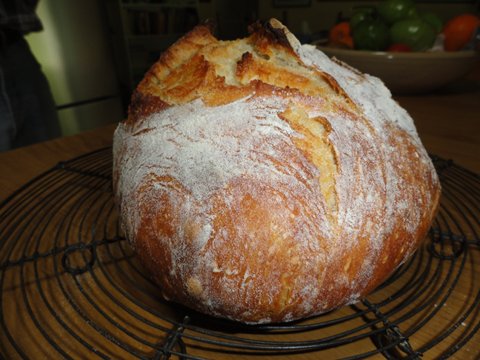
Bread is one of those foods that, when made with your own hands, gives a great deal of satisfaction and delight. It's only flour and water but it symbolises so much. I bake bread most days and use a variety of flours that I buy in bulk. Often I make a sandwich loaf because we use most of our bread for lunchtime sandwiches and for toast. Every so often I branch out to make a different type of loaf. I have tried sour dough in the past but I've not been happy with any of them. I'll continue to experiment with sour dough because I like the idea of using wild yeasts and saving the starter over a number of years to develop the flavour and become a part of the family. However, the loaf I've been branching out to most often is just a plain old five minute bread. By five minutes I mean it takes about five minutes actual work to prepare but it's the easiest of all bread to make and to get consistently good loaves from. If you're having people around for lunch or...
Image

This is my last post.

I have known for a while that this post was coming, but I didn't know when. This is my last post. I'm closing my blog, for good, and I'm not coming back like I have in the past.  I've been writing here for 16 years and my blog has been many things to me. It helped me change my life, it introduced me to so many good people, it became a wonderful record of my family life, it helped me get a book contract with Penguin, and monthly columns with The Australian Women's Weekly and Burke's Backyard . But in the past few months, it's become a burden. In April, I'll be 75 years old and I hope I've got another ten years ahead. However, each year I'll probably get weaker and although I'm fairly healthy, I do have a benign brain tumour and that could start growing. There are so many things I want to do and with time running out, leaving the blog behind gives me time to do the things that give me pleasure. On the day the blog started I felt a wonderful, h...
Image

What is the role of the homemaker in later years?

An email came from a US reader, Abby, who asked about being a homemaker in later years. This is part of what she wrote: "I am a stay-at-home mum to 4 children, ages 9-16. I do have a variety of "odd jobs" that I enjoy - I run a small "before-school" morning drop-off daycare from my home, I am a writing tutor, and I work a few hours a week at a local children's bookstore. But mostly, I cherish my blissful days at home - cooking, cleaning (with homemade cleaners), taking care of our children and chickens and goats, baking, meal-planning, etc. This "career" at home is not at all what I imagined during my ambitious years at university, but it is far more enriching. I notice, though, that my day is often planned around the needs of my family members. Of course, with 4 active kids and a husband, this is natural. I do the shopping, plan my meals, cook dinner - generally in anticipation of my family reconnecting in the evening.  I can't h...
Image

Every morning at home

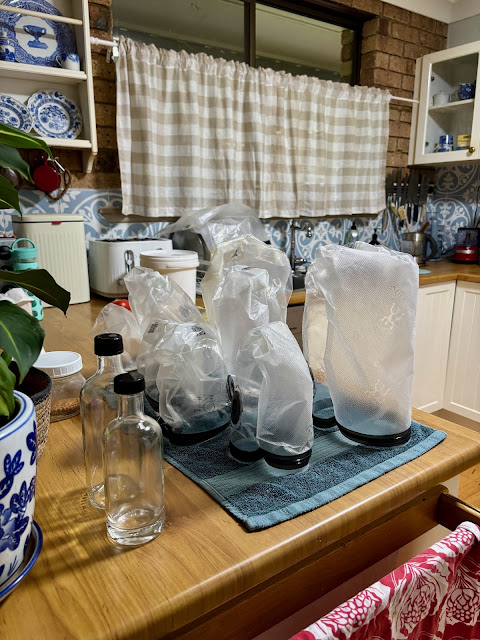
Every morning when I walk into my kitchen it looks tidy and ready for a day's work. Not so on this morning (above), I saw this when I walked in. Late the previous afternoon when I was looking for something, I came across my rolled up Zwilling vacuum bags and decided they had to be washed and dried. So I did that and although I usually put them outside on the verandah to dry it was dark by then. I turned the just-washed bags inside out and left them like this on a towel. It worked well and now the bags are ready to use when I bring home root vegetables, cabbages or whatever I buy that I want to last four or five weeks.
Image

You’ll save money by going back to basics

When I was doing the workshops and solo sessions, I had a couple of people whose main focus was on creating the fastest way to set up a simple life. You can't create a simple life fast, it's the opposite of that It's not one single thing either - it's a number of smaller, simpler activities that combine to create a life that reflects your values; and that takes a long to come together. When I first started living simply I took an entire year to work out our food - buying it, storing it, cooking it, preserving, baking, freezing, and growing it in the backyard. This is change that will transform how you live and it can't be rushed.  
Image


Trending Articles

NOT the last post

This will be my last post here.  I've been writing my blog for 18 years and now is the time to step back. I’ve stopped writing the blog and come back a couple of times because so many people wanted it, but that won’t happen again, I won’t be back.  I’ll continue on instagram to remain connected but I don’t know how frequent that will be. I know some of you will be interested to know the blog's statistics. 
Image

Every morning at home

Every morning when I walk into my kitchen it looks tidy and ready for a day's work. Not so on this morning (above), I saw this when I walked in. Late the previous afternoon when I was looking for something, I came across my rolled up Zwilling vacuum bags and decided they had to be washed and dried. So I did that and although I usually put them outside on the verandah to dry it was dark by then. I turned the just-washed bags inside out and left them like this on a towel. It worked well and now the bags are ready to use when I bring home root vegetables, cabbages or whatever I buy that I want to last four or five weeks.
Image

You’ll save money by going back to basics

When I was doing the workshops and solo sessions, I had a couple of people whose main focus was on creating the fastest way to set up a simple life. You can't create a simple life fast, it's the opposite of that It's not one single thing either - it's a number of smaller, simpler activities that combine to create a life that reflects your values; and that takes a long to come together. When I first started living simply I took an entire year to work out our food - buying it, storing it, cooking it, preserving, baking, freezing, and growing it in the backyard. This is change that will transform how you live and it can't be rushed.  
Image

Creating a home you'll love forever

Living simply is the answer to just about everything. It reduces the cost of living; it keeps you focused on being careful with resources such as water and electricity; it reminds you to not waste food; it encourages you to store food so you don't waste it and doing all those things brings routine and rhythm to your daily life. Consciously connecting every day with the activities and tasks that create simple life reminds you to look for the meaning and beauty that normal daily life holds.  It's all there in your home if you look for it. Seemingly mundane tasks like cleaning and cooking help you with that connection for without those tasks, the home you want to live in won't exist in the way you want it to.  Creating a home you love will make you happy and satisfied.
Image

Time changes everything

I've been spending time in the backyard lately creating a contained herb and vegetable garden. My aim is to develop a comfortable place to spend time, relax, increase biodiversity and encourage more animals, birds and insects to live here or visit. Of course I'd prefer my old garden which was put together by Hanno with ease and German precision. Together, we created a space bursting at the seams with herbs, vegetables and fruity goodness ready to eat and share throughout the year. But time changes everything. What I'm planning on doing now, is a brilliant opportunity for an almost 80 year old with balance issues. In my new garden I'll be able to do a wide range of challenging or easy work, depending on how I feel each day. It’s a daily opportunity to push myself or sit back, watch what's happening around me and be captivated by memories or the scope of what's yet to come.
Image

It's the old ways I love the most

I'm a practical woman who lives in a 1980’s brick slab house. There are verandahs front and back so I have places to sit outside when it's hot or cold. Those verandahs tend to make the house darker than it would be but they're been a great investment over time because they made the house more liveable. My home is not a romantic cottage, nor a minimalist modern home, it's a 1980’s brick slab house. And yet when people visit me here they tell me how warm and cosy my home is and that they feel comforted by being here. I've thought about that over the years and I'm convinced now that the style of a home isn't what appeals to people. What they love is the feeling within that home and whether it's nurturing the people who live there.
Image

Making ginger beer from scratch

We had a nice supply of ginger beer going over Christmas. It's a delicious soft drink for young and old, although there is an alcoholic version that can be made with a slight variation on the recipe. Ginger beer is a naturally fermented drink that is easy to make - with ginger beer you make a starter called a ginger beer plant and after it has fermented, you add that to sweet water and lemon juice. Like sourdough, it must ferment to give it that sharp fizz. To make a ginger beer plant you'll need ginger - either the powdered dry variety or fresh ginger, sugar, rainwater or tap water that has stood for 24 hours to allow the chlorine to evaporate off. You'll also need clean plastic bottles that have been scrubbed with soap, hot water and a bottle brush and then rinsed with hot water. I never sterilise my bottles and I haven't had any problems. If you intend to keep the ginger beer for a long time, I'd suggest you sterilise your bottles. MAKING THE STARTER In a...
Image

An authentic look at daily life here — unstaged and real

Most days Hanno was outside happily working in the fresh air. It may surprise you to know that I started reading my book,  Down to Earth , yesterday - the first time since I wrote it 13 years ago.  I had lent it to my neighbor, and when she returned it, I started reading, expecting to find surprises. Instead, I realised the words were still familiar—as if they were etched into my memory. As I flipped through the pages, I was reminded of how important it was for me to share that knowledge with others. The principles in Down to Earth changed my life, and I truly believed they could do the same for others. After just 30 minutes of reading, I put the book down, reassured that its message still holds true: we can slow down and reshape our lives, one step at a time.
Image