down to earth

  • Home
  • About Us
  • Down To Earth Book
  • Privacy Policy
Well, some of you realised what I'd done even if  I didn't. I'd spent a rather harrowing day with my friend Bernadette in the emergency room of a hospital yesterday, came home at 4pm, checked the comments, made a couple of notes for today's post, pressed "publish" instead of "save" then shut down the computer. Oops.

So let's go through that list.  After a very busy week, I took time out on Saturday to reconnect with the chooks.  They are always a delight, but occasionally they do something really crazy and I love them even more because of it.  On Saturday I went out to feed them and let them out to free range and found the scene below.  I had to go back inside to get the camera, because it had to be recorded, not only for me, but for you too.  These three girls have been broody for quite some time, although I think Heather is only playing at it because she's often out of the nest too.  She's decided she wants to fly and when I open the gate of the chook pen, she flies out over the others.  So here in the nest, Germaine and Mary sit, sometimes with Heather. They are all in THE nest.  It's everyone's favourite.  Usually they each sit in a separate nest, but not on Saturday!  
Heather, Germaine (sitting on Heather's head) and Mary.

While I had the camera in my hand I wandered around the backyard to see what Hanno had been doing while I worked last week.  He's been concerned that the wires he laid over the roots of the grapefruit and mandarin tree weren't protecting the roots enough, so he made these nifty cages.  We still have room to place the mulch around the roots, but the chooks can't scratch the roots.  Citrus have their roots close to the surface and if chickens scratch them enough, it can kill the tree.  But not now.  : - )

We don't have much in the way of vegetables growing now but the fruit still comes.  Lemons are growing well, oranges are coming on for winter, red paw paw (papaya) have grown but haven't ripened yet and a few passionfruit are almost ripe.  We've had so much rain lately, everything in the yard is green green green!  The grass is thick and lush, the crunchy brown grass of early January is a fading memory now.
Lots of lemons for harvesting in Winter.

Yesterday, while I was out with Bernadette, Hanno planted up some seedlings.  I'm not sure what he put in, so that will have to wait for another day.  I do know the time for a main planting for the year is almost here.  We are opposite to most others here in the sub-tropics, here we start our main crops in March (the beginning of Autumn) and plant through until about November (the end of Spring).  That last planting generally keeps us in vegetables until March rolls around again.  Hanno has developed a great system but we're quite unorthodox and we're not burdened by too many gardening rules.  I'll write more about that when I write about the new seedlings.
Juicy passionfruit.
Another thing I'll write about later, because this post is getting quite long now, is the book I'm reading A Well Kept Home - Household traditions and simple secrets from a French grandmother.      I think I became aware of the book on Ronelle's blog, or maybe it was another, but whereever I found it, it's a real gem of a book.

On Saturday, Hanno and I decided to treat ourselves to a late release movie from the DVD store.  The choice - Julie and Julia, of course.  I'd been wanting to see it for so long.  I like Meryl Streep and Julia Child, but apart from those two people being part of the movie, I knew nothing about it.  It turned out to be about a woman, Julie, who writes a blog!  She worked for a company designing the 9/11 memorial park, and while she was at work, she received calls from really sad people who lost loved ones in the tragedy, she listened to complains and she generally came home each night worn out and depressed.  She decided she had to do something and decided to make every recipe in Julia Child's French cookbook, and then write about it.  The movie follows the life of Julie while she starts cooking and writing her blog until she becomes popular, is featured in the New York Times and they start talking about her writing a book.  Interwoven in the Julie story is the delightful tale of Julia Child in France in the 1950s with all the superb fashions, hats and gloves.  And the butter!  Of course it's in most French recipes and at the end of the film, Julie leaves a packet of butter under a photo of Julia at the Julia Child museum.  It's really touching and sweet and that one scene would have made me love the film forever.  
 That is a self seeded passionfruit vine growing along the fence.

It also made me think about my own book - the one I've been writing on and off for ages, and whether it will ever be finished.  Julia's book took eigth years!  That gives me some hope.  I haven't talked about it for a long time but I am still writing, I still have my New York agent, and I still hope to have the book published one day.  Watching Julie and Julia made me realise that the self doubt that comes with writing a book seems to be universal.  I do wonder if it will ever be finished, I wonder too if anyone will be still here when, and if, it is.

I have work again today and it's my very long day - 8am till 8pm.  It's the normal work day with a couple of meetings at the end of it.  Tomorrow I'll take Bernadette to have her chemo.  Work again on Wednesday and hopefully, after that, I'll write a few lines for the book.  I am full of enthusiasm for it, it's just time I lack at the moment.  But even though these days are full, the work load is getting lighter and as we settle into our new work building, many new possibilities open up.  These are exciting times for me, even though I'm worn out by them.  I do know that I'm indeed fortunate to have so many opportunities at this stage of my life, and like most things I hope to make the most of them.

I hope this week is a good one for all of us.  ♥
reconnect with the chooks, new plants in, a well kept home and julie julia
Blue is the colour for this weekend's kitchens - look at this little beauty.  This is Suzanne's kitchen in South Australia.  You can tell when this photo was sent by the Christmas pudding hanging there.

Suzanne writes:
‘This is my little kitchen, we have an old home so our kitchen is walk through with the bathroom coming off of it on the side.

I lack all of what ‘most’ girls have with their new, large spacious kitchens, but it has no effect on the food I cook, only probably the time I spend in here.  I have no dishwasher, so with three children it can get a little cluttered but I have a lovely double sink that was put in a few years ago and I have just got a new oven after about 14 years….lucky me!!
My husband made my bench top, yes I only have one! from jarrah floorboards, and the other little bits and pieces of furniture are not fitted. I love to collect blue glass and blue and white china, and I think this little kitchen shows it all off beautifully.

I will have a new kitchen one day, but for now, I am happy here preparing meals, baking, and using home produce(see my cucumbers and tomatoes on the sink!) for my family………Thank you for the opportunity to share a little piece of my home with you all.’

You can visit Suzanne's lovely blog here.

I am ready to receive some more kitchen sink photos if you want to be part of this series.  Please send two only and reduce the size of them to about 20 percent before sending.  You can send them to rhondahetzel at gmail dot com
 
Please don't forget to comment. A comment is like payment for the time taken to post, and in this case in sending in the photos.  Many of us were enthusiastic about this series, so make sure all the photos get a good number of comments.  I don't want any of the people sending in photos to regret joining in.  Thank you friends.
 
We have another Carla today but today's kitchen is in Western Australia.  

Carla writes:
"Here are some photos of my kitchen. The first one is of the sink and the outlook I have through the window. The blinds are wooden and I have them drawn up so that hopefully you can see it also. It overlooks the patio where we sit to have our cuppas and breakfast. In the background there is my 60th birthday present DH had built for me to hang my greenery. 
Next to that is an old freezer which is choc a block full with frozen garden produce. Inside, the light wood grain Formica bench top compliments the wooden blinds and spice rack on the left On the right the cane shelf with delft blue ware tins that once had Dutch biscuits in when bought from the shop. But in order to keep them with the blue theme I kept the tins to reuse them. They now contain the teas,coffees and sugar. My crocheted dish cloth is hanging over the sink divider. I have a double sink. However I keep the drain rack in the right sink as I never use a tea towel to dry dishes. I always drain and let them air dry. I feel it's healthier, rather than wipe more germs over them with a tea towel that more often than not has been used to wipe my hands. When we built this house I chose not to have dishwasher.
The photo of the whole kitchen shows the fridge and freezer side by side on the left, the walk in pantry in the corner and then my gas cook top stove and electric oven underneath. 

On the wall above it, is my most favourite piece of delft blue ware, the Dutch coffee grinder. To the right on the bench I keep the salt pot, a container with a brush I use for dipping in oil and a spoon rest, again all in Delft blue. It was a hobby of mine to get things to go into my "Dutch" kitchen and follow the blue theme which took a quite some time over the last 10 years before we went on the pension. I'm glad I did now, as this is the part of the house we spend most of our time and it has become a comfortable place to work in amongst my little treasures. It's not a big kitchen but very functional and I love being in there."

Please don't forget to comment. A comment is like payment for the time taken to post, and in this case in sending in the photos.  Many of us were enthusiastic about this series, so make sure all the photos get a good number of comments.  I don't want any of the people sending in photos to regret joining in.  Thank you friends.
I am going through a very busy time here right now. I worked again yesterday but apart from a meeting with the high school principal and teachers to work out an agreement between us and the Flexischool, my day involved not doing the work of the Centre but showing various visitors around. I was actually very pleased to be able to show the Centre to one of the two politicians who raised the money for us to build it. Carolyn Male is the sitting Member for Pine Rivers but used to be our local member of parliament. When she was in that position, she lobbied endlessly on our behalf. Anna Bligh (our Premier) was our other helper and I hope to thank her personally if she does the official opening. And today a Senator will be there for morning tea and we always take advantage when we have the ear of a politician. There are so many things we can make them aware of, so many people who need help and so few funds with which to do it. So today I'm back at work to do a bit of lobbying of my own, but I hope to be home again just after lunch.

My son Kerry came up to look through the Centre yesterday, but with all the other visitors, I didn't have time to talk to him. Hanno showed him around and off they went to lunch. I was really thankful to find him still here when I came home and we had dinner together before he drove the two hour trip home.

I was contacted by the ABC yesterday asking if I would do a spot on radio every fortnight talking about frugal living. How could I say no to that. It's a good way to spread the word. That first interview is this morning.

Monday is going to be another busy day with a 12 hour work day - it's my normal work with two meetings tacked onto the end of it. But after that, my friends, everything should start to settle down again and I can concentrate on being here at home, get back to making and doing and being mindful of why I live this way. I don't like to be so hurried, I doubt it's good for my health and it feels like I'm not concentrating enough to do a good job.

I have no doubt many of you have similar busy days and I really have little to complain about. I am missing my at home days and look forward to spending more time here and being able to write about slow and mindful living again. So bear with me as I go through the busy period.

Thank you for your visits this week and for the wonderful and helpful comments left. It really makes writing this blog seem worthwhile when I know that others are wanting to live more simply and connecting here from all over the world. I hope you have a lovely weekend.
Today we're in Carla's kitchen but I'm not sure of the location.  Carla, if you read this, drop me a line.  I do know Carla is a chicken girl because she has chook curtains and wall hangings, so we are in familiar territory.


Carla writes:

"Here is my Kitchen sink.   It is always busy.   I would shine it all up but it would be fruitless as I am always doing dishes.
This is my dining area which has turned into my sewing area as my sewing room is too cold to sew in.   Hope you all enjoy my busiest area in my house."

Please don't forget to comment. A comment is like payment for the time taken to post, and in this case in sending in the photos.  Many of us were enthusiastic about this series, so make sure all the photos get a good number of comments.  I don't want any of the people sending in photos to regret joining in.  Thank you friends.
I slept in this morning.  I was exhausted last night and still feel tired.  I don't have time to write now because I have a deadline today for a writing assignment.  I'll be back tomorrow with another reader's kitchen  photos.  In the meantime, I hope you enjoy re-reading, or reading for the first time, this post from January 2008.  Is about the important skills of mending and repairing.
 

There is mending to be done today. When I stripped the bed yesterday, I noticed a tiny rip just under Hanno's pillow. The cotton sheet is thinning, but it's still worthy of repair. Mending will give that sheet at least another summer with us before it goes on to other duties like polishing clothes, tomato stake ties or wipes for Airedale beards.

I have to tell you I love mending. It is one of those cherished homemaker duties that really connects me to this life we are living. It is a firm reminder that Hanno and I don't want to live in a throw-away world, that we care for what we own and we reduce, reuse, repair, recycle, renovate and revive. We are renegades and rebels, we don't throw much out. We want to resuscitate the planet, we are into renewal, we want to make reparation. Okay, enough of the "re" words. LOL

I am ashamed to tell you that back in my free-spending years I would throw away a perfectly good shirt or pants rather than repair them. That included throwing away clothes that just needed a button sewn on. : - ( I wish I could take back all those wasteful times but the best I can do now is to make sure I remain a good steward. Whatever needs to be repaired here now, is, and not wasted in the ever growing piles of "landfill" rubbish dumps.


Sometimes I come across a small rip or missing button in the course of my day but I usually find mending jobs when I'm washing or ironing. I make sure now that I look carefully at the fabrics and fasteners and put aside any that need repair. I have a spot in my sewing room where broken clothes and household goods sit until I have enough for a mending session. In the past couple of weeks, I've sewn on a number of buttons, reinforced handles on cloth shopping bags, and patched an old business shirt of Hanno's so he can wear it in the garden. Today I have the sheet to repair and I will also strengthen the top of a zipper on a pair of shorts and hand stitch the hem.

If you're new to mending and repairing, there is a nice little guide here that might help you. Get into the habit of collecting any buttons you find in your home. Have a small (recycled) jar handy to collect them so that when you find the shirt or dress with the button missing, you'll know exactly where to go to the find the matching button. When you're ironing, check hems and collars so you can repair them before they get out of hand. I remember my mother removing collars to turn them over on my dad's shirts. I have no doubt this almost doubled the life of his shirts. I haven't had to turn any collars yet, but it's something I will do in the future.

Here are other guides on how to sew darn a sock or a jumper/sweater, how to sew on a button and how to mend a tear (video). This is a lovely article about mending and the art of living.

I'm off to tidy my sewing room and start my mending. I hope you're having a good week and that you enjoy your time reading here. I send warm hugs to all of you.
If you're about to start a new season garden, your time will be best served by enriching your soil.  This will do more for the health of your garden and the abundance of your crops than any fertiliser you apply later in the season.  If you plant your seeds and seedlings into fertile, living soil, you give them the best chance of success.
Our garden in full production with the compost heap and bin sitting quietly at the back. (Click on photos to enlarge.)

Yesterday we talked about enriching the soil and there is no better way to do that than by adding compost. Compost is a gentle fertiliser that adds organic matter to the soil.  Organic matter will bring the worms in, and they will bring in all manner of microbes that will help creature the soil you need for good crops.  Another great thing about compost is that it will help you manage your kitchen and garden waste, you end up throwing less in the rubbish bin and recycle bin, and you will make, at home, the best fertiliser possible for your garden.

Once you start making compost, you'll look at your household waste in a different way.  Many things that were once alive, like paper, cardboard, cotton and linen fabric, hair, tea leaves etc, can be used to make compost.  Instead of being waste, they'll now be a resource to make the best fertiliser around.  So start your search today.  If you're decluttering, bingo!  You can use all those old papers, magazines and worn out skirts in your compost heap.  Set up a little compost collection bucket in your kitchen for the kitchen waste you want to put into the compost.  It's best if this has a lid if you want to empty it once a day.

Our compost heap this morning.  Hanno has moved the brown compost to the left side so he can start another heap with the new grass clippings.

There are two categories of materials you need for making compost, and for the sake of simplicity, we'll call them greens (which supply nitrogen) and browns (which supply carbon).  Greens are the wet nitrogen filled materials like grass clippings, kitchen waste and fresh manures. Browns are dry things like paper, cardboard and straw.  You will need 30 browns (carbon) to one green (nitrogen).  Now that might sound complicated but all it means is that you need much more dry material like paper and straw than you need greens. Everything you add to the heap should be small.  Chop up the scraps, cardboard etc with your garden spade before adding.  The smaller it is, the faster it will decompose.  BTW, if you don't have enough kitchen scraps to make a compost heap, chop up your kitchen waste and bury it in the garden.  It will decompose and add to the fertility of the soil.

BROWNS - carbon
  • shredded newspaper and magazines - but nothing glossy and coloured 
  • shredded computer paper 
  • cardboard - cut up in small pieces
  • crushed egg shells  
  • ash  
  • straw and hay   
  • hair  
  • the contents of your vacuum cleaner - check to make sure there's no plastic  
  • wool and cotton clothing 

GREENS - nitrogen
  • grass clippings
  • leaves
  • green garden waste - but nothing that is diseased and no woody branches, they take too long to break down
  • anything high in nitrogen like cow, goat, sheep, chicken and horse manures, chicken manure pellets
  • fruit and vegetable peelings - not onion or citrus, which are best in a separate pile because they take a long time to decompose
  • kitchen waste - but not meat or dairy products
  • seaweed 
DON'T ADD ...
  •  meat
  • dairy products
  • diseased plants
  • anything plastic or acrylic
  • dog or cat poo
This is our compost in mid winter.  This time the compost in use is on the right (with potatoes growing out the top) and the newer material is on the left.

WHERE TO PUT THE COMPOST HEAP
Build your compost heap on bare ground, not on bricks or pavers.  You want the worms and microbes to find and colonise the compost, so it needs to be on the soil.  Site the heap close to the garden where it will be used and if you have dogs or chickens, it will need to be fenced off or else they will eat what you put in there.  If you live in an extreme climate, it might be best if you shelter the heap up against a wall.  This will also provide a solid border to one side of the heap.

HOW TO START
  • Start on bare earth by placing a thick layer of shredded newspaper or straw as your base.
  • Add whatever other ingredients you have, alternating browns and greens if you can (sometimes you can't).  
  • Always remember the 30 brown to one green ratio.  If your compost is too dry with browns ,it won't decompose, if it is too wet with greens, it will smell.  When the heap has been going for a while, if it is too dry, add greens, if it's too wet, add browns.
  • On the first day, if you've built a reasonable heap, get the hose and moisten it.  Don't wet it, just a slight spray to moisten things and to start the heap off.  
  • If you have heavy rain or snow, or if you're in a cold climate, you will need to protect the heap with a heavy tarpaulin.  If you can, tie a brick to each corner with cord to keep it in place over the heap.
  • If you don't have any animal or poultry manure, see if you can buy or barter a bag, or, alternatively, buy a bag of chicken manure pellets from the produce store and lightly scatter them through the layers as you add to the heap.  Animal manure should also be added every so often to the heap.  The manure will heat up the compost and activate the compost a great deal.  Comfrey leaves will also help speed up decomposition.
 Comfrey will help activate and speed up the composting process.
    Making compost is not rocket science but you do need to watch your green to brown ratio.  The truth is, if you threw all the above into a heap in your backyard, it would eventually rot down, no matter what you did and you'd have compost.  But we are actively working to increase the fertility of our gardens, so we want compost and we want it NOW.  What ever you can do to speed up the process, do it.  Turning the compost helps speed it up, so turn it over with a fork about once a week.

    If you build your heap well, you'll feel it heat up and sometimes you'll see steam coming off it.  If the heap doesn't heat up, add more manure and mix it in.  But even if it doesn't heat up, if you're in a warm climate and you turn it regularly, you'll have compost in about eight weeks.  It will take longer in cold climates.  But  use your gardener's common sense and help it along however you can.  Protection up against a brick wall, covering the heap and adding manure will help heat up the heap even in cold climates.  If you have any tips on cold climate compost, please add your comment.  We'd all love to learn more about this interesting subject.

    Eventually, all the pieces of paper, hair, manure and kitchen waste will evolve into beautiful dark brown, sweet smelling compost. Planting your seeds and seedlings into soil enriched with compost will give them the best chance of survival, but compost making is an ongoing garden task.  If you can make a lot of it in summer, and you live in a snowy climate, store it in your shed over winter for the coming season.  If you're in a milder climate, it's fine to just having it sitting in the garden waiting to be used.  Making compost might seem like a chore in the beginning, but it will become second nature to you, and when that happens, you'll reduce the amount of  household waste you give to other people to dispose of for you and you'll have a continuous supply of the best soil conditioner and fertiliser.
    Newer Posts Older Posts Home


    My books were all published by Pengiun, and are available at Amazon US, Amazon UK and Amazon Au

    Search here

    Total Pageviews

    Translate


    I'm Rhonda Hetzel and I've been writing my Down to Earth blog since 2007. Although I write the occasional philosophical post, my main topics include home cooking, happiness and gardening as well as budgeting, baking, ageing, generosity, mending and handmade crafts. I hope you enjoy your time here.

    MY FAVOURITE PLACES

    • Grandma Donna's Place
    • Grandma Donna's YouTube
    • Grandma Donna's Instagram
    • This Simple Day
    • Nicole's Instagram

    Give More

    Give More

    Popular posts last year

    Making ginger beer from scratch

    We had a nice supply of ginger beer going over Christmas. It's a delicious soft drink for young and old, although there is an alcoholic version that can be made with a slight variation on the recipe. Ginger beer is a naturally fermented drink that is easy to make - with ginger beer you make a starter called a ginger beer plant and after it has fermented, you add that to sweet water and lemon juice. Like sourdough, it must ferment to give it that sharp fizz. To make a ginger beer plant you'll need ginger - either the powdered dry variety or fresh ginger, sugar, rainwater or tap water that has stood for 24 hours to allow the chlorine to evaporate off. You'll also need clean plastic bottles that have been scrubbed with soap, hot water and a bottle brush and then rinsed with hot water. I never sterilise my bottles and I haven't had any problems. If you intend to keep the ginger beer for a long time, I'd suggest you sterilise your bottles. MAKING THE STARTER In a...
    Image

    NOT the last post

    This will be my last post here.  I've been writing my blog for 18 years and now is the time to step back. I’ve stopped writing the blog and come back a couple of times because so many people wanted it, but that won’t happen again, I won’t be back.  I’ll continue on instagram to remain connected but I don’t know how frequent that will be. I know some of you will be interested to know the blog's statistics. 
    Image

    How to make cold process soap

    I'm sure many of you are wondering: "Why make soap when I can buy it cheaply at the supermarket?" My cold process soap is made with vegetable oils and when it is made and cured, it contains no harsh chemicals or dyes. Often commercial soap is made with tallow (animal fat) and contains synthetic fragrance and dye and retains almost no glycerin. Glycerin is a natural emollient that helps with the lather and moisturises the skin. The makers of commercial soaps extract the glycerin and sell it as a separate product as it's more valuable than the soap. Then they add chemicals to make the soap lather. Crazy. Making your own soap allows you to add whatever you want to add. If you want a plain and pure soap, as I do, you can have that, or you can start with the plain soap and add colour, herbs and fragrance. The choice is yours. I want to add a little about animal and bird fat. I know Kirsty makes her soap with duck fat and I think that's great. I think t...
    Image

    Preserving food in a traditional way - pickling beetroot

    I've had a number of emails from readers who want to start preserving food in jars but don't know where to start or what equipment to buy.  Leading on from yesterday's post, let's just say up front - don't buy any equipment. Once you know what you're doing and that you enjoy preserving, then you can decide whether or not to buy extra equipment. Food is preserved effectively without refrigeration by a variety of different methods. A few of the traditional methods are drying, fermentation, smoking, salting or by adding vinegar and sugar to the food - pickling. This last method is what we're talking about today. Vinegar and sugar are natural preservatives and adding one or both to food sets up an environment that bacteria and yeasts can't grow in. If you make the vinegar and sugar mix palatable, you can put up jars of vegetables or fruit that enhance the flavour of the food and can be stored in a cupboard or fridge for months. Other traditional w...
    Image

    Cleaning mould from walls and fabrics

    With all this rain around we've developed a mould problem in our home. Usually we have the front and back doors open and that good ventilation stops most moulds from establishing. However, with the house locked up for the past week, the high humidity and the rain, mould is now growing on the wooden walls near our front door and on the lower parts of cupboards in the kitchen. Most of us will find mould growing in our homes at some point. Either in the bathroom or, in humid climates, on the walls, like we have now. You'll need a safe and effective remedy at some point, so I hope one of these methods works well for you. Mould is not only ugly to look at, it can cause health problems so if you see mould growing, do something about it straight away. The longer you leave the problem, the harder it will be to get rid of it effectively. If you have asthma or any allergies, you should do this type of cleaning with a face mask on so you don't breathe in any spores. Many peopl...
    Image

    Five minute bread

    Bread is one of those foods that, when made with your own hands, gives a great deal of satisfaction and delight. It's only flour and water but it symbolises so much. I bake bread most days and use a variety of flours that I buy in bulk. Often I make a sandwich loaf because we use most of our bread for lunchtime sandwiches and for toast. Every so often I branch out to make a different type of loaf. I have tried sour dough in the past but I've not been happy with any of them. I'll continue to experiment with sour dough because I like the idea of using wild yeasts and saving the starter over a number of years to develop the flavour and become a part of the family. However, the loaf I've been branching out to most often is just a plain old five minute bread. By five minutes I mean it takes about five minutes actual work to prepare but it's the easiest of all bread to make and to get consistently good loaves from. If you're having people around for lunch or...
    Image

    This is my last post.

    I have known for a while that this post was coming, but I didn't know when. This is my last post. I'm closing my blog, for good, and I'm not coming back like I have in the past.  I've been writing here for 16 years and my blog has been many things to me. It helped me change my life, it introduced me to so many good people, it became a wonderful record of my family life, it helped me get a book contract with Penguin, and monthly columns with The Australian Women's Weekly and Burke's Backyard . But in the past few months, it's become a burden. In April, I'll be 75 years old and I hope I've got another ten years ahead. However, each year I'll probably get weaker and although I'm fairly healthy, I do have a benign brain tumour and that could start growing. There are so many things I want to do and with time running out, leaving the blog behind gives me time to do the things that give me pleasure. On the day the blog started I felt a wonderful, h...
    Image

    What is the role of the homemaker in later years?

    An email came from a US reader, Abby, who asked about being a homemaker in later years. This is part of what she wrote: "I am a stay-at-home mum to 4 children, ages 9-16. I do have a variety of "odd jobs" that I enjoy - I run a small "before-school" morning drop-off daycare from my home, I am a writing tutor, and I work a few hours a week at a local children's bookstore. But mostly, I cherish my blissful days at home - cooking, cleaning (with homemade cleaners), taking care of our children and chickens and goats, baking, meal-planning, etc. This "career" at home is not at all what I imagined during my ambitious years at university, but it is far more enriching. I notice, though, that my day is often planned around the needs of my family members. Of course, with 4 active kids and a husband, this is natural. I do the shopping, plan my meals, cook dinner - generally in anticipation of my family reconnecting in the evening.  I can't h...
    Image

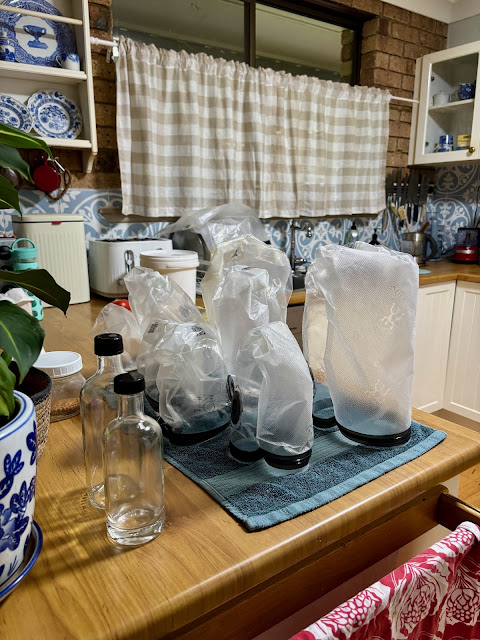
    Every morning at home

    Every morning when I walk into my kitchen it looks tidy and ready for a day's work. Not so on this morning (above), I saw this when I walked in. Late the previous afternoon when I was looking for something, I came across my rolled up Zwilling vacuum bags and decided they had to be washed and dried. So I did that and although I usually put them outside on the verandah to dry it was dark by then. I turned the just-washed bags inside out and left them like this on a towel. It worked well and now the bags are ready to use when I bring home root vegetables, cabbages or whatever I buy that I want to last four or five weeks.
    Image

    You’ll save money by going back to basics

    When I was doing the workshops and solo sessions, I had a couple of people whose main focus was on creating the fastest way to set up a simple life. You can't create a simple life fast, it's the opposite of that It's not one single thing either - it's a number of smaller, simpler activities that combine to create a life that reflects your values; and that takes a long to come together. When I first started living simply I took an entire year to work out our food - buying it, storing it, cooking it, preserving, baking, freezing, and growing it in the backyard. This is change that will transform how you live and it can't be rushed.  
    Image


    Trending Articles

    NOT the last post

    This will be my last post here.  I've been writing my blog for 18 years and now is the time to step back. I’ve stopped writing the blog and come back a couple of times because so many people wanted it, but that won’t happen again, I won’t be back.  I’ll continue on instagram to remain connected but I don’t know how frequent that will be. I know some of you will be interested to know the blog's statistics. 
    Image

    Every morning at home

    Every morning when I walk into my kitchen it looks tidy and ready for a day's work. Not so on this morning (above), I saw this when I walked in. Late the previous afternoon when I was looking for something, I came across my rolled up Zwilling vacuum bags and decided they had to be washed and dried. So I did that and although I usually put them outside on the verandah to dry it was dark by then. I turned the just-washed bags inside out and left them like this on a towel. It worked well and now the bags are ready to use when I bring home root vegetables, cabbages or whatever I buy that I want to last four or five weeks.
    Image

    You’ll save money by going back to basics

    When I was doing the workshops and solo sessions, I had a couple of people whose main focus was on creating the fastest way to set up a simple life. You can't create a simple life fast, it's the opposite of that It's not one single thing either - it's a number of smaller, simpler activities that combine to create a life that reflects your values; and that takes a long to come together. When I first started living simply I took an entire year to work out our food - buying it, storing it, cooking it, preserving, baking, freezing, and growing it in the backyard. This is change that will transform how you live and it can't be rushed.  
    Image

    Creating a home you'll love forever

    Living simply is the answer to just about everything. It reduces the cost of living; it keeps you focused on being careful with resources such as water and electricity; it reminds you to not waste food; it encourages you to store food so you don't waste it and doing all those things brings routine and rhythm to your daily life. Consciously connecting every day with the activities and tasks that create simple life reminds you to look for the meaning and beauty that normal daily life holds.  It's all there in your home if you look for it. Seemingly mundane tasks like cleaning and cooking help you with that connection for without those tasks, the home you want to live in won't exist in the way you want it to.  Creating a home you love will make you happy and satisfied.
    Image

    Time changes everything

    I've been spending time in the backyard lately creating a contained herb and vegetable garden. My aim is to develop a comfortable place to spend time, relax, increase biodiversity and encourage more animals, birds and insects to live here or visit. Of course I'd prefer my old garden which was put together by Hanno with ease and German precision. Together, we created a space bursting at the seams with herbs, vegetables and fruity goodness ready to eat and share throughout the year. But time changes everything. What I'm planning on doing now, is a brilliant opportunity for an almost 80 year old with balance issues. In my new garden I'll be able to do a wide range of challenging or easy work, depending on how I feel each day. It’s a daily opportunity to push myself or sit back, watch what's happening around me and be captivated by memories or the scope of what's yet to come.
    Image

    It's the old ways I love the most

    I'm a practical woman who lives in a 1980’s brick slab house. There are verandahs front and back so I have places to sit outside when it's hot or cold. Those verandahs tend to make the house darker than it would be but they're been a great investment over time because they made the house more liveable. My home is not a romantic cottage, nor a minimalist modern home, it's a 1980’s brick slab house. And yet when people visit me here they tell me how warm and cosy my home is and that they feel comforted by being here. I've thought about that over the years and I'm convinced now that the style of a home isn't what appeals to people. What they love is the feeling within that home and whether it's nurturing the people who live there.
    Image

    Making ginger beer from scratch

    We had a nice supply of ginger beer going over Christmas. It's a delicious soft drink for young and old, although there is an alcoholic version that can be made with a slight variation on the recipe. Ginger beer is a naturally fermented drink that is easy to make - with ginger beer you make a starter called a ginger beer plant and after it has fermented, you add that to sweet water and lemon juice. Like sourdough, it must ferment to give it that sharp fizz. To make a ginger beer plant you'll need ginger - either the powdered dry variety or fresh ginger, sugar, rainwater or tap water that has stood for 24 hours to allow the chlorine to evaporate off. You'll also need clean plastic bottles that have been scrubbed with soap, hot water and a bottle brush and then rinsed with hot water. I never sterilise my bottles and I haven't had any problems. If you intend to keep the ginger beer for a long time, I'd suggest you sterilise your bottles. MAKING THE STARTER In a...
    Image

    An authentic look at daily life here — unstaged and real

    Most days Hanno was outside happily working in the fresh air. It may surprise you to know that I started reading my book,  Down to Earth , yesterday - the first time since I wrote it 13 years ago.  I had lent it to my neighbor, and when she returned it, I started reading, expecting to find surprises. Instead, I realised the words were still familiar—as if they were etched into my memory. As I flipped through the pages, I was reminded of how important it was for me to share that knowledge with others. The principles in Down to Earth changed my life, and I truly believed they could do the same for others. After just 30 minutes of reading, I put the book down, reassured that its message still holds true: we can slow down and reshape our lives, one step at a time.
    Image