down to earth

  • Home
  • About Us
  • Down To Earth Book
  • Privacy Policy
Chickens were the first pets my sons ever had.  Shane and Kerry were about eight and nine when we bought our first little flock.  The boys helped look after those chooks and it was their responsibility to feed them, give them fresh water every day and to collect the eggs.  They used to walk around with them and take them visiting to various hidden spots in our back garden.  Those chooks taught my sons about death and new life, and the importance of a gentle touch.  They were an important part of their childhood.  Whenever they visit now, they still go out to see the chooks.

At the moment we have our chooks roaming through the dying vegetable patch.  They're scratching around, turning over the compost and eating bugs.   Soon they'll be out of there after a job well done and we'll be planting up again.  Above is Anne Shirley and with Kylie on the compost in the background.

If you have small children you must teach them how to be near chickens.  Chooks will be stressed if they're handled roughly or if children are screaming near them or chasing them.  The same goes for dogs and cats.  Our dogs have always been protective of our chickens but it is in their nature to see chooks as prey.  You have to spend time with them and show them that the chickens are a valued part of the family and should not be chased.  This takes time and patience.  You'll have to pick up the chooks and sit with them.  Call the dog over and let him smell the chicken while you're holding it.  Pat/pet both of them so the dog realises the chicken is a friendly addition to the backyard.  Doing that over and over again will help train the dog.  Still, don't leave the dog alone with the chooks until you're absolutely sure it won't attack the chooks.

If your chooks start scratching and you notice they have lice, this is fairly normal in dry and warm temperatures.  Treat the lice straight away by covering the chook with food grade diatomaceous earth.  You can usually buy it from your local produce/grain store.  Make sure you cover under the wings and tail and around the comb and wattles.  To help prevent this happening again give the chooks an area where they can dust bathe.  It just needs to be a bare patch where they can scratch up the soil and roll in the dry dirt.  This is will help prevent lice.
This is our new feeder.  We wanted a feeder that would keep rats out of the food when it was left overnight.  This feeder closes when there are no chooks around.  When they want to feed, they stand on the steel plate at the front and the hopper opens.  Currently it's in training mode while the chooks learn where the food is and how to get it.
There is still so much to write about keeping chickens but space and time will make this my last post on them for a while.  Please try to buy pure breeds and not the Isa Browns that are available almost everywhere.  You might have to look around a bit but there will be pure breeds available near most capital cities and large towns.  But no matter what breed you buy, all chickens will add to your life.  They'll give you hours of free entertainment with their mad antics as well as the best and freshest eggs available.
Quentin at the feeder with two broodies in the background in the blue nesting boxes.

Karen, you should work on worm prevention.  Add a tablespoon of apple cider vinegar and a squeeze of garlic to every 10 litres of the chicken's drinking water.  Keep new chickens from old ones to prevent worms being brought in. Make sure their water is always fresh and clean. Feed them good quality food.  Keep their quarters clean.

Carol, I guess we don't let the chickens reproduce because we don't want to keep roosters and we find it difficult giving them away - you never know if they'll end up in the pot.  When we gave away Seth we offered him with his girlfriend, a silver sussex hen and hoped they'd stay together as a breeding pair.  But you can never be sure.  If we could be guaranteed all girl eggs, we'd do it but the roosters are a real problem for us.  A couple of years ago we threw caution to the wind and had some rare  fertile partridge Wyandotte eggs sent to us which we put under one of our Rhode Island Reds.  They hatched out on Christmas day when we were at the Christmas breakfast, and the first time mother squashed all of them.  What do you do with your roosters?

Kathy, I'd ask your immediate neighbours if they have a problem with you keeping three chickens.  I bet they don't.  Your zoning laws are stupid.  Imagine what our pioneering ancestors would have thought of such nonsense.  Chickens helped them survive through very tough times when there were no supermarkets or corner stores.   Everyone has a right to raise their own food and a few chooks doesn't diminish the neighbourhood, it does the opposite.  Good luck.

Penniless, Polish chooks are not good layers.  Often they don't lay at all.  It's been bred out of them and now they're usually kept as show birds.  Many chooks go off the lay when they're moulting and will restart when they gain their feathers back.  They put their energy into making feathers rather than making eggs.  You could try giving the non-polish chooks a week of high protein feed - just soaking a slice of bread in milk will provide added protein for them.  See if that works.  How old are they? 

Leslie, once chickens know that their own eggs are food, it's difficult to break them of the habit of eating them. And often, if the other chooks see the eggs being eaten, they'll join in.  Leaving eggs in the nests for long periods is a great temptation for chickens.  I doubt there is a cure for this but collecting eggs frequently will take away the temptation.

Jan, snake proofing a chicken coop is quite difficult.  Snakes don't know about fences or doors, they just see everything as another obstacle to overcome.  You'll need to block every  hole, even the very small ones.  We did that with the small hole chicken wire but you could also use shade cloth or fly screen wire.  Pythons are the worst around chooks because they will swallow a chook whole, smaller snakes will look for eggs and swallow them whole.   So get your hammer and nails and go over the chicken coop looking for any hole and block it off.    Good luck.

Pinkandwhitepony, a good sized small flock would be eight chooks, a large one 20.  You should never keep just one chook.  If you want eggs for breakfast and you have a small family, three or five chickens would do.  Speaking about companions, you'll find if you get different breeds, often the same colours will become friends.  Our black chooks rarely hang out with our white and buff coloured chooks.  Heather, our salmon coloured Faverolles, is friends with Martha, a buff Orpington.  The red chooks stick together and the black chooks always wander the backyard in a group, without any other colours.

Annikka, chickens rarely overeat.  They regulate themselves well and that is why most people leave a hopper full of feed in the chook pen so they can eat when they feel like it.  We give out chooks bread almost every day and only the large varieties, like the Orpingtons and Sussex are big girls.

Yvette, your chicken house sounds like a masterpiece of recycling,  Well done!

Becky, I'm no expert on breeding chickens but I would imagine the separation from the main flock would be the most important thing.  Also, make sure your breeding girls are healthy and maybe feed them extra protein to get them through the long days of sitting on eggs.

I hope I have encouraged you to think about chickens if you've never had them before.  Like most other new things, you'll have to learn about your girls and give them good food, love and protection but they will return everything you give to them tenfold.   Dive.

As discussed yesterday, the most important part of preparing to bring chickens to live at your home is to provide safe living quarters.  If you check the comments on the previous post, you'll see that predators can cause major damage, and let me add, major heartache too.  Once you establish your little flock, you'll quickly become attached to them and want to keep them safe. The preparation will pay off later when you know you can put your girls to bed every night and they be safe and sound the next morning.  Remember too that if your chooks become stressed - by dogs chasing them, children handling them roughly or thunder, egg production will suffer.
Chickens are real characters and they love to climb.  If you can, provide places where they can climb and sit off the ground.
So what chickens should we buy?  There is no one answer to that question.  It will depend on how much room you have, what you want to chooks for - either eggs or meat,and how much time you have to spend with them.  Some people will want to raise their chooks from chickhood and will buy fertilised eggs and hatch them in an incubator; some will buy day old chicks and raise them as part of an exercise in getting to know the chickens before they start laying; some will buy pullets that are e ready to lay and some will get chooks that are proven layers.  
Here, from left, we have a buff Sussex, a buff Orpington, light Sussex rooster, Barnevelder rooster, silver Sussex, Rhode Island Red, Australorpe and New Hampshire.
If you want to raise chickens from eggs or from their first days, you'll need to have a bit of time to spend with them.  Our local chook lady, Margaret, from whom we bought several strong and healthy Rhode Island Reds and some pretty bantams, hand rears her chickens and early on handles the chicks and carries them around with her while she's in the yard.   She works near them or takes them to where she is working so they get used to people.  When we buy her chooks they're always very tame and friendly and often let you pick them up.  If you raise your own chicks, try to do at least some of that work to get the chicks used to people.  You have to be careful, they're very fragile at that age, so it's not a daily task for small children, but they will benefit a lot from being around you and scratching around while you work near them.
If you don't want that added responsibility or don't have the time, buy pullets which  are chickens that are almost ready to lay their first egg.  They'll be around 20 - 22 weeks of age.  Here  we pay around $12 - $15 for a pullet and you'll be assured that all your chooks are hens and within a couple of weeks they'll start laying eggs.  When a chook is ready to lay, all you have to do is provide a safe nesting area and she will do the rest.  You can see they're getting ready to lay when their combs and wattles start growing and becoming red. Those first eggs are really sweet.  They'll be little and sometimes they'll be laid with no shell, or a soft shell.  As the egg laying progresses, you might get double yolkers or very large eggs but when the chooks hormones settle down, you'll be rewarded with consistently uniform eggs that will provide your family with an excellent source of nutrition.
 Chickens are like seeds - it's best to choose heirlooms.  Just like seeds that have been hybridised by seed companies so that you have to buy your seeds every year instead of saving your own and replanting, chickens have been modified for the caged poultry industry.  The ability to reproduce has been bred out of hybrid chickens so they are egg laying machines that do not take time out during the year to go broody and potentially raise their own babies..   Let me tell you that sometimes having chooks that go broody is a complete pain in the neck, but even if they're not sitting on eggs, they'll rest and replenish the calcium levels.  They use a lot of calcium to make egg shells. If you want  the best for your girls, you'll be pleased  they take that rest.  So choose heirlooms if you can and help the pure breeds survive the attacks on their survival by large corporations.
Happily free ranging in the backyard in the late afternoon sun.
Just a word about broody chooks.  They usually go broody when the weather starts getting warmer and the potential for it lasts all through those hot months.  Just ten minutes ago, I went out to feed the animals and let the chooks out, and Heather is sitting on the nest, along with Germaine and Mary.  Mary has been there for weeks, Germaine for a week and now Heather has joined them.  It means that while they sit, they won't be laying an egg almost every day and when the other girls come in to lay, they'll steal those eggs and sit on them as their own.  When chooks are broody, you have to be vigilant in collecting the eggs as often as possible, and as soon as they're laid.  Most of our hens lay their eggs between 8am and 10am.  We check the nests at 11am and bring the eggs in.  We check again in the afternoon.  To stop a chook sitting on a nest, you have to lock them away from the nests, although sometimes, when you do that, they'll lay a little batch of eggs in the bush and try to hide them from you.  If you find eggs like this, throw them out because you don't know how long they've been there.

If you have adult chooks and get some chicks or any new chooks, it's wise to keep them separated for a while before mixing them.  You'll be able to make sure you're not introducing any diseases from outside and your baby chicks will be safer.  This is our coop being modified to what it is now, can you see Hanno on the roof?

Here is a chart of chicken breeds.   On this chart you can check their size, whether they're suitable for hot or cold climates and their behaviour.  Some breed are flighty, others suit confinement well, some like to free range.  If you have a small space, choose bantams, otherwise you go for your preference in colour - both in feather and egg.  If you want chooks for meat, choose the large varieties, if you want good layers, go for New Hampshires, Plymouth Rocks, Australorps or Rhode Island Reds, they're all reliable. Never buy just one chicken, go for two at least. Chickens feel safer in groups.  A small group would be four to six, a large group would be around 20.  Twenty is a good number for a backyard flock if you have the space.  That will give you enough eggs for your family and some to sell or give away, but please be guided by the regulations in your area.  Apparently chickens can recognise up to 200 other chooks, but prefer small family groups of 20 or less.

Tomorrow I'll finish off the chicken information and answer any questions you might have.


Today's post is a crossover between food and backyard livestock. Let's talk chooks, or as the rest of the world knows them, chickens.  Many people are looking at creative ways of bringing healthy food into their homes and even if chooks have never been part of your home before, the time might be ripe now to introduce them.  Chickens may be kept in a variety of climates - from tropical to cold and snowy.  As long a you have a safe home for them that is appropriate to the climate, a roost for sleeping on, nesting boxes and food, chooks will happily make their home with you.

 
George, our old rooster. George is a bantam (the size) partridge (the colour) Pekin (the breed).

Before you get your first chickens, think about the predators lurking in your area.  Your chooks must be kept safe - they will reply on you to protect them because up against a dog, fox, raccoon, hawk, coyote, large cat or snake, they have no hope.  This is an important responsibility.  Make sure you can keep them safe in a barn, coop or chicken tractor.  If you have snakes in the area, it will need to be snake-proof, if you know of wild dogs, or even neighbourhood dogs, you need to be able to lock your girls safely away at night.  Chickens do not see well at night so if something creeps into their coop, they won't see it and will be a sitting duck, erm chook.

 We used shredded paper before we realised they were eating it.  Now we lay down straw, it soaks up the droppings and we add it to the compost heap.

When you get the accommodation sorted out, you'll need to install some roosts, off the ground,  for the flock to sleep on.  These can be sticks from the bush that have been tidied up a bit to remove burs or they can be dowel attached to two side braces.  Don't rely on the nesting boxes as sleeping quarters because they soon mess up the nests and you'll have to change the nesting material every day.  When your girls go in to lay eggs, you want them to do it in a clean environment.  Place some straw under the roosts to soak up the droppings made every night.  That can be removed when necessary and added to the compost heap.

Nesting boxes can be a safe and darkish area, like a box or old container.  It should have a small strip of wood nailed  over the bottom of the box - they will step over this when they enter the nest.  It will help keep the nesting material in and stop eggs rolling out.  If you live in a hot climate, try to add a bit of ventilation to the nesting boxes.  Hanno drilled a few holes in the side walls of ours. Your chooks will like a private darkish spot in which to lay their eggs, so place the boxes away from the door and in a dark corner.  Fill the nesting box with straw or hay to provide a little nest that will safely hold the eggs. We used to used shredded paper for this but found the chooks would eat it.  BTW, don't put any polystyrene boxes near chooks, they peck at it and eventually eat it.  Not good.
 
Heather, our salmon coloured Faverolles as a baby chick.

Chickens must have fresh water at all times.  Particularly in hot weather, but this applies to all chickens, they need water.  Depending on your container, this may have to be refilled daily.  We use a bucket as a water container but be aware that baby chicks will drown.  If you buy chicks, you'll need a water feeder that they can't fall in to.
 
Martha - our little bantam buff Pekin.

Food - chooks eat almost everything, including meat.  If you buy chicks, you'll start them on chicken starter or scratch food. You should buy good quality feed and supplement it with kitchen scraps, odds and ends from the garden and old bread.  If you want organic eggs, you'll need to buy organic feed.  We buy layer pellets and mash, which is mixed seeds like sunflower, wheat, millet and barley.  There are a number of plants you can grow to help feed your chickens.  Pigeon pea, sunflowers and comfrey are all favourites but they also love tomatoes with grubs in them, outer lettuce and cabbage leaves, radish tops, silverbeet and spinach.  In fact almost everything you eat, the chickens will eat if you feed them that from the day you get them.  If you go on a gardening rampage looking for grasshoppers and caterpillars, the chooks will eat all of them for you.  They love something warm in winter - we make nice warm porridge and milk for our girls every morning in winter.  Any high protein food you give them will enable them to produce more eggs and if you find your chooks off the lay for a reason other than moulting, a high protein boost for a couple of days will often get them laying again.
 
These are all the same breed but different colours.  They're all Sussex chickens.  Seth is the large white rooster, behind him is Margaret Olley, our buff Sussex and the two black girls are silver Sussex.   Sussex chooks have a black necklace and tail feathers.
When you have your own chooks, you shouldn't be throwing out any food scraps, apart from bones, and even those they will pick as clean as a whistle.  Never feed mouldy food or raw soy beans to your chickens - the mould will poison them and the raw soy beans can be toxic to chickens  Remember, what you feed them will help form eggs and you want the best and safest eggs possible.  Chooks  love eating grass and if they do, the eggs they produce will contain Omega 3.  Let your flock out on a grassed area for free ranging every day if you can.  This can be a small area like a little back yard, or a huge paddock.  While they're pecking on the grass, they'll eat any bugs they find as well as any frogs or mice.  They'll also pick up little stones, and dirt that will help them digest their food.  Chooks don't have teeth and their food is ground up in their gizzards, with the help of the grit they pick up in the field.  If they can't be let out to free range, your chooks should have a supply of grit added to their food.  You can also grind up eggs shells in the processor and add them as a calcium supplement.  It will help strengthen their egg shells.

As you can see this is a big subject so we'll continue tomorrow.  Then we'll talk about selecting your chickens and how to raise them well.
This is Dee's kitchen in Idaho, USA.

Dee writes:
 "I've been reading your blog for about the last 3 years. I really enjoy your tutorials! In fact, tomorrow I am going to try my first batch of cold pressed soap! I've always enjoyed reading your blog and never once have I joined the discussion - but this new Kitchen Sink idea was fun. Also, my kitchen is my favorite room of our home so don't mind sharing! 

My husband and I moved here about 4 years ago. We built this house together, and put a lot of ourselves into it. We did most of the work ourselves or traded out what we couldn't do ourselves. I chose every fixture, paint color, etc. And this is the first house where we have both felt at "home". We live in a small town, Payette, Idaho USA. We have a little over an acre of land, a barn that is over 100 years old where our chickens live, and I have a huge garden every year. We love it here. When we moved here, we were getting out of a large city where it was crowded and expensive. We wanted to simplify, and we wanted to raise animals and have a nice garden. We have had sheep and a cow, and chickens and next year we plan to have turkeys. When we moved here, I was able to quit working outside the home and focus on my household. And we planned to have children too, so I wanted to be home with them because I don't think there is any job more rewarding. 
Sadly, we were unable to have children and after spending over $30,000.00 on fertility treatments I became pregnant only to miscarry. It was devastating, and words do not describe what we've been through. We have managed to keep ourselves out of credit card debt by refinancing our home, until this year. My husband found out he had a health problem and we had to get him treatment that was not covered by his insurance. His medicine cost us $1,000.00 per month! We are not wealthy people, and this was not something we had anticipated. So we put these medicines on our credit card. Then my husband lost his job in the beginning of October! So, we are both looking for work again. The government is going to cut the unemployment starting January 1st. And what we get right now is only enough to pay our mortgage payment. When his unemployment is cut, we will have no way of paying the mortgage payment. It's a sad situation, and I know a lot of people in half a dozen states that are in the same boat as us. Many of our friends have already lost homes to foreclosure. I thought I would send you these pictures of my kitchen, because I think it may only be "my" kitchen for a short while longer. We don't qualify for any government aid, and we've applied for every job there is with no luck so far! We are hoping to both find work and try to get our debt under control and get back to our simple life. Even if that means that we wont be living in our home. And we have learned a lot from this situation, I've found even more ways to save money. Someday, when our situation improves we want to try to adopt a baby.  Please enjoy my pictures. These were taken right after I cleaned up from breakfast this morning."

Please don't forget to comment.  A comment is like payment for the time taken to post, and in this case in sending in the photos.  Many of us were enthusiastic about this series, so make sure all the photos get a good number of comments.  I don't want any of the ladies sending in photos to regret joining in.  Thank you friends. 
Good morning everyone.  Today we are visiting Daphne whose kitchen is in Boston, USA.

Daphne writes:
"Yes those are dirty dishes in the sink. I figure I usually have some in the afternoon so I ought to be honest about it. My husband does some of the dishes at night, but often not all of them fit into the dishwasher. I make sure it is totally clean and the dishes are put away every morning. If I'm quick, I can get it done while my eggs are cooking.
My kitchen doesn't have a lot of counter space. It is a one woman kitchen. But with a pantry (whose door is always kept open) I have plenty of storage space. The short dark shelf is for all my home canned goods. When I bought the house they called it a country kitchen. I grew up in the western US where country kitchens are huge with lots of counter space. This kitchen is pretty small by comparison, but for where I live now, Boston, it is a good sized  kitchen. I always find it interesting what the different expectations are in different parts of the country. It will be fun to watch what the kitchens are like in Australia.
Oh and the strangest thing people comment on is the container of egg shells by the stove. I keep them separate from the compost pile because I powder them in spring and feed them to my tomato plants."

You can visit Daphne's blog here.

Please don't forget to comment.  A comment is like payment for the time taken to post, and in this case in sending in the photos.  Many of us were enthusiastic about this series, so make sure all the photos get a good number of comments.  I don't want any of the ladies sending in photos to regret joining in.  Thank you friends. 
I'm taking a break from kitchen sinks and simple living today so I can tell you about what's been occupying my time this past week, and on and off for the past year.  I work as the volunteer coordinator at our local Neighbourhood Centre, and with the help of a grant from our State government, we've just moved into a brand new building.  I often get emails asking me about the kind of work I do as a volunteer, so this is the ideal opportunity to answer those queries.


This is the front of the building, my office is the lower horizontal window behind that first bit of wood panel.


Our Centre is unfunded and operates with the help of about 30 volunteer workers, fund-raising, public donations and occasional government grants.  We have a  *Flexischool that currently has 20 students and three government funded teachers, and we rent space to a family support worker and a community development worker, both of whom we work closely with.
The building is as green as we could make it using the funds we had.  We have four water tanks that are plumbed to the toilets and garden hoses, solar hot water and cross ventilation.  Next year I'm applying for a grant that, I hope, will allow us to install solar panels for the electricity the building uses. 

Our mission is to work with the poor and disadvantaged but we support and assist anyone who walks through our door and asks for help. We offer a range of services, such as emergency food assistance, free counselling, free legal service, free workshops on various things like frugal and simple living, budgeting, nutrition and making healthy meals on a budget - we do this in conjunction with our local University. We have a community bus that we rent out and Hanno drives to take our seniors on shopping trips and outings.  Now we have more space we'll be starting playgroup for young mums with babies and toddlers, we have a sewing circle and teach knitting and I'm working on putting together some cooking from scratch classes.  We had a Permaculture garden at our last home and we'll be starting a new one in this new place too.  Apart from teaching people the principles of Permaculture, it's a wonderful addition to our emergency food program because we invite those people to whom we give a couple of bags of groceries to pick fresh food to take home as well.  At our new home we have a grand site for vegetables and fruit and I see a time in the future when we encourage our Flexischool students to go outside and pick fresh bananas and oranges and whatever else we grow there.  Hmmm, let me think now, what else do we do?  We have a youth program, parenting workshops and first aid for babies, and next month we're presenting the new CRP course with the local ambulance.  I supervise community service orders for teenagers and we hope the community Youth Justice program will be located at our Centre again.  This is an alternative to a court appearance for youth who have not offended before.  We offer domestic violence counselling and family relationships counselling in conjunction with other organisations who send their workers to us.  We auspice new groups and help them establish themselves under our banner and insurance, and when they're strong enough, they work independently.  And we give space to small groups were they can set up a desk and have a public presence in our town.  We also do the catering at the Bunya Dreaming Festival which is the local aboriginal festival (on tomorrow), Santa's Helpers - gifts and Christmas hampers for the poor and our annual Christmas breakfast in the park.

We do other things but I think you get the general idea.
This is the office that I share with our book keeper.  It's still in a shambles, I put up my computer after this photo was taken and I'll sort out my desk and shelves this morning, I promise.

So this past week we moved into our new home.  I worked closely with the architects and builders during the planning and construction and we have exactly the building we were hoping for.  No, that's not quite right, it's better than I ever imagined or hoped for.  I've been working in my current job for four years now and during that time we operated from old houses and there has been a feeling that we struggle along and do the best we can with what we have. But this new building, even though it's just a building, shows our community and the people with whom we work, that the poor and disadvantaged are valued and they are not hidden away or second best.
The entrance to the neighbourhood centre, the side path alongside the building leads to the Flexischool at the back.

You know, I walked the corridors in an empty building yesterday afternoon, locking up, and making our little home secure for the night and I could not help but think of the worthwhile and important work that will be done in all those rooms.  It's been a long time coming, we've been going for 16 years, but now we are in the position to offer first class service to our clients in a state of the art facility. We can teach simple and frugal living skills and offer the support and encouragement that many people need.  I never thought I'd ever be proud of a building - it's JUST a building!, but I do feel it.  I feel proud of our new Centre, I am honoured to work there and I look forward to many days when I drive down the mountain again towards home feeling that the hours in my day have been hours well spent.

* Flexischool is a small school for students who, for whatever reason, do not fit well within the government school system.


Today's kitchen belongs to Geodyne who lives in England.  I love this little kitchen and particulary like the old fashioned taps at the sink.  I would feel very much at home in this kitchen.

Geodyne writes:
 "I really enjoy your blog, as I live a similar lifestyle (without the retirement part yet!) and have lived in your area in the past as well, having grown up in Qld.


I rarely indulge in this type of blog participation, but wanted to because I love the idea of people sharing their kitchens. I live in a small villlage just outside Cambridge, UK. My kitchen is completely unrenovated 1950s, in a bungalow that reminds me of Australian houses, instead of the more normal English houses. I thought I'd clear up my kitchen sink before I took the photo, but this is what it normally looks like! I love to cook, so there's always a rack of dishes drying by the sink. I have a very pleasant outlook from my sink through a big picture window into the back garden, where I overlook the herb garden and my kitchen garden (one of three veg gardens I have), and where I can watch the chickens patrol their territory, seeing off any doves which dare enter their domain. One of my indulgences is a proper Australian clothesline in the back yard.


The second photo shows my kitchen proper taken from my back door. The kitchen had a range in the recess long before my time, and I'd love to have one there again but it's not possible at the moment. All food prep happens on the oak and granite bench in the centre of the kitchen, which I love. There are lots of pots for the aforementioned cooking, and what you can't see are the two cast-iron frypans which get daily use. They hang from the end of the bench. The gin is out to remind me that it's time to make sloe gin. It's a small kitchen, but what really makes it is the huge pantry beside where I'm standing. That allows me to store the goodies from my garden, and I make the most of it."

You can find Geodyne's blog here.

Please don't forget to comment.  A comment is like payment for the time taken to post, and in this case in sending in the photos.  Many of us were enthusiastic about this series, so make sure all the photos get a good number of comments.  I don't want any of the ladies sending in photos to regret joining in.  Thank you friends.    
I believe today's topic is one of the most important practical things we learn about in our homes - food storage.  I hope you join with me to share what you do because I am always open improving what I do and looking for new methods.  So let's get down to it, why is it so important and what should we be doing?

Buying food is usually a never-ending expense in the household budget. If you can save money on your food bills, you'll generally save big money over the course of your life.  So it makes sense that not only should you look for bargains, buy local and get the freshest food available, you should also store your food so it doesn't deteriorate before you eat it.

I've written before now on the differences in how the northern hemisphere, particularly north America, preserves food in jars.  Canning meat, fish, beans, soup and other high protein foods is quite common there but not in Australia.  Here we tend to preserve relish, chutney, jams, tomato sauce, tomatoes and fruits that do well in a sterilsed jar with lemon juice added.  I think we follow the UK tradition, but I may be wrong.  Here we tend to commonly freeze our meat and fish if it's to be kept for a long period.  I am not going to write about freezing or preserving/canning here, I've done it in the past and it's a subject of its own, but here is a link to one of my preserving/canning posts and to a post on freezing.

Like most things in this simple life, we will all do things the way it best suits our way of living.  Hanno and I grow a lot of our own food so our methods may differ from those of you who buy everything you need.  Basically, we freeze our meat which we buy in bulk, we also freeze small amounts of fish when we buy it at the co-op.  Excesses of vegetables are frozen after blanching and stored in the freezer for up to three months.  Always bag your frozen food well., freezer burn will ruin your food if it's not wrapped correctly.  Don't think that freezing will preserve your food indefinitely.  Freezing stops the fast growth of bacteria, but the sooner you can eat the food, the better.  Long term freezing is not good for any food.  Generally three months is a good rule to work by, and that is the length of a season, so if you're freezing to see you through winter, the three month rule should work well.  Also be guided by your freezer manual though and always take into account the number of times you have power outages.  If they're frequent and long in your neck of the woods, freezing large amount of food might not turn out to be so frugal after all.

I have a food stockpile and a pantry.  The stockpile is in a separate cupboard and it contains all the unopened packets, tins and jars of food that will see us through an emergency and help us save money.  The pantry is in the kitchen and that contains food we are currently using.   As soon as a bag or container of food is taken from the stockpile and opened, it is decanted into a container and stored in the pantry.

We store a lot of grains, flour, nuts, seeds and dried goods.  Everything goes into the freezer for a period when it first comes home from the shop.  This will kill any bugs or larvae lurking within.  I try to use glass containers for these things but for the larger amounts I use food grade plastic.  I got some food grade plastic buckets for storing flour from my local baker.  These are really handy, but recently I found some Decor square buckets capable of holding 10 kgs (22 lbs).  If you can get square buckets, they'll fit in the cupboard and use the space you have more efficiently than round buckets.  Beans, chick peas, lentils, dried fruit, salt, rice, sugar, coconut, polenta etc are all purchased in bulk, if possible, and stored in large mason jars in the pantry.

We buy olive oil and rice bran oil in large tins when it's on sale and that is used for cooking and making soap.  Always check the 'use by' or 'best before' dates when you buy something you know will be stored for a while.  Look through the items to see if any have later dates, if they do, choose those.  When you bring new food home, make sure the older food is eaten first and place new food at the back, bringing the older food to the front of your cupboard or fridge.

We use the fridge for short term food storage.  Fruit and vegetables, either bought or grown in the backyard, we usually stored in the fridge.  Lettuce, capsicums (peppers), eggplant, beans, cucumbers all are stored in the vegetable crisper.  Celery is washed, the top removed, and wrapped in foil.  It will stay crisp like this for two months.  Nuts are placed in small jars and kept in the fridge.  Herbs are picked as we need them.  Food such as tomatoes, avocados, peaches, bananas, passionfruit do not benefit from refrigeration, and give off gasses that accelerate ripening in other fruit and vegetables, so I store them on the kitchen bench.  None of them last long and they're fine for their short life in a bowl on the bench.  Leaving them on the bench for a week will also allow them to develop their full flavour.  Potatoes and onions are stored in baskets at the bottom of the pantry in the dark.  If you buy potatoes or onions in plastic bags, take them out when you come home because the plastic will make them sweat and they'll rot. They both need air circulation in a cool dark space.

We buy milk when it's needed and store that in the fridge.  But you can easily freeze milk.  We always have powdered milk in the cupboard as well and I usually cook with powdered milk, not fresh.  Bread is usually baked daily, with the leftovers fed to the chickens and dog.

Learn how to use what you keep in the pantry in a variety of ways.  Experiment with your stored food and keep learning.
This is an important subject because food needs to be healthy and safe to eat every time you eat it.   One of your jobs as a homemaker is to learn about how to safely store food in the way most suited to your climate and way of living.  If you get this right, you'll save money because you'll rarely have to throw food out and your family will eat only safe food.


I could go on forever about food storage but it's time now to wait for your comments and see what's happening in your kitchen. I'm looking forward to reading them.
Newer Posts Older Posts Home


My books were all published by Pengiun, and are available at Amazon US, Amazon UK and Amazon Au

Search here

Total Pageviews

Translate


I'm Rhonda Hetzel and I've been writing my Down to Earth blog since 2007. Although I write the occasional philosophical post, my main topics include home cooking, happiness and gardening as well as budgeting, baking, ageing, generosity, mending and handmade crafts. I hope you enjoy your time here.

MY FAVOURITE PLACES

  • Grandma Donna's Place
  • Grandma Donna's YouTube
  • Grandma Donna's Instagram
  • This Simple Day
  • Nicole's Instagram

Give More

Give More

Popular posts last year

Making ginger beer from scratch

We had a nice supply of ginger beer going over Christmas. It's a delicious soft drink for young and old, although there is an alcoholic version that can be made with a slight variation on the recipe. Ginger beer is a naturally fermented drink that is easy to make - with ginger beer you make a starter called a ginger beer plant and after it has fermented, you add that to sweet water and lemon juice. Like sourdough, it must ferment to give it that sharp fizz. To make a ginger beer plant you'll need ginger - either the powdered dry variety or fresh ginger, sugar, rainwater or tap water that has stood for 24 hours to allow the chlorine to evaporate off. You'll also need clean plastic bottles that have been scrubbed with soap, hot water and a bottle brush and then rinsed with hot water. I never sterilise my bottles and I haven't had any problems. If you intend to keep the ginger beer for a long time, I'd suggest you sterilise your bottles. MAKING THE STARTER In a...
Image

NOT the last post

This will be my last post here.  I've been writing my blog for 18 years and now is the time to step back. I’ve stopped writing the blog and come back a couple of times because so many people wanted it, but that won’t happen again, I won’t be back.  I’ll continue on instagram to remain connected but I don’t know how frequent that will be. I know some of you will be interested to know the blog's statistics. 
Image

How to make cold process soap

I'm sure many of you are wondering: "Why make soap when I can buy it cheaply at the supermarket?" My cold process soap is made with vegetable oils and when it is made and cured, it contains no harsh chemicals or dyes. Often commercial soap is made with tallow (animal fat) and contains synthetic fragrance and dye and retains almost no glycerin. Glycerin is a natural emollient that helps with the lather and moisturises the skin. The makers of commercial soaps extract the glycerin and sell it as a separate product as it's more valuable than the soap. Then they add chemicals to make the soap lather. Crazy. Making your own soap allows you to add whatever you want to add. If you want a plain and pure soap, as I do, you can have that, or you can start with the plain soap and add colour, herbs and fragrance. The choice is yours. I want to add a little about animal and bird fat. I know Kirsty makes her soap with duck fat and I think that's great. I think t...
Image

Preserving food in a traditional way - pickling beetroot

I've had a number of emails from readers who want to start preserving food in jars but don't know where to start or what equipment to buy.  Leading on from yesterday's post, let's just say up front - don't buy any equipment. Once you know what you're doing and that you enjoy preserving, then you can decide whether or not to buy extra equipment. Food is preserved effectively without refrigeration by a variety of different methods. A few of the traditional methods are drying, fermentation, smoking, salting or by adding vinegar and sugar to the food - pickling. This last method is what we're talking about today. Vinegar and sugar are natural preservatives and adding one or both to food sets up an environment that bacteria and yeasts can't grow in. If you make the vinegar and sugar mix palatable, you can put up jars of vegetables or fruit that enhance the flavour of the food and can be stored in a cupboard or fridge for months. Other traditional w...
Image

Cleaning mould from walls and fabrics

With all this rain around we've developed a mould problem in our home. Usually we have the front and back doors open and that good ventilation stops most moulds from establishing. However, with the house locked up for the past week, the high humidity and the rain, mould is now growing on the wooden walls near our front door and on the lower parts of cupboards in the kitchen. Most of us will find mould growing in our homes at some point. Either in the bathroom or, in humid climates, on the walls, like we have now. You'll need a safe and effective remedy at some point, so I hope one of these methods works well for you. Mould is not only ugly to look at, it can cause health problems so if you see mould growing, do something about it straight away. The longer you leave the problem, the harder it will be to get rid of it effectively. If you have asthma or any allergies, you should do this type of cleaning with a face mask on so you don't breathe in any spores. Many peopl...
Image

Five minute bread

Bread is one of those foods that, when made with your own hands, gives a great deal of satisfaction and delight. It's only flour and water but it symbolises so much. I bake bread most days and use a variety of flours that I buy in bulk. Often I make a sandwich loaf because we use most of our bread for lunchtime sandwiches and for toast. Every so often I branch out to make a different type of loaf. I have tried sour dough in the past but I've not been happy with any of them. I'll continue to experiment with sour dough because I like the idea of using wild yeasts and saving the starter over a number of years to develop the flavour and become a part of the family. However, the loaf I've been branching out to most often is just a plain old five minute bread. By five minutes I mean it takes about five minutes actual work to prepare but it's the easiest of all bread to make and to get consistently good loaves from. If you're having people around for lunch or...
Image

This is my last post.

I have known for a while that this post was coming, but I didn't know when. This is my last post. I'm closing my blog, for good, and I'm not coming back like I have in the past.  I've been writing here for 16 years and my blog has been many things to me. It helped me change my life, it introduced me to so many good people, it became a wonderful record of my family life, it helped me get a book contract with Penguin, and monthly columns with The Australian Women's Weekly and Burke's Backyard . But in the past few months, it's become a burden. In April, I'll be 75 years old and I hope I've got another ten years ahead. However, each year I'll probably get weaker and although I'm fairly healthy, I do have a benign brain tumour and that could start growing. There are so many things I want to do and with time running out, leaving the blog behind gives me time to do the things that give me pleasure. On the day the blog started I felt a wonderful, h...
Image

What is the role of the homemaker in later years?

An email came from a US reader, Abby, who asked about being a homemaker in later years. This is part of what she wrote: "I am a stay-at-home mum to 4 children, ages 9-16. I do have a variety of "odd jobs" that I enjoy - I run a small "before-school" morning drop-off daycare from my home, I am a writing tutor, and I work a few hours a week at a local children's bookstore. But mostly, I cherish my blissful days at home - cooking, cleaning (with homemade cleaners), taking care of our children and chickens and goats, baking, meal-planning, etc. This "career" at home is not at all what I imagined during my ambitious years at university, but it is far more enriching. I notice, though, that my day is often planned around the needs of my family members. Of course, with 4 active kids and a husband, this is natural. I do the shopping, plan my meals, cook dinner - generally in anticipation of my family reconnecting in the evening.  I can't h...
Image

Every morning at home

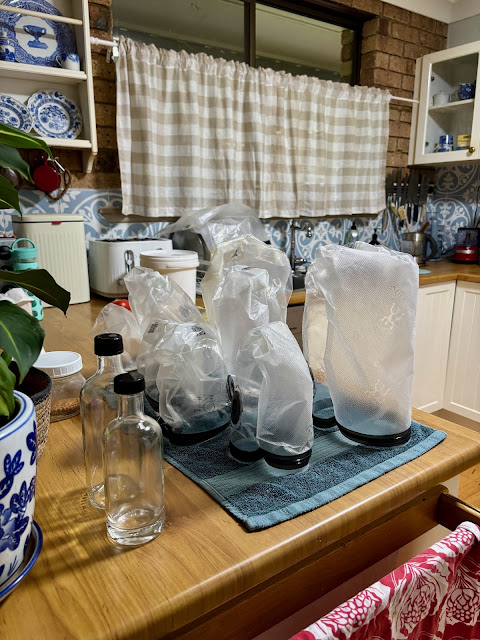
Every morning when I walk into my kitchen it looks tidy and ready for a day's work. Not so on this morning (above), I saw this when I walked in. Late the previous afternoon when I was looking for something, I came across my rolled up Zwilling vacuum bags and decided they had to be washed and dried. So I did that and although I usually put them outside on the verandah to dry it was dark by then. I turned the just-washed bags inside out and left them like this on a towel. It worked well and now the bags are ready to use when I bring home root vegetables, cabbages or whatever I buy that I want to last four or five weeks.
Image

You’ll save money by going back to basics

When I was doing the workshops and solo sessions, I had a couple of people whose main focus was on creating the fastest way to set up a simple life. You can't create a simple life fast, it's the opposite of that It's not one single thing either - it's a number of smaller, simpler activities that combine to create a life that reflects your values; and that takes a long to come together. When I first started living simply I took an entire year to work out our food - buying it, storing it, cooking it, preserving, baking, freezing, and growing it in the backyard. This is change that will transform how you live and it can't be rushed.  
Image


Trending Articles

NOT the last post

This will be my last post here.  I've been writing my blog for 18 years and now is the time to step back. I’ve stopped writing the blog and come back a couple of times because so many people wanted it, but that won’t happen again, I won’t be back.  I’ll continue on instagram to remain connected but I don’t know how frequent that will be. I know some of you will be interested to know the blog's statistics. 
Image

Every morning at home

Every morning when I walk into my kitchen it looks tidy and ready for a day's work. Not so on this morning (above), I saw this when I walked in. Late the previous afternoon when I was looking for something, I came across my rolled up Zwilling vacuum bags and decided they had to be washed and dried. So I did that and although I usually put them outside on the verandah to dry it was dark by then. I turned the just-washed bags inside out and left them like this on a towel. It worked well and now the bags are ready to use when I bring home root vegetables, cabbages or whatever I buy that I want to last four or five weeks.
Image

You’ll save money by going back to basics

When I was doing the workshops and solo sessions, I had a couple of people whose main focus was on creating the fastest way to set up a simple life. You can't create a simple life fast, it's the opposite of that It's not one single thing either - it's a number of smaller, simpler activities that combine to create a life that reflects your values; and that takes a long to come together. When I first started living simply I took an entire year to work out our food - buying it, storing it, cooking it, preserving, baking, freezing, and growing it in the backyard. This is change that will transform how you live and it can't be rushed.  
Image

Creating a home you'll love forever

Living simply is the answer to just about everything. It reduces the cost of living; it keeps you focused on being careful with resources such as water and electricity; it reminds you to not waste food; it encourages you to store food so you don't waste it and doing all those things brings routine and rhythm to your daily life. Consciously connecting every day with the activities and tasks that create simple life reminds you to look for the meaning and beauty that normal daily life holds.  It's all there in your home if you look for it. Seemingly mundane tasks like cleaning and cooking help you with that connection for without those tasks, the home you want to live in won't exist in the way you want it to.  Creating a home you love will make you happy and satisfied.
Image

Time changes everything

I've been spending time in the backyard lately creating a contained herb and vegetable garden. My aim is to develop a comfortable place to spend time, relax, increase biodiversity and encourage more animals, birds and insects to live here or visit. Of course I'd prefer my old garden which was put together by Hanno with ease and German precision. Together, we created a space bursting at the seams with herbs, vegetables and fruity goodness ready to eat and share throughout the year. But time changes everything. What I'm planning on doing now, is a brilliant opportunity for an almost 80 year old with balance issues. In my new garden I'll be able to do a wide range of challenging or easy work, depending on how I feel each day. It’s a daily opportunity to push myself or sit back, watch what's happening around me and be captivated by memories or the scope of what's yet to come.
Image

It's the old ways I love the most

I'm a practical woman who lives in a 1980’s brick slab house. There are verandahs front and back so I have places to sit outside when it's hot or cold. Those verandahs tend to make the house darker than it would be but they're been a great investment over time because they made the house more liveable. My home is not a romantic cottage, nor a minimalist modern home, it's a 1980’s brick slab house. And yet when people visit me here they tell me how warm and cosy my home is and that they feel comforted by being here. I've thought about that over the years and I'm convinced now that the style of a home isn't what appeals to people. What they love is the feeling within that home and whether it's nurturing the people who live there.
Image

Making ginger beer from scratch

We had a nice supply of ginger beer going over Christmas. It's a delicious soft drink for young and old, although there is an alcoholic version that can be made with a slight variation on the recipe. Ginger beer is a naturally fermented drink that is easy to make - with ginger beer you make a starter called a ginger beer plant and after it has fermented, you add that to sweet water and lemon juice. Like sourdough, it must ferment to give it that sharp fizz. To make a ginger beer plant you'll need ginger - either the powdered dry variety or fresh ginger, sugar, rainwater or tap water that has stood for 24 hours to allow the chlorine to evaporate off. You'll also need clean plastic bottles that have been scrubbed with soap, hot water and a bottle brush and then rinsed with hot water. I never sterilise my bottles and I haven't had any problems. If you intend to keep the ginger beer for a long time, I'd suggest you sterilise your bottles. MAKING THE STARTER In a...
Image

An authentic look at daily life here — unstaged and real

Most days Hanno was outside happily working in the fresh air. It may surprise you to know that I started reading my book,  Down to Earth , yesterday - the first time since I wrote it 13 years ago.  I had lent it to my neighbor, and when she returned it, I started reading, expecting to find surprises. Instead, I realised the words were still familiar—as if they were etched into my memory. As I flipped through the pages, I was reminded of how important it was for me to share that knowledge with others. The principles in Down to Earth changed my life, and I truly believed they could do the same for others. After just 30 minutes of reading, I put the book down, reassured that its message still holds true: we can slow down and reshape our lives, one step at a time.
Image