down to earth

  • Home
  • About Us
  • Down To Earth Book
  • Privacy Policy
I'm having a short break but I noticed there are a lot of readers visiting this morning. I've decided to occasionally feature popular posts from the archives so you have something to read when you visit.

JUST DO IT


Anna S by Carl Larsson from here.

I really enjoyed reading a comment from Elizabeth yesterday. She said, in part, “I have been reading your blog for some time but until last week I just read and wished but did not action in anyway. That is, until this last weekend when I thought 'just do it!' So, I have started knitting a cardigan, knitted three squares for a throw for this winter, and made a chicken soup using up a chicken carcass for the very first time!" It is obvious to me that Elizabeth has been thinking about how she wants to change her life for some time, and now she's just dived right in. Living deliberately, there is nothing like it.

When Thoreau wrote his book, Walden, he had left his job and set up in a small cabin to live alone in the woods. He wrote: "I went to the woods because I wished to live deliberately, to front only the essential facts of life, and see if I could not learn what it had to teach, and not, when I came to die, discover that I had not lived. I did not wish to live what was not life, living is so dear; nor did I wish to practise resignation, unless it was quite necessary. I wanted to live deep and suck out all the marrow of life, to live so sturdily and Spartan-like as to put to rout all that was not life, to cut a broad swath and shave close, to drive life into a corner, and reduce it to its lowest terms, and, if it proved to be mean, why then to get the whole and genuine meanness of it, and publish its meanness to the world; or if it were sublime, to know it by experience ..." I think that is one of the most profound pieces of writing I've ever read and since I discovered Walden, many years ago, I have tried to live to the spirit of what Thoreau wrote in that one passage.


So what exactly is living deliberately? I guess there may be several different interpretations but to me it means taking control of my life, thinking about what it is I want my life to be, knowing what I want to do every day, or what I have to do to achieve my goals, and then living that life. Very few people have their life planned out for them and handed over on a silver platter. But what many people do is to just react to life. They have no real plans, they live each day doing what is expected of them, then, when something out of the ordinary happens, they react to it. There is no real plan, no map to follow, just reactions to what life throws.

Deliberate living is deciding what you want your life to become, working out the steps you need to take to make that happen, then, as Elizabeth said, just do it. You will still get life throwing the unexpected at you, but when it happens, you work to solve the problem, then you get back on track.

Those three little words, just do it, are the best advice for anyone hovering on the edge of a simple life. You might be hovering because you don’t know what to do first, because you feel you can’t do it all so why bother with a little bit, or you’re waiting for just the right time – until you move, you get that pay rise, you retire, the kids move out – whatever the right time will be for you, let me tell you there will be no right time. The only right time is now.

The other thing Elizabeth said was that she feels renewed now when she wakes up. I feel that way too. Every day you continue along the path you’ve chosen, you feel you have purpose and you feel renewed.

I think the economic crisis will bring a lot more people to this way of living but living simply is much more than a financial strategy, it's more than your location, it's more than how you manage your home or plant your vegetables. It's about you, how you think about your life and how you express your values day by day. Anyone can learn to make yoghurt, budget, knit dishcloths and grow tomatoes, the real trick is for your actions to reflect how you think and how you want to live. What good is it to list the hundred things you've accomplished if you're not made happy by what you do, if you aren't renewed by it, and if you don't do it with grace, humility and generosity.

When you deliberately choose this way of life, you will be doing things that bypass the conveniences of your old life, there will be many things you'll do differently, but if you do it well, if you really throw yourself into your life, if you live deep and suck out all the marrow of life, not only will you be living deliberately, you will be changed by it. Just do it.


NUT SLICE RECIPE

Combine the following dry ingredients in a bowl:
1 cup self raising flour OR one cup plain (all purpose) flour + 1 teaspoon baking powder
1 cup rolled oats
1 cup walnuts
½ cup brown sugar

Melt 125 grams butter (1 stick/4 ozs)
Add 1 lightly beaten egg

Mix the dry ingredients with the wet and press the dough into a slice tin. Firm it down before baking on 180C (350F) for about 2o minutes. Don't leave it in too long or the outer sides will be very hard. When cooked, cut into slices. You could substitute the walnuts for a cup of sultanas (golden raisins) or choc chips or any nuts you have on hand.
We had a beautiful Christmas morning.  It wasn't too hot, there were clouds blocking the sun and when we left home at 6.15am, there was the promise of a wonderful day ahead.  Hanno and I drove to the Centre where, along with a few others, we packed our cars with tables, chairs, equipment and food, and headed off to the local park.


 Hanno and some of the volunteer chefs cooking up a feast for everyone.

The Centre where I work as a volunteer invites the town to share breakfast every Christmas morning.  For the past few weeks I've been organising this and I wanted it to be the best yet.  Santa had contacted me to let me know he'd be there, we had a lot of volunteers to help set up, cook and tidy up, all we needed was a crowd of people.

Well, they didn't let me down, I think we served about 700 breakfasts.  The toughest part of organising such an event is that you never know how many people will come along.  We ran out of bacon late in the morning, but had sausages and eggs left over.  We also served cooked tomatoes and mushrooms, bread and butter, fresh tropical fruit, organic muesli and yoghurt, cereals with local dairy milk, fruit juice, spring water, tea and coffee.  I've already bagged up the leftover sausages, they and the eggs and bread will be given out to people needing food assistance over the holidays.

It was a lovely morning.  Homeless people mixed with business leaders, children came along with new toys, people who might nod in the street during the year, sat down and ate breakfast together.  I feel blessed being part of it.  As usual, my faithful sidekick, Hanno, was with me to help.  He loves cooking the sausages so that is where he was for the first few hours, then he had a break and sat chatting with a paramedic under a tree, sipping coffee.

There were a couple of short downpours of rain but no one cared.  It's all part of living in the subtropics at Christmas time.  Many people came over to me to thank the Centre for hosting such an amazing event, we received lots of donations and Hanno and I came home happy people.  It really is the best part of Christmas for me.

I am taking a break for a short while to rest and get ready for a busy new year.  I have a few ideas for the blog in the coming months and I'm eager to share them with you.  Thank you for your visits here during the year.  It never fails to astound me that people keep coming!  Thank you for the warm friendships many of you have extended to me and for the many wise and wonderful comments.  A special thanks to Sharon who helps me here, the forum and at the simple, green, frugal co-op blog.   Warm hugs, Sharon, I appreciate you very much.

I hope you're squeezing every bit of joy out of the festivites and that your new year opens with optimism, hope and desire for continued change.  I know mine will and I want as many people as possible to be walking along this chosen road with me.

Take care, friends.  I'll see you soon.

ADDITION:   There is an online sale at American Yarns - 20% off everything in the store.  Starts 26 December and runs for five days.  Use the code 'bdaysale09' at the checkout to get your 20% saving.  Click here to go to the store.


Today we have the last kitchen sink photo for the year.  We'll continue the series next year and soon I'll be calling for more photos, so get your cameras out, ladies and gentlemen.  I'd love to see a man's kitchen and kitchens from Australia, New Zealand, England, Canada, France, Germany, Italy, Singapore, Japan and every other cosy corner of the world this blog is read.

Our photos today come from Deb at Homespun Living.  I'm sure many of my readers know Deb.  Her waffle weave dishcloth is my favourite and I've linked to it a number of times.  There is a lovely green dishcloth in one of these photos.  I also copied Deb's beautiful idea to hand stitch my kitchen curtains.  Mine are similar to Deb's but I have tea cups, not tea pots.


Deb writes:
" This end of the kitchen is where we eat every day. The round wooden table and the chairs were found at tag sales and refurbished – I painted the chairs, recovered the seats, and refinished the table. I think everything you see in the picture {except the light fixture} was found secondhand, previously loved by someone, and now put to new use in our home. The wall cabinet holds vintage bowls – most used day to day, and some used to hold wine corks, cookie cutters, etc. The long side table is another tag sale find and holds wire baskets with table linens, a black metal box where we stow snacks, an old bread box I painted, a plate rack, and a little curio cabinet my father-in-law built. The goal is to achieve a simple, functional space that is also warm and cozy.

Two years ago we gave the kitchen a facelift on a tight budget. The farmhouse sink and faucet were both deals I found on Ebay, the new oak countertop was actually gymnasium flooring that was given to us, and we transformed our wood cabinets with cream-colored paint. The dishdrainer is from Ikea, and the dishcloth I hand knit. The curtains are vintage linen tea towels that I embroidered with tea pots and hung from clips. And, with each changing season, there is a wonderful view from the window over my farmhouse sink."

Please don't forget to comment.  A comment is like payment for the time taken to post, and in this case in sending in the photos.  Many of us were enthusiastic about this series, so make sure all the photos get a good number of comments.  I don't want any of the ladies sending in photos to regret joining in.  Thank you friends.

I'll do one more post tomorrow before I take my break.  I'll see you then.
Our boxing day kitchen sink is situated in America.  This kitchen is Pam's from Life on a Southern Farm blog.   Pam writes:

"This is our recycled kitchen sink. When we were building the house about 15 years ago we came across 2 sinks like this one and 2 bathroom sinks at a salvage store. The sinks came out of an old hotel near Atlanta, Ga that was torn down. I think we paid maybe $10 for all 4 sinks.

One side is very deep and I just love it. It is just right for washing out large canning pots and pans. We put the other double sink in the downstairs bathroom and the 2 single sinks in the upstairs bathroom.


I know you said 2 pictures but the other picture is the kitchen floor. It is oak wood that my husband sawed on the sawmill from trees off our property"


Please don't forget to comment.  A comment is like payment for the time taken to post, and in this case in sending in the photos.  Many of us were enthusiastic about this series, so make sure all the photos get a good number of comments.  I don't want any of the ladies sending in photos to regret joining in.  Thank you friends.
Recently I conducted a comprehensive survey of Hanno and I and discovered that we have the warmest, friendliest and most loyal readers in the entire blogdom. Thank you for your visits and comments this year and for supporting the Down to Earth forum.  Thanks also to the wonderful group of ladies who help me on the forum, I couldn't do it without them.  You'll find their blogs on my blogroll.  It's been an absolute pleasure for me to discover more about you during the year and to have so many of you come out of hiding.  I look forward to next year when we'll all move together towards a simpler life.

We'll have two more kitchen sink posts and then I'll have a some time off.  

I found this Michael Leunig poem on Duckherder's blog last Christmas and have never found another Christmas poem I like more. So, for those who missed it the first time, and for those who love it as much as I do, here it is again.  Merry Christmas everyone, and Duckie.


I see a twinkle in your eye, so this shall be my Christmas star and I will travel to your heart: the manger where the real things are.
And I will find a mother there who holds you gently to her breast, a father to protect your peace, and by these things you shall be blessed.
And you will always be reborn and I will always see the star and make the journey to your heart: the manger where the real things are.
I think today's kitchen comes from America.  Montanasmama doesn't say where she is from, but from the name and the measurement in inches, I'm guessing the USA.  Montanasmama, if you drop by today, please let us know what state you're in.

She writes:

"I know my sink looks huge in this little kitchen but it has the same foot print of a double bowl sink. I have found it SO much more user friendly then the double bowl in my old house. If you look you will see two water taps on the sink. One is for the city water, which is new to me and lovely to have when things get dry but I don't want to drink,cook, or ruin my tea with it. The other tap is for my gravity fed spring water system. I just re-routed the spring water from my old house to the new. If something happens to the city water I can switch the whole house over to the spring system. I chose the high curved taps to make it easy to fill and clean big pots. 

The door by the fridge is a pocket door leading into the walk in pantry. Having a hinged door here would have been very unhandy. Because the kitchen is small the "off the rack" kitchen islands were all too big for the space. To make my little island I took two 18" wide cabinets and attached them end to end giving me a small work area and 8 more drawers. I bought a slightly defective piece of corian counter top for it. I was going to use some kind of stone but just happened upon the corian stuff, it was the perfect size and cheap! How often will that happen? The other counters are laminate and I didn't fell comfortable with putting really hot stuff down on them so the little island takes care of where to put that right out of the oven or off the burner stuff."
 
Please don't forget to comment.  A comment is like payment for the time taken to post, and in this case in sending in the photos.  Many of us were enthusiastic about this series, so make sure all the photos get a good number of comments.  I don't want any of the ladies sending in photos to regret joining in.  Thank you friends.
 
The last two kitchens this year will appear this weekend - Pam's kitchen from Life on a Southern Farm will feature on Saturday and Deb's kitchen from Homespun Living will be our last kitchen for the year on Sunday.
 
Girl in the pink dress asked for a post on making wholewheat/wholemeal bread.  I made some yesterday so here are my thoughts.  The most important element in wheat bread is gluten, it gives bread its shape and fluffiness. There are 30 different proteins in wheat, glutenin and gliadin are the two that form gluten.  Gluten develops in the dough when moisture is added and the mixture is stirred and kneaded.  Bread must be kneaded for at least eight minutes, preferably 10 minutes, to develop the gluten so it's strong enough to hold the shape of the bread and all the air that gives us the lightness we want.  No one wants dense gluggy bread.

When you make white bread and knead the dough well, you'll get a light loaf.  When you make wholemeal bread, the added bran and fibre in the flour, makes it very important for you to knead the dough properly.  If you don't, the gluten won't be developed enough to hold the pockets of air and you'll get a small dense loaf.

Let me make this clear - it doesn't matter how you knead your bread dough.  If you want to use a bread maker that's fine!  If you want to knead by hand, that's fine!  The point of the exercise is to knead it sufficiently to make a decent loaf of bread.  Every loaf of bread you make at home will be better for you and cheaper than anything you buy.  If you want to produce most of your own bread and you need a breadmaker to do that, there is nothing wrong with that, despite what others might tell you.  You are your own boss, do what you know is right for you and your family.  If you love the feeling of hand making bread, do it.  If you don't have the time for kneading, can't seem to get it right or find it too difficult, use a breadmaker.  I have a breadmaker here and I often use it to knead my dough.  I never cook in the machine because I prefer bread baked in the oven.  But you do what is best for you and what is easiest.

 
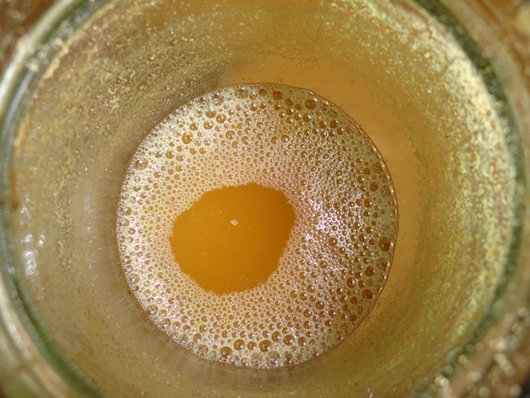
I opened a new pack of yeast yesterday so I made sure I proved it.  To prove yeast, half fill a cup with warm water.  Don't have it too hot because hot water will kill the yeast. Add the amount  of yeast you need and a teaspoon of sugar and stir it until it's mixed properly with the water.  Leave it for five to ten minutes. 

With the water and sugar to feed on, the yeast will activate and start frothing.  You can see this in the photo above.

When you're sure the yeast is alive and active you can add everything to your bowl or bread machine bucket.  My recipe for yesterday's bread was:
  • 3½ cups flour - I used half white and half stoneground wholemeal. Using some white flour will give a lighter loaf, using all wholemeal will give a heavier loaf.  You'll need 3½ cups, you decide how much white or wholemeal, if any, you'll use.  Buy bread flour, baker's flour, strong flour or high protein flour for your bread.
  • 1½ teaspoons yeast
  • 2 teaspoons salt
  • 1 teaspoon sugar 
  • about 2 cups of water You'll use more water with wholemeal flour but all flours are different.  Add almost all of the two cups, mix the dough and look to see if it needs more.

This is the dough in my breadmaker after I added two cups of water.  You can see in the photo that the dough is too dry, so I added another ¼ cup, then another ¼ cup.  Don't add the extra water all at once because it might be too much.  You need to look at it and judge if you have enough water or not.  This really does change from flour to flour and also on how humid it is.  You'll need less water in humid weather because there will be more water (from the air) already in the flour.
 
Now the water is in and I see that the dough is moist but not wet and sloppy.  I can still see a bit of dry flour at the bottom so I know it's fine now to walk away and do something else while the machine kneads the dough.
 
When I hear the machine's alarm, I go back to remove the dough.  Lightly flour your clean bench.  If you don't want to use your bench and prefer a board, put a moist tea towel/kitchen towel under the baord so it doens't slip around. 

 
Knead the dough by hand for a minute so it's nice and round and all the uneven bits are underneath.  

 
At this stage you can either just shape it and put it in greased a bread loaf tin or chop it into pieces to make bread rolls.  I did both and used my small loaf tin.
 
Wet the tops of the dough and sprinkle on anything your heart desires. I used polenta yesterday but I often use rolled oats, sesame or poppy seeds or a mixture of all of them.
 
Leave the dough in a warm spot to rise.  My kitchen was warm yestrday (28C) so I left the dough, uncovered, on the bench. Half an hour later it was ready to bake.  Make sure you don't let the dough rise too much because it will puff right up then collapse.  Also, handle the dough gently after it has risen because if you drop it or tap the side of the tin hard, it will lose all the air that's just caused it to rise.  If you do that, you'll have to let it rise again.

There are two kinds of rise when making bread.  One is the rise caused by the yeast and the gluten trapping the air given off by the yeast.  The other rise is oven lift and it happens when dough is placed in a hot oven.  A hot oven will make the dough puff up and then cook.  Make sure your oven is hot before you put the dough in.


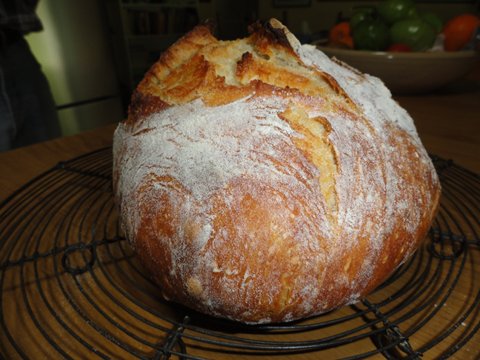
About half an hour later you'll have a house smelling of hot bread and your lunch sitting on the bench cooling slightly before you cut into it.

Bread making is not just following a recipe.  It involves looking, touching and judgement.  Get in there and touch the dough, learn how a good dough feels, learn how to spot problems and how to fix them.  If you can bake a good loaf of bread and are the chief provider of bread for your family, you're doing your job of homemaker well.  Bread is a staple and it's well worth your time and effort to get it right.   You'll save money and provide your family with healthy food with no preservatives, and that is a fine thing.   Happy baking everyone!
I see living simply as a series of adjustments.  Much of what I'm doing now, I did before but in a different way, or with a different attitude.  Shopping, housework, cooking, baking, gardening, knitting, and keeping chickens were all in my life before I started living more deliberately but now they're carried out with a more generous and caring heart and not just because I have to. Now my days have a rhythm of their own, I have no watch, I rarely look at the wall clock, the day and the season tell me whatever time I want to know about.  I've adjusted to a gentler way where mostly, time doesn't mean much.


But every so often, like today, the summer solstice in Australia, I stop and actively think about time; the time I have, how I'll use it today and in the coming year. This year coming will be a busy.  I have many things planned and the challenge for me is not to come up with fresh ideas and to change what I'm doing, but to balance work with recreation, and to slow myself enough to enjoy every hour of every day.  If I don't do that, what's the point?


I have found I need to be much more organised living as I do.  If we haven't thought to buy all the supplies we need, we have to rush out to get them at inconvenient times and those extra trips use more time and fuel.  If we're not organised when sowing our seeds, there will be no fresh salads, no potatoes, no good juicy tomatoes, we'll have to buy what we need, and I see that as a step backwards.  So today I'll take the time to organise my new diary.  I'll write up all those things that will make the coming year easier for me because I'm organised and prepared.  I'll write in dates I need to remember, important days when I should be at particular places, sowing days and sewing days, reminders to slow down, days out with Hanno and all my work enagements and deadlines.   There is a lot to put into that diary.


One of the things I can tell you about now is that will be taking next week off.  We have our Christmas morning breakfast and then the start of the Boxing Day test cricket match when I'll be sitting with my knitting and watching the entire day's play.  The following day is the last You, me and the kitchen sink for the year and then we'll have a few days rest here when I won't post but give all my attention to Hanno and my home.  When I come back I'm starting a simple living series when, for about a month, I'll write about the elements of a simple life as I see them, both practical and intellectual.  Many of these topics have already been written about but there are so many new readers now I thought I'd write a brand new condensed series, day after day, and with fresh eyes.  I hope new and older readers alike will find something in it. I expect it will serve me well to freshen my attitudes to what I do, to rethink how I work here, and to think about what is important and what isn't. 

I hope you enjoy this solstice day.  Do you use this as a planning day?  If not, how do you mark the solstice?

All graphics are Carl Larsson paintings.
Newer Posts Older Posts Home


My books were all published by Pengiun, and are available at Amazon US, Amazon UK and Amazon Au

Search here

Total Pageviews

Translate


I'm Rhonda Hetzel and I've been writing my Down to Earth blog since 2007. Although I write the occasional philosophical post, my main topics include home cooking, happiness and gardening as well as budgeting, baking, ageing, generosity, mending and handmade crafts. I hope you enjoy your time here.

MY FAVOURITE PLACES

  • Grandma Donna's Place
  • Grandma Donna's YouTube
  • Grandma Donna's Instagram
  • This Simple Day
  • Nicole's Instagram

Give More

Give More

Popular posts last year

Making ginger beer from scratch

We had a nice supply of ginger beer going over Christmas. It's a delicious soft drink for young and old, although there is an alcoholic version that can be made with a slight variation on the recipe. Ginger beer is a naturally fermented drink that is easy to make - with ginger beer you make a starter called a ginger beer plant and after it has fermented, you add that to sweet water and lemon juice. Like sourdough, it must ferment to give it that sharp fizz. To make a ginger beer plant you'll need ginger - either the powdered dry variety or fresh ginger, sugar, rainwater or tap water that has stood for 24 hours to allow the chlorine to evaporate off. You'll also need clean plastic bottles that have been scrubbed with soap, hot water and a bottle brush and then rinsed with hot water. I never sterilise my bottles and I haven't had any problems. If you intend to keep the ginger beer for a long time, I'd suggest you sterilise your bottles. MAKING THE STARTER In a...
Image

NOT the last post

This will be my last post here.  I've been writing my blog for 18 years and now is the time to step back. I’ve stopped writing the blog and come back a couple of times because so many people wanted it, but that won’t happen again, I won’t be back.  I’ll continue on instagram to remain connected but I don’t know how frequent that will be. I know some of you will be interested to know the blog's statistics. 
Image

How to make cold process soap

I'm sure many of you are wondering: "Why make soap when I can buy it cheaply at the supermarket?" My cold process soap is made with vegetable oils and when it is made and cured, it contains no harsh chemicals or dyes. Often commercial soap is made with tallow (animal fat) and contains synthetic fragrance and dye and retains almost no glycerin. Glycerin is a natural emollient that helps with the lather and moisturises the skin. The makers of commercial soaps extract the glycerin and sell it as a separate product as it's more valuable than the soap. Then they add chemicals to make the soap lather. Crazy. Making your own soap allows you to add whatever you want to add. If you want a plain and pure soap, as I do, you can have that, or you can start with the plain soap and add colour, herbs and fragrance. The choice is yours. I want to add a little about animal and bird fat. I know Kirsty makes her soap with duck fat and I think that's great. I think t...
Image

Preserving food in a traditional way - pickling beetroot

I've had a number of emails from readers who want to start preserving food in jars but don't know where to start or what equipment to buy.  Leading on from yesterday's post, let's just say up front - don't buy any equipment. Once you know what you're doing and that you enjoy preserving, then you can decide whether or not to buy extra equipment. Food is preserved effectively without refrigeration by a variety of different methods. A few of the traditional methods are drying, fermentation, smoking, salting or by adding vinegar and sugar to the food - pickling. This last method is what we're talking about today. Vinegar and sugar are natural preservatives and adding one or both to food sets up an environment that bacteria and yeasts can't grow in. If you make the vinegar and sugar mix palatable, you can put up jars of vegetables or fruit that enhance the flavour of the food and can be stored in a cupboard or fridge for months. Other traditional w...
Image

Cleaning mould from walls and fabrics

With all this rain around we've developed a mould problem in our home. Usually we have the front and back doors open and that good ventilation stops most moulds from establishing. However, with the house locked up for the past week, the high humidity and the rain, mould is now growing on the wooden walls near our front door and on the lower parts of cupboards in the kitchen. Most of us will find mould growing in our homes at some point. Either in the bathroom or, in humid climates, on the walls, like we have now. You'll need a safe and effective remedy at some point, so I hope one of these methods works well for you. Mould is not only ugly to look at, it can cause health problems so if you see mould growing, do something about it straight away. The longer you leave the problem, the harder it will be to get rid of it effectively. If you have asthma or any allergies, you should do this type of cleaning with a face mask on so you don't breathe in any spores. Many peopl...
Image

Five minute bread

Bread is one of those foods that, when made with your own hands, gives a great deal of satisfaction and delight. It's only flour and water but it symbolises so much. I bake bread most days and use a variety of flours that I buy in bulk. Often I make a sandwich loaf because we use most of our bread for lunchtime sandwiches and for toast. Every so often I branch out to make a different type of loaf. I have tried sour dough in the past but I've not been happy with any of them. I'll continue to experiment with sour dough because I like the idea of using wild yeasts and saving the starter over a number of years to develop the flavour and become a part of the family. However, the loaf I've been branching out to most often is just a plain old five minute bread. By five minutes I mean it takes about five minutes actual work to prepare but it's the easiest of all bread to make and to get consistently good loaves from. If you're having people around for lunch or...
Image

This is my last post.

I have known for a while that this post was coming, but I didn't know when. This is my last post. I'm closing my blog, for good, and I'm not coming back like I have in the past.  I've been writing here for 16 years and my blog has been many things to me. It helped me change my life, it introduced me to so many good people, it became a wonderful record of my family life, it helped me get a book contract with Penguin, and monthly columns with The Australian Women's Weekly and Burke's Backyard . But in the past few months, it's become a burden. In April, I'll be 75 years old and I hope I've got another ten years ahead. However, each year I'll probably get weaker and although I'm fairly healthy, I do have a benign brain tumour and that could start growing. There are so many things I want to do and with time running out, leaving the blog behind gives me time to do the things that give me pleasure. On the day the blog started I felt a wonderful, h...
Image

What is the role of the homemaker in later years?

An email came from a US reader, Abby, who asked about being a homemaker in later years. This is part of what she wrote: "I am a stay-at-home mum to 4 children, ages 9-16. I do have a variety of "odd jobs" that I enjoy - I run a small "before-school" morning drop-off daycare from my home, I am a writing tutor, and I work a few hours a week at a local children's bookstore. But mostly, I cherish my blissful days at home - cooking, cleaning (with homemade cleaners), taking care of our children and chickens and goats, baking, meal-planning, etc. This "career" at home is not at all what I imagined during my ambitious years at university, but it is far more enriching. I notice, though, that my day is often planned around the needs of my family members. Of course, with 4 active kids and a husband, this is natural. I do the shopping, plan my meals, cook dinner - generally in anticipation of my family reconnecting in the evening.  I can't h...
Image

Every morning at home

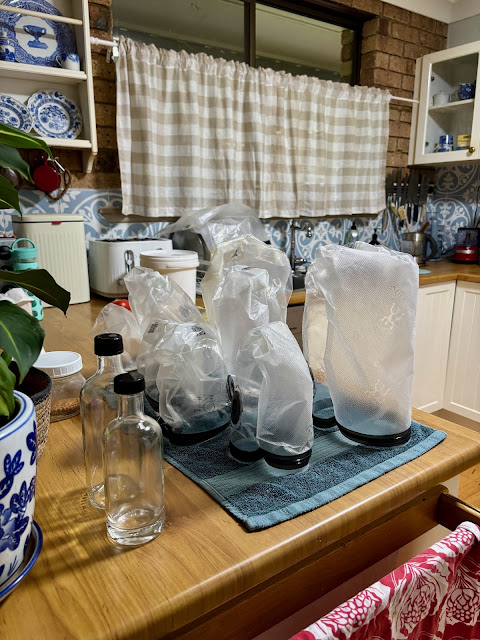
Every morning when I walk into my kitchen it looks tidy and ready for a day's work. Not so on this morning (above), I saw this when I walked in. Late the previous afternoon when I was looking for something, I came across my rolled up Zwilling vacuum bags and decided they had to be washed and dried. So I did that and although I usually put them outside on the verandah to dry it was dark by then. I turned the just-washed bags inside out and left them like this on a towel. It worked well and now the bags are ready to use when I bring home root vegetables, cabbages or whatever I buy that I want to last four or five weeks.
Image

You’ll save money by going back to basics

When I was doing the workshops and solo sessions, I had a couple of people whose main focus was on creating the fastest way to set up a simple life. You can't create a simple life fast, it's the opposite of that It's not one single thing either - it's a number of smaller, simpler activities that combine to create a life that reflects your values; and that takes a long to come together. When I first started living simply I took an entire year to work out our food - buying it, storing it, cooking it, preserving, baking, freezing, and growing it in the backyard. This is change that will transform how you live and it can't be rushed.  
Image


Trending Articles

NOT the last post

This will be my last post here.  I've been writing my blog for 18 years and now is the time to step back. I’ve stopped writing the blog and come back a couple of times because so many people wanted it, but that won’t happen again, I won’t be back.  I’ll continue on instagram to remain connected but I don’t know how frequent that will be. I know some of you will be interested to know the blog's statistics. 
Image

Every morning at home

Every morning when I walk into my kitchen it looks tidy and ready for a day's work. Not so on this morning (above), I saw this when I walked in. Late the previous afternoon when I was looking for something, I came across my rolled up Zwilling vacuum bags and decided they had to be washed and dried. So I did that and although I usually put them outside on the verandah to dry it was dark by then. I turned the just-washed bags inside out and left them like this on a towel. It worked well and now the bags are ready to use when I bring home root vegetables, cabbages or whatever I buy that I want to last four or five weeks.
Image

You’ll save money by going back to basics

When I was doing the workshops and solo sessions, I had a couple of people whose main focus was on creating the fastest way to set up a simple life. You can't create a simple life fast, it's the opposite of that It's not one single thing either - it's a number of smaller, simpler activities that combine to create a life that reflects your values; and that takes a long to come together. When I first started living simply I took an entire year to work out our food - buying it, storing it, cooking it, preserving, baking, freezing, and growing it in the backyard. This is change that will transform how you live and it can't be rushed.  
Image

Creating a home you'll love forever

Living simply is the answer to just about everything. It reduces the cost of living; it keeps you focused on being careful with resources such as water and electricity; it reminds you to not waste food; it encourages you to store food so you don't waste it and doing all those things brings routine and rhythm to your daily life. Consciously connecting every day with the activities and tasks that create simple life reminds you to look for the meaning and beauty that normal daily life holds.  It's all there in your home if you look for it. Seemingly mundane tasks like cleaning and cooking help you with that connection for without those tasks, the home you want to live in won't exist in the way you want it to.  Creating a home you love will make you happy and satisfied.
Image

Time changes everything

I've been spending time in the backyard lately creating a contained herb and vegetable garden. My aim is to develop a comfortable place to spend time, relax, increase biodiversity and encourage more animals, birds and insects to live here or visit. Of course I'd prefer my old garden which was put together by Hanno with ease and German precision. Together, we created a space bursting at the seams with herbs, vegetables and fruity goodness ready to eat and share throughout the year. But time changes everything. What I'm planning on doing now, is a brilliant opportunity for an almost 80 year old with balance issues. In my new garden I'll be able to do a wide range of challenging or easy work, depending on how I feel each day. It’s a daily opportunity to push myself or sit back, watch what's happening around me and be captivated by memories or the scope of what's yet to come.
Image

It's the old ways I love the most

I'm a practical woman who lives in a 1980’s brick slab house. There are verandahs front and back so I have places to sit outside when it's hot or cold. Those verandahs tend to make the house darker than it would be but they're been a great investment over time because they made the house more liveable. My home is not a romantic cottage, nor a minimalist modern home, it's a 1980’s brick slab house. And yet when people visit me here they tell me how warm and cosy my home is and that they feel comforted by being here. I've thought about that over the years and I'm convinced now that the style of a home isn't what appeals to people. What they love is the feeling within that home and whether it's nurturing the people who live there.
Image

Making ginger beer from scratch

We had a nice supply of ginger beer going over Christmas. It's a delicious soft drink for young and old, although there is an alcoholic version that can be made with a slight variation on the recipe. Ginger beer is a naturally fermented drink that is easy to make - with ginger beer you make a starter called a ginger beer plant and after it has fermented, you add that to sweet water and lemon juice. Like sourdough, it must ferment to give it that sharp fizz. To make a ginger beer plant you'll need ginger - either the powdered dry variety or fresh ginger, sugar, rainwater or tap water that has stood for 24 hours to allow the chlorine to evaporate off. You'll also need clean plastic bottles that have been scrubbed with soap, hot water and a bottle brush and then rinsed with hot water. I never sterilise my bottles and I haven't had any problems. If you intend to keep the ginger beer for a long time, I'd suggest you sterilise your bottles. MAKING THE STARTER In a...
Image

An authentic look at daily life here — unstaged and real

Most days Hanno was outside happily working in the fresh air. It may surprise you to know that I started reading my book,  Down to Earth , yesterday - the first time since I wrote it 13 years ago.  I had lent it to my neighbor, and when she returned it, I started reading, expecting to find surprises. Instead, I realised the words were still familiar—as if they were etched into my memory. As I flipped through the pages, I was reminded of how important it was for me to share that knowledge with others. The principles in Down to Earth changed my life, and I truly believed they could do the same for others. After just 30 minutes of reading, I put the book down, reassured that its message still holds true: we can slow down and reshape our lives, one step at a time.
Image