down to earth

  • Home
  • About Us
  • Down To Earth Book
  • Privacy Policy
Our first peek into our readers' kitchens is from Myra in Pittsburgh, Pennsylvania. Thanks for sharing your kitchen with us, Myra!


Click on photos to enlarge them.

Myra writes: "Attached are two photos of my kitchen sink. Nothing special except that it's near midnight and it's clean!! Usually there is a sink full of dirty dishes but I try to go to bed with a clean kitchen. I have made two waffle weave dishcloths which I have enjoyed knitting. I have my kleen kanteen which I take everywhere with me. I have a water filter attached to the faucet to filter out lead and pharmaceuticals. I keep a water glass beside it to drink from frequently. I spend a lot of time here. I recently quit my job downtown at a law firm in order to live a more simple life. My days are spent taking care of my new puppy, planning my spring garden and organizing my new relaxed and simple life."


What a lovely kitchen to start us off on this series. It's much tidier than mine! Myra, I didn't find a blog link in your email and I'm assuming you don't have one. That's fine, but if you do and want me to include your blog link, please send it to me. :- )

Next Thursday we'll feature Jillian's kitchen. Jillian lives in South Australia. The photos will appear in the order in which they're received. I hope you all enjoy this series.

Please do not send any more photos. I have enough for the next three months. I'll let you know in February when I need more sent. Thanks for the great response. I think it's going to be a great series.

This is not today's real post, it's below.

I find it difficult to post on a Thursday but I don't want a gap in the week's postings. I've been thinking about this for a while and now I think I have a good idea. I want to feature some photos from a reader's home each Thursday. My post will be two photos, plus any caption provided, the subject - the kitchen sink and the kitchen.

Please send me two photos, reduce the size before you send (about 450 pixels x 450 pixels, or thereabouts) of your kitchen and your kitchen sink. Describe what's in the photo and point out anything interesting. I will feature one reader's photos per week and include a link to their blog if they have one.

I'm really looking forward to this. I love looking at the functional interiors of family homes. :- )

NO more photos will be accepted at this time. I'll let you when I need more.
After two days of being away from home and working in my voluntary job, I'm back home in my haven today. I really do feel this is my haven here - every home should feel like that. When I talk with the people who come into our Centre for help, I silently wish I could place everyone of them into a warm and loving home. Such homes can heal and provide not only a safe haven from the outside world but also give significant emotional comfort. Early on in my journey towards a simpler life, being at the Centre help me understand the true value of my home. Seeing people who had no home, and those who live in dysfunctional homes, gave me a very clear understanding of how I wanted my home to be. I wanted a home that sustained us and everyone who visited us.

Freedom from Fear Stretched Canvas Print
Picture from Allposters.com

A sustainable home is not necessarily the biggest and best house in the street; this kind of home is not identified by the look of it. To me, the worth of this home is judged by the way people live in their homes, how they share their lives, by what they give importance to, by the way they model behaviour to the members of their clan, by the boundaries they set, by the work they do to provide that nurturing space and possibly by a hundred other things that are more difficult to define, but responsibility, respect, warmth, generosity, kindness and care need to be in the mix.

One thing is for sure, sustainable homes are not created by filling them with expensive appliances, furniture and other symbols of material "success". Their character is much more complex. The chief ingredients for making a home that sustains and nurtures are the people who live there, the feelings they have for each other and the way they express those feelings. I wish that every home was a sustainable one but sadly that is not the case. It's not even close to it.

I am sure that many people who start out on life with a partner think the hard part will be working to equip and furnish their home and being able to buy the things that will make them happy. I believe that is a shallow kind of happiness, if it is happiness at all. The really difficult part of life with a partner, setting up home and being a parent is to provide a decent home that provides support, nourishment, protection and security. It should be the one place where the family know with absolute certainty that they are loved, where they can be their true selves, can recuperate from being at school or at work, and have fun, help, be productive and creative and learn how to live. The home is where children should learn their values and where parents should always strive to live by theirs. It's complex, is not just bricks and mortar.

It doesn't matter what stage of life you're at, keep your eye on the prize. The prize is not an having an outstanding house, it's having an outstanding family and home. And it's tough to juggle life, family, home, money, friends, hopes and wishes, and sometimes you fail. But in those times when it comes together, when you look and see what you hope to see, when you realise that repeating that suggestion over and over has finally paid off, when you hear a quiet "I love you" and know it is meant in its truest sense, when you want to announce to the world what a wonderful family you have but instead keep it inside you to nourish and grow, when you think you've failed but realise you haven't, when you put the family to bed at night and sit, content, those are the times that will make up for the uncertainty and toughness of it all. And as I look back on my life of family and home building I know for sure that it was not just the good times that made us what we are today, it was the hard times too.

I know we don't get a lot of encouragement to build stable and happy families. The encouragement seems to be focused on success, creating wealth, spending to help the nation and acquisition, and while those elements may have some importance, they are secondary. Our real mission is to build productive and healthy families, that will create productive and healthy communities, that combined together build the nation. I am here to gently encourage and remind you that what you do at home is significant and meaningful, and that creating a sustainable home provides the ideal environment for your family to thrive in.

Spaces are opening up in the vegetable garden after harvesting all those ripe vegetables. Hanno and I talked about it on the weekend and we've decided to rest the garden over summer. We used to always do this. Summer always brings with it very hot and humid weather and thousands of bugs so it's a battle to keep everything productive and healthy. In the past couple of months we've noticed our tomatoes haven't been producing well and there have been a few fruit fly strikes. That's not a good sign and it convinced up to stop producing for all of summer and let the soil rejuvenate.


Hanno took these photos of the sunflowers. He caught them just as the sun had highlighted them from the back. I love these photos. Didn't he do a good job!

Our plan is to harvest almost everything that is growing now. That includes cucumbers, tomatoes, sunflowers, silverbeet, beetroot, eggplant, potatoes, celery, zucchinis, capsicums, leeks, beans and corn. We also have various herbs, ginger, sweet potato and green onions growing, they'll all stay in and shouldn't have too much of a problem growing over summer. When we harvest those vegetables, we'll let the chickens in for a couple of days to clean up the bugs and insect eggs in the soil, then we'll plant green manures.


Green manure will keep the garden productive over the hot months, enrich the soil and make the worms happy. I'll go to Green Harvest for the seeds - they have a big range of green manures, we'll go for some kind of a legume and grass mix. You can read about green manures here.


Soon the bright yellow of the sunflowers will be gone and it will be all green out there. I'm actually looking forward to having the summer off and not worrying about whether our tank water will stretch or if they'll be more rain. We will use the valuable water we do have in the tanks to keep our fruit going and we will concentrate on making our fruit vines and trees productive and healthy.

So, it's back to the vegetable market for us soon. I know the vegetables won't taste as good, I know they'll not be as fresh and who knows what sprays will hide in what we buy but for now this is what we have to do. Our next planting will be in March.

We had a lovely weekend. I woke early on Saturday to bake pastry cases that I'd already prepared and had waiting in the fridge. It was our fundraising morning for the Centre and I was on a promise for more mini quiches. The ingredients cost $17 and we turned that into $72. Now that's value adding! So I crept around mixing eggs, cooking bacon, onion and garlic - there were two sleeping men in the house and I didn't want to wake them. Kerry came to visit on Friday and stayed the night and as he works so hard at his job I hate to ruin a sleep-in for him. So the cheese was grated and the minis baked while the house filled with the aroma of a French farmhouse. When Hanno woke, I had my shower, dressed then drove up the mountain with the still warm quiches.


The mini quiches. These are very popular on a fundraising stall because they seduce everyone who hasn't yet had their breakfast.

It does my heart good to see those volunteers at work. There were six of them there, organising, carrying, preening, helping and selling and all happy to do it. In the end, after four hours, they'd made just over $1000. All that money goes to the Centre to help with the work we do. We are an unfunded Centre so fundraising and donations make or break us.


Two bottles of lemon cordial, bread and butter cucumbers and some left over spiced vinegar.

Kerry left at lunchtime, I made a large jar of bread and butter cucumbers and some lemon cordial from the frozen lemon juice treasure I have hiding in the freezer, then went to my work room to sew. I few minor repairs were carried out, then I spent quite some time writing Christmas cards for the volunteers where I work. I've invited them all to afternoon tea next week where I will give each of them a small gift (I can't tell you what I bought because many of them read my blog), and my thanks for the important work they do.

The cards finished I started tidying up, putting away this and that, sorting through cottons and wool and while I worked, the rain started. We've had only one good shower of rain since the night before the wedding (in June) so I didn't get too excited. But soon the rain was horizontal, winds were roaring, leaves and small branches started falling and the front tank overflowed. Hanno and I stood on the veranda to watch the lightening fork downwards and a river of water flow down the driveway and snake its way to the side of the house. Alice and Koda stayed inside - Alice asleep with her deafness making her oblivious to the chaos outside and Koda curled up tight in the corner of my sewing room.


Alice and Koda.

Before too long, maybe an hour, the heavy rain stopped and gentle showers hung around for another hour. Our garden was well and truly soak, for the first time in many, months, and all three water tanks were overflowing. It's a good feeling going into Summer next week knowing that we have enough water to see us through it.


My sons know me well. Kerry gave me this vintage tea towel on the weekend. He found it in a sack of rags at the place he works at.

Sunday was a different story. I had expected to watch some of the cricket but the match finished early, on Saturday. :- ( Oh well. I baked biscuits instead. I already had the dough made up in the freezer so all I had to do was add dark choc chips, work them in, form the biscuits and put them in the fridge to harden up again before baking. Now we have a jar full of biscuits - with no preservatives - waiting to be eaten with tea and coffee. The rest of the day was taken up with writing my Burke's Backyard article and transferring hundreds of photos to a flash drive. I bought a little flash drive just for this purpose - it's 16 gigabytes and cost $50. The first of my many computers was bought in 1988, it was 20 Mb, RAM 64 kilobytes and it cost over $3000. How times have changed.

And now it's the beginning of a new week with all the possibilities and opportunities that holds. I hope your week will be a good one, you achieve all you hope to achieve and you move further along your simple life path. I wonder what new things you can tell me you did at the end of this week. : - )


It was cricket day yesterday. The day that signifies the beginning of summer for me, when I watch the first day of a five day cricket match, doze on and off in my chair, knit, and generally laze about. Back in the 1980s, when my children were in primary school, and I was working full time and studying for a degree, it was also the time when study was finished for the year, preparations for Christmas and the summer holidays were just about to start and I had that one day off, alone, to relax.


New cleaning cloths.

I've changed in many ways since then and now I can't just sit doing nothing, so in addition to my knitting, yesterday I also made notes for a magazine article I'm writing and cut up rags. I like to keep that rag bag full and yesterday I added some good sized flannel cloths that once used to be a winter nightie. Waste not, want not. I never buy cleaning cloths, they all come from our old clothes, sheets and towels now. I cut them into the sizes I need, some I hem and some I don't, and I leave them to wait their time in my rag bag which hangs in the laundry.


The ragbag hangs in the laundry.

There are other speciality cloths here in addition to the cleaning rags. I also have a number of cotton cloths used for straining yoghurt and making cheese. These cloths are soft cotton and they generally fray around the edges, so I always hem them. I don't want fragments of cotton in our food. These cloths are also used to cover food, either sitting on the kitchen bench or in the fridge. If you don't want to use plastic wrap in the fridge, a moist cotton cloth will serve you well if the item is only in the fridge for a couple of days. If you would like to make yourself some of these cloths, buy some soft muslin, lawn or handkerchief linen, cut it to the size you need and hem the edges. Make sure you wash the cloth before using it on your food. These cloths and covers don't have to be ironed but they must always be clean.


Straining cloths and jug covers.

Other handy items to have in your cupboard are a few crocheted or cotton cloth jug covers. I have one large and one small crocheted cover and a couple of cotton cloth covers. The crochet covers are fine for covering a jug of milk or cold water when it's sitting on a table for a while. The cotton covers are needed when I'm fermenting and making things like ginger beer, sourdough and vinegar. They keep the bugs out, especially those annoying vinegar flies that many people call fruit flies, but they allow air and natural yeasts into the food you're making.


An old doiley with weights attached now serves an a jar cover.

To make a crocheted cover, there are plenty of crochet patterns online, but you could also do as I did for my small cover - I looked through my old doilies to find something suitable and just attached weights with embroidery cotton. The weights you use can be buttons, beads or shells with a hole drilled in the top.


This is a deep drawer in my kitchen where I keep my tea towels, cloths and covers.

Many of these cloths were commonplace in our grandmas' homes but they died an unnatural death in modern times. You won't find them in a shop, these are something you make yourself. But it's simple sewing, even for those who have never sewn before. They're the ideal beginners project.


Once you've made these simple covers, rags and straining cloths, you might like to ramp up your move towards self reliance and make other household linens like cloth napkins, tea towels, aprons, shopping totes and table cloths. All are easy newbie projects, all will help you create a more simple home and all will help you in your daily homemaking.

Thank you for your visits this week. We're fast moving towards the holiday season and all the extra work and busy times that holds. Don't forget to take care of yourself when you have that extra work. Take time out, take things slowly and enjoy what you do. I'll see you again next week, my friends.


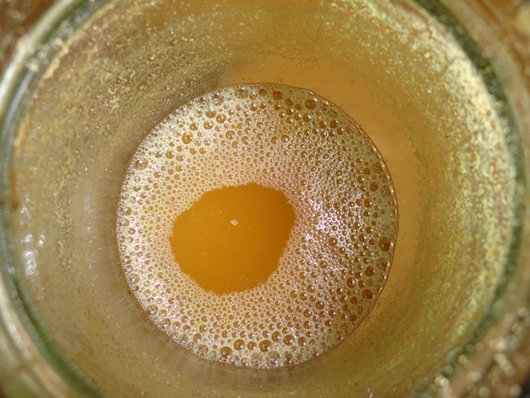
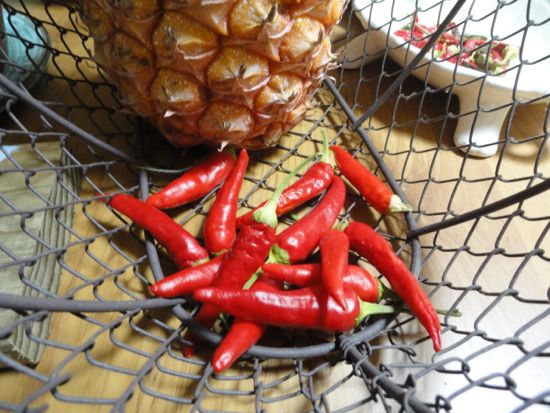
You would have noticed some pineapple in a jar sitting next to the beetroot yesterday. That is the first stage of pineapple vinegar I'm making from scratch. It's another great skill to have because it will mean you use the entire pineapple, not just the juicy, sweet inside. Pineapple vinegar is made from the bits you usually throw in the compost bin, but here you can put them to work for you instead of wasting a lot of the pineapple.


Start with a good pineapple - if it's organic, that's great, but you can use an ordinary pineapple from the market. Cut the top off - if you're in a warm climate, you can plant the top and grow your own pineapple - they take two years to fruit. But back to the kitchen, get your vegetable brush and thoroughly clean the pineapple skin. Rinse off and cut the skin from the pineapple. Cut the pineapple in quarters and cut out the core. You can use the pineapple flesh for any of your usual dishes, you don't need to add it to the vinegar jar.


Chop up the core and skin and put the pieces into a large jar. Mix ¼ cup of sugar in a litre/quart of water and pour it over the pineapple skin. Cover with a cotton cloth. This is a recipe where you're using the wild yeasts and bacteria in the air to help ferment the fruit and sweet water, so you don't want to put a lid on it, you want to keep bugs out and allow the yeasts in. Leave the pineapple jar sit to on the kitchen bench for a few weeks.


After two or three week, this mix might turn brown and then go clear again. That's good! It might also develop a little mould on top, that's fine too. Just scoop it off with a clean spoon. If a greyish gelatinous blob forms on the top of the vinegar, either as it's sitting on the bench or after it's bottled, that's excellent, you've made mother of vinegar. And you can use that mother as a starter to make more vinegar.

Two things are important in vinegar making - the temperature in the room it's made in and oxygen, another reason not to put a lid on the jar. The ideal temperature is between 15C - 25C degrees (60F - 80F). If the temperature is too low, it will take longer to make and won't be as good, and if it's too high, I doubt you'll make mother, but the vinegar will still be fine to use. You can introduce oxygen into the vinegar simply by stirring it every day.


Taste the vinegar after a couple of weeks, it should already be vinegary, you can then remove the pineapple pieces and put them in the compost. Leave the vinegar on the bench for another two weeks to develop the complex character of good vinegar. When you're happy with the taste, strain the vinegar through a clean cotton cloth two or three times and store it in a clean bottle with the lid on. It's perfectly okay to use this as it is, in fact it's a healthier alternative to the regular store bought vinegar. However, if you want to store the vinegar for a long time, you'd best pasteurise it. You do that simply by boiling it in a water bath, the guidelines for pasteurising at home are here. I keep my home made vinegar in the cupboard and use it within about two months.


Pineapple vinegar is excellent as part of a salad dressing and especially good to make a salsa dressing. You could use it to preserve your beetroot or bread and butter cucumbers. It's also a nice gift for someone who likes to cook. This is really easy to make and I encourage you to try it. I'm sure you'll be surprised at the results you get, and it's one more step on the self reliance trail.
Beets are one of the most nutritious vegetables you can eat. The root can be served raw, juiced, boiled, baked and pickled. The green tops can be steamed, boiled or stir fried or used in the same way you use silverbeet or spinach. Beets are one of the easy to grow vegetables everyone should fall in love with.


If you're new to food preservation, pickled beets is one of those easy to learn processes that while not fully utilising canning or processing procedures, will help you preserve your beetroot for a very long time in the fridge.


If you're growing beets, pick about 6 of them, or buy a bunch from the market. Don't cut into the roots because they'll bleed their juice out. Cut the tops off about ½ inch above the top of the root, leaving a little of the green. Scrub the roots with a vegetable brush and wash clean. It's okay to have different sizes but you have to remember to remove the smaller ones first and give the big ones more cooking time. You want them to cook until they're knife tender.

Add the roots to a pot of cold water with a little salt added and bring to the boil with the lid on. When they start to boil, turn down the heat and simmer them until you can easily slip a sharp knife into them. Remove the small ones first, give the larger ones a couple of extra minutes cooking time. When all are cooked, drain the water off in a colander and let them cool down. This part of the process should take about 20 minutes.

When they're still warm, slip the skins off. You can do this with your hands, the skins should just slide right off. Wash your hands as soon as you finish to remove the red stains. Your hands won't be stained as long as you wash them regularly throughout this process.

While the beets are cooking you can make your spiced vinegar. Into a saucepan place:
1 cup water
2 cups vinegar - I used apple cider vinegar
2 ½ tablespoons sugar
½ teaspoon salt
2 teaspoons of mixed spices - I mixed up a combo of celery seeds, mustard seeds and peppercorns and used two teaspoons of the mix.

Bring this mixture to the boil and simmer it for two minutes.

Trim off the tops and bottoms and put into the compost bucket, then slice the roots. Six sliced beetroots will generally fit into a one litre/quart jar. Pour the spiced vinegar over the beetroot to cover all of them. Then seal the lid and store in the fridge.

NOTE: make sure your jars, lids and any seals you use are scrupulously clean. Give them a good wash and run hot water over the jar and lids before you use them. When you intend to keep food for a long time, it's important to always start off with everything clean.


Pickled beetroot will keep well in the fridge for six months. If you want to keep it longer you'll need to process it in a water bath canner.

Pickled beetroot can be served as part of a trio of pickled vegetables along with bread and butter cucumbers and pickled onions. All of them are delicious eaten as part of a salad and compliment the rich creamy dressings of some salads very nicely. I am serving this trio of pickled vegies at our Christmas lunch.

I hope you enjoy the recipe.

Nutritional Value of Beet - from here
Beet is a rich source of Potassium, Iron, Magnesium, Manganese, Phosphorus and Copper. Whereas Calcium, Sodium, Zinc and Selenium are present in small amounts. Vitamin Content: Beet consists of Vitamin C, Folate and Betaine in large quantities. Vitamin A, Thiamin, Riboflavin, Niacin, Vitamin B6 and Pantothenic Acid are also present in small amounts. It also constitutes traces of Beta Carotene.

Newer Posts Older Posts Home


My books were all published by Pengiun, and are available at Amazon US, Amazon UK and Amazon Au

Search here

Total Pageviews

Translate


I'm Rhonda Hetzel and I've been writing my Down to Earth blog since 2007. Although I write the occasional philosophical post, my main topics include home cooking, happiness and gardening as well as budgeting, baking, ageing, generosity, mending and handmade crafts. I hope you enjoy your time here.

MY FAVOURITE PLACES

  • Grandma Donna's Place
  • Grandma Donna's YouTube
  • Grandma Donna's Instagram
  • This Simple Day
  • Nicole's Instagram

Give More

Give More

Popular posts last year

Making ginger beer from scratch

We had a nice supply of ginger beer going over Christmas. It's a delicious soft drink for young and old, although there is an alcoholic version that can be made with a slight variation on the recipe. Ginger beer is a naturally fermented drink that is easy to make - with ginger beer you make a starter called a ginger beer plant and after it has fermented, you add that to sweet water and lemon juice. Like sourdough, it must ferment to give it that sharp fizz. To make a ginger beer plant you'll need ginger - either the powdered dry variety or fresh ginger, sugar, rainwater or tap water that has stood for 24 hours to allow the chlorine to evaporate off. You'll also need clean plastic bottles that have been scrubbed with soap, hot water and a bottle brush and then rinsed with hot water. I never sterilise my bottles and I haven't had any problems. If you intend to keep the ginger beer for a long time, I'd suggest you sterilise your bottles. MAKING THE STARTER In a...
Image

NOT the last post

This will be my last post here.  I've been writing my blog for 18 years and now is the time to step back. I’ve stopped writing the blog and come back a couple of times because so many people wanted it, but that won’t happen again, I won’t be back.  I’ll continue on instagram to remain connected but I don’t know how frequent that will be. I know some of you will be interested to know the blog's statistics. 
Image

How to make cold process soap

I'm sure many of you are wondering: "Why make soap when I can buy it cheaply at the supermarket?" My cold process soap is made with vegetable oils and when it is made and cured, it contains no harsh chemicals or dyes. Often commercial soap is made with tallow (animal fat) and contains synthetic fragrance and dye and retains almost no glycerin. Glycerin is a natural emollient that helps with the lather and moisturises the skin. The makers of commercial soaps extract the glycerin and sell it as a separate product as it's more valuable than the soap. Then they add chemicals to make the soap lather. Crazy. Making your own soap allows you to add whatever you want to add. If you want a plain and pure soap, as I do, you can have that, or you can start with the plain soap and add colour, herbs and fragrance. The choice is yours. I want to add a little about animal and bird fat. I know Kirsty makes her soap with duck fat and I think that's great. I think t...
Image

Preserving food in a traditional way - pickling beetroot

I've had a number of emails from readers who want to start preserving food in jars but don't know where to start or what equipment to buy.  Leading on from yesterday's post, let's just say up front - don't buy any equipment. Once you know what you're doing and that you enjoy preserving, then you can decide whether or not to buy extra equipment. Food is preserved effectively without refrigeration by a variety of different methods. A few of the traditional methods are drying, fermentation, smoking, salting or by adding vinegar and sugar to the food - pickling. This last method is what we're talking about today. Vinegar and sugar are natural preservatives and adding one or both to food sets up an environment that bacteria and yeasts can't grow in. If you make the vinegar and sugar mix palatable, you can put up jars of vegetables or fruit that enhance the flavour of the food and can be stored in a cupboard or fridge for months. Other traditional w...
Image

Cleaning mould from walls and fabrics

With all this rain around we've developed a mould problem in our home. Usually we have the front and back doors open and that good ventilation stops most moulds from establishing. However, with the house locked up for the past week, the high humidity and the rain, mould is now growing on the wooden walls near our front door and on the lower parts of cupboards in the kitchen. Most of us will find mould growing in our homes at some point. Either in the bathroom or, in humid climates, on the walls, like we have now. You'll need a safe and effective remedy at some point, so I hope one of these methods works well for you. Mould is not only ugly to look at, it can cause health problems so if you see mould growing, do something about it straight away. The longer you leave the problem, the harder it will be to get rid of it effectively. If you have asthma or any allergies, you should do this type of cleaning with a face mask on so you don't breathe in any spores. Many peopl...
Image

Five minute bread

Bread is one of those foods that, when made with your own hands, gives a great deal of satisfaction and delight. It's only flour and water but it symbolises so much. I bake bread most days and use a variety of flours that I buy in bulk. Often I make a sandwich loaf because we use most of our bread for lunchtime sandwiches and for toast. Every so often I branch out to make a different type of loaf. I have tried sour dough in the past but I've not been happy with any of them. I'll continue to experiment with sour dough because I like the idea of using wild yeasts and saving the starter over a number of years to develop the flavour and become a part of the family. However, the loaf I've been branching out to most often is just a plain old five minute bread. By five minutes I mean it takes about five minutes actual work to prepare but it's the easiest of all bread to make and to get consistently good loaves from. If you're having people around for lunch or...
Image

This is my last post.

I have known for a while that this post was coming, but I didn't know when. This is my last post. I'm closing my blog, for good, and I'm not coming back like I have in the past.  I've been writing here for 16 years and my blog has been many things to me. It helped me change my life, it introduced me to so many good people, it became a wonderful record of my family life, it helped me get a book contract with Penguin, and monthly columns with The Australian Women's Weekly and Burke's Backyard . But in the past few months, it's become a burden. In April, I'll be 75 years old and I hope I've got another ten years ahead. However, each year I'll probably get weaker and although I'm fairly healthy, I do have a benign brain tumour and that could start growing. There are so many things I want to do and with time running out, leaving the blog behind gives me time to do the things that give me pleasure. On the day the blog started I felt a wonderful, h...
Image

What is the role of the homemaker in later years?

An email came from a US reader, Abby, who asked about being a homemaker in later years. This is part of what she wrote: "I am a stay-at-home mum to 4 children, ages 9-16. I do have a variety of "odd jobs" that I enjoy - I run a small "before-school" morning drop-off daycare from my home, I am a writing tutor, and I work a few hours a week at a local children's bookstore. But mostly, I cherish my blissful days at home - cooking, cleaning (with homemade cleaners), taking care of our children and chickens and goats, baking, meal-planning, etc. This "career" at home is not at all what I imagined during my ambitious years at university, but it is far more enriching. I notice, though, that my day is often planned around the needs of my family members. Of course, with 4 active kids and a husband, this is natural. I do the shopping, plan my meals, cook dinner - generally in anticipation of my family reconnecting in the evening.  I can't h...
Image

Every morning at home

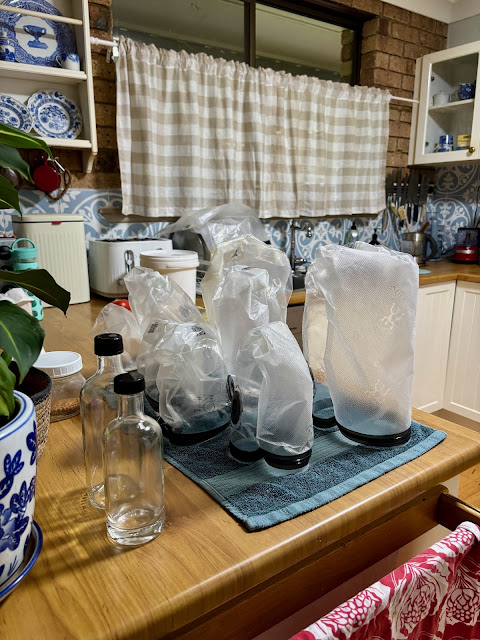
Every morning when I walk into my kitchen it looks tidy and ready for a day's work. Not so on this morning (above), I saw this when I walked in. Late the previous afternoon when I was looking for something, I came across my rolled up Zwilling vacuum bags and decided they had to be washed and dried. So I did that and although I usually put them outside on the verandah to dry it was dark by then. I turned the just-washed bags inside out and left them like this on a towel. It worked well and now the bags are ready to use when I bring home root vegetables, cabbages or whatever I buy that I want to last four or five weeks.
Image

You’ll save money by going back to basics

When I was doing the workshops and solo sessions, I had a couple of people whose main focus was on creating the fastest way to set up a simple life. You can't create a simple life fast, it's the opposite of that It's not one single thing either - it's a number of smaller, simpler activities that combine to create a life that reflects your values; and that takes a long to come together. When I first started living simply I took an entire year to work out our food - buying it, storing it, cooking it, preserving, baking, freezing, and growing it in the backyard. This is change that will transform how you live and it can't be rushed.  
Image


Trending Articles

NOT the last post

This will be my last post here.  I've been writing my blog for 18 years and now is the time to step back. I’ve stopped writing the blog and come back a couple of times because so many people wanted it, but that won’t happen again, I won’t be back.  I’ll continue on instagram to remain connected but I don’t know how frequent that will be. I know some of you will be interested to know the blog's statistics. 
Image

Every morning at home

Every morning when I walk into my kitchen it looks tidy and ready for a day's work. Not so on this morning (above), I saw this when I walked in. Late the previous afternoon when I was looking for something, I came across my rolled up Zwilling vacuum bags and decided they had to be washed and dried. So I did that and although I usually put them outside on the verandah to dry it was dark by then. I turned the just-washed bags inside out and left them like this on a towel. It worked well and now the bags are ready to use when I bring home root vegetables, cabbages or whatever I buy that I want to last four or five weeks.
Image

You’ll save money by going back to basics

When I was doing the workshops and solo sessions, I had a couple of people whose main focus was on creating the fastest way to set up a simple life. You can't create a simple life fast, it's the opposite of that It's not one single thing either - it's a number of smaller, simpler activities that combine to create a life that reflects your values; and that takes a long to come together. When I first started living simply I took an entire year to work out our food - buying it, storing it, cooking it, preserving, baking, freezing, and growing it in the backyard. This is change that will transform how you live and it can't be rushed.  
Image

Creating a home you'll love forever

Living simply is the answer to just about everything. It reduces the cost of living; it keeps you focused on being careful with resources such as water and electricity; it reminds you to not waste food; it encourages you to store food so you don't waste it and doing all those things brings routine and rhythm to your daily life. Consciously connecting every day with the activities and tasks that create simple life reminds you to look for the meaning and beauty that normal daily life holds.  It's all there in your home if you look for it. Seemingly mundane tasks like cleaning and cooking help you with that connection for without those tasks, the home you want to live in won't exist in the way you want it to.  Creating a home you love will make you happy and satisfied.
Image

Time changes everything

I've been spending time in the backyard lately creating a contained herb and vegetable garden. My aim is to develop a comfortable place to spend time, relax, increase biodiversity and encourage more animals, birds and insects to live here or visit. Of course I'd prefer my old garden which was put together by Hanno with ease and German precision. Together, we created a space bursting at the seams with herbs, vegetables and fruity goodness ready to eat and share throughout the year. But time changes everything. What I'm planning on doing now, is a brilliant opportunity for an almost 80 year old with balance issues. In my new garden I'll be able to do a wide range of challenging or easy work, depending on how I feel each day. It’s a daily opportunity to push myself or sit back, watch what's happening around me and be captivated by memories or the scope of what's yet to come.
Image

It's the old ways I love the most

I'm a practical woman who lives in a 1980’s brick slab house. There are verandahs front and back so I have places to sit outside when it's hot or cold. Those verandahs tend to make the house darker than it would be but they're been a great investment over time because they made the house more liveable. My home is not a romantic cottage, nor a minimalist modern home, it's a 1980’s brick slab house. And yet when people visit me here they tell me how warm and cosy my home is and that they feel comforted by being here. I've thought about that over the years and I'm convinced now that the style of a home isn't what appeals to people. What they love is the feeling within that home and whether it's nurturing the people who live there.
Image

Making ginger beer from scratch

We had a nice supply of ginger beer going over Christmas. It's a delicious soft drink for young and old, although there is an alcoholic version that can be made with a slight variation on the recipe. Ginger beer is a naturally fermented drink that is easy to make - with ginger beer you make a starter called a ginger beer plant and after it has fermented, you add that to sweet water and lemon juice. Like sourdough, it must ferment to give it that sharp fizz. To make a ginger beer plant you'll need ginger - either the powdered dry variety or fresh ginger, sugar, rainwater or tap water that has stood for 24 hours to allow the chlorine to evaporate off. You'll also need clean plastic bottles that have been scrubbed with soap, hot water and a bottle brush and then rinsed with hot water. I never sterilise my bottles and I haven't had any problems. If you intend to keep the ginger beer for a long time, I'd suggest you sterilise your bottles. MAKING THE STARTER In a...
Image

An authentic look at daily life here — unstaged and real

Most days Hanno was outside happily working in the fresh air. It may surprise you to know that I started reading my book,  Down to Earth , yesterday - the first time since I wrote it 13 years ago.  I had lent it to my neighbor, and when she returned it, I started reading, expecting to find surprises. Instead, I realised the words were still familiar—as if they were etched into my memory. As I flipped through the pages, I was reminded of how important it was for me to share that knowledge with others. The principles in Down to Earth changed my life, and I truly believed they could do the same for others. After just 30 minutes of reading, I put the book down, reassured that its message still holds true: we can slow down and reshape our lives, one step at a time.
Image