down to earth

  • Home
  • About Us
  • Down To Earth Book
  • Privacy Policy
There is a lot of satisfaction to be gained working on ordinary tasks in the home. Gone are the days when homemakers were at the bottom of the pile. Now we have taken control of our homes, we see one of our jobs as managing the home budget and saving as much money as we can, we have stepped up to recycling and repairing, we are living frugally and green and we are enriched by that. Our lives are happily home made. All over the world handmade is making a comeback, showing us that what we produce with our own hands generally satisfies us more than what we buy at the store. We are making unique homes to our own taste full of soft cottons and linens, cutting down on the world's waste and showing our children that both the beautiful and the practical can be make at home.


I read somewhere this past week, maybe it was at the forum, that some feel guilty when they work on their craft projects at home. The idea being that if they enjoy it and look forward to it - be it quilting, sewing, knitting, soap making or whatever, it is entertainment and joy rather than work. I have never felt that way and I have never considered my knitting, sewing and soapmaking as anything but part of my housework. I don't see these things as separate crafts. To me, they are part of my everyday work.

I grew up in a time when dresses, shirts, children's clothes, soft furnishings and knitwear were homemade. If you needed a new quilt or skirt, there was no huge store where you could buy something cheap from China - you made what you needed. Store bought clothes were bought for special occasions. Most homes had piles of fabric and balls of wool waiting to be made into what was needed in everyday life. There was no other option and homemakers did that work as part of their daily tasks.


So for me, I don't hope there will be time available for me to sit down and sew or knit. I plan those tasks in with my normal everyday chores. I usually do my hand work in the afternoon and the more strenuous work in the morning. Knitting for the family and for gifts is part of my housework, sewing a new tablecloth, napkins, aprons or curtains are as much a part of my work as washing up and sweeping the floor. It all goes into the good of my home and even if I love doing it and look forward to it, it's still a household task.


I hope that you get some enjoyment out of most of the things you do in your home. Of course there are some things you won't like doing as much, but if you enjoy sewing and knitting and making whatever it is you need for your home, that is your pay-off for the tasks you don't like so much. Joy is lurking in your home, it is one of your daily tasks to find it.

If you haven't thought about your work in this way, take some time soon to look at what you do and think about the nature of your work. Plan your craft type work in with your normal housework. Never ever feel guilty for doing what you love and as long as you plan your handwork in with your more strenuous housework, you'll have time and energy for all of it.

Steel Kitten is having a wonderful giveaway to celebrate her 300th post. But that is not the only reason to visit her. Her blog is full of interesting posts and great photos and you have to see the fingerless gloves she knitted! Click here to visit.

Also, we are having a competition at the Down to Earth Forum. To be eligible to win, simply write a post and tell us about your simple life - what is working, what isn't working, what you love, what you don't love and what you hope to be doing this time next year. The winner may have been living this way for years or have just started. We are looking for the most interesting and engaging post. Everyone may enter.

The winner will receive two 50 gram balls of beautiful Australian grown and spun, pure, machine washable wool - Cleckheatons Country Naturals, and a pattern for fingerless gloves and a man's wool hat. I will post internationally.

If you have not joined the forum yet, click here to register and you can go straight in.


Two girls fighting over one baby, an enemy is identified and killed on sight, a mutant lurking in the shadows! Am I on the set of a Hollywood movie? No, it's more exciting than that - it's my backyard where life and death meet on a daily basis and all the strangeness is real. Come with me, I'll show you ...


Click on each photo to enlarge.

I've been spending some time in the garden in the early morning lately. Since Hanno had his knee operation, I've taken on his garden tasks. I like to do that early, before the sun gets too hot. So at about 5am I collect the eggs, let the girls out to free range for the day, start watering the plants and checking to see that all is as it should be. Wild geese honk as they fly over on their migratory path and realise that the pond they always relied on has been filled in by the person who lives over the back. Yet another natural place taken away by "development". It's quite, it seems like nothing much happens, but that belies the truth. It's a jungle out there!


We've been growing two types of sunflowers this season - Mexicans and giant Russians. The first of the Mexicans has flowered and I'm looking forward to the time when I can pick a bunch of them and have them inside on the kitchen table. The Giant Russians are for the chooks and wild King parrots. As soon as they see the massive yellow heads they'll send out the call and every King in the vicinity will come and feast on them.


Look carefully, a stranger approaches. These caterpillars eat into the centre of sunflowers and stop them flowering. I picked it off the leaf and squashed it under my Croc. Life and death in the vegetable garden, it's tough.


These look like ruby silverbeet but they are beetroot, from the same family. You can eat the leaves and the roots. We've been eating a lot of raw beets lately, grated with salads. I've also given some to my friend Bernadette who is using them as an organic juice.


The Marketmore cucumbers are growing well and have been fruiting for about a month. They'll soon be replaced by a follow up crop of these Lebanese cucumbers (below) that have been grown at the end of the Giant Russian sunflower rows.


There is an empty patch here that I'm sure Hanno has plans for and on the edge, a new crop of celery just starting to come up. I've been picking some of the baby celery leaves for our salads - they're crisp and tender but haven't yet developed the strong celery flavour that I love.


And what's this? A mutant! A white cucumber flower when they should all be yellow. Very interesting. I had a good look and it's the only white flower. All the others are as they should be. But it's growing a cucumber, so I'll just have to watch it and see if it's different in any other way. This is how new types are found - natural mutation. They are called sports. It may be something, it may not be. We'll wait and see.


Around the corner from the mutant, corn is growing sweet and strong. We've had a few feeds from these, have a few more to go and we have follow ups growing in the next bed. Further along this row are Chinese greens that we grow for the chooks. It's not that we don't like them, it's just that they grow faster than any other green and therefore we can keep up the supply of them for our hungry chickens.


Nestled in between the giant Russians and the Washington Navel orange, looking towards the parsley and eggplants. I harvested the first two eggplants and added them to my basket.


The first of the sweet potatoes are sprouting. Like any good Permaculture plant, they'll perform at least two roles. We'll eat them and the mass of vines they produce will help shade the chook house during the hottest summer months.


And while I stood there looking at the sweet potatoes and giving them a good soaking with the hose, a real hullabaloo broke out beside me. I had collected the eggs earlier and one of the broodies came back to find her eggs gone. She tried to take over the nest of her sister, who has been sitting on one egg for about two weeks. They both stood up, fought on the little ladder, both changed nests, then changed back again and all the time making enough noise to have me locked up. I hosed them to calm them down and they ran off. But the one who had been sitting on the one egg, soon rushed back and is still now sitting on that egg. We'll throw it away when we finally get it out from under her.


My harvest basket, minus the tomatoes I picked and the eggs collected earlier. It made a fine meal for us that night.


A prawn salad - with local prawns from Caloundra, and everything on the plate, except the potatoes, white onion and the prawns, grown out the back, in that jungle out there.
After two hectic days of work at the Centre, I'm working at home today. Gone are the days when I would have looked forward to relaxing, shopping and going out to visit friends. Now, settling back into the routine of washing up, sweeping, making beds and baking brings me back to myself and reminds me that my home is the place where I am put right again.


I work in the welfare sector and it's a very tough job sometimes. I don't counsel anyone, I manage the Centre I work at, and I guess I act as a surrogate mother and dish out kindness with cups of tea and encouragement along with advice about getting a job or looking after the family.

I had never worked in welfare before - had never even been in a neighbourhood centre until I wandered in there to ask if they needed any help, but working here in my home prepared me for working there. I teach my The Frugal Home workshop and stretch the slim budget there until I hear those pennies scream, but my preparation for that job is more than those obvious practical things. Since I have have taken control of my home and made it the place I want it to be, I feel empowered to take on many more things.


If someone were to see me working here at home they might believe that I am "just a housewife". How many times have we all used that phrase to describe ourselves? Well I am "just a housewife" who has taken back control of my own life. No longer am I a slave to fashion and advertising, I am not just filling in time by doing my daily tasks. What I do here now is a part of me, it makes me who I am and enables me to do the things I do.

Never undersell yourself or your role of homemaker. Running a home is similar to running a business. You need to work to a budget, manage people, make hard decisions, work to a schedule, delegate tasks, work long hours and make sure those you work with are productive and content. In fact, while all those elements describe the running of both a home and a business, at home you have extras - your work never stops and you raise children. Raising the next generation is not only an important part of family life, it's important for the nation too.


Family photos. The first one is of my sons Shane and Kerry when they were about nine and ten, with their friend Gavin in the middle.

Taking control of the home, while sounding harsh, is, I think, the key to success. You need to take charge, delegate, have routines, get family members working for the good of the family and while that is happening, model the bahaviour you want to see in your children. A tough call, I know, but it pays off if you get it right. I know that we homemakers are looked down upon by many people but don't you ever believe they are right. What we do is the most important job; what we do makes the nation strong.

If you have to describe what you do, proudly name yourself "homemaker", or if you work outside the home as well - "homemaker/teacher", "homemaker/retail assistant" or whatever it is you do. Don't fall in with the rest of them and try to make us invisible. Let everyone know what we do, that we are an important part of our society and that we are proud of the work we do. I am an ordinary woman, there is nothing special about me, but because I have the attitude I have, people listen to me. I got the confidence to be the me I am now from my home - by taking control here and making it productive and alive.

You can do the same thing.

For those of you around Geelong, today I'll be interviewed on your local radio station at around 9.30am. Tomorrow I'll be on a few stations in northern Tasmania at 7.40am. Those are Queensland times, not local time, so you'll have to add an hour.

The headlines will read: Homemaker speaks, the nation listens. ; - )

I'm sure you all know by now that I love knitting - dishcloths being a favourite subject of my affection. Well, I was reading a knitting book last week and came across a new (to me) pattern that I thought would make up a very nice dishcloth. I worked it over the weekend and have just taken a photo for you.


It has got a fair bit of texture so it will scrub well but the holes make it lighter than the average dishcloth. And the good bit it, it's a good pattern for a beginner. It uses mainly knit rows, with one purl row and one that will introduce two new techniques to you. It's called the Ridged Ribbon Eyelet pattern.

Your two new techniques are K2tog and yo. K2tog means knit two together and it means exactly that. Instead of doing your normal knit stitch you do it exactly as you normally would but you put your needle through two stitches, instead of one. Then knit as you would if you were doing your normal stitch. Watch this video to see how to K2tog.

Yo means yarn over.
That's it! It's a way of increasing one stitch (to replace the one you decreased with your k2tog) and will help make a hole. You'll only see the hole properly when you knit on and do another row. To do a yo - simply wind your yarn around your right needle - from back to front, you make a loop instead of a real stitch. Watch this video to see how to yo.


I used size 9 needles and Lions 100% cotton. The blue band is a bamboo and cotton blend. Cast on an uneven number of stitches, I cast on 31 but if you wanted a large cloth, go up to 39 or 41. Then:
Row one: Knit
Row two: Purl
Row three: Knit
Row four: Knit
Row five: *K2tog. yo; repeat from * to last stitch, K1. <- this means knit two together, then yarn over for the entire row, your last stitch is one plain knit stitch.
Row six: Knit

Repeat the sequence until you have the length you want.

When you do the two next rows after your k2tog row, you'll see the pattern forming. This is a really good pattern to introduce you to two new stitches. I hope that if you are one of my new knitters, you'll try this as well. Let me know how you're going with your knitting and if you're enjoying it. If you have a photo of your knitting to send to me, please send it.

Here is Paula's recipe for Cheap and Easy Biscuits from the forum. I misread it - it makes almost 100 biscuits from this one recipe. BTW Paula, I gave this recipe to my friend Meryl yesterday. Meryl is the chief baker and fundraiser at our Centre, she is older than I am and very experienced with fete and stall cooking, she's never heard of this recipe either, but she loves it too. Thanks for sharing.

Originally Posted by paula hewitt on Down to Earth Forum
I bake all our biscuits, cakes and bread, so I am always on the lookout for recipes which are quick and easy. I thought I would share one of my favourite biscuit (cookie) recipes. It is easy, quick, cheap and it makes 7 or 8 dozen biscuits, which keep well. The dough and cooked biscuits keep well in the freezer. I use butter and wholemeal flour, but white flour and margarine can be substituted. I have only ever used tinned sweetened condensed milk in this recipe, but i imagine that Rhonda Jean's homemade condensed milk would work just as well.

makes 7-8 dozen, cook 10 min at 180C

500 grams butter (approx 1.1 lb)
1 can condensed milk (390-400 gram)
1 cup sugar
5 cups wholemeal self raising flour (or plain flour and baking powder)
toppings like choc chips, smarties, jam, cinnamon and sugar

cream butter and sugar, add condensed milk. stir in flour. roll into balls and flatten. top with choc chips etc, or thumbprint and add jam for jam drops.

bake at 180C for approx 10 min until golden brown. cool on racks


I love finding a recipe that I know I'll use in the years to come. I found such a recipe a couple of weeks ago and was delighted with the results. It came from the Down to Earth forum, submitted by Paula Hewitt and she calls them Easy and Cheap Biscuits (cookies).


The great thing abut this recipe is that it uses only four ingredients. Paula says the recipe makes 70 - 80 biscuits. I made up one lot of about 40, another batch of 25 a week later and I still have one batch frozen as a log in the freezer.


I had two rolls of dough to freeze.

Makes 7-8 dozen, cook 10 min at 180C

500 grams butter (approx 1.1 lb)
1 can condensed milk (390-400 gram)
1 cup sugar
5 cups wholemeal self raising flour (or plain flour and baking powder)
toppings like choc chips, smarties, jam, cinnamon and sugar

Cream butter and sugar, add condensed milk. stir in flour. roll into balls and flatten. top with choc chips etc, or thumbprint and add jam for jam drops.

Bake at 180C for approx 10 min until golden brown. cool on racks.

I topped some of mine with jam and marmalade. Others with chocolate sprinkles and choc chips. All of them were delicious and they kept well in a sealed container.


I turned some into jam drops.

I'm going to share this recipe with our fundraisers at work. I reckon a little tray of these biscuits would sell at our stall for about $4 which would make us just over $50 per batch. I estimate the cost of ingredient to be just under $10 if we buy condensed milk, and less if we make our own. Definitely a handy recipe for charity fundraising.


But here at home it's a good one to make up and have in the freezer for unexpected guests. You could defrost the dough and have them cooked in under an hour. I've written the recipe inside the cover of my Feast cookbook, I'm sure Nigella would approve. This is definitely a keeper.

You'll notice I've put up some Amazon ads for the USA, Canada and the UK. The UK Amazon is now offering free postage to UK buyers from now until January 1, 2010. There is no minimum purchase needed. I will use any money I make on these ads to finance the set up and ongoing costs of the forum.

The start of another week and I'm back to working Mondays and Tuesdays from today. Hasn't this year gone fast! I guess you're all working on your Christmas gifts. I have discovered a new favourite dishcloth pattern. I'll show it to you tomorrow. I hope you have a beautiful week.


I'm happy to report that it all went very well with Hanno's surgery yesterday. He went in at 1pm, I popped down to Spotlight to check out a sale then spent a couple of hours in the waiting room, knitting, and he hobbled out at 5.30pm. We got home around 6pm. He had no pain, didn't need crutches and he slept fairly well last night. Today and tomorrow will be the test, the doctor said he must allow the knee to heal but he also needs to exercise it. His idea of rest, and mine, are entirely different so we'll see what happens today. My guess is he'll sit on the couch and on the front verandah until he reads everything he wants to read, then he'll want to wander around. Thank you all for your kind thoughts and prayers.

A week's work from Allposters.

I was going to write about biscuits today but that can wait for another time because I'm going to carry on from yesterday. My post on "perfection" seemed to hit a cord with a few of you so let's expand on that.

I was saddened to read some of yesterday's comments. I know it's difficult to overcome something you've live with in childhood but as adults we have the choice to live as we wish. Examine your fears, think about what you believe perfection to be and develop the strength to toss out old ideas and work on new ones. Oh, and examine your fears in the bright light of day, not at 3am lying silently in the darkness when everything seems hopeless. If trying to be perfect just isn't working for you then replace that need with doing your best.

When elite athletes train for the Olympics they don't try to beat world records, they try to beat their own personal best. And that is a helpful tactic here too. Just do your best on any given day, you can't ask for more than that. I know that as I go through my week, some days I feel I can take on the world, and some days I just want to write, drink tea and rest. NO ONE, has the capacity to work perfectly every day. Not every day will be perfect - in fact very few are.

If you're expecting perfection you're setting yourself up for disappointment. You're hoping for something that rarely happens. Don't do that to yourself. Instead, today, this very minute, say to yourself that you're replacing the expectation of perfection with doing your best. And in the days that follow this one, try your best in every thing you do. Slow down and concentrate on what it is you're doing - don't rush through your work trying to get it done - and do your best. Some days your best will be spectacular and some days it won't be but as long as you can go to bed each day thinking that you did the best you could do on that day, that will stand you in good stead. Hopefully over the course of a few months, you'll replace your mother's voice in your head, insisting on perfection, with: I'm proud that I did the best I could.

I have touched on this subject before here: The best

I hope today is a good one for you and that whatever you do, you'll do your best and be happy with it. And remember, happiness is not one huge reward you find one day. It's tiny fragments that are collected every day and added to your basket. Never stop looking for whatever happiness you can find. It maybe in the passage of a book, it may be lurking in your garden or on the faces of your children. Take note of every happy moment, add them to your basket and be enriched by the thought of them as you go through your day.


It doesn't take much, just one good night's sleep and I'm ready to take on the world again. Thank you for your good wishes and prayers for Hanno, we both appreciate them. We'll go in later this morning and be home late this afternoon; no doubt there will be news to write about tomorrow.


A recent shared lunch at the Centre I work at.

But today I want to talk about perfection. I don't talk about it much, mainly because I don't believe many things are perfect, I rarely seek perfection and I tend to feel a bit uneasy when things look too good. I prefer to live in a slightly wobbly, less than perfect world. It suits my nature, I don't have to constantly measure myself against some "perfect" ideal and I learn so much when I make mistakes. Don't mistake perfection for happiness, they are two entirely different things.

If you were to ask me how I discovered how to do what I do I would probably tell you that my mistakes have taught me well. My mentors are books and the fading memories of the many things my mother and grandmother taught me. I also have the remarkable benefit of having grown up in a time when people did for themselves. But the mistakes I made along the way have taught me things I will never forget. When I first left home I tried to forget what I knew because I wanted to be modern, eat convenience foods and live more outside my home than in it. When I reversed that trend I found I still remembered much of what I was taught and saw but still, my main teacher were the mistakes I made.


Even with fresh seeds, not all seeds will germinate.

There is nothing better for making you remember a sequence, a recipe, a method, than putting time into something and then realising you have to start again. A mistake, that perfect teacher, makes you undo stitches, give food to the chooks and make a skirt into an apron, all because you did something wrong. But do you ever make that same mistake again - I don't, I learn from what I did wrong and redoing it cements it into my brain.


It doesn't have to match. Our old couch sits happily beside our new couch.

If you're starting off with knitting, sewing, crochet, soap making, homemaking or marriage, be kind to yourself when you make a mistake. See it as a gift. You won't waste too much of your project if you unpick and redo, and the process of doing it will be your teacher. Don't look for perfection, except if you are seeking a warm sunny day, a five out of five nest of new hatchlings, or the first glimpse of your new baby. They will all be perfect, most other things rarely are.

I applaud you if you set delicious meals on the table every night, if you never drop a stitch, or if you produce batch upon batch of perfect soap. But when you do make a mistake, don't beat yourself up about it. Be kind to yourself, let yourself enjoy all this life has to give you - even the mistakes. See a mistake for what it is - an opportunity to teach yourself. I remember the first time I tried to knit a headband. I unpicked that thing about 10 times before I got the tension and size right, and then it turned into a hat! But I learnt so much from that hat. It still shines as a bright beacon for me because it taught me not only how to knit hats and headbands, it taught me that wasting time on perfection sometimes gets in the way of what I want and need.


My own less than perfect day today will include taking my husband in for surgery, knitting, thinking about whether to replace a broken dishwasher, cooking, updating my diary and mapping out what I'm doing from now till Christmas, including deadlines (I really don't want to do that) and reading. There will be parts of today I don't like but overall it is a day just like all others to be mined for all the enjoyment I can find in it.

I wonder what you're doing on this less than perfect day.


Newer Posts Older Posts Home


My books were all published by Pengiun, and are available at Amazon US, Amazon UK and Amazon Au

Search here

Total Pageviews

Translate


I'm Rhonda Hetzel and I've been writing my Down to Earth blog since 2007. Although I write the occasional philosophical post, my main topics include home cooking, happiness and gardening as well as budgeting, baking, ageing, generosity, mending and handmade crafts. I hope you enjoy your time here.

MY FAVOURITE PLACES

  • Grandma Donna's Place
  • Grandma Donna's YouTube
  • Grandma Donna's Instagram
  • This Simple Day
  • Nicole's Instagram

Give More

Give More

Popular posts last year

Making ginger beer from scratch

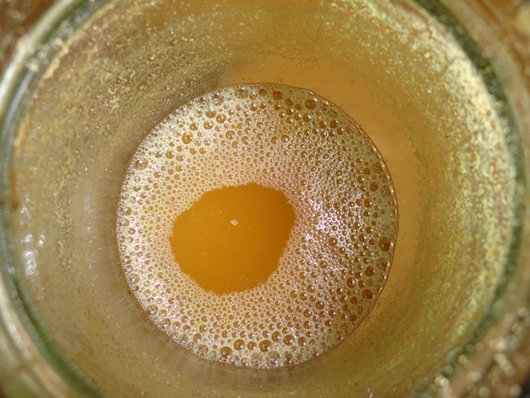
We had a nice supply of ginger beer going over Christmas. It's a delicious soft drink for young and old, although there is an alcoholic version that can be made with a slight variation on the recipe. Ginger beer is a naturally fermented drink that is easy to make - with ginger beer you make a starter called a ginger beer plant and after it has fermented, you add that to sweet water and lemon juice. Like sourdough, it must ferment to give it that sharp fizz. To make a ginger beer plant you'll need ginger - either the powdered dry variety or fresh ginger, sugar, rainwater or tap water that has stood for 24 hours to allow the chlorine to evaporate off. You'll also need clean plastic bottles that have been scrubbed with soap, hot water and a bottle brush and then rinsed with hot water. I never sterilise my bottles and I haven't had any problems. If you intend to keep the ginger beer for a long time, I'd suggest you sterilise your bottles. MAKING THE STARTER In a...
Image

NOT the last post

This will be my last post here.  I've been writing my blog for 18 years and now is the time to step back. I’ve stopped writing the blog and come back a couple of times because so many people wanted it, but that won’t happen again, I won’t be back.  I’ll continue on instagram to remain connected but I don’t know how frequent that will be. I know some of you will be interested to know the blog's statistics. 
Image

How to make cold process soap

I'm sure many of you are wondering: "Why make soap when I can buy it cheaply at the supermarket?" My cold process soap is made with vegetable oils and when it is made and cured, it contains no harsh chemicals or dyes. Often commercial soap is made with tallow (animal fat) and contains synthetic fragrance and dye and retains almost no glycerin. Glycerin is a natural emollient that helps with the lather and moisturises the skin. The makers of commercial soaps extract the glycerin and sell it as a separate product as it's more valuable than the soap. Then they add chemicals to make the soap lather. Crazy. Making your own soap allows you to add whatever you want to add. If you want a plain and pure soap, as I do, you can have that, or you can start with the plain soap and add colour, herbs and fragrance. The choice is yours. I want to add a little about animal and bird fat. I know Kirsty makes her soap with duck fat and I think that's great. I think t...
Image

Preserving food in a traditional way - pickling beetroot

I've had a number of emails from readers who want to start preserving food in jars but don't know where to start or what equipment to buy.  Leading on from yesterday's post, let's just say up front - don't buy any equipment. Once you know what you're doing and that you enjoy preserving, then you can decide whether or not to buy extra equipment. Food is preserved effectively without refrigeration by a variety of different methods. A few of the traditional methods are drying, fermentation, smoking, salting or by adding vinegar and sugar to the food - pickling. This last method is what we're talking about today. Vinegar and sugar are natural preservatives and adding one or both to food sets up an environment that bacteria and yeasts can't grow in. If you make the vinegar and sugar mix palatable, you can put up jars of vegetables or fruit that enhance the flavour of the food and can be stored in a cupboard or fridge for months. Other traditional w...
Image

Cleaning mould from walls and fabrics

With all this rain around we've developed a mould problem in our home. Usually we have the front and back doors open and that good ventilation stops most moulds from establishing. However, with the house locked up for the past week, the high humidity and the rain, mould is now growing on the wooden walls near our front door and on the lower parts of cupboards in the kitchen. Most of us will find mould growing in our homes at some point. Either in the bathroom or, in humid climates, on the walls, like we have now. You'll need a safe and effective remedy at some point, so I hope one of these methods works well for you. Mould is not only ugly to look at, it can cause health problems so if you see mould growing, do something about it straight away. The longer you leave the problem, the harder it will be to get rid of it effectively. If you have asthma or any allergies, you should do this type of cleaning with a face mask on so you don't breathe in any spores. Many peopl...
Image

Five minute bread

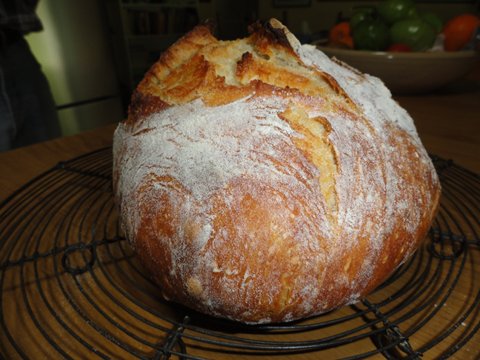
Bread is one of those foods that, when made with your own hands, gives a great deal of satisfaction and delight. It's only flour and water but it symbolises so much. I bake bread most days and use a variety of flours that I buy in bulk. Often I make a sandwich loaf because we use most of our bread for lunchtime sandwiches and for toast. Every so often I branch out to make a different type of loaf. I have tried sour dough in the past but I've not been happy with any of them. I'll continue to experiment with sour dough because I like the idea of using wild yeasts and saving the starter over a number of years to develop the flavour and become a part of the family. However, the loaf I've been branching out to most often is just a plain old five minute bread. By five minutes I mean it takes about five minutes actual work to prepare but it's the easiest of all bread to make and to get consistently good loaves from. If you're having people around for lunch or...
Image

This is my last post.

I have known for a while that this post was coming, but I didn't know when. This is my last post. I'm closing my blog, for good, and I'm not coming back like I have in the past.  I've been writing here for 16 years and my blog has been many things to me. It helped me change my life, it introduced me to so many good people, it became a wonderful record of my family life, it helped me get a book contract with Penguin, and monthly columns with The Australian Women's Weekly and Burke's Backyard . But in the past few months, it's become a burden. In April, I'll be 75 years old and I hope I've got another ten years ahead. However, each year I'll probably get weaker and although I'm fairly healthy, I do have a benign brain tumour and that could start growing. There are so many things I want to do and with time running out, leaving the blog behind gives me time to do the things that give me pleasure. On the day the blog started I felt a wonderful, h...
Image

What is the role of the homemaker in later years?

An email came from a US reader, Abby, who asked about being a homemaker in later years. This is part of what she wrote: "I am a stay-at-home mum to 4 children, ages 9-16. I do have a variety of "odd jobs" that I enjoy - I run a small "before-school" morning drop-off daycare from my home, I am a writing tutor, and I work a few hours a week at a local children's bookstore. But mostly, I cherish my blissful days at home - cooking, cleaning (with homemade cleaners), taking care of our children and chickens and goats, baking, meal-planning, etc. This "career" at home is not at all what I imagined during my ambitious years at university, but it is far more enriching. I notice, though, that my day is often planned around the needs of my family members. Of course, with 4 active kids and a husband, this is natural. I do the shopping, plan my meals, cook dinner - generally in anticipation of my family reconnecting in the evening.  I can't h...
Image

Every morning at home

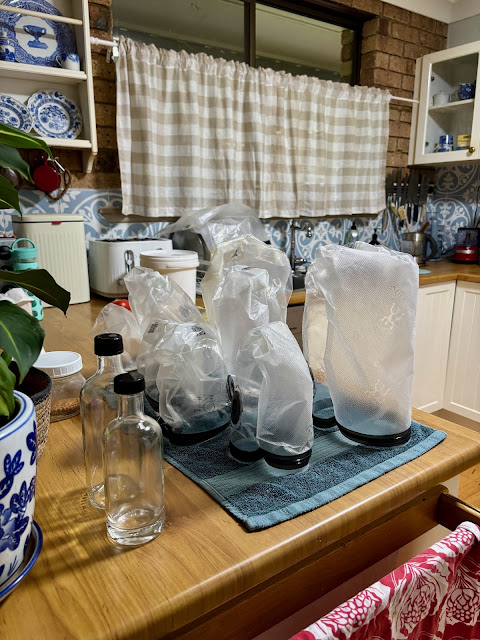
Every morning when I walk into my kitchen it looks tidy and ready for a day's work. Not so on this morning (above), I saw this when I walked in. Late the previous afternoon when I was looking for something, I came across my rolled up Zwilling vacuum bags and decided they had to be washed and dried. So I did that and although I usually put them outside on the verandah to dry it was dark by then. I turned the just-washed bags inside out and left them like this on a towel. It worked well and now the bags are ready to use when I bring home root vegetables, cabbages or whatever I buy that I want to last four or five weeks.
Image

You’ll save money by going back to basics

When I was doing the workshops and solo sessions, I had a couple of people whose main focus was on creating the fastest way to set up a simple life. You can't create a simple life fast, it's the opposite of that It's not one single thing either - it's a number of smaller, simpler activities that combine to create a life that reflects your values; and that takes a long to come together. When I first started living simply I took an entire year to work out our food - buying it, storing it, cooking it, preserving, baking, freezing, and growing it in the backyard. This is change that will transform how you live and it can't be rushed.  
Image


Trending Articles

NOT the last post

This will be my last post here.  I've been writing my blog for 18 years and now is the time to step back. I’ve stopped writing the blog and come back a couple of times because so many people wanted it, but that won’t happen again, I won’t be back.  I’ll continue on instagram to remain connected but I don’t know how frequent that will be. I know some of you will be interested to know the blog's statistics. 
Image

Every morning at home

Every morning when I walk into my kitchen it looks tidy and ready for a day's work. Not so on this morning (above), I saw this when I walked in. Late the previous afternoon when I was looking for something, I came across my rolled up Zwilling vacuum bags and decided they had to be washed and dried. So I did that and although I usually put them outside on the verandah to dry it was dark by then. I turned the just-washed bags inside out and left them like this on a towel. It worked well and now the bags are ready to use when I bring home root vegetables, cabbages or whatever I buy that I want to last four or five weeks.
Image

You’ll save money by going back to basics

When I was doing the workshops and solo sessions, I had a couple of people whose main focus was on creating the fastest way to set up a simple life. You can't create a simple life fast, it's the opposite of that It's not one single thing either - it's a number of smaller, simpler activities that combine to create a life that reflects your values; and that takes a long to come together. When I first started living simply I took an entire year to work out our food - buying it, storing it, cooking it, preserving, baking, freezing, and growing it in the backyard. This is change that will transform how you live and it can't be rushed.  
Image

Creating a home you'll love forever

Living simply is the answer to just about everything. It reduces the cost of living; it keeps you focused on being careful with resources such as water and electricity; it reminds you to not waste food; it encourages you to store food so you don't waste it and doing all those things brings routine and rhythm to your daily life. Consciously connecting every day with the activities and tasks that create simple life reminds you to look for the meaning and beauty that normal daily life holds.  It's all there in your home if you look for it. Seemingly mundane tasks like cleaning and cooking help you with that connection for without those tasks, the home you want to live in won't exist in the way you want it to.  Creating a home you love will make you happy and satisfied.
Image

Time changes everything

I've been spending time in the backyard lately creating a contained herb and vegetable garden. My aim is to develop a comfortable place to spend time, relax, increase biodiversity and encourage more animals, birds and insects to live here or visit. Of course I'd prefer my old garden which was put together by Hanno with ease and German precision. Together, we created a space bursting at the seams with herbs, vegetables and fruity goodness ready to eat and share throughout the year. But time changes everything. What I'm planning on doing now, is a brilliant opportunity for an almost 80 year old with balance issues. In my new garden I'll be able to do a wide range of challenging or easy work, depending on how I feel each day. It’s a daily opportunity to push myself or sit back, watch what's happening around me and be captivated by memories or the scope of what's yet to come.
Image

It's the old ways I love the most

I'm a practical woman who lives in a 1980’s brick slab house. There are verandahs front and back so I have places to sit outside when it's hot or cold. Those verandahs tend to make the house darker than it would be but they're been a great investment over time because they made the house more liveable. My home is not a romantic cottage, nor a minimalist modern home, it's a 1980’s brick slab house. And yet when people visit me here they tell me how warm and cosy my home is and that they feel comforted by being here. I've thought about that over the years and I'm convinced now that the style of a home isn't what appeals to people. What they love is the feeling within that home and whether it's nurturing the people who live there.
Image

Making ginger beer from scratch

We had a nice supply of ginger beer going over Christmas. It's a delicious soft drink for young and old, although there is an alcoholic version that can be made with a slight variation on the recipe. Ginger beer is a naturally fermented drink that is easy to make - with ginger beer you make a starter called a ginger beer plant and after it has fermented, you add that to sweet water and lemon juice. Like sourdough, it must ferment to give it that sharp fizz. To make a ginger beer plant you'll need ginger - either the powdered dry variety or fresh ginger, sugar, rainwater or tap water that has stood for 24 hours to allow the chlorine to evaporate off. You'll also need clean plastic bottles that have been scrubbed with soap, hot water and a bottle brush and then rinsed with hot water. I never sterilise my bottles and I haven't had any problems. If you intend to keep the ginger beer for a long time, I'd suggest you sterilise your bottles. MAKING THE STARTER In a...
Image

An authentic look at daily life here — unstaged and real

Most days Hanno was outside happily working in the fresh air. It may surprise you to know that I started reading my book,  Down to Earth , yesterday - the first time since I wrote it 13 years ago.  I had lent it to my neighbor, and when she returned it, I started reading, expecting to find surprises. Instead, I realised the words were still familiar—as if they were etched into my memory. As I flipped through the pages, I was reminded of how important it was for me to share that knowledge with others. The principles in Down to Earth changed my life, and I truly believed they could do the same for others. After just 30 minutes of reading, I put the book down, reassured that its message still holds true: we can slow down and reshape our lives, one step at a time.
Image