down to earth

  • Home
  • About Us
  • Down To Earth Book
  • Privacy Policy
There have been quite a few questions over the past two dairy days so I'll use this post to answer them. I hope you try making these dairy products. They are very tasty, they're cheaper than the store bought products and you'll help keep old skills alive, particularly if you pass on what you know.

Sueellen wrote: Will have a go at the yoghurt but am curious to know if you have posted a recipie for sour cream. My thoughts are that you would need only to sour some fresh cream with lemon juice or vinegar but I might be completely wrong.

Sueallen, sour cream is easy to make at home but I don't think I've posted about it before. If you make this on a day when you've used the oven, you can use the residual heat in the oven to make the sour cream. Get yourself a 750ml mason jar, or glass container with a lid, add ½ cup of room temperature cultured buttermilk and two cups of room temperature cream and stir thoroughly. Wrap the jar in a towel and place it in the warm oven, leave it for 24 hours. Then you have your sour cream.

Attila, you can reserve some of this yoghurt to make your next batch. Every so often, you'll need to buy a new batch of yoghurt as a fresh starter.

Allison wrote: Reading this now I did not cover my jars with a lid so maybe that was my issue. I did cover it with a coffee filter to keep things out of the jar.

Allison: you must put the lid on to hold in the heat. Yoghurt needs a constant low warm temperature for the bacteria to multiply. Try it again with the lid on. Don't overheat the milk once the yoghurt is in it as that will kill the culture, but it does need constant warmth.

Reyna wrote: I would like to freeze some yoghurt to use in place of icecream for smoothies. Is there a special way of doing that, or do you just freeze, stir, freeze, stir etc like you do icecream??

Reyna, that way would certainly work well, or you could use an icecream maker, but I would do it another way. As the frozen yoghurt will be going into smoothies, I'd just freeze shallow covered trays of yoghurt. You will get a few ice crystals but it will be blended in with other ingredients, so that won't matter. It will be much less work this way.

Kristin, adding a lot of starter yoghurt - a full cup, and the extra powdered milk, is the key to making thick yoghurt.

white lilly wrote: I was wondering what the difference would be if the store bought yoghurt has gelatine added. Because the yoghurt I made with using store bought yoghurt was a bit what you call slimmy. Could this be caused by gelatine or something else.

white lilly: gelatine in the starter yoghurt will inhibit the whey separating from the curds and if you're going to make cheese from the yoghurt, that is a problem. If you use starter yoghurt containing gelatine it will take the yoghurt longer to firm up, and if you use the yoghurt before it's finished maybe that felt "slimey". You'd be much better off using a starter yoghurt that is "natural" with its beneficial bacteria added, but with as few extra additives as possible.

Anna wrote: My latest batch of yoghurt didn't work right, so I had to throw it away - smelt and tasted like squashed ants - blechh. I'm interested to see that people add milk powder to their mix, I'll have to try that. I don't think I'm keeping the mix warm enough either, will have to try the esky technique!

Anna: when you make the yoghurt keep it at a consistent warm temperature. You also need to use sterilised jars as the introduction of any other bacteria will inhibit the growth of the beneficial bacteria.

mecathie: yes, you can use any type of milk.

meagan wrote: A week went by and I still had the whey in the fridge but I was afraid it had gone off so I threw it out. How long does whey last before you should use it?

Meagan: If kept in the fridge in a pre-sterilsed bottle or jar, whey should last about 3-4 weeks. If it starts going off you'll notice mould forming on the top.

Lors, a Greek starter yoghurt always makes a delicious thick yoghurt. I'm pleased you tried it.

Barbara: people from many countries have their own version of fresh yoghurt or buttermilk cheese. Germans calls theirs quark, but there are many versions and names.

Shan wrote: In the end of your post it says something like 'It won't last longer than that in the freezer". I'm assuming that you meant 'will'? I'm not sure though b/c I haven't put any dairy products in the freezer except ice cream ;) So I wanted to check to see? Also what is UHT?

Shan,
I meant "won't last longer than that". Ricotta needs to be eaten fresh. It will last a couple of days in the fridge and maybe a week or 10 days in the freezer. After that it will be tasteless and, if over frozen, like rubber. You can easily freeze milk and cream and then defrost them in the fridge when you're ready to use them. UHT stands for ultra high temperature. This milk is sterilised by being super heated. That is why it can sit on a shelf for many months without going off.

Yesterday we had a 500gram/16oz tub of yoghurt that cost $3.50 and turned it into two litres/quarts of yoghurt that cost about $4. One litre/quart of that was eaten as yoghurt - with one cup reserved to make the next batch, the other litre/quart was made into quark cheese. Quark is a simple fresh cheese that doesn't require any special equipment and will be ready for eating as soon a you finish making it.


Above is quark made on the weekend. I added finely chopped cucumbers that had been salted and allowed to drain for an hour, pepper and topped it with a sprinkling of paprika.

This is an extract from a post I wrote a long time about about making quark.

QUARK
When you have your yoghurt made and you want to make quark, you need a large jug, a strainer and a piece of clean cotton cloth. Wash the cloth with pure soap, rinse well and wring it out so it's not dripping wet. Place the strainer in the jug and the cloth over the strainer. Then add the yoghurt.

Cover the yoghurt with the cloth, so the mix is entirely covered.


Put a plate on top and and weigh the plate down with something fairly heavy. I have used a pot of jam. The process of making quark involves removing the water (whey) from the yoghurt. You do that by sitting the yoghurt in the strainer, in the fridge, weighed down so the whey can drain from the yoghurt into the jug.

To get a suitable dry quark, you'll need to allow it to drain for at least 24 hours, possibly 48 hours. When you think it's able to be moulded into a cheese shape, remove the quark from the strainer, pack it into a mould and then turn it out onto a plate.

The quark below is an old photo of quark I made a few months ago. The savory quark was made by adding salt and pepper to taste to the finished quark and adding some chopped chives. You could also add chilli or chilli sauce over the top of the quark.

This sweet quark below was sweetened with a little honey and then I added a small amount of homemade strawberry jam to the top of the quark.


Whey is a by-product of quark. It is the fluid part of the yoghurt that is full of live lactobacillus acidophilus and is very good for you. You can use whey in a number of ways, don't throw it away. (<- Nice sentence there.) Whey makes a nice drink, you can drink it as is or when it is cold. It could also be added to smoothies. It is an excellent replacement for milk in any baking you might be doing. Whey will give you a great result in cakes, scones or biscuits. It can be added to sauerkraut, relish or pickles to add live culture to those foods.

This is the amount of whey I got from one litre/quart of yoghurt.

You can also use it to make ricotta. You need an awful lot of whey to make ricotta. It takes the whey from 5 gallons of milk to make 1 kilo/2 pounds of ricotta, so I use the small amount of whey I usually have in another way. BTW, if you want to make ricotta and you have such a quantity of whey, go here to find out how to do it.

RICOTTA
1 litre/quart milk - can be fresh cow's, powdered, UHT or goat's milk
2 tablespoons lemon juice or cider vinegar
whey

If you want to use the ricotta for a dessert, you may like to add one cup of cream for a creamier ricotta.


The finished ricotta.

Place all ingredients in a heavy bottom saucepan and heat up to simmering point. Don't boil it and don't allow it to burn. Stir to prevent scalding the milk. Soon after you add the acid (lemon/vinegar) you will notice the curds separate from the whey.


When you notice small bubbles form it's hot enough. Turn off the heat and let it sit in the saucepan for 30 minutes.

Prepare a strainer with an open weave cotton cloth in it, in the same way you did when making quark. Place the strainer over a large jug with the cloth in the strainer. Take a slotted spoon and add the curds to the strainer and allow the whey to drain into the jug. This will take a few hours for a dry ricotta and maybe one hour for a smooth creamy ricotta suitable for dessert. When it's drained enough, wind the top of the cloth around so you can give it one last squeeze, then the ricotta is ready for use. I used mine in lasagna. It freezes well so you could wrap it in plastic wrap and freeze it or store in the fridge for a day or two. It won't keep longer than that in the freezer.


The leftover whey doesn't contain much protein now, but you could still use it in baking. I give it to the chooks as an extra treat - we soak old bread in the whey and the chooks love it.

I hope you try these cheeses. They will be a healthy addition to your kitchen and another way you can be a self reliant cook. Don't forget that you can use any milk from fresh raw milk to UHT milk. Often that decision is made for you because you have to use the cheapest option. The raw milk will be live and the UHT will be sterile but you will still get good cheese no matter what you use.

There are many little cost cutting measures you can take in a frugal home. Most of them, when you see them as an isolated unit, look too insignificant to bother about, but add them all up and you'll make good savings. Saving grocery money is an important goal for most homemakers; it means paying off more debt and all the good things that come from that. So being able to make two cups of yoghurt into two litres/quarts might seem small, but it will save you money and learning how to do it adds to your skill base, and that, my friends, is important.

Live food can multiply, it's one of its numerous benefits. I know many of you use yoghurt to make new yoghurt but there are many new readers here and quite a few young homemakers so I would like to revisit how to make yoghurt at home. I encourage you to add your method of making yoghurt in your comment. My way will not suit everyone and you may encourage someone to learn this skill.


You can do this two ways - either buy a powdered yoghurt starter or just a tub of natural yoghurt. The yoghurt must be natural with no gelatin added. I bought the best yoghurt in my area - Maleny Natural, a cows milk yoghurt that has won gold medals at both the Sydney Royal and the Ekka shows. It cost $3.50 for a 500 gram/16 oz tub. Check the use by date and get the freshest yoghurt you can find. This is important you need live beneficial bacteria for this to work. You could also use sheep or goat yoghurt as a starter as long as it contains a live culture and it's unflavoured with no gelatin. Remember, starting with fresh ingredients of the best quality you can afford and find will give you the best yoghurt.

The cheapest way to make this up is to use powdered milk but you can also use milk from the supermarket, raw cow's milk or soy, goat or sheep milk. You could also use UHT milk and if you do, you don't have to almost boil the milk at the start - this milk is sterile. To make up the powdered milk you'll need just under one litre/quart water and the recommended amount of milk powder to make up whole milk, and about ¼ cup extra of powdered milk.

You'll need a 1 litre/quart mason jar or some other sealable container, a saucepan and a towel.

Make up the powdered milk in the saucepan, or if you're using fresh milk, add it to the saucepan over heat. Heat the milk until you see tiny bubbles start to form at the edges, then remove from the heat. This process will kill off any harmful bacteria that would spoil the yoghurt. Pour the milk into a pre-sterilised mason jar. You can sterilise the jar by pouring boiling water into it or putting it into a warm oven for 20 minutes. Be careful to keep everything clean as you don't want to contaminate the milk, utensils or jar once you've started .


This is the finished yoghurt.

Let the milk cool but don't let it go cold. When the milk has reached the point where you can put your hands around the jar without it burning you, it's time to add your yoghurt. Add about a cup full of yoghurt and the extra ¼ cup of powdered milk - this will give you a thicker yoghurt. Then seal the jar and wrap it in a towel. Put it into a warm (not hot) oven, that is turned off, and leave it there, without opening the door for about 12 hours. When you open it again, you'll have yoghurt.


You can flavour the yoghurt with jam, honey and vanilla, maple syrup or stewed fruit. If you want to add fresh fruit, add it just before you eat it. I put my yoghurt into smaller jars for sweetening - one here is raw honey and vanilla, the other is homemade rosella jam. Store it in the fridge, it will keep for about three weeks. Tomorrow we'll go on to a couple of things you can make with the unflavoured yoghurt.

You can buy yoghurt starter in Australia here and here or in the US/Canada here and here, if you're in another country, Google "yoghurt/yogurt starter UK" or whatever your country is.
We had a peaceful weekend, didn't do much but potter around the house, I worked on the forum quite a bit, tweaking and reading the manual, while Hanno did some gardening and tidying up outside. There are always tasks waiting to be done in a simplified home and here it's no different.


Hanno pulled out the last of the winter kale and planted up dwarf bean seedlings in their place. They're nicely protected with straw mulch and will soon be joined by corn seedlings that are not quite ready to plant yet. A storm during the week gave us a bit of water in the tanks so some of that stored water was used on the garden, but we still need good rain to soak deep into the soil and fill the tanks. This is often the driest time of the year for us, late Autumn, but when the monsoon arrives and the rains start in November, everyone breathes a sigh of relief that we have water again. Of course, with climate change, we can't rely now on those once dependable patterns. So, for now, we're hoping that rain will fall and the storms won't cause too much damage this year.


Spring time always makes the chooks broody and at the moment we have five hens eager to become mothers. There are four on the nests and Lucy, our Old English Game hen, has taken it upon herself to separate from the flock and make her own nest. She has been missing for a few days but Hanno found her yesterday, with a nest of five eggs. She's in trouble though, she's been eating the next door neighbour's lettuces so she'd better watch herself.


Back inside the house, I made bread - yeasted rolls one day and sour dough the other. I keep persisting with sour dough because I want to make bread without yeast but every time I make it, it disappoints. I have tried several recipes so I guess I just don't have the knack or taste for it, so for now, I'm sticking with my yeast bread. I made heavy grain rolls on the weekend but I flitter between grain flour to rye to unbleached organic white. We like the variety and they usually turn out very well.


While I was in the kitchen I also made yoghurt, ricotta, quark (more on them later in the week) and muesli. This is a new muesli recipe that I just made up of things I like to eat. I just mixed together some oats, moist coconut, dried apricots and cranberries, lecithin granules and LSA mix, which is a mixture of crushed linseeds, sunflower seeds and flaked almonds. It's delicious. I think next time I make it, I'll leave the oats out of the mix so I can soak them overnight and add them just before breakfast. If you soak your muesli, how do you do it?


Over the weekend I also worked on two aprons, did some stitching, knitting and started making a tea cosy for a Christmas gift. I still haven't made room for, or used, the overlocker/serger given to me recently. I'll have to get to it soon because I will need it for a couple of projects I'm working on now. And what would the weekend be without phone calls to my family. I spoke with my sister Tricia and Shane, Sarndra and Kerry on the phone and Jens came over to help Hanno move tree branches and garden waste to the dump.


I would like to do a crochet-along over at the forum and need an experienced crocheter to help me. The project is a milk jug cover that I have the pattern for, so if you have the time and would like to help, please let me know.


Another week starts today and I am looking forward to it. There are so many things to do each day, it's a pleasure to get up early and get stuck into it. I have a work meeting tonight and work Tuesday and Wednesday. As we get closer to our move, it gets busier there, it will soon be time to organise the move and pack up again. I am really enjoying the forum and getting to know the members, and working on my gifts for Christmas. Each day is full of satisfying work that fills my soul and makes me sleep well at night. I hope you had a restful weekend and that the week ahead will be a good one for all of us.


I want to say a special thank you to Leigh at Blog Chicks who helped me set up the new forum last week. She basically did the whole installation and advised me what to do along the way. It was a complicated process and without her help I would either have had to pay someone to do it or struggled with it for a long time.

I have never met Leigh. I came across her site when I was added to the top Australian women bloggers list, which she compiles. Then I found Blog Chicks, her forum for chicks who blog, like me. :- ) The forum is friendly and you can ask questions about blogging or troubleshoot there if you're having a problem with your blog. The forum is there to support and encourage blogging.

So this woman, whom I had never met, offered to help me after I slipped in a question about forums into a forum about blogging. I didn't know then that the support I would get from Leigh would be so gracious and generous, but true to the nature of her site, she encouraged and supported. I like that, a woman who not only talks the talk but also walks the walk.

If you have a blog, click here, drop by and register, you never know when you too will need help. Thanks Leigh.
I had a question from a reader the other day regarding cleaning soap making utensils and equipment. She wanted to know if it was okay to wash the soap making equipment and use it for other kitchen tasks that involve food. If you thoroughly wash all your utensils and equipment it is fine to use it all for other food making tasks. However, if you use a wooden spoon for soap making, you should dedicate that spoon to that task and store it with your soap making ingredients, rather than keep it in the kitchen. Wooden spoons are porous and might absorb some of the caustic elements of the soap making process and, if left to sit in a pot of stew, might contaminate the stew. I didn't read that anywhere, I thought of it myself.


So when you go to wash your plastic, glass and metal utensils, use your common sense, think about all the cracks and crevices that might hide soap. Soak them in the sink for a while then get a brush and scrub all the areas that might hold soap, or put it all in the dishwasher. When they're thoroughly clean, they're ready for your kitchen tasks. I know there is advice out there that says have a separate set of everything for soap making, but why?

We used to be a society that followed in the footprints of our parents. We had mothers and fathers who set the rules, were role models for their children and who taught by example. Sadly, that is not so common now. Often young people have to ask these questions because they have never seen, first hand, a lot of the things they want to do, like soap making, and they don't trust their own judgement to think it thorough themselves.


Common sense has a role to play in almost everything we do on a daily basis and yet many people don't trust themselves to make safe and sensible decisions. I have often wondered about that and I think it's because many decisions aren't ours to make any more. We are over protected. We have governments and local councils who make rules and regulations about such a wide variety of things, and corporations whose products line our shelves, that we don't really have to think about our own circumstances; we know there is a rule for it or a product we can buy.


I guess that is fine if you want to live a sheltered life, but I don't. I have decided to step outside what is "normal" for my class and age and I want to rely on myself more and others less. Now let me first say that I am not advocating anarchy or even civil disobedience, I am merely saying that I make my own decisions and, if there are any consequences for a wrong decision, I suffer that, and make sure I don't make the same mistake again. I am horrified when I see councils and governments setting regulations and making laws about all manner of things. You can't legislate against stupidity, they should have public awareness campaigns about taking responsibility for ourselves and reviving common sense.

One of the problems is that often we don't even know we are making a decision. For instance, if you buy those antiseptic kitchen wipes, and you haven't thought of the consequences of that, you will be wiping out the normal yeasts and bacteria that should be in your home. Yes, you will get rid of the bad bacteria, but those wipes don't discriminate, they wipe everything out, and then you wonder why you can't make ginger beer, sauerkraut or sour dough. Soap and water, or even a few drops of tea tree oil if you have a bad problem, will get rid of most bugs - the wipes used on a daily basis are overkill.


There are many examples I could come up with but let me just say that your life is the sum total of all the decisions you make, allowing someone else to make too many of those decisions for you will result in a one size fits all society that I don't want to be a part of. All the young mums out there pregnant with their first baby. I know you want to do the best for your child, but the best doesn't necessarily involve buying all the products you see out there. Think about the consequences of those buying decisions, both for yourself and your baby. Making more and buying less will not only put you in a better financial position it will also give your baby a greener future. Instead of being guided by advertising, be guided by your mother or your local mothers' group.

I love variety, change and difference and that is not a bad thing - you have seen how I live, I am not a radical, I am just advocating that you question, be sceptical, and decide for yourself. And even these words I'm offering to you now, you should question what I say, make sure it suits you and if it doesn't, keep doing what you're doing. But if you question, use your common sense and make decisions based on self reflection, consideration of consequences and how you want to live, you will make a life unlike any other.


I mean no disrespect highlighting this soap making question. I actually do understand why it was asked - skills are not being passed on, and being multi-skilled develops self confidence. But I hope to use the opportunity to highlight what I see as an underlying problem of mass dependence on needing, and sometimes wanting, others to think for us. There is a lot to be said for taking responsibility for one's self, questioning the way things are done and making your own way. My way might not be the right way for everyone else, but it suits me fine and it is like that because I think about my decisions, ignore rules that don't make sense to me and use my common sense. And that, my friends, has made all the difference.


Chances are you've come across recipes for meatballs in tomato sauce but I'm going to recommend mine to you because it's one of those that is perfect for us stockpilers - it uses items from the freezer, garden, pantry and stockpile cupboard.


The trick to this dish, and most other meat dishes, is to develop flavour in the meat by caramelising the sugars when you fry it. Caramelising is the process where you add a little oil to the frying pan, add the meat balls and let them fry to a brown stage without burning. The brownness that develops during that stage adds a huge amount of flavour to the final dish. Adding uncooked meatballs to a sauce will not give you the fine flavour that caramelising will. As most of you know, I cook from scratch and don't add bouillon cubes, stock powder, soup mixes or pre-cooked sauces. I prefer to develop the flavour already in the ingredients to build up in stages as I go. The result is a wholesome meal full of flavour but with no preservative or artificial flavours added.


MEATBALLS IN TOMATO SAUCE

Meatballs
750 grams (2 pounds) minced beef (ground beef)
1 large onion
herbs - I used parsley, oregano, bay and marjoram. You could also use chives, chilli, thyme or basil.
4 slices of old bread
2 eggs
¼ cup milk
salt and pepper

Sauce
1 large onion, chopped
2 cloves garlic, crushed
whatever herbs you used in the meatballs, add here too, finely chopped.
several leaves of silverbeet or spinach, chopped
2 bay leaves
2 tablespoons tomato paste
1 tin tomatoes - or your home canned tomatoes, about 2 cups
1 teaspoon sugar
salt and pepper

Method
Soak the old bread in the beaten eggs and milk. Finely chop the onion and herbs. I do this in a little processor so it's very fine. These are very small meatballs so your ingredients need to be very finely chopped. Add the meat to a bowl and add the soaked bread, leaving the rest of the egg mixture to one side. Add the chopped onion and herbs and mix with your clean hands. Add salt and pepper to taste. Whatever egg mixture is left over, add now and mix in so the meat and the other ingredients are thoroughly combined. Wash your hands, then with wet hands, form the meat into little balls.


Heat up your frying pan, add a small amount of oil and when the pan is hot, add the meatballs. Turn the balls so that all sides are able to brown. When the meatballs are brown all over, remove them from the pan to a plate and keep them to one side.


To make the sauce:
Use the same pan you fried the meat in. Add the chopped onion and garlic and stir while it cooks. Be careful as the garlic can burn. If it does it will add a bitter taste to you meal. When the onion is soft, add the tomato paste and stir in. Cook for two minute to get the raw taste out of the tomato paste. Add the tomatoes, chopped silverbeet/spinach and herbs and stir. Add salt and pepper to taste and the teaspoon of sugar. The sugar takes the acid taste off the tomatoes. If you're using your own home grown tomatoes, you probably don't need the sugar. Bring the sauce to the boil, then turn the heat right down to a simmer. Add the meatballs and continue cooking, very slowly, for 20 minutes.


Serve with pasta and a garden salad.


This amount is enough for at least two meals for Hanno and I, with a lunch for me to take to work. It can be frozen for a couple of months or whatever your freezer's recommendation is for processed meats or sausages.

I was going to answer a question about cleaning my soap making utensils and using them for other tasks. I have some thoughts that go along nicely with that topic, so I'll write a post about it all tomorrow.

I'll check those registrations now for the members who had trouble registering yesterday. So far we haven't had many problems with the registering and it's much easier than the other forum. The moderators have worked very hard to bring over as many of the old threads as they could manage but we're also keeping the old forum as an archive you can dip into. All the signs indicate that this forum will be better than the old one, it's user friendly and many of the members are used to the format of VBulletin. When we are all settled in, there will be swaps, challenges, competitions and prizes in each of the sections. It's already a bustling community full of people eager to learn and pass on what they know. The atmosphere is calm and friendly and the threads are building up nicely. Over 300 people have signed up in the past 24 hours, why don't you join us?

We are waiting for rain to fall. Our tanks are empty. There was thunder and lightening last night but only about five minutes of rain. We are using town water on the vegetables to keep them growing and each time I do that I think that we should get another tank. I thought 15,000 litres/4,000 gallons would be enough for us, our annual rainfall is 1200mm/47 inches, but it is apparent that if we are to produce backyard food on an ongoing basis, we need to store more water for these times of drought.


Click on photos to enlarge them.

But despite our water shortage, the garden is growing well and producing some nice vegetables. At the moment we are growing cucumbers, potatoes, tomatoes, capsicums (peppers), leeks, lettuce, sunflowers, radishes, zucchini, bok choi, celery, silver beet, the last of the kale and cabbages, beetroot, wild rocket (arugula) carrots, corn, eggplant, Welsh onions, parsley, chives, oregano, curry plant, marjoram, yarrow, comfrey, thyme, bay and a selection of fruit.


It's the first time we've grown this variety of cucumber and we haven't eaten any yet but they look like real winners. I'm definitely going to save some of these seeds for future years, and for a seed box swap over at the forum.


The first of the eggplants. These are heirlooms, Black Beauty.


Tomatoes and lettuce, all we need is the bread.


Our constant companions - the chooks. This is Cocobelle, the grand matriarch of the flock, with Heather, our little feather-panted Faverolles. Chooks provide nitrogen in the form of their manure for the garden, they catch bugs we don't even see and they provide us with hours of entertainment.


I have just harvested about a kilo (2 pounds) of ginger and a small amount of turmeric. They're still outside because I haven't had time to do anything with them yet but the ginger will be used in cooking and for ginger beer and the turmeric will be used in curries and as a tea.


These sweet potatoes will be planted soon. I'll take photos when I plant them. Basically you just need a couple of sweet potatoes that have sent out shoots. Waiting for them to shoot is the hardest part, the rest is easy if you're in a warm climate.


These are follow up tomatoes, beans, silverbeet and those tiny spots on the back tray will be little daisies. I always plant flowers in the vegetable garden. They bring the bees in and provide some colour amidst all the green.


Every time I walk through our garden I remind myself how lucky we are to live were we do. With the call of the wild ducks and geese, a wall of rain forest to shelter us from wind and prying eyes and our vegetables to keep us going, there is no other place I'd rather be.

What are you growing this season?

Newer Posts Older Posts Home

Search here

Total Pageviews

Translate


I'm Rhonda Hetzel and I've been writing my Down to Earth blog since 2007. Although I write the occasional philosophical post, my main topics include home cooking, happiness and gardening as well as budgeting, baking, ageing, generosity, mending and handmade crafts. I hope you enjoy your time here.

MY FAVOURITE PLACES

  • Grandma Donna's Place
  • Grandma Donna's YouTube
  • Grandma Donna's Instagram
  • This Simple Day
  • Nicole's Instagram

Give More

Give More

Popular posts last year

Making ginger beer from scratch

We had a nice supply of ginger beer going over Christmas. It's a delicious soft drink for young and old, although there is an alcoholic version that can be made with a slight variation on the recipe. Ginger beer is a naturally fermented drink that is easy to make - with ginger beer you make a starter called a ginger beer plant and after it has fermented, you add that to sweet water and lemon juice. Like sourdough, it must ferment to give it that sharp fizz. To make a ginger beer plant you'll need ginger - either the powdered dry variety or fresh ginger, sugar, rainwater or tap water that has stood for 24 hours to allow the chlorine to evaporate off. You'll also need clean plastic bottles that have been scrubbed with soap, hot water and a bottle brush and then rinsed with hot water. I never sterilise my bottles and I haven't had any problems. If you intend to keep the ginger beer for a long time, I'd suggest you sterilise your bottles. MAKING THE STARTER In a...
Image

NOT the last post

This will be my last post here.  I've been writing my blog for 18 years and now is the time to step back. I’ve stopped writing the blog and come back a couple of times because so many people wanted it, but that won’t happen again, I won’t be back.  I’ll continue on instagram to remain connected but I don’t know how frequent that will be. I know some of you will be interested to know the blog's statistics. 
Image

How to make cold process soap

I'm sure many of you are wondering: "Why make soap when I can buy it cheaply at the supermarket?" My cold process soap is made with vegetable oils and when it is made and cured, it contains no harsh chemicals or dyes. Often commercial soap is made with tallow (animal fat) and contains synthetic fragrance and dye and retains almost no glycerin. Glycerin is a natural emollient that helps with the lather and moisturises the skin. The makers of commercial soaps extract the glycerin and sell it as a separate product as it's more valuable than the soap. Then they add chemicals to make the soap lather. Crazy. Making your own soap allows you to add whatever you want to add. If you want a plain and pure soap, as I do, you can have that, or you can start with the plain soap and add colour, herbs and fragrance. The choice is yours. I want to add a little about animal and bird fat. I know Kirsty makes her soap with duck fat and I think that's great. I think t...
Image

Preserving food in a traditional way - pickling beetroot

I've had a number of emails from readers who want to start preserving food in jars but don't know where to start or what equipment to buy.  Leading on from yesterday's post, let's just say up front - don't buy any equipment. Once you know what you're doing and that you enjoy preserving, then you can decide whether or not to buy extra equipment. Food is preserved effectively without refrigeration by a variety of different methods. A few of the traditional methods are drying, fermentation, smoking, salting or by adding vinegar and sugar to the food - pickling. This last method is what we're talking about today. Vinegar and sugar are natural preservatives and adding one or both to food sets up an environment that bacteria and yeasts can't grow in. If you make the vinegar and sugar mix palatable, you can put up jars of vegetables or fruit that enhance the flavour of the food and can be stored in a cupboard or fridge for months. Other traditional w...
Image

Cleaning mould from walls and fabrics

With all this rain around we've developed a mould problem in our home. Usually we have the front and back doors open and that good ventilation stops most moulds from establishing. However, with the house locked up for the past week, the high humidity and the rain, mould is now growing on the wooden walls near our front door and on the lower parts of cupboards in the kitchen. Most of us will find mould growing in our homes at some point. Either in the bathroom or, in humid climates, on the walls, like we have now. You'll need a safe and effective remedy at some point, so I hope one of these methods works well for you. Mould is not only ugly to look at, it can cause health problems so if you see mould growing, do something about it straight away. The longer you leave the problem, the harder it will be to get rid of it effectively. If you have asthma or any allergies, you should do this type of cleaning with a face mask on so you don't breathe in any spores. Many peopl...
Image

Five minute bread

Bread is one of those foods that, when made with your own hands, gives a great deal of satisfaction and delight. It's only flour and water but it symbolises so much. I bake bread most days and use a variety of flours that I buy in bulk. Often I make a sandwich loaf because we use most of our bread for lunchtime sandwiches and for toast. Every so often I branch out to make a different type of loaf. I have tried sour dough in the past but I've not been happy with any of them. I'll continue to experiment with sour dough because I like the idea of using wild yeasts and saving the starter over a number of years to develop the flavour and become a part of the family. However, the loaf I've been branching out to most often is just a plain old five minute bread. By five minutes I mean it takes about five minutes actual work to prepare but it's the easiest of all bread to make and to get consistently good loaves from. If you're having people around for lunch or...
Image

This is my last post.

I have known for a while that this post was coming, but I didn't know when. This is my last post. I'm closing my blog, for good, and I'm not coming back like I have in the past.  I've been writing here for 16 years and my blog has been many things to me. It helped me change my life, it introduced me to so many good people, it became a wonderful record of my family life, it helped me get a book contract with Penguin, and monthly columns with The Australian Women's Weekly and Burke's Backyard . But in the past few months, it's become a burden. In April, I'll be 75 years old and I hope I've got another ten years ahead. However, each year I'll probably get weaker and although I'm fairly healthy, I do have a benign brain tumour and that could start growing. There are so many things I want to do and with time running out, leaving the blog behind gives me time to do the things that give me pleasure. On the day the blog started I felt a wonderful, h...
Image

What is the role of the homemaker in later years?

An email came from a US reader, Abby, who asked about being a homemaker in later years. This is part of what she wrote: "I am a stay-at-home mum to 4 children, ages 9-16. I do have a variety of "odd jobs" that I enjoy - I run a small "before-school" morning drop-off daycare from my home, I am a writing tutor, and I work a few hours a week at a local children's bookstore. But mostly, I cherish my blissful days at home - cooking, cleaning (with homemade cleaners), taking care of our children and chickens and goats, baking, meal-planning, etc. This "career" at home is not at all what I imagined during my ambitious years at university, but it is far more enriching. I notice, though, that my day is often planned around the needs of my family members. Of course, with 4 active kids and a husband, this is natural. I do the shopping, plan my meals, cook dinner - generally in anticipation of my family reconnecting in the evening.  I can't h...
Image

Every morning at home

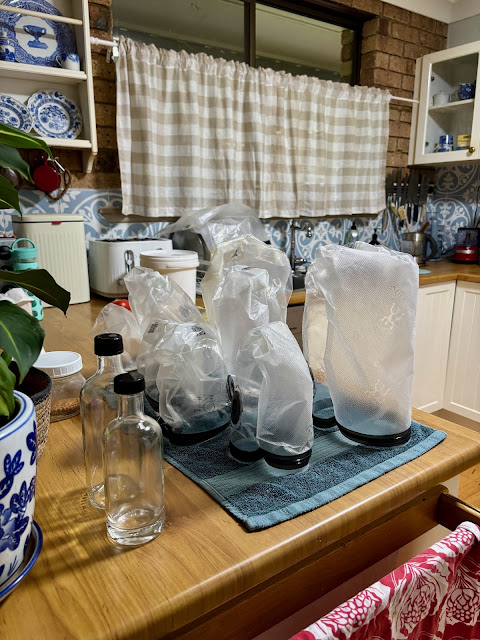
Every morning when I walk into my kitchen it looks tidy and ready for a day's work. Not so on this morning (above), I saw this when I walked in. Late the previous afternoon when I was looking for something, I came across my rolled up Zwilling vacuum bags and decided they had to be washed and dried. So I did that and although I usually put them outside on the verandah to dry it was dark by then. I turned the just-washed bags inside out and left them like this on a towel. It worked well and now the bags are ready to use when I bring home root vegetables, cabbages or whatever I buy that I want to last four or five weeks.
Image

You’ll save money by going back to basics

When I was doing the workshops and solo sessions, I had a couple of people whose main focus was on creating the fastest way to set up a simple life. You can't create a simple life fast, it's the opposite of that It's not one single thing either - it's a number of smaller, simpler activities that combine to create a life that reflects your values; and that takes a long to come together. When I first started living simply I took an entire year to work out our food - buying it, storing it, cooking it, preserving, baking, freezing, and growing it in the backyard. This is change that will transform how you live and it can't be rushed.  
Image


Trending Articles

NOT the last post

This will be my last post here.  I've been writing my blog for 18 years and now is the time to step back. I’ve stopped writing the blog and come back a couple of times because so many people wanted it, but that won’t happen again, I won’t be back.  I’ll continue on instagram to remain connected but I don’t know how frequent that will be. I know some of you will be interested to know the blog's statistics. 
Image

Every morning at home

Every morning when I walk into my kitchen it looks tidy and ready for a day's work. Not so on this morning (above), I saw this when I walked in. Late the previous afternoon when I was looking for something, I came across my rolled up Zwilling vacuum bags and decided they had to be washed and dried. So I did that and although I usually put them outside on the verandah to dry it was dark by then. I turned the just-washed bags inside out and left them like this on a towel. It worked well and now the bags are ready to use when I bring home root vegetables, cabbages or whatever I buy that I want to last four or five weeks.
Image

You’ll save money by going back to basics

When I was doing the workshops and solo sessions, I had a couple of people whose main focus was on creating the fastest way to set up a simple life. You can't create a simple life fast, it's the opposite of that It's not one single thing either - it's a number of smaller, simpler activities that combine to create a life that reflects your values; and that takes a long to come together. When I first started living simply I took an entire year to work out our food - buying it, storing it, cooking it, preserving, baking, freezing, and growing it in the backyard. This is change that will transform how you live and it can't be rushed.  
Image

Creating a home you'll love forever

Living simply is the answer to just about everything. It reduces the cost of living; it keeps you focused on being careful with resources such as water and electricity; it reminds you to not waste food; it encourages you to store food so you don't waste it and doing all those things brings routine and rhythm to your daily life. Consciously connecting every day with the activities and tasks that create simple life reminds you to look for the meaning and beauty that normal daily life holds.  It's all there in your home if you look for it. Seemingly mundane tasks like cleaning and cooking help you with that connection for without those tasks, the home you want to live in won't exist in the way you want it to.  Creating a home you love will make you happy and satisfied.
Image

Time changes everything

I've been spending time in the backyard lately creating a contained herb and vegetable garden. My aim is to develop a comfortable place to spend time, relax, increase biodiversity and encourage more animals, birds and insects to live here or visit. Of course I'd prefer my old garden which was put together by Hanno with ease and German precision. Together, we created a space bursting at the seams with herbs, vegetables and fruity goodness ready to eat and share throughout the year. But time changes everything. What I'm planning on doing now, is a brilliant opportunity for an almost 80 year old with balance issues. In my new garden I'll be able to do a wide range of challenging or easy work, depending on how I feel each day. It’s a daily opportunity to push myself or sit back, watch what's happening around me and be captivated by memories or the scope of what's yet to come.
Image

It's the old ways I love the most

I'm a practical woman who lives in a 1980’s brick slab house. There are verandahs front and back so I have places to sit outside when it's hot or cold. Those verandahs tend to make the house darker than it would be but they're been a great investment over time because they made the house more liveable. My home is not a romantic cottage, nor a minimalist modern home, it's a 1980’s brick slab house. And yet when people visit me here they tell me how warm and cosy my home is and that they feel comforted by being here. I've thought about that over the years and I'm convinced now that the style of a home isn't what appeals to people. What they love is the feeling within that home and whether it's nurturing the people who live there.
Image

Making ginger beer from scratch

We had a nice supply of ginger beer going over Christmas. It's a delicious soft drink for young and old, although there is an alcoholic version that can be made with a slight variation on the recipe. Ginger beer is a naturally fermented drink that is easy to make - with ginger beer you make a starter called a ginger beer plant and after it has fermented, you add that to sweet water and lemon juice. Like sourdough, it must ferment to give it that sharp fizz. To make a ginger beer plant you'll need ginger - either the powdered dry variety or fresh ginger, sugar, rainwater or tap water that has stood for 24 hours to allow the chlorine to evaporate off. You'll also need clean plastic bottles that have been scrubbed with soap, hot water and a bottle brush and then rinsed with hot water. I never sterilise my bottles and I haven't had any problems. If you intend to keep the ginger beer for a long time, I'd suggest you sterilise your bottles. MAKING THE STARTER In a...
Image

An authentic look at daily life here — unstaged and real

Most days Hanno was outside happily working in the fresh air. It may surprise you to know that I started reading my book,  Down to Earth , yesterday - the first time since I wrote it 13 years ago.  I had lent it to my neighbor, and when she returned it, I started reading, expecting to find surprises. Instead, I realised the words were still familiar—as if they were etched into my memory. As I flipped through the pages, I was reminded of how important it was for me to share that knowledge with others. The principles in Down to Earth changed my life, and I truly believed they could do the same for others. After just 30 minutes of reading, I put the book down, reassured that its message still holds true: we can slow down and reshape our lives, one step at a time.
Image