down to earth

  • Home
  • About Us
  • Down To Earth Book
  • Privacy Policy
Years ago, when I sat alone on my front veranda, thinking about how I could change my life to become the person I wanted to be, the thing that I knew above everything else was that I would have to develop a frugal mindset. Nothing could be achieved without that vital change. It was difficult at first because I too had that attitude that I worked hard and I deserved everything that was available to me. If I saw it in a shop, I believe there was no reason why I shouldn't have it. Hanno and I earned a lot of money but we still had credit card debt because the more we had, the more we wanted.


Now when I look back on it, I barely recognise that other "me". Now the way we live makes so much sense. We have everything we need. We understand now that joy and happiness aren't found in the vast shopping centres we all know, those precious qualities are found within. I don't shop now in the way I did then. I use to go shopping whenever I felt like it, and now I see shopping as a waste of time. I get more satisfaction creating what I need at home instead of buying it already made and inferior to my own home produce.

That frugal mindset is well and truly alive within me. When I see products now, I check them over for quality, often they lack it and I know that I can make it better myself. There is a group of foods that I will never buy again although we enjoy them and eat them frequently. Making them at home is easy, cheaper, greener and we get a better product.


One of those foods is fresh cheese. Fresh cheese are those cheeses that are cultured and are allowed to stand to drain off the whey. Quark, ricotta, Gruth, cream cheese and panir are all fresh cheese and can be made at home with no special equipment and just a little time. Most of the world's older societies developed their own fresh cheeses, they're all called something different, many are very similar and most are made with yoghurt, buttermilk or whey.

I often make a yoghurt cheese similar to the German Quark. Hanno loves it and it costs only a fraction of the store bought product, which satisfied my frugal mindset. Often fresh cheese is a tad on the bland side and slightly tart but they are also excellent carriers of other flavours - like herbs, honey or fruit. To make this cheese, just make or buy some yoghurt. Yoghurt is yet another product easily made at home for much less that what you will pay in the shop but if you buy it a 500 gram (1lb) tub will make up two cups of cheese.


You'll need a large jug with a strainer that is lined with muslin, cheese cloth or cotton. Pour the yoghurt in and cover it over with the sides of the cloth. Place a plate on top with a heavy weigh, like a tin of fruit, on top and put it in the fridge. Leave for about three days and during that time the whey will drain from the yoghurt, leaving a firmish cheese behind. You can add salt, pepper and herbs to half, and something sweet to the other half - here I've added raw honey. It's very tasty, and a healthy topping for bread or toast. Don't throw the whey out, use it in your baking, instead of milk, for fine cakes, pikelets, scones and biscuits. You could also make ricotta from the whey and get two types of cheese from the one lot of yoghurt or milk.


And it satisfies my frugal mindset and my need for good wholesome food that I can make at home. If you haven't tried this yet, I encourage you towards it.


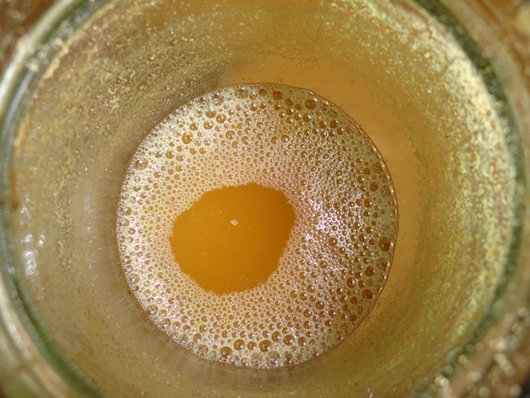
Fresh cheese is just one of the many things you can make yourself at home, and with practise and time, you'll produce food that is superior in quality and taste to those you buy at the store. The photo above shows my kitchen bench at the moment. I'm making red wine vinegar - from leftover wedding wine, and ginger beer from ground ginger, sugar and water. The ginger beer plant is now on its fourth day, it has just started to bubble and it smells divine.

I know we've all been told that what we buy is always better than home made, but don't believe that. It's a convenient lie that encourages a consumerist way of life. If you believe that lie, you won't develop many life skills and you'll always rely on other people to keep you fed. Take back your independence, be responsible for your own life and teach your family, by your own actions, that the home production of some common foods is a good start to a kind of self reliance that will build character and responsibility. This isn't rocket science - it's just learning new methods and understanding how certain foods work. So don't go back to the store for yoghurt, fresh cheese, vinegar, soft drinks or sodas, stay here with me in my kitchen and we can all make own own.

ADDITION: I want to thank all those readers who have bought Amazon books, DVDs and kitchen goods using my Amazon store. I appreciate your support very much and because of it, I will today order $30 worth of books. Good times!

ANOTHER ADDITION: Can anyone answer Ann's question?: Rhonda, I have been missing out on soft cheeses as I'm pregnant and we are told to avoid soft cheeses due to the risk of listeria. I'm wondering if any mums to be have consumed homemade soft cheeses taking every precaution with cleanliness in the kitchen or should we avoid homemade soft cheeses too?

ERM, YES, ANOTHER ADDITION: EcoMILF is having a giveaway. There is such a lovely story attached to this, take the time to read it and add your name to the draw. It closes tomorrow. Click here to read Meagan's post.


Even if I covered my eyes and wandered around my backyard I would know it was Spring. The warm air on my skin and the unmistakable aroma of native frangipani flowers give it away every time. Spring has arrived here and it's brought with it new life, flowers, tiny new shoots, bright green leaves and the promise of healthy food over the coming months.

Lately, Hanno has been working most days in the garden. There is always something to do out there. So with the weeding, watering, planting, plucking, tying up, and organising, the garden has sprung into life, trellises are going up, tomatoes are being staked and, already, we are harvesting.

Take a walk through the garden with me now. You'll have to imagine the sweet scent of the frangipanis, the call of the whip birds and the warm air on bare arms, but the rest you can see in these photos.


Tassels are forming on half grown corn.


There are always too many zucchinis. Why don't we learn!


Next Winter's Washington Navel oranges.


Grown from seeds in the bush house, these newly planted cucumber seedlings will soon cover that trellis.


Baby Quentin, the light Sussex chick.


These baby capsicums (sweet peppers) should be ready for harvesting in about three weeks. The follow on flowers and the fruit they turn into will be part of our Christmas lunch.


More cucumbers. These already climbing their trellis. There are certain vegetables you can't have enough of. Cucumbers are one of those vegetables. Friends and neighbours are always happy to receive a fresh cucumber and any left over are pickled for later in the year.


The view from the garden gate.


Ann Shirley (a New Hampshire), Martha (a buff Orpington) and Heather (a salmon Faverolles) all waiting for food.


More new plantings to replace the cabbages that are almost all gone. Here we have lettuce, wild rocket (arugula) and boy choi.

Sunflowers - these are being grown for the chooks but in reality, the King parrots will eat them well before they ripen enough for the chooks. We don't mind though. The Kings' habitat is slowly being eroded and if we are to keep this glorious bird, we need to help it survive.


Eggplants are starting to flower. These are heirlooms - Black Beauty.


The potatoes have just sprouted under a thick layer of straw.


And finally, the gardener - Hanno, hard at work on his pet project - backyard food production.

We garden all year now and we've been doing this for a long time, but every year it gets me. Spring is such a wonderful time to rediscover the joys of gardening and the feeling of quiet satisfaction we get knowing we can produce organic food on the land we live on.

"Personally, I have been very impressed by the slow food movement. It is about celebrating the culture of food, of sharing the extraordinary knowledge, developed over millennia, of the traditions involved with quality food production, of the sheer joy and pleasure of consuming food together. Especially within the context of family life, this has to be one of the highest forms of cultural activity." Prince Charles
I love risotto. It's one of those easy to modify recipes that almost everyone likes - including vegetarians, and I'm sure you could modify this recipe to suit vegans as well. My two favourite risottos are pumpkin and mushroom. There is something about those two vegetables that make this dish something really special. Here is my version of pumpkin risotto, the ingredients are enough for two people.


INGREDIENTS
2 cups of uncooked pumpkin - I used a Japanese pumpkin but you could also use butternut squash, Queensland Blue pumpkin, the little Kent or Golden Nugget pumpkins. Choose a rich dark orange pumpkin that can be baked in the oven and hold its shape.
1 cup uncooked Arborio rice - or some other rice suitable for risotto. Ordinary rice will not work in this dish. Risotto rice swells up and absorbs the liquid added in this recipe. It also releases its starch into the dish and you end up with a very creamy rice.
Homemade vegetable stock - more on this below
Olive oil
Parmesan cheese

HOW TO MAKE VEGETABLE STOCK
Into a large sauce pan pour two litres/quarts of water.
Add whatever vegetables you have on hand - chopped. I used celery, carrot, corn, onion, garlic and parsley. Add the parsley in one piece so you can remove it at the end of the cooking period. Don't add strong flavours like cabbage or parsnips because they'll take over the flavour of the dish.


Add salt and pepper to your taste. Remember, adding salt to food, especially to vegetables, brings out their flavour. It's very important to season food as you cook. Put the lid on the pan and bring to the boil, then simmer for about 30 minutes. Strain the vegetables out of the stock before you use it. The stock must be boiling when you add it to the rice.

PREPARING THE PUMPKIN


Chop of the pumpkin into bit sized pieces, toss over a little extra virgin olive oil (or whatever oil you use), add salt and pepper to taste and bake in the oven until golden and soft. You can see we are adding salt and pepper again. Each layer of this dish should be seasoned as it cooks. Combining properly seasoned and cooked layers will give you a well rounded final dish that shouldn't need further seasoning at the table.


When the pumpkin is cooked, put it to one side until it's needed.

SETTING EVERYTHING UP
You will need your saucepan of boiling stock right next to your frying pan on the stove. You will be scooping the stock into the frying pan so the frying pan needs to be on the heat and so does the stock. You'll need a soap ladle for adding the stock and a wooden spoon to stir the risotto.

TO MAKE THE RISOTTO
Add a splash of olive oil to your frying pan and turn on the heat. When it's hot, add the rice and stir it around until every grain is coated in oil.


Then start adding the stock to the rice. You start by adding two scoops, then stir the rice until the liquid is totally absorbed. When you add the stock it will look like the photo below.


When enough of the stock has been absorbed to go to the next stage, it will look like the photo below.


Keep adding the stock one scoop at a time, and keep stirring. Stirring the rice is an important element of this dish. It releases the starch from the rice to make a creamy risotto. When the liquid has absorbed into the rice, add another scoop of stock. Keep doing that until almost all the stock is gone and then add the baked pumpkin pieces. This part of the process will take about 15 - 20 minutes.


Let the rice simmer on the heat while it absorbs the liquid and while that is happening, grate some Parmesan cheese. Please use a piece of cheese, not that horrible stuff already shredded in the packet.


You'll only need a small amount of cheese. This photo looks like a lot but it's only a small piece that's been fluffed up by the Microplane grater.


Add the cheese to the rice and stir in. It's almost ready now. What you're looking for now is creamy rice that is not dry but not too liquid.


Keep stirring gently until it reaches a point you're happy with. If you look at the top photo, that it the consistency to aim for.

Risotto is genuine home cooking at its best. It's simple, yet complex enough to guarantee you good food for your family or guests. The best risottos are home made. Restaurants often put risotto on the menu but you need mama standing at the stove stirring to make a great risotto, and it needs to be served immediately. Leaving risotto in a warm oven dries it out. Restaurants can't afford the time to keep one chef on one serving for 20 minutes. So if you want good risotto, make it at home.

I hope you enjoy it.


Hanno bought me this lovely bunch of flowers for our wedding anniversary today. We were married in Hamburg, Germany, 30 years ago.

One of the most important subjects I should be concerned about is one I don't write much about but we've had a couple of requests for a posts about daily routines and organisation, so here goes. I guess the reason it doesn't jump into my head like other subjects do is that my days are very similar now, there is an easy rhythm that is often repeated, and, if my truth is told, they don't need much organising. It wasn't always that way though.

My days are anchored by a set of daily tasks that are the same every day: feed animals, make breakfast, wash the dishes, make the bed, sweep the floor. Whether I go out, go to work, stay at home and potter around, or stay at home and work at writing all day, those five core tasks are always done. I do other things as well, but those five things are my unchanging constants and they're almost automatic. I don't know about you but I can be a bit wonky some mornings. Doing those five tasks seems to set me up for the day. I do them and while I do, my head and heart settle and when they're finished, I can think about what else has to be done. Another example of this working was when Hanno was still working shift work. He would get up for morning shift at 5.30am, he'd shower and get into his work clothes. While he was doing that, I would wander into the kitchen, make his breakfast, his packed lunch and a cup of tea for me and when he was ready, he'd eat breakfast while I had a cuppa with him, then he'd leave. Those few things would get me ready for the day, and when they were done, I'd know what would follow and the order I would do things in.


New girl, Quentin, free ranging with aunties Martha and Heather.

Other tasks that proceed or follow my five daily tasks, and which happen every day, include writing my blog or checking the forum, checking emails, feeding the animals, (all done before the core five) and knitting, cooking and tidying up (always after).

Then I have unusual tasks that might happen once a week, once a month or once a year. When I have unusual tasks, I make a list because if I don't, I'll forget one or two of them. My unusual tasks might include: make ginger beer starter, preserving, make fruit cake, ironing, plant seeds, water garden, make yoghurt, make fresh cheese, sweep verandas, tend worm farm, harvest loofahs or lemons, email photos to work, mend skirt or write article. These are the interesting tasks that I usually enjoy doing. They're different, and they add variety to my day.

So a work day often looks like this:
Rise, shower and dress
Write blog
Check emails
Feed animals
Make breakfast
Wash dishes
Sweep floor
Pack lunch
Go to work
Hanno makes dinner
Clean kitchen after dinner

A work at home day is like this:
Rise, shower and dress
Write blog
Check emails
Feed animals
Make breakfast
Wash dishes
Tidy kitchen
Bake bread
Sweep floor - all unlisted tasks
Write book/check blog/check forum - unlisted
Lunch
Knit - unlisted
Make ginger beer - on list
Sweep verandas - on list
Write article - on list
Mend skirt - on list
Harvest vegetables - on list
Watering - on list
Make dinner - unlisted
Wash dishes - unlisted
Clean kitchen - unlisted

As you can see, certain things like making meals and cleaning up are never put on a list because they are either done every day or they are part of a normal process - such as we eat dinner every day. The rest of the tasks that I do, but don't do every day, I list each morning after breakfast and after I've done my core five tasks. By then my head is clear and I know what I need to do and what I have the time and energy for.


A basket of fresh zucchinis and beans.

If you think about it, I'm sure you'll have a set of core tasks that you do as soon as you get up in the morning before you have a chance to think about them. You don't have to organise them, they organise you. You'll probably also have a set of tasks that are done most days - like making dinner and packing lunches, that you don't have to be reminded of. But aside from those two set of tasks, there will be the things that need doing today, but not every day - they go on a list. BUt if you're new to lists, then maybe it's wise to list all your taks, including your core tasks, in the order they'll be done, until you get used to working in this way. If you can do your list the night before, that's great, if not, do it while you have your breakfast. The important tasks should always be first so they get done.

And remember, things on the list that don't get done can be transferred over to the following day but make sure you prioritise your list so the important things at at the top and are done first.

I'm very interested in how you organise yourself each day, if you have a moment, please share your routine with us, it may help someone who is in a similar situation to you.

Hanno and I will be busy bees this morning. I was out watering the vegetables before the sun came up; it's going to be very warm here again today with the possibility of another dust storm. I did some work in the bush house too, planting more seeds for follow up crops. I asked Hanno to cut our bay tree back to the stump because it's covered with scale and it's too much of a hassle to spray the darn thing. I harvested enough leaves to do us for a couple of months, when I expect the tree to be in full production again.


I came inside to make breakfast around 7.30, called Hanno inside when it was ready - scrambled backyard eggs with herbs, tomato and toast, and black tea, and now we're both working on our different tasks for the morning. I want to sit and knit all afternoon so I need to get through a few things so that can happen. Otherwise we'll just be pottering around today and tomorrow - working, enjoying the weather, watching the goings on in the yard and taking in all we are offered.


Just a gentle reminder to get busy with your handmade Christmas gifts. I'm very slow with mine but I'm doing the best I can with the amount of time I have this year.

If you'd like some real inspiration, look here. It's a real treat of a blog. I adore her crafted items and her home is just lovely.

There is a very good clasp purse tutorial here. They would make great gifts for Christmas or birthdays.

If you're new to embroidery or stitching, here is a very good site for you. It clearly shows how to stitch various stitches. Maybe you could stat with a sampler.

And finally, this is just a delightful blog full of bees, food, chooks and gardening.

Enjoy your reading and have a happy weekend.

It is such a good idea to take time out every so often and do something out of the ordinary. Yesterday, Hanno and I set off for a day in Brisbane. It was an easy prep for the trip - just a bottle of water for us both and the lemon pie, because we knew we had a delicious lunch being cooked for us. We arrived just before lunch so we had a chance to sit and talk for a while and enjoy a cold drink.


Sarndra and Shane were both happy for me to take photos to show on the blog but I didn't think to take them until we had dessert - the best quiche had already been eaten.

Lunch consisted of the best quiche I've ever eaten and a garden salad. Of course you would expect a fine quiche from a fine dining chef but this one was made by Sarndra, with a little help from Shane who made the pastry. The quiche was feta cheese, olives and sun dried tomatoes on Maggie Beer's sour cream pastry. I've asked Sarndra to email the recipe to me and when she does I'll pass it on to you. It's a masterpiece. And I have to tell you that having a daughter-in-law who says she isn't a good cook, but produces such a delicious dish is a great joy to me. Our Sarndra is a very capable woman.


Their home is furnished with new, second hand and found furniture and it all goes together to make a warm, comfortable and inviting home.

I don't write a lot about raising babies and young children. It's such a long time ago for me now, although I do remember a lot of it - the struggles and anxiety, and being up all through the night when they were sick or scared. I also remember the many moments of pure joy when I watched either of my sons do something they thought they couldn't do or when they brought home a prize from school, or a new friend. I recall reading to them, playing on the floor with Legos, all of us going to the movies, birthday parties, camping trips and holidays in Sydney with my parents. Through all those times I hoped they would grow into good and decent men who remembered the values they were brought up with and who would make a life that made them happy and proud. And they have!


Lemon meringue pie.

I have never seen Shane happier than he is right now. Sarndra is the ideal girl for him and when I see them together, even though they're just starting out in their marriage, with all the struggles and adjustments that come with that, it seems to me they are the real deal - a fixed unit, together forever. Marriage is tough, there is no doubt about that, and I know that my marriage has had all the highs and lows that most marriages go through. As I look back on my marriage, I think what got us through all those lows was that there were a lot of highs and there was a strong foundation of love, acceptance and respect. We talked through our problems and had more than one fight (never in front of the kids) but through all those bad times we always had trust in each other. That never died. Never ever. I think when the trust goes, so does the marriage.


This area is just near the front door.

As we were leaving, we wished Sarndra happy birthday for next Tuesday and mentioned that on Monday it's our 30th wedding anniversary. Sarndra said she hoped she and Shane will be as happy as Hanno and I are on their 30th anniversary. Seeing them as they are now, I think they have a very good chance of that happening.

Thanks for a great lunch Shane and Sarndra!
Hanno and I are having a day off today. We're going into Brisbane to have a combined birthday lunch for Hanno and Sarndra. Hanno's birthday was last week, Sarndra's birthday is next week so it's a good chance for us to catch up and to celebrate two important events. Someone asked the other day for a photo of Shane and Sarndra's flat. I'm taking my camera and I'll ask them but they have to be totally comfortable with it.

I've just put a lemon meringue pie in the oven to bake. I made it from scratch this morning starting at 5am. Alice sleeps in the kitchen and she must have thought she was dreaming because she just lay there watching me. Shane said he'd make lunch and I said I'd bring dessert. It's always good to share - the food, the tasks, the conversation and the washing up.


Usually at 3pm the sky is bright blue and the sun is shining. This is yesterday in the main street of Maleny.

If you heard about the dust storm over Australia yesterday, it started off in and around Sydney early in the morning with bright red skies. I've never seen anything like it. By early afternoon, I looked out the window at work to see clouds of dust and what looked like a winter's haze. Our dust was a yellow colour and it covered everything, including my car in the car park - Hanno had just washed it.


The drive home from work. Usually on the right hand side you can see blue sky and the pacific ocean.

Before driving home yesterday I visited the building site for our Centre. The frame is up, and I've been told we'll be moving in around 1 December. I'm so excited! The Centre has been operating for 16 years and we've been in all sorts of poky little places. Finally, the government has recognised the work we do and soon we will have this wonderful new building. I can hardly wait.


The frame is up! Our new Centre.

Thank you all for your votes. I really appreciate them and your support. I doubt I'll get anywhere near winning because all the other nominees are very big Asian blogs but being nominated is a prize for me. If you can't register your vote here on the side bar, go here to their site. Remember, you have to vote in every section before you submit your vote.

And now I'm off to check the pie and get ready to go out. I hope you all have a beautiful day.
I was really surprised to be nominated for the Most Influential Blog in the first Asia Pacific Blog Awards. I am now one of five finalists for this award. Yikes! I can't believe it. Now it's over to you. I've put the voting button on the right side of the blog so if you feel you'd like to vote for me, please do. You have to place a vote in every category, not just the one I'm in. And, you can vote more than once, but only once every two hours. Thanks everyone. I appreciate your help with this.
Newer Posts Older Posts Home

Search here

Total Pageviews

Translate


I'm Rhonda Hetzel and I've been writing my Down to Earth blog since 2007. Although I write the occasional philosophical post, my main topics include home cooking, happiness and gardening as well as budgeting, baking, ageing, generosity, mending and handmade crafts. I hope you enjoy your time here.

MY FAVOURITE PLACES

  • Grandma Donna's Place
  • Grandma Donna's YouTube
  • Grandma Donna's Instagram
  • This Simple Day
  • Nicole's Instagram

Give More

Give More

Popular posts last year

Making ginger beer from scratch

We had a nice supply of ginger beer going over Christmas. It's a delicious soft drink for young and old, although there is an alcoholic version that can be made with a slight variation on the recipe. Ginger beer is a naturally fermented drink that is easy to make - with ginger beer you make a starter called a ginger beer plant and after it has fermented, you add that to sweet water and lemon juice. Like sourdough, it must ferment to give it that sharp fizz. To make a ginger beer plant you'll need ginger - either the powdered dry variety or fresh ginger, sugar, rainwater or tap water that has stood for 24 hours to allow the chlorine to evaporate off. You'll also need clean plastic bottles that have been scrubbed with soap, hot water and a bottle brush and then rinsed with hot water. I never sterilise my bottles and I haven't had any problems. If you intend to keep the ginger beer for a long time, I'd suggest you sterilise your bottles. MAKING THE STARTER In a...
Image

NOT the last post

This will be my last post here.  I've been writing my blog for 18 years and now is the time to step back. I’ve stopped writing the blog and come back a couple of times because so many people wanted it, but that won’t happen again, I won’t be back.  I’ll continue on instagram to remain connected but I don’t know how frequent that will be. I know some of you will be interested to know the blog's statistics. 
Image

How to make cold process soap

I'm sure many of you are wondering: "Why make soap when I can buy it cheaply at the supermarket?" My cold process soap is made with vegetable oils and when it is made and cured, it contains no harsh chemicals or dyes. Often commercial soap is made with tallow (animal fat) and contains synthetic fragrance and dye and retains almost no glycerin. Glycerin is a natural emollient that helps with the lather and moisturises the skin. The makers of commercial soaps extract the glycerin and sell it as a separate product as it's more valuable than the soap. Then they add chemicals to make the soap lather. Crazy. Making your own soap allows you to add whatever you want to add. If you want a plain and pure soap, as I do, you can have that, or you can start with the plain soap and add colour, herbs and fragrance. The choice is yours. I want to add a little about animal and bird fat. I know Kirsty makes her soap with duck fat and I think that's great. I think t...
Image

Preserving food in a traditional way - pickling beetroot

I've had a number of emails from readers who want to start preserving food in jars but don't know where to start or what equipment to buy.  Leading on from yesterday's post, let's just say up front - don't buy any equipment. Once you know what you're doing and that you enjoy preserving, then you can decide whether or not to buy extra equipment. Food is preserved effectively without refrigeration by a variety of different methods. A few of the traditional methods are drying, fermentation, smoking, salting or by adding vinegar and sugar to the food - pickling. This last method is what we're talking about today. Vinegar and sugar are natural preservatives and adding one or both to food sets up an environment that bacteria and yeasts can't grow in. If you make the vinegar and sugar mix palatable, you can put up jars of vegetables or fruit that enhance the flavour of the food and can be stored in a cupboard or fridge for months. Other traditional w...
Image

Cleaning mould from walls and fabrics

With all this rain around we've developed a mould problem in our home. Usually we have the front and back doors open and that good ventilation stops most moulds from establishing. However, with the house locked up for the past week, the high humidity and the rain, mould is now growing on the wooden walls near our front door and on the lower parts of cupboards in the kitchen. Most of us will find mould growing in our homes at some point. Either in the bathroom or, in humid climates, on the walls, like we have now. You'll need a safe and effective remedy at some point, so I hope one of these methods works well for you. Mould is not only ugly to look at, it can cause health problems so if you see mould growing, do something about it straight away. The longer you leave the problem, the harder it will be to get rid of it effectively. If you have asthma or any allergies, you should do this type of cleaning with a face mask on so you don't breathe in any spores. Many peopl...
Image

Five minute bread

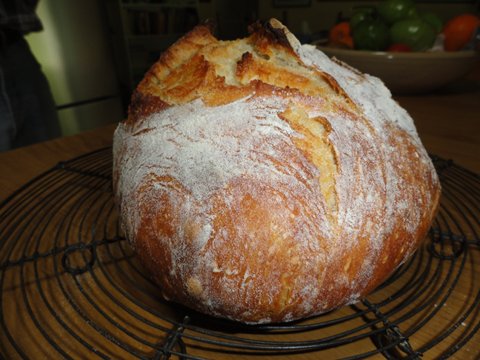
Bread is one of those foods that, when made with your own hands, gives a great deal of satisfaction and delight. It's only flour and water but it symbolises so much. I bake bread most days and use a variety of flours that I buy in bulk. Often I make a sandwich loaf because we use most of our bread for lunchtime sandwiches and for toast. Every so often I branch out to make a different type of loaf. I have tried sour dough in the past but I've not been happy with any of them. I'll continue to experiment with sour dough because I like the idea of using wild yeasts and saving the starter over a number of years to develop the flavour and become a part of the family. However, the loaf I've been branching out to most often is just a plain old five minute bread. By five minutes I mean it takes about five minutes actual work to prepare but it's the easiest of all bread to make and to get consistently good loaves from. If you're having people around for lunch or...
Image

This is my last post.

I have known for a while that this post was coming, but I didn't know when. This is my last post. I'm closing my blog, for good, and I'm not coming back like I have in the past.  I've been writing here for 16 years and my blog has been many things to me. It helped me change my life, it introduced me to so many good people, it became a wonderful record of my family life, it helped me get a book contract with Penguin, and monthly columns with The Australian Women's Weekly and Burke's Backyard . But in the past few months, it's become a burden. In April, I'll be 75 years old and I hope I've got another ten years ahead. However, each year I'll probably get weaker and although I'm fairly healthy, I do have a benign brain tumour and that could start growing. There are so many things I want to do and with time running out, leaving the blog behind gives me time to do the things that give me pleasure. On the day the blog started I felt a wonderful, h...
Image

What is the role of the homemaker in later years?

An email came from a US reader, Abby, who asked about being a homemaker in later years. This is part of what she wrote: "I am a stay-at-home mum to 4 children, ages 9-16. I do have a variety of "odd jobs" that I enjoy - I run a small "before-school" morning drop-off daycare from my home, I am a writing tutor, and I work a few hours a week at a local children's bookstore. But mostly, I cherish my blissful days at home - cooking, cleaning (with homemade cleaners), taking care of our children and chickens and goats, baking, meal-planning, etc. This "career" at home is not at all what I imagined during my ambitious years at university, but it is far more enriching. I notice, though, that my day is often planned around the needs of my family members. Of course, with 4 active kids and a husband, this is natural. I do the shopping, plan my meals, cook dinner - generally in anticipation of my family reconnecting in the evening.  I can't h...
Image

Every morning at home

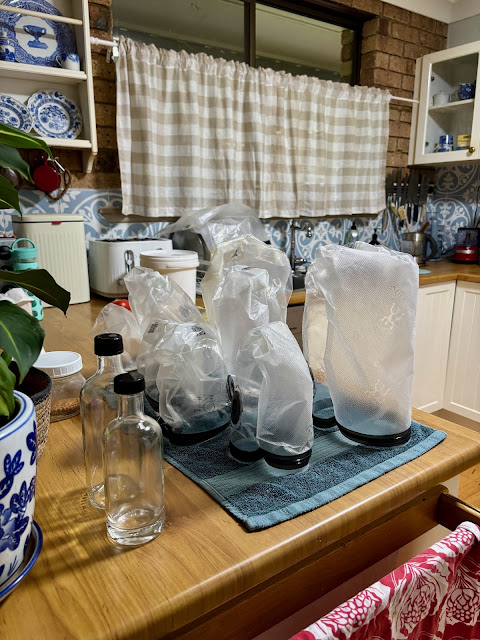
Every morning when I walk into my kitchen it looks tidy and ready for a day's work. Not so on this morning (above), I saw this when I walked in. Late the previous afternoon when I was looking for something, I came across my rolled up Zwilling vacuum bags and decided they had to be washed and dried. So I did that and although I usually put them outside on the verandah to dry it was dark by then. I turned the just-washed bags inside out and left them like this on a towel. It worked well and now the bags are ready to use when I bring home root vegetables, cabbages or whatever I buy that I want to last four or five weeks.
Image

You’ll save money by going back to basics

When I was doing the workshops and solo sessions, I had a couple of people whose main focus was on creating the fastest way to set up a simple life. You can't create a simple life fast, it's the opposite of that It's not one single thing either - it's a number of smaller, simpler activities that combine to create a life that reflects your values; and that takes a long to come together. When I first started living simply I took an entire year to work out our food - buying it, storing it, cooking it, preserving, baking, freezing, and growing it in the backyard. This is change that will transform how you live and it can't be rushed.  
Image


Trending Articles

NOT the last post

This will be my last post here.  I've been writing my blog for 18 years and now is the time to step back. I’ve stopped writing the blog and come back a couple of times because so many people wanted it, but that won’t happen again, I won’t be back.  I’ll continue on instagram to remain connected but I don’t know how frequent that will be. I know some of you will be interested to know the blog's statistics. 
Image

Every morning at home

Every morning when I walk into my kitchen it looks tidy and ready for a day's work. Not so on this morning (above), I saw this when I walked in. Late the previous afternoon when I was looking for something, I came across my rolled up Zwilling vacuum bags and decided they had to be washed and dried. So I did that and although I usually put them outside on the verandah to dry it was dark by then. I turned the just-washed bags inside out and left them like this on a towel. It worked well and now the bags are ready to use when I bring home root vegetables, cabbages or whatever I buy that I want to last four or five weeks.
Image

You’ll save money by going back to basics

When I was doing the workshops and solo sessions, I had a couple of people whose main focus was on creating the fastest way to set up a simple life. You can't create a simple life fast, it's the opposite of that It's not one single thing either - it's a number of smaller, simpler activities that combine to create a life that reflects your values; and that takes a long to come together. When I first started living simply I took an entire year to work out our food - buying it, storing it, cooking it, preserving, baking, freezing, and growing it in the backyard. This is change that will transform how you live and it can't be rushed.  
Image

Creating a home you'll love forever

Living simply is the answer to just about everything. It reduces the cost of living; it keeps you focused on being careful with resources such as water and electricity; it reminds you to not waste food; it encourages you to store food so you don't waste it and doing all those things brings routine and rhythm to your daily life. Consciously connecting every day with the activities and tasks that create simple life reminds you to look for the meaning and beauty that normal daily life holds.  It's all there in your home if you look for it. Seemingly mundane tasks like cleaning and cooking help you with that connection for without those tasks, the home you want to live in won't exist in the way you want it to.  Creating a home you love will make you happy and satisfied.
Image

Time changes everything

I've been spending time in the backyard lately creating a contained herb and vegetable garden. My aim is to develop a comfortable place to spend time, relax, increase biodiversity and encourage more animals, birds and insects to live here or visit. Of course I'd prefer my old garden which was put together by Hanno with ease and German precision. Together, we created a space bursting at the seams with herbs, vegetables and fruity goodness ready to eat and share throughout the year. But time changes everything. What I'm planning on doing now, is a brilliant opportunity for an almost 80 year old with balance issues. In my new garden I'll be able to do a wide range of challenging or easy work, depending on how I feel each day. It’s a daily opportunity to push myself or sit back, watch what's happening around me and be captivated by memories or the scope of what's yet to come.
Image

It's the old ways I love the most

I'm a practical woman who lives in a 1980’s brick slab house. There are verandahs front and back so I have places to sit outside when it's hot or cold. Those verandahs tend to make the house darker than it would be but they're been a great investment over time because they made the house more liveable. My home is not a romantic cottage, nor a minimalist modern home, it's a 1980’s brick slab house. And yet when people visit me here they tell me how warm and cosy my home is and that they feel comforted by being here. I've thought about that over the years and I'm convinced now that the style of a home isn't what appeals to people. What they love is the feeling within that home and whether it's nurturing the people who live there.
Image

Making ginger beer from scratch

We had a nice supply of ginger beer going over Christmas. It's a delicious soft drink for young and old, although there is an alcoholic version that can be made with a slight variation on the recipe. Ginger beer is a naturally fermented drink that is easy to make - with ginger beer you make a starter called a ginger beer plant and after it has fermented, you add that to sweet water and lemon juice. Like sourdough, it must ferment to give it that sharp fizz. To make a ginger beer plant you'll need ginger - either the powdered dry variety or fresh ginger, sugar, rainwater or tap water that has stood for 24 hours to allow the chlorine to evaporate off. You'll also need clean plastic bottles that have been scrubbed with soap, hot water and a bottle brush and then rinsed with hot water. I never sterilise my bottles and I haven't had any problems. If you intend to keep the ginger beer for a long time, I'd suggest you sterilise your bottles. MAKING THE STARTER In a...
Image

An authentic look at daily life here — unstaged and real

Most days Hanno was outside happily working in the fresh air. It may surprise you to know that I started reading my book,  Down to Earth , yesterday - the first time since I wrote it 13 years ago.  I had lent it to my neighbor, and when she returned it, I started reading, expecting to find surprises. Instead, I realised the words were still familiar—as if they were etched into my memory. As I flipped through the pages, I was reminded of how important it was for me to share that knowledge with others. The principles in Down to Earth changed my life, and I truly believed they could do the same for others. After just 30 minutes of reading, I put the book down, reassured that its message still holds true: we can slow down and reshape our lives, one step at a time.
Image