down to earth

  • Home
  • About Us
  • Down To Earth Book
  • Privacy Policy
I didn't get around to my tomatoes yesterday, there were too many other things happening. One of them may be of interest to you - I processed four buckets full of lemons. Our lemon tree is a Eureka. It flowers almost all year but we harvest the main crop in late winter. The fruit is a true lemon flavour, not as mild as the Meyer lemon and not as tart as the bush lemon. All the fruit hold a good amount of juice.


The problem with harvesting four buckets of lemons is that some of them will go off before they're used, so I juice all the lemons in one big juicing session and freeze what I don't use straight away.


Being a late Winter harvest, it makes perfect sense to me to make lemon cordial with some of the juice. I love to offer home made drinks to our visitors. Lemon cordial is the quickest and easiest to make and during summer, I always have either home made lemon cordial or ginger beer in the fridge. Most people love being offer an old fashioned drink, icy cold from the fridge with ice cubes clinking.


Just a word on the storage bottles. If you're storing this in the freezer, use plastic bottles as the juice will expand a bit when it freezes. You can use glass bottles for the cordial itself because that is stored in the fridge.

CORDIAL
can be made with any fruit juice, including lemon, orange, raspberry, strawberry, pineapple or passionfruit, or anything else that takes your fancy.

Make up a simple sugar syrup - this is generally half water mixed with half sugar. So if you want to make two cups of syrup, you'd mix one cup of water with one cup of sugar. You can make a lighter syrup by adding more water, say one and a half cups of water to one cup of sugar.

Heat the sugar and water on the stove to dissolve the sugar crystals, then cool.


To make the cordial, add equal parts syrup to juice. You do this by half filling a bottle with juice, then topping it up with syrup. That cordial is stored in the fridge.

To make a glass of cordial, pour in about three tablespoons of cordial (test taste, you might need more or less) into a glass and fill it up right to the top with iced water and some ice cubes. A sprig of mint or pineapple sage in the drink is a nice touch.


It took me about half an hour to juice all the lemons. I have a juicing attachment on my food processor so it doesn't take long at all. That half hour of work gave us 12 litres (3½ gallons) of pure lemon juice for the freezer and three bottles of lemon cordial for the fridge.

I took my first glass of new season lemon cordial out to the veranda to relax and enjoy the warm late Winter day. Half an hour of knitting out there and I was ready for the next task.

I hope to take my tomato photos today so I'll write about that in my next post. Thank you for your comments this week. I love seeing all the new names in the comments, but I miss my old readers. Please say hello if you have the time. I know it's pointless commenting all the time, but I'd like to know you're still there. :- )

I'm feeling a bit tired today so this will be short. We had a big day yesterday going into Brisbane to collect my friend from hospital. We brought her home and waited until her family arrived then came back home again. That big city traffic really gets to me now. I need a while to recover. I'll spend a relaxing day at home today and I'll be in the garden to take photos for a post I'll do tomorrow on tomatoes.

But I have a couple of important bits of information for you today. Burt's Bees contacted me a while ago to ask for help with their survey in Australia. I've only used one of their products that was sent to me from the USA, and I loved it. Now they're selling in Australia so I'm happy to help. I forgot about the survey and remembered it yesterday, so better late then never, I'll share part of what they sent:

We are about to launch an online survey asking Australian consumers about their concerns and attitudes to ‘natural’ ingredients – what ‘natural’ means to them and what matters to them about ‘natural’ ingredients in personal care (meaning products for body, face, hair etc). Burt’s Bees has done a similar survey in the US but as far as we know, no-one’s done one here.

Why are we doing this? Firstly, because we just don’t want to make assumptions about what Australians think and know about ‘natural’ in personal care. Obviously Burt’s Bees is a ‘natural’ focused company but this survey is about understanding what consumers actually want. All sorts of assumptions get made in marketing and both Burt’s Bees and Porter Novelli Adelaide have decided that’s not enough for us. So we’re asking. We’ve decided to approach online communities because we know connecting online is one way consumers can share their unfiltered views and concerns, and that’s what we want to hear. Yes, you will be talking to a PR company and a manufacturer in the industry - because we genuinely want to know what people are thinking.

We will use the results of the survey in the following ways: we will report back to the blogs and site communities that link to the survey on what we find, we will share the results with the health and beauty media in Australia and we will make the results available via the Burt’s Bees website. We hope the results will help address any concerns or confusions about what ‘natural’ means and how it is presented in Australia. (One result of a similar survey in the US was that Burt’s Bees joined together with other major natural personal care companies to develop a national standard for ‘natural’ via the Natural Products Association.

The survey is for Australian residents and will run from August 20 until November 14. You can find it here.

ADDITION:
Thanks to my readers for alerting me to the sale of Burts Bees to Clorox. There is some information about it here at organicconsumers.org.

UK READERS here is a survey for you.
For those not in the UK or Australia, RSPCA is the Royal Society for the Prevention of Cruelty to Animals.

Stefan from the UK RSPCA sent this:
For the first time ever, the RSPCA Good Business Awards is open to the public through the People’s Choice Supermarket award which means that people can vote for the supermarket they think is doing the most for animal welfare.

Further information on the award and the achievements of each of the shortlisted supermarkets is available at here.

Take care, I'll see you tomorrow.


I haven't cooked chicken for years. I stopped eating meat for many years only to start again after reading Nourishing Traditions. So in my quest for frugal and tasty meals, I came back to roast chicken. This is one of the easiest meals you'll ever cook but it can be made fancy enough for a celebration dinner, or simple enough for a chicken and salad sandwich. Chicken is very versatile.

The main thing you have to be careful of is drying the chicken out while cooking it. So don't overcook it, take it from the oven as soon as it's done and let it rest wrapped in foil for 20 minutes before carving.

I like to stuff the cavity with a herb stuffing. The herb can be anything you have growing or have bought, I used:
  • 3 slices of stale bread (any type of bread is fine)
  • 1 medium onion
  • a handful of parsley
  • a few leaves of sage
  • sprinkle of dried oregano - dried oregano has a different taste to the fresh and it goes well with chicken
  • 2 small eggs or one large egg


Put all that in a processor and whiz it up or chop it very finely.

To stuff the chicken:
Clean your chicken well by removing the gizzards and running water through the bird. Wipe dry with a kitchen cloth or paper towel.


Using a spoon or your clean hands, load the stuffing into the cavity.


When the cavity is full, separate the skin from the breast and slip a spoonful of stuffing under the breast skin. That will help keep the chicken moist while it's roasting.

I forgot to do this - tuck the legs under the chicken so they cook close to the body. Otherwise the legs will overcook at the ends like they have here.


Place the chicken in a roasting dish with a little olive oil and brush the chicken with oil to keep it moist. While it is cooking, baste the chicken with the juices that have collected in the pan. This will also give you a moist chicken.

Cook on 190 - 200C (370 - 390F) until the chicken is golden brown and the juices run clear. You can test this by inserting a sharp knife in between the breast and the leg and watch the juices come out. If they're pink, cook another 10 minutes. If clear, remove the bird and cover with foil to rest.

I served this with roast potato, pumpkin, corn and onion and a from scratch gravy.


Chicken Gravy
  • Remove the chicken from the roasting pan. You want the bottom of the pan just covered with juices and oil.
  • Add two level tablespoons of plain (all purpose) flour to the juices, along with salt and pepper to taste and stir it together. It should look like a loose paste. If it's too dry, add a little more olive oil.
  • Place the pan over a medium heat and allow the paste to turn brown while you stir it. Stand there and watch it because it will burn quickly if you don't.
  • As soon as it's a nice brown colour, add about 2 cups of water OR chicken stock OR a splash of white wine and water and immediately stir the gravy to stop lumps forming.
  • Stir until the gravy boils and thickens and then turn it down. Keep stirring until you have a nice brown sauce for your chicken. If it's too thin, allow it to sit on the heat to evaporate off some of the liquid.
Leftovers can easily be used. We had chicken salad the next day with this chicken and I made my sandwich for work using some of the chicken as well. But you could also make chicken stir fry, chicken curry, chicken pie or chicken casserole with dumplings. Don't forget to keep the carcass to make chicken stock or coup.

The second most asked question I get here is: "how do I start living like you do?". It comes a close second to: "why do you have all those pots on sticks in your garden?" Well friends, today I'll answer one of those questions, and it will have nothing to do with pots on sticks.


Hanno took this photo from the roof. Good eh?

When I first made my change I'd already been doing a lot of the things that became important in our quest for a simple life - I'd baked bread on and off for many years, we'd kept chooks for 25 years, when we lived in the bush we stockpiled groceries. I guess one big step was to understand that there were others living how I wanted to live and that really inspired me like nothing else. Just having a name for it made a difference to me but knowing there were others I could learn from made me realise that we were not alone and that what I hoped for was possible. BTW, the kids were still living at home when all this started.

So what did I hope for? Well, after many years of working as a writer I wanted to work alone in my own home. I wanted to develop myself as a person and as a homemaker. I wanted to collect eggs and honey, I wanted to harvest vegetables every day, I wanted to preserve food. There was a part of me that wanted to create so I knew knitting, sewing and writing would be part of my future. I wanted to give up work and be free to build a little homestead in my backyard where the sun ripened fruit and vegetables, rain collected from our roof filled rain tanks and where chickens and bees reminded me everyday that I was part of a natural world, not a corporate one.

Surprisingly, that romantic dream actually became a reality but it was a bumpy road that lead me to where I am now. If you're at the beginning of this journey, never expect to arrive at a destination because there is none. But one of the important things you will notice, if you trust yourself enough, is that once started, this journey will take you quietly by the hand and lead you to from one step, to the next, and the next.


To illustrate that point, let me tell you what happened here. Once the decision was made to close my business and live on what Hanno was earning in our little local shop, I knew that my first job was to find ways to save. The money I was bringing in stopped, so we had to reduce costs. I looked for different ways to shop for groceries - because we spent money on that every week. I looked around for the best consistent prices (Aldi), did most of my shopping there and shopped at my local IGA for the rest. I found a bulk food store where I bought flour, nuts, spices, beans, chick peas etc. I found our local dairy, with the best milk in the state, sold cheaper diary products right at their door. So did our local cheese maker. They sold cheese and yoghurt at their door, with yoghurt at half price. It was just a matter of seeing what was in my local area. There was much more than I ever thought there was. When I had the shopping sorted, I started stockpiling - that saved me time and money. Our once a week shop became a monthly one, saving time, money and fuel.

We looked around the home to save more money. We got rid of our pay TV and the second car, stopped buying magazines and most books (I still get books from my Amazon associates account when I build up enough points), we stopped buying clothes and shoes on a regular basis. Still now, all these years later, we have enough clothes in our wardrobes to do us, and will have for a few years to come. Oh, we look daggy at home wearing out everything until it goes into the worm bin, but that's okay, we are far beyond judging each other by what we look like and the clothes we wear. It feels good to get the full value from what we own. Fashion is well and truly in the past for us. Now we're comfortable in our own skin.


In the past I had hated housework and did everything I could think of to avoid it. But while I was living this slower life, it occurred to me that if I wanted to live in a home that nurtured and comforted, I would be the one to make that home. So at this point my next step was to learn how to make my own cleaners, how to do my house work well, how to use my time wisely, and how to look after myself while I was looking after my family. Morning tea on the front verandah came into being then, and it still survives, strong as ever today. I did a lot of thinking during this period and changed how I thought about a few things. In the end, when I felt comfortable with the changes I had made in our home, I felt that I had remade myself as well. I had gone from being a corporate worker who wanted to change her life, to a homemaker, happy to work at a slower pace, happy to wear daggy clothes while I worked in the garden, happy to live on less, happy to stop shopping. Just happy!


Martha, Heather and Cocobelle. Martha and Heather are best friends.

When we got the vegetable garden producing and the hens laying, I realised I had to teach myself how to store food more effectively. I already knew how to preserve in a water bath, I knew how to make jams and relish, but I'd never done it in a purposeful and productive way before. All my previous efforts were a bit of a gimmick really, to see if I could do what my grandmother did. Well, it worked, I started putting up our excesses in jars and then we decided to buy a freezer. We started freezing vegetables in packs, just one or two bags as they were ready for picking, with larger sessions for end of season harvests. I tried drying, fermenting and sour doughs. All worked well and are still part of my food prep at various times of the year.

This post is getting way too long so let me just finish off by saying that at every stage of our journey, we've just done the next thing that needed doing. There is always a next thing in a simple life. You're always fine tuning, changing or looking for a solution to a problem, so trust yourself to go with the next thing and your life will probably flow along nicely like ours does.

One thing is for sure, trusting yourself will lead you to your own unique life, one that is not influenced by any other. Sure we all support each other, even over all these vast distances between our homes, but trusting yourself to take your own next step, will guarantee your life will develop in a way that suits you perfectly. Starting with the first thing you want to do in your simple life will lead you to a question or the need to learn (or relearn) a new skill. Take each step as it comes, there is no hurry, this life is slow and relaxed, and when you master that skill, there will be another that pops its head up. Trust this process, trust yourself and take it slow. When you look back in a year or two you'll see a trail of questions that you found answers to and a period of rebuilding skills that took you along to the next step and the next. Along the way a life will be built and as I said, never expect to arrive at a destination. The journey itself is our prize.


Around here, spring cleaning doesn't only happen inside. Hanno has been busy cleaning screens, doors and windows. He borrowed Jens' high pressure cleaner and blasted the wire screens with plain water. They came up beautifully. He also checked the rollers on the sliding doors and found one was broken. The replacement cost a few dollars and was easily replaced, ensuring the door works well in the coming months.


The old wheel on the left was badly chipped and broken.

It's also time to clean up the backyard and prepare for the bushfire and storm season or if you're in the northern hemisphere, for Winter. We haven't had any fires since we moved here but we're surrounded by pine forests so the threat of a summer fire is ever-present. You have to do most of the prep well before you ever hear of a fire near your home; by then, it's too late. So remove things like ladders or anything flammible that might be resting against the side of the house, rake up any rubbish, mulch or papers that might be laying around and put away everything that can be safely stored in the shed or garage.


Get up on the roof and clean out the gutters. If you have extras on your roof like we have, give them a clean too. Hanno cleaned all our skylights and solar panels while he was on the roof, and when he did that he checked the seals on the skylights and made sure there were no cracks or damage on them or the solar panels. Make sure you check your downpipes.


There is plenty to be done in the vegetable garden too. I removed diseased leaves from one tomato bushes and made sure all tomatoes and beans were secured to their supports. Make sure you never put diseased leaves or plant material in the compost. It will survive and spread in your later crops. These leaves were put in a plastic bag to solarise then they'll be thrown in the rubbish bin.


If you live in a temperate climate, now is the time to start fertilising your vegetables. We fertilise all year long here, but if you're putting in a new garden, Spring is the time to start your fertilising routine. If you're in a cold climate and are just moving into Autumn/Fall, you'll soon be putting your garden to sleep for the Winter. So go around and remove old mulch and plants or anything else that insects may use to overwinter in. The cleaner your garden is when you lay it to rest, the healthier it will be when you start it again next Spring. Do any of my northern hemisphere friends sow a green manure crop in late Summer or Fall? Please leave a link where I can read about how you do this. I'd like to know how to best keep fertility in a garden bed while it's under snow.


Make sure tomatoes are staked and mulched.

There are a few things to be done in the chicken coop too but I'll be writing a post about preparing the chickens for Summer soon, so I'll include everything in that.


You should check your lawn mower to make sure the blades are sharp and will serve you well over Summer. If they need replacing, do that now as part of your Spring cleaning. Check the spark plug, it may need cleaning and make sure the filter is clean. Finally, wipe the mower over with a clean cloth.


If you want to take cuttings to propagate plants you already have in the garden, late Winter and Spring is a good time to do that.

Otherwise, it's just a matter of walking around your house and checking that everything is in good order and clean. One day's work doing this will pay off later in the year. It's all part of the mindset of looking after what you own. If everything is kept well and in good order, it's less likely you'll have to replace what you own before you get the service you expect.

What's on your list for Spring cleaning outside? I love knowing how you're caring for your home. It inspires me to do my best here and it connects me to all you like-minded souls who live simply.


Spring cleaning can be done at any time of the year. We tend to do it when it's cool but warm enough to have the doors and windows open. The temperatures here the past few days have broken records for being too warm for the end of winter. Hanno and I wanted to start our spring cleaning soon but we realised if we left it any longer we might be doing that extra work in the blazing heat, so we started yesterday. If you want to join us, throw open your doors and windows, put your apron on and let's start. Depending on how much time you have, you can do all the inside chores in one day, do one room at a time or put aside 30 minutes a day to work through what you need to do.


Plan and make a list of what you intend to do.

Everyone's list will be different for this but there will be some things in common. Most of us will have to clean windows, screens and shutters - I'll write about outside chores tomorrow. Some of us will need to wash curtains. Other common tasks will include:
  • Change seasonal clothes, wash and store what you won't be wearing for the next few months.
  • Wash and store gloves, mittens, hats and scarves, or get them out ready to wear again.
  • Change bedding - wash quilts, doonas, duvets, blankets, or get them our to air ready to use again. Either remove or add electric blankets, depending on your season.
  • Vacuum under the bed.
  • Ask someone to help you turn the mattress - top to bottom and over.
  • If you have pillows that can be washed - wash them and hang in the sun to dry.
  • Give the house a thorough vacuuming - move the furniture to get under and behind.
  • Vacuum the furniture - remove cushions and pillows and get right into the crevasses.
  • Wash pillow and cushion covers.
  • Take the rugs and mats outside for a thorough shaking. Let them sit over the fence for a while in the sun - face down to minimise fading.
  • Clean and organise the fridge.
  • Move the fridge out and vacuum behind it. Also carefully vacuum the back of the fridge to get rid of any accumulated dust.
  • Clean and organise the pantry and stockpile.
  • Remove everything from the kitchen benches and clean thoroughly.
  • Go through your magazine stockpile and give away the old ones. (Hanno will laugh when he sees this because I don't buy magazines any more and I'm not getting rid of my stockpile of British Country Living magazines.)
  • Clean and organise your bathroom cupboard. Safely get rid of any old medications (the local pharmacy/drug store will probably take them back).
  • Wash the shower curtain.
  • Clean the toothbrush storage area.
  • Soak hair brushes and combs in a weak solution of chloride bleach or peroxide.
  • Clean out any cupboard that needs it.


No matter how much advertising you might see for products that will help you with spring cleaning, don't fall for it. Use the home made products that have served you well during the year. You'll also need a lot of clean cloths, so you might have to cut up an old towel to help you clean and wipe dry.


And if you can't do everything you want to do, don't feel guilty, just organise yourself. Make a list of things you can do next week, the week after, or whenever your other work allows. Not all of us have the time to dedicate to this yearly thorough cleanup. There will be a number of chores I'll be doing in the coming weeks as part of my spring clean.

Spring cleaning is not the most enjoyable task but it will help you stay on top of your cleaning and organising. If you do a thorough clean now, do a little bit every day, then you'll keep your house clean and tidy and you'll feel better for it. Providing a warm and comfortable home for yourself and your family is a big part of living a simple life. This is another step towards providing just that.

I'm sure I've left off some necessary tasks on my list. I'd be interested in knowing what your spring cleaning routine is and how long it takes you to carry it all out.


Hello everyone. I hope you're having a lovely weekend.

I'm trying to work out Twitter. If you want me to follow you, my user name is rhondajean

:- )


We had a lovely day yesterday. Thank you for your warm wishes for us.

This question is from slakermom: "what do you do with your extra produce? Obviously a lot can be preserved, but what about things like lettuce? There's only so much salads I can eat."

Harvesting is one of the most important parts of the entire process and you have to get it right or you'll waste food. We eat tomatoes almost every day that are freshly picked and eaten in salads or on sandwiches. When there are too many, and that is a truly joyful occasion, I'll pick the excess - usually when they're still green - and ripen them in the shade. Temperature ripens tomatoes, not sunlight. When they're ripe, I'll make relish, sauce or chutney, process it in a water bath and store it in the cupboard. I do a similar thing with cucumbers and beetroot - we eat them fresh but when we have a lot of them, they're picked, pickled and then stored in the fridge.

Cabbages are also eaten fresh in coleslaw and cooked and we probably eat one cabbage every week or two during winter. Like the tomatoes, we grow more than we eat fresh and at some point in the season, I'll make sauerkraut.

We plant vegetables for our chooks and dog too. The chooks eat cabbage, silverbeet, lettuce, broccoli, radish tops, corn, peas and anything with a bug in it. Alice has anything that we would eat from the garden made into her stew that we cook for her each week.

Vegetables like corn, beans, peas, silverbeet, spinach, cauliflower, broccoli, kale, carrots are all good to freeze. To do that effectively, wait until you have enough for at least a serving for your family, pick, blanche then bag them up for the freezer. Never skip the blanching step, it makes a difference. Some days you'll only have enough excess for one or two bags for the freezer, other days you have a lot more than that. Just take it as it comes, it will only take you a few minutes to process a bag or two. Don't think it's too small an amount to worry about. You'll be happy to have it later when you can just take the frozen vegetables from the freezer and have them on the table to eat that night.

Potatoes, pumpkin and onions can all be stored in a cool dry place and will last for a few months if you find a place that is rodent-free. I know many of our American and Canadian friends can and freeze pumpkin but as far as I know, this is never done in Australia.

Don't look at the current crops as being only for that season. If you can spread the availability of produce over a wide time span, you'll be getting the best from your plantings. So with that in mind, try to plant a few extra plants so you'll be able to freeze or preserve some produce for later in the year.

Steelkitten, we do use straw to mulch our plants. It's cheap and easy to get here. When we buy ours, we buy about 12 bales and store them in the shed. We usually don't have a problem with seeds in our mulch. If you can get the chooks to sort through it, they'll eat all the seeds for you. Otherwise, you'll just have to pull out the green shoots when they grow - and if you do have chooks, they'll love to eat the grass shoots and they'll be full of Omega oils.

Maxine, Hanno will pick a lot of the kale to have in one of his seasonal pork meals. He cooks the kale with smoked pork sausage and meat. I don't eat it but he feasts on it for a few days because he makes a big pot. There will be kale left after he picks, so a couple of days later, we'll pick it all to clear the area for tomatoes. That kale will be processed in a water bath and stored in the cupboard.

Avalon, we tilled the original soil, added a lot of manure and compost and then enclosed the beds with the besser blocks. The soil is higher than the surrounding soil because we added a lot of nutrients and continue to add them between every new crop.

Linda, there'll be a post about the bush house soon.

Karyn, I forget the exact size, it's something like 2 metres x 6 metres (6'x20').

Trina, Heather has been a very healthy girl since we brought her home as a two week old chick. However, in the flock we bought with Heather, about six of them died. They were a mixture of rare breed chooks, Heather was the only Faverolles. There was a Barnevelder, some Plymouth Rocks, Sussex, Hamburgs. From what I have read, it is quite normal to have a portion of a flock died when they're relocated and we've certainly found that to be true. If they survive the relocation and settle in, usually they live for a very long time. We often have old chooks here. At the moment Cocobelle is our oldest at five years.

Evelyn, bok choy bolts in the heat. So does lettuce, broccoli, coriander (cilantro), spinach and cauliflower. Tomatoes don't set their fruit well in the heat either. Over around 30C (85F), tomatoes often stop producing flowers or setting them to fruit if they're already there.

Courtney, don't give up, love. You're doing the right thing, even though a lot of people around you don't know it ... yet. :- )

Newer Posts Older Posts Home

Search here

Total Pageviews

Translate


I'm Rhonda Hetzel and I've been writing my Down to Earth blog since 2007. Although I write the occasional philosophical post, my main topics include home cooking, happiness and gardening as well as budgeting, baking, ageing, generosity, mending and handmade crafts. I hope you enjoy your time here.

MY FAVOURITE PLACES

  • Grandma Donna's Place
  • Grandma Donna's YouTube
  • Grandma Donna's Instagram
  • This Simple Day
  • Nicole's Instagram

Give More

Give More

Popular posts last year

Making ginger beer from scratch

We had a nice supply of ginger beer going over Christmas. It's a delicious soft drink for young and old, although there is an alcoholic version that can be made with a slight variation on the recipe. Ginger beer is a naturally fermented drink that is easy to make - with ginger beer you make a starter called a ginger beer plant and after it has fermented, you add that to sweet water and lemon juice. Like sourdough, it must ferment to give it that sharp fizz. To make a ginger beer plant you'll need ginger - either the powdered dry variety or fresh ginger, sugar, rainwater or tap water that has stood for 24 hours to allow the chlorine to evaporate off. You'll also need clean plastic bottles that have been scrubbed with soap, hot water and a bottle brush and then rinsed with hot water. I never sterilise my bottles and I haven't had any problems. If you intend to keep the ginger beer for a long time, I'd suggest you sterilise your bottles. MAKING THE STARTER In a...
Image

NOT the last post

This will be my last post here.  I've been writing my blog for 18 years and now is the time to step back. I’ve stopped writing the blog and come back a couple of times because so many people wanted it, but that won’t happen again, I won’t be back.  I’ll continue on instagram to remain connected but I don’t know how frequent that will be. I know some of you will be interested to know the blog's statistics. 
Image

How to make cold process soap

I'm sure many of you are wondering: "Why make soap when I can buy it cheaply at the supermarket?" My cold process soap is made with vegetable oils and when it is made and cured, it contains no harsh chemicals or dyes. Often commercial soap is made with tallow (animal fat) and contains synthetic fragrance and dye and retains almost no glycerin. Glycerin is a natural emollient that helps with the lather and moisturises the skin. The makers of commercial soaps extract the glycerin and sell it as a separate product as it's more valuable than the soap. Then they add chemicals to make the soap lather. Crazy. Making your own soap allows you to add whatever you want to add. If you want a plain and pure soap, as I do, you can have that, or you can start with the plain soap and add colour, herbs and fragrance. The choice is yours. I want to add a little about animal and bird fat. I know Kirsty makes her soap with duck fat and I think that's great. I think t...
Image

Preserving food in a traditional way - pickling beetroot

I've had a number of emails from readers who want to start preserving food in jars but don't know where to start or what equipment to buy.  Leading on from yesterday's post, let's just say up front - don't buy any equipment. Once you know what you're doing and that you enjoy preserving, then you can decide whether or not to buy extra equipment. Food is preserved effectively without refrigeration by a variety of different methods. A few of the traditional methods are drying, fermentation, smoking, salting or by adding vinegar and sugar to the food - pickling. This last method is what we're talking about today. Vinegar and sugar are natural preservatives and adding one or both to food sets up an environment that bacteria and yeasts can't grow in. If you make the vinegar and sugar mix palatable, you can put up jars of vegetables or fruit that enhance the flavour of the food and can be stored in a cupboard or fridge for months. Other traditional w...
Image

Cleaning mould from walls and fabrics

With all this rain around we've developed a mould problem in our home. Usually we have the front and back doors open and that good ventilation stops most moulds from establishing. However, with the house locked up for the past week, the high humidity and the rain, mould is now growing on the wooden walls near our front door and on the lower parts of cupboards in the kitchen. Most of us will find mould growing in our homes at some point. Either in the bathroom or, in humid climates, on the walls, like we have now. You'll need a safe and effective remedy at some point, so I hope one of these methods works well for you. Mould is not only ugly to look at, it can cause health problems so if you see mould growing, do something about it straight away. The longer you leave the problem, the harder it will be to get rid of it effectively. If you have asthma or any allergies, you should do this type of cleaning with a face mask on so you don't breathe in any spores. Many peopl...
Image

Five minute bread

Bread is one of those foods that, when made with your own hands, gives a great deal of satisfaction and delight. It's only flour and water but it symbolises so much. I bake bread most days and use a variety of flours that I buy in bulk. Often I make a sandwich loaf because we use most of our bread for lunchtime sandwiches and for toast. Every so often I branch out to make a different type of loaf. I have tried sour dough in the past but I've not been happy with any of them. I'll continue to experiment with sour dough because I like the idea of using wild yeasts and saving the starter over a number of years to develop the flavour and become a part of the family. However, the loaf I've been branching out to most often is just a plain old five minute bread. By five minutes I mean it takes about five minutes actual work to prepare but it's the easiest of all bread to make and to get consistently good loaves from. If you're having people around for lunch or...
Image

This is my last post.

I have known for a while that this post was coming, but I didn't know when. This is my last post. I'm closing my blog, for good, and I'm not coming back like I have in the past.  I've been writing here for 16 years and my blog has been many things to me. It helped me change my life, it introduced me to so many good people, it became a wonderful record of my family life, it helped me get a book contract with Penguin, and monthly columns with The Australian Women's Weekly and Burke's Backyard . But in the past few months, it's become a burden. In April, I'll be 75 years old and I hope I've got another ten years ahead. However, each year I'll probably get weaker and although I'm fairly healthy, I do have a benign brain tumour and that could start growing. There are so many things I want to do and with time running out, leaving the blog behind gives me time to do the things that give me pleasure. On the day the blog started I felt a wonderful, h...
Image

What is the role of the homemaker in later years?

An email came from a US reader, Abby, who asked about being a homemaker in later years. This is part of what she wrote: "I am a stay-at-home mum to 4 children, ages 9-16. I do have a variety of "odd jobs" that I enjoy - I run a small "before-school" morning drop-off daycare from my home, I am a writing tutor, and I work a few hours a week at a local children's bookstore. But mostly, I cherish my blissful days at home - cooking, cleaning (with homemade cleaners), taking care of our children and chickens and goats, baking, meal-planning, etc. This "career" at home is not at all what I imagined during my ambitious years at university, but it is far more enriching. I notice, though, that my day is often planned around the needs of my family members. Of course, with 4 active kids and a husband, this is natural. I do the shopping, plan my meals, cook dinner - generally in anticipation of my family reconnecting in the evening.  I can't h...
Image

Every morning at home

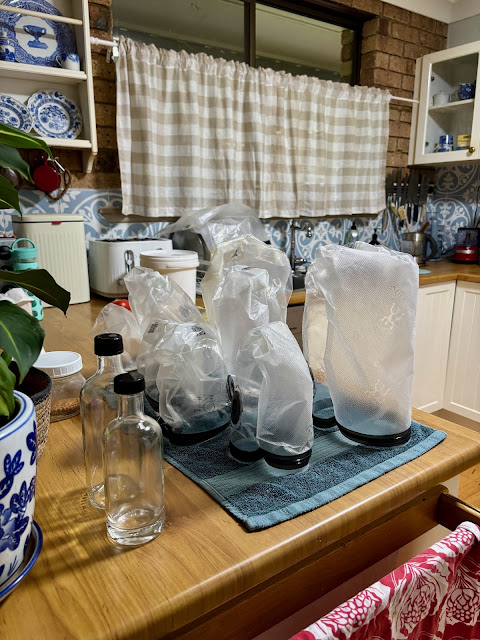
Every morning when I walk into my kitchen it looks tidy and ready for a day's work. Not so on this morning (above), I saw this when I walked in. Late the previous afternoon when I was looking for something, I came across my rolled up Zwilling vacuum bags and decided they had to be washed and dried. So I did that and although I usually put them outside on the verandah to dry it was dark by then. I turned the just-washed bags inside out and left them like this on a towel. It worked well and now the bags are ready to use when I bring home root vegetables, cabbages or whatever I buy that I want to last four or five weeks.
Image

You’ll save money by going back to basics

When I was doing the workshops and solo sessions, I had a couple of people whose main focus was on creating the fastest way to set up a simple life. You can't create a simple life fast, it's the opposite of that It's not one single thing either - it's a number of smaller, simpler activities that combine to create a life that reflects your values; and that takes a long to come together. When I first started living simply I took an entire year to work out our food - buying it, storing it, cooking it, preserving, baking, freezing, and growing it in the backyard. This is change that will transform how you live and it can't be rushed.  
Image


Trending Articles

NOT the last post

This will be my last post here.  I've been writing my blog for 18 years and now is the time to step back. I’ve stopped writing the blog and come back a couple of times because so many people wanted it, but that won’t happen again, I won’t be back.  I’ll continue on instagram to remain connected but I don’t know how frequent that will be. I know some of you will be interested to know the blog's statistics. 
Image

Every morning at home

Every morning when I walk into my kitchen it looks tidy and ready for a day's work. Not so on this morning (above), I saw this when I walked in. Late the previous afternoon when I was looking for something, I came across my rolled up Zwilling vacuum bags and decided they had to be washed and dried. So I did that and although I usually put them outside on the verandah to dry it was dark by then. I turned the just-washed bags inside out and left them like this on a towel. It worked well and now the bags are ready to use when I bring home root vegetables, cabbages or whatever I buy that I want to last four or five weeks.
Image

You’ll save money by going back to basics

When I was doing the workshops and solo sessions, I had a couple of people whose main focus was on creating the fastest way to set up a simple life. You can't create a simple life fast, it's the opposite of that It's not one single thing either - it's a number of smaller, simpler activities that combine to create a life that reflects your values; and that takes a long to come together. When I first started living simply I took an entire year to work out our food - buying it, storing it, cooking it, preserving, baking, freezing, and growing it in the backyard. This is change that will transform how you live and it can't be rushed.  
Image

Creating a home you'll love forever

Living simply is the answer to just about everything. It reduces the cost of living; it keeps you focused on being careful with resources such as water and electricity; it reminds you to not waste food; it encourages you to store food so you don't waste it and doing all those things brings routine and rhythm to your daily life. Consciously connecting every day with the activities and tasks that create simple life reminds you to look for the meaning and beauty that normal daily life holds.  It's all there in your home if you look for it. Seemingly mundane tasks like cleaning and cooking help you with that connection for without those tasks, the home you want to live in won't exist in the way you want it to.  Creating a home you love will make you happy and satisfied.
Image

Time changes everything

I've been spending time in the backyard lately creating a contained herb and vegetable garden. My aim is to develop a comfortable place to spend time, relax, increase biodiversity and encourage more animals, birds and insects to live here or visit. Of course I'd prefer my old garden which was put together by Hanno with ease and German precision. Together, we created a space bursting at the seams with herbs, vegetables and fruity goodness ready to eat and share throughout the year. But time changes everything. What I'm planning on doing now, is a brilliant opportunity for an almost 80 year old with balance issues. In my new garden I'll be able to do a wide range of challenging or easy work, depending on how I feel each day. It’s a daily opportunity to push myself or sit back, watch what's happening around me and be captivated by memories or the scope of what's yet to come.
Image

It's the old ways I love the most

I'm a practical woman who lives in a 1980’s brick slab house. There are verandahs front and back so I have places to sit outside when it's hot or cold. Those verandahs tend to make the house darker than it would be but they're been a great investment over time because they made the house more liveable. My home is not a romantic cottage, nor a minimalist modern home, it's a 1980’s brick slab house. And yet when people visit me here they tell me how warm and cosy my home is and that they feel comforted by being here. I've thought about that over the years and I'm convinced now that the style of a home isn't what appeals to people. What they love is the feeling within that home and whether it's nurturing the people who live there.
Image

Making ginger beer from scratch

We had a nice supply of ginger beer going over Christmas. It's a delicious soft drink for young and old, although there is an alcoholic version that can be made with a slight variation on the recipe. Ginger beer is a naturally fermented drink that is easy to make - with ginger beer you make a starter called a ginger beer plant and after it has fermented, you add that to sweet water and lemon juice. Like sourdough, it must ferment to give it that sharp fizz. To make a ginger beer plant you'll need ginger - either the powdered dry variety or fresh ginger, sugar, rainwater or tap water that has stood for 24 hours to allow the chlorine to evaporate off. You'll also need clean plastic bottles that have been scrubbed with soap, hot water and a bottle brush and then rinsed with hot water. I never sterilise my bottles and I haven't had any problems. If you intend to keep the ginger beer for a long time, I'd suggest you sterilise your bottles. MAKING THE STARTER In a...
Image

An authentic look at daily life here — unstaged and real

Most days Hanno was outside happily working in the fresh air. It may surprise you to know that I started reading my book,  Down to Earth , yesterday - the first time since I wrote it 13 years ago.  I had lent it to my neighbor, and when she returned it, I started reading, expecting to find surprises. Instead, I realised the words were still familiar—as if they were etched into my memory. As I flipped through the pages, I was reminded of how important it was for me to share that knowledge with others. The principles in Down to Earth changed my life, and I truly believed they could do the same for others. After just 30 minutes of reading, I put the book down, reassured that its message still holds true: we can slow down and reshape our lives, one step at a time.
Image