down to earth

  • Home
  • About Us
  • Down To Earth Book
  • Privacy Policy


I cleaned out my work room on Saturday, a job that had been waiting for me since the wedding. With Tricia and I rummaging in the fabric stash for quilt fabric and thread, and the various other activities associated with the wedding, looking for ribbons and pins, it was quite evident it needed some order restored. I spend quite some time in my work room now that I'm writing the book every day. My laptop is in there, along with the sewing machine and my knitting supplies so at times it's the centre of a lot of activity. But it's quiet and away from the general pace of our home so it suits me well as a work room.


I reorganised the desk top, moving the sewing machine to a better position, folded fabric and ribbons, sorted and stored cotton reels, paired up knitting needles and found two bodkins, lost for a month or so, that were poked into balls of wool. When I pulled them out of the wool, I remembered putting them in there for safe keeping. Ahem. I was sure I would remember that. :- )


But there was one tragedy - I have two baskets and one box full of wool and cotton, and one of the baskets had been attacked by wool moths! I initially saw tiny white casings, that I since discovered are their skins or shells that they grow out of quickly. Along with the tiny white bits were droppings. Ugh. And, of course, wool that had been eaten through so that although the entire ball was not eaten, they'd eaten through the strands leaving me with lots of strands instead of one continuous one. I threw three balls into the compost. It was only the pure wool they went for, they left the cotton alone.


The contents of the wool basket, in the sun, after inspection and culling of damaged wool.

These are clothes/wool moths. They're sort of greyish with dark spots on the wings, although I imagine each continent would have their own wool moth. They aren't pantry moths that eat grain. I don't use moth balls or naphthalene. The International Agency for Research on Cancer classifies naphthalene as possibly carcinogenic to humans and animals, but I'll take the simple way, they're killed by freezing. I have emptied my basket of wool and cotton and it's been sitting in the sun on the back veranda. I'll bag it up and put it in the freezer for a week and then store it all in air tight containers. I have learned a valuable lesson.

Everything you ever wanted to know about the wool moth.
And more, with photos.
How to store wool.

I invite you all to share any information you have on these moths, particularly the keen knitters who have stashes of wool in their homes just like I do. How are you storing your pure wool? What do you do with the woollen clothes you're wearing, do you store them in any special way when they're not in use?

I came across a very good series of You Tube videos on dehydrating foods recently. There are a few there and well worth taking some time for.

Also, this site has some excellent advice on preserving/canning.

I hope you're enjoying your weekend.
A reader asked me to write more on dishcloths - she is having problems with the cloths she knitted because they're too thick and don't dry out properly. I had the same problem with some of my Lions cotton cloths. They're fine in summer, but in winter they don't dry out well. I also found some of the thick cloths aren't very good for cleaning delicate things like wine glasses or fine vases.


My dishcloths needed to evolve, I needed to make lighter cloths. So using no real pattern I made a few lighter cloths using 4 ply cotton or 2 ply cotton - the traditional crochet cotton. If you only have 8 ply cotton, you could try knitting with larger needles to give you a looser weave and a not so thick cloth. I'm really happy with the new cloths - I use a light one about 50 percent of the time. They're easier to work with, especially now it's colder, and I find it's much easier cleaning glasses with the lighter cloth.

If you're trying to stop buying disposable items at the supermarket, home knitted dish cloths will fill that spot where you used to buy sponges or cotton cloths from the shop. Eventually they get too grotty to use and most people throw them out. The idea behind the cotton dishcloth that you make yourself, is that it's stronger and therefore can be washed with the normal washing many times before it starts showing signs of age. I have cloths here I've used for three years and they're still going strong.


I usually have about 15 - 20 cloths in my wire basket waiting to be used at any one time. I can change them every day if I want to but usually change them every second day. They're highly absorbent and can be used for a variety of household chores like dusting, cleaning, and polishing. I use different cloths in the kitchen, the laundry and the bathroom. All are colour coded so I know where they go back to after they've been washed and hung in the sun to dry.


This is 4 ply cotton at front and 2 ply at back (red and beige).

Knitting dishcloths is a good practical exercise if you are new to knitting. It will teach you your basic stitches and in the end, you have something you can use in the home. Do enough dishcloths and you'll slowly gain the confidence to tackle larger items. Keep in mind, you can practise any new stitches on your dishcloths before you try them on a jumper or scarf.

One of the best gifts to give either man or woman is a bar of home made soap and a knitted wash cloth. So if you haven't yet fallen for the old fashioned charms of the knitted cloth, think of those gifts and grab your needles.

Here is a lovely pattern for a knitted cloth from I live on a farm.
And some new (to me) patterns at Tipnut.
A link to the type of cottons I'm talking about.


Next in the series of readers questions is how to start living simply.

Well, the answer to this is to know why you want to simplify your life. Is it because you feel stressed all the time? Are you concerned about the chemicals in your life? Are you moving to another house and want to change the way you live along with everything else? Are you trying to save money? Or are you tired of living with debt and stress and long to return to a gentler way of life? There are probably as many reasons to simplify as there are people reading this post, so let me tell you where I started and maybe that will work for you too.


When I stopped working for a living I had not thought about simplifying but I had grown up in the 1950s and remembered a life much simpler than the one I was living. Before I married, when I lived in isolated parts of Australia, I stockpiled, I gardened when I was younger and the first pets I ever bought for my sons were chooks. Those chooks taught them so much - about gentleness, attention to detail and the never-ending responsibility of providing food and water for pets. I have been 'green' most of my life but had never reflected that in my life consistently or with conviction.

I suppose I was ripe for the picking.

I wanted to live in a different way, I wanted to leave the stress of "normal" life behind me, I wanted to slow down, be quieter and more in touch with my family and my natural surroundings. And while I did all that I wanted to open myself up to whatever my life would hold at this point. Whatever was out there I wanted to "know it by experience" as Thoreau would say. I looked forward to collecting eggs and honey, to growing food fit for a king's table and living a meaningful life. I wanted to say goodbye to gossip, meaningless celebrities, greed and having everything at any price and hoped to discover a world where grace, respect and enrichment filled the sweet air I breathed. Boy, did I hit the mother lode when I started to slow down and live according to my values. It was all there; I found what I hoped for and much more.


I started by organising my money in more accountable ways, by making a budget and sticking to it and by cutting back a lot on what I was buying. I shopped in a different way - what used to be one chaotic weekly trip to the supermarket and a few other trips back to pick up things I'd forgotten, turned into a planned monthly shopping trip. We started planning our trips out and doing as much as we could each time we went out instead of making a lot of little trips for one or two things.

I started stockpiling, then my grocery shopping was even less frequent. This gave me a lot more time at home and that time was put into the vegetable garden. Over the first few years we produced vegetables only during the cooler months, having summer as our down time, but as we came to rely more on the garden produce, we continue planting year round.

To help our garden produce at its best, we have compost brewing all the time, we added a worm farm for castings and worm tea, and of course, we always have chickens in the backyard. We bought our first about 25 years ago when the boys were little and we still enjoy the clucking outside. The backyard wouldn't be the same without the chooks. At the moment, we're building up our fruit production. We had lemons, bananas, loquats, oranges, pecans and passionfruit since we arrived here, in the past few years we've added pink grapefruit, mandarins (clementines), blueberries, red paw paw (papaya) and avocados.


I started preserving/canning and freezing to save various excesses in the garden and to be sure we had good home made sauces, relishes and jams. I have always cooked from scratch so no changes there but we did stop buying the occasional takeaway meal and I developed a set of fast food that I could make at home. I also tried my hand at cheese making, fermenting - sauerkraut and vinegar, and baking.


In an endeavour to cut costs and stop bringing chemicals into our home I started making homemade cleaners and vegetable oil soap. This is one of the few areas Hanno isn't quite fully onboard with yet. I use the homemade soap to wash my hair but he's using a Neutragena shampoo at the moment and he still buys detergents ever so often, but he's promised to not do that in the future. He loves the homemade laundry powder and the other bicarb, lemon and vinegar concoctions I use, so we haven't gone too far off our course.

I love knitting and stitchery but the truth is I see them as part of my housework. I mend rather than throw out and I look after what we own so we use everything fully. I knit for the pure and simple reason that we need knitted dish cloths and face cloths and various woollies for winter wearing. I'm knitting a pair of fingerless mittens for Hanno now and will then knit him a pure wool jumper (sweater). Handiwork also provides gifts for giving throughout the year. Our gift for Shane and Sarndra at their wedding last month was a queen size wedding quilt. It was a gift I felt really good about giving them and they accepted with gratitude, I'm sure they'll treasure it for a long time. But there are also smaller gifts for birthdays and Christmas and more and more I'm finding people appreciate the time and effort that has gone into a hand made gift.

So as you can see, once we started living a more simple life, one thing lead to the next and it grew organically to what we have today. I think most plans will develop themselves once the first step has been taken; it's always that first step that's the most difficult. And make sure you remember that my life and what I've just described for you certainly isn't the only version of a simple life. You don't have to give up work or wait until your children leave home and you don't have to be living in the country. You can do this anywhere, at any time. Cut back on your spending, look at the way you feed yourself and change what you can for the better, teach your self how to bake, sew, knit and whatever you do, be pleased with what you achieve, don't dwell on what you haven't done. That will be waiting for you when you can manage it.

So now to the important part - we've talked so far about the practical side of simplicity, but you also need to think about yourself and your life in a different way, and you need to slow down, stop multi-tasking and be kind to yourself. As soon as you make your first step, say to yourself that you're living simply, tell others, if they ask, that you can't go shopping with them because: "I decided to live more simply, I won't be going out shopping very much now. I'm saving to pay off my debts." Just hearing yourself say that will affirm your change. Build on it by thinking about your life and your changes every day. This way of living is as much about how you think about yourself and your life as it is about the practical things you do everyday. If you do many of the things I've described but still think of yourself as a shopper and long to get back to the mall, that is where you'll end up. You have to develop a simple mindset. Think about the values you want to live by. I want generosity, kindness, grace and respect in my life, and I consciously work on ways to live to those values. If you can, take time out for yourself every day. Think about ways you can reconnect with your family and how you can develop your simple life.

And then, just do it.


Day three of readers questions and this subject seems to be a favourite one here - homemaking. I really enjoy writing about this because I think we don't have enough homemaking role models and, as a job, it's often devalued by people around us.

And why is that? Why is homemaking as a career seen as such a dull and dead end thing to do? I think it has a lot to do with money. Homemakers aren't paid in hard cash, homemakers, my friends, are paid in love and the warm affection and appreciation of a close family. But it's not worth the time worrying about how we are viewed. Like most homemakers I just get on with the job and let the comments land where they may.


I know that my life is better now that I take care of my home and family as my main concern. It wasn't always the case. I used to dislike housework and paid for home help when I was working outside the home. That kept me at arm's length and I never really knew the significance of caring for a home until I gave up work and came home. I really returned to my home in its fullest sense. I stopped the nonsense of not wanting to do housework, and that was the making of me. I realise now that the day to day tasks of homemaking - the bed making, sweeping, cleaning, laundry, cooking and a hundred other things, created the person I have become. Those tasks slowed me down enough for me to focus on my work, to value it and to see that making a home comfortable, safe and warm remakes me and gives my family a gift like no other.

What else could help prepare our families for their day as much as a warm, clean bed, a good healthy breakfast and encouragement as they walk out the door? Where else but at home could we raise our children with a feeling of being loved, safe and wanted? Who else could stand as a strong role model for a child but a loving and confident homemaker who teaches by example the values of self confidence, hard work, honesty and common sense? And BTW, I think common sense is not so common and it is a skill to be taught like any other.


My children have left home now and are building good lives for themselves. Now my homemaking nourishes Hanno and I. I am grateful that I came home when I did and discovered the true feeling of living well in a place of my own making. Nothing else gives the satisfaction of knowing that the efforts of my day give me a place to land when times are tough. I know that we can regain our strength here, no matter how hard we have worked, and I know that whatever I put into my home is returned to me ten-fold.

There is a lot to be said about the art of homemaking. I could write here all morning about the tasks that build character and demonstrate love and care but what I want to encourage in you is the knowledge that no matter what you hear or read about being at home with your children, what you're doing is one of the most important things you'll ever do. Don't listen to the naysayers, don't judge yourself or your calling to be at home by what others may say about it. Keep reminding yourself that nurturing your family with the results of your daily homemaking tasks help make you and build character. Know, deep down to your core, that raising children to be decent, hardworking people who will go on to contribute to their country and build their own family is as important a job as any other.


I have just had two days at work, today I'll be here at home all day. Nothing makes me more content knowing I can potter around, doing this and that, getting through my daily tasks. Hanno will wake soon, we'll have breakfast together and then start our work. He will probably be outside while I work inside but we'll meet for morning tea on the front veranda later in the morning. Morning tea together, sitting in the sun, talking about our plans, is one of the rewards of this life for us. It's a simple thing but it symbolises the gentle nature of our lives now, rewards us for what we've already achieved and sets us up for what is to come. The rewards of being a homemaker are many - they may not involve cash but they're there for the taking, and they are renewed everyday simply by working in our homes.

All graphics from here.

This is the second in the series of readers questions. Today, companion planting and natural insect control, and another lady wanted anything to do with gardening; so two birds, one stone. ;- )


I have to be honest and tell you that I'm not a real believer in the repellent kind of companion planting. I think that a few plants benefit being planted together, but in my experience it's not many. However, I am a big fan of flowers in the vegetable garden that help attract the right kind of insects. That kind of companion planting works very well.


Here is a list of companion plants. The repellent plants I think work well in the garden are marigolds, wormwood and nasturtiums. Marigolds help rid the garden of nematodes, and nasturtiums or wormwood are good planted close to the cabbage family as they attract the white cabbage moth away from the plants.


There are a lot of flowers that will serve you well in the vegie patch. Of course you need bees and other pollinating insects if you're growing flowing vegetables like tomatoes, beans, pumpkins and potatoes. Bees are attracted by most flowers because they collect nectar to make honey and pollen to feed to the larvae. Going from flower to flower to collect as much as they can before going back to the hive, they take pollen from one plant to the next and help with plant fertilisation as they go. Flowering plants are a must in a vegetable patch. Some of the best include: allysium, red clover, Queen Anne's lace, cosmos, coriander, parsley flowers, dill, small daisies and lucerne.


There are plenty of other good insects you'll want in your garden, like lady beetles, lace wings and hoverflies. Beneficial garden insects are listed here. And yes, it lists spiders and some wasps as being good bugs. If you're afraid of spiders and stinging insects, I encourage you to sit in the garden one day when it's sunny and just watch the insects at work. They won't take much notice of you but you'll see them working away for their own benefit, and for yours. If you don't try to kill them or catch them, they'll stay out of your way. They're part of the natural environment you're trying to reconnect with out in the garden, so work with them, not against them.

Here is an excellent site containing information about organic pest control with some recipes for natural garden sprays.


But there is no replacement for the time honoured tasks of weeding and observation. If you weed out all the places some insects use to hide and overwinter, you'll get rid of a big problem. And going into the garden to look at your plants as often as possible will show you straight away if there are caterpillars chewing on leaves or tiny black spots that indicate insect activity. If you can get into the habit of looking, and picking off the bad bugs you find, you'll be on your way towards a healthy organic garden.


This week I'll be answering the questions asked by readers last week. The first is on retirement.

I guess we fell into retirement without thinking too much about it. Well, maybe I did that, Hanno probably didn't, he's very careful and always plans, especially when finances are involved. Nevertheless, we both found ourselves "retired" - he is well and truly over retirement age (65 years) and gets a pension, I am still under retirement age and earn a bit of money writing. We are among the first of the baby boomers, and in Australia, the laws on superannuation (401K) only came into being during the early 1990, so we didn't come to this life with a pile of cash sitting in a retirement fund. Very few early boomers have cushy little nest eggs on which to travel the world and those who do would probably have lost a lot of it during this recession, if they invested in shares or real estate. We have a few shares but they lost a lot of value in the past year and I have a small amount of superannuation cash waiting for me when I turn 65.

I have never believed that we needed anywhere near what financial planners say you need - it's something like $500,000 per person! We live on less than $25,000 a year and pensions well and truly cover that. Of course, it depends on how well your own country provides for its elders ,but it also relies on debt - if you do have debt, it would be very difficult to retire on a small amount. We are lucky and paid off all our debt many years ago, we own our home and we're in good health. Health plays a part too, and we have kept our private health insurance - that is covered in our $25,000 a year. We do have free medical and hospital care in my country but it's slow, you go on waiting lists, and we want the comfort of knowing we can have the best of health care if either one of us is ill. But I don't want to make this post solely about money, because if you live as we do, while money is important, it's not the most important thing.

And please note, I am not a financial adviser, have never worked in any industry connected with banking or investments and I'm merely relaying our circumstances to you so you can understand our retirement, and maybe work on your own plans.

If you plan on a simpler lifestyle when you retire, yes, pay off debt first and put away some money, but above all else, develop a set of skills that will help you live the way you want to live. Learn to cook from scratch, learn how to bake, sew and mend, Work out what you'll do with an over abundance of vegetables - will you freeze or preserve/can? While you're still working, buy the tools and appliances you'll need to do all those daily and seasonal tasks.


Look critically at your home, will it support you in retirement? You'll have a lot more time to work at home - time to produce food in the backyard, raise chickens for eggs or meat, harvest honey from bee hives. Will you be able to do those things where you are now? Do you know how to sew, knit and mend? If you answered no, now is the time to learn. What about home maintenance and supporting your lifestyle with home servicing? Doing your own will save a lot of money. Learn how to unblock drainpipes, change the oil on the car, service the lawn mower, and clear the guttering on the roof. These activities will not only save you money, they'll fill your hours, keep you fit and active and give you purpose. Instead of working for a living, you'll be working for your life.

Get used to not buying clothes and shoes every year - fashion is overrated anyway. Develop your own style that is plain and simple and be proud that you've stared down the fashion police. If you don't already do it, buy the best quality you can afford and products that can be repaired. You want things to last as long as possible so look for value for money instead of the cheapest price. If you are both working, see if you can live on one income now, and save the other income for buying water tanks, solar panels or a reliable, and cheap to run, car.


I encourage you to do all these things and also to think about your life and what will make you happy. Living simply is a lot of work and as long as you go in knowing and embracing that you can't go far wrong. You will be disappointed however, if you think this life we live is easy. It's satisfying, enjoyable, rewarding and wonderful but it's not always easy. You have to really know that.

But if you want to feel content with life and proud of what you do for yourself, if you want to take your life by the collar and give it a good shake, then this is the life for you. We can do whatever we feel like doing most days, we have the satisfaction of growing some of our own food, eating healthy food, taking each day slowly and we grow confident knowing we can look after ourselves, even if a major disaster occurred. We have grown closer to our own lives, we provide the raw materials for many of the things we need, we aren't passive bystanders any more.

I guess our example shows that if you have no debt, own your own home, have the space to grow some food and the knowledge to put some of that food up for later in the year, if you can conserve rather than spend and be happy doing that, then this kind of retirement may suit you too. It's probably the opposite to what a mainstream retirement is - whereby you save and invest as much as possible so you can stop work, relax and travel. We look forward to the work we do now, because the work helps give purpose to each day.

So if you are looking for a retirement that keeps you busy, entertained and thoughtful, if you want to feel in control of your life, if you are prepared to do simple honest work for the rest of your life, then start preparing for it now - in developing your skill set that will deliver to you a life like no other. I am here to show you it is possible, the hard bit is up to you - are you ready for it?

I watch Compass every week and saw this BBC program last week. It's a very interesting look at two Amish families in Lancaster County. You can watch it from the Compass site.
Newer Posts Older Posts Home

Search here

Total Pageviews

Translate


I'm Rhonda Hetzel and I've been writing my Down to Earth blog since 2007. Although I write the occasional philosophical post, my main topics include home cooking, happiness and gardening as well as budgeting, baking, ageing, generosity, mending and handmade crafts. I hope you enjoy your time here.

MY FAVOURITE PLACES

  • Grandma Donna's Place
  • Grandma Donna's YouTube
  • Grandma Donna's Instagram
  • This Simple Day
  • Nicole's Instagram

Give More

Give More

Popular posts last year

Making ginger beer from scratch

We had a nice supply of ginger beer going over Christmas. It's a delicious soft drink for young and old, although there is an alcoholic version that can be made with a slight variation on the recipe. Ginger beer is a naturally fermented drink that is easy to make - with ginger beer you make a starter called a ginger beer plant and after it has fermented, you add that to sweet water and lemon juice. Like sourdough, it must ferment to give it that sharp fizz. To make a ginger beer plant you'll need ginger - either the powdered dry variety or fresh ginger, sugar, rainwater or tap water that has stood for 24 hours to allow the chlorine to evaporate off. You'll also need clean plastic bottles that have been scrubbed with soap, hot water and a bottle brush and then rinsed with hot water. I never sterilise my bottles and I haven't had any problems. If you intend to keep the ginger beer for a long time, I'd suggest you sterilise your bottles. MAKING THE STARTER In a...
Image

NOT the last post

This will be my last post here.  I've been writing my blog for 18 years and now is the time to step back. I’ve stopped writing the blog and come back a couple of times because so many people wanted it, but that won’t happen again, I won’t be back.  I’ll continue on instagram to remain connected but I don’t know how frequent that will be. I know some of you will be interested to know the blog's statistics. 
Image

How to make cold process soap

I'm sure many of you are wondering: "Why make soap when I can buy it cheaply at the supermarket?" My cold process soap is made with vegetable oils and when it is made and cured, it contains no harsh chemicals or dyes. Often commercial soap is made with tallow (animal fat) and contains synthetic fragrance and dye and retains almost no glycerin. Glycerin is a natural emollient that helps with the lather and moisturises the skin. The makers of commercial soaps extract the glycerin and sell it as a separate product as it's more valuable than the soap. Then they add chemicals to make the soap lather. Crazy. Making your own soap allows you to add whatever you want to add. If you want a plain and pure soap, as I do, you can have that, or you can start with the plain soap and add colour, herbs and fragrance. The choice is yours. I want to add a little about animal and bird fat. I know Kirsty makes her soap with duck fat and I think that's great. I think t...
Image

Preserving food in a traditional way - pickling beetroot

I've had a number of emails from readers who want to start preserving food in jars but don't know where to start or what equipment to buy.  Leading on from yesterday's post, let's just say up front - don't buy any equipment. Once you know what you're doing and that you enjoy preserving, then you can decide whether or not to buy extra equipment. Food is preserved effectively without refrigeration by a variety of different methods. A few of the traditional methods are drying, fermentation, smoking, salting or by adding vinegar and sugar to the food - pickling. This last method is what we're talking about today. Vinegar and sugar are natural preservatives and adding one or both to food sets up an environment that bacteria and yeasts can't grow in. If you make the vinegar and sugar mix palatable, you can put up jars of vegetables or fruit that enhance the flavour of the food and can be stored in a cupboard or fridge for months. Other traditional w...
Image

Cleaning mould from walls and fabrics

With all this rain around we've developed a mould problem in our home. Usually we have the front and back doors open and that good ventilation stops most moulds from establishing. However, with the house locked up for the past week, the high humidity and the rain, mould is now growing on the wooden walls near our front door and on the lower parts of cupboards in the kitchen. Most of us will find mould growing in our homes at some point. Either in the bathroom or, in humid climates, on the walls, like we have now. You'll need a safe and effective remedy at some point, so I hope one of these methods works well for you. Mould is not only ugly to look at, it can cause health problems so if you see mould growing, do something about it straight away. The longer you leave the problem, the harder it will be to get rid of it effectively. If you have asthma or any allergies, you should do this type of cleaning with a face mask on so you don't breathe in any spores. Many peopl...
Image

Five minute bread

Bread is one of those foods that, when made with your own hands, gives a great deal of satisfaction and delight. It's only flour and water but it symbolises so much. I bake bread most days and use a variety of flours that I buy in bulk. Often I make a sandwich loaf because we use most of our bread for lunchtime sandwiches and for toast. Every so often I branch out to make a different type of loaf. I have tried sour dough in the past but I've not been happy with any of them. I'll continue to experiment with sour dough because I like the idea of using wild yeasts and saving the starter over a number of years to develop the flavour and become a part of the family. However, the loaf I've been branching out to most often is just a plain old five minute bread. By five minutes I mean it takes about five minutes actual work to prepare but it's the easiest of all bread to make and to get consistently good loaves from. If you're having people around for lunch or...
Image

This is my last post.

I have known for a while that this post was coming, but I didn't know when. This is my last post. I'm closing my blog, for good, and I'm not coming back like I have in the past.  I've been writing here for 16 years and my blog has been many things to me. It helped me change my life, it introduced me to so many good people, it became a wonderful record of my family life, it helped me get a book contract with Penguin, and monthly columns with The Australian Women's Weekly and Burke's Backyard . But in the past few months, it's become a burden. In April, I'll be 75 years old and I hope I've got another ten years ahead. However, each year I'll probably get weaker and although I'm fairly healthy, I do have a benign brain tumour and that could start growing. There are so many things I want to do and with time running out, leaving the blog behind gives me time to do the things that give me pleasure. On the day the blog started I felt a wonderful, h...
Image

What is the role of the homemaker in later years?

An email came from a US reader, Abby, who asked about being a homemaker in later years. This is part of what she wrote: "I am a stay-at-home mum to 4 children, ages 9-16. I do have a variety of "odd jobs" that I enjoy - I run a small "before-school" morning drop-off daycare from my home, I am a writing tutor, and I work a few hours a week at a local children's bookstore. But mostly, I cherish my blissful days at home - cooking, cleaning (with homemade cleaners), taking care of our children and chickens and goats, baking, meal-planning, etc. This "career" at home is not at all what I imagined during my ambitious years at university, but it is far more enriching. I notice, though, that my day is often planned around the needs of my family members. Of course, with 4 active kids and a husband, this is natural. I do the shopping, plan my meals, cook dinner - generally in anticipation of my family reconnecting in the evening.  I can't h...
Image

Every morning at home

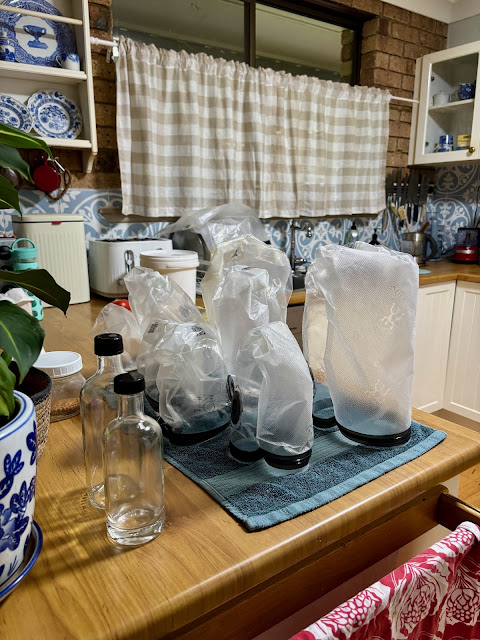
Every morning when I walk into my kitchen it looks tidy and ready for a day's work. Not so on this morning (above), I saw this when I walked in. Late the previous afternoon when I was looking for something, I came across my rolled up Zwilling vacuum bags and decided they had to be washed and dried. So I did that and although I usually put them outside on the verandah to dry it was dark by then. I turned the just-washed bags inside out and left them like this on a towel. It worked well and now the bags are ready to use when I bring home root vegetables, cabbages or whatever I buy that I want to last four or five weeks.
Image

You’ll save money by going back to basics

When I was doing the workshops and solo sessions, I had a couple of people whose main focus was on creating the fastest way to set up a simple life. You can't create a simple life fast, it's the opposite of that It's not one single thing either - it's a number of smaller, simpler activities that combine to create a life that reflects your values; and that takes a long to come together. When I first started living simply I took an entire year to work out our food - buying it, storing it, cooking it, preserving, baking, freezing, and growing it in the backyard. This is change that will transform how you live and it can't be rushed.  
Image


Trending Articles

NOT the last post

This will be my last post here.  I've been writing my blog for 18 years and now is the time to step back. I’ve stopped writing the blog and come back a couple of times because so many people wanted it, but that won’t happen again, I won’t be back.  I’ll continue on instagram to remain connected but I don’t know how frequent that will be. I know some of you will be interested to know the blog's statistics. 
Image

Every morning at home

Every morning when I walk into my kitchen it looks tidy and ready for a day's work. Not so on this morning (above), I saw this when I walked in. Late the previous afternoon when I was looking for something, I came across my rolled up Zwilling vacuum bags and decided they had to be washed and dried. So I did that and although I usually put them outside on the verandah to dry it was dark by then. I turned the just-washed bags inside out and left them like this on a towel. It worked well and now the bags are ready to use when I bring home root vegetables, cabbages or whatever I buy that I want to last four or five weeks.
Image

You’ll save money by going back to basics

When I was doing the workshops and solo sessions, I had a couple of people whose main focus was on creating the fastest way to set up a simple life. You can't create a simple life fast, it's the opposite of that It's not one single thing either - it's a number of smaller, simpler activities that combine to create a life that reflects your values; and that takes a long to come together. When I first started living simply I took an entire year to work out our food - buying it, storing it, cooking it, preserving, baking, freezing, and growing it in the backyard. This is change that will transform how you live and it can't be rushed.  
Image

Creating a home you'll love forever

Living simply is the answer to just about everything. It reduces the cost of living; it keeps you focused on being careful with resources such as water and electricity; it reminds you to not waste food; it encourages you to store food so you don't waste it and doing all those things brings routine and rhythm to your daily life. Consciously connecting every day with the activities and tasks that create simple life reminds you to look for the meaning and beauty that normal daily life holds.  It's all there in your home if you look for it. Seemingly mundane tasks like cleaning and cooking help you with that connection for without those tasks, the home you want to live in won't exist in the way you want it to.  Creating a home you love will make you happy and satisfied.
Image

Time changes everything

I've been spending time in the backyard lately creating a contained herb and vegetable garden. My aim is to develop a comfortable place to spend time, relax, increase biodiversity and encourage more animals, birds and insects to live here or visit. Of course I'd prefer my old garden which was put together by Hanno with ease and German precision. Together, we created a space bursting at the seams with herbs, vegetables and fruity goodness ready to eat and share throughout the year. But time changes everything. What I'm planning on doing now, is a brilliant opportunity for an almost 80 year old with balance issues. In my new garden I'll be able to do a wide range of challenging or easy work, depending on how I feel each day. It’s a daily opportunity to push myself or sit back, watch what's happening around me and be captivated by memories or the scope of what's yet to come.
Image

It's the old ways I love the most

I'm a practical woman who lives in a 1980’s brick slab house. There are verandahs front and back so I have places to sit outside when it's hot or cold. Those verandahs tend to make the house darker than it would be but they're been a great investment over time because they made the house more liveable. My home is not a romantic cottage, nor a minimalist modern home, it's a 1980’s brick slab house. And yet when people visit me here they tell me how warm and cosy my home is and that they feel comforted by being here. I've thought about that over the years and I'm convinced now that the style of a home isn't what appeals to people. What they love is the feeling within that home and whether it's nurturing the people who live there.
Image

Making ginger beer from scratch

We had a nice supply of ginger beer going over Christmas. It's a delicious soft drink for young and old, although there is an alcoholic version that can be made with a slight variation on the recipe. Ginger beer is a naturally fermented drink that is easy to make - with ginger beer you make a starter called a ginger beer plant and after it has fermented, you add that to sweet water and lemon juice. Like sourdough, it must ferment to give it that sharp fizz. To make a ginger beer plant you'll need ginger - either the powdered dry variety or fresh ginger, sugar, rainwater or tap water that has stood for 24 hours to allow the chlorine to evaporate off. You'll also need clean plastic bottles that have been scrubbed with soap, hot water and a bottle brush and then rinsed with hot water. I never sterilise my bottles and I haven't had any problems. If you intend to keep the ginger beer for a long time, I'd suggest you sterilise your bottles. MAKING THE STARTER In a...
Image

An authentic look at daily life here — unstaged and real

Most days Hanno was outside happily working in the fresh air. It may surprise you to know that I started reading my book,  Down to Earth , yesterday - the first time since I wrote it 13 years ago.  I had lent it to my neighbor, and when she returned it, I started reading, expecting to find surprises. Instead, I realised the words were still familiar—as if they were etched into my memory. As I flipped through the pages, I was reminded of how important it was for me to share that knowledge with others. The principles in Down to Earth changed my life, and I truly believed they could do the same for others. After just 30 minutes of reading, I put the book down, reassured that its message still holds true: we can slow down and reshape our lives, one step at a time.
Image