down to earth

  • Home
  • About Us
  • Down To Earth Book
  • Privacy Policy
After we changed how we lived, going from crass consumerism to a more mindful way of living, I looked around and thought that Hanno and I might as well be living on an island because we'd isolated ourselves so much from our friends and neighbours. All that mindless buying was still happening in the general community and in the rare instance of telling someone what we were doing, I was always asked the most pointed of disheartening questions: why!?!
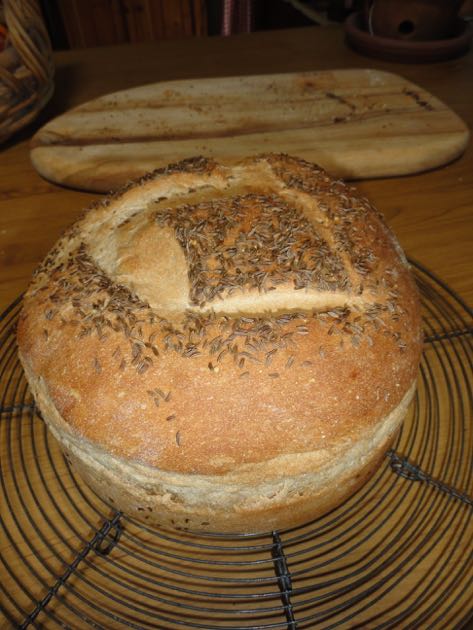
 Rye loaf with carraway seeds, made in a cake tin.

I knew I had to connect with like-minded people and the only way I knew how to do that was to volunteer to work in my community. I started working as a volunteer in a local neighbourhood centre and very soon after that, was appointed manager. We helped people with food parcels, warm blankets, clothes, budgeting, we offered a place to be during the day to connect and have coffee. I taught bread baking, soap making, and cooking from scratch. We set up a Centrelink office with a visiting worker one morning a week, we offered free workshops, a sewing circle, community garden, counselling and we had a variety of free services such as parenting support and playgroup, a free legal service, Alcoholics Anonymous and Narcotics Anonymous. There was a Flexischool attached, with 25 students.  Although I was tired at the end of every day, I was happy that I was surrounded by good people who shared many of my values.  During the time I was there we moved twice, from one old house to another, and then to a magnificent two million dollar purpose-built facility. I stayed there for seven years and only left when Hanno nearly cut off his hand with a chain saw and he needed me at home.

Delicious butter cake.

Quite a few things changed while I was there. I stopped judging others, made myself available to help whoever came along and I began encouraging and supporting those around me. I'm still proud of those personal changes because I believe they made me a better person, but I'm far from ideal and still have a lot of improvements to make. The biggest change was in 2008 when the global financial crisis hit. Many jobs were lost and although Australia faired better than most countries, many people were in dire straits here. The community relied on the neighbourhood centre more and after I left there a couple of years ago, it continued to grow to be a significant part of a caring community. 
Last year's flowering kohl rabi.
Surrounding yourself with like-minded people can happen in many different ways. Often there aren't the people in the community that you want to befriend but you can find them online. There are many people who comment here and the mutual feeling of friendship and support that has built up is amazing. I don't reply to as many comments as I'd like but I build up an idea of people just by reading their comments.

Volunteering in your community can place you in the middle of a group of people you'd never have met otherwise. It can be challenging but you can make it less threatening by joining a group whose values you support, such as the CWA, WI, a local craft group or church.


Support and encouragement can also be found in books and blogs. There are many others like me who write about the lifestyle changes we can all make. You might never meet the people who write what your read but just knowing you share similar tasks and seeing how others work can be incredibly motivating.

I'm heartened by seeing the changes that have happened in recent years. There are more people thinking about the consequences of consumerism and climate change and making positives changes to move towards simpler lives and sustainability. Farmers markets, local food and micro businesses have slowly moved into the mainstream making some food and lifestyle changes easier and cheaper.

Luffas waiting to be skinned.

There is no reason to feel isolated any more. Of course you have to make the move to connect with those around you, and it will take some effort on your part. If you're buying all, or some, of your weekly food and groceries at small businesses who make good soap and green cleaners, local producers of milk, vegetables, eggs and honey, the farmers of free range meat and chickens, then I'd be surprised if you remain isolated. The people who run those community business, and those you meet when you're shopping, will be able to tell you about community gardens, free workshops and activities you can get involved in. And when you do that, there will be no turning back.

How have you connected online and in your real life? What have you done that made a difference.

Sage flowers.

It's Friday again. What a week it's been here. Hanno is not feeling well but is taking Jamie to kindy every day and I've been working away like a trojan, dividing my time between writing, editing, housework and cooking. Consequently, there are not many links this week as I haven't had time to read as much as I usually do. As my mother used to say, at least we know we're alive. ;- )  

Thank you for your interesting and supportive comments during the week. I often wish I could respond more but I do read every one of the comments, I often smile when I read them, and when I close my blog down for the day, I always feel like I've spent time with friends.

It's a twin thing
Curios and curiouser: the weird and wonderful stuff that artists collect
Fat guidelines lacked any solid scientific evidence
Baby food from shops half as nutritious as homemade meals, study finds
Look at this nifty piece of lovely mending
17 excellent binding tutorials
A few readers have asked me to do a post about blogging, which I'm happy to do. I think the internet is one of the most powerful changes that ordinary people have had access to in my lifetime. The internet is one of those systems that is usually controlled by governments, and mere mortals like us don't often get anywhere near such influential and important technology. I'm pretty sure that if they'd known what it would develop into, there would have been government controls and we'd be paying through the nose to use it now. But here we are, able to Skype each other from one side of the world to the other, we can see how total strangers live by reading their blogs and just by writing what we want to write, we can publish those words to the world simply by pressing a button. It's the stuff revolutions are made of. It's truly remarkable.


If you've grown up in the age of Facebook and Skype, you probably take the ability to communicate freely all over the world in your stride. But I'm still in awe of it and probably will remain so till I stop tapping away on this keyboard. I grew up in a time when the only way you could have anything published in the newspaper was by taking a degree in journalism, and even then you had to brave the overabundance of editors and filters before your words were seen by a reading public.

Blogs changed everything. The filters disappeared and we got genuine free speech for the first time; although that has a down side too. All of a sudden there was an easy to use, free platform that anyone with a computer could use. It was too powerful a temptation for me and I started blogging in 2007, this will be my 2347th post. 

There are hundreds of websites with so called 'experts' who will tell you how to be a successful blogger but usually they equate 'success' with how to make money. I wanted to blog to get information out and to connect with people who understood what I was talking about. As a result, a diverse community has built up here. Some are quite vocal, some are silent, some email me with their news because they don't feel comfortable writing public comments. That's all fine by me.  


If you want to start a blog, I'd suggest you sign up to Blogger. It's a free site, owned by Google, so the site very rarely has any problems with downtime or hackers. You can start off with a very simple template, which gives your blog the look it displays to the world and as you learn more about blog technology, you can modify it to suit your own style. If you have an iphone or a digital camera, it's a simple process to take photos and videos and with a couple of clicks, they'll be published along with your words.

If you were to ask my advice about starting a blog, I'd tell you to write the truth in the best way you know how, to respect your readers, to be polite and interesting and to write about what you know. Decide straight away why you want to blog. Do you want to stay in touch with your family and friends? If so, you can have a private blog and invite those you know to join you. Do you want to develop your voice and an audience? You'll have a lot of competition, you'll have to write well, be interesting, write to your subject in an original and convincing way and in the beginning, you'll have to write every day, often with no audience.


Just to give you an idea of your competition and the work load: 
  • according to Wikipedia, in 2014, there were around 172 million Tumblr blogs and 75.8 million Wordpress blogs. Blogger is the most popular blogging platform in use, however Blogger does not publish their statistics. I've seen an estimate of there being about half a billion blogs world-wide.
  • bloggers who blog every day have five times more traffic than those who blog every few days or weekly.
  • quality content and page design are the two main factors in building your audience.
  • you'll get more links and readers if you use photos on your blog. Readers are more likely to connect to genuine bloggers and photos can be a way of telling your truth.

I didn't follow any of the commonly given advice when I started blogging, and still don't now. I think success is down to two things: good writing and good luck. I certainly think it's a wonderful way to improve writing and photography skills. Here are a few of the things I think are important:
  • Write well and often.
  • Know your subject.
  • Share what you know.
  • Encourage others.
  • Don't expect to build up a huge audience writing about your pet bird. Your subject matter needs to be fairly broad to attract readers.
  • Don't expect overnight success.
  • If you really think your blog is good but after a year you still have no audience, don't give up.
  • Visit other blogs writing the same topic and leave comments. If they're interesting comments, other people may follow the link back to your blog.
  • Don't steal words or photos from other blogs.
  • Read a guide to internet copyright.
Like most other new activities we learn, blogging takes a bit of patience, some applied psychology and a willingness to do your best. Apart from that, it just takes time.  Good luck!

Having a blog like this is like having a top notch psychologist on standby, 24/7. When I blow a gasket about something and mention it on the blog, all you lovely tender hearts ride in on white stallions and lift me up again. Thank you for your comments over the weekend. It's really nothing that it happened but it's everything that you reacted to what was said in the way you did. ♥︎ I've said it before but it's still true, my readers have the kindest hearts and I'm thankful every day for it.

= = = = = = 

With not much time over the weekend, I've chosen to do another pictorial post today. I recently restored thousands of daily life photos from a portable drive to my laptop. I hope you enjoy browsing through them.

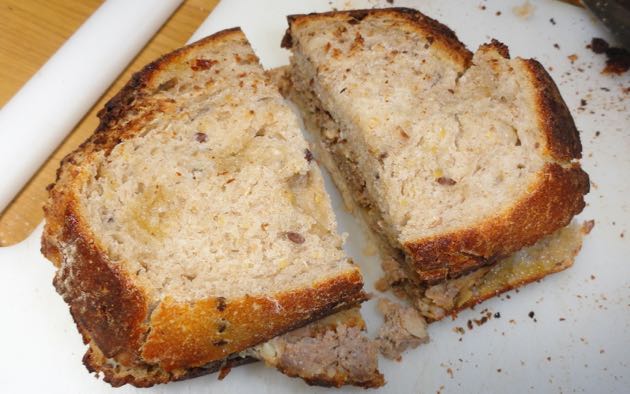
 Homemade bread and meat loaf. One of my favourite sandwiches.
There is often food-related work happening in our kitchen. Here is Hanno helping get nectarines ready for jam.
These apples were just a few of the dozens of apples we were given a couple of years ago. I forget what I did with most of them but I know there were a lot of apple turnovers and pies made.
 Above and below: making pasta.

Want to walk down memory lane with me?  Here are my sons, Shane and Kerry when they were little boys. Shane (right) would have been six there, and Kerry, five.
 And here we are in this torn photo from the late 1970s. I still have a giggle when I see this photo.
 There is always a drawer to be cleaned and tidied.
 And cook books to read.
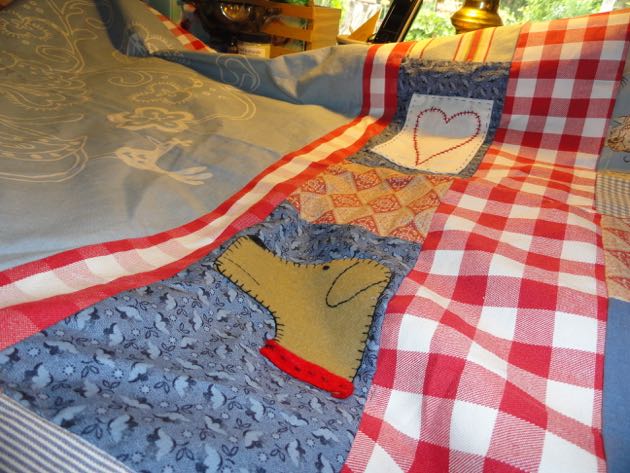
Tricia made this very pretty table cloth one year when she was visiting. It's made of scraps, old tea towels and pieces from my stash.
 You've heard of Sarah plain and tall?  This is Kathleen frizzled and round.
These gawky girls didn't know what to do on the first day they arrived to live with us.
This scene is a few minutes from our home. Yes, they are zebras and giraffes.
 It's Australia Zoo, the home of the Crocodile Hunter. This is a crocodile waiting to be fed.
I often write about Jamie being here but here is Alex when he stayed with us last Easter. I don't see him nearly as much as I'd like because Shane and Sarndra live a few hours drive away, but I think of him every day. 

Sorting through our vegetable seeds.
Time for morning tea and a homemade biscuit, and always fresh bread ready to be sliced.
I was asked recently what is the secret to a happy life. There is no secret. It's a long time since we earned the big dollars, but life is better now. It doesn't take much effort to make a happy life. Usually it's paid for in work rather than dollars and it is made better by sharing with our family. And that, my friends, is it in a nutshell - family, hard work and sharing.

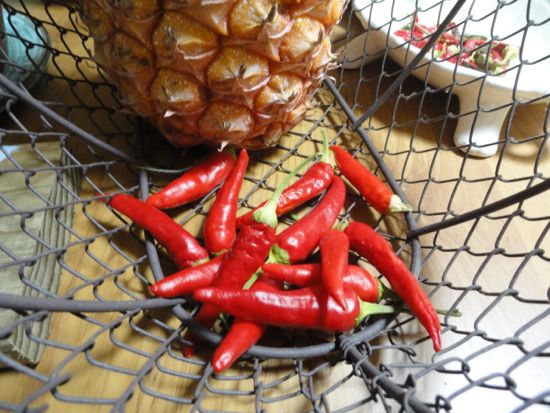
Homegrown hot chillies and garlic.

To the person who emailed, telling me in no uncertain terms, to categorise my links, I hope you aren't as rude in real life. The links are placed in the order I find them and will remain like that. Some days I wonder why I do this. :- \

The Australian’s obituary of Colleen McCullough is a sad reflection of how women’s lives are valued
I quit my job to set up a post-apocalyptic commune
Easy floor mattress for kids - I love this idea
Hurry up and slow down
When I travelled over to the next town a couple of weeks ago to pick up my bulk bread flour, I noticed they had chick pea flour.  I bought some for Sunny. She is making chickpea tofu with it. I haven't made it myself but the recipe seems quite easy and it looks like a very good alternative to soy tofu.
How to clean your sewing machine
Preserving lemons without salt
12 Ways Self-Sufficiency Will Make You a Happier Person
Latest issue of From Scratch magazine


We've lived here for 18 years, longer than we've lived in any other home. Before we arrived here, we'd moved 22 times. We're still refining our home, still settling in and allowing ourselves the luxury of changing things to suit our age and idea of ourselves. I still think of my home now as 'the new place". I guess I feel that because so many things changed when we moved. We developed a new way of living here and changed ourselves right down to the core in the process.

When we moved in we spent a couple of thousand dollars on the garden, we bought new furniture, added a bedroom and a new kitchen. We were supposedly putting "our stamp" on our home. Funny, no matter how much we spent, it never felt like much in those early years. My life was caught up in work, I didn't think about home; it was part of my life but it wasn't part of me. Of all the surprises that came my way in the past 18 years, knowing the relationship I have with my home now is one of the biggest. I feel that the house and land are a part of me now, part of my family and part of my history. I have no doubt that on the last day I'm alive, I'll be here, enjoying the birds, the aroma of the pine forest and the splendid feeling of warm, comfortable isolation I feel every day I live here.


We eventually put "our stamp" on our home but it wasn't by buying furniture or an instant garden. It was by living our ordinary days here. By doing house work and weeding and collecting eggs. The house knew much better than I did that buying things to feel at home is just temporary gloss. What it needed was time and love and years of bread baking in the oven and soup simmering on the stove. It needed the soft glow of candle light, the sound of newborn babies crying, the experience of hearing so much good news and some very sad news. I think all that living has been drawn into the fabric of the house now, even though it stands as a silent witness to what happens here.


Soon there will be the sound of another newborn baby's cry here, there'll be more out of tune renditions of "Happy Birthday", more garments produced with soft organic yarn, more Christmas trees being decorated, many more twinkling lights on humid summer evenings, more story books being read and maybe more books being written. And Hanno and I will live many more ordinary days here being totally fulfilled and made happy within the boundaries of our land. 

A few years ago, I wrote that we should all bloom where we are planted and over the years since, many people have told me that they took that to heart. I think I wrote that with such passion because that is what we've done here. Our twenty-third move was our last because this home compelled us to slow down and just live. There was no other requirement, no need of fancy furniture and appliances. All it needed from us was to work within these walls, to take the time to notice and appreciate what is here and to add many more memories as the years slip by.


I used to wear my hair longer when I was younger. I think I was in my late fifties when I had it cut short. Through all my young years I bought a variety of hair clips, most of them good quality French clips, and when my hair was shorter, they spent over a decade sitting in the bathroom drawer.  As many of you know, I haven't been to the hairdresser for a long time. Short hair is now longer, the weather is hot and I went searching for my clips to pull back my hair and get a little pony tail happening.  


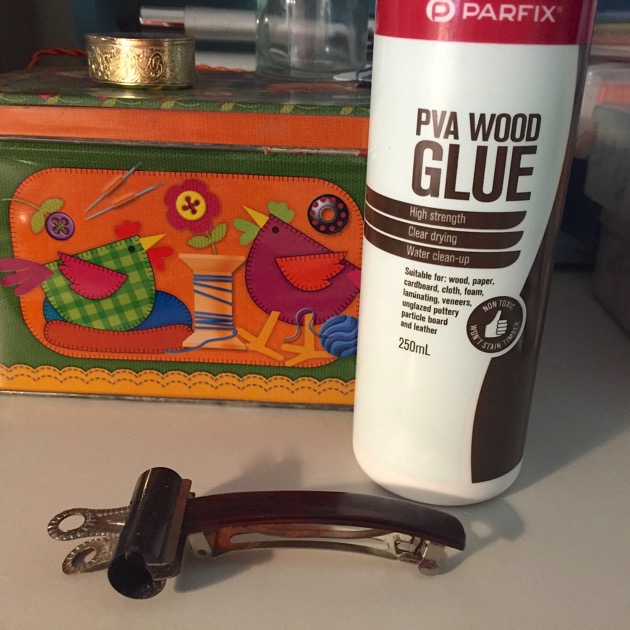
I'd only been using the clips for a few days and my favourite one, which must be 35 years old, felt a bit wobbly. When I removed it from my hair, the top had almost separated from the stainless steel clip it was sitting on. For a wide range of reasons, I did not want to buy a new clip - that would mean going to the shops and I'd rather stay clear of them. I decided the best way forward was to repair it. It seemed a simple repair to me. Just a few dabs of glue and time would probably fix it.

This is probably the strangest selfie I've ever taken.

I found some PVA wood glue that I'd used previously on metal. I cleaned the clip thoroughly, dabbed on some glue, then pressed it down with my fingers. Excess glue seeped out the sides, I wiped it off and cleaned the clip again, then secured the top to the bottom with a bulldog clip. It stayed like that overnight. The next morning, the clip was useable again. I have it in my hair now and it makes me wonder about how long I'll be able to use it. I think it will be with me till the grave. The steel clip and the ornamental top are both in good shape and as long as the glue does its job, it should be fine. Small steps.

What are the more unusual things you've repaired?

… it has become too easy in our time to assume that childrearing, housekeeping, and caregiving, along with all the varieties of manual work, are somehow undignified and unworthy. And we have attempted to lighten and improve them by means of gadgets and institutions. But I would argue that these are the most basic and the most noble vocations. How can we live, or how can we live for very long, as a people if we don’t take care of the children, keep house, and give care to all things needing care? I think the hierarchy that places work done away from home above work done at home is utterly phony. 
Conversions with Wendell Berry, University Press of Mississippi 2007.

If I had to choose only one author to read for the rest of my life, it would be Wendell Berry. He is not afraid to speak the truth, no matter how unpopular it may be. I try to follow his example. His books inspire me to be a better woman, wife, mother, grandmother, writer and yes, housekeeper. He reminds me of the fine tradition I'm part of and why it's so important to humanity. 
And despite what I just wrote, I do "get it". I understand why housework is seen as dull and boring. I thought that myself when I worked outside the home and before I slowed down and changed how I looked at the world. House work interrupted what I wanted to do. It didn't occur to me that the work of my home was something that was capable of giving satisfaction and pride. Over the years, housekeeping has gone from being a full time occupation, a job that women took pride in, to being a something that's supported by appliances, short cuts, life hacks and convenience foods. Now, instead of being creative work that changes with the seasons and is different in every home, the housework of convenience and technology is monotonous and uninvolving. It's work we either put off or try to get through as fast as possible.

Whether you work full time in your home or full time away from the home, housework never ends. There will always be something you can do in your home and it's up to you to end your daily housework when it suits you. I wrote about that in my book and it's still as true today as it ever was. I think you have to have a fundamental change in mindset to understand what housework is, the importance it plays in life and that without it, we don't amount to much.

I feel very comfortable now in my role as homemaker. I also feel comfortable being a working author. One doesn't cancel out the other, they're both important to me; both contribute substantially to my happiness and how I view the world, both require intelligence and creativity. We are all capable of doing more than one job, much more. I think those who feel trapped by housework and those who just don't do it, have not made their homes into the places they need them to be. I found that when I thought about my home, when I changed things around to better suit how I work, when I took control and started working how I wanted to work, when I understood that house work is a creative process, it got better and easier, and I was happier. Making my house a home is a work in progress where there'll always be something to do, something to change, plans to make and something to look forward to. And that is the difference. If your home is part of your life plan, when it stops being just a place for clothes and sleeping. It becomes part of a inventive process that makes your life better, so it's just common sense to do the work to make sure it continues.
Housework is done by women and men now, and by some children. It's not as narrowly defined as it was before - women's work. So why is it still seen by so many as dull and tedious. Why don't we understand that if we want to live in a clean, comfortable home, serve healthy food, send our students and workers off every day to learn and earn, or be one of the workers or students who goes out well fed, clean and happy, that we have to work to make it happen. Nothing will ever be handed to us on a platter with a card that says, you deserve this. So never underestimate the power of house work. It makes everything else possible.
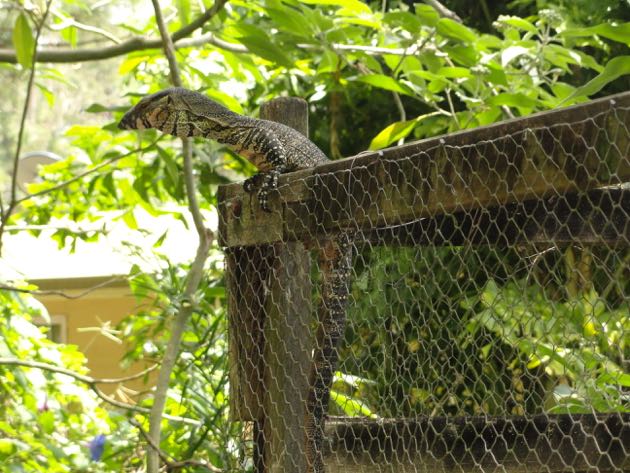
This is one of our local lizards, climbing out of the chicken coop after looking for eggs. This old boy is about 6 feet long from nose to tail.

The very hot weather and humidity has eased up a bit here. The days are warm but pleasant.  I hope you're not too cold or hot. Enjoy the weekend as we cruise down to autumn.

Delicious vegetarian meals
What the British are buying at the supermarket
Preserved tomatoes
Are non-stick pans a health hazard?
Meet the farmer - Jo Salatin @ Polyface Farm | You Tube
Australia will get hotter than the rest of the world
Piketty turns down France's highest distinction on grounds that government should not decide who is honourable  (Hear, here.)
UK church ladies fundraiser cake recipes
Bueno Vista Farm From Scratch Workshops
Good news for Jeremy
Coffee cup holder tutorial


If you have a large freezer, a fairly easy way of saving money when buying meat for the family is to buy your meat in bulk from a family butcher.  We don't eat as much meat as we used to but we used to save a lot of money with a bulk meat buy every so often.  It doesn't seem to be a popular option now and I wonder why.  My guess is that most people are used to buying food on a small tray at the supermarket and the thought of a bulk buy of many kilos or pounds of meat is overwhelming for them.


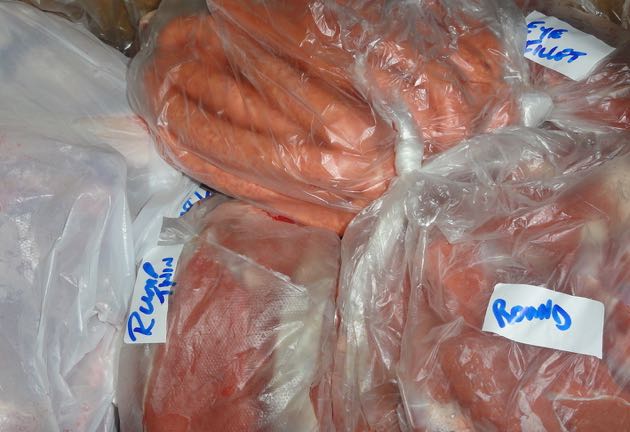
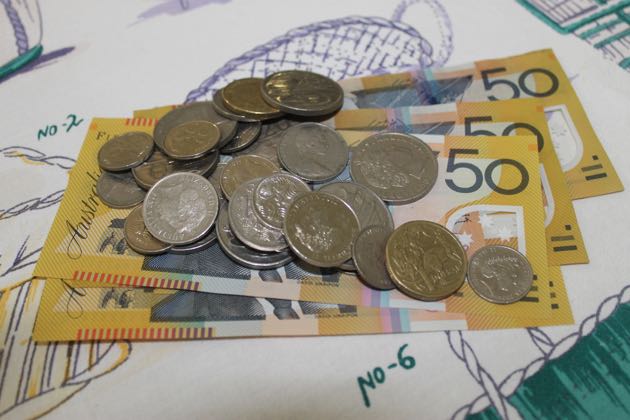
The best way to go about this is to find a butcher close to where you live, go in and talk about the meat you need.  Before you go, work out if you want beef, pork or lamb and let the butcher guide you with prices, cuts and delivery. Beef is very big and instead of going for a side, you can order either a forequarter or a hind quarter. A hind quarter will weigh about 60 kg/130lbs and is made up of  T-bone, round, topside, eye fillet, rump, silverside, skirt steak, shin, mince/ground beef, sausages, bones and fat. My local price for beef now is around $8 to $9. In Woolworths, just for comparison, eye fillet is around $40 a kilo and T-bone is $22 a kilo. But what you're getting, even though it's the best end, is some of the cheaper cuts too - the shin, mince, sausages are all cheaper, but taking the hind quarter as a whole, is cheaper than buying smaller portions at a supermarket. I think the quality is better as well. So if you bought this 60kg hind quarter at $9 a kilo, you'd pay $540. Remember, these prices are only an estimate.


Of course, $540 is a lot of money to pay out for meat so it's a wise option to ask a friend or relative to go halves with you. You would each get around 30 kg/66lbs of meat for $270 and that could be made to last quite a while. It's a good idea to get back to the butcher before that beef runs out and buy a different type of meat to add variety to your diet.

Pork and lamb come in smaller portions so you can get a full side of these meats. A side of pork weighs around 30kg/66lbs and (locally) costs about $7-$8 a kilo.  So a side of pork will cost about $240. A side will give you leg roast, shoulder roast, chops and sausages. If you can add that to your freezer while you still have beef, you'll be serving up a wide variety of meals.

If lamb is your preference, that too comes in a smaller side, about 20kg, at a cost of around (locally) $9 - $10 a kilo. If you bought the same thing at Wooloworths, you'd pay well over $20 a kg for lamb steak, chops or cutlets. In a side of lamb you'll get leg roast, loin chops, shoulder chops, chump chops, the lamb flap, shank, fat and bones.  Again, if you can get one of these into your freezer while you still have a selection of the other types of meat, you'll have the equivalent of a small butcher shop in your freezer.


Maybe you can form a small buying circle and get a small selection of beef, pork or lamb divided up between all of you. Or if your group is a large one, get a side of beef and a full lamb and pork. You may be able to do a better deal with your butcher to supply that kind of order.

Please note: all the prices and weights I've written about are in my local area and will vary according to how far the meat is transported and how much rain has fallen over the pastures. When you're looking around for a suitable butcher, ask where the meat is from and was it raised in a pasture, as well as the price. In Australia, most cattle and sheep are free range but you have to ask about pork and chicken. I prefer them all to be free range.

The butcher will expect you to say how you want the meat cut, if you want sausages or mince/ground meat, and if you want to take the fat and bones. I always take the bones but not the fat but if you're a soap maker, maybe you want to experiment with rendering the fat down to make soap. The decision is your and you have to make up your mind before you place your order.  When I make a bulk order of beef, I usually say I want some roasts, silverside, steak, sausages, mince and the bones. If you're buying with others, tell the butcher that so he knows how to portion everything and when you pick up the meat, or have it delivered, the meat will be packed in plastic bags as you ordered.

Don't expect to make an order for bulk meat and go in to pick it up that day.  Generally you'll need to order about a week before you want the meat because the butcher will have to order extra meat in to cover the order.  When it arrives, it's usually hung for a while and then it has to be cut according to your requirements. It's not a fast process, so remember that and give the butcher plenty of time to give you what you ask for. So as you can see, when it's explained it's not so overwhelming or weird. It's just a different, and I think better, way of buying meat. Make friends with your local butcher, say what you want and ask the butcher to give you an estimate for that order. I'm sure you'll be surprised at the savings that can be made.

Have you bought meat in bulk? How do you do it? Are you part of a large order with a friend or do you go solo?


We didn't go over budget during the holidays but there have been many years when we did. If this has happened to you and you're now facing a lot of unwanted bills, I hope we can help. I invite all the readers here to join together to help everyone who needs to get back on their feet again.  Every day, in emails and comments, I'm reminded that this blog has the potential to help people. If you're in a sound financial position, or if you're paying off debt successfully, I encourage you to share your knowledge to help fellow readers.


I hope there will be a number of you who comment with good ideas below. We all have our ups and downs in life. Today you might be helping someone recover from overspending, tomorrow it may be you or me who needs help.

Even if you have one or two incomes coming in, you will have to wait to work the time needed before you collect your pay, and when you do, will there be money leftover to help you get back on your feet? I think the best thing to do is to actively look for ways to make a bit of spare cash. And I guess that will take some work on your behalf but it's better than having to pay extra interest on your debt or fees because you can't make a payment.  Try to pay your mortgage or rent on time, as usual. If you can manage that, these steps to earn extra cash might make all the difference towards getting back on track.


Here are some of the things I would do if I needed to find some extra money:
  • Live off my stockpile for two weeks.  This would leave two week's food budget money to be put towards the holiday debt.
  • Declutter my entire house, shed and garage and have a garage sale. You're hitting two birds with one stone doing this - getting rid of "stuff" and, hopefully, paying off debt.
  • Eat vegetarian meals every second day for a month. This would free up two week's of money usually spent on meat, chicken and fish.
  • See if you can find a temporary job or freelance work.
  • If possible, if you're not on a contract or at the end of your contract, cut off services such as an extra phone, Netfix, pay TV etc to maximise your savings. You can reconnect again later (if you want to) when you're in a better financial position.
When you put in the time and effort and it starts paying off, make sure you put all that extra money towards your debt. Temptation is a terrible thing. Don't start thinking that the extra money is for spending. You've been down that track and now you're trying to repair the damage. Nothing can beat the feeling of being in charge of your debt and then being debt-free. So stop the guilt trip, just do what you need to do, pay off the debt and when you're back on track, continue to pay off whatever you can as fast as you can. Because when you have no debt, life will change and you'll feel that anything is possible. And maybe it is.

What are your ideas to get back on track after overspending?

Newer Posts Older Posts Home


My books were all published by Pengiun, and are available at Amazon US, Amazon UK and Amazon Au

Search here

Total Pageviews

Translate


I'm Rhonda Hetzel and I've been writing my Down to Earth blog since 2007. Although I write the occasional philosophical post, my main topics include home cooking, happiness and gardening as well as budgeting, baking, ageing, generosity, mending and handmade crafts. I hope you enjoy your time here.

MY FAVOURITE PLACES

  • Grandma Donna's Place
  • Grandma Donna's YouTube
  • Grandma Donna's Instagram
  • This Simple Day
  • Nicole's Instagram

Give More

Give More

Popular posts last year

Making ginger beer from scratch

We had a nice supply of ginger beer going over Christmas. It's a delicious soft drink for young and old, although there is an alcoholic version that can be made with a slight variation on the recipe. Ginger beer is a naturally fermented drink that is easy to make - with ginger beer you make a starter called a ginger beer plant and after it has fermented, you add that to sweet water and lemon juice. Like sourdough, it must ferment to give it that sharp fizz. To make a ginger beer plant you'll need ginger - either the powdered dry variety or fresh ginger, sugar, rainwater or tap water that has stood for 24 hours to allow the chlorine to evaporate off. You'll also need clean plastic bottles that have been scrubbed with soap, hot water and a bottle brush and then rinsed with hot water. I never sterilise my bottles and I haven't had any problems. If you intend to keep the ginger beer for a long time, I'd suggest you sterilise your bottles. MAKING THE STARTER In a...
Image

NOT the last post

This will be my last post here.  I've been writing my blog for 18 years and now is the time to step back. I’ve stopped writing the blog and come back a couple of times because so many people wanted it, but that won’t happen again, I won’t be back.  I’ll continue on instagram to remain connected but I don’t know how frequent that will be. I know some of you will be interested to know the blog's statistics. 
Image

How to make cold process soap

I'm sure many of you are wondering: "Why make soap when I can buy it cheaply at the supermarket?" My cold process soap is made with vegetable oils and when it is made and cured, it contains no harsh chemicals or dyes. Often commercial soap is made with tallow (animal fat) and contains synthetic fragrance and dye and retains almost no glycerin. Glycerin is a natural emollient that helps with the lather and moisturises the skin. The makers of commercial soaps extract the glycerin and sell it as a separate product as it's more valuable than the soap. Then they add chemicals to make the soap lather. Crazy. Making your own soap allows you to add whatever you want to add. If you want a plain and pure soap, as I do, you can have that, or you can start with the plain soap and add colour, herbs and fragrance. The choice is yours. I want to add a little about animal and bird fat. I know Kirsty makes her soap with duck fat and I think that's great. I think t...
Image

Preserving food in a traditional way - pickling beetroot

I've had a number of emails from readers who want to start preserving food in jars but don't know where to start or what equipment to buy.  Leading on from yesterday's post, let's just say up front - don't buy any equipment. Once you know what you're doing and that you enjoy preserving, then you can decide whether or not to buy extra equipment. Food is preserved effectively without refrigeration by a variety of different methods. A few of the traditional methods are drying, fermentation, smoking, salting or by adding vinegar and sugar to the food - pickling. This last method is what we're talking about today. Vinegar and sugar are natural preservatives and adding one or both to food sets up an environment that bacteria and yeasts can't grow in. If you make the vinegar and sugar mix palatable, you can put up jars of vegetables or fruit that enhance the flavour of the food and can be stored in a cupboard or fridge for months. Other traditional w...
Image

Cleaning mould from walls and fabrics

With all this rain around we've developed a mould problem in our home. Usually we have the front and back doors open and that good ventilation stops most moulds from establishing. However, with the house locked up for the past week, the high humidity and the rain, mould is now growing on the wooden walls near our front door and on the lower parts of cupboards in the kitchen. Most of us will find mould growing in our homes at some point. Either in the bathroom or, in humid climates, on the walls, like we have now. You'll need a safe and effective remedy at some point, so I hope one of these methods works well for you. Mould is not only ugly to look at, it can cause health problems so if you see mould growing, do something about it straight away. The longer you leave the problem, the harder it will be to get rid of it effectively. If you have asthma or any allergies, you should do this type of cleaning with a face mask on so you don't breathe in any spores. Many peopl...
Image

Five minute bread

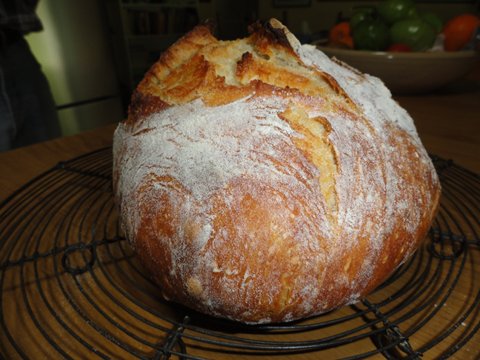
Bread is one of those foods that, when made with your own hands, gives a great deal of satisfaction and delight. It's only flour and water but it symbolises so much. I bake bread most days and use a variety of flours that I buy in bulk. Often I make a sandwich loaf because we use most of our bread for lunchtime sandwiches and for toast. Every so often I branch out to make a different type of loaf. I have tried sour dough in the past but I've not been happy with any of them. I'll continue to experiment with sour dough because I like the idea of using wild yeasts and saving the starter over a number of years to develop the flavour and become a part of the family. However, the loaf I've been branching out to most often is just a plain old five minute bread. By five minutes I mean it takes about five minutes actual work to prepare but it's the easiest of all bread to make and to get consistently good loaves from. If you're having people around for lunch or...
Image

This is my last post.

I have known for a while that this post was coming, but I didn't know when. This is my last post. I'm closing my blog, for good, and I'm not coming back like I have in the past.  I've been writing here for 16 years and my blog has been many things to me. It helped me change my life, it introduced me to so many good people, it became a wonderful record of my family life, it helped me get a book contract with Penguin, and monthly columns with The Australian Women's Weekly and Burke's Backyard . But in the past few months, it's become a burden. In April, I'll be 75 years old and I hope I've got another ten years ahead. However, each year I'll probably get weaker and although I'm fairly healthy, I do have a benign brain tumour and that could start growing. There are so many things I want to do and with time running out, leaving the blog behind gives me time to do the things that give me pleasure. On the day the blog started I felt a wonderful, h...
Image

What is the role of the homemaker in later years?

An email came from a US reader, Abby, who asked about being a homemaker in later years. This is part of what she wrote: "I am a stay-at-home mum to 4 children, ages 9-16. I do have a variety of "odd jobs" that I enjoy - I run a small "before-school" morning drop-off daycare from my home, I am a writing tutor, and I work a few hours a week at a local children's bookstore. But mostly, I cherish my blissful days at home - cooking, cleaning (with homemade cleaners), taking care of our children and chickens and goats, baking, meal-planning, etc. This "career" at home is not at all what I imagined during my ambitious years at university, but it is far more enriching. I notice, though, that my day is often planned around the needs of my family members. Of course, with 4 active kids and a husband, this is natural. I do the shopping, plan my meals, cook dinner - generally in anticipation of my family reconnecting in the evening.  I can't h...
Image

Every morning at home

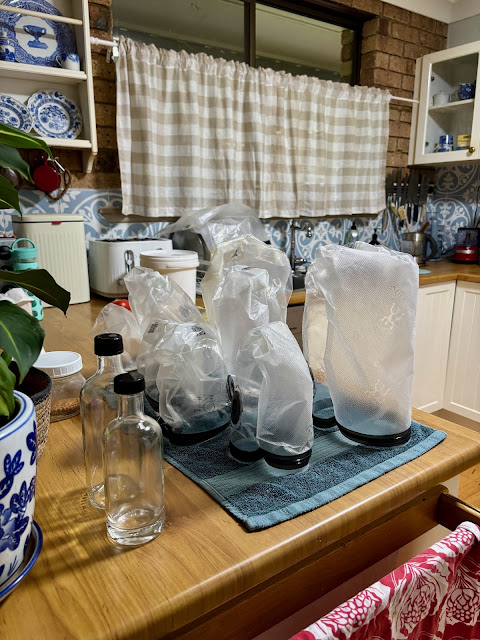
Every morning when I walk into my kitchen it looks tidy and ready for a day's work. Not so on this morning (above), I saw this when I walked in. Late the previous afternoon when I was looking for something, I came across my rolled up Zwilling vacuum bags and decided they had to be washed and dried. So I did that and although I usually put them outside on the verandah to dry it was dark by then. I turned the just-washed bags inside out and left them like this on a towel. It worked well and now the bags are ready to use when I bring home root vegetables, cabbages or whatever I buy that I want to last four or five weeks.
Image

You’ll save money by going back to basics

When I was doing the workshops and solo sessions, I had a couple of people whose main focus was on creating the fastest way to set up a simple life. You can't create a simple life fast, it's the opposite of that It's not one single thing either - it's a number of smaller, simpler activities that combine to create a life that reflects your values; and that takes a long to come together. When I first started living simply I took an entire year to work out our food - buying it, storing it, cooking it, preserving, baking, freezing, and growing it in the backyard. This is change that will transform how you live and it can't be rushed.  
Image


Trending Articles

NOT the last post

This will be my last post here.  I've been writing my blog for 18 years and now is the time to step back. I’ve stopped writing the blog and come back a couple of times because so many people wanted it, but that won’t happen again, I won’t be back.  I’ll continue on instagram to remain connected but I don’t know how frequent that will be. I know some of you will be interested to know the blog's statistics. 
Image

Every morning at home

Every morning when I walk into my kitchen it looks tidy and ready for a day's work. Not so on this morning (above), I saw this when I walked in. Late the previous afternoon when I was looking for something, I came across my rolled up Zwilling vacuum bags and decided they had to be washed and dried. So I did that and although I usually put them outside on the verandah to dry it was dark by then. I turned the just-washed bags inside out and left them like this on a towel. It worked well and now the bags are ready to use when I bring home root vegetables, cabbages or whatever I buy that I want to last four or five weeks.
Image

You’ll save money by going back to basics

When I was doing the workshops and solo sessions, I had a couple of people whose main focus was on creating the fastest way to set up a simple life. You can't create a simple life fast, it's the opposite of that It's not one single thing either - it's a number of smaller, simpler activities that combine to create a life that reflects your values; and that takes a long to come together. When I first started living simply I took an entire year to work out our food - buying it, storing it, cooking it, preserving, baking, freezing, and growing it in the backyard. This is change that will transform how you live and it can't be rushed.  
Image

Creating a home you'll love forever

Living simply is the answer to just about everything. It reduces the cost of living; it keeps you focused on being careful with resources such as water and electricity; it reminds you to not waste food; it encourages you to store food so you don't waste it and doing all those things brings routine and rhythm to your daily life. Consciously connecting every day with the activities and tasks that create simple life reminds you to look for the meaning and beauty that normal daily life holds.  It's all there in your home if you look for it. Seemingly mundane tasks like cleaning and cooking help you with that connection for without those tasks, the home you want to live in won't exist in the way you want it to.  Creating a home you love will make you happy and satisfied.
Image

Time changes everything

I've been spending time in the backyard lately creating a contained herb and vegetable garden. My aim is to develop a comfortable place to spend time, relax, increase biodiversity and encourage more animals, birds and insects to live here or visit. Of course I'd prefer my old garden which was put together by Hanno with ease and German precision. Together, we created a space bursting at the seams with herbs, vegetables and fruity goodness ready to eat and share throughout the year. But time changes everything. What I'm planning on doing now, is a brilliant opportunity for an almost 80 year old with balance issues. In my new garden I'll be able to do a wide range of challenging or easy work, depending on how I feel each day. It’s a daily opportunity to push myself or sit back, watch what's happening around me and be captivated by memories or the scope of what's yet to come.
Image

It's the old ways I love the most

I'm a practical woman who lives in a 1980’s brick slab house. There are verandahs front and back so I have places to sit outside when it's hot or cold. Those verandahs tend to make the house darker than it would be but they're been a great investment over time because they made the house more liveable. My home is not a romantic cottage, nor a minimalist modern home, it's a 1980’s brick slab house. And yet when people visit me here they tell me how warm and cosy my home is and that they feel comforted by being here. I've thought about that over the years and I'm convinced now that the style of a home isn't what appeals to people. What they love is the feeling within that home and whether it's nurturing the people who live there.
Image

Making ginger beer from scratch

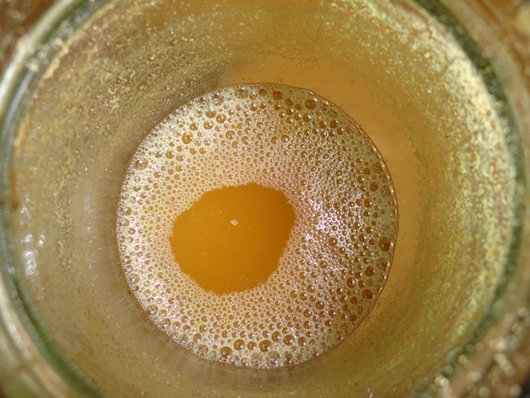
We had a nice supply of ginger beer going over Christmas. It's a delicious soft drink for young and old, although there is an alcoholic version that can be made with a slight variation on the recipe. Ginger beer is a naturally fermented drink that is easy to make - with ginger beer you make a starter called a ginger beer plant and after it has fermented, you add that to sweet water and lemon juice. Like sourdough, it must ferment to give it that sharp fizz. To make a ginger beer plant you'll need ginger - either the powdered dry variety or fresh ginger, sugar, rainwater or tap water that has stood for 24 hours to allow the chlorine to evaporate off. You'll also need clean plastic bottles that have been scrubbed with soap, hot water and a bottle brush and then rinsed with hot water. I never sterilise my bottles and I haven't had any problems. If you intend to keep the ginger beer for a long time, I'd suggest you sterilise your bottles. MAKING THE STARTER In a...
Image

An authentic look at daily life here — unstaged and real

Most days Hanno was outside happily working in the fresh air. It may surprise you to know that I started reading my book,  Down to Earth , yesterday - the first time since I wrote it 13 years ago.  I had lent it to my neighbor, and when she returned it, I started reading, expecting to find surprises. Instead, I realised the words were still familiar—as if they were etched into my memory. As I flipped through the pages, I was reminded of how important it was for me to share that knowledge with others. The principles in Down to Earth changed my life, and I truly believed they could do the same for others. After just 30 minutes of reading, I put the book down, reassured that its message still holds true: we can slow down and reshape our lives, one step at a time.
Image