down to earth

  • Home
  • About Us
  • Down To Earth Book
  • Privacy Policy
During the week I had a question from a young woman, Ms J, asking: As with all of us life tends to increase its demands at different times, whether it be work, additional family members, sickness etc. I was wondering at times like that, what chores do you tend to leave for when things settle down again?

Well Ms J, you're right. I doubt there is anyone who can say everything goes smoothly, every day. It might be something unexpected, like a family member being sick, it might be extra paid work, or it could just be that I just don't feel I have the energy to do the work I need to do.  When there is a spanner in the works, the first thing that goes out of my routine is making bread, and I buy bread from our local baker. I tend to drop the easy things that take up time - I don't water the garden, sweep the floor or make dinner. But it's easy for me because there's no one here to complain, except Hanno, and he doesn't.


Most things work themselves out. I just have to sweep more and water more the following day, but not making dinner tends to pose a problem. Usually I have a homemade frozen meal lurking in the freezer or I'll just whip up some herby scrambled eggs and toast. That fills the gaps.


Now I'm older with no children to look after I don't have a regular schedule for my household chores. I don't vacuum on Mondays or wash on Wednesdays. I don't set aside a specific time to tidy up. I generally do things when they need doing and when I feel like doing them. But I know Ms J, that you have small children and I'm pretty sure you'd have to do chores when you don't feel like it. I did when I had a young family.

There is no one-size-fits-all when it comes to household chores - we should all do what works for us. The trick is to feel no guilt about leaving work undone occasionally. We all know that housework never ends, so if it's not finished, what's the problem? I wrote a post about that same subject, good lord, seven years ago! It might help explain how I go about leaving work undone with the blissful lack of guilt I wear like a cloak of honour. I'll add this one about organising housework too for good measure.


There are many differences between house work and paid work but I think the biggest difference is that when you go out to work, you can choose (or have chosen for you) a finishing time when you can walk away and go home. You know your work has finished for the day. You've been given permission to stop. You don't have that option as a homemaker. There will always be work to do, you know that, your partner knows it and probably even the kids know it. So you have to make the decision when to draw your own line. When do you step away and say, that's it for today. And how do you feel good about doing it?


It wasn't always so clear cut for me. In the beginning I struggled with knowing when enough was enough. I felt guilty about sitting down and having a cup of tea. When I started working in my home full time, I had to rethink a lot of the expectations I had of myself and those my family had of me too. I wanted my days to be meaningful and satisfying, and that didn't involve working like a robot. Now when I stop work, I feel satisfied with the work I've done and I know that it's okay to walk away. I know work at home is not one solid block of unrelenting work. It is up to me to find a balance, to find enjoyment in the work and meaning in my days. I have to establish healthy boundaries for myself, so I won't feel resentful about the work I do in my home. And if part of that is walking away, even though there is still work to be done, then that is what I do.  It was not an easy transition going from a busy-must-get-this-done kind of homemaker to a more relaxed one. Like all processes, it was one step at a time until I felt right about where I was. And I was surprised along the way that my more relaxed approach still got jobs done. A new start every day and an end point too, because housework never ends.


So, what chores to you tend to leave when things are hectic or when you don't have the time and energy to do what you normally do?


It's very easy to spend a lot of money in the garden. Raised beds, top soil from the garden supplier, blocks, sleepers, fertiliser, tools, fences, wheel barrows, water, and then there's the plants. But like many other things, if you're organised you can save a lot of money creating a garden without pouring money into it. Let's face it, if it's going to cost too much to produce your own, you're better off buying fruit and veg until you can grow your own at a reasonable cost.

Before you start, work out how much you spend on weekly fruit and vegetables and that will be your budgeting guide. You'll have to spend a little bit more to set up your garden and that cost should be returned to you over the following years, but if your gardening costs are too high, you may have to rethink. Always work to a year's budget, weekly budgets don't work here. You'll spend a lot the week you buy seeds and seedlings and then you may not buy anything for a month or so. But the main thing is to work out what your budget will be, and then stick to it.


  SEEDS  
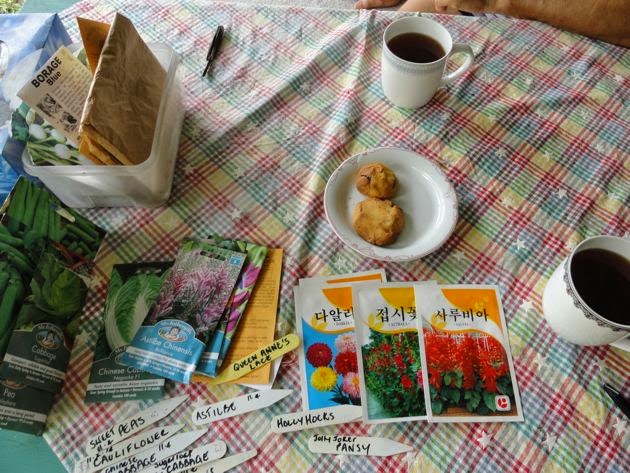
The cheapest way of growing vegetables year after year is to use open pollinated (heirloom) seedlings and save the seeds at the end of the season to be planted out again the next seasons.  This is how all our ancestors would have produced their backyard food. It was a source of pride for gardeners to have a large collection of viable seeds to plant out and swap with neighbours every year. You can't plant seeds from hybrid plants, they don't reproduce true to type. They must be open pollinated. If you start out using that seeds, you'll cut down on your costs because, theoretically, you'll only have to buy the seeds once, and when you want to add new varieties to your collection. You can buy these seeds online in almost every country now.

Here are some older posts on:
How to work out what to grow
How to test for seed viability
How to save seeds


  SEEDLINGS  
Sometimes you just miss the deadline for planting out your seeds and before you know it, it's time to plant. When that happens, go to your local market to buy your seedlings. We can buy seedlings from the garden nursery here at about $3 for four or six seedlings but at the market they're $1 for 12.

  CUTTINGS, SLIPS, TUBERS  
As in ornamental gardens, you can grow plants from cuttings, slips and seeds in a vegetable garden too.  Before you buy all your supplies, check the post below for what you can grow from what you may already have in your kitchen right now. Remember, the rule of enriched soil stands for these too. There are several perennial vegetables that will just keep growing for donkeys years. For instance, we have a stand of Welsh onions given to me by a reader many years ago and they're still going strong. You can also find a perennial leek, rhubarb and asparagus.  Even if you have to buy these vegetables to start them, they'll keep you going for many many years.


I've planted up some avocado seeds and they're doing really well. I know some will say they'll never have fruit or it will take too long, but I'm more optimistic than that and I prefer to think things will work. So far, they are. Just today I snapped off a piece of ginger from a fresh rhizome bought at the shop. I'll keep it in the kitchen until it sprouts, then I'll plant it. Gardening is full of these type of plants, keep your eyes open for them because they'll never be advertised.

Sweet potato can be grown from slips. These are sprouts that form on the vegetable and develop into a long vine. You can cut then off, very close to the sweet potato and plant them in a pot. Soon you'll see new growth and you can plant it in the garden.  Please note, sweet potatoes need a warm climate and a lot of room to grow.

We have three new blueberry bushes because I took cuttings from the bushes we have growing here. I took eight cuttings, three of them took and are growing well now the warmer weather his here. Some might think that three from eight isn't much but I just know that for very little effort and no cost, I have three new blue berry bushes growing outside now. (BTW, Jamie calls them blue bellies).

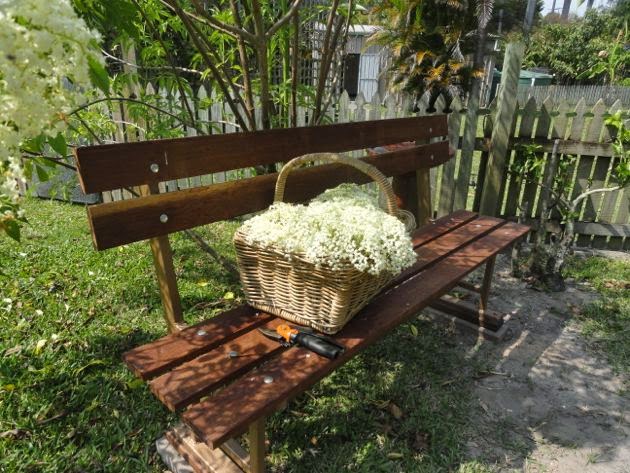
Elder grows really well from cuttings. You can remove the runners from strawberries to form new plants. Pineapples will grow from the spiky top if you live in a warm climate. There are so many things that can be done.

What can be grown from cuttings? 

  COMPOST  and MANURE   
The best thing you can do for your garden is to add compost to it. As soon as you decide to garden, start a compost heap. Even if it just sits in the corner and rots slowly, it will be worthwhile when you come to planting your garden. There is a composting guide here.

Compost is a great help in cutting down on your household waste. All your kitchen scraps, old newspapers, garden waste, old chook nesting material and chook manure can go in the compost and over a couple of months it will turn itself into the most wonderful soil additive.

You may have to buy cow or horse manure, another excellent soil additive, but if you have a paddock or farm near by, ask if you can collect the manure. Often farmers are happy to be rid of it. If you do collect it, ask if the animals have recently been wormed. Worming medication will kill the worms in your soil and you won't want that.


  MULCH  
Mulching will help keep the moisture in the soil and the soil at an even temperature. It's essential in most Australian and dry gardens. You can harvest your grass, dry it out for a month or so and use that as mulch but you have to keep fluffing it up because it has a tendency to matt up and block the rain from getting through to the roots of your plants.

Mulch is one of the few things we buy for the garden. We buy organic sugar cane mulch and it works really well in our garden. It's holds the moisture in and at the end of the season, we can dig it in to add more organic matter to the soil.

  HOMEMADE LIQUID FERTILISERS  
This is a no brainer. If you're growing comfrey, yarrow, nettles, or even weeds, you can pick them, add it to water in a bucket, wait for a couple of weeks, and you'll have excellent fertiliser. Here is a guide that I wrote a while back.

We still buy sulphate of potash, Seasol and trace elements (all organic) and we buy them in large containers so they're cheaper. But our main fertiliser is comfrey which is made for next to nothing and can be used as a weak tea every two weeks on most vegetables.


  BENEFICIAL INSECTS AND PLANTS  
When left alone, natural systems balance themselves out with no help from us. It's when we try to manipulate things, killing insects we are scared of, that things start going wrong. There are plenty of of insects that will help you in the garden by killing off or keeping away other pest insects. If you can attract those insects, you'll help create a natural balance in your garden. So put away the sprays and start growing the plants the beneficial insects love. They'll do the work for you. Here is an old post about what to plant and the insects you want in your garden.

  TOOLS  
At the moment, we need a new spade. The one Hanno has used for years is bent and needs replacing. We could get a cheap one from the hardware store but there is a man at our local Sunday market who sells old tools. They're much better quality than those on sale now, so that's where we'll buy our new spade. I'm not sure how much he'll charge, but I doubt it will be the same price as a new one. If you can buy old tools, often they'll be better quality than those you'll buy new now. Many of them are made in China and just don't stand up to the tough work of gardening. It's a shame that so many people see buying cheap tools as an option because instead of lasting for many years, most of them break and you have to buy it again. And again. If you need garden tools, ask around. Many older people get rid of their tools when they down size. It's worthwhile looking out for them.  Gumtree is a good place to look, so is your local newspaper.

  WATER  
Many of us forget the obvious things and water is one of those. Every garden needs water; some more than others. If you're gardening and you have to pay for your water, I encourage you to collect as much water as you can from your own roof. You can go the traditional Australian route and install a water tank. Unfortunately, most of the government rebates for water tanks have ended but it's still worthwhile looking to see if you can get a rebate and then decide if it's an option for your garden. I reckon the average backyard vegetable patch would need at least 50 litres of water a week during the summer, give or take. You should factor that cost into your gardening costs when you're planning your garden. 

Even if you don't install a tank, you can still rig up the down pipes to spill into a barrel or large container. In addition to our two large water tanks, we have a 200 litre open bin in our garden that Hanno has rigged up to collect the water from the chicken house roof. That's 200 litres of water we can use that is free. A bucket will hold 10 litres of water. If you have a down pour, place your buckets outside to catch every drop you can. It's being proactive like this that makes the difference. And yes, the mosquitoes will breed in still water, so every couple of days, run an old fine kitchen sieve through the water to catch the larvae. Just tip them out on the ground, they die out of water.

There are many other things I could keep writing about but as you can see, this post is long enough already. So take it slow, don't take on too much when you start, try to do as much for yourself as you can, and think about your purchases before you make them.  Happy gardening everyone!


There is no doubt you can save money if you have the space, time and energy to produce organic vegetables and fruit in your backyard. Hanno and I have been doing that on and off for almost forty years but it can be a balancing act because if you're not careful, gardening can become a very expensive exercise. During those years we've worked out how to work a garden, produce food and do it with an eye on the costs too. So I thought I'd spend some time today and tomorrow bringing those ideas together in two posts with the hope of sharing how to save money and showing that a productive garden can be a thrifty one too.

Before we start on frugal gardening though I'm going to address other issues that will effect how some of you garden. It's not the main reason for the post on this topic but unless I address these issues, some new gardeners will waste a lot of time wondering why they can't produce the fresh food they hope for.


I'm directing this post mainly, but not exclusively, at the new gardeners, so, let's talk a bit about our similarities and our differences. Now we have the benefit of blogs and can see what ordinary folk grow, and not just the idealised gardens featured in magazines, that ability to look into each other's backyards can sometimes create problems. I've lost count of the number of times I've blogged about preparing soil before you start, but every time I do my library talks and in frequent emails, people ask me what they're doing wrong. Their problem is that their garden doesn't look like our garden. When I ask how they prepared their soil for planting,  usually the answer is: huh!?

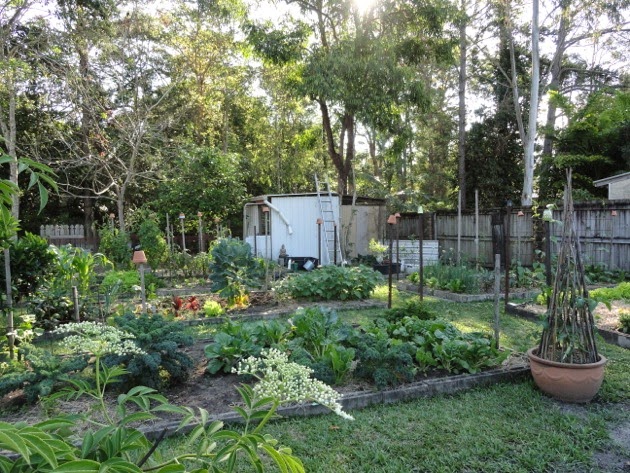
The black kale plant above is one of several we grew about five years ago. They looked like a mini forest because they all grew to about six feet tall.

The health of your plants and abundance of your harvests depends on building up your soil before you start planting. Plants need nutrients in the soil to give the best results and if the soil is depleted or has never been productive, your plants might survive, but they won't thrive. You'll do the same amount of work week by week, but you won't get the great results you will get if you take the time to enrich your soil before you plant. If you don't add organic matter - compost, manures, green manure crops etc into your soil, no amount of fertiliser added later will make up for it. Please prepare your soil well and keep on enriching it between crops. Every time you plant something new, get into the habit of adding manure or compost to the soil. As they grow, plants use the organic matter in the soil to help them grow. This must be replenished frequently.  It is for that reason that you should start composting before you start planting. Here is one of my composting posts about how to start a compost heap. You can buy compost but making your own will make your garden sustainable and it will help you manage your household waste. It's also much cheaper.


There are a lot of differences in gardens world-wide, soil and climate differ but the actual planting methods are generally the same everywhere. If you're a new gardener, or you've just moved to a new location, try to find a local planting guide to help you decide how to start. You might also ask gardening neighbours or join a community garden to find out what and when to plant, and all the things you need to know in your area.


Backyard vegetable production varies a lot depending on what climate you live in. Here in Australia we have a fairly warm climate but it varies a lot from north to south. Our country goes from the hot tropics right down to the cooler regions of Tasmania, which gets the winds right off Antarctica. Overall, but with a few exceptions, we can grow food all year long here. Naturally it's the salad type crops in summer and things like cabbages, cauliflowers, potatoes, parsnips etc in winter.  And because we can grow fresh food all year, in Australia we usually grow small amounts over a long period and preserve whatever excesses we have along the way.

In the colder countries such as Canada, USA, UK, Ireland and many parts of Europe, the growing period is shorter but there are much larger amounts grown. This allows cold climate gardeners to eat the vegetables fresh during the summer and autumn and then to preserve the excess in various ways, seeing them through the winter months when snow covers the ground and gardening is impossible. No matter where you live though, please start slow, planting the vegetables you like to eat or are hard to find. You'll need a couple of years to build up soil fertility, work out what and how to grow and what will work best in your garden. Gardening can be hard work. The last thing I want to do is for you to stop after the first year because it's too difficult. Start small and slow and with the easier vegetables and after you develop your skills you can expand your garden and grow more.

Plant flowers in the garden to encourage pollinators and put some herbs into pots on the side of the garden to add interest and save space.

There are a million things I could tell you about gardening but I've highlighted these paragraphs above because sometimes young gardeners write to me upset that their gardens are failing. The message here is, if you can, connect with local gardeners so you know how to enrich your soil, what the best plants are for your region, when to plant them and what pests to look out for.

I didn't expect that to take up so much space - gardening is a multifaceted topic and it's easy to spill out the words. Tomorrow I'll write all about the thrift aspect of gardening - how you can save as much money as possible while producing fresh organic vegetables for your family.


I usually start preparing my fermented ginger beer around this time of the year. I like having it on hand to offer to family and friends when they visit. It's a simple process but it takes over a week to get the finished drink into a bottle and sometimes, as it's a natural fermented drink, it doens't go according to plan and I end up with a ginger concoction I have to throw away.  This way of living is an ever-evolving process, I'm always hoping to improve what I do, so I decided to look for a healthy drink that I could make up overnight, or in one day, and still be happy to offer it to guests.

Enter ginger cordial.  I wanted to stay with a ginger drink because I can grow ginger here and I think the ginger family - ginger, turmeric, cardamom and galangal - contains many health giving properties. 

The easiest way to peel ginger is by scraping a teaspoon over the skin. When the skin is off, just cut the hard bits off with a sharp knife.

  GINGER CORDIAL  
  • piece fresh ginger about three inches/8cm
  • 1½ litres/quarts tap water
  • 1 cup sugar
  • rind one lemon
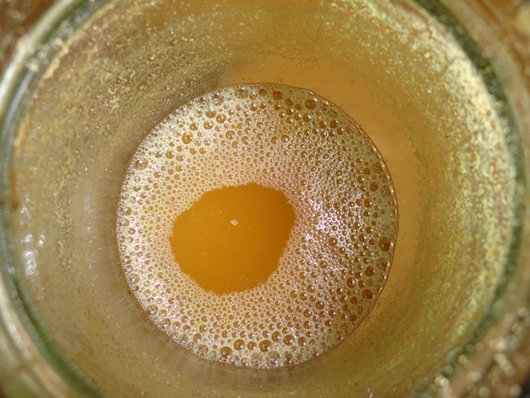
Peel and grate the ginger. Grating is better than slicing because the greater surface area you have, the better the flavour. Place the grated ginger, water, sugar and lemon rind in a saucepan and bring to the boil. Stir to make sure all the sugar dissolves. Turn off the heat, put the lid on the saucepan and leave on the stove top over night. The next morning, strain the ginger liquid through a muslin cloth over a strainer, sitting in a jug. Pour the ginger cordial into clean bottles and store it in the fridge.

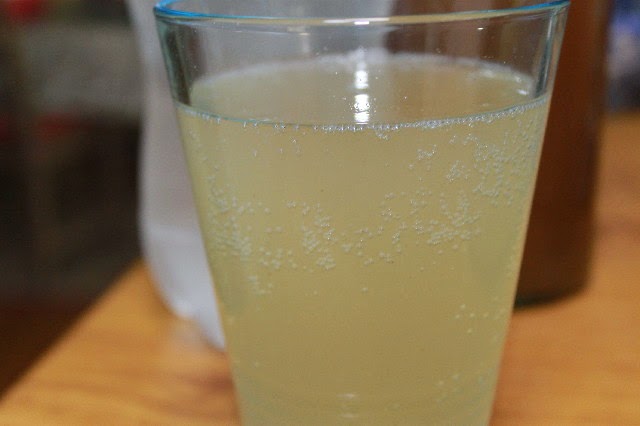
To make up a drink, pour a small amount (40mls/2oz) of ginger cordial into a glass and fill the glass with cold natural mineral water or soda water. We're using the Aldi mineral water which is 79 cents per 1.25 litre bottle. Add ice and a lemon slice. You can also drink it using cold tap water or as an addition to your hot black tea.


I didn't use the muslin with this batch and ended up with sediment in the bottles. Next time I'll remove that by using a muslin cloth to strain the liquid.


This is a really delicious drink, and I think it's as good (or better) as the well known ginger beer brands, including Bundaberg. This is the ingredients list for Bundaberg ginger beer: Carbonated water, cane sugar, ginger root, natural flavours, acid (citric acid), yeast, preservatives (202, 211), antioxidant (ascorbic acid). 

I encourage you to try it. It's easier to make than the fermented drink and you can cook up a batch in a short amount of time instead of waiting over a week for it to ferment. Having said that, I'll still be making the fermented drink as well when I have more time. This is an addition to my homemade drinks repertoire, not an instead-of.


When Sarndra was here recently she gave me a very thoughtful gift. It's a beautifully framed hand painted swallow and calligraphy artwork created by her best friend Lissy from Yellow Poppies.  It's the first thing you see now when you walk in our front door.  Isn't it beautiful! It sums up my thoughts about family very nicely: Family, where life begins and love never ends. Thanks Sarndra and Lissy.
Enjoy the weekend, friends. See you on the other side.  ♥︎


Enterprising missionaries, introverted farmers
Meet Maine's teen farmers  I love this story. I believe there is nothing better for teen boys than hard physical work. They're also keeping a tradition alive, learning about working for a living and receiving their first pay cheque.
Admiring apples at the RHS harvest festival
Don't judge the veg by its cover
Green Kitchen Stories - great vegetarian recipes
Life in a 'degrowth' economy
Make your own jelly flu shots
Button crafts
Crochet cowl - very pretty free pattern
Beautiful basket weave baby blanket - free knitting pattern
How to make tea, according to the scientists
How to clean burnt gunk off stainless steel

I was asked recently to write about my decision to stop flying. Before I do that, I have to tell you that I do take occasional flights in my mind and when I found out last week that I was to be a grandma again, I was sky high for hours.


I don't remember exactly when my last flight was. I'm guessing it was in the late 1990s, before I started living as I do now. Back then, I owned a business writing training and induction manuals for the mining industry. I had to travel to the mines fairly frequently but with every flight I hated it more and I realised that driving would be much more enjoyable. I wouldn't be part of the herd being shuffled this way and that, I could pack what I wanted, listen to my own music and stop when I felt like it. Driving replaced flying for me then. It must have been around 1998. Now for long distance travel, I either go by train or drive - we have a hybrid car.

I refuse to fly because I'm concerned with the environmental impact every flight has.

I'm lucky to be Australian because I believe there is no better place to be. If I want to go on holiday, I will do that within my own country and there will be no flying involved. Long distance visiting can be done via Skype and if I'm called to participate in a conference, I can do so via teleconferencing. A few years ago I was tested on how committed I am to these beliefs when I was invited to attend an awards ceremony in Singapore, with flights and accommodation supplied. I declined. It wasn't difficult, I didn't hesitate, I knew there was nothing that would get me on a plane. When I did my book tour, I drove from state to state with Hanno, instead of flying. We had the best time on that road trip and I know that had we flown, I would never have associated the word "best" with anything I did on that trip.

Since 2001 the security at airports has been ramped up and it's not unusual now to see long queues of travellers at airports waiting to be processed. When I see that, when I see and hear how little respect is shown to passengers, when I think of the potential dangers lurking, I wonder why so many people still fly. The longer I don't fly, the more reasons I think of to never put myself in that situation again. But I won't go on about it because I think everyone has to discover their own reasons and be firmly convinced by them for it to have a permanent impact.

I think that long-lasting profound lifestyle change comes about when we change ourselves first and then try for group solutions, starting with our own communities. I am the only one who can put my beliefs into action, I can't make anyone believe what I do and I certainly don't want to blindly follow what others do. So for me, this is a personal stand and nothing that I expect you or anyone in my family to be a part of. And my decision to remain earth bound is not translated into judgement of people who don't. We all make our own choices and I am happy for that.

Why David Holmgren doesn't fly much anymore
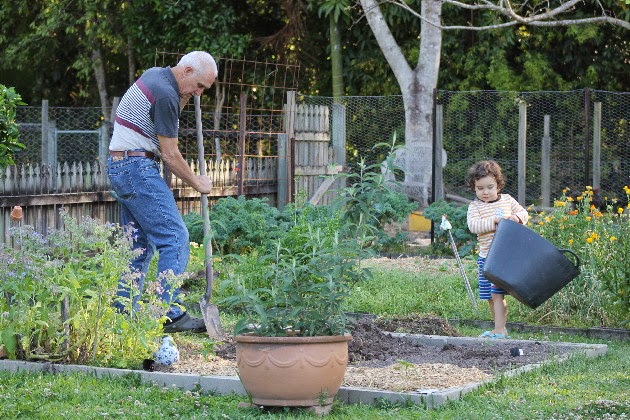
It requires few lessons to develop an interest in gardening in young children. They usually like playing in dirt, digging and asking about things. If you allow them to pick fruit and vegetables in the garden to taste as they play outside, they usually connect the dots and don't grow up thinking that tomatoes and lettuces just appear on a supermarket shelf. They know because they've experienced gardening first hand or someone took the time to show them how plants grow.


Jamie is developing a real love of gardening. He's three and he's planted capsicum and chilli, he weeds, he scatters seed, digs and waters. When we are in the garden, he's there with us. He doesn't have to be asked. As soon as we head outside, he is with us, unconditionally, until we come back inside. It's the best kind of learning - learning by doing. That stays with you for life.

Shane, Sarndra and Alex.

Whenever I hear the words: we've got something to tell you, I know I'm in for something very special and, maybe, life changing. I heard those words when Shane and Sarndra decided to get married, when their son Alex was on his way and again from Kerry and Sunny when they got engaged and when Sunny was pregnant with Jamie. I heard it again when Shane and Sarndra visited recently (photo below). They announced their wonderful news when we gathered at Sunny's for our family dinner. Yes, they're having another baby! I can't tell you how happy I am to see my family grow and get stronger.


I'm so proud of Shane and Sarndra, they're both hard workers, they're active and interested in so many things, and they're wonderful parents to Alex. And now another baby. My heart is so full I can hardy express my feelings, and to think we have to wait until next April before we can welcome another little life into our family. I'm crossing my fingers for 15 April (my birthday). :- )

Before my own sons were born in 1980 and 1981, I'd never really thought much about my family. I'd met assorted cousins, aunties and uncles, my mother's mother and father and my mother's sister and brother. My father's family lived in Brisbane when we lived in Sydney so I only met my Swedish grandma once, when I was two, just before she died. I knew most of my extended family only through old grainy black and white photos. But when Shane and Kerry where born, it was like a switch had been turned on and I just had to find out more about who I was and where I came from. I think this is a common thing among Australians - all of us, except our aboriginal friends, came from somewhere else.  In 1982, I wanted to know where somewhere else was and I started looking.

I knew we'd been in Australia for a long time. When I was born the prime minister was Ben Chifley, the monarch was King George VI and the population of Australia was 7.7 million. I knew my father's family had come out from Ireland during the potato famine in the mid-1800s and I certainly did confirm that when I started my research. I looked into my family history for a few years, but then life took over and I had no time for genealogy. When I returned to it, technology had made things much easier. Instead of searching microfiche at the local library and sending letters of inquiry to the archives office and waiting weeks for an answer, I could join ancestry.com and geni. com and not only get answers immediately, but also link up with other people in my family who I'd never heard of but who happened to be researching a different branch of our family. The early online family trees I found were so interesting!

The most endearing part of my research was discovering that on my mother's side, I am a seventh generation Australian, descended from convicts William (Lumpy) Dean and Elizabeth Hollingsworth, who arrived here in 1797. They married at Parramatta and when they served their time, they were granted leave, and started working in the very young town of Sydney. They were given a land grant out on the road to Parramatta, and they operated the government toll on that road as well as a pub called the Corporation Inn, where they lived with their eight children. That area is now know as Eastern Creek. When Lumpy died, aged 78, he was a wealthy man and an advocate of good education for the poor. It was said he could dance the hornpipe as well as any man half his age. (LOL) Below is a photo of the Corporation Inn which was the house Lumpy and Elizabeth lived in until they died. It was situated on Parramatta Road but was demolished to widen the highway in the 1960s. There is now a suburb and school in Sydney named after him.


Family is such an important part of us. These are the people we share not only our genes with but also our history. I'm very lucky to have been born into my family. Sure there have been ups and downs - we have convicts and politicians, but we're an interesting family and I like that.  And soon our family will have a new member. I'm looking forward to meeting my new grand child and then adding their name to our family tree. One more link in our family's strong chain. ♥︎ 

If you've never done any research into your own family roots, I encourage you to do it. It's fascinating and sometimes surprising. I started on ancestry.com.au but there are other websites too. If you have some time, go exploring. It will give you a good idea of where you fit into your family.

Alex, Jamie and Opa watching Octonauts.

Happy second birthday to my beautiful grand-nephew, Johnathan!


I'm really savouring the last cool nights and warm days before summer turns up the heat. There is a lot to be done here. I'm finishing off my last book but there is also my daily housework so I generally settle into writing after that is done. I hope your home life is bubbling along nicely. Thanks for the wonderful comments left this week, friends. I'll see you again next week. Enjoy the weekend!

= = = ♥︎ = = =

Setting a budget for Christmas spending - this is a down to earth forum challenge for anyone who is trying to stick to a budget over Christmas.
eco thrifty living
A working life
20 steps to a frugal lifestyle
Amish hospitality
Knit lessons
High waisted baby overalls
Crochet basics - single, half double and slip stitch
32 favourite hair tutorials
How the creative process fits into life - get a cup of tea, it's long and interesting
Home Farmer featured articles - how to make a bee hotel, strawberry wine, chicken treats etc
Your nose knows death is imminent
Crazy cake designs in pictures
Small changes are happening all around the Western world with more people realising that simple  life is not only better for us but better for the planet as well. (Did you know we've lost 50 percent of our wildlife in the past 40 years?)  Many people are being guided towards a simpler life by blogs and books, and it's wonderful to see community groups taking on the challenge and applying for funding to provide workshops on how to become more self-reliant while guiding their communities towards a more sustainable future.


I wish more people would give up on recreational shopping and comparing themselves to their neighbours. I know that change is difficult and starting any thing new is often so challenging that some folk stop in their tracks and decide to stay where they are. When change does come about and there are difficulties adjusting to new ways, or the work involved in daily life, often the temptation is to go back to your old life. It looks easier and it's so familiar. I don't often talk about the difficulties, not because there haven't been any for me but because I worked through most of my issues before I started blogging. I'm also at an age when I don't worry when things go wrong. When they do, I think about the problem and then start working on solutions. I can't be bothered with the drama now. I just get on with it.


But the truth is this way of living can be difficult, especially when you start. Bearing in mind that we all structure our lives differently, usually there is more work to be done living this way because you stop buying ready-made. When you make your own it takes more time and so many people are time-poor now. I think simple life is easier for people who have a more relaxed frame of mind and that perfectionists can struggle with it. But if you do struggle with the time aspect, just take one day at a time, take on one new task at a time and don't be hard on yourself if you have to make adjustments. I'd like it to be easier, but it's not. It is what it is. We all have to find our own ways of making it work.

Take cuttings, grow things from seed. I took eight blueberry cuttings last year and three of them took. In a few years, we'll have three more blueberry bushes that cost nothing but some effort, water and potting mix.


If you're just starting, start slowly, learn the skills you need, practise them, then move on to the next. Do your work and live every hour mindfully. Discover your own feelings about what you're doing. Look at your home and see what you can change there to help you become more productive. And I'm not talking about buying containers to help you organise yourself. I mean literally, change your home. Move saucepans to a better location, organise your pantry so it's an asset not a liability, make your work areas work for you. Mend things, take cuttings, collect seeds, look after what you already own, stop buying expensive cleaning chemicals and start making what you need to clean your home. It will be safer and cheaper. Try to do all the things that don't cost money. For me that's noticing I have calendula self-seedling in the garden and using those seedlings instead of buying another packet of seeds. It's taking cuttings of daisies from a neighbour instead of buying plants at the garden centre and growing avocado from seed instead of buying a plant. Yes, I know it might not work, but it might, and I've already wasted money on avocado trees and have them die on me - with self-grown seeds I feel free enough to experiment with planting and locations.

Look after what you own. These jumpers have been washed and dried flat in the shade. Now they'll be folded carefully and put away until next winter.

Our small solar system helps keep our bills down but we are also mindful of how we use electricity in our home.

Your main focus in your younger years is to not accumulate unnecessary debt, and as you grow older, to pay off the debt you have. To do that you'll need an armoury of frugal ideas to save money so you can pay off your debt. Solar power will help with the elecricity bills but if you can't afford to install it, work out ways to cut back your electricty usage. Do the same for water. It sounds difficult but when you get into it, it's quite easy. Hanno and I live on the same average water and electricity usage as one person. If you can save money on these utilities it's generally a great saving because they're bills that will keep coming as regular as clockwork.

Our solar hot water system.

We give up a lot of what is taken for granted in our modern world. For instance, I haven't flown anywhere for over ten years. It's something I felt strongly about - still do, but again, that decision is not for everyone and I don't expect anyone in my family to follow my lead. We spend most of our time here. We enjoy being here but we have to be here to look after our garden and chickens, to cook from scratch and to keep house the way I want to.  I would not be able to do what I do if we had frequent trips out. There are other things we've given up but I prefer to look at what we've gained. Personally, I love growing some of our food and being able to cook an entire meal from scratch, using the thrifty ideas more aligned with the 1950s than the 21st century.  Knowing I can do that gives me the confidence to continue to peel back the layers of modern life until I am left with what is plain and simple - never done to any particular plan or ideal, it's just ordinary life lived every day according to our values.


And I think that's the key to all this - a change of mindset and to think of this way of living as flexible and changeable. I certainly would not be working as I do today if I were a younger woman with children to care for. I have time now for entire days of cooking, gardening and knitting. You can still do it when you're young, but you'll be doing it differently. Even ten years ago I worked differently. So give yourself a break. Don't look at anyone, especially me, and think this is what you have to do. You should do what is needed in your home - whatever that is. And if you can't do all you want to do yet, accept that, get over it and get on with it. Because I will tell you one thing I know is true for all of us. If you live your life according to your values and beliefs, if you plan your time and do what you can, if you take one small step and then another, you will be enriched by it and have the strength and confidence to do it again tomorrow.

Newer Posts Older Posts Home


My books were all published by Pengiun, and are available at Amazon US, Amazon UK and Amazon Au

Search here

Total Pageviews

Translate


I'm Rhonda Hetzel and I've been writing my Down to Earth blog since 2007. Although I write the occasional philosophical post, my main topics include home cooking, happiness and gardening as well as budgeting, baking, ageing, generosity, mending and handmade crafts. I hope you enjoy your time here.

MY FAVOURITE PLACES

  • Grandma Donna's Place
  • Grandma Donna's YouTube
  • Grandma Donna's Instagram
  • This Simple Day
  • Nicole's Instagram

Give More

Give More

Popular posts last year

Making ginger beer from scratch

We had a nice supply of ginger beer going over Christmas. It's a delicious soft drink for young and old, although there is an alcoholic version that can be made with a slight variation on the recipe. Ginger beer is a naturally fermented drink that is easy to make - with ginger beer you make a starter called a ginger beer plant and after it has fermented, you add that to sweet water and lemon juice. Like sourdough, it must ferment to give it that sharp fizz. To make a ginger beer plant you'll need ginger - either the powdered dry variety or fresh ginger, sugar, rainwater or tap water that has stood for 24 hours to allow the chlorine to evaporate off. You'll also need clean plastic bottles that have been scrubbed with soap, hot water and a bottle brush and then rinsed with hot water. I never sterilise my bottles and I haven't had any problems. If you intend to keep the ginger beer for a long time, I'd suggest you sterilise your bottles. MAKING THE STARTER In a...
Image

NOT the last post

This will be my last post here.  I've been writing my blog for 18 years and now is the time to step back. I’ve stopped writing the blog and come back a couple of times because so many people wanted it, but that won’t happen again, I won’t be back.  I’ll continue on instagram to remain connected but I don’t know how frequent that will be. I know some of you will be interested to know the blog's statistics. 
Image

How to make cold process soap

I'm sure many of you are wondering: "Why make soap when I can buy it cheaply at the supermarket?" My cold process soap is made with vegetable oils and when it is made and cured, it contains no harsh chemicals or dyes. Often commercial soap is made with tallow (animal fat) and contains synthetic fragrance and dye and retains almost no glycerin. Glycerin is a natural emollient that helps with the lather and moisturises the skin. The makers of commercial soaps extract the glycerin and sell it as a separate product as it's more valuable than the soap. Then they add chemicals to make the soap lather. Crazy. Making your own soap allows you to add whatever you want to add. If you want a plain and pure soap, as I do, you can have that, or you can start with the plain soap and add colour, herbs and fragrance. The choice is yours. I want to add a little about animal and bird fat. I know Kirsty makes her soap with duck fat and I think that's great. I think t...
Image

Preserving food in a traditional way - pickling beetroot

I've had a number of emails from readers who want to start preserving food in jars but don't know where to start or what equipment to buy.  Leading on from yesterday's post, let's just say up front - don't buy any equipment. Once you know what you're doing and that you enjoy preserving, then you can decide whether or not to buy extra equipment. Food is preserved effectively without refrigeration by a variety of different methods. A few of the traditional methods are drying, fermentation, smoking, salting or by adding vinegar and sugar to the food - pickling. This last method is what we're talking about today. Vinegar and sugar are natural preservatives and adding one or both to food sets up an environment that bacteria and yeasts can't grow in. If you make the vinegar and sugar mix palatable, you can put up jars of vegetables or fruit that enhance the flavour of the food and can be stored in a cupboard or fridge for months. Other traditional w...
Image

Cleaning mould from walls and fabrics

With all this rain around we've developed a mould problem in our home. Usually we have the front and back doors open and that good ventilation stops most moulds from establishing. However, with the house locked up for the past week, the high humidity and the rain, mould is now growing on the wooden walls near our front door and on the lower parts of cupboards in the kitchen. Most of us will find mould growing in our homes at some point. Either in the bathroom or, in humid climates, on the walls, like we have now. You'll need a safe and effective remedy at some point, so I hope one of these methods works well for you. Mould is not only ugly to look at, it can cause health problems so if you see mould growing, do something about it straight away. The longer you leave the problem, the harder it will be to get rid of it effectively. If you have asthma or any allergies, you should do this type of cleaning with a face mask on so you don't breathe in any spores. Many peopl...
Image

Five minute bread

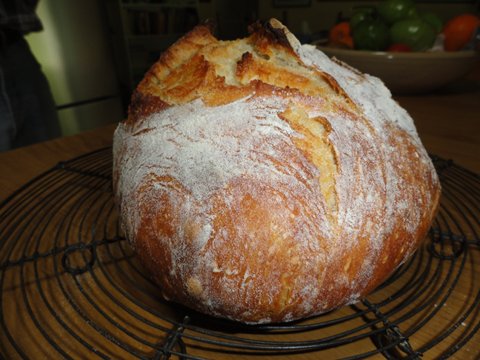
Bread is one of those foods that, when made with your own hands, gives a great deal of satisfaction and delight. It's only flour and water but it symbolises so much. I bake bread most days and use a variety of flours that I buy in bulk. Often I make a sandwich loaf because we use most of our bread for lunchtime sandwiches and for toast. Every so often I branch out to make a different type of loaf. I have tried sour dough in the past but I've not been happy with any of them. I'll continue to experiment with sour dough because I like the idea of using wild yeasts and saving the starter over a number of years to develop the flavour and become a part of the family. However, the loaf I've been branching out to most often is just a plain old five minute bread. By five minutes I mean it takes about five minutes actual work to prepare but it's the easiest of all bread to make and to get consistently good loaves from. If you're having people around for lunch or...
Image

This is my last post.

I have known for a while that this post was coming, but I didn't know when. This is my last post. I'm closing my blog, for good, and I'm not coming back like I have in the past.  I've been writing here for 16 years and my blog has been many things to me. It helped me change my life, it introduced me to so many good people, it became a wonderful record of my family life, it helped me get a book contract with Penguin, and monthly columns with The Australian Women's Weekly and Burke's Backyard . But in the past few months, it's become a burden. In April, I'll be 75 years old and I hope I've got another ten years ahead. However, each year I'll probably get weaker and although I'm fairly healthy, I do have a benign brain tumour and that could start growing. There are so many things I want to do and with time running out, leaving the blog behind gives me time to do the things that give me pleasure. On the day the blog started I felt a wonderful, h...
Image

What is the role of the homemaker in later years?

An email came from a US reader, Abby, who asked about being a homemaker in later years. This is part of what she wrote: "I am a stay-at-home mum to 4 children, ages 9-16. I do have a variety of "odd jobs" that I enjoy - I run a small "before-school" morning drop-off daycare from my home, I am a writing tutor, and I work a few hours a week at a local children's bookstore. But mostly, I cherish my blissful days at home - cooking, cleaning (with homemade cleaners), taking care of our children and chickens and goats, baking, meal-planning, etc. This "career" at home is not at all what I imagined during my ambitious years at university, but it is far more enriching. I notice, though, that my day is often planned around the needs of my family members. Of course, with 4 active kids and a husband, this is natural. I do the shopping, plan my meals, cook dinner - generally in anticipation of my family reconnecting in the evening.  I can't h...
Image

Every morning at home

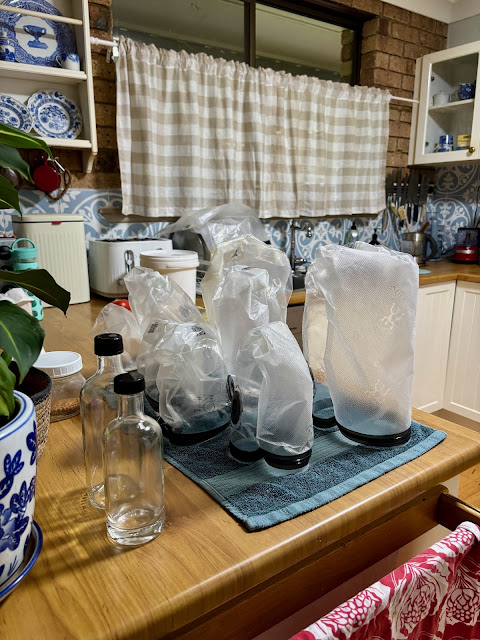
Every morning when I walk into my kitchen it looks tidy and ready for a day's work. Not so on this morning (above), I saw this when I walked in. Late the previous afternoon when I was looking for something, I came across my rolled up Zwilling vacuum bags and decided they had to be washed and dried. So I did that and although I usually put them outside on the verandah to dry it was dark by then. I turned the just-washed bags inside out and left them like this on a towel. It worked well and now the bags are ready to use when I bring home root vegetables, cabbages or whatever I buy that I want to last four or five weeks.
Image

You’ll save money by going back to basics

When I was doing the workshops and solo sessions, I had a couple of people whose main focus was on creating the fastest way to set up a simple life. You can't create a simple life fast, it's the opposite of that It's not one single thing either - it's a number of smaller, simpler activities that combine to create a life that reflects your values; and that takes a long to come together. When I first started living simply I took an entire year to work out our food - buying it, storing it, cooking it, preserving, baking, freezing, and growing it in the backyard. This is change that will transform how you live and it can't be rushed.  
Image


Trending Articles

NOT the last post

This will be my last post here.  I've been writing my blog for 18 years and now is the time to step back. I’ve stopped writing the blog and come back a couple of times because so many people wanted it, but that won’t happen again, I won’t be back.  I’ll continue on instagram to remain connected but I don’t know how frequent that will be. I know some of you will be interested to know the blog's statistics. 
Image

Every morning at home

Every morning when I walk into my kitchen it looks tidy and ready for a day's work. Not so on this morning (above), I saw this when I walked in. Late the previous afternoon when I was looking for something, I came across my rolled up Zwilling vacuum bags and decided they had to be washed and dried. So I did that and although I usually put them outside on the verandah to dry it was dark by then. I turned the just-washed bags inside out and left them like this on a towel. It worked well and now the bags are ready to use when I bring home root vegetables, cabbages or whatever I buy that I want to last four or five weeks.
Image

You’ll save money by going back to basics

When I was doing the workshops and solo sessions, I had a couple of people whose main focus was on creating the fastest way to set up a simple life. You can't create a simple life fast, it's the opposite of that It's not one single thing either - it's a number of smaller, simpler activities that combine to create a life that reflects your values; and that takes a long to come together. When I first started living simply I took an entire year to work out our food - buying it, storing it, cooking it, preserving, baking, freezing, and growing it in the backyard. This is change that will transform how you live and it can't be rushed.  
Image

Creating a home you'll love forever

Living simply is the answer to just about everything. It reduces the cost of living; it keeps you focused on being careful with resources such as water and electricity; it reminds you to not waste food; it encourages you to store food so you don't waste it and doing all those things brings routine and rhythm to your daily life. Consciously connecting every day with the activities and tasks that create simple life reminds you to look for the meaning and beauty that normal daily life holds.  It's all there in your home if you look for it. Seemingly mundane tasks like cleaning and cooking help you with that connection for without those tasks, the home you want to live in won't exist in the way you want it to.  Creating a home you love will make you happy and satisfied.
Image

Time changes everything

I've been spending time in the backyard lately creating a contained herb and vegetable garden. My aim is to develop a comfortable place to spend time, relax, increase biodiversity and encourage more animals, birds and insects to live here or visit. Of course I'd prefer my old garden which was put together by Hanno with ease and German precision. Together, we created a space bursting at the seams with herbs, vegetables and fruity goodness ready to eat and share throughout the year. But time changes everything. What I'm planning on doing now, is a brilliant opportunity for an almost 80 year old with balance issues. In my new garden I'll be able to do a wide range of challenging or easy work, depending on how I feel each day. It’s a daily opportunity to push myself or sit back, watch what's happening around me and be captivated by memories or the scope of what's yet to come.
Image

It's the old ways I love the most

I'm a practical woman who lives in a 1980’s brick slab house. There are verandahs front and back so I have places to sit outside when it's hot or cold. Those verandahs tend to make the house darker than it would be but they're been a great investment over time because they made the house more liveable. My home is not a romantic cottage, nor a minimalist modern home, it's a 1980’s brick slab house. And yet when people visit me here they tell me how warm and cosy my home is and that they feel comforted by being here. I've thought about that over the years and I'm convinced now that the style of a home isn't what appeals to people. What they love is the feeling within that home and whether it's nurturing the people who live there.
Image

Making ginger beer from scratch

We had a nice supply of ginger beer going over Christmas. It's a delicious soft drink for young and old, although there is an alcoholic version that can be made with a slight variation on the recipe. Ginger beer is a naturally fermented drink that is easy to make - with ginger beer you make a starter called a ginger beer plant and after it has fermented, you add that to sweet water and lemon juice. Like sourdough, it must ferment to give it that sharp fizz. To make a ginger beer plant you'll need ginger - either the powdered dry variety or fresh ginger, sugar, rainwater or tap water that has stood for 24 hours to allow the chlorine to evaporate off. You'll also need clean plastic bottles that have been scrubbed with soap, hot water and a bottle brush and then rinsed with hot water. I never sterilise my bottles and I haven't had any problems. If you intend to keep the ginger beer for a long time, I'd suggest you sterilise your bottles. MAKING THE STARTER In a...
Image

An authentic look at daily life here — unstaged and real

Most days Hanno was outside happily working in the fresh air. It may surprise you to know that I started reading my book,  Down to Earth , yesterday - the first time since I wrote it 13 years ago.  I had lent it to my neighbor, and when she returned it, I started reading, expecting to find surprises. Instead, I realised the words were still familiar—as if they were etched into my memory. As I flipped through the pages, I was reminded of how important it was for me to share that knowledge with others. The principles in Down to Earth changed my life, and I truly believed they could do the same for others. After just 30 minutes of reading, I put the book down, reassured that its message still holds true: we can slow down and reshape our lives, one step at a time.
Image