down to earth

  • Home
  • About Us
  • Down To Earth Book
  • Privacy Policy
We had lunch with Kerry, Sunny and Jamie last Friday when we invited them to join us at a German restaurant up in the mountains. It was really cold, with a cruel wind, but in that restaurant, perched on the mountainside looking out over the range below and the Pacific Ocean beyond, we had a fire blazing, hot food and good company. It was a delightful lunch and a good way to celebrate Kerry's birthday. He'll be back at work for his birthday next weekend, so we got in early.
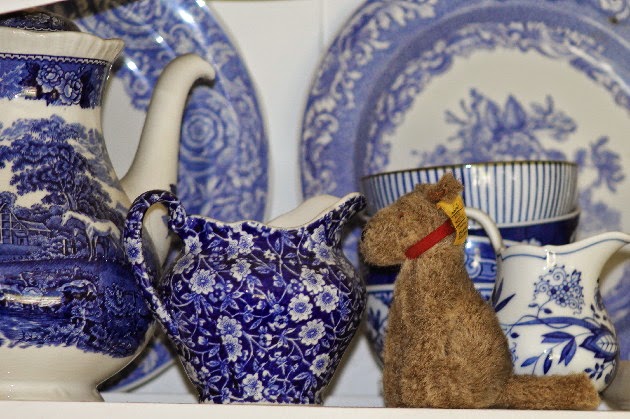
There was a time when we always had two Airedales in the back yard. Now I only have this one little one, a gift Hanno bought me when we lived in Germany. He's a Steiff Airedale.

Our weekend here was a pleasant mix of work and relaxation. I have been knitting a mitten for Hanno's damaged right hand. He nearly cut that hand off with a chainsaw a couple of years ago, and although he has almost the full use of the hand, the circulation is quite poor and his hand is always cold. This mitten, knitted in double strand baby alpaca should keep it warm on even the coldest days. I've also made a little rice bag to slip into the mitten.

Wool scarf knitting from a couple of weeks ago. This is New Zealand pure wool and organic red fine wool.


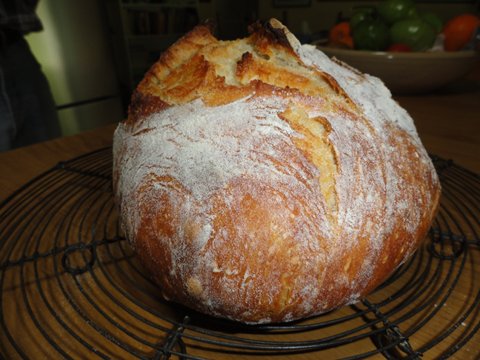
My weekend cooking was really quick and easy. I made a five minute loaf on Saturday to have with the vegetable soup I made. That bread is so delicious and it takes next to no time at all to make. If you're new to baking, I'll go over the recipe later in the week and hopefully encourage the young readers out there to put on their aprons and bake some bread. Baking is one of those simple life skills we all should have.


Hanno didn't share the soup because he cooked his German speciality grünkohl und schweinefleisch - kale and pork (above). No doubt there are many different ways to make this recipe. Hanno does it the way his mother taught him, which was probably what she was taught by her mother. It's a mix of smoked pork sausage, pork knuckle and bacon, cooked with onions, kale and potatoes and thickened slightly with oats. He makes a big pot at least once a year, in winter, and it takes him about four or five days to work his way through it. He tells me it gets better every day. :- )

My soap from yesterday, just about to be poured into moulds.

Sunday morning had me back in the kitchen again, this time making a batch of soap. I changed my recipe, slightly, this time. That's big for me. I'm a plain and simple woman and usually when I find something I like, that's it, it's mine forever; I see no need for change.  But both Hanno and I have sensitive skin which seems to be worsening as we age. We need our daily soap to be wholesome nourishing soap, containing only natural ingredients. The bulk of my recipe is Australian extra virgin olive oil, with a smaller amount of olive oil infused with calendula petals, and organic coconut oil. I have to leave it to cure for a few weeks but I think I'm on to a winner.  It looks and feels very creamy. I'll go through the recipe with you next week.

It's satisfying and comforting working in my kitchen, producing what I need for my family and myself. There seems to be a view that women who work at home have no power and their work is monotonous. I think the opposite is true. There is true power in taking control of a household and running it to suit the exact needs of the people who live there. The work we do here helps us live an unorthodox life that is enriching because it's so changeable, seasonal and creative. I doubt you get that in most jobs. Most paid occupations are a set group of skills that must be performed to a set standard over and over again. I was thinking about that while I worked on my various tasks on the weekend. Tomorrow I'll be writing about the powerhouse we can all create in our own homes but in the meantime, what did you do on the weekend?

I hope you have a restful weekend ahead and are able to spend time with people you love. Thank you for all your wonderful comments. Most of the time I don't have time to reply but I want you to know the comments often make me smile and sometimes make me frown, but they always make me appreciate the time you take to reach out. It's an important part of the blog for me and I appreciate having you here to share that. No person is an island and my blog works at its best when commentary is coming in with ideas and encouragement being shared.

Stay warm, or cool, wherever you are, and enjoy the weekend.  

❤ ❄ ❤ 


No-poo experiment six months later
DIY sunscreen recipes
Over 60% of breads sold in the UK contain pesticide residues
Organic food better
Rent a wife
Better off renting?
Best before dates
Greening your kitchen
11 ways to green your laundry
How to green your cleaning routine
Essence of Permaculture by David Holmgren. A free download in several languages.
Uh oh, it's me again. This time on ABC Radio 612 with Chris Welsh, and broadcast state-wide in Queensland on Wednesday evening.
The rate of food wastage in many Western countries, including Australia, is shameful. The current estimation is that about 30 percent of the food we buy is wasted. That is just plain crazy. If you can organise yourself to not waste any food, you'll have money to pay off debt, to save or use to buy something you need. I think the main problem is a general lack of skills when it comes to selecting fresh food in the shops and then storing it correctly at home. Luckily these are skills anyone can learn.

If food spoils before you've had a chance to eat it then it might be wise to rethink your food buying and storage strategy. If food is stored in the fridge and sits there until it looks unusable or the use by date tell you it's not safe to eat it, then you're probably buying too much food, or at least the wrong kind of food.


Either way, you have to get rid of spoiled food. It either goes in the bin for transport to land fill or to the compost heap if you've got one set up. Maybe some of it can be given to the chickens but never give them food with mould or fungus on it. Often the compost heap is the only option. You don't need to have a working vegetable garden to have a compost heap. Composting your food waste is far better than sending it to land fill. Taking care of your own perishable rubbish, makes you more self-reliant and independent. Even if that compost heap sits there and the compost is never used, if it just decomposes and enriches the soil beneath it, it's a far better option than sending your food waste to the tip.

Our compost heap is a very simple affair - just lawn clipping, green leaves, fruit and potato peels, paper and old straw from the chicken pen etc, thrown together in a pile and kept moist. Over the weeks and months it will decompose.

To set up a compost heap, find a space on garden soil away from the house so you don't have to look at it all the time. If you have three sides holding the food waste in, that's ideal, but it can be done without it.  Just add your food scraps as you have them, add pieces of cardboard, shredded or ripped paper, old envelopes, contents of the vacuum cleaner, old pieces of cotton, wool and linen, cuttings from the garden and lawn clippings. You can add anything that has once been alive but do not add dairy products or meat/fish of any kind. That will attract rats and mice. When you've added the food waste, try to cover the heap with a layer of lawn clippings or cardboard. That will stop any smells and will keep the heap safe from visiting birds. When it's dry, hose the heap. It should be kept moist but not wet. If you do that, you'll be able to compost your own food and some household waste and save it from going to landfill. A worm farm will do a similar thing but it will use much less waste.

Even though you add to the compost heap all the time, it should be decomposing and therefore shrinking in size. But if the heap does grow a little and you're making good compost, get a spade and throw it around on your lawn or ornamentals plants to use it up.

The other great strategy to reduce food waste is to plan your menus every week. If you're only buying what you need for that week's meals, you'll have less waste (and more money).  There are many posts at the forum about menu planning. If you don't know what to do, read some of the posts, or ask someone to help.


Many people recommend growing your own fruit and vegetables but make sure that is a viable option before you start.  If you're starting from scratch and have to buy soil or enrich virgin soil, build or buy raised beds, fertiliser, seeds and seedlings, sometimes it doesn't make financial sense. If you want to start raising vegetables, start small - with easy vegetables such as lettuce, carrots and beans and build up your crops and skills each year. And don't just learn about planting and varieties, learn about harvesting, storing and preserving food as well. You'll do yourself no good if you grow a great crop of all the vegetables you want to eat but then waste a lot of them because you don't know how to store or preserve them.

If you can't use all your lemons, juice them and freeze the juice. I make lemon cordial during the summer months with our frozen lemon juice.

You need to be proactive when you produce food at home. If you're growing lemons, collect recipes for lemon dishes so you can use the lemons when you have an abundance, and you will have. If you don't want to use all of them, find someone to barter with. Almost everyone wants lemons, you won't have any trouble swapping them for something you want.  The same goes for everything you're growing. Know what you'll do with it when you have a small amount or a large amount.  Learn the skill before you need to use it. It is this kind of thinking that allows some homemakers and gardeners to get ahead while others struggle.

Learn how to make leftovers into something delicious on the second or third day. You'll save yourself the cost of making another meal from scratch, you'll save the electricity it would take to cook it and the time it takes to cook from scratch. Above all else though, you'll be building up your skills and fully utilising the food you have on hand. That skill might make or break you one day.

 Find some good recipes for using leftovers, then use them.


Recipes for leftovers 1
Recipes for leftovers 2
Recipes for leftovers 3

Other tips include:
  • Clean out your crisper bins in the fridge before you shop. Use the vegetables and fruit that are still in there before you buy a new batch. Vegetables can be used to make a soup or casserole and that will be one less meal you have to shop for.
  • Have a plan for leftovers. Stretching a meal from one to two or three days is a skill we can all develop.
  • If produce needs to be stored in a certain way, do it.
  • Don't store potatoes or onions in plastic bags, they'll rot.
  • Wrap celery in aluminium foil - it will keep well for six weeks, still crisp.
  • Most vegetables store better in sealed plastic bags rather than just being open in the crisper.
  • Don't overstock your stockpile.
  • Buy only what you know you'll eat.
I wonder how you manage food in your home. Do you have any clever tips and hints to add to this list? I'd love to hear them.

My series of ABC radio talks is continuing but I forgot to give you the links the last three weeks. Here they are:
  • Keeping a clean home
  • Backyard chooks
  • Preserving food and baking
Please note, I wrongly gave double the amount of ingredients when I was talking about the laundry liquid. You should halve the amounts if you want to make it. The instructions are here.


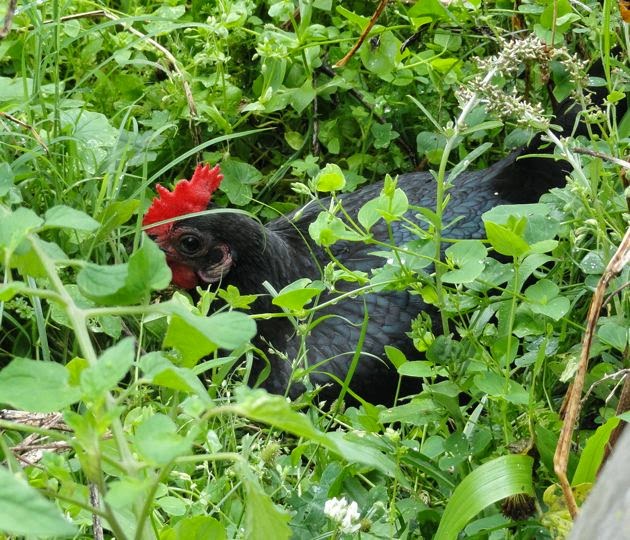
After deteriorating quite suddenly over the past few days, our little blind chook, Lucy, died yesterday. :- (   It's something all chicken keepers have to deal with but it's never easy when it happens. That is Lucy above, sitting on one of her many secret nests.

This winter has been the coldest winter in a long time in many parts of Australia. Where I live, we usually have a sprinkling of days in July and August when the night time temperature falls to about three or four degrees. This year we've had much more than that, and colder. Right now we're at the end of a two week run of cold nights and winds that go right through you. Australian houses where I live are set up for the heat rather than the cold. We don't have an open fire or a heater as such; we have reverse cycle air conditioning but I don't like using it. Hanno and I disagree on the safety of wood burning stoves. I would like to have one for winter warmth, he thinks they're polluting and unhealthy.


So in times such as these, when winter winds make us all rug up, I turn to my kitchen for warmth. I make casseroles, soups, roasts and other slow cooking meals that give the impression of warmth when it's cooking, then fulfils the promise when we eat it. So far, it's kept me going.

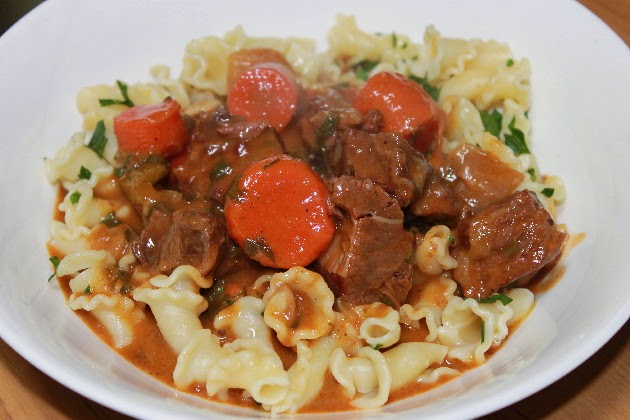
The one dish I keep returning to on very cold days is beef casserole. It's easy to prepare, nutritious, hearty and when I cook it in the slow cooker, it takes only about 20 minutes to prepare. If you're working outside the home on these cold winter days, there would be nothing better than this dish to welcome you back home at night. If you could prepare this meal on a Sunday afternoon, and make a double portion, you'd have two excellent winter warmer meals for two of your work days during the week.  

I know there are quite a few readers who don't cook much. I had an email from a young man last week who told me that it's been two years since he left home and he's only cooked three meals. I want you all to try this so I'm giving basic instructions for all the new cooks. Following this recipe will give you a superb meal that can be the basis of your expanding recipe file.  Here's is the step-by-step guide on how to do it.

This ingredients list is based on a family of four to eight, depending on ages. Please adjust to your own circumstances but remember, even if it's just one or two in your family, this will sit very well in the fridge for two days or it can be frozen in portions and eaten later.
You'll need:
  • about 1kg/2.2lbs gravy beef, shin beef or blade steak - cut in 5 cm/2 inch squares. Meat cooked slowly will shrink and having the meat in bigger portions helps it stay moist.
  • 2 medium onions, peeled and cut into quarters
  • 2 large carrots, peeled and cut into 5cm/2 inch pieces
  • 2 sticks of celery, cut into 5cm/2 inch pieces
  • 2 cloves garlic, peeled and crushed
  • salt and pepper to taste
  • 2 tablespoons plain/all purpose flour
  • two tablespoons paprika - you could substitute chilli, curry power or curry paste
  • ½ cup chopped parsley

Optional extras: if you have vegetables in the fridge that have to be eaten, this is the ideal dish to add them to. Any of these would be ideal - capsicum/pepper, zucchini, turnips, parsnips, a small amount of cabbage, cauliflower, kale, silverbeet/chard, Brussel sprouts, sweet potato, potatoes.

On Sunday afternoon, or in the morning before you go to work: 
  1. Cut the meat into large squares.
  2. Place plain flour, salt, pepper, paprika (or chilli/curry) into a bowl and mix.
  3. Coat the meat in the seasoned flour.
  4. Put a large frying pan on the stove and add two tablespoons of cooking oil. I use virgin olive oil. When the oil is hot, but not smoking, add half the meat and brown it on all sides. Remove the meat and repeat with the other half. Remove the meat. Remember, you're just browning the outside of the meat at this point. You're not cooking it. Browning the meat will give the casserole a deep, rich flavour, so don't skip this step.
  1. Into the same pan, add all the vegetables and brown them for about five minutes. 
  2. If there is any seasoned flour left over, add it and mix it in.
  3. Add the meat back to the pan with the vegetables. At this point, it should look like the photo above.
  1. Pour over enough water to just cover the meat. Not too much water, just enough to cover.
  2. Stir the meat until the sauce starts to thicken.
  3. When the sauce is thick, pour the casserole into your slow cooker, add the parsley and put the lid on. Remember, nothing is cooked at this stage. You've just developed the flavours and caramelised your ingredients. They will cook in the slow cooker.
  1. If you're doing this on Sunday, place the inner part of the slow cooker in the fridge at this point. Tomorrow morning as soon as you get up, take it out of the fridge and sit it on the bench for a while so it's not going on the heat straight from the fridge. Take no notice of this step if you're cooking it straight away.
  2. When you're ready to cook the casserole, turn the slow cooker onto the low setting if you're going to leave it all day, or high if you want to eat the meal in about four hours.
  3. Place the lid on. Make sure there is nothing touching the slow cooker - no tea towel or plastic cups etc.
This must cook for at least four hours but can be left all day or overnight on a low setting if you prefer. Depending on what vegetables you've included, you won't have to add anything else. But if you want to bulk this meal out a bit for the men and boys in the family you could serve it with rice, buttered noodles, dumplings, mashed potato or crusty bread.  The beauty of this dish is that when you walk into your home after a hard day's work, you'll smell this cooking and you'll know you have a hearty meal ready to serve when you're ready to eat it. Ask everyone to put away their coats and bags, wash their hands, and get the children to set the table while you're mashing the potatoes and pouring the drinks.

Any leftover casserole can be placed in a covered bowl for eating tomorrow or in a freezer bag or container for eating at another time. I hope you enjoy it. Next week, I'll share an equally delicious chicken meal that can be cooked while you're out at work or busy at home with other things.


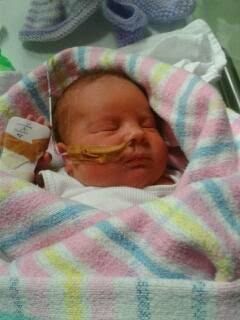
Here she is! Born on Wednesday to Danny and Laura.

We've had very cold days and nights here in many parts of Australia. There has been record snow falls in the alps and strong winds. I hope you're staying warm. For all my friends experiencing summer in other parts of the world, I hope it's not too hot for you and you're enjoying clinking ice cubes in your cold drinks. Enjoy the weekend, everyone!

Power to the people - I'm not sure if anyone outside Australia will be able to watch this but all Australians should. - Hanno's recommendation
Great free DIY furniture plans
Knitting with rags - floor rug project
Tips for running a small business when the children are off school
Work Shop - getting people together
Koala video - watch it to the end, very cute
Using leftover risotto - I guess there must be leftover risotto somewhere in the world ;- )
Ideas for leftover milk, or in the case of many of you reading here, ideas for the height of milking season
Strawberry swirl cream cheese pound cake
Elderflower recipes
Will switching to a water meter save money? In England and Wales your water company is obliged to install a water meter free of charge if you ask
Ten tips for cross stitchers
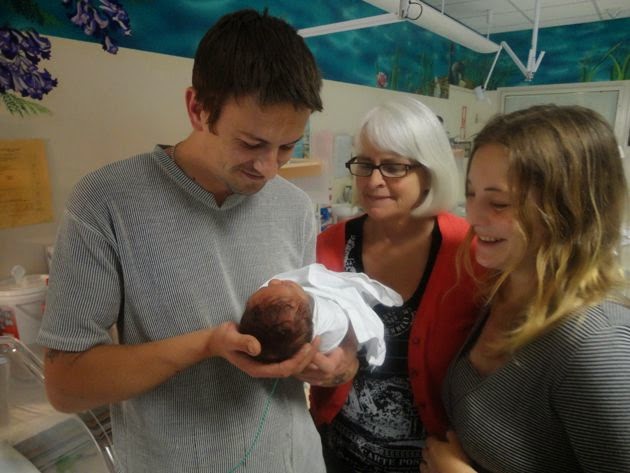
I am very proud and happy today. We have a new baby in our family - Tricia has a grand daughter! Congratulations Daniel and Laura on the birth of your little girl. The first girl to be born in our part of the family for more years than I care to remember. 

I have no recent photos of Danny and Laura but here is a photo of them both with Tricia when their son Johnathan was born in 2012.

Born in Sydney last night, about five weeks premature, by Caesarian, the baby is fine but Laura has high blood pressure. Danny was at her side during the birth. I'm sure I'll hear more news later. In the meantime, I'm smiling every time I think of that baby girl, and Tricia.
I had an email from a young woman the other day who told me she had suffered significant abuse when she was growing up and had severed all ties with her family. She said she was doing well now, had embraced simple life, had a good job, had recently married and was looking forward to the birth of her first baby next month. Being a soon-to-be first time mother made her wonder about family traditions and what she should be passing on to her children.  Having the history she has, she doesn't want to carry on any of her family traditions but wants a thread of family history to run through her new family. What could she do?

I told her she should start her own traditions.


When you think about it, every tradition, whether very grand or the small family traditions most of us enjoy, starts because one person decided it was important enough to continue and connect families over the years. We can all be that person, we can all start our own family traditions.


The easy and obvious ones are attached to the holidays - Christmas, Hanukkah, Chinese New Year etc. Often these involve large family gatherings and food, specific to that time of year. In my home, we've embraced some aspects of traditional religious holidays and mixed them with things that we wanted to include. We observe some traditions from Hanno's culture and some from mine. It doesn't have to be the same for all families. It just has to be right for yours. So with these traditions, think about what the tradition is, then modify it to suit you and your family. After that, you just have to do it.

You could easily start small family traditions such as dad reading to the children before bed. My father used to do that and I read to my sons. Go camping at Easter time or at the same time during the year when you always have a few days off. Enter food in the local show/fair using some of grandma's old recipes and see if you can improve every year. Get the kids involved too. Start some food traditions. Not just in what you eat but in preparing the food as well. Start a family preserving day where you invite all the willing members of your family to bring over a box of tomatoes or fruit and then cook and bottle sauce or jam for later in the year. Those traditions can become much loved family events where family stories and history are passed on.


A very worthwhile tradition is everyone gathering at the kitchen table to eat the main meal of the day. It is there we can really connect with our children and share what's happening today and next week. Make sure there are no phones at the table and if yours rings, don't answer it. If you're trying to teach your teens that their phone isn't as important as the family meal time, you have to reinforce that by ignoring your phone while you're seated at the table.


We all benefit from traditions. Whether it's because they give us a feeling of belonging to a particular family or because they create a bond between everyone that nothing will break. Traditions can help make us stronger and feel safe and secure, not only in ourselves but as a family group as well.

So to that young woman, I encourage you to look at what you do throughout the year and mark the important days with your own traditions. I can't think of a better time to do it than when a new baby is born into the family - it's a new life in so many ways.

What are your family traditions? Did you start any new traditions of your own?

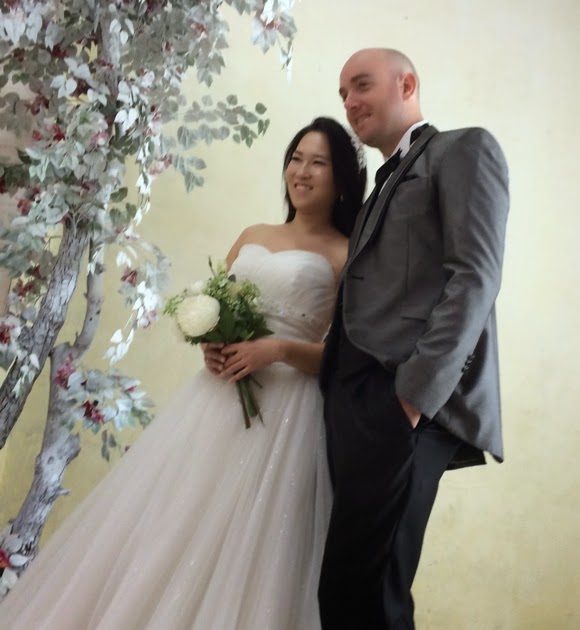
I'm very happy to tell you that Kerry and Sunny are engaged. Kerry bought the ring before he went over to Korea in March and proposed to Sunny while he was there. We couldn't tell anyone until all members of both sides of the family knew about it. We're not sure when the wedding will be but I'm sure when they've had a chance to discuss it, we'll have a wonderful day to look forward to. Hanno and I couldn't be happier to see both our sons married to strong, hard working, beautiful women. 

It is the custom in Korea to have engagement photos taken in formal dress, similar to our wedding photos. These photos were taken in Korea. More photos are taken at the wedding and those photos are of the couple and their families.


When your own children get married it gets harder and easier. Many people told me that babies were difficult, that two year olds were the worst, that five year olds would make me rip my hair out, that teenagers were unbearable. But I found that while it was not always a bed of roses, that each year was better than the one before it and with every passing year I loved my sons more. They may not be perfect but in my eyes they're very close to it. So that's the easy part. I think it's harder because you have to establish relationships with girlfriends, then wives, and that isn't always easy. I have grown so close to Sarndra and Sunny now, I love them as my daughters and have dispensed with the "in-law". I am a very proud mother and grandma and I'm very thankful to have the family I have.

Kerry and Jamie in Korea in March.

Kerry, Sunny and Jamie are still living near us and we look after Jamie when we're needed. Sunny has settled in again since they returned from Korea a couple of weeks ago and while her mother hasn't fully recovered yet, Sunny talks to her and her sisters on the phone frequently. She is looking for a job now so they can both work towards building up their savings again.

Kerry visited Shane and Sarndra while Sunny was in Korea.

Shane, Sarndra and Alex are living further up the coast at Gladstone. It's about a five hour drive from here. They're got a lovely home in a good suburb and they're working hard towards their future. Shane is undergoing training on his job, Sarndra works part-time in a fabric and craft shop and Alex goes to day care on those days. It's a wonderful little day care centre. The woman who looks after Alex takes the children on outings and organises very creative activities for them. She also has a private Facebook page where she posts videos and photos every day so all the families can see what their children are doing every day.

Shane, Sarndra and Alex at the town of 1770.

Here is Alex about to have a snack. : - )

It's Alex's birthday this week. He will be three years old. It looks like we might all drive up to celebrate, not on his birthday but soon after. I think spending time together will be good for both Alex and Jamie. They see photos and can recognise each other so having that face-to-face contact will help build their relationship. And it will be heart-warming for me to see us all together again as a family. I am fully aware that families who love and support each other don't just happen by chance. There is a lot of time and effort that goes into relationship building but we're all prepared to do what it takes to make our family what we want it to be.

I hope you've enjoyed this family post. I get a lot of emails asking me about my family so I'm pleased to share this brief update. Thanks to Sarndra and Sunny too for allowing me to use their photos.

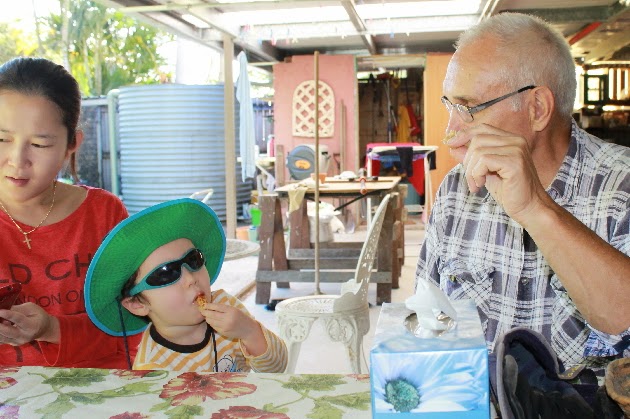
We had a quiet and relaxed weekend which included lunch with Sunny and Jamie on Saturday. The weather was cool so it was a good time for roast pork shoulder with fresh red cabbage, Dutch Cream potatoes, peas and gravy. We always welcome Sunny and Jamie with open arms when they visit and love having them here. I love hearing about what they've been doing and while we're talking, Jamie sits with us for a while, then runs off to play, then returns again.


Sitting on the back verandah eating pork crackling, waiting for the potatoes to cook. Someone is looking very smooth in those glasses and hat. 


Jamie helped opa with Lucy, our blind chicken. She is an Old English Game hen. He helped feed her, then opa showed him how to hold her gently. When they took Lucy over to the grass, Jamie spent a while in the sunshine talking to her and making sure she was drinking her water.


When we came inside for lunch, there wasn't much to do. I only had to make the gravy and put the meat and vegetables on serving dishes, then everyone helped themselves at he table. As usual, Jamie finished his plate and then we all enjoyed cheesecake and coffee, or for one of our guests, strawberry milk.


Opa serves up the gravy while Sunny cuts Jamie's meat and vegetables.

I have very fond memories of my childhood when we had a roast for lunch on Sundays. Often dad cooked so mum could have a day off and even though it was a family lunch, there always seemed something very special about it. Later in the day, for our evening meal, dad would load up a trolley of cold cuts, salad, bread, butter and drinks and then wheel it into the lounge room where mum would be helping us to practise our reading or spelling and in front of our open fire, we'd share this most humble of meals. I hope we're helping Jamie build similar memories that he'll be able to pass on his to his own children. I firmly believe that a loving and secure childhood creates the firm foundation for a good life and being a small part of that, makes me a very happy woman.

The rest of the weekend was a mix of small tasks, knitting, gardening and cooking. It was cold with gusty winds on Sunday so we stayed close to the house and had frequent cups of tea. I always feel grateful for my home in cold weather. It might be a remnant instinct left over from the caveman days when being out in the open in winter might have meant an early death. Whatever the reason, having out family close on a cold winter's day, sharing good food, is one of the seasonal joys for us.

I can hardly wait until tomorrow when I have some very exciting news to share with you. I'll see you then. :- )
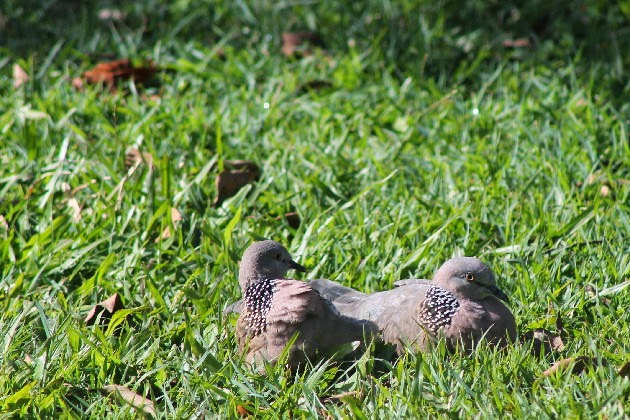
A pair of spotted doves resting in the sunshine just outside my window yesterday morning.

It's been a week of cold nights and mornings here and one of the coldest winters I can remember for a long time. No doubt many of you in other countries will be either enjoying the hot summer temperatures or struggling through them. No matter what the temperature where you are, I hope you find relief with a hot tea or a cold drink while you relax.

Thanks for your visits and comments during the week. I look forward to seeing you again next week.

Honeysuckle lemonade @ local milk
Picnic recipes
Selling on taste, not health
A Swedish garden blog - Madelief
Going vegetarian can cut your diet's carbon footprint
Summer slice quilt tutorial
Saving water: the writer takes on this month's challenge
Vegetable garden planning for beginners
Coles admits to threatening suppliers
Woolworths accused of raising prices to plug earnings hole
Australian Organic Gardening Resource Guide - this is Green Harvest's just released catalogue for seeds and organic gardening products
Colourful basket weaving

I used to hate being defined by my job. If I was anything, I said to myself, I was not a technical writer for the mining industry, I was much more radical and interesting than that. But the truth was that I was indeed that kind of writer and slowly but surely, it made me unhappy. It seems that many of us are defined by our job. What is the first thing many people ask each other, especially men, when they meet for the first time? What do you do? God forbid you should say you're a mother and wife working at home. That's not acceptable, they want to know your commercial value. Mother and wife = zero. 


But I'd like to dispute that because even though I don't get paid for the work I do, I save a lot of money by taking charge of my home and home producing much of what we need here. We don't get paid, but the value of the work we do is significant. We might not earn money in the conventional sense now, but we save money and the work we do here in our home, allows us to live this slow and gentle life.


Now I want to be defined by my job. If someone asks what I do, I could say I am a frugal housekeeper, a cook, baker, a preserver of food, seamstress, knitter, gardener, chook wrangler, cleaner, maintenance woman and oh, I write about it too. But that's not the important part. The significance part of this work isn't the writing, it is the housework that us keeps warm, fed, comfortable and alive. That's the significant part of the equation for all of us but only the commercial value is generally acknowledged as being important. pffffft


The simple work of every home is often work that's been done over the centuries that has been modified for our modern times. It's still the same work, it's nothing fancy, we are carrying on the traditions of our great grandmas and grandpas. And I'm proud that I do that. I am surprised and saddened that so many look down at the work we do because it's honest work that gives us a good life. Isn't that what everyone is aiming for? If you've been reading here for a while you'll know I don't care much about what other people think of me. I want my family and friends to love me but if someone I don't know questions what I do with my days and gives me a disapproving look, who cares.

Hettie catching the last rays of sunshine yesterday afternoon.

Some people in my position would describe themselves as a writer or author and although I sometimes do descrbe myself as such to people when I'm out in the community working, I am foremost a wife, mother, mother-in-law and grandmother. And I write about those important roles. I love the terminology of all of it too. I say I'm a grandma and some people are surprised I'm comfortable with the term. I'll take ten helpings of grandma, gardener, cook and knitter over one helping of technical writer or author any day. Because that is what I am now, I have moved from valuing myself as a commercial entity to believing that my true value is in the simple, ethical qualities I bring to my family and the hard work I do in my home. The life I live now is the golden prize that is available to anyone who wants to claim it and do the work, at any stage of life. I doubt you can put a price on that and maybe it can't be defined by a job title.

I've spent the past few days baking, sewing and knitting. They are such simple, old-fashioned tasks and I know my great grandmothers (and yours) would have been doing something very similar over the years, way back when. I like how these older tasks so easily fit into modern times, filling life with interest, meaning and purpose; and replacing acquisition for many of us. You see it more and more now - younger women and men taking up the needles, learning how to bake and cook, and being satisfied and enriched by it. I am so pleased this is happening because it means that these traditionally women's tasks and crafts will go on and can be passed on to younger girls and boys, women and men.

 Date scones - a winter favourite here.


As well as that connection I have with older times and the interest and purpose these tasks give me now, baking, sewing and knitting/crochet also help me cut my household costs. Buying bread flour in bulk helps me produce good bread for my family for less than the five or six dollars a loaf from a good bakery. I completely bypass the supermarket sliced bread, and have done for many years, because I don't want the artificial flavourings and preservatives that come with it, or the plastic it's wrapped in. I believe I can make a loaf of equal quality to that from a good bakery and although I haven't costed it for a few years, I guess it would cost me about three dollars for a good loaf baked at home. It's a saving of about five hundred dollars per year based on three loaves a week.


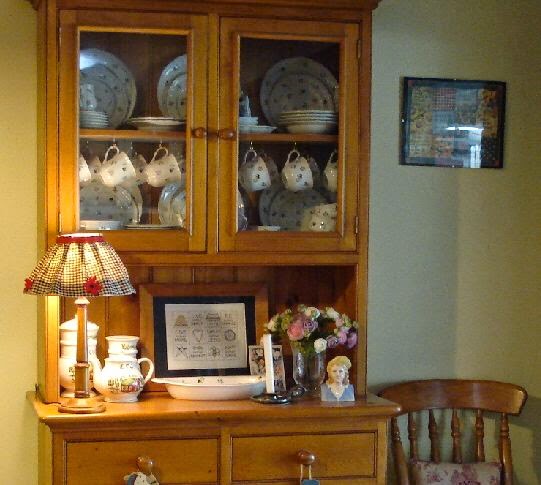
Similar savings can be made if you have a yarn and fabric stash. Making gifts and the soft furnishings you need at home using the fabric from your stash will save you a decent amount each year. Over the weekend I made a lamp shade using fabric I had here. It's much prettier than any I could have bought, I have unusual taste in these things and I doubt I would have been able to buy anything close to what I like, so it's a win-win. I save money and I also get a lamp shade that suits my taste and blends in beautifully with what we already have here.  I'm also using resources I have on hand, don't have to go out to buy what I need and the icing on the cake is the satisfaction I feel when I look at that lamp. Not just now but into the future as well.


We will welcome a new baby into our family soon. Tricia's son Danny and his partner Laura are expecting a daughter and as part of a gift for the baby, I've started knitting a little dark pink hat. It's a washable, organic wool and cotton blend, done on straight needles, because I didn't have a suitably sized pair of circular needles on hand. I hope it helps keep the baby warm because she will live in the Blue Mountains where it's very cold. Once again, I had the yarn and needles here, so getting our gift underway hasn't cost anything. I love being able to welcome a baby with home knitting.

It's a worthwhile exercise to collect any fabrics or yarn anyone offers you over the years. You might also find inexpensive fabric and yarns at your local second-hand shops. Even if you have no projects in mind, building a stash will help you when you do need something. Having the materials on hand helps you cut your costs, it inspires creativity, it gives that all important feeling of self-reliance and if, like me, you believe that homemade comes from the heart, your gifts will be a fine indication of your feelings towards the person you give your gift to.

I think of my stash as another form of stockpiling. It saves time and money and allows me to have my own materials on hand when I need them. Are you using your stash for your projects too or are you trying to build up a stash?


Brrrr, it's cold here this morning but it should warm up later with a sunny day. I hope if your weather is cold, you have warm soup, gloves and jumpers on hand. I hope if it's warm where you are that you have salads, cold drinks and a fan. But who knows what could happen. With the weather the way it is, we don't always get what is expected.

Thank you for your visits this week, and for your comments. Comments mean a lot more than a few words on a screen. It's like you're taking the time to wave back and say "hello, I'm here too!" Those of us who write blogs, need that. Not just me, we all need it.  Whatever you're doing this weekend, take some time for yourself, sit down and relax for a while. The work will still be there when you get back to it.

- - - ♥︎ - - -

Having a baby will simplify your life
CWA halls closing
Pop into Nundle tea cosy
Washington DC is banning polystyrene containers
How to read olive oil labels
Living life on a simple note
Where are all the mothers?
When kids share a room, awesome things happen (apologies for using the word "awesome")
And carrying on from the previous link, here is something I wrote in 2007 about old fashioned houses
Thrifty gardener's guide to companion planting
The revolution - axing our personal debt
I received an email from a young woman the other day who told me that she's so conflicted about a choice she has to make that she's deliberately not thinking about it and she'll probably end up just flipping a coin to decide. She said by doing that she'll be getting what is meant to be. Phttttt! I don't believe in fate or coincidence. I believe we make our own luck and good fortune by working for what we want. Usually the decisions we have to make are those involving your work, family, friends and home so you should do as much thinking about those decisions as you can. The choices you make, whether they be good choices or bad, will impact you when you make them, and like a ripple on a pond, long into the future too. Flipping a coin to make a decision is like saying you're not worth the effort. Everything you do matters.


Flipping a coin and deliberately not thinking about important issues is side stepping the opportunity you have to make your own decisions. I encourage all of you to plan ahead and live according to your values. Own your life! This isn't a dress rehearsal. You don't want to realise that too late.  Plan your life as best you can, but be flexible when you have to be. Planning ahead will give you the best chance of success because you can actively work towards what you want. Non-planning really doesn't take the decision making out of your hands, there will still be an outcome. You're making the choice to not make a decision and then you have to take what comes of that.


When I look back and think of all the people I've met, the work I've done, the places I've seen, the time spent on such a wide variety of things, the countless hours I've spent raising babies and children and teens, the years I've spent working, I can see clearly that my path to here was never straight. It was one with curves, highs and lows, periods of intense happiness but also periods so dark I could barely see what was ahead. Some of my choices were not given enough thought and some just plain wrong, but all those past choices helped make me the person I am now. Sometimes I look back I wonder where all that energy came from, and where it went. I've tried many things, left most of them behind, and am here now with my basket full of what is important to me. I am happy and self-confident and I have the most wonderful family.


So to that young woman who wrote, and to all of you, I encourage you to think about what you want, work hard for it, plan your days and make the most of the intelligence, skill and talents you have. Stay close to your family and friends. I'm not saying this is easy, in fact, I know its not, but since when was the easy option the smart one? No matter what, when you think enough about the issue you're dealing with and then make the decision you need to make, own it, and then put in the effort to make it work.

Are you a decision maker or are you inclined to flip a coin?


I have a couple of food recipes for you today. I love sharing my recipes, they're just plain and simple, but I get a thrill when people say they like them. I really should say I have one recipe because one is for pizza and I don't think you can recommend a recipe for that because everyone has their own ideal toppings. I, for instance, love anchovies on my pizza but most people's eyes glaze over when I say that. Apologies to all with weak stomachs.  


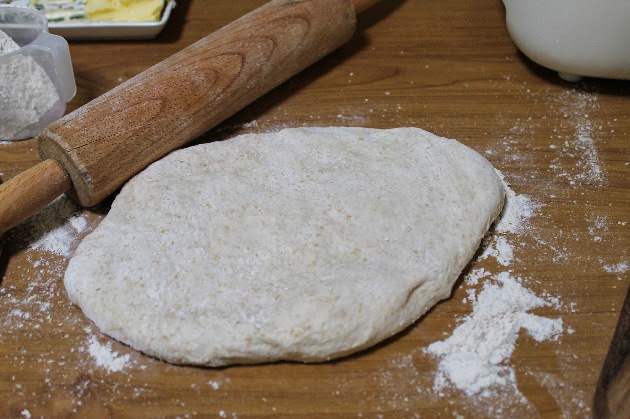
I do however, have a hint for a base that might make pizza night easier for you. When I know I'm going to have pizza during a particular week, when I make my next batch of bread, I add another cup of flour, more water, a pinch more yeast and a splash of olive oil. Oil or butter in dough makes the dough more tender and pliable so it's easier to roll out flat when preparing pizza. It doesn't spoil the bread by adding it. When the dough is made in the bread machine, I take off a piece big enough for one pizza base and freeze it or refrigerate it (depending on when I'll be making it) until it's needed. It saves me the extra step on the pizza night of making the dough. I've been making wholemeal dough lately but pizza dough can be made with any type of bread flour. I should remind you the pizza dough I make is for two people. Adjust yours according to the number of bases you need.


My other recipe is for sausage rolls. These are sold in almost every bakery in Australia and when my boys where young, they were always the most popular food I served at their birthday parties. They're a good standby to have when you're entertaining, especially on cold winter nights. I guarantee you, when you put out a tray of hot sausage rolls and a bowl of tomato sauce, they're be gone in less than five minutes. 


Men and boys in particular, love these and it's a great food for those parents here who like to hide vegetables.  I add carrot, onion and celery to mine and you'd never know it when they're cooked. They're a very devious party food. ;- )  I make most of my pasty but I never make puff pastry or filo pastry. These sausage rolls need two sheets of frozen puff pastry.

SAUSAGE ROLLS
1 kg/2.2 lbs finely minced beef, pork, lamb or chicken
1 medium onion, finely chopped
1 medium carrot, grated
1 stick celery, finely diced
salt and pepper - you need good seasoning in this, don't be shy with the salt and pepper

2 sheets frozen puff pastry
egg wash - egg wash is an egg yolk or a whole egg mixed with a little water


  1. Turn on your oven to 220C/430F to preheat. Puff pastry gets its flaky texture when cold pastry goes into a very hot oven.
  2. Place two sheets of pastry on the bench and cut into two even pieces. Make sure the pastry remains cold. You want it defrosted but not at room temperature.
  3. Combine the meat and whatever finely diced vegetables you're using in a large bowl, add the seasoning. 
  4. Mix well and when it's thoroughly combined run the meat mixture in a narrow sausage along the middle of the pastry. (See photo above.)
  5. Brush the side of the pastry with egg wash to help the pastry seal.
  6. Roll up the sausage roll in a long log shape, make sure it seals along the edges where the pastry meets.
  7. With a pastry brush, brush egg wash over the top of the rolls.
  8. Cut the rolls into the size you need them to be.
  9. Make three small slashes in the top of every sausage roll.
  10. Place on a baking tray, not touching, and place into the hot oven. 
  11. After five minutes, turn the heat down to 180C/355F and cook until golden brown.
  12. Cool on a rack for a couple of minutes before serving.

In addition to hiding the vegies in these rolls, you can also modify them if you're serving a large tray of them at a party. Divide your ingredients up and make three different batches.  Do one according to the recipe above, add one level teaspoon of cayenne pepper OR one finely diced green chilli to batch number two and one level tablespoon of curry powder to batch three. Delicious! Be prepared for a couple of your guests to ask for the recipe. I hope you enjoy them.

Newer Posts Older Posts Home


My books were all published by Pengiun, and are available at Amazon US, Amazon UK and Amazon Au

Search here

Total Pageviews

Translate


I'm Rhonda Hetzel and I've been writing my Down to Earth blog since 2007. Although I write the occasional philosophical post, my main topics include home cooking, happiness and gardening as well as budgeting, baking, ageing, generosity, mending and handmade crafts. I hope you enjoy your time here.

MY FAVOURITE PLACES

  • Grandma Donna's Place
  • Grandma Donna's YouTube
  • Grandma Donna's Instagram
  • This Simple Day
  • Nicole's Instagram

Give More

Give More

Popular posts last year

Making ginger beer from scratch

We had a nice supply of ginger beer going over Christmas. It's a delicious soft drink for young and old, although there is an alcoholic version that can be made with a slight variation on the recipe. Ginger beer is a naturally fermented drink that is easy to make - with ginger beer you make a starter called a ginger beer plant and after it has fermented, you add that to sweet water and lemon juice. Like sourdough, it must ferment to give it that sharp fizz. To make a ginger beer plant you'll need ginger - either the powdered dry variety or fresh ginger, sugar, rainwater or tap water that has stood for 24 hours to allow the chlorine to evaporate off. You'll also need clean plastic bottles that have been scrubbed with soap, hot water and a bottle brush and then rinsed with hot water. I never sterilise my bottles and I haven't had any problems. If you intend to keep the ginger beer for a long time, I'd suggest you sterilise your bottles. MAKING THE STARTER In a...
Image

NOT the last post

This will be my last post here.  I've been writing my blog for 18 years and now is the time to step back. I’ve stopped writing the blog and come back a couple of times because so many people wanted it, but that won’t happen again, I won’t be back.  I’ll continue on instagram to remain connected but I don’t know how frequent that will be. I know some of you will be interested to know the blog's statistics. 
Image

How to make cold process soap

I'm sure many of you are wondering: "Why make soap when I can buy it cheaply at the supermarket?" My cold process soap is made with vegetable oils and when it is made and cured, it contains no harsh chemicals or dyes. Often commercial soap is made with tallow (animal fat) and contains synthetic fragrance and dye and retains almost no glycerin. Glycerin is a natural emollient that helps with the lather and moisturises the skin. The makers of commercial soaps extract the glycerin and sell it as a separate product as it's more valuable than the soap. Then they add chemicals to make the soap lather. Crazy. Making your own soap allows you to add whatever you want to add. If you want a plain and pure soap, as I do, you can have that, or you can start with the plain soap and add colour, herbs and fragrance. The choice is yours. I want to add a little about animal and bird fat. I know Kirsty makes her soap with duck fat and I think that's great. I think t...
Image

Preserving food in a traditional way - pickling beetroot

I've had a number of emails from readers who want to start preserving food in jars but don't know where to start or what equipment to buy.  Leading on from yesterday's post, let's just say up front - don't buy any equipment. Once you know what you're doing and that you enjoy preserving, then you can decide whether or not to buy extra equipment. Food is preserved effectively without refrigeration by a variety of different methods. A few of the traditional methods are drying, fermentation, smoking, salting or by adding vinegar and sugar to the food - pickling. This last method is what we're talking about today. Vinegar and sugar are natural preservatives and adding one or both to food sets up an environment that bacteria and yeasts can't grow in. If you make the vinegar and sugar mix palatable, you can put up jars of vegetables or fruit that enhance the flavour of the food and can be stored in a cupboard or fridge for months. Other traditional w...
Image

Cleaning mould from walls and fabrics

With all this rain around we've developed a mould problem in our home. Usually we have the front and back doors open and that good ventilation stops most moulds from establishing. However, with the house locked up for the past week, the high humidity and the rain, mould is now growing on the wooden walls near our front door and on the lower parts of cupboards in the kitchen. Most of us will find mould growing in our homes at some point. Either in the bathroom or, in humid climates, on the walls, like we have now. You'll need a safe and effective remedy at some point, so I hope one of these methods works well for you. Mould is not only ugly to look at, it can cause health problems so if you see mould growing, do something about it straight away. The longer you leave the problem, the harder it will be to get rid of it effectively. If you have asthma or any allergies, you should do this type of cleaning with a face mask on so you don't breathe in any spores. Many peopl...
Image

Five minute bread

Bread is one of those foods that, when made with your own hands, gives a great deal of satisfaction and delight. It's only flour and water but it symbolises so much. I bake bread most days and use a variety of flours that I buy in bulk. Often I make a sandwich loaf because we use most of our bread for lunchtime sandwiches and for toast. Every so often I branch out to make a different type of loaf. I have tried sour dough in the past but I've not been happy with any of them. I'll continue to experiment with sour dough because I like the idea of using wild yeasts and saving the starter over a number of years to develop the flavour and become a part of the family. However, the loaf I've been branching out to most often is just a plain old five minute bread. By five minutes I mean it takes about five minutes actual work to prepare but it's the easiest of all bread to make and to get consistently good loaves from. If you're having people around for lunch or...
Image

This is my last post.

I have known for a while that this post was coming, but I didn't know when. This is my last post. I'm closing my blog, for good, and I'm not coming back like I have in the past.  I've been writing here for 16 years and my blog has been many things to me. It helped me change my life, it introduced me to so many good people, it became a wonderful record of my family life, it helped me get a book contract with Penguin, and monthly columns with The Australian Women's Weekly and Burke's Backyard . But in the past few months, it's become a burden. In April, I'll be 75 years old and I hope I've got another ten years ahead. However, each year I'll probably get weaker and although I'm fairly healthy, I do have a benign brain tumour and that could start growing. There are so many things I want to do and with time running out, leaving the blog behind gives me time to do the things that give me pleasure. On the day the blog started I felt a wonderful, h...
Image

What is the role of the homemaker in later years?

An email came from a US reader, Abby, who asked about being a homemaker in later years. This is part of what she wrote: "I am a stay-at-home mum to 4 children, ages 9-16. I do have a variety of "odd jobs" that I enjoy - I run a small "before-school" morning drop-off daycare from my home, I am a writing tutor, and I work a few hours a week at a local children's bookstore. But mostly, I cherish my blissful days at home - cooking, cleaning (with homemade cleaners), taking care of our children and chickens and goats, baking, meal-planning, etc. This "career" at home is not at all what I imagined during my ambitious years at university, but it is far more enriching. I notice, though, that my day is often planned around the needs of my family members. Of course, with 4 active kids and a husband, this is natural. I do the shopping, plan my meals, cook dinner - generally in anticipation of my family reconnecting in the evening.  I can't h...
Image

Every morning at home

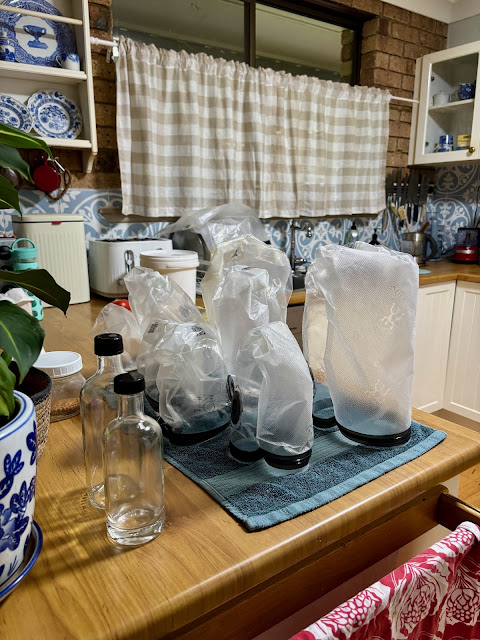
Every morning when I walk into my kitchen it looks tidy and ready for a day's work. Not so on this morning (above), I saw this when I walked in. Late the previous afternoon when I was looking for something, I came across my rolled up Zwilling vacuum bags and decided they had to be washed and dried. So I did that and although I usually put them outside on the verandah to dry it was dark by then. I turned the just-washed bags inside out and left them like this on a towel. It worked well and now the bags are ready to use when I bring home root vegetables, cabbages or whatever I buy that I want to last four or five weeks.
Image

You’ll save money by going back to basics

When I was doing the workshops and solo sessions, I had a couple of people whose main focus was on creating the fastest way to set up a simple life. You can't create a simple life fast, it's the opposite of that It's not one single thing either - it's a number of smaller, simpler activities that combine to create a life that reflects your values; and that takes a long to come together. When I first started living simply I took an entire year to work out our food - buying it, storing it, cooking it, preserving, baking, freezing, and growing it in the backyard. This is change that will transform how you live and it can't be rushed.  
Image


Trending Articles

NOT the last post

This will be my last post here.  I've been writing my blog for 18 years and now is the time to step back. I’ve stopped writing the blog and come back a couple of times because so many people wanted it, but that won’t happen again, I won’t be back.  I’ll continue on instagram to remain connected but I don’t know how frequent that will be. I know some of you will be interested to know the blog's statistics. 
Image

Every morning at home

Every morning when I walk into my kitchen it looks tidy and ready for a day's work. Not so on this morning (above), I saw this when I walked in. Late the previous afternoon when I was looking for something, I came across my rolled up Zwilling vacuum bags and decided they had to be washed and dried. So I did that and although I usually put them outside on the verandah to dry it was dark by then. I turned the just-washed bags inside out and left them like this on a towel. It worked well and now the bags are ready to use when I bring home root vegetables, cabbages or whatever I buy that I want to last four or five weeks.
Image

You’ll save money by going back to basics

When I was doing the workshops and solo sessions, I had a couple of people whose main focus was on creating the fastest way to set up a simple life. You can't create a simple life fast, it's the opposite of that It's not one single thing either - it's a number of smaller, simpler activities that combine to create a life that reflects your values; and that takes a long to come together. When I first started living simply I took an entire year to work out our food - buying it, storing it, cooking it, preserving, baking, freezing, and growing it in the backyard. This is change that will transform how you live and it can't be rushed.  
Image

Creating a home you'll love forever

Living simply is the answer to just about everything. It reduces the cost of living; it keeps you focused on being careful with resources such as water and electricity; it reminds you to not waste food; it encourages you to store food so you don't waste it and doing all those things brings routine and rhythm to your daily life. Consciously connecting every day with the activities and tasks that create simple life reminds you to look for the meaning and beauty that normal daily life holds.  It's all there in your home if you look for it. Seemingly mundane tasks like cleaning and cooking help you with that connection for without those tasks, the home you want to live in won't exist in the way you want it to.  Creating a home you love will make you happy and satisfied.
Image

Time changes everything

I've been spending time in the backyard lately creating a contained herb and vegetable garden. My aim is to develop a comfortable place to spend time, relax, increase biodiversity and encourage more animals, birds and insects to live here or visit. Of course I'd prefer my old garden which was put together by Hanno with ease and German precision. Together, we created a space bursting at the seams with herbs, vegetables and fruity goodness ready to eat and share throughout the year. But time changes everything. What I'm planning on doing now, is a brilliant opportunity for an almost 80 year old with balance issues. In my new garden I'll be able to do a wide range of challenging or easy work, depending on how I feel each day. It’s a daily opportunity to push myself or sit back, watch what's happening around me and be captivated by memories or the scope of what's yet to come.
Image

It's the old ways I love the most

I'm a practical woman who lives in a 1980’s brick slab house. There are verandahs front and back so I have places to sit outside when it's hot or cold. Those verandahs tend to make the house darker than it would be but they're been a great investment over time because they made the house more liveable. My home is not a romantic cottage, nor a minimalist modern home, it's a 1980’s brick slab house. And yet when people visit me here they tell me how warm and cosy my home is and that they feel comforted by being here. I've thought about that over the years and I'm convinced now that the style of a home isn't what appeals to people. What they love is the feeling within that home and whether it's nurturing the people who live there.
Image

Making ginger beer from scratch

We had a nice supply of ginger beer going over Christmas. It's a delicious soft drink for young and old, although there is an alcoholic version that can be made with a slight variation on the recipe. Ginger beer is a naturally fermented drink that is easy to make - with ginger beer you make a starter called a ginger beer plant and after it has fermented, you add that to sweet water and lemon juice. Like sourdough, it must ferment to give it that sharp fizz. To make a ginger beer plant you'll need ginger - either the powdered dry variety or fresh ginger, sugar, rainwater or tap water that has stood for 24 hours to allow the chlorine to evaporate off. You'll also need clean plastic bottles that have been scrubbed with soap, hot water and a bottle brush and then rinsed with hot water. I never sterilise my bottles and I haven't had any problems. If you intend to keep the ginger beer for a long time, I'd suggest you sterilise your bottles. MAKING THE STARTER In a...
Image

An authentic look at daily life here — unstaged and real

Most days Hanno was outside happily working in the fresh air. It may surprise you to know that I started reading my book,  Down to Earth , yesterday - the first time since I wrote it 13 years ago.  I had lent it to my neighbor, and when she returned it, I started reading, expecting to find surprises. Instead, I realised the words were still familiar—as if they were etched into my memory. As I flipped through the pages, I was reminded of how important it was for me to share that knowledge with others. The principles in Down to Earth changed my life, and I truly believed they could do the same for others. After just 30 minutes of reading, I put the book down, reassured that its message still holds true: we can slow down and reshape our lives, one step at a time.
Image