down to earth

  • Home
  • About Us
  • Down To Earth Book
  • Privacy Policy
One of the ongoing comments I've had since I started writing my blog, and also in my real life, is that simple life isn't that simple. Many people tell me that spending hours growing and preparing food and cleaning products is much more complicated that buying mainstream from the supermarket. Many of them tell me that they're too busy to do those things and that buying what is needed every week simplifies their lives because it's easier.

That's fine by me. I'm not trying to convince anyone that this way of living is the grand panacea for all of life's complexities. I think that to live a simple life, at the very least, you need to cut out or cut back on a variety of things, but how you do that is up to you. I know what works for me and my family and that is how I live. We have cut our environmental footprint considerably over the past 12 - 13 years and we've done it consistently. If you're doing the same thing then you're on the right track. 


I've thought about this a lot and I know the following are simplified by doing them at home, from scratch:
  • baking bread
  • making preserves
  • growing vegetables and some fruit
  • keeping chickens for eggs
  • making cleaning products and laundry liquid
  • making soap
  • cooking from scratch
  • baking from scratch
  • disposing of disposables
  • mending
  • knitting dishcloths, jumpers, cardigans, gloves, hats etc
That list could go on and on.

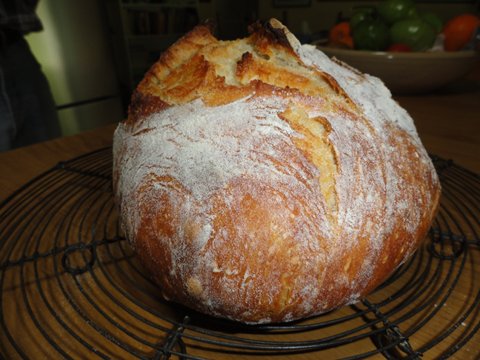
Let me explain my beliefs. When I bake bread at home, I buy bulk flour in a heavy paper bag, bulk yeast (or I make sour dough), and I add things I have on hand for other purposes - oats, butter, salt, sugar, nuts, seeds etc. So I buy two products specific to bread making, that I buy every couple of months, and I have the rest on hand. Making a loaf of bread takes me about 15 minutes in work time. I make the dough in the bread maker and then bake the dough in the oven. That way I get a delicious loaf without too much time given over to it.  My electricity comes form solar panels.


To buy a loaf of bread at the supermarket, I have to drive to the supermarket and buy the bread - every day if I want fresh bread every day. That bread will have been made in some far off factory that is staffed by people who probably all used fuel to get to the factory, it will be loaded with preservatives and other artificial additives. It will be packaged in plastic with a plastic clip to hold the bag closed.  All the ingredients for the bread will have been transported to the factory, the rolls of plastic or bread bags will have been transported to the factory as well. When the bread is made and wrapped, then it's transported to the supermarket, where I drive to buy it. That's a lot of fuel being used for something that can easily be made at home. It's a lot of artificial additives too - I'm sure you don't add preservatives and artificial flavourings to your bread at home, neither do I. It's not necessary when you make it yourself.


The same could be said for every product on that list. I buy the ingredients, yarn or fabrics a few times a year and they are stored in my home till they're needed. Of course it looks simpler when you think you're just going to the shop to buy those goods, but they're all come from somewhere, they all have a chain of production and delivery, and varying amounts of fossil fuels attached to them. That is not simple, in fact it's extremely complex and unsustainable.

Some tell me they frequently use disposable products - that they save time. I've turned my back on as many disposable products as I can and my housework takes the same amount of time as it did before. Disposables don't save time, they're more convenient, yes, less messy, yes, but also unsustainable and much more expensive. Making do with what we can produce here at home has cut down the amount of rubbish we send to the land fill as well. If I was shopping like I did all those years ago, I'd be sending full bins and not composting or recycling anything at home, and still working to pay for it all.


"Simple" shouldn't be confused with "more convenient" or "easy". Simple usually involves you doing some form of work - to bake the bread, milk the cow, make the cheese, kill the pig, harvest the tomatoes, peel the potatoes, cook the meat, pack the lunch, fill the water bottles, knit the cardigan, darn the socks or whatever. More convenient is getting someone else to do those things for you, or buying the same thing over and over again. It is easier, and it might seem more simple to drive to the shop to pick up all those things, but think about what's gone on to get all those products on the supermarket shelves, all the fuel used to deliver the raw ingredients to the factories, all the people and fuel needed to process the products and to get the people to the factories and the products from the factories to the shops.

There are many definitions of simple living but I think it means taking control of your own life and becoming self reliant in many different ways. Through that self reliance comes the opportunity to pay off debt, to live on less money, to connect with your family and friends and to have your home and family as the centre of your world. Home, family, friends and your community become your focus and the commercial world and the flimflammery of modern life take a back seat. But that's my view, how do you define simple life?


It's been a cold week here in our warm country. We desperately need rain but the forecast isn't offering any hope of that in the near future. I hope the weather at your home is what you want it to be.  I do my last library talk at Nambour next week and then have some scheduled for September in the Moreton Bay area. I'm looking forward to meeting those Brisbane people.

I hope you have a wonderful weekend. Keep smiling. :- )

Cute cotton summer top for a little girl - tutorial from Purl Bee
Experimenting with viruses
Context Institute: whole system pathways to a thriving sustainable future
Good and Cheap - a free download of what look like excellent meals by Leanne Brown
Tips for photographing chickens
McClennan Heritage Farm 
From Scratch free online homesteading magazine
Mara shawl pattern
Reinforcing and darning
Short row spiral knitting - rug, free pattern
Germany breaks solar power records
Where do your donation dollars go?


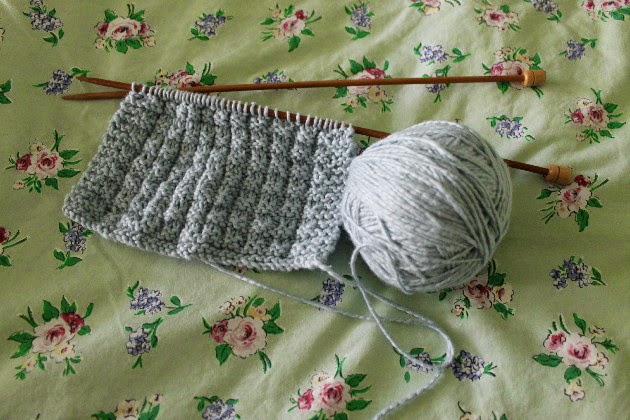
I've yet to find a more comfortable winter activity than knitting. Just thinking about my wool, cotton and needles gives me a good feeling. And then there's the important choice of where to knit. Even though knitting is so portable when you take the kids to sport or dancing, a little warm chair to knit in is part of winter for me. I have an arm chair set up in the lounge room where I'm surrounded by knitting, needles, wool, patterns, a little jar of markers, a darning needle and small scissors. Bliss.


Alone is a good place to be when you knit because you sometimes need silence to explore the ideas that will form in your brain when you undertake the simple repetition that makes up knitting. Some say that knitting is similar to crochet and I suppose that's right in some ways, but to me, knitting is more like meditation. The long periods of repetition encourage thought that can sometimes be deep and illuminating. But showing her true versatility, knitting will also see you through your favourite TV program, a tennis match or rehearsal.

These photos, above and below, are the same shawl. I'm not sure what happened to the colour but the top one is true.

I've just finished my second shawl. It was very simple knitting, ideal for a beginner who wants to progress beyond scarves and dish cloths. I made both of mine with organic cotton, one in the colour Diligence, a dark grey and the most recent in Patience, a camel light brown. I thought a lot about those two qualities while I was knitting my shawls.  I'm also doing up a few dishcloths to show at my library talks. The one on my needles now is Deb's waffle weave, which is in my book and was asked about at one of the talks. I recently knitted a pair of fingerless mittens (in New Zealand pure Merino) for Hanno but when I finished them and gave them to him I noticed I'd knitted one in a greenish grey and one in a bluish grey. Ahem. I guess I'll be doing up another pair. They'll match this time. :- )


Knitting is a wonderfully creative investment of time in the practical activity of making clothing and soft furnishing for your home. Generally the clothes we knit last for many years so it's wise to use the best yarn you can afford. That yarn will be rubbing against skin when it's worn so try to steer clear of the Chinese acrylics and look for more natural alternatives. Real wool breathes, real cotton is cooling. But think about the time you invest in knitting too and make that time enjoyable by using yarns you like the feel of. Use good needles. I'm totally won over by bamboo needles and although I have metal, wood and vintage plastic, I always choose my Japanese bamboo needles now. I've noticed that Japanese needle sizes are alongside the UK and US sizes on various charts now. I think that reflects the incredible influence that Japanese crafts, fabrics and implements have had in the West in recent years.

I am not the best knitter in the world and my projects are rarely, if ever, perfect, but knitting makes me happy so I'll keep clicking those needles. I really enjoy the time I spend making things from wool and cotton. It feels right. It suits me and my life. If you're a beginner, and you're looking for help and encouragement you'll find it at the forum. There is a monthly thread where members show and tell their latest projects. Chel and Judy are there to keep your hands busy and your mind thinking creatively while the rest of us appreciate all you show us.

What's on your needles?

Purl Bee's knitting tutorials and knitting terms
Purl Bee's knitted home projects
How to knit a bag
Knitting ideas
I have no doubt that a change of mindset towards a less complicated and busy life would help almost everyone pursue their simple life dreams. It's not easy to switch from the culturally-sanctioned spend-up-big-and-then-pay-for-it lifestyle to a simpler life. Almost all good things are difficult to acquire and you have to be prepared to work for them. The easy things are what most people do. So if you were to ask me today how to change a mindset of convenience to something more sustainable, I'd tell you that, like most things, it's a process of small changes.


There is a lot to be said for cultivating respect for oneself, others, our work, our homes and our environments. I doubt you could live this life if there wasn't some respect there to begin with but as you move into it, as your mindset changes, respect grows and builds understanding and contentment into your ordinary days. I never think much about the special days, the births and deaths, the weddings and anniversaries, because those days take care of themselves. It's our ordinary days we need to be mindful of. They need work and commitment.


I want my life to be full of spectacular ordinary days that are sprinkled with special days. I know that no one is going to walk up to me and offer me such a life on a silver platter. The creation of that kind of life is for the person who lives it. For me, respect plays a big part in giving me those memorable ordinary days. I respect the work I do here because it helps give me the lifestyle I want. That includes not only my housework but also my writing in various forms. My housework gives me the comfort and simplicity I want in my life, my writing gives me creative expression and the opportunity to connect with like-minded people all over the world.  For me, that's a great combination. But there are thousands of other combinations and it's up to everyone to find what works for them.


But I am doing all this for a reason other than comfort and connections. I am living according to the values that are important to me. They provide an ethical structure in which to live my life.  Respect, a change of mindset, mindfulness, self reliance, trust, grace and resilience all play a part. So if you're not really connecting with your simple life in the way you want to, although you're being frugal, organising yourself and doing all the practical things, maybe you need to look at your values and your mindset.  Simple life certainly involves a lot of practical things bunched in together but if it's to last, those practicalities are usually built on beliefs and ideology.

Open yourself up to new experiences and read a lot. If you can get hold of some of Wendell Berry's work, he is an excellent guide. In the meantime, read this poem of his. It's sublime. Of course, I'm not going to steer you away from the practical guides and recipe books that teach what you need to know but don't shy away from books that make you think. They can help you build a solid foundation for your life and will give you good reason to continue in times of doubt.

What has influenced you in your simple living journey?

How much is enough by Vicki Robin
The question of lifestyle by the editors of In Context
Enough by me, written in 2010
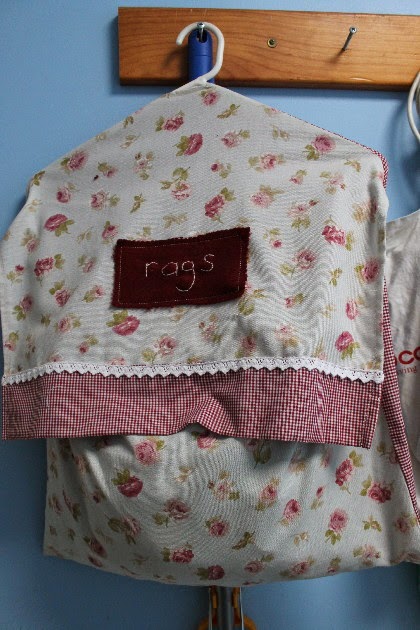
Lori asked about making a rag bag after she read the last post.  I wrote about this way back in 2008 so here is that post, Lori. I hope you can make one up by reading those instructions and seeing the photos. Just start with a sturdy clothes hanger and take your measurements from that.


And here is a post about rags, again. I hope this motivates you to start your own rag bag. Let me know how you get on. 


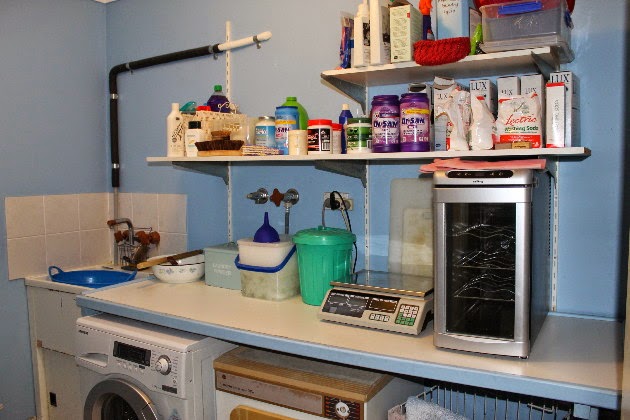
I've been trying to find the time to clean out my laundry and finally got to it yesterday. I scrubbed the sink and bench, cleaned the floor and went through all my products to make sure they were necessary and usable. I went through the rag bag and it was getting low so I found an old towel, cut it up and added the rags to the bag. I threw out some old soap I had in a container. I didn't know it was there; it was rancid. Note to self: don't hide soap, it doesn't last, you silly girl. 


It's not pretty but it's a working laundry so I just need it to be serviceable and productive. I do a fair bit of work in the laundry. As well as storing all my cleaning ingredients, I also use it to store my cheese fridge and to dry out and then store homemade soap. There is a 15 litre bucket in the sink that I use for soaking, which I do a lot of, and on the floor are two buckets and mops. And for Madeleine who emailed asking about mops, I use a cotton mop and bucket most of the time but also a more modern sponge/squeegee mop that I use with a handmade terry cover over the squeegee head. It gets into the corners better than the cotton mop does, although the cotton mop is much easier to use. I don't know what it is about the modern squeegee-type mops. I find they're difficult to move around on the floating floor we have. Do you have that problem?


The main thing though is that the room where all my cleaning is based, is now clean and ordered. There have been few changes in that room over the years and one thing will always remain the same: the work we do in our simple lives is easier if our work spaces and supplies are organised. I'm still making laundry liquid in preference to laundry powder because I can use it for so many other cleaning jobs. Still using oxy-bleach to soak whites and stubborn stains. Still using vinegar and bicarb for general cleaning. I never dry clothes in a dryer, always on the line outside, I'm still washing exclusively in cold water in a front loader. I still hate ironing. I will never go back to commercial cleaners. When the homemade cleaners cost so little to make and they do a better job, using less chemicals, why would I change? I find that as I age, my asthma is getting worse. I think that going back to high chemical cleaners might do me in.


My next task during the coming week is to move all the shopping bags I have in the laundry. The long term task is to remove the old dryer. Even though it still works, it's now 33 years old and I haven't used it for a long, long time. We bought it to dry our new babies' nappies. I hope they'll accept it at the rubbish dump's recycle shop. It's either there or the museum. ;- )


Slow magazine winter edition is out now so if you're looking for a decent read this weekend, see if you can find it at your local newsagent. If they don't have it, ask them to get it in for you. There is a preview of it here on Facebook and yes, that is my article An inconvenient truth about convenience food. So get yourself a cup of tea, find a place in the sun and slow down with Slow. I hope you enjoy it.
Look who's back. Sunny and Jamie flew in from Korean yesterday morning. :- )  We will have a quiet weekend, a mix of work and rest. I hope you have time out for yourself over the coming days and take the opportunity to relax.  I'll see you next week.

 - - - - ♥︎ - - - -

Farmers paying for Woolworths Oliver campaign
Farmers ask Oliver to intervene
Oliver's butcher shop closed after mouse droppings found
Upcycling furniture
Homemade chicken waterer
13 acres
The evolution of leisure
How to mend old shoes
10 vegetarian and vegan blogs you need to know about
Crocheting how-tos, step-by-step
My friend Michele is having a giveaway for the first anniversary of her blog - going grey and slightly green

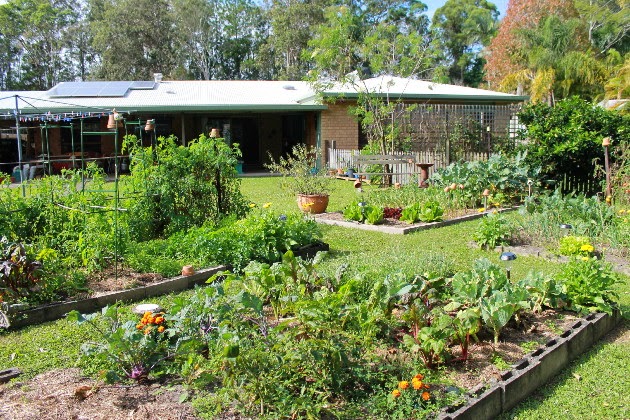
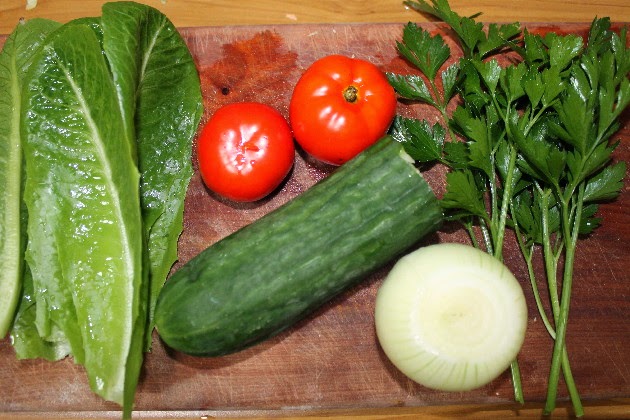
Our garden is doing good things this year, thanks to Hanno and all his soil prep and maintenance work. We're eating from the garden most days and it's still overflowing with healthy abundance. I have a bag full of green beans in a plastic bag with a little water in it, sealed off from the air and when I checked them a few hours ago, they were still crisp and green. Just the thing for the green bean salad I want to make for tomorrow's lunch. We'll also have potato, egg and herb salad, just picked red and green lettuce leaves, rich red tomatoes and beetroot. Everything, except for the potatoes, will come from our garden. Our potatoes are growing but they're still about two months off being harvested. I'll serve that salad with the leftover roast pork I cooked for Sunday lunch, and a bit of mayonaisse I'll make from scratch before serving. There may even be warm rye bread with caraway seeds just out of the oven. The possibilities are endless.

Borage is one of the many flowers attracting pollinators to the garden.

I feel rich having a garden. It's so easy to go out and pick herbs for a pot cooking on the stove, or tomatoes for a sandwich, or oranges for a snack or juice, but those simple acts are enriching and empowering and give us the best food possible. We are rich.


We are lucky in that we can grow a wide variety of fruits and vegetables here.  We have snow peas, broccoli, cauliflowers and cabbages growing because of the cool nights and tomatoes, capsicums, beans and herbs growing because of the warm days.  In the photo above you can see the first of the cauliflowers peeking out. There are also beans, peas, onions, garlic, potatoes, kale, daikon and much more. Sunny and Jamie will be back at the end of the week and it will be such a pleasure to share our vegetables with them again.


Above are cherry tomatoes growing like a house on fire, while furthur over, to the right on the photo below, the large Rouge de Marmande tomato have dropped most of their leaves after producing delicious tomatoes for the past six weeks. They'll be pulled out in the next day or so and will be replaced by sweet peas and Brandywine seedlings. In the meantime we'll survive on the tomatoes in the kitchen, as well as the cherries and Amish Paste.


The chooks feast on a sprouted lettuce. They love eating whatever is thrown over the fence. Except, that is, for Jezebel the big Australorpe girl standing there staring at me.  I took about eight photos and in all of them she's just staring. She's my favourite girl at the moment. I love walking behind them so I can see their downy bottoms from the back. They all look as if they're wearing big black bloomers.


They are the potatoes straight ahead, with beans and passionfruit on the right and cabbages on the left.  In summer, that trellis will provide some good shade for the chook house.


This is part of our parsley patch. It's a good year for parsley. A tip for those who want to grow parsley, buy good heirloom seeds such as Giant of Italy and sow plenty of them in pots. Often it will take a month for parsley to germinate but they can be helped along by watering (once) with a pinch of Epsom Salts in a litre of water, or by soaking the seeds in hot water the night before you intend sowing.  Tend them well in their pots, don't over water, parsley hates too much water, and when they're about two inches tall, transplant them to a full sun position in your garden, close to the edge of the garden to help with frequent harvesting. When the parsley season comes to an end, it will send up a tall flower.  Allow that to develop and turn into seeds. Harvest all of the seeds, and sprinkle some around the garden for the following season.  If they like the place they're growing, parsley will self sow and you won't have to wait for it to germinate in pots again.


The tiny speck in this calendula is a native bee. They're stingless and usually live in holes in tree trunks. These bees produce a delicious concentrated honey that the aboriginal people call "sugar bag".

We are so lucky to have the land, skills and mindset to grow our own vegetables. Not only do they feed our bellies, they feed our souls too. Walking out into a garden I've helped to plant and nurture gives me the feeling of wellbeing that many companies try to sell in the form of vitamin pills and holidays abroad.  Wellbeing is a simple concept though and it's available to everyone who has a flourishing garden and the will to be part of their surroundings.

Don't forget we have a busy Sustainable Backyards section over at the Down to Earth Forums. Robyn and Vikki are the moderators there but we all chime in when we can. If you have any gardening questions, go there and ask. There are many good gardeners there willing to share what they know.


I've been moving towards this project for some time.  A few months ago I found this curtain, added it to my Pinterest pages and started putting together my old doilies so I could make it.  When Tricia came up a few months ago, she made it up for me as two kitchen curtains. They didn't fall well because instead of hanging in a long single length, they were very wide.  After a couple of weeks looking at them, I took them down, put them away and made kitchen curtains using the cutoffs of our bedroom curtains. Then I happened upon Jane Brocket's garden party quilt and it ignited my passion again.


A few days ago, I got the curtains out of the cupboard, did some alterations, added a middle section, sewed the curtains into one piece and turned them into a table cloth.  When I laid our table with that cloth, those doilies felt as if they'd come home at last and were made to grace our table. Now I have the pleasure of seeing those old doilies - some of them with family history - much more often. With just a little work, it's become part of my every day. I much prefer to use what I have instead of keeping them in a cupboard. And it's made up a beautiful cloth that used to be part of my family history into part of daily life.


You can make something like this too. Search for doilies, embroidered table cloths and hand towels, tea towels and old handkerchiefs, or even small pieces of fancy fabric you like the look of. If you don't have enough, stitch a few pieces of plain fine cotton copying the older styles in the pieces you have. Try to make each piece fairly similar in weight. My cloth has very soft handkerchief cotton, light linen and a lot of fine cotton but most of them are very old, have been washed a lot and have lost any heaviness they once had. Set all your pieces out on a bed first to work out your patterns and size and to be sure of the colours and shapes, then pin it and sew on the sewing machine.


In the photo above, I think that little red flower spray was worked by Tricia when we were at school, the white lace doily at the front is mums, the blue cross stitch I bought at Blackheath a few years ago and it looks like one of Tricia's old hankies on the left. The white lace at the back was bought at an antique shop a few years ago and I think it was once church linen - I think a candle stick stood on it. When the cloth was laid, I added roses and gerberas from the front garden and stood back. A few more tweaks and I was satisfied, the project was finished. I had a cloth to be proud of that makes me think of my wonderful family and all the fine stitchers among our ranks. It also gives me the unusual opportunity to sit at the kitchen table with them again and that, my friends, is the icing on the cake.

Do you have a cloth or curtains like this? Do you have any handiwork that reminds you of your family?

Judy has started a thread at the forum about this, click here to go there.
We sat on that bench under the tree on the left. 

We had a day out yesterday. We left just after peak hour, which didn't seem to make any difference to the traffic, drove down towards the city, turned off the freeway after about 15 minutes and sailed into a small coastal town called Scarborough. The tide had just gone out, seabirds were picking over their findings on the rocks and, under a she-oak, we sat with a cup of hot tea and enjoyed the beauty of it all. It was the highlight of the day for me. 

 Lunch at the boat club.

Later we had a seafood lunch at the local boat club, picked up some stationery at Officeworks and then decided to look in at the North Lakes shopping centre.  As Jamie would say: "No good." We took a dozen steps into Target and I said to Hanno, "I can't stand this, let's go." We walked out into the centre again, sat down and had a drink which was quite horrible. I told Hanno the shopping centre was depressing, I didn't want to look at anything, there was nothing I wanted, I just wanted to go. And we did. He agreed. I must remember that shopping centres don't get any better and we're much better off outside than inside them.

I hope you enjoy your weekend.  I'll be giving a talk at one of the local libraries on Saturday morning and spending the rest of the time working on my quilt and out in the garden with Hanno and the chooks. Take care.  
- - - ♥︎ - - ♥︎ - - -

Back to Basics: Living with "Voluntary Simplicity"
How to sew on a button
Jeans repair shop
Online exhibition at Smithsonian Institute - Food, transforming the American Table 1950 - 2000
How to menu plan using veggie boxes
How to finish seams without a serger/overlocker
The rising cost of child care - Britain, Sweden, United States
10 tips from grandma for a greener home - I know this is preaching to the converted but it's good to see popular sites like Treehugger promoting these simple measures
Elderflower jelly recipe
Doughnut recipe
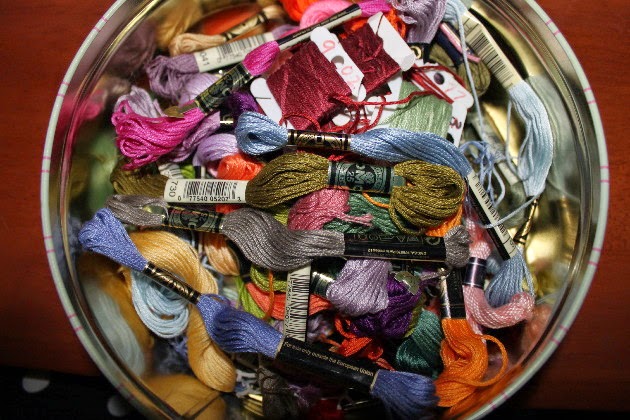
I recently found these photos of a Jane Brocket quilt, made with vintage embroidery pieces,  and it sparked my desire to embroider again. I love hand sewing. Now that these stitched pieces are popular again, it's become very difficult to find enough old embroidery to make a large project such as a quilt or tablecloth. I thought it might be a worthwhile exercise to make up a few pieces, modelled on these old patterns. But first I had to organise myself and my sewing threads.

So yesterday I did a job I've been putting off for months. I sorted through my embroidery threads and organised them in boxes, according to colour. I've been a stitcher for many years and have quite a large collection of threads, mainly DMC. These threads are quite expensive and it's worth my while to look after those I have. The last time I looked, these skeins of thread were between 99 cents and $1.25 so my collection, and maybe yours too, would cost a lot to replace.

A lot of us have a tin full of threads like this.  I decided to organise mine into these little boxes.
I already had a couple of boxes full of my threads, but I needed more space and a couple of new boxes.
 Start by sorting it all into colours and then wind all your skeins onto a little plastic spool.
Threads are easier to keep without getting tangled if they sit on a spool rather than held together with their little labels.
 Don't forget to write the colour code on the spool with permanent marker.

If you're starting out and only have a few colours, I still think it's a good idea to buy one of these little organising caddies. I used the Birch Midi Organiser Box available at Spotlight. It keeps the threads clean, dust-free and ready to use. You'll soon fill a box as threads are the type of product you tend pick up a few at a time when you buy other craft items or start a new project. It doesn't take long to fill a box. You can use an empty compartment to store your needles.

Start off by winding all your threads on a plastic spool onto which you've written the number code of the thread. You'll need that to buy an exact colour replacement in the future. I've found the best way to store them is to colour sort them, but if you've like another way better then do that.

If you want to try this craft, I've written this post about how to get started with embroidery and if you feel guilty about sitting down during the day with your crafts, read this post I wrote many years ago. It might ease your mind.

Here are some embroidery links:
Purl Bee stitchery tutorials
Vintage patterns 1
Vintage patterns 2
Some of my stitchery patterns

- - - ♥︎- -♥︎ - - -

You are invited to participate in a study into the way we consume goods and how that affects our life experiences. Why does it matter? Because there is currently not enough understanding in this area; and understanding can lead to change for the better. But to understand we need you!

All you are asked to do is spend thirty minutes of your time completing an anonymous questionnaire. It can be completed online or in paper form on request. Easy. Participation is entirely voluntary and you can opt out at anytime before completing the questionnaire. There will be no repercussions either way.

The study is being conducted by an honours student in the Bachelor of Psychological Science degree at La Trobe University, Wodonga campus. For more information or to get involved, please click on the following link: http://latrobepsy.az1.qualtrics.com/SE/?SID=SV_3t0Ig6VSdWFBLkV

Alternatively you can email the investigator at sarich@students.latrobe.edu.au for more information or to receive a paper version of the questionnaire.

Thanks for your help.
Before I start my post, I just have to say this to the world: Sunny and Jamie will be home again next week! I have missed them so much, I can't even begin to tell you. So there, it's on the page, I am breathing easier now................and waiting.  :- )

- - - ♥︎ - - - ♥︎ - - - ♥︎ - - -

I turned an invisible corner on the weekend and yesterday got back to my "normal" routine. My season of hectic work schedules and deadlines is behind me now and I'm settled in my home again, not just physically but emotionally as well. When I was so busy, even though I was here at home, my mind constantly wandered to the work I was doing and rarely to what I needed to do in my home. Consequently I cut corners, stopped doing some things, became a bit of a sad sack and yearned for the day when I could get back into my true rhythm. I wanted that daily familiarity again.


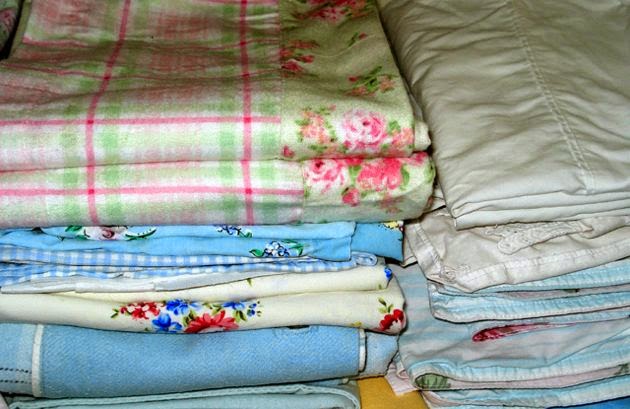
So yesterday I changed the bed linen, opened the bedroom windows to let in the light and fresh air, put a few whites on to soak, tidied the laundry and washed the hallway floors.  Hanno did some renovations last week and the floor has been quite dusty since then. The weather is warm and sunny so I wandered around the garden looking at what needs to be harvested or tended to. When I came back inside Hanno was performing one of his winter rituals - washing and sorting a bucket of kale ready for his big annual pork and kale pot. It's one of winter's high points for him. And yes, it is winter here, and still 25C/77F. Sigh. I am hoping that as we move further into June, the weather will be colder, I'll need a shawl and we'll warm up with hot chocolate and tea instead of cool down with cold water and cordial.


Mid-morning I cleaned my desk and put aside the fabric I'll be using for my quilt. I still haven't started it but yesterday afternoon, I sorted through the pieces and have come up with a random non-pattern that I'll be working on today. I'm no patchwork expert by any means. I tend to focus less on the pattern and more on the practicality of piecing together some scraps to make a beautiful and warming quilt. I might hand stitch some of it, simply because I enjoy hand sewing a lot and I fancy the idea of sitting with needle and thread with the quilt over my legs.

Lunch for Hanno was his pork and kale dish and for me, ham and eggs. We both had a glass of homemade orange and passionfruit cordial made with sparkling mineral water. Morning tea was pikelets with black cherry jam and tea, and dinner for both of us was just a little snack. Easy.


The only thing I didn't do that I had planned on was to make bread. Now that we have our main meal at lunchtime, we eat less bread, so I'm still not sure when I'll make the bread, whether I'll make it every day like I used to or what form it will take - bread rolls, small loaves or free-form no knead bread. That, my friends, is what I'll be working out today and I have to say that it is good to be back home solving such quiet, gentle and simple problems.

Have you too discovered that daily routines and rhythms help you get through your work?  I hope you have a lovely day and that it's not too hot or cold where you are. xx


Newer Posts Older Posts Home


My books were all published by Pengiun, and are available at Amazon US, Amazon UK and Amazon Au

Search here

Total Pageviews

Translate


I'm Rhonda Hetzel and I've been writing my Down to Earth blog since 2007. Although I write the occasional philosophical post, my main topics include home cooking, happiness and gardening as well as budgeting, baking, ageing, generosity, mending and handmade crafts. I hope you enjoy your time here.

MY FAVOURITE PLACES

  • Grandma Donna's Place
  • Grandma Donna's YouTube
  • Grandma Donna's Instagram
  • This Simple Day
  • Nicole's Instagram

Give More

Give More

Popular posts last year

Making ginger beer from scratch

We had a nice supply of ginger beer going over Christmas. It's a delicious soft drink for young and old, although there is an alcoholic version that can be made with a slight variation on the recipe. Ginger beer is a naturally fermented drink that is easy to make - with ginger beer you make a starter called a ginger beer plant and after it has fermented, you add that to sweet water and lemon juice. Like sourdough, it must ferment to give it that sharp fizz. To make a ginger beer plant you'll need ginger - either the powdered dry variety or fresh ginger, sugar, rainwater or tap water that has stood for 24 hours to allow the chlorine to evaporate off. You'll also need clean plastic bottles that have been scrubbed with soap, hot water and a bottle brush and then rinsed with hot water. I never sterilise my bottles and I haven't had any problems. If you intend to keep the ginger beer for a long time, I'd suggest you sterilise your bottles. MAKING THE STARTER In a...
Image

NOT the last post

This will be my last post here.  I've been writing my blog for 18 years and now is the time to step back. I’ve stopped writing the blog and come back a couple of times because so many people wanted it, but that won’t happen again, I won’t be back.  I’ll continue on instagram to remain connected but I don’t know how frequent that will be. I know some of you will be interested to know the blog's statistics. 
Image

How to make cold process soap

I'm sure many of you are wondering: "Why make soap when I can buy it cheaply at the supermarket?" My cold process soap is made with vegetable oils and when it is made and cured, it contains no harsh chemicals or dyes. Often commercial soap is made with tallow (animal fat) and contains synthetic fragrance and dye and retains almost no glycerin. Glycerin is a natural emollient that helps with the lather and moisturises the skin. The makers of commercial soaps extract the glycerin and sell it as a separate product as it's more valuable than the soap. Then they add chemicals to make the soap lather. Crazy. Making your own soap allows you to add whatever you want to add. If you want a plain and pure soap, as I do, you can have that, or you can start with the plain soap and add colour, herbs and fragrance. The choice is yours. I want to add a little about animal and bird fat. I know Kirsty makes her soap with duck fat and I think that's great. I think t...
Image

Preserving food in a traditional way - pickling beetroot

I've had a number of emails from readers who want to start preserving food in jars but don't know where to start or what equipment to buy.  Leading on from yesterday's post, let's just say up front - don't buy any equipment. Once you know what you're doing and that you enjoy preserving, then you can decide whether or not to buy extra equipment. Food is preserved effectively without refrigeration by a variety of different methods. A few of the traditional methods are drying, fermentation, smoking, salting or by adding vinegar and sugar to the food - pickling. This last method is what we're talking about today. Vinegar and sugar are natural preservatives and adding one or both to food sets up an environment that bacteria and yeasts can't grow in. If you make the vinegar and sugar mix palatable, you can put up jars of vegetables or fruit that enhance the flavour of the food and can be stored in a cupboard or fridge for months. Other traditional w...
Image

Cleaning mould from walls and fabrics

With all this rain around we've developed a mould problem in our home. Usually we have the front and back doors open and that good ventilation stops most moulds from establishing. However, with the house locked up for the past week, the high humidity and the rain, mould is now growing on the wooden walls near our front door and on the lower parts of cupboards in the kitchen. Most of us will find mould growing in our homes at some point. Either in the bathroom or, in humid climates, on the walls, like we have now. You'll need a safe and effective remedy at some point, so I hope one of these methods works well for you. Mould is not only ugly to look at, it can cause health problems so if you see mould growing, do something about it straight away. The longer you leave the problem, the harder it will be to get rid of it effectively. If you have asthma or any allergies, you should do this type of cleaning with a face mask on so you don't breathe in any spores. Many peopl...
Image

Five minute bread

Bread is one of those foods that, when made with your own hands, gives a great deal of satisfaction and delight. It's only flour and water but it symbolises so much. I bake bread most days and use a variety of flours that I buy in bulk. Often I make a sandwich loaf because we use most of our bread for lunchtime sandwiches and for toast. Every so often I branch out to make a different type of loaf. I have tried sour dough in the past but I've not been happy with any of them. I'll continue to experiment with sour dough because I like the idea of using wild yeasts and saving the starter over a number of years to develop the flavour and become a part of the family. However, the loaf I've been branching out to most often is just a plain old five minute bread. By five minutes I mean it takes about five minutes actual work to prepare but it's the easiest of all bread to make and to get consistently good loaves from. If you're having people around for lunch or...
Image

This is my last post.

I have known for a while that this post was coming, but I didn't know when. This is my last post. I'm closing my blog, for good, and I'm not coming back like I have in the past.  I've been writing here for 16 years and my blog has been many things to me. It helped me change my life, it introduced me to so many good people, it became a wonderful record of my family life, it helped me get a book contract with Penguin, and monthly columns with The Australian Women's Weekly and Burke's Backyard . But in the past few months, it's become a burden. In April, I'll be 75 years old and I hope I've got another ten years ahead. However, each year I'll probably get weaker and although I'm fairly healthy, I do have a benign brain tumour and that could start growing. There are so many things I want to do and with time running out, leaving the blog behind gives me time to do the things that give me pleasure. On the day the blog started I felt a wonderful, h...
Image

What is the role of the homemaker in later years?

An email came from a US reader, Abby, who asked about being a homemaker in later years. This is part of what she wrote: "I am a stay-at-home mum to 4 children, ages 9-16. I do have a variety of "odd jobs" that I enjoy - I run a small "before-school" morning drop-off daycare from my home, I am a writing tutor, and I work a few hours a week at a local children's bookstore. But mostly, I cherish my blissful days at home - cooking, cleaning (with homemade cleaners), taking care of our children and chickens and goats, baking, meal-planning, etc. This "career" at home is not at all what I imagined during my ambitious years at university, but it is far more enriching. I notice, though, that my day is often planned around the needs of my family members. Of course, with 4 active kids and a husband, this is natural. I do the shopping, plan my meals, cook dinner - generally in anticipation of my family reconnecting in the evening.  I can't h...
Image

Every morning at home

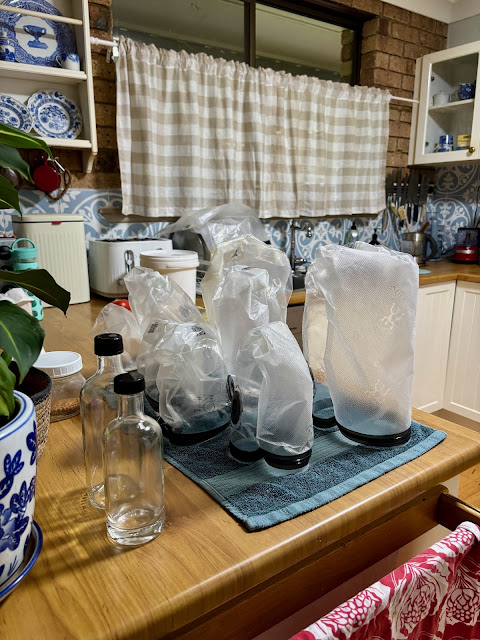
Every morning when I walk into my kitchen it looks tidy and ready for a day's work. Not so on this morning (above), I saw this when I walked in. Late the previous afternoon when I was looking for something, I came across my rolled up Zwilling vacuum bags and decided they had to be washed and dried. So I did that and although I usually put them outside on the verandah to dry it was dark by then. I turned the just-washed bags inside out and left them like this on a towel. It worked well and now the bags are ready to use when I bring home root vegetables, cabbages or whatever I buy that I want to last four or five weeks.
Image

You’ll save money by going back to basics

When I was doing the workshops and solo sessions, I had a couple of people whose main focus was on creating the fastest way to set up a simple life. You can't create a simple life fast, it's the opposite of that It's not one single thing either - it's a number of smaller, simpler activities that combine to create a life that reflects your values; and that takes a long to come together. When I first started living simply I took an entire year to work out our food - buying it, storing it, cooking it, preserving, baking, freezing, and growing it in the backyard. This is change that will transform how you live and it can't be rushed.  
Image


Trending Articles

NOT the last post

This will be my last post here.  I've been writing my blog for 18 years and now is the time to step back. I’ve stopped writing the blog and come back a couple of times because so many people wanted it, but that won’t happen again, I won’t be back.  I’ll continue on instagram to remain connected but I don’t know how frequent that will be. I know some of you will be interested to know the blog's statistics. 
Image

Every morning at home

Every morning when I walk into my kitchen it looks tidy and ready for a day's work. Not so on this morning (above), I saw this when I walked in. Late the previous afternoon when I was looking for something, I came across my rolled up Zwilling vacuum bags and decided they had to be washed and dried. So I did that and although I usually put them outside on the verandah to dry it was dark by then. I turned the just-washed bags inside out and left them like this on a towel. It worked well and now the bags are ready to use when I bring home root vegetables, cabbages or whatever I buy that I want to last four or five weeks.
Image

You’ll save money by going back to basics

When I was doing the workshops and solo sessions, I had a couple of people whose main focus was on creating the fastest way to set up a simple life. You can't create a simple life fast, it's the opposite of that It's not one single thing either - it's a number of smaller, simpler activities that combine to create a life that reflects your values; and that takes a long to come together. When I first started living simply I took an entire year to work out our food - buying it, storing it, cooking it, preserving, baking, freezing, and growing it in the backyard. This is change that will transform how you live and it can't be rushed.  
Image

Creating a home you'll love forever

Living simply is the answer to just about everything. It reduces the cost of living; it keeps you focused on being careful with resources such as water and electricity; it reminds you to not waste food; it encourages you to store food so you don't waste it and doing all those things brings routine and rhythm to your daily life. Consciously connecting every day with the activities and tasks that create simple life reminds you to look for the meaning and beauty that normal daily life holds.  It's all there in your home if you look for it. Seemingly mundane tasks like cleaning and cooking help you with that connection for without those tasks, the home you want to live in won't exist in the way you want it to.  Creating a home you love will make you happy and satisfied.
Image

Time changes everything

I've been spending time in the backyard lately creating a contained herb and vegetable garden. My aim is to develop a comfortable place to spend time, relax, increase biodiversity and encourage more animals, birds and insects to live here or visit. Of course I'd prefer my old garden which was put together by Hanno with ease and German precision. Together, we created a space bursting at the seams with herbs, vegetables and fruity goodness ready to eat and share throughout the year. But time changes everything. What I'm planning on doing now, is a brilliant opportunity for an almost 80 year old with balance issues. In my new garden I'll be able to do a wide range of challenging or easy work, depending on how I feel each day. It’s a daily opportunity to push myself or sit back, watch what's happening around me and be captivated by memories or the scope of what's yet to come.
Image

It's the old ways I love the most

I'm a practical woman who lives in a 1980’s brick slab house. There are verandahs front and back so I have places to sit outside when it's hot or cold. Those verandahs tend to make the house darker than it would be but they're been a great investment over time because they made the house more liveable. My home is not a romantic cottage, nor a minimalist modern home, it's a 1980’s brick slab house. And yet when people visit me here they tell me how warm and cosy my home is and that they feel comforted by being here. I've thought about that over the years and I'm convinced now that the style of a home isn't what appeals to people. What they love is the feeling within that home and whether it's nurturing the people who live there.
Image

Making ginger beer from scratch

We had a nice supply of ginger beer going over Christmas. It's a delicious soft drink for young and old, although there is an alcoholic version that can be made with a slight variation on the recipe. Ginger beer is a naturally fermented drink that is easy to make - with ginger beer you make a starter called a ginger beer plant and after it has fermented, you add that to sweet water and lemon juice. Like sourdough, it must ferment to give it that sharp fizz. To make a ginger beer plant you'll need ginger - either the powdered dry variety or fresh ginger, sugar, rainwater or tap water that has stood for 24 hours to allow the chlorine to evaporate off. You'll also need clean plastic bottles that have been scrubbed with soap, hot water and a bottle brush and then rinsed with hot water. I never sterilise my bottles and I haven't had any problems. If you intend to keep the ginger beer for a long time, I'd suggest you sterilise your bottles. MAKING THE STARTER In a...
Image

An authentic look at daily life here — unstaged and real

Most days Hanno was outside happily working in the fresh air. It may surprise you to know that I started reading my book,  Down to Earth , yesterday - the first time since I wrote it 13 years ago.  I had lent it to my neighbor, and when she returned it, I started reading, expecting to find surprises. Instead, I realised the words were still familiar—as if they were etched into my memory. As I flipped through the pages, I was reminded of how important it was for me to share that knowledge with others. The principles in Down to Earth changed my life, and I truly believed they could do the same for others. After just 30 minutes of reading, I put the book down, reassured that its message still holds true: we can slow down and reshape our lives, one step at a time.
Image