down to earth

  • Home
  • About Us
  • Down To Earth Book
  • Privacy Policy

I've been reading about recycling and reusing lately and two of the facts I came across absolutely shocked me. Source  They were:
  1. Australia is the second highest producer of waste per person in the world at approximately 650 kilograms per person. This is second only to the United States America, which produces approximately 715 kilograms per person.
  2. The average Australian family of four people makes enough rubbish in one year to completely fill a three-bedroom house from floor to ceiling.
What are we doing!
 Plant a garden and make compost.

The local Council here has been encouraging residents towards a more responsible attitude about recycling and waste for some time. In 2009 they thought our landfill dumps would be full by now, 2014, and although that hasn't happened, I'm guessing it isn't far off. It's time for all of us to take this seriously. What we're doing is not sustainable. Not only do rubbish dumps emit gasses into the atmosphere, they use a lot of land that probably can't be used again.

On average, every year every Australian throws out:
  • 330 kilograms of paper
  • 552 aluminium cans
  • 118 kilograms of plastic
  • 74 kilograms of metals
  • 414 kilograms of food
  • 206 glass bottles/jars
I wonder where Canada, UK, France, Germany, Italy and Holland stand on this. I wonder about Japan, China and India too.

Just looking at that list shows me areas to target. Paper can be composted, aluminium cans can be taken to a recycling depot. Food can be managed better and some bottles and jars can be reused at home, the rest recycled and made into new glass.  I don't know enough about metals and plastic to comment on them but at the very least they should be sent to the recycle depot for processing.

 Bottle and jars can be recycled for preserving and storing.


Get rid of as many disposable products as you can and reuse your homemade products over and over again.

Use modern cloth nappies/diapers.
 Feed waste food to your worm farm or chickens.

Waste management for all of us starts at the shops. As well as choosing products, you also choose the packaging that comes with it. If you think your products are over packaged, tell the manager of the store, either in person or via email, and tell them you won't be buying that product until it's packaged responsibly.  Changes won't be made until consumers complain about it. As consumers, I don't think we fully understand how powerful we are. Manufacturers have to keep us happy and when we don't complain, they think we are. It's up to us to stand up and tell them we won't buy their products unless the packaging is consumer and environmentally-friendly.

Cut up old towels and sheets and use them as cleaning rags.
Buy food in bulk when you can.

And what can we do in our own homes?
  • Before you go grocery shopping, do your menu plan and only buy what you need, not what you think you might use. That will cut down on waste and it will keep money in your pocket. 
  • If you have a garden, compost as much as you can, and give waste food to the chooks or dogs. 
  • If you have a stockpile cupboard, only buy what you know you'll use, add new products to the back of the cupboard and use from the front.
  • Buying food in bulk will save on packaging. Or if you can, buy large packets and then break them up into smaller, reusable containers when you get home. You'll still be getting the product you want but you'll have less packaging and it will be cheaper.
  • Replace as many of the disposable products as you can with reusable ones - nappies/diapers, dishcloths and rags made from old sheets and towels come to mind.
  • Don't buy water or drinks in plastic bottles when you go out, take a refillable bottle from home. 
  • If you buy coffee when you're out, take a reusable cup with you. 
  • Avoid using plastic utensils and paper plates. 
  • Shop at op/thrift shops.
  • Join Freecycle in your area to give away appliances and furniture you don't need.  
  • Growing some of your own food will help cut down on thousands of plastic bags that contain store bought produce.  
  • Make your own produce bags and carry bags and refuse the plastic option at the shop.
  • Swap clothes, kids toys and books with friends instead of throwing them out. 
  • Use the library instead of buying magazines or books, or use your computer to read the digital versions.
I have been meaning to show you this bottle for a long time.  I got two of them from the wonderful Biome store in Brisbane. It's a reusable glass bottle with a silicone covering to protect the glass. The thing I love about it is that I can clearly see inside the bottle to make sure it's clean and the top is very easy to tighten and remove, even for my older, weaker wrists. These bottles would be ideal for someone with arthritis and for children. This is the 400ml bottle, they are also available in smaller and larger versions. They are fairly expensive but mine have lasted two years and have been dropped; I have a feeling they'll last a lifetime.

If you have a bin specifically for recycling, go to your Council or local authority website and read about what you can recycle in your area. Many Councils now have a Waste Minimisation Strategy. You should read that too. Your Council will probably also have a list of what it accepts for recycling and if it needs any special treatment by you before it's placed in the bin. Here, for instance, we must rinse out all the plastic drink, milk, yoghurt etc containers, and newspapers must have any plastic wrapping removed before we place them in the bin. And when you have your recyclable waste in the bin, don't contaminate it with anything. If your bin is contaminated, it will probably not be recycled because that kind of sorting just doesn't happen at the depots now.

I hope you'll join me in trying to reduce the amount of materials sent to the land fill. What you do will affect your local area both now and in the future. Surely many of us could cut the amount of waste we generate by simply using some of the methods listed above. There certainly is no better time to start than right now. How do you recycle? Do you have some special tips to share?
 Maya Angelou RIP
"I've learned that people will forget what you said, people will forget what you did, but people will never forget how you made them feel."


I had a busy week with three mornings spent at the libraries meeting many wonderful like-minded people. I'll be at home today, tidying up and cooking. Tomorrow there is another radio interview (local ABC radio at 9am) and then lunch with two dear friends at Daisy's Place. I am really looking forward to that. I hope to have a slow and quiet weekend, relaxing, gardening and sewing.

I hope you have a lovely weekend too. Thank you for visiting this week. See you again soon. :- )

Hector wins the Red Oche Prize
Germany leading the world in solar power
Simple solar cooker for five dollars
Recipes for leftover apples
Ten things that will make you happy
How to mend a ripped seam
Blue honey
How to separate eggs
The Fearse Family
Reuse recognised
Our economy wants you to be in debt - 5 things you can do to take charge
We had a wonderful time at the Coolum Beach library yesterday with lots of enthusiasm and plenty of questions from the people who came along.  Today I'm at Caloundra, at this end of the coast, and I'm looking forward to it very much. Such beautiful people come along to the talks, it's a pleasure to be there.

I didn't have the will to start writing a post when I came home yesterday but I've got a few photos taken in the last three weeks that I want to share with you so I thought now is the ideal time to do that.  So, in no particular order ...

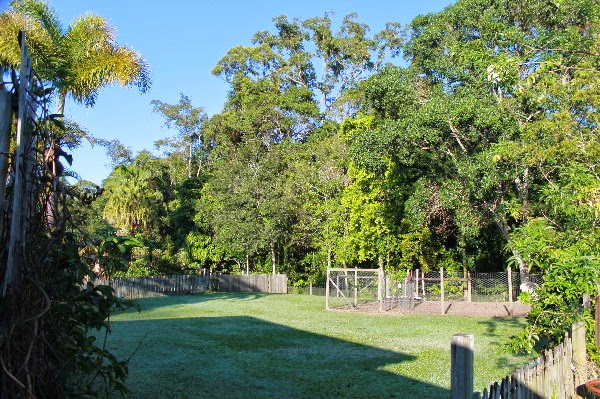
Early morning in the backyard.

Bluebell, one of our blue Australorpes, in her black winter stockings.

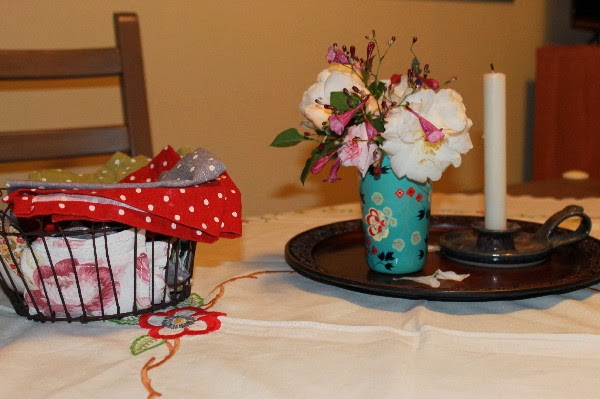
The beautiful hand-embroidered, vintage tablecloth given to me as a birthday gift by my friend Kathleen.

 Filling the biscuit jar - these are chocolate chip and nut.

Sausage rolls - a homemade weekend treat.

Spanish omelette, baked in the oven.

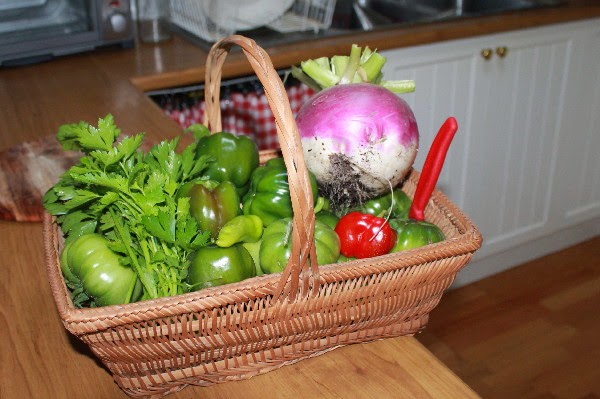
 A backyard harvest a few days ago.

Have a lovely day. I'll see you soon!

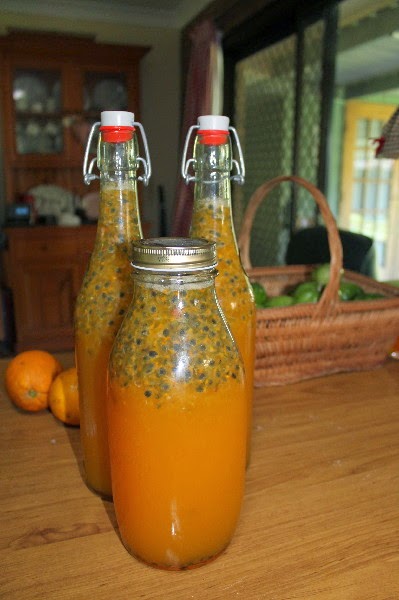
I'm starting my library talks today at the Coolum Library and looking forward to meeting the people who come along. It's booked out. No doubt there will be some who read this blog. If you're going, please introduce yourself. I'm not sure how many posts I'll be able to do this week but I'll leave you today with this recipe for passionfruit and orange cordial and a link to yesterday's podcast of my second talk on ABC radio.


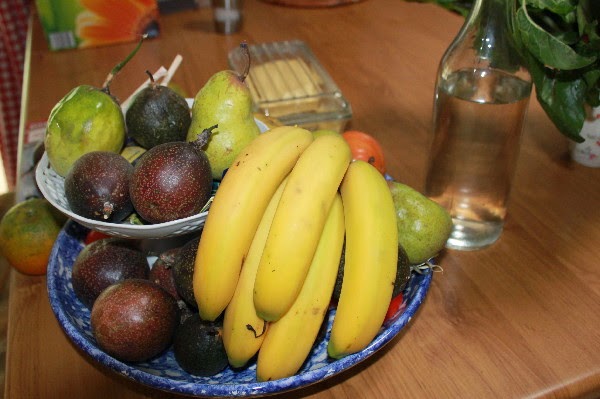
We have a glut of passionfruit at the moment and our navel oranges are having a very good year. I think we had rain exactly when the fruit needed it. Jamie loves passionfruit but he's still in Korea so I decided to use some of the passions to make cordial for him. Otherwise they'd be a faded memory by the time he's home again.

Most cordials are made the same way. You need a simple sugar syrup and you combine that with the fruit you have. Most fruits need to be juiced, or in the case of pineapple, crushed. The sweeter the fruit, the less sugar you add to the mix. You'll have to use your own common sense by tasting it as you go. Remember, all cordials are mixed with water - either cold tap water, sparkling mineral water or soda water. Again, you decide how strong you want your drinks to be and add less or more of the cordial to water, according to your taste.


PASSIONFRUIT AND ORANGE CORDIAL
8 oranges, juiced
12 passionfruits, scooped out

SUGAR SYRUP
Regular sugar syrup is one cup of water to one cup of sugar but I am using sweet fruit in this one, so I made a weaker syrup. This syrup is two cups of water to one cup of sugar.

I made up 1½ litres/quarts of fruit juice and added 1½ litres/quarts of weak sugar syrup.  Simply mix it together, pour it into a bottle and that's it. It will keep in the fridge for a about six weeks. The sugar preserves the drink. Remember to dilute the cordial with water before you drink it.

And finally, this is the link to the second ABC radio interview I did with Jess Hinchliffe recently. They'll be running on Monday afternoons for the next two months on Mary-Lou Stevens' Drive program.

Enjoy your day.

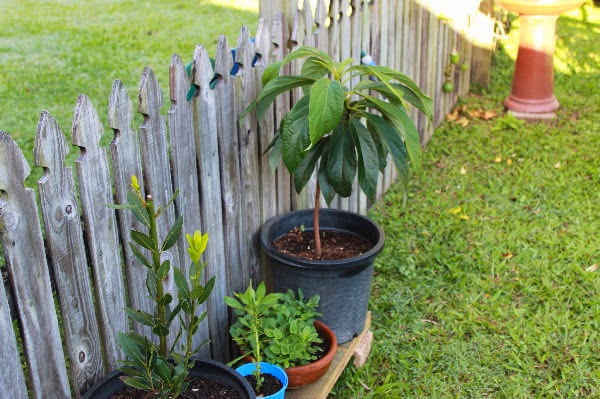
Do you know you can use the seed of a just eaten avocado to start an avocado tree? You often hear or read that it's a useless exercise because the trees take between seven to ten years to produce fruit, but I still do it. I'm not interested in speed. All natural things take time. If you were to buy a grafted avocado tree today and plant it, it would take a couple of years to produce decent avocados. So if you have the land, and you love avocados, why not grow a few from seed and see how it goes. You're not losing anything.

This seedling avocado is two years old.

When we moved to the home we live in now, there was an old avocado tree full of avocados in the backyard. A few months after moving in, the council used our backyard as the beginning of the installation of sewers in our town and the machinery moving over the tree's roots killed it. Avocados hate having their roots compressed, interfered with or excessive moisture. Since then I've bought a few grafted trees but everyone of them died from Phytophthora and at over $30 per tree, it hurts. A seedling tree grown from a seed might take longer before fruit form and it may even die, but I'm not throwing away $30+ each time I have another go at home grown avocados.

Avocados are categorised as either A or B. Each flower is bisexual and opens twice, once as a female and once as a male. You can produce avocados with one tree, but you'll increase your yield a lot if you have more than one tree, preferably one A and one B type. Avocados will grow anywhere there is no frost and even in frosty areas you can grow them in a large pot that can be brought inside. They also make an excellent and lush indoor plant. If you're in a cold area, Bacon is the best variety for you.

Type A - Gwen, Hass, Lamb Hass, Pinkerton, Reed, Rincon, Secondo and Wurtz.
Type B - Bacon, Edranol, Fuerte, Llanos Hass, Ryan, Sharwil, Shepard and Zutano.

We love avocados but they're quite expensive so we limit ourselves. We have a generous neighbour up the road - organisedcastle, and she sometimes brings us a few from her tree. The avos I love the most though come from my friend Meryl because she grows the magnificent Reed avocado. Reed is round, creamy and large. Just one will make a big bowl of guacamole. In my humble opinion, I think it's the best tasting avo. You rarely see them on sale in the supermarkets because they don't travel well but often the organic boxes and some CSAs carry them. We had a few of of Meryl's Reeds in early autumn and I've now got a sprouted seed. It will soon join my other seed-grown avocado that is now about two years old (photo above).

It's easy to sprout a seed. Simply wash it and put it in a small container with the bottom of the seed in the water. Change the water every few days. Soon the roots will emerge, then the top shoot. When the seedling is about 10 inches tall, snip off the top half inch of the top shoot to encourage the seedling to develop side shoots.  When there are leaves and the seedling looks healthy, plant it in soil.  You can plant the seed straight into soil too instead of sprouting it first but I like sprouting them on the window sill in the kitchen.

This is the sprouted Reed seed. It's still about two months away from planting out. 

The most important part of growing avocados in the ground is to provide excellent drainage. They love deep, sandy soils and need to be kept watered during hot weather - a bucket of water every two days in summer. If you're mulching, use hay or straw but keep it away from the trunk because it will encourage disease.

Mindful of the failures I've had in the past, I'm planting these in a different way.  We had quite a high annual rainfall here so I want to keep the avocado's roots out of the sometimes flooding rain we get. If the roots stay in water for 48 hours the tree will probably die. I'm going to plant these in large pots with extra large drainage holes in the base and sit them in full sun where they'll grow in pots in top quality potting mix and manure. I am hoping the roots grow out of the base of the pots and into the soil - that will give the tree increased vigour and fruit growing ability but it will keep the main root ball out of the wet clay soil. We'll see how this goes. So far the score is Avocado 2 vs Rhonda 0.

Varieties of avocado

I am hoping to get my patchwork quilt started this weekend. I have the fabrics selected, I need to work out the size of my patches now, and then start cutting. During the rest of the weekend I'll be knitting, cooking, cleaning, gardening and on Saturday I have a live interview on local ABC radio. I hope your weekend is restful and productive.  See you all next week. :- )

- - - ♥︎ - - -

The rise of mending - how Britain learned to repair clothes again
Stitched up
Get the most out of your clothes
How to make a swaddle blanket - I've posted this before but there are a lot of new babies at the moment
How to make a simple patchwork quilt
Quilt gardens
Growing older should be a source of pride
Rare orchid found in Dorset sewage works
Vegan mac and cheese recipe
The perfect cinnamon buns
Recipe for Monte Carlos (biscuits/cookies)
History through the eyes of Google View


Last Wednesday I agreed to do an interview with local ABC radio here at home. At 10.30, reporter Jess Hinchcliffe arrived and what a delight she was. A country girl from Rockhampton, I showed her  the garden and the chooks before we shared tea and cake with Hanno in the kitchen.  Then we settled down to talk for a while. The first part of her interview can be listened to here: ABC Radio. It will continue over a few weeks. I hope you enjoy it.

That interview was scheduled for 10.30 and while I was washing up at 9.30, the door bell rang. I opened the door to the two people standing there and said: "You're really early, I'm not ready."  The man replied: "We're not who you think we are. We're from the Department of Agriculture." Gulp. I let them in.


It turned out they'd read about me planting Sunny's seeds a while back and wanted to know if they'd been declared at the border. They had, Sunny has been in and out of Australia enough times to know the procedures. But they still took the seeds for checking and have just returned them to me. There is a huge problem with unchecked seeds being imported and they are potentially harmful to our environment. I told the inspector I'd put up a link to the database where seeds and plant material can be checked to see if they're allowed or not. Please use this database, particularly if you're importing seeds via eBay or any other overseas dealer.  We all love our gardens but have to abide by the rules that protect our local environments.

Here are the steps to access the database to discover the import conditions for a wide variety of goods, not just seeds or plants:
  1. Go to - www.daff.gov.au
  2. In the centre of the page click on – Importing to Australia
  3. Then click on – ICON Import Conditions Database 
  4. Then click on the word – ICON (which is highlighted)
  5. The next screen asks for the Commodity, Country and End Use
If you enter, for example, Ginger, All Countries and All End Uses you are taken to a page which then lists the import conditions for a variety of ginger etc with the import conditions for each item. You then just click in the particular commodity that you want to import.

Please take care when importing anything. We live in a beautiful country and I'm sure that, like me, you want it to stay that way.

PLUS ONE: I also did an interview recently with Yours magazine. That is in this month's edition. :- )


Yesterday we discussed menu plans, stockpiling and how to get the best value for money when shopping. I hope you read the comments too because they added a lot to the discussion. Today let's discuss the recipes and meals for our families. If you don't cook, or are are new to it, I encourage you to search online for the nutritional guidelines for your country. We all eat not just for the taste of the food, but because that is how we supply our bodies with the vitamins, fibre, carbohydrates, protein, fat and water we should be ingesting every day. If you're going to start cooking, you need to know the nutritional guidelines as well as a few good recipes. Sometimes a cook book will give you these guidelines, if you've been cooking for a while you'll know them, but at the start, do some research to make sure you're including everything you should.


I have a repertoire of about 30 from-scratch meals I can easily cook and these are the meals we eat on a day-to-day basis. I try to vary the type of protein I cook, and we usually eat chicken, pork, vegetable, egg, fish and lamb meals. The only beef we eat is topside mince when I make a meatloaf or meat sauce for pasta. I usually cook enough at one time to eat for two meals - that saves time, energy and washing up. Often we have the second meal on the following night, sometimes I freeze it for the following week. It's a good habit to get into.

Although I don't like encouraging anyone to buy products, I think there are a couple of kitchen appliances that can help with cooking. I do it because I firmly believe that if you set yourself up to cook and it turns out to be good food that's easy to prepare, you'll be more likely to keep cooking from scratch. I recommend a steamer - either bamboo or steel, a slow cooker or a pressure cooker and a bread maker. You can fit a steamer on top of a saucepan in which you're cooking potatoes or a stew, and in the steamer you can have any of your softer vegetables, like spinach, silver beet, peas etc. You'll save on gas or electricity because they both use the same place on the stove and the energy heating the saucepan also generates the steam to cook whatever is in the steamer. A slow cooker is great if you're working or busy in the home all day. You can pack it with your meal in the morning and leave it to cook on low all day. At the end of the day, it's ready to be dished up. A pressure cooker will cook stews, corned beef, soups etc in a very short time and is also a helping hand for the busy cook. A bread maker can be used to bake healthy bread tailored to your family's dietary requirements - no preservatives/sugar/salt, or you can use it to knead the bread and then bake the loaf in the regular oven. And if you want fresh bread for work and school lunches, you can pack the bread maker overnight and wake up to fresh bread first thing in the morning.


Look for some recipe books in the library that have meals you like the look of. If you can find frugal recipes, that's even better. I have two books here - The Austerity Cookbook and The Next-to-Nothing Cookbook, both have a range of healthy and cheap meals. I also am the proud owner of The Thrifty Kitchen which I adore.  It also preaches thriftiness but with a more modern slant. If you can't find any of those, look online at the many recipe sites and search by the ingredient you want to cook with. It will present you with a list of meals to suit that ingredient. When you cook a meal you and your family like and you cook it again, modify it to suit your tastes, then start building up your repertoire of 30 meals.  Try to have a variety of foods that use different proteins, and don't just rely on meat - it's expensive and many of us eat too much of it. Before too long you'll have enough meals for an entire month.


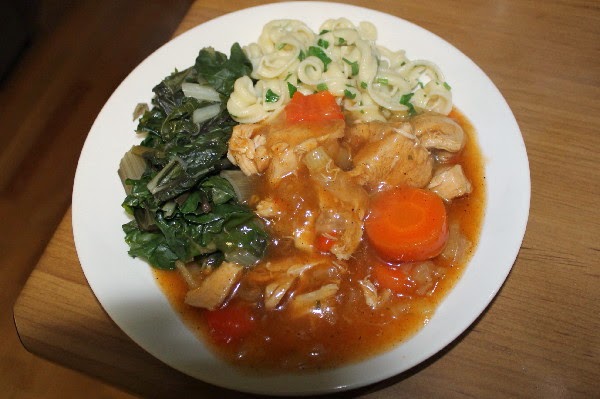
I cooked the chicken in this saucepan above. That is my steamer with the silverbeet sitting on top of the saucepan. After the photo, I cooked the vegetables with the lid on.

As an example of what I cook, on Monday I did the grocery shopping and found a tray of free range chicken (two breasts) reduced from $7.34 to $4.40. It expired the following day. So I bought it and cooked up a little chicken fricassee that day which we had for two meals. As well as the chicken I added vegetables and herbs from the garden and fridge, and I cooked up some pasta with butter and parsley and steamed silver beet to go with it. Delicious! When you cook that sort of meal, you brown the meat, then add the vegetables and herbs, season it to your taste - I added salt, pepper and paprika - then add enough water or stock to cover the meat and vegetables, put the lid on and cook it slowly for about 30 minutes. Right at the end, add more herbs, taste for seasoning, adjust if necessary and thicken the sauce with about two tablespoons of cornflour stirred into a paste with a little water. Stir thoroughly and cook for another minute. If you have enough for another meal the next day, wait until the food has cooled, pour it into a bowl or air proof container and store it in the fridge for the next day. We had this meal on Monday and yesterday. Today will be a vegetarian meal.

Another quick tip is when you're braising or slow cooking on the stove top, bring the food up to the boil, then turn the heat right down and keep the lid on. The same applies to boiling vegetables and eggs too. Cooking with the lid on keeps the heat in the pan and saves a little bit of energy on that day. If you add it up over a year, you save quite a bit from just that one tiny measure.

Here is my recipe for lentil soup. You can use whatever lentils you like, including the green or yellow dahl peas usually used in pea soup. Always wash lentils, or any grain, before cooking.  In Australia, the lentils will cost about $3 for this amount. Smoked pork bones cost about $3.50 for this amount. Lentils are high in protein so this could serve a large family for their main meal, maybe with the addition of some crusty home-baked bread. You'll be able to serve this nutritious soup for under $10 for eight people or make it for a smaller family and use the left overs the following day.

LENTIL SOUP IN THE SLOW COOKER - 8 servings
500 grams/1 lb dried lentils
250 grams/½ lb bacon bones or any smoked ham/bacon bones that will fit in the slow cooker
1 large onion, chopped
2 stalk celery, chopped
2 carrots, chopped
6 pieces of parsley
1 lay leaf
salt and pepper
8 cups of water or stock

Wash the lentils in cold running water and place in a crock pot with all the other ingredients, except the liquid. When you're sure it all fits in, pour in water or stock. Put the lid on and turn on to low for eight hours or high for five hours.  Check the soup 30 minutes before the due time, remove the bones and stir the soup.  Check for seasoning. Allow to simmer for another 30 minutes, add more parsley right at the end and serve.

The important thing is to cook meals that fit within the budget and that your family look forward to. The evening meal is often the one chance in the day to sit around the kitchen table, relax and talk about what everyone did that day. It's a good way of reconnecting with your family and working out if everyone is okay, or not. And remember, no phones, ipads or games at the table. This is old school - just you and your family. It's worth it, this is an important part of the day for every family.

I'm guessing that most of us try to live well without spending too much money. Some of us are forced via our circumstances to do it, some make a philosophical decision that they want to live that way. One thing is for sure, if you cut the amount of money you spend, not only on food and groceries but also on the modern trappings of life, you'll be able to pay off your debts sooner and you'll also be helping to reduce green house gasses as well. Bravo!


Living well on a small amount of money is not about the big choices. It's a series of consistent decisions to live on the budget you've defined for yourself. It's about shopping for bargains and making as much at home as you can. If you have the time to make some of the things you now buy, you'll save money, and probably get a better product. If you can reduce your grocery bill, you'll be able to make consistent savings every time you shop. So let's talk about the everyday decisions we all make.


The first decision is about organising your money, and that just means making up a budget. Now if your eye just glazed over and your pulse started to race, it's not as bad as you think. YOU set your own limits, YOU write your budget according to what money you have coming in and what you need. YOU are the main definer of your fate. If you've been pretending that the B word is for everyone else, think again. Budgeting will help you live well, help you pay your bills on time, calculate what you have to spend and generally keep you on your financial track, whatever that is.  Some of us can get away with no budget, but it's so easy to fall back into those modern day spending habits, a budget will keep you focused. And it gets easier the longer you do it.

But let's focus on shopping now. Staples, or the ingredients you need to make up recipes, are the real foundation of your pantry and stockpile. They don't change from month to month - flour, tea, coffee, sugar, butter, honey, dried fruits, oats, rice, spices etc. Work out what you use as staples and keep your supplies topped up when you shop. It's the fresh food such as vegetables, fruit, dairy, meat, fish etc that will change. When you prepare to go shopping, check what's in the fridge that has to be used, make up a menu plan, then work out when you'll shop. If you get supermarket flyers in the post and check out the bargains that way, then you'll wait until you have that week's flyers and make up your menu plan according to what's on special and what you already have in the fridge and garden. Then you'll do your shopping. I think it's a better idea to check the fridge so you don't buy what you already have, then go shopping with a list of the staples you need. I like to see what's in the shops, especially the seasonal foods, and buy what is cheap because it's in season and fresh. But whether you shop after seeing what's available or already have your meals planned before you go shopping, always shop with a list of what staples you need so you don't have to run back to the shops during the week to buy a pound of butter, flour or some onions.

I encourage you to shop for ingredients rather than frozen meals and you'll save money if you don't buy convenience foods such as washed salads, sliced or grated cheese, bottled cooking sauces or packets of prepared spices. By doing the work of washing, grating and making up your own recipes, you'll save a lot of money and develop your skills in the kitchen.

Now that we shop at Aldi, I find it's only the meat specials I'm interested in, and then only the free range meats. If they have nothing I want, I usually end up at the butcher shop because he has better quality meat, it's local and often cheaper than the supermarket meat. I encourage you to check out your local butcher and green grocer and don't just rely on the supermarkets. Another quick tip is to not always rely on meat as your main meal protein. Legumes, grains, fish, eggs, tofu and dairy products are all valuable and reasonably cheap sources of protein.


In most circumstances, but not all, stockpiling will save you money and time. It works for us but doesn't work for my sister, Tricia, because she lives alone and tends to shop for what she needs every couple of days. But if you're part of a small, medium or larger family, or a group of students, stockpiling should work for you and you'll always have food on hand.  There is a post here about stockpiling.


If you have some land, another food strategy that will save money as well as give you the best organic fruit and vegetables, is to grow your own, or some of it. If you do this, you'll also have to learn about when to harvest, how to manage your harvests so you don't waste anything and often that means you'll learn how to preserve in jars and freeze your produce. There are many posts here about that as well. The best way to search my blog is to look in the search facility in my side bar.  Type in the word or phrase: "stockpiling", "menu plan", "soap making" etc and a list of posts should appear.

I just want to remind you that it is rare to make big savings doing this.  It's all about consistent, regular small savings when you do the grocery shopping, but menu planning, shopping for bargains, stockpiling and buying less because you grow it and make it yourself, will all make a difference. So don't think small savings aren't worth it, they add up. When you look back over a year, you'll be surprised just how much you were able to save by sticking to your plan.

Tomorrow we'll talk about, and share, our recipes and thoughts on frugal food. I look forward to reading your comments about today's topic. I'll see you again as we carry on this important discussion tomorrow.

I finished the frugal living book on Friday, mainly because I dragged it out by doing bits and pieces that had nothing to do with the book, but I heaved a sigh of relief when the last key strokes were made. I have one more book to write now - on baking - but I'm having time away from books for a while to get back to real life. I need to get into my routines again. I want to clean out cupboards, cook, bake and sew, and I want to write my blog. The books won't be published until early next year so the last one can wait.  This week I'll be writing out a plan of what I'll be talking about when I give a series of talks for the local libraries that start next week. There is a flyer below with the details.


Yesterday I went through my beige and red fabric stashes. I am fortunate to have been the beneficiary of quite a bit of fabric from Tricia and Cathy over the years, and even though I'm not the quilter or patchworker they both are, my cupboard looks like it belongs to one mad patchworker because of their legacies. I'm sure all the quilters and patchers will know what I'm talking about - I pick up a neatly folder piece of fabric and often it will have a circle cut from the middle, or a strip cut off the side, or stars or triangles cut into the most interesting parts of the pattern. Still, beggars can't be choosers and when I accepted their cast offs, I knew that one day I'd have enough time to make quilts and I hoped the passion to create them would still be there.  It is. A few years ago I divided the mixed stash up into colours so when I look for something in particular, it's fairly easy to find it because it's all there, together. 


I want to make a quilt to go over the beige couch we have in the lounge room. I covered it with the quilt Tricia made while she sat with our mum when she was very ill and eventually died. But I want to keep that quilt and don't want it in daily use. We need a cover because when the grandkids are here, like most kids, they can make a mess and even though the couch is 17 years old, I want to keep it going a bit longer. It will be a patch quilt, in no particular style or pattern, just the colours and patterns from the stash that look good to my eye. And because the quilt is just to cover a couch and not a person, I'll use an old quilted mattress protector I have in the linen cupboard as the batting. I also have a couple of old doona/duvet covers that I no longer use that will do nicely as the backing. So apart from the cotton thread I'll have to buy to match the chosen fabric, I won't spend a penny.

And that's good because I snapped back into frugal mode since last Tuesday's government budget. I don't want to discuss the budget or anything else political on my blog, it is what it is and I prefer to just get on with it. But for the overseas readers, many welfare benefits have been cut, the co-payment for a doctor's visit will rise, and after July, fuel prices will rise. When that happens it will filter through to groceries and many other things because most items are delivered, if not manufactured as well, using fuel. Many Australians will be hit hard and although Hanno and I won't have it as bad as most, we're still tightening our belts and we've postponed our trip to Tasmania. We have to do some work on the house that will use the money we would have spent on our holiday. We don't have many holidays so it's a disappointment for both of us, but if we step up on the savings, we'll be able to go next year or the year after when we have the cash again.


We already live thrifty lives and I'm pleased we do. I want to talk about thrift tomorrow. I feel we have more control over what we do than we used to have when we over-spent and wasted so much. Life's main priority then I was working was to repay debt. When you make the decision to live a more simple life it gives you different priorities and more options. You discover there are things you can do to give yourself a better life, and you soon realise that if you do those things, life will be better. I like the idea of us sharing what works for us and I hope that people who are struggling to make ends meet and those who will be effected by the budget can use the information to better their situation.  I look forward to a discussion about frugal life tomorrow.

Please note, the Caloundra sessions are booked out.

It never fails to amaze and impress me when I look at the work crafters do. It could be quilting, sewing, mending, knitting, rug making or any other craft, people who make them work tirelessly on producing beautiful items to use at home and give as gifts. If you're looking for some inspiration, look no further. Over at the forum, the members are showing what they're working on. There are tissue covers, dressing gowns, place mats and more. It's motivated me to turn on the sewing machine this weekend and start a project.

If you're renting your home and can't put in a garden or you simply don't have the time to establish a garden now, there's a thread on the forum that might interest you. Robyn has been experimenting with a micro garden and writes about her success, with photos.

I hope you're enjoying a relaxed and crafty weekend.
I wasn't going to do my weekend reading this week but I came in here and saw that I already had a sizeable list, so here it is.  I'm happy to say I've worked hard on the book and will be back with you on Monday. Jess from local ABC Radio came here on Wednesday and did a great interview which they'll run in short segments in the coming weeks. This morning I'll do a short, live talk on ABC Capricornia to give a few tips on frugal living in response to the budget.

I hope you have a wonderful weekend. I'll see you again on Monday!

Lazy Seamstress tutorials for recycled fashion
Compost - the ultimate form of recycling
Insecticide use killing off bees
Freezing mushrooms
Pillowcases for every bed - an easy sewing project, with tutorial, at Purl Bee
Lucid Tree - the motherlode of free, thought-provoking documentaries and movies
The five-a-day [fruit and veg] disaster: why the numbers don't add up
Safeguarding the future of food security
The Cerigo Shawl - this lady is the most beautiful knitter and this is one of her patterns


I'll be busy finishing off my book and doing some book publicity this week so there will be no blog posts for the next few days. I'll see you as soon as I'm finished. I'll be back with a knitting post, some thoughts on slow cooking and whatever else pops into my mind. Take care everyone.
I took this photo of Hanno last week when we went down to the beach to have lunch.

Another week has flowed under the bridge and the weekend is about to open up its arms again. I hope you have some interesting projects to get stuck into and that you spend time with those you love.

We had some good news this week with Sunny and Jamie making plans to come back from Korea at the end of the month. They've been gone almost four months. We miss them so much but we're pleased they both had time to spend with their Korean family.

Terms and Conditions
Green Lifestyle Magazine
Dining out in Japan
Recipes for smoothies
Moments, not things, this Mother's Day
Homemade sweet Italian sausage at Buttered Side Up
For those of you going into the warmer weather - cultured popsicles @ Nourished Kitchen
Tiny House Living
10 things creative people know - my pick of the week
It's time to reclaim your kitchen - Michael Pollan infographic
I love this story about Kitty and Doll Doll from the Spitalfields blog. It highlights how much life has changed in the past 90 years.
Using code words for family safety

Earlier in the week we shared what we love about our homes and the work we do there. I thank you all for sharing your incredible stories; I thought many of them were inspirational and I'm sure other readers did too. Now let's carry on highlighting what we love about our simple lives. Today we're going out to the backyard to examine what we love out there. You may be growing fruit and vegetables, you might have chickens, pigs, goats, a house cow or bees. Or are you harvesting water, generating electricity or recycling? We want to know what you're doing in your backyard, why you're doing it and why it's important. It's much easier to sit and read a book so why do you want to work outside instead? I hope some of the men join in today. I know you're out there. :- )


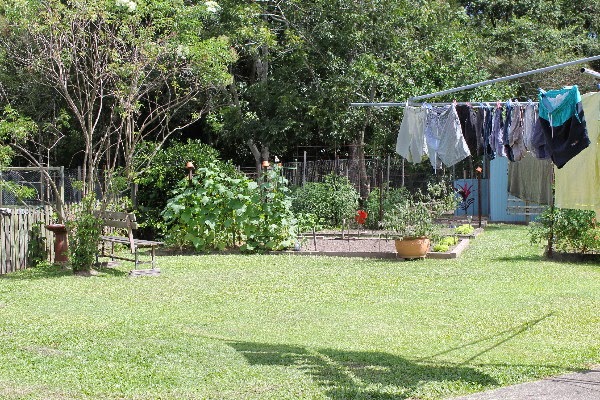
I'll lead off. You've seen photos of our backyard and will have probably have noticed the line of trees along the back boundary, behind the chicken run. That is a creek that defines the back boundary of our property, and along that creek runs a thick line of remnant rainforest. That rainforest and the fences on each side seem to embrace us and anyone in the backyard. It gives a feeling of seclusion and privacy and I count myself very lucky to be able to produce food in that space. I love the feeling of being self-contained here, that we can grow food, keep chickens, harvest water, make things out of scraps, use what we produce to keep our grocery bill lower than average and take advantage of the land we live on. Making our land productive gives us better value for the money we spent buying this place.


But I think the main thing is the feeling I get when I walk out there. There is a feeling of connection, that we're improving this land, increasing its fertility, encouraging microbes to grow in the soil along with the vegetables and knowing that partnership benefits the plants, the soil and us. I love that such a productive area is also very beautiful and that I can sit out there, work, pick things, invite people around, enjoy my family there or just sit alone and think under the elder tree and no one can come along and tell me to leave. When I produce good food in my backyard it makes me feel capable and reliable and that what we're doing here has more significance than just mucking about in the backyard. There is purpose here.


I like the idea of being self-reliant too. We harvest water from the roof and it is enough water to tend the garden, keep the chickens alive and clean everything out there. We are able to harvest and store 15,000 litres and therefore do not taking any water from the local dam for our outdoor activities and tasks.  We make our own hot water in the solar water system on the roof and using the solar panels beside it, we shape our lives to cut down on electricity and get by with that small system. In the two years since we had it installed we've paid only one small bill. We don't want to make money with our solar panels, we just want to live how we live without paying electricity bills. We try to recycle and compost as much as we can so the burden of disposing of our waste is not entirely on the local council. I know we pay good money for them to do that but I believe it's up to us to do as much as we can ourselves.


The icing on the cake is walking inside with a basket brimming with fresh eggs and organic vegetables and eating those vegetables minutes after they've been picked. Yesterday I picked three organic oranges from the tree and filled a glass with the juice. In less than five minutes, that drink was gone. I felt healthy just drinking it and I know that even if I had a million dollars, I could not have bought a better drink than that. And it all comes from our backyard.

I'm eager to read about your backyard too, or your food growing.  This is not about cooking the food, that will come soon, it's about your backyard, what you do out there and the feeling you get by doing it.


Most of us live on the edge. Although we live in cities, suburbs, rural towns and out in the middle of nowhere, we choose to live apart from what is considered to be "normal" nowadays. Even if we're surrounded by people or close to them, we are living on the edge of the mainstream because we've changed our mindset; we're on a slower and gentler journey.  And it is for that reason that I want to encourage you all to highlight what is important to you - to express what you love about the various things we do that others don't.  This is a reminder, or encouragement, if that's what you need today, about the life we live and why we live like this. People in the mainstream have a monotonous stream of information, advertising and peer support about their lifestyle, spending, shopping and fashion. That keeps them going - it reminds them of what they love, what is important to them. If you watch television, listen to the radio, surf the internet, read magazines or walk around the city, you'll see the current constantly changing cultural must haves; the products and services that help people live lives of convenience. 

All that glitters is not gold.


Let's share our own advertisement for a slow and simple life because we won't see it advertised, or if we do it will be the commercialised dumbed-down version of it. This will remind all of us of what we love and why we chose to walk this road less travelled. We don't have "things" to love, ours is more about feelings and self awareness, but we do need to acknowledge it. When we take the time to remember and verbalise what we value, it reminds us of the significance of it.  So let's share what we value about what makes up our simple lives - we'll do it a bit at a time so we're not overwhelmed. And today, let's start with our homes and homemaking. What is important about your home and the work you do there? Let me start it off.


The most important part of home and homemaking to me is that I have a place where I feel safe, comfortable and nurtured, and a place to work. Here in this ordinary brick slab house, at the end of a one lane, dead-end street, I am productive and creative and I think I could live another twenty years and still not be finished with the list of projects I'd like to do right here. When I finish writing these books, I want to start sewing some light quilts and teach myself how to make baskets from some of the materials growing here on our land. I'd like to take up rug making again. I loved it back in the 1980s, I want to get back to it. I want to expand on what I produce in the kitchen, be that main meals, bread, cakes, various drinks or dairy products.  I want to make more soap for gifts and I want to perfect liquid Castile soap. I want to see Jamie and Alex grow up as good strong boys and young men, just like their fathers did. I want to read a lot more. I might adopt a non-deplume and write a novel. Who knows what I will do but I do know that everything I do will be done here, in my home.


Homemaking gives structure and meaning to my days. What I do in my home is important to me and my family. The opportunities here are almost endless and that has created an enthusiasm for life that has been infused into every day. And with each passing day I know the work I do here makes my life better. Some people hate housework. I am grateful to have it and equally grateful to have my home.


There are a lot of other reasons I love being in my home and doing the work required to run it but I'd like to read what you have to say. What's the most important part of homemaking for you? Why do you value your home?  Tomorrow we'll share our stories about another aspect of our lives. I hope you'll join in.

Newer Posts Older Posts Home


My books were all published by Pengiun, and are available at Amazon US, Amazon UK and Amazon Au

Search here

Total Pageviews

Translate


I'm Rhonda Hetzel and I've been writing my Down to Earth blog since 2007. Although I write the occasional philosophical post, my main topics include home cooking, happiness and gardening as well as budgeting, baking, ageing, generosity, mending and handmade crafts. I hope you enjoy your time here.

MY FAVOURITE PLACES

  • Grandma Donna's Place
  • Grandma Donna's YouTube
  • Grandma Donna's Instagram
  • This Simple Day
  • Nicole's Instagram

Give More

Give More

Popular posts last year

Making ginger beer from scratch

We had a nice supply of ginger beer going over Christmas. It's a delicious soft drink for young and old, although there is an alcoholic version that can be made with a slight variation on the recipe. Ginger beer is a naturally fermented drink that is easy to make - with ginger beer you make a starter called a ginger beer plant and after it has fermented, you add that to sweet water and lemon juice. Like sourdough, it must ferment to give it that sharp fizz. To make a ginger beer plant you'll need ginger - either the powdered dry variety or fresh ginger, sugar, rainwater or tap water that has stood for 24 hours to allow the chlorine to evaporate off. You'll also need clean plastic bottles that have been scrubbed with soap, hot water and a bottle brush and then rinsed with hot water. I never sterilise my bottles and I haven't had any problems. If you intend to keep the ginger beer for a long time, I'd suggest you sterilise your bottles. MAKING THE STARTER In a...
Image

NOT the last post

This will be my last post here.  I've been writing my blog for 18 years and now is the time to step back. I’ve stopped writing the blog and come back a couple of times because so many people wanted it, but that won’t happen again, I won’t be back.  I’ll continue on instagram to remain connected but I don’t know how frequent that will be. I know some of you will be interested to know the blog's statistics. 
Image

How to make cold process soap

I'm sure many of you are wondering: "Why make soap when I can buy it cheaply at the supermarket?" My cold process soap is made with vegetable oils and when it is made and cured, it contains no harsh chemicals or dyes. Often commercial soap is made with tallow (animal fat) and contains synthetic fragrance and dye and retains almost no glycerin. Glycerin is a natural emollient that helps with the lather and moisturises the skin. The makers of commercial soaps extract the glycerin and sell it as a separate product as it's more valuable than the soap. Then they add chemicals to make the soap lather. Crazy. Making your own soap allows you to add whatever you want to add. If you want a plain and pure soap, as I do, you can have that, or you can start with the plain soap and add colour, herbs and fragrance. The choice is yours. I want to add a little about animal and bird fat. I know Kirsty makes her soap with duck fat and I think that's great. I think t...
Image

Preserving food in a traditional way - pickling beetroot

I've had a number of emails from readers who want to start preserving food in jars but don't know where to start or what equipment to buy.  Leading on from yesterday's post, let's just say up front - don't buy any equipment. Once you know what you're doing and that you enjoy preserving, then you can decide whether or not to buy extra equipment. Food is preserved effectively without refrigeration by a variety of different methods. A few of the traditional methods are drying, fermentation, smoking, salting or by adding vinegar and sugar to the food - pickling. This last method is what we're talking about today. Vinegar and sugar are natural preservatives and adding one or both to food sets up an environment that bacteria and yeasts can't grow in. If you make the vinegar and sugar mix palatable, you can put up jars of vegetables or fruit that enhance the flavour of the food and can be stored in a cupboard or fridge for months. Other traditional w...
Image

Cleaning mould from walls and fabrics

With all this rain around we've developed a mould problem in our home. Usually we have the front and back doors open and that good ventilation stops most moulds from establishing. However, with the house locked up for the past week, the high humidity and the rain, mould is now growing on the wooden walls near our front door and on the lower parts of cupboards in the kitchen. Most of us will find mould growing in our homes at some point. Either in the bathroom or, in humid climates, on the walls, like we have now. You'll need a safe and effective remedy at some point, so I hope one of these methods works well for you. Mould is not only ugly to look at, it can cause health problems so if you see mould growing, do something about it straight away. The longer you leave the problem, the harder it will be to get rid of it effectively. If you have asthma or any allergies, you should do this type of cleaning with a face mask on so you don't breathe in any spores. Many peopl...
Image

Five minute bread

Bread is one of those foods that, when made with your own hands, gives a great deal of satisfaction and delight. It's only flour and water but it symbolises so much. I bake bread most days and use a variety of flours that I buy in bulk. Often I make a sandwich loaf because we use most of our bread for lunchtime sandwiches and for toast. Every so often I branch out to make a different type of loaf. I have tried sour dough in the past but I've not been happy with any of them. I'll continue to experiment with sour dough because I like the idea of using wild yeasts and saving the starter over a number of years to develop the flavour and become a part of the family. However, the loaf I've been branching out to most often is just a plain old five minute bread. By five minutes I mean it takes about five minutes actual work to prepare but it's the easiest of all bread to make and to get consistently good loaves from. If you're having people around for lunch or...
Image

This is my last post.

I have known for a while that this post was coming, but I didn't know when. This is my last post. I'm closing my blog, for good, and I'm not coming back like I have in the past.  I've been writing here for 16 years and my blog has been many things to me. It helped me change my life, it introduced me to so many good people, it became a wonderful record of my family life, it helped me get a book contract with Penguin, and monthly columns with The Australian Women's Weekly and Burke's Backyard . But in the past few months, it's become a burden. In April, I'll be 75 years old and I hope I've got another ten years ahead. However, each year I'll probably get weaker and although I'm fairly healthy, I do have a benign brain tumour and that could start growing. There are so many things I want to do and with time running out, leaving the blog behind gives me time to do the things that give me pleasure. On the day the blog started I felt a wonderful, h...
Image

What is the role of the homemaker in later years?

An email came from a US reader, Abby, who asked about being a homemaker in later years. This is part of what she wrote: "I am a stay-at-home mum to 4 children, ages 9-16. I do have a variety of "odd jobs" that I enjoy - I run a small "before-school" morning drop-off daycare from my home, I am a writing tutor, and I work a few hours a week at a local children's bookstore. But mostly, I cherish my blissful days at home - cooking, cleaning (with homemade cleaners), taking care of our children and chickens and goats, baking, meal-planning, etc. This "career" at home is not at all what I imagined during my ambitious years at university, but it is far more enriching. I notice, though, that my day is often planned around the needs of my family members. Of course, with 4 active kids and a husband, this is natural. I do the shopping, plan my meals, cook dinner - generally in anticipation of my family reconnecting in the evening.  I can't h...
Image

Every morning at home

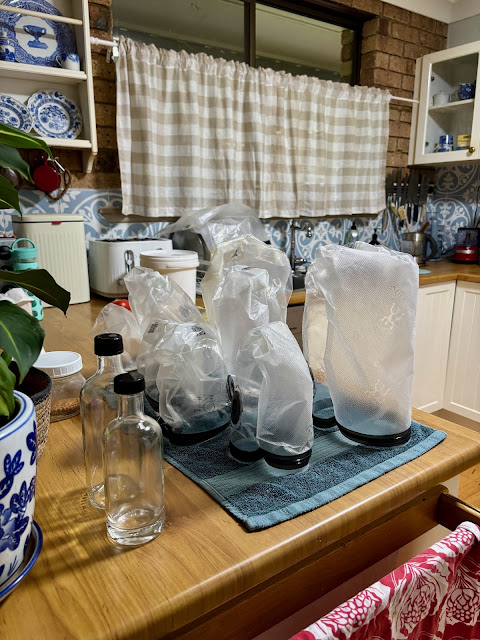
Every morning when I walk into my kitchen it looks tidy and ready for a day's work. Not so on this morning (above), I saw this when I walked in. Late the previous afternoon when I was looking for something, I came across my rolled up Zwilling vacuum bags and decided they had to be washed and dried. So I did that and although I usually put them outside on the verandah to dry it was dark by then. I turned the just-washed bags inside out and left them like this on a towel. It worked well and now the bags are ready to use when I bring home root vegetables, cabbages or whatever I buy that I want to last four or five weeks.
Image

You’ll save money by going back to basics

When I was doing the workshops and solo sessions, I had a couple of people whose main focus was on creating the fastest way to set up a simple life. You can't create a simple life fast, it's the opposite of that It's not one single thing either - it's a number of smaller, simpler activities that combine to create a life that reflects your values; and that takes a long to come together. When I first started living simply I took an entire year to work out our food - buying it, storing it, cooking it, preserving, baking, freezing, and growing it in the backyard. This is change that will transform how you live and it can't be rushed.  
Image


Trending Articles

NOT the last post

This will be my last post here.  I've been writing my blog for 18 years and now is the time to step back. I’ve stopped writing the blog and come back a couple of times because so many people wanted it, but that won’t happen again, I won’t be back.  I’ll continue on instagram to remain connected but I don’t know how frequent that will be. I know some of you will be interested to know the blog's statistics. 
Image

Every morning at home

Every morning when I walk into my kitchen it looks tidy and ready for a day's work. Not so on this morning (above), I saw this when I walked in. Late the previous afternoon when I was looking for something, I came across my rolled up Zwilling vacuum bags and decided they had to be washed and dried. So I did that and although I usually put them outside on the verandah to dry it was dark by then. I turned the just-washed bags inside out and left them like this on a towel. It worked well and now the bags are ready to use when I bring home root vegetables, cabbages or whatever I buy that I want to last four or five weeks.
Image

You’ll save money by going back to basics

When I was doing the workshops and solo sessions, I had a couple of people whose main focus was on creating the fastest way to set up a simple life. You can't create a simple life fast, it's the opposite of that It's not one single thing either - it's a number of smaller, simpler activities that combine to create a life that reflects your values; and that takes a long to come together. When I first started living simply I took an entire year to work out our food - buying it, storing it, cooking it, preserving, baking, freezing, and growing it in the backyard. This is change that will transform how you live and it can't be rushed.  
Image

Creating a home you'll love forever

Living simply is the answer to just about everything. It reduces the cost of living; it keeps you focused on being careful with resources such as water and electricity; it reminds you to not waste food; it encourages you to store food so you don't waste it and doing all those things brings routine and rhythm to your daily life. Consciously connecting every day with the activities and tasks that create simple life reminds you to look for the meaning and beauty that normal daily life holds.  It's all there in your home if you look for it. Seemingly mundane tasks like cleaning and cooking help you with that connection for without those tasks, the home you want to live in won't exist in the way you want it to.  Creating a home you love will make you happy and satisfied.
Image

Time changes everything

I've been spending time in the backyard lately creating a contained herb and vegetable garden. My aim is to develop a comfortable place to spend time, relax, increase biodiversity and encourage more animals, birds and insects to live here or visit. Of course I'd prefer my old garden which was put together by Hanno with ease and German precision. Together, we created a space bursting at the seams with herbs, vegetables and fruity goodness ready to eat and share throughout the year. But time changes everything. What I'm planning on doing now, is a brilliant opportunity for an almost 80 year old with balance issues. In my new garden I'll be able to do a wide range of challenging or easy work, depending on how I feel each day. It’s a daily opportunity to push myself or sit back, watch what's happening around me and be captivated by memories or the scope of what's yet to come.
Image

It's the old ways I love the most

I'm a practical woman who lives in a 1980’s brick slab house. There are verandahs front and back so I have places to sit outside when it's hot or cold. Those verandahs tend to make the house darker than it would be but they're been a great investment over time because they made the house more liveable. My home is not a romantic cottage, nor a minimalist modern home, it's a 1980’s brick slab house. And yet when people visit me here they tell me how warm and cosy my home is and that they feel comforted by being here. I've thought about that over the years and I'm convinced now that the style of a home isn't what appeals to people. What they love is the feeling within that home and whether it's nurturing the people who live there.
Image

Making ginger beer from scratch

We had a nice supply of ginger beer going over Christmas. It's a delicious soft drink for young and old, although there is an alcoholic version that can be made with a slight variation on the recipe. Ginger beer is a naturally fermented drink that is easy to make - with ginger beer you make a starter called a ginger beer plant and after it has fermented, you add that to sweet water and lemon juice. Like sourdough, it must ferment to give it that sharp fizz. To make a ginger beer plant you'll need ginger - either the powdered dry variety or fresh ginger, sugar, rainwater or tap water that has stood for 24 hours to allow the chlorine to evaporate off. You'll also need clean plastic bottles that have been scrubbed with soap, hot water and a bottle brush and then rinsed with hot water. I never sterilise my bottles and I haven't had any problems. If you intend to keep the ginger beer for a long time, I'd suggest you sterilise your bottles. MAKING THE STARTER In a...
Image

An authentic look at daily life here — unstaged and real

Most days Hanno was outside happily working in the fresh air. It may surprise you to know that I started reading my book,  Down to Earth , yesterday - the first time since I wrote it 13 years ago.  I had lent it to my neighbor, and when she returned it, I started reading, expecting to find surprises. Instead, I realised the words were still familiar—as if they were etched into my memory. As I flipped through the pages, I was reminded of how important it was for me to share that knowledge with others. The principles in Down to Earth changed my life, and I truly believed they could do the same for others. After just 30 minutes of reading, I put the book down, reassured that its message still holds true: we can slow down and reshape our lives, one step at a time.
Image