down to earth

  • Home
  • About Us
  • Down To Earth Book
  • Privacy Policy
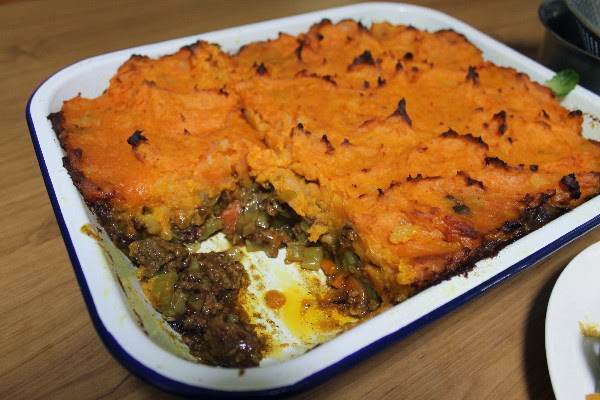
Cottage pie with mash top.

I've been cooking. Isn't a warm kitchen a comforting place to be on a cold Sunday? I can see the steam coming up from my tea and the food cooking on the stove and it makes me feel grateful that I'm warm in my own home and that for us, at this time, life's good. The cooler months are the best time for cooking. When I'm baking, it's nice and cosy near the oven, and just spending time there reminds me that our food today will be warming and nourishing. Gratitude seems like such an incompetent and weak word when I think of all the people who have neither warmth nor nourishment.

My first recipe is for a variation of the humble cottage pie. This one is curried beef mince with a sweet potato topping and it's delicious any time of the year, but particularly satisfying when it's cold outside. All that spice warms a body deep down to the bones.


I'm sure most of you know how to make a curried mince filling but I'll go over it again for the new cooks.

MEAT BASE - serves four hearty meals
  • About 500 grams/one pound of beef mince
  • One large onion, chopped
  • One large carrot, diced
  • Three sticks celery, sliced
  • ¼ medium cabbage, finely sliced
  • One clove garlic, crushed
  • Salt and pepper to taste
  • ½ litre/1 pint water
  • Two tablespoons curry powder or paste
  • Two tablespoons corn flour with enough water to mix into a paste

MASH TOP
  • Two large sweet potatoes, chopped
  • Two medium potatoes, chopped
Brown the meat in a frying pan and remove from the pan. Cook the onion, carrot, celery and cabbage  in the same pan until they start to turn golden brown. Place the meat back in the pan with the vegetables, add the salt, pepper, garlic and curry powder and stir it to prevent burning. Allow the spice to become aromatic and add half a litre/one pint of water, bring to the boil, then turn down the heat to simmer.  When the vegetables are cooked thoroughtly, add the cornflour paste and mix until the thick gravy forms. You can use any vegetables you want to use but these work well in this combination.

To make the top, peel and chop the sweet potatoes and potatoes into similar size pieces. Boil in salted water until soft, about 20 minutes, then pour off the water and mash the potatoes. Add salt and pepper with a little butter or cream until the potato is smooth. You can add herbs to the mash if you like.


Pour the filling into a baking tray and top with the mashed potato. Place in a 190C/375F oven until the mash is golden - about 30 minutes. Serve with brussel sprouts, silverbeet/chard or spinach.  If you use all the vegetables listed above you'll be eating six different vegetables. It's a healthy, filling and frugal meal.


The next recipe is for a new (to me) cake I've just started baking in the last week or so. It's similar to impossible pie, in cake form. For our new cooks, impossible pie is a pie made with a variety of ingredients which separate into layers while they cook. Often you have them come out of the oven with a sort of crust, a filling and a top, even though it went in as one single batter.

This is the cake they call magic cake, I got the recipe from here and it was absolutely delicious. You'll love it if you like custard desserts. The cake makes up as a very thin batter and comes out of the oven as a base, a custard layer and a cake top. The next time I make it, I'll make a coffee version.

What were you cooking on the weekend?

There is a thread on the forum about cottage pies now. If you have time, go and share your recipe.

A real toasted sandwich - homemade grain bread with home-grown tomato, homemade cheese and chilli jam and a gifted avocado.

It's May already! No matter what you're doing this weekend, I hope you enjoy yourself and have the chance to relax. No one is going to walk up to you and whisper: "make yourself a cup of tea and sit down for a while", so I'll remind you to do it, a few times, over the weekend.

No matter where you are in the world, I hope you'll vote for me in the People's Choice best blog awards. Thank you. :- ) The voting ends Monday at 5pm.

Thanks for your visits here during the week. As ever, I enjoy reading your comments and knowing that so many of you are walking this path along with us.

34 grandmothers and what they cook
How to live in a sustainable home
1 million women
The 2014 list of the USA's fruit and vegetables with the most and the least amount of pesticides
40 household cleaning tips
Energy saving tips for old homes
Kids' lunchbox recipes and ideas
My friend Ben Hewitt has written a great post about an old ice box and how they use it as a refrigerator for six months of the year. This is good old common sense and certainly worth your time to read it - One of these days.
The perfect cup of tea, with no tea bags
River Cottage You Tube Channel you can subscribe
How to make a four dollar wool nappy cover from an old blanket
Got homegrown milk?
I think most of us want to feel that we’re spending our time wisely, that we’re productive, contribute our fair share and get the job done efficiently. I felt like that when I worked for a living; I feel the same now working at home. There is no doubt that if you work as a doctor, nurse, teacher, fire fighter, police officer, retail assistant, factory worker, lawyer, scientist or truck driver, you’ll be part of the national work force and be rightly proud of the part you play in the nation’s progress and success.  You'll be respected for the role you play in your community and as a bread winner for your family. Homemakers care for children, manage the household budget, have control of the family’s spending, balance budgets, clean, cook and bake for their families, drive children to school and after school activities. They stay up at night with sick children and partners, shop for healthy food while spending the least amount of money, mend, recycle, sew, and they often make many of the cleansers they use. Homemakers send students and workers off every day well fed, clean and ready to work after a sound night’s sleep. Homemakers play a large part in the nation’s progress and success too, but they are rarely acknowledged, let alone respected for it.


Homemaking has been looked down upon for decades. That is not going to change overnight. But I think that homemaking has undergone a radial change and not many people know it. Homemaking now has more in common with the 1900 - 1950s style of homemaking, instead of the 1960 - 1990s style. Many of us are now actively engaged in traditional crafts and activities while using using modern technology and appliances in this radical and proactive enterprise. There is a huge group of homemakers who work in the commercial world in addition to their work at home, there are many homemakers who work at home, earning extra money to boost family finances, there are the homeschooling homemakers and homemakers who volunteer in their communities. It's changing.


We need to work together to help change outdated attitudes about homemaking, so that not only do we continue our work at home with the support of family and friends, but we also open up the option of a homemaking career for younger people, both women and men, who, right now, might not even know it's an intelligent and important option. You can help spread the word by telling your friends and neighbours about your favourite activities, maybe bread and soap making. Show them your knitting and sewing. Demonstrate your life in gentle ways. Be your own best advertisement. If we can develop our own strategy to talk about our work in a way that highlights the significance of it, if we show, by example, that homemaking makes us content, if we reskill ourselves for a productive future, if we guide our families with grace and confidence and if we share our experiences in a thoughtful way then we'll gain some of the support we all hope for and validate our choice to be what we are.


I know that my life is better now that I take care of my home and family as my main concern. It wasn't always the case. I never really knew the significance of caring for a home until I gave up work and came home. I realise now that the day-to-day tasks of homemaking - the bed making, sweeping, cleaning, laundry, cooking and the physical work of a home, as well as all the sitting on the front verandah relaxing and thinking, created the person I have become.  But there are many women who balance work, volunteering, home businesses, homeschooling and homemaking. We all work in different ways but we are doing the same work, we're caring for family and home - our nations' true assets.


Homemakers make most of the buying decisions in the home and that gives you and me the power of the dollar/pound. Use it. If you don't like the service you receive, if the goods you buy are faulty or inferior, complain. When we're assertive, shopkeepers listen. They're not stocking an ingredient you need? Ask for it. Shopping is best done with a happy mindset, it's not an exercise of walking behind a trolley picking up products and dropping them in. It's much more involved and active than that. Read labels, know what you're buying, ask, know your products and where to get the best deals. We want good quality and the best value for our money, the shopkeepers want you to take what is in the shop at the advertised price. Shopping is our battlefield. Doing it well gives you the power of the money you spend. We all have to take advantage of that.


Modern homemaking is an independent creative activity, it can be whatever you want it to be and it will give you many wonderful reasons to get up every morning. If you really do become what you do, then I have become a modern homemaker who wants to show women and men a way of life that will slow them down and bring enrichment and meaning into their lives. My home has become a centre point for me, where I am made content and self-reliant by the work I do. Right here is where I find a steadfast inspiration every day to carry on. I didn’t know a life lived like this was possible until I stumbled into it. My home is where I reclaimed my independence and discovered how to live well and to my true potential. It may not be everyone's choice to work at home doing household chores but I have been enriched by it and I doubt I would be as happy as I am without meaningful work to do every day. I don't want to live a life where I don't have to do any work, and I don't want to be dragged down by it either. I have found a good balance that requires of me that I plan, work and put in the time and in return I get this feeling of sublime contentment. And I am thankful that homemaking slowed me down enough to discover that, to enjoy the natural world surrounding me and to enrich my spirit.
The forecast is for a cold weekend, the bright glare of sunlight has evaporated, leaves are turning yellow and soon the wisteria vine will be bare. The months from now till October are my favourites. I feel more energised, a fertile garden out the back is primed to produce abundant crops of fresh organic fruit and vegetables. Add eggs from the chickens to that abundance, and we have the warm promise of a self-sustaining home. In the cooler months, the sky is bluer, the grass is greener, the air is cleaner and all things seem possible to me.

 Cucumber salad.
Christmas fruit cakes.

One of the noticeable differences that cooler weather brings is the way we cook. I think being a good home cook is an important simple life skill. If you move away from expensive cuts of meat and seafood you need to be able to turn plain and simple ingredients into memorable meals using your expertise and experience. In our home we don't have many winter salads, we focus our sights firmly on hearty soups, stews and if we have meat and vegetables, we usually have a rich hot gravy with it. When I cook food here, I hope that it will be within budget, wholesome and delicious but one thing it is always - it's always cooked entirely from scratch and often from local, if not backyard, produce.

Brown rice and vegetable salad.
Chicken tenderloins with homemade herby crumbs.

I have a lot of cookery books but I use them to give me ideas rather than instructions. I very rarely use recipes but I like looking at what and how other people cook. If I like what I see, I try to do my version of it. I think the internet is a great way to help develop cooking skills. If you find someone who cooks your kind of food, and they do it from scratch with no cans of soup or packets of seasoning, keep going back to see what they cook and try cooking something similar. These culinary guides are valuable when you first start cooking, or cooking in a different way, and can lead you to success with your meals.

 Pork meat balls made using homemade bread crumbs, parsley, onion, egg, salt and pepper.

You need to think about your ingredients too and even a dish you've cooked often can be changed over the years.  Lately I've found the pork chops we buy have been dry so instead of having a pork chop each, I recently made pork meatballs and vegetables. It was delicious and thrifty and I'll use the same recipe to make a pork meatball pasta sauce as well. It was a timely reminder for me to not get stuck in my ways - to experiment, change ingredients and cooking methods and learn from the results of that.

I guess most of us are influenced in our cooking by our parents and what we ate when we were growing up. I still use some of my parents' and grandmother's recipes, but Shane, Kerry and Sunny are all chefs, so I ask them for recipes and advice too. Add to that all my cookery books, the thousands of cooking blogs and I know I'll never run out of inspiration or guidance. And that's good, because cooking good food is important.  What style of cook are you? How did you develop your cooking skills?

ADDITION: There is a great follow-up conversation about this happening over at the forum. Click here to go there.


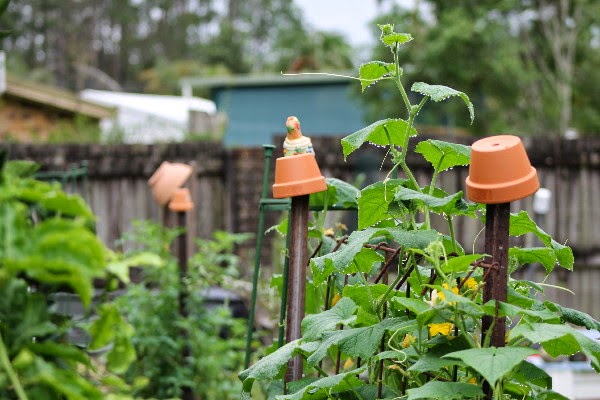
Well, I'm still pickling cucumbers. Cucumbers are one of those crops that you have to be prepared for because you get so many of them. We already have pickled cucumbers in the fridge but I'll be making a few more jars from Saturday's harvest. Hanno pulled the vines out on Saturday afternoon and hiding under the terracotta pots he found 30 or 40 harlequin beetles and ladybugs. I'd been wondering what had been nibbling at the cucumbers and there it was - harlequins! It's a good reminder to look under the pots every so often. I've found spiders under them before but never a village of bugs.


The rest of the garden is growing well. We're harvesting French and cherry tomatoes, herbs, bok choy, ruby chard, lettuce, oranges and passionfruits and yesterday Hanno planted some black kale for the chooks (it grows really tall and doesn't take up much room), cauliflowers, kohl rabi, beetroot and more lettuces. 

It's such a pleasure to be outside in the sunshine at the moment. I think I enjoy autumn more with every year that passes. With the gentle breeze and the birds swooping in to visit, sitting on the garden bench under the elder tree is such a seasonal pleasure. Sometimes I feel like staying there all morning. The fresh vegetables there to be harvested are the icing on the cake.


This patch has now been planted with tomatoes and beetroot.


We've had problems with tomato grubs this year. Have you had it too? How are you dealing with it? We're using Dipel (Bacillus thuringiensis) which is a non-toxic, organic spray but I'd love to hear of other methods.  Generally we pick off caterpillars but this type burrows into green tomatoes before you know they're there and only see them when a black hole appears.  I've picked three with that hole and have them sitting in a basket with the chitting potatoes on the back verandah. I'll ripen them and give them to the chooks.

Ah, the chooks. They're laying like mad and I've sold two dozen eggs this week. We've decided not to keep Patrick. We are both big sooky-la-las when it comes to chickens and animals and we don't want to deal with roosters if we hatch any chickens. Patrick is a beautiful gentle boy - a pure barred Plymouth Rock. He hasn't started crowing yet. I'd like him to go to a farm or a good suburban home already set up with a flock of hens. I don't want him to be eaten. If you live on or near the Sunshine Coast and can fill those requirements, we'll happily hand him over to you and hope he fathers some magnificent chicks for you.

How is your garden going at the moment?

If you have a spare few minutes later today can you help Ripe Near Me get some vital points. I've written about it before here but they need our help now to gain international recognition and, no doubt, expand their service through that.  There is info here about it and you can vote for them here.

I hope it's a wonderful week ahead for all of us.


Don't forget Mother's Day is coming up on May 11. 

When I look at the stock at Odgers and McClelland Exchange Store I think I could have a use for all of it. Maybe your mum would too. You still have time to order from their online shop. If you're not sure, have a look at the Falconware teapots. I have one, I love it and I use it every day. Click here to see the latest in store.

Two important questions are posed on the forum at the moment, along with many, many other items of interest. Drop in for a read over the weekend.

  • What is sustainability?
  • Would you like to take on the 12:12:12 challenge?  This is a decluttering challenge. You need to find 12 items to throw away, 12 items to donate, and 12 items to be returned to their proper home.  This challenge started a couple of days ago but it's fine to start right now.

Eco Yarns Sale
There is a quick one week sale starting today!

Use code MAYflower for 10% off all items, with FREE SHIPPING for orders over $80 for the week of the sale. Normal shipping rates are $10 per order or free shipping for all orders over $150.00.

Please note: Vivian is away from the 16 May to the 13 June. All orders placed during this time will be dispatched when she returns. 

It's another long weekend here in Australia. Today is Anzac Day, and most Australians and New Zealanders will be enjoying a public holiday.  I hope everyone enjoys the day. If you're not in our part of the world, I hope your Friday and weekend is just what you're hoping for.


I will be madly knitting away using the beautiful organic cotton from EcoYarns. I'm knitting dishcloths to have a few samples when I do my library talks again this year, and I'm on the first of two shawls.  At some point during the weekend, I'll be doing some ironing.  Can you tell by looking at this pile of clothes that I like red?


I haven't been on the blog much this week because I've had work to do at the forum, I'm still writing and I had book publicity commitments. I'll be back as usual next week with, I hope, some interesting blog posts for you.
- - - ♥-♥-♥- - -

Climate change is the fight of our lives  The paragraph below is an extract from this article:

And just as we have changed before, we can change again. After listening to the great farmer-poet Wendell Berry deliver a lecture on how we each have a duty to love our "homeplace" more than any other, I asked him if he had any advice for rootless people like me and my friends, who live in our computers and always seem to be shopping from home. "Stop somewhere," he replied. "And begin the thousand-year-long process of knowing that place."

Cutting cherry tomatoes the easy way
One fifth of China's farmland polluted
Shipton Mill: the flour fuelling Britain's baking revolution
What's the difference between a cold and the flu?
Gurrumul is one of our finest musicians. Here he is, this week, singing for the royals. Gurrumul has been blind since birth and he sings his indigenous language. - video
This year's best sites and apps
Triple berry Dutch baby
Chickens - behavioural research - a must read for those with chickens


The weather is close to perfect at the moment. The evenings are cool, the days sunny, the humidity is low and it makes me feel happy and optimistic. I spent some time yesterday morning planting granny's bonnets (aquilegia) in the vegetable garden. I love seeing flowers in with the tomatoes and cabbages, it's something you don't expect. Flowers bring the bees in too, and that makes it even better. Hanno has been working in the garden too. He's trying to remove the stumps of trees felled a few years ago that are now providing a problem with his ride on mower. Soon we'll organise a day together, when it's a bit colder, when we weed and prune the front garden and plant out a few cuttings I've been growing in the bush house.


Whether in the front or back garden, this time of year is our busy time in the garden and when we're not out there, we're thinking about being out there. But there is one thing we must remember at this time of year, when the weather makes being outside such a sublime pleasure, and that is to go out there, enjoy it and just soak it all in. No work, just sitting or walking or sipping tea. We make these spaces to be beautiful and serene and it's at times like these that they should be appreciated, looked at, thought about, enjoyed and celebrated.

Simple life is as much about slowing down and enjoying your surroundings and your home as it is about the thrifty management of household funds and low impact living. We live in an age where many people are permanently busy and although I am busy at times, I take time out of every day to relax, think and appreciate what surrounds me. Those times, sometimes brief and some not so, help me get through the harder times.


Would it surprise you to know that when I'm not giving talks around the libraries I only go away from my home about two or three times a month? Here is where I want to be, I've moved away from wanting to driving around or shop or even to be where a lot of other people are. Here at home is my place and I'm happy here. Always. I'm not saying that you should be that radical in your relationship with your home life and the work you do there but I do encourage you to drop the "busy" mantel, to start saying "no" and make a slower life.


Recently I read this newspaper article about busy lives and the scenario of busyness was so far away from my personal experiences when I was in the garden yesterday, that I had to link to it in the hope it would resonate with you as well. I loved: "Learn to say no": it's such a cliche, and easy to assume it means only saying no to tedious, unfulfilling stuff. But "the biggest, trickiest lesson," as the author Elizabeth Gilbert once put it, "is learning how to say no to things you do want to do" – stuff that matters." We all need to say yes to ourselves.

So am I saying to stop doing all your work and just enjoy? No, that would become boring very quickly and we all need to work. But I am saying that in the middle of your work take a break, to plan downtime into your schedule, and to slow down and appreciate what you're working for. I hope you're enjoying life as you live it and not saving up that enjoyment for later - the weekend, retirement, or whatever. Enjoying the ordinary things in life and having simple down time to relax is what helps us carry on and live life to its potential. But no one will come along and tell you to stop working, no one will tell you to not be busy all the time, you have to give that gift to yourself.

Everyone should taste produce they've grown themselves at some point in their life. It's a skill we should all have - that ability to plant a seed, seedling, vine or tree, manage it, watch it and eat it when the time it right. However, some people can't do it. They have either no time or they have no land. If you're in that group of people because you're either out at work during daylight hours and have no energy when you're home, you're raising a young family or looking after an elderly relative, or you simply just don't have the land because you're renting, I might have a solution. 

My solution won't give you an abundance of food, nor will it allow you to give up shopping for fresh food at the market. What it will do though, is allow you to grow one thing well so you can experience the taste of real food and start to develop food growing skills.


This project can be carried out indoors or out in the backyard. The options are, outside, to plant a fruit tree or vine or, inside, to grow mini salad lettuce. If you're renting and you're going to plant the fruit tree, you may need to ask your landlord for permission to do this. Once you've got that, you're set. Most landlords, even those opposed to a garden going in, would probably be okay with a tree of suitable size. But there will be some readers who own their own land but haven't yet fully utilised its opportunities. Please include yourself in this.


Hanno and I travelled to Germany in the late 1970s so I could meet his family. We intended to stay for a couple of months but ended up staying a couple of years. I often went food shopping by myself, and although I went to German language classes, I picked up a better understanding of the language when I was out shopping. One day I bought some peaches from Greece. Unlike Australia at that time they imported food from other countries and it was really interesting to me to taste these fruits. Those peaches from Greece were the best I'd ever tasted and I was convinced that it was the climate there, coupled with the soil the peach tree grew in that made this magnificent and remarkable difference in taste.

And then I grew peaches here in our backyard and I knew then that the mysterious element was time. Many fruits and vegetables grown now don't taste of much at all. Tomatoes don't taste like tomatoes, apples are bland and don't taste like they used to. I think that's because they're grown fast, usually fed with all sorts of man-made fertilisers and then they're stored. They grow true to the look they should have, true to the smell, they feel the same, but they do not taste the same. They've lost the taste of real food. When we grew our peaches, they started off small but even then they had the most delicious, intense peach aroma and flavour. Our tree grew in the middle of the vegetable garden and it was watered when the vegetables were and fertilised with comfrey. Those harvests, wow, they were magnificent. It was like we were eating the sweetest, most carefully tendered peaches, sold at the best shop in town. But the truth was we had tendered them in our little backyard, along with all the other food we ate. We gave it no special treatment, no extra water; it was just allowed to grow at its own pace and to develop the unique and extraordinary flavour of traditionally-grown, organic peaches. Sadly we pulled out that tree when the fruit fly found us a few years later.


But now we have our oranges that the fruit fly don't bother with. Hanno was in the kitchen yesterday while I was writing and in he came with a slice of orange - "taste this," he said.  Well, it was like the peaches all over again - that intense orange flavour that commercial oranges don't have. That orange was perfect, although it didn't look like much. It was still tinged with green on the top of the orange, it had a couple of bumps, but that flavour, the flavour of a sun-soaked, organic orange was there to make us forget all about the look and just remember that taste.


So if you have room and the right climate I encourage you to plant an orange. You'll be growing some of your own food but the work required will be a small fraction of what you'd be doing if you had a vegetable garden. A tree is a real investment - unlike most vegetables that have to be resown every year, a tree will take a few years to start, then you'll have oranges galore. You'll still have to learn about what the orange tree needs to thrive, you'll have to water it - that's nothing. And then once a year, you'll get a crop of the sweetest oranges from your backyard. You will have produced fruit; real food. An orange tree needs an open sunny spot to grow, dig a large hole to plant it in, add compost and manure - both can be bought in bags at the produce or hardware store or at the garden centre. If there are any flowers on the tree when you plant it, snip them off. I know it seems counter-productive to do so but it will allow the tree to establish its roots in the first year instead of concentrating on producing fruit. Do it the second year too. After that it just needs fertilising with the manure a few times a year and a deep watering once a week, maybe a bucket full. When the flowers and fruit appear, increase the watering to two buckets a week.

Luckily it's not just an orange you'll be getting. With your oranges, as well as eating them fresh from the tree, you'll have juice, fruit for jam, flavouring for cakes, biscuits and your savoury dishes and if there is some left over, maybe a bottle or two of cordial.

We have a Washington navel orange tree - we have a couple of them and they're a good tree in any backyard. If your climate is too cold for citrus, or you don't like oranges, try a cold climate apricot, pear or apple. Grow what you love and what can be grown where you live but do give it a try. You'll be gardening and producing some of your own food but without the fussing of a vegetable garden.


Just pull out these tender little lettuces when you have a salad and sow new seeds to replace them.

And if you have no room, time or permission, try the indoor option. Get a long trough pot, similar to those used as window boxes, fill it with potting mix and compost and plant lettuce seeds of your choice. Sit the pot on a warm window sill, or outdoors if the temperature is right. Lettuce need bright light to grow but they don't need full sun, so a light window sill would be perfect. You'll have to water them and care for them, and when they're two or three inches high, pull them out, cut off the roots and replace those you pull out with a new line of seeds to continue the lettuce throughout the season.  What you've have are little mini lettuces, with all the nutrition of a well grown organic lettuce, and it will be fresh. You can't buy freshness - you have to grow it yourself. But if you do this small project, not only will you be starting to learn abut food production, you'll be eating some of the best lettuce or oranges you've ever eat. And that is priceless.

What other ideas do you have to help non-gardeners with food growing skills?


Baked eggs in spicy tomato sauce.

I've been reading a few threads at the forum this morning and came across an older thread I hadn't seen before. It's by one of our mods, Tessa, and she's asking about food goals for the year. So whether you want to read a list of month-by-month goals or read about many specific things our members are going to concentrate on, it's all there. I found it very interesting, and quite motivating, to read what other's have in mind. 

It's a beautiful day here, Hanno is out in the garden and I'm just about to join him with a cup of tea. I hope you're enjoying your weekend. xxx

Early morning in the garden.

How cooking can change your life - Michael Pollan, Youtube
Backyard Permaculture - Youtube
Sunny spinach pie recipe
You're not as busy as you say you are
Ways to start living a frugal life
Inside urban green - modern methods of growing food
This is a radio interview I did with ABC radio in South Australia yesterday. The host is Stan Thomson
Free pattern for a knittewoollen beanie
Pretty craft blog - Helen Phillips
A delightful pottery artist blog
I love this idea - Fred's modern rite of passage

If you're in northern NSW, or in Sydney and would like a weekend away, go no further than Nundle. This little town is hosting an Easter festival and everyone's invited to two days of live music, games, magic shows and great food.  Go here for more information.

It's a long weekend in Australia - four days when it's usually thought to be the last time you can go camping before the cold weather sets in. We won't be camping but we'll have plenty of interesting things to do in our garden.  This afternoon we're going to Jens and Cathy's for a catchup. I hope you enjoy your Easter weekend too. See you next week. :- )
An email arrived last week from a reader in Canberra. For those of you who don't live here, Canberra is situated half-way between Sydney and Melbourne. It's our national capital and it contains our parliament buildings, the mint, war memorial, the national gallery and library. The city is home to thousands of public servants and people who own and work in the businesses that support them. Our reader, Sarah, writes:

"We have been on a quest for a simpler life since we left Vancouver with one small child. My boss demanded full time work, I had no childcare space (despite a 1.5 year wait list), a long commute, etc. We have greatly improved our lives in coming to Canberra but I want a whole lot more. Life is so serious here in Canberra. It does not make sense to me that our generation has to squeeze ourselves into cities or suburbs with super high mortgages, commuting, childcare, rushing around, etc. just so our children can go to good schools and continue this pattern themselves. I would love to read about your ideas for people with young families looking to escape that treadmill."


It never occurred to me when I was younger that the majority of us sell our life hours for money. It was only when I was older, and much more concerned trying to balance work with life that this strange reality dawned on me. The way we live in Western society is so deeply entrenched most of us never question it. But it is what it is, the majority of us have not been born into great wealth. We have to earn our keep by selling what we've got - our intellectual and physical capabilities and the life hours that go with them.

I am a worker bee, have been all my life, so you won't be surprised to know that I think work is a good thing. I firmly believe that we all should work for what we get in life. But I don't think we should work an entire lifetime. We aren't here just to keep our country's businesses going, we are here to find love, happiness and contentment and to build strong families. Doing that will keep our species and our nations going. So if you were to ask me how to set up a strong simple life that would function well right through until old age, I would say to work hard to buy a home and when the mortgage is paid off, to move to a blend of paid work and home work in a town you want to live in. Though I imagine there would be some who would want to give up work altogether when they're established and debt-free, and there will also be many folk who live in the same place all their lives. When you are debt-free and working towards it, your focus would be to reduce the cost of living as much as you can, to make your home a place of production where you make as much as possible, and to keep the traditional skills of homemaking and small farming alive while you live your simple life in, but separate from, the mainstream.


Remember, that you don't have to wait until you pay off your debts to start living a much simpler life. You can start right now if you want to.  You need to think about what you want in your life, what your own values are and decide to step back from buying everything you want. Then, by living frugally and paying off debt as you go, you have time to develop the skills you will require when you dive fully into this life. Some of you will pay off your mortgages faster than others but that really is the key to this. To be free of debt and to live frugally, producing some of what you need, while working enough to pay for your lower cost of living.

We all know that life doesn't always go by any rules. If you've never been able to buy a home and are a lifelong renter, you're still well and truly included in this, although your path might be a bit more unstable if you are in a situation when you have to leave a loved home because the landlord has other plans. Buying a home puts more power into your hands but not all of us can do it, or we do it, then lose it.  But if you can live frugally then it might be possible for you to go to part-time work too but you'd have to have a good emergency fund to cushion you from the unexpected. We all need that.

From the time you decide to live a more simple life you need to be more prudent and thrifty, you'll  learn what you need to know in your particular situation, you'll plan and budget. You have to look after what you own and make the most of what you have. If you have land, use it to grow food. You'll be getting the full value of your land if you can live on it and grow food on it as well. Don't be tempted by fashion or updating what you own to keep up with the neighbours. Make your own cleaners, dispose of all the disposables, make do, cook from scratch, stockpile, and pay every cent you save on your mortgage. And while all this is going on, find the best in every day and be content with what you've got. 


Simple life has many offerings but you have to look for them, nothing is handed to you on a silver platter. Yes, your life will be full of activity but there is nothing wrong with that. The work you do for pay and at home will give you the life you want, and it will build character. Most of the work you do at home is worked at your own pace, it's gentle work and it gives you what you need. And as the months turn into years, I hope you'll find the contentment and happiness that can be found living this way.

So to answer part of Sarah's question specifically: I think it does make sense to work to set yourself up in life, buying a home and what you think you need to live well. After setting up with a partner you should be focused on earning enough to buy a home. I think it's best to do that fast with both of you working, and certainly before children are born. But that only has to be done in cities and suburbs if that is the only place you can find work. You may be one of those lucky people who can work from home and not be tied to a specific location. When the kids are born, if you can continuing paying off your debt as fast as possible, while enjoying life as well, you'll have a good chance of being able to transition to part-time work in about eight to ten years, depending on your mortgage. Those early years of hard work and sacrifice pay off when you own your home. Then, if you want it, you could sell your town or suburban house and buy somewhere less expensive, maybe in a semi-rural location where the houses are cheaper, but your still have access to city life when you want it. By selling a city house you'll have enough to buy a rural home and a nest egg to keep you going while you establish yourself.


Many people know from an early age they want more than what city life offers, others get sick of the rat race in mid-life, sell up and go and live in the country. I'm reminded of Duncan and Megan at the Odgers and McClelland Exchange Stores who gave up city life with two young boys and set up in the country town of Nundle. Now they operate a homewares store and if you read Megan's blog, you'll see they're living a busy but very rich life. 

Sarah, you must live true to your values and if they don't include paying off a high mortgage, private schools or commuting then you have to work out a plan to move away from that scenario. You don't have to live in any particular place, but you need to have the means to live the way you want to live. Start planning your escape. Work out a plan to pay down your mortgage, put the children in good public schools when you need to and work towards a life that will enrich you. I think it all starts with buying a home. When you have that asset, you'll be able to structure the life you want but don't forget to live simply from today.


If you'd asked me when I was fifty, when I would start to feel old, I would have told you 80ish. I turn 66 today and I'm starting to feel old. Feeling old to me means I'm starting to slow down, I'm less inclined to take on new things and while I feel I've seen it all, I also have an optimistic view of what is coming and my ability to meet whatever it is with confidence. BTW, I don't think growing old is a bad thing, it's what we're all doing every day. I think life often gets better as you age. When I was 50, I wanted to live till I was 110. I'm not that selfish now and whenever my time is up, I'll be grateful that I had an interesting life and for the great majority of it, I was happy.

And just to prove I'm not a glamorous 25 year old masquerading behind these words, here is my birthday photo - the Queen and I do them every year - taken yesterday afternoon when I was 65. ;- )

Living to a really old age is not part of my plan now. I don't want to die tomorrow or in the next few years, but I don't want to live passed 90 either. I am happy knowing that my family is settled and that grandchildren have been born. I have had a few successes in my life, but having the family I have has been the greatest of them.

Today Hanno and I might go out for a seafood lunch. It depends on Kerry though because he flies back in from his job today and Hanno has to pick him up. If we're too late for lunch, we might have afternoon tea up the mountain at the French cafe. It will be good to have a day off too, I'll do some knitting, wander around and no doubt I'll talk on the phone to various family members and friends. It's a day for pottering, not working.

I want to thank you all for being here today and for reading what I write. It's not often a woman my age gets to have an audience and that's something that I think about almost every day. So thanks for giving that to me, for reading, for commenting and for walking this path alongside me.

- - - ♥-♥-♥- - -

Newer Posts Older Posts Home


My books were all published by Pengiun, and are available at Amazon US, Amazon UK and Amazon Au

Search here

Total Pageviews

Translate


I'm Rhonda Hetzel and I've been writing my Down to Earth blog since 2007. Although I write the occasional philosophical post, my main topics include home cooking, happiness and gardening as well as budgeting, baking, ageing, generosity, mending and handmade crafts. I hope you enjoy your time here.

MY FAVOURITE PLACES

  • Grandma Donna's Place
  • Grandma Donna's YouTube
  • Grandma Donna's Instagram
  • This Simple Day
  • Nicole's Instagram

Give More

Give More

Popular posts last year

Making ginger beer from scratch

We had a nice supply of ginger beer going over Christmas. It's a delicious soft drink for young and old, although there is an alcoholic version that can be made with a slight variation on the recipe. Ginger beer is a naturally fermented drink that is easy to make - with ginger beer you make a starter called a ginger beer plant and after it has fermented, you add that to sweet water and lemon juice. Like sourdough, it must ferment to give it that sharp fizz. To make a ginger beer plant you'll need ginger - either the powdered dry variety or fresh ginger, sugar, rainwater or tap water that has stood for 24 hours to allow the chlorine to evaporate off. You'll also need clean plastic bottles that have been scrubbed with soap, hot water and a bottle brush and then rinsed with hot water. I never sterilise my bottles and I haven't had any problems. If you intend to keep the ginger beer for a long time, I'd suggest you sterilise your bottles. MAKING THE STARTER In a...
Image

NOT the last post

This will be my last post here.  I've been writing my blog for 18 years and now is the time to step back. I’ve stopped writing the blog and come back a couple of times because so many people wanted it, but that won’t happen again, I won’t be back.  I’ll continue on instagram to remain connected but I don’t know how frequent that will be. I know some of you will be interested to know the blog's statistics. 
Image

How to make cold process soap

I'm sure many of you are wondering: "Why make soap when I can buy it cheaply at the supermarket?" My cold process soap is made with vegetable oils and when it is made and cured, it contains no harsh chemicals or dyes. Often commercial soap is made with tallow (animal fat) and contains synthetic fragrance and dye and retains almost no glycerin. Glycerin is a natural emollient that helps with the lather and moisturises the skin. The makers of commercial soaps extract the glycerin and sell it as a separate product as it's more valuable than the soap. Then they add chemicals to make the soap lather. Crazy. Making your own soap allows you to add whatever you want to add. If you want a plain and pure soap, as I do, you can have that, or you can start with the plain soap and add colour, herbs and fragrance. The choice is yours. I want to add a little about animal and bird fat. I know Kirsty makes her soap with duck fat and I think that's great. I think t...
Image

Preserving food in a traditional way - pickling beetroot

I've had a number of emails from readers who want to start preserving food in jars but don't know where to start or what equipment to buy.  Leading on from yesterday's post, let's just say up front - don't buy any equipment. Once you know what you're doing and that you enjoy preserving, then you can decide whether or not to buy extra equipment. Food is preserved effectively without refrigeration by a variety of different methods. A few of the traditional methods are drying, fermentation, smoking, salting or by adding vinegar and sugar to the food - pickling. This last method is what we're talking about today. Vinegar and sugar are natural preservatives and adding one or both to food sets up an environment that bacteria and yeasts can't grow in. If you make the vinegar and sugar mix palatable, you can put up jars of vegetables or fruit that enhance the flavour of the food and can be stored in a cupboard or fridge for months. Other traditional w...
Image

Cleaning mould from walls and fabrics

With all this rain around we've developed a mould problem in our home. Usually we have the front and back doors open and that good ventilation stops most moulds from establishing. However, with the house locked up for the past week, the high humidity and the rain, mould is now growing on the wooden walls near our front door and on the lower parts of cupboards in the kitchen. Most of us will find mould growing in our homes at some point. Either in the bathroom or, in humid climates, on the walls, like we have now. You'll need a safe and effective remedy at some point, so I hope one of these methods works well for you. Mould is not only ugly to look at, it can cause health problems so if you see mould growing, do something about it straight away. The longer you leave the problem, the harder it will be to get rid of it effectively. If you have asthma or any allergies, you should do this type of cleaning with a face mask on so you don't breathe in any spores. Many peopl...
Image

Five minute bread

Bread is one of those foods that, when made with your own hands, gives a great deal of satisfaction and delight. It's only flour and water but it symbolises so much. I bake bread most days and use a variety of flours that I buy in bulk. Often I make a sandwich loaf because we use most of our bread for lunchtime sandwiches and for toast. Every so often I branch out to make a different type of loaf. I have tried sour dough in the past but I've not been happy with any of them. I'll continue to experiment with sour dough because I like the idea of using wild yeasts and saving the starter over a number of years to develop the flavour and become a part of the family. However, the loaf I've been branching out to most often is just a plain old five minute bread. By five minutes I mean it takes about five minutes actual work to prepare but it's the easiest of all bread to make and to get consistently good loaves from. If you're having people around for lunch or...
Image

This is my last post.

I have known for a while that this post was coming, but I didn't know when. This is my last post. I'm closing my blog, for good, and I'm not coming back like I have in the past.  I've been writing here for 16 years and my blog has been many things to me. It helped me change my life, it introduced me to so many good people, it became a wonderful record of my family life, it helped me get a book contract with Penguin, and monthly columns with The Australian Women's Weekly and Burke's Backyard . But in the past few months, it's become a burden. In April, I'll be 75 years old and I hope I've got another ten years ahead. However, each year I'll probably get weaker and although I'm fairly healthy, I do have a benign brain tumour and that could start growing. There are so many things I want to do and with time running out, leaving the blog behind gives me time to do the things that give me pleasure. On the day the blog started I felt a wonderful, h...
Image

What is the role of the homemaker in later years?

An email came from a US reader, Abby, who asked about being a homemaker in later years. This is part of what she wrote: "I am a stay-at-home mum to 4 children, ages 9-16. I do have a variety of "odd jobs" that I enjoy - I run a small "before-school" morning drop-off daycare from my home, I am a writing tutor, and I work a few hours a week at a local children's bookstore. But mostly, I cherish my blissful days at home - cooking, cleaning (with homemade cleaners), taking care of our children and chickens and goats, baking, meal-planning, etc. This "career" at home is not at all what I imagined during my ambitious years at university, but it is far more enriching. I notice, though, that my day is often planned around the needs of my family members. Of course, with 4 active kids and a husband, this is natural. I do the shopping, plan my meals, cook dinner - generally in anticipation of my family reconnecting in the evening.  I can't h...
Image

Every morning at home

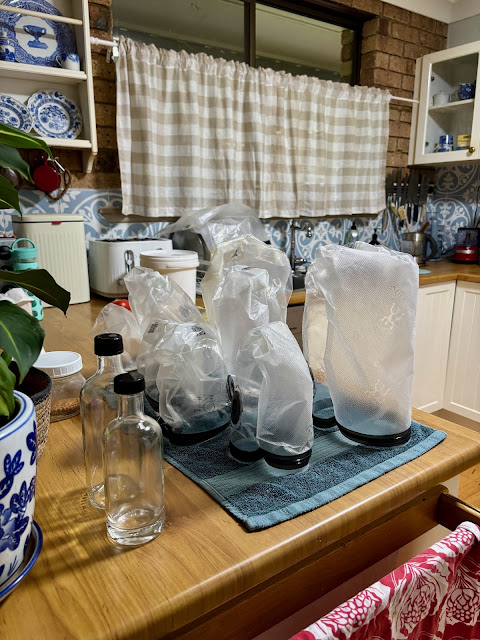
Every morning when I walk into my kitchen it looks tidy and ready for a day's work. Not so on this morning (above), I saw this when I walked in. Late the previous afternoon when I was looking for something, I came across my rolled up Zwilling vacuum bags and decided they had to be washed and dried. So I did that and although I usually put them outside on the verandah to dry it was dark by then. I turned the just-washed bags inside out and left them like this on a towel. It worked well and now the bags are ready to use when I bring home root vegetables, cabbages or whatever I buy that I want to last four or five weeks.
Image

You’ll save money by going back to basics

When I was doing the workshops and solo sessions, I had a couple of people whose main focus was on creating the fastest way to set up a simple life. You can't create a simple life fast, it's the opposite of that It's not one single thing either - it's a number of smaller, simpler activities that combine to create a life that reflects your values; and that takes a long to come together. When I first started living simply I took an entire year to work out our food - buying it, storing it, cooking it, preserving, baking, freezing, and growing it in the backyard. This is change that will transform how you live and it can't be rushed.  
Image


Trending Articles

NOT the last post

This will be my last post here.  I've been writing my blog for 18 years and now is the time to step back. I’ve stopped writing the blog and come back a couple of times because so many people wanted it, but that won’t happen again, I won’t be back.  I’ll continue on instagram to remain connected but I don’t know how frequent that will be. I know some of you will be interested to know the blog's statistics. 
Image

Every morning at home

Every morning when I walk into my kitchen it looks tidy and ready for a day's work. Not so on this morning (above), I saw this when I walked in. Late the previous afternoon when I was looking for something, I came across my rolled up Zwilling vacuum bags and decided they had to be washed and dried. So I did that and although I usually put them outside on the verandah to dry it was dark by then. I turned the just-washed bags inside out and left them like this on a towel. It worked well and now the bags are ready to use when I bring home root vegetables, cabbages or whatever I buy that I want to last four or five weeks.
Image

You’ll save money by going back to basics

When I was doing the workshops and solo sessions, I had a couple of people whose main focus was on creating the fastest way to set up a simple life. You can't create a simple life fast, it's the opposite of that It's not one single thing either - it's a number of smaller, simpler activities that combine to create a life that reflects your values; and that takes a long to come together. When I first started living simply I took an entire year to work out our food - buying it, storing it, cooking it, preserving, baking, freezing, and growing it in the backyard. This is change that will transform how you live and it can't be rushed.  
Image

Creating a home you'll love forever

Living simply is the answer to just about everything. It reduces the cost of living; it keeps you focused on being careful with resources such as water and electricity; it reminds you to not waste food; it encourages you to store food so you don't waste it and doing all those things brings routine and rhythm to your daily life. Consciously connecting every day with the activities and tasks that create simple life reminds you to look for the meaning and beauty that normal daily life holds.  It's all there in your home if you look for it. Seemingly mundane tasks like cleaning and cooking help you with that connection for without those tasks, the home you want to live in won't exist in the way you want it to.  Creating a home you love will make you happy and satisfied.
Image

Time changes everything

I've been spending time in the backyard lately creating a contained herb and vegetable garden. My aim is to develop a comfortable place to spend time, relax, increase biodiversity and encourage more animals, birds and insects to live here or visit. Of course I'd prefer my old garden which was put together by Hanno with ease and German precision. Together, we created a space bursting at the seams with herbs, vegetables and fruity goodness ready to eat and share throughout the year. But time changes everything. What I'm planning on doing now, is a brilliant opportunity for an almost 80 year old with balance issues. In my new garden I'll be able to do a wide range of challenging or easy work, depending on how I feel each day. It’s a daily opportunity to push myself or sit back, watch what's happening around me and be captivated by memories or the scope of what's yet to come.
Image

It's the old ways I love the most

I'm a practical woman who lives in a 1980’s brick slab house. There are verandahs front and back so I have places to sit outside when it's hot or cold. Those verandahs tend to make the house darker than it would be but they're been a great investment over time because they made the house more liveable. My home is not a romantic cottage, nor a minimalist modern home, it's a 1980’s brick slab house. And yet when people visit me here they tell me how warm and cosy my home is and that they feel comforted by being here. I've thought about that over the years and I'm convinced now that the style of a home isn't what appeals to people. What they love is the feeling within that home and whether it's nurturing the people who live there.
Image

Making ginger beer from scratch

We had a nice supply of ginger beer going over Christmas. It's a delicious soft drink for young and old, although there is an alcoholic version that can be made with a slight variation on the recipe. Ginger beer is a naturally fermented drink that is easy to make - with ginger beer you make a starter called a ginger beer plant and after it has fermented, you add that to sweet water and lemon juice. Like sourdough, it must ferment to give it that sharp fizz. To make a ginger beer plant you'll need ginger - either the powdered dry variety or fresh ginger, sugar, rainwater or tap water that has stood for 24 hours to allow the chlorine to evaporate off. You'll also need clean plastic bottles that have been scrubbed with soap, hot water and a bottle brush and then rinsed with hot water. I never sterilise my bottles and I haven't had any problems. If you intend to keep the ginger beer for a long time, I'd suggest you sterilise your bottles. MAKING THE STARTER In a...
Image

An authentic look at daily life here — unstaged and real

Most days Hanno was outside happily working in the fresh air. It may surprise you to know that I started reading my book,  Down to Earth , yesterday - the first time since I wrote it 13 years ago.  I had lent it to my neighbor, and when she returned it, I started reading, expecting to find surprises. Instead, I realised the words were still familiar—as if they were etched into my memory. As I flipped through the pages, I was reminded of how important it was for me to share that knowledge with others. The principles in Down to Earth changed my life, and I truly believed they could do the same for others. After just 30 minutes of reading, I put the book down, reassured that its message still holds true: we can slow down and reshape our lives, one step at a time.
Image