down to earth

  • Home
  • About Us
  • Down To Earth Book
  • Privacy Policy
Yesterday I did what I tell others to do all the time.  I took a day off and looked after myself.  Around 9am I loaded up my iPod full of music and headed off for the hour's drive into the big smoke.  My good friend Susan travelled down to Brisbane from Townsville with her husband and while he was attending to business, Susan and I talked, had lunch, talked, walked around, talked, moved from the lunch cafe to the afternoon tea cafe and talked.  It was a lovely day spent with a good friend and it did me a lot of good.


I picked Susan up at the Art Gallery and we went to the beautiful West End.  Being Tuesday, a few of the cafes were closed but we found a place that sold fresh orange juice and pink grapefruit so we were happy.  I have known Susan for over 20 years and we've grown close during that time.  She is about 10 years younger than me, her children have just left home to pursue careers and she now has more time to enjoy life.  When she emailed last week and said she'd be in town and could I come in for lunch, I hesitated for a while, then realised I wanted and needed to go. I'm so glad I did.

It seemed like 15 minutes, but a few hours flew by and it was time to tackle the almost peak hour traffic and drive home.  Naturally I got lost. I don't know why they continue to change things as soon as I'm used to them being as they are!  I didn't let it spoil my day, I just turned up the music and enjoyed watching people walking along the streets as I found my way home.  As soon as I got out of the main traffic I relaxed more, then turning off the freeway onto the Glasshouse Mountains road I felt I was back in familiar territory.  I stopped at a roadside stall to buy tomatoes and pears, then five minutes later I was home.  As I drove in, Hanno was feeding the animals.  It felt good to be back.

There were many things I could have done here yesterday but I chose not to do any of them.  That trip into town to spend time with Susan did me more good than anything I would have done here.  I let Jo, my editor, know I wouldn't be working on the book, she just went on to the next chapter, no problems.  Hanno was fine, he worked in the garden and relaxed in the afternoon. The housework I might have done is still there. Sometimes what matters most is the care you give to yourself.  There is no fairy godmother who will come along and tell you to take it easy for a while or take the day off.  Only you know when you need time out, so be kind to yourself and relax when you need to.  No one will benefit if you're stressed or fall in a heap.  I think nurturing is a skill we develop as we age and although we may happily take care of our family and friends, we also have to give a little love to ourselves.  I'm on top of the world today and ready to face the world - or at least my part of it at my neighbourhood centre.  What are yo doing today?
Last week, Raspberry wrote:  I don't know if you previously did a post about wise economy and what that means, but I would love to see you do one. Wise economy doesn't always means buying what's cheapest, but it can sometimes be difficult to know when it's wise to buy what's cheapest and when it's wise to pay extra, especially when it comes to quality. I would love your thoughts on this issue.


Raspberry was commenting on my knitting post when I wrote:  I use to think it was a wise economy to buy the cheapest wool; I no longer believe that. The cheapest wool comes with its own invisible price attached. Fibres - even natural fibres like pure cotton and wool, are often processed with harsh chemicals you don't want on your skin. Paying a few dollars more for a better quality yarn will give you a better quality garment and peace of mind, knowing it's not tainted.

As Raspberry said, the cheapest isn't always the best value for money.  What good is a scarf that you buy the wool for, knit and start to use, only to find that it irritates your skin, is too scratchy or leaves a rash.  You won't want to throw it away because you spent all that time and money on it. That scarf will sit in your cupboard and not be used. Saving a few dollars not buying the yarn you really wanted will turn into a total waste of money.

There is no rule that covers this.  Often when it comes to making a decision on what to buy, you have to try it first. For instance, I thought buying embroidery cotton would be simple and straight forward so I bought a slightly cheaper brand. I discovered when I'd made the cover, embroidered and washed it, one of the red colours ran.  Since then I always buy the more expensive cotton.  I think the best advertising is word of mouth from someone you trust.  If you're going to buy something, ask your friends what they know about it.  If you can't find anyone who knows and it's a small item, buy the smallest amount you can to try it.


If you're learning how do various things, ask those you're learning from about how they choose their materials or ingredients.  If you're starting a new craft, learn as much about the materials as you do about the techniques.  Do your research, read good books on your topic and be selective about what you find on the internet.  There will be differing opinions on just about everything.  

I can't give you recommendations for various products but I am firmly convinced of the wise economy of:
  • buying good quality that lasts, can be recycled, mended, changed, painted, dyed or handled down through the family.  This applies to clothes, shoes, appliances, furniture, equipment, tools and cars and much more.  The longer you use anything, the more value you're getting for the dollars you put into it.
  • cloth nappies/diapers. Setting yourself up with cloth nappies/diapers is a good investment.  Generally you'll spend about $1200 for everything you need.  You have to pay for washing costs, but make your own washing liquid and that cost goes down significantly, hang them on the line to dry, it goes down again.  When you have one set, you have enough for most, if not all, of the babies you'll have.  The cost of disposable nappies/diapers in Australia, is said to be about $3000 for each baby.  It's a big difference in financial cost and in the cost to the environment.
  • buying goods produced in your own country and if you can buy local produce, meat or goods, it's the best bonus.
  • buying organic, if you can afford it.  If you can't, buy it whenever you can and be okay with that.  Just do your best and rest easy.
  • living within your means, or below it.
  • teaching children the value of money when they're growing up.
  • cooking from scratch and developing a good selection of incredible recipes that people ask you for.  When that happens you know the food you cook is healthy and thrifty without sacrificing flavour.
  • never walking down the cleaning aisle of a supermarket unless it is to collect borax, bicarb, vinegar and soap.
  • looking after what you already own.
  • doing your own repairs and maintenance - from darning, sewing and mending to changing the tyres around on your car, changing the oil, checking brake fluid and tyre pressure and everything else you're skilled enough to do.
  • growing your own vegetables and cultivating plants that will allow you to make your own fertilisers - comfrey, yarrow etc.
  • developing a worm farm to help you recycle household waste and to supply fertiliser and microbes to your garden.
  • preserving, canning or freezing excess vegetables.  Whether you grow them or buy them in season at the market.
  • paying your mortgage off faster than you're expected to.  You can do that by paying fortnightly instead of monthly or paying extra payments throughout the year.  It's a sacrifice, but the payoff in savings is extraordinary.
  • getting rid of disposables as much as possible. 

I guess my overall recommendation is to know about what you buy. Otherwise you're at the mercy of the manufacturers and we all know that's not always the best position to be in. If you go into the shop to buy something, go armed with as much knowledge as possible.  When you buy something that exceeds your expectations or disappoints you, tell your friends about it.  Making the decision to buy is never easy but if you're aware and have done some research, you'll be better placed.  Don't be one of the uneducated sitting on the side lines thinking that everything you should know will be on the label.  It won't be.  I think there are many good manufacturers and ethical retailers out there.  The problem is, generally, we don't know who is who.  

What are your wise economies?

We've started planting!  Our vegetable season has begun and will continue right through from now till December, when it will be too hot for us and the vegetables, and there will be too many bugs.  We've start off with our cold weather only crops - red cabbage, sugarloaf cabbage, cauliflower and I still have to sow seeds for brussel sprouts. We also have seedlings for marigolds, snow peas, tomatoes and lettuce, and seeds for beans, telephone peas, radishes, Portuguese cabbage, cucumbers, turnips, squash, silverbeet and a few others I've forgotten now.  We have to buy kale seedlings and potatoes and we have a sprouting sweet potato that will go in near the chook house.


This year, I have something new that I've wanted for a long time.  It's a potting box (above).  I lose so much potting mix when I plant, so I drew a diagram and asked Hanno to make it for me.  Naturally it's made with recycled materials - this is the perfect project for using up what's in the shed - this time he used some old floor boards.  Now I can fill the box with potting soil and quickly fill my seedling trays and pots with none falling to the ground.  It's much faster because I just scoop the soil in to the waiting trays.


I do my seed sowing in a greenhouse Hanno built for me many, many years ago.  It a simple construction of a stone floor, shade cloth and benches.  In there, I do my sowing, potting on, I keep the worm farm and orchids, as well as any cuttings I have growing.  It's the ideal place to keep sick plants, or those that are in need of protection from the sun, heat or wind. The stone floor helps create a cool, moist atmosphere.  When I leave any of my plants in there, as long as there is ample rain, they grow like wildfire.  I have bins full of potting mix and seed raising mix and it's quite close to a water tank for easy watering.  It's the ideal working spot.


There is something very satisfying about sowing seeds.  It's an exercise in optimism - that these little seeds will break through their case and send up shoots that will survive long enough to fulfil their purpose - the production of vegetables.  And planting seedings give you an instant understanding of what the garden will look like soon and how you'll help fill your food requirements over the coming months.


We had the family over for lunch yesterday but before they arrived, Hanno started cleaning up the vegetable gardens and planted the first seedlings.  The photo above shows what it looks like today.  All that green in the garden beds are weeds that will have to be pulled out.  There are a few things left from last year - the herbs (out of view) and a corner full of yarrow, as well as perpetual leeks and some tomatoes.


There is also a paw-paw/papaya with ripening fruit, a bay tree and a full Washington navel orange tree in the vegetable garden too.  The oranges will be ready for eating around June and it looks like we'll have enough for eating and juicing  this year.  Freshly squeezed orange juice, particularly from freshly picked organic oranges, is my favourite drink of all time.  I am looking forward to that.  

We hope to pack in enough vegetables to cover all our needs, except for onions, which for some reason won't grow here.  The price of vegetables is very high now, so we'll save some money if we can grow instead of buy what we need.  To be truthful though, the reason we grow vegetables is to productively use the land we live on, to fill our days with meaningful work, to eat high quality, fresh, organic food, to keep heirloom vegetable seed stocks turning over and healthy, and to eat varieties of vegetables that have long disappeared from the shelves of supermarkets.  Supermarkets specialise in vegetables that travel well, that are uniform in size and colour and have been grown quickly, usually with the help of chemical fertilisers.  To eat a tomato that tastes like a tomato, to mash the best potato you've ever mashed, to pick a snap pea that snaps, those vegetables, my friends, must be grown in your backyard, picked at exactly the right time and brought inside to be cooked for the table that evening, or preserved or frozen for future meals.

Happy gardening everyone!


This is a Friday photo feature that anyone with a blog can join. It opens the door to us sharing our lives through these photos and gives us all a new way to discover each other, and maybe form new friendships. Your photo should show something at home that you're thinking about TODAY. If you're in another country you should join in when you read this, even if it's still Thursday.

To take part, all you have to do is post a photo, write a short caption explaining it, and link it back to here. Please write a new post, don't link to an older one. When your photo is published, come back and add a comment below, with a link to your blog photo. Please visit all the blogs that appeal to you and leave a comment. If you are wondering why no one has commented on your On my mind post, maybe it's because you haven't commented on anyone else's. Slow down, take the time to cruise around and enjoy your cyber visits.


This rug is on my mind. We bought it a while back to sit under our kitchen table.  Although it's beautiful, it's not practical in that position and very difficult to clean.  Hanno and I tried covering the rug with bicarb yesterday, a sure way to clean a dark rug, but, as we found out, not a lighter one.  Does anyone have ideas?  It's a 100 percent cotton base with pure wool weaved decorations.  The care instructions say dry clean only but I'm thinking of testing it for colour fastness and might wet clean with a brush, liquid soap and cold water.

With two busy days behind me I'm happy to be back with you.  I've been working at home and in the community,  where I gave the speech on International Women's Day, worked on a grant submission, talked to a lot of people and farwelled a good friend who will soon be working in the city.  Bye Fiona!  My knitting kept me calm and centred even on the busiest day.  I love taking my knitting with me and often knit up a quick few rows, then get back to work, calmer and better able to concentrate.


Are you a knitter?  It's such a wonderful craft.  Not only does it have that ability to calm and sooth frazzled nerves on those busy days, it helps you produce fine garments and accessories for the whole family, or for gifts.  The feel of the soft cotton or wool as it slides through your fingers and the reassuring repetitive motion of the needles working the yarn, feels like, even on the worst day, a simple kind of meditation.


Recently I've been reading Elizabeth Zimmermann's wonderful book Knitting Without Tears.  If you're new to knitting, or a keen knitter who wants to learn from the best, I recommend this book to you.  It starts with Elizabeth explaining this and that, such as: '"Ply is a frequently misunderstood concept.  It has nothing to do with the thickness of the yarn, except in a relative way, and everything to do with its construction.  A ply is a strand of wool  Two, three, four, or more strands are twisted together to make 2-ply, 3-ply, 4-ply, or many plied wool.  Since the strands can be of any thickness, it is clear that the thickness of the wool does not depend on the number of plies but on the thickness of the individual ply."  And she states something I'm just coming to understand myself: "A well-made sweater, knitted with good will and good wool, is beyond price; why try to save a dollar on the material?" I use to think it was a wise economy to buy the cheapest wool; I no longer believe that.  The cheapest wool comes with its own invisible price attached.  Fibres - even natural fibres like pure cotton and wool, are often processed with harsh chemicals you don't want on your skin.  Paying a few dollars more for a better quality yarn will give you a better quality garment and peace of mind, knowing it's not tainted.  Choosing your yarn is one of the delights of knitting.  There are so many different types now, many of them are organic and they're as soft as a feather.


Elizabeth also writes about the choice of needles and stitches, the techniques of left and right handed knitting, increasing, decreasing, casting on, how to join wool, recover from mistakes and the all important topic of gauge. There are illustrations and patterns written in Elizabeth's distinctive narrative style.  If you have problems reading normal knitting patterns, grab one of Elizabeth's books, because her patterns read like something is talking to you in plain English.  There is even a section on how to wash your knitted garments.


I am knitting with all organic yarns for our babies, I'm using a book Sarndra gave me called "Cute and Easy Baby Knits - 25 adorable projects for 0 - 3 year olds."  There are some delightful patterns in there, and true to the front cover, they're cute and easy.  Both Sarndra and Sunny have picked out projects they like so my sister and I are hoping to give them what they want, plus extras.  I won't be able to go ahead at full steam into my knitting yet - I still have some work to complete for the book and a few other things, but as I go along I'll take photos and show you what I'm doing.


If you've been wanting to take up some knitting needles and start clicking away but you're not sure of techniques, ply, how to choose yarn or needles or where to start, I believe there are four possible starting points, in no particular order: 
  1. Go to the Down to Earth forum, introduce yourself and ask if someone will mentor you.  
  2. Ask an elderly lady in your street if she'll show you how to knit. 
  3. Find a copy of Knitting Without Tears. 
  4. Look online at YouTube - search for "how to cast on", "how to knit" or "knitting" and you'll have a fine selection of instructions, that you can stop and start at will, that will show you the ins and outs of it.
What are you knitting right now?  Do we have any male readers who are knitters?  

Happy knitting everyone.

ADDITIONAL RESOURCES:  
The fabulous online knitters' magazine Knitty.
A great community of knitters with patterns and many good ideas for projects - Ravelry.


I believe the best way to clean well in the kitchen, without harsh chemicals, is to use hot water, soap and a variety of brushes.  The brushes in the photo are those I use in my kitchen every day.  I have a dish brush, a scrubbing brush, a small round brush to get into smallish spaces, a toothbrush for cleaning around the taps and the top of the drain and, of course, a bottle brush for cleaning out metal water bottles, preserving jars, ginger beer and cordial bottles.


Brushing will give you a deep clean without ruining the surface of any appliance, pot or plate. If you use hot water and soap with a brush to clean, then rinse that off with hot water and dry, you'll get a very clean result.  The answer to whatever kitchen cleaning question you have is usually elbow grease, hot water and soap, not smearing on chemicals.  Who knows what reside gets left behind with the chemicals. 

You don't hear much about brushing as a way of cleaning but that's not because it doesn't work.  It's because no one makes money out of it.  I'm here to tell you it works well.  Try it, I'm sure you'll be surprised.  Don't forget to disinfect your brushes regularly and they'll last a long time.

~~~~~~~~~~~~~~~~~~
I've been contacted by two respected organisations who want as many of us as possible to complete surveys for them. The first is an Australian organisation, the Simplicity Institute. Now that simple living is being seen in the mainstream as a viable alternative lifestyle, I think it wise for us to talk about how we live. I hope you have time for these surveys.

If you live a 'simple' lifestyle in one way or another, we need your help!

The Simplicity Institute is an organization dedicated to research and policy analysis around the topic of simple living, downshifting, and similar lifestyles. This research is profoundly important as it touches the core of global problems such as climate change, over-consumption, work-life balance and a host of other social and ecological issues.
The Simplicity Institute's current research project is focused on people who have chosen a 'simpler' lifestyle, including changes such as reduced or restrained income, reduced consumption or reduced working hours.

If this sounds like you, then you are part of the most promising social movement on the planet. Learning more about people like you is therefore extremely important, so if you can spare 4 minutes to answer some quick questions then please do! As an added incentive, if you participate you'll go into the draw to win an exciting book package on the topic of 'simple living'.

To learn more and help build a better future, 
click: http://simplicityinstitute.org/phpQ/fillsurvey.php?sid=2

The second is:

We are a group of students from the School of Journalism & Mass Communication at Florida International University. We are currently conducting a study on social media, bloggers and participants as part of our Communication Research course. As a blog publisher, we would greatly appreciate your sharing with us your opinions on various topics related to your blogging experience by filling out a short survey. Although participation is completely voluntary and you can decline participation, we do value your perspective and knowledge and therefore hope to have your response.

As our research attempts to learn about blog readers too, we would ask you to kindly distribute the survey link to your automated mailing list or post it on your blog.

The survey will take you no longer than 10 minutes to complete and you can access it through the link below:
https://www.surveymonkey.com/s/greenliving_sybil

This survey is anonymous and does not require any identifying information. We can assure you that data will be kept confidential and results will be aggregated in a way that individual responses cannot be linked to their sources.

Please pass these links along to your networks.

~~~~~~~~~~~~~~~~
Today is the 100th anniversary of International Women's Day in Australia. I've been asked to speak at a local Women's Day function. I'm not sure how many people will turn up but I know we'll have lunch, talk and have fun. I hope you enjoy your day too. Do you celebrate International Women's Day? Are you doing something special?


We set off early, with light rain falling, for the two hour drive south to the Gold Coast.  Our plan was to have a quick breakfast when we got hungry and to pick up a couple of things for the babies at Ikea, which we would pass on the way.  So with my basket packed with a lemon meringue pie for dessert at lunch time, something to read on the way and Hanno driving, I was set.

We got to Ikea at 8.20am and when the doors opened to the restaurant, we went in and had their $2.95 hot breakfast and tea and coffee.  I can't say I enjoyed it. It tasted like a cheap breakfast, which wasn't such a big surprise. I made a note to myself that if we did this again, to bring sandwiches and a thermos of hot tea.


Sarndra is due in mid July and Sunny in a couple of weeks.

We had a lovely time together.  We met at Shane and Sarndra's flat; I hadn't been there before (Hanno helped them move in) so  Sarndra gave me a quick tour of the place.  It's just the right size for them, it's on the ground floor with a little garden outside and close to the beach and shops.  The all important nursery is sunny, with two windows, and a comfy chair for a breastfeeding mum.  Hanno helped Shane put up the cot we bought them and we all stood back admiring the scene, imagining what it would look like in July.  My sister Tricia, asked me to buy some cot bedding for both sets of parents, so I bought cot sheets and little quilts from Ikea.  The cots will look really cute when they're made up.

Sunny and Kerry arrived shortly after so we all sat around talking while Shane and Sarndra prepared a delicious lunch of roast chicken, mashed potatoes, chilli and garlic cauliflower and peas. We had the lemon pie afterwards. Sunny told us about her mum coming over from Korea for the birth, and how the last doctor's appointment went.  I have to say both mothers-to-be look so healthy, as you can see in the photo above.  They're feeling fine and optimistic and looking forward to having their babies here with us.  It's a wonderful time for our family and I can't imagine two finer girls to have as daughters-in-law.  I know they'll both be caring, gentle and wise mothers.  As a family, we are very fortunate to have such a fine younger generation coming through. I know they all still think of themselves as crazy kids, but I see mature qualities in all of them that are evolving now into something significant and long-lasting, just in time for their new roles as parents.

This is a Friday photo feature that anyone with a blog can join. It opens the door to us sharing our lives through these photos and gives us all a new way to discover each other, and maybe form new friendships. Your photo should show something at home that you're thinking about TODAY. If you're in another country you should join in when you read this, even if it's still Thursday.

To take part, all you have to do is post a photo, write a short caption explaining it, and link it back to here. Please write a new post, don't link to an older one. When your photo is published, come back and add a comment below, with a link to your blog photo. Please visit all the blogs that appeal to you and leave a comment. If you are wondering why no one has commented on your On my mind post, maybe it's because you haven't commented on anyone else's. Slow down, take the time to cruise around and enjoy your cyber visits.


Today I'm thinking about our trip to the Gold Coast on Sunday to have lunch with Shane, Sarndra, Kerry and Sunny.  It's been a while since we've seen everyone, though we talk frequently on the phone.  I have to remember to take every thing with us especially the nappies sent by Rebecca at Bean Sprout Bubba.  I'm so pleased with them, the quality is excellent and I'm sure the new mums and babies will love them too.  We also have some bits and pieces that I've sewn, a tiny bit of knitting and a cot.  Oh, and Shane asked if I could bring a homemade lemon meringue pie, so I'll make that on Saturday and pop it in my basket.  Who knew that preparing for a new baby as a grandma would be so heart warming and exhilarating!
I suppose it didn't take long to write my book but it seemed to drag on at times and certainly gave me cause to think about how I usually spend my days.  I still do a bit of freelance writing when it comes my way but the majority of my time is spent as a homemaker.  When I first gave up paid work, I wanted to close the world out, spend time in the garden collecting eggs, vegetables and flowers and along with that, I hoped to renew my spirit. I needed to do it; I was on the verge of being burnt out.


I thought the garden and the chooks would help me recover from spending years in the workforce and shopping malls, and of course they did. What I didn't expect was the charm and pleasure I found in ordinary domestic work. Sweeping the floor, making beds, baking bread, making soap, mending and knitting slowed me down and revealed to me that being the kind housewife I became was exactly what I needed to strengthen and save me.


I guess I am what most people would call an old fashioned housewife, but what I'm doing, the way I do my day to day tasks, isn't old fashioned to me, it's how I was taught and what I saw everyday as I was growing up.  I was born in 1948 so I was a child during the 50s and a teenager and a young 20-something in the 1960s.  All through those formative years I saw the women around me washing up at the sink, hanging clothes in the sun to dry, mending clothes, walking to the shops to collect fresh fruit, vegetables, meat and milk each day.  What I am doing was imprinted on me all those years ago, every day I am thankful for the knowledge it gave me and I see no need to modernise.


I've grown used to the workings of a simple home - the baking, cooking, sewing, gardening and mending.  When I didn't have the time to do it all while I was writing, I felt deprived and a bit empty.  I don't think anyone should be defined by their job, but I know I am what I do.  I am a housewife.  I keep house, I volunteer, with Hanno's help, we make as much as we can to support this life we live, and we are not deminshed by that, we are enriched and energised by it. 


I worked in the community yesterday but today I'll be working here, along side Hanno, doing the things I missed during the past few months.  I can't tell you exactly what it is I missed - what part of it or what particular task - I missed IT, the entire thing, doing my house work, which usually started by writing a blog post and sending it out to you.  So here I am, back, ready to continue on, open to everything that comes our way and very grateful that soon our family will grow and, once again, the cycle will continue.

Addition: The book is called Down to Earth and will be published by Penguin early 2012.
Hello again!  I've been beavering away in my little office for a few months now, with the door closed from eight till five.  I have to work like that because I am so easily lured away by any flimsy excuse or thoughts of knitting and cricket. But it paid off, I met my deadline and had the manuscript in on time yesterday.  I feel a huge sense of relief and freedom.  I'm going to enjoy getting back to all my regular chores and having the time to do whatever I want each day.

The idea of being able to create a Down to Earth book really appealed to me and being able to do it all from my home was the icing on the (whole orange) cake.  I have no doubt there will be suggestions to rework and restructure bits of it, but I'm happy with that and I'll learn from my mistakes. There is still a lot of work ahead with editing and promoting the book, so I'm fortunate to still feel immense enthusiasm for the project.  I hope, like this blog, the book provides information about the practical day to day activities of a simple life and helps many people clarify and work through life changing decisions.  And of course, I want it to be a good read.  I have my fingers crossed on that one.

What else has been happening in our neck of the woods? Today I'm back working at the Neighbourhood Centre and really looking forward to being there again.  This Sunday, Hanno and I will drive down to the Gold Coast to have lunch with Shane, Sarndra, Kerry and Sunny.  Sunny's baby will be born very soon (in March) so I'm sure the lunch will be full of catching up and talking about the future.  Oh!  another update - both babies are boys.  : - )  Sarndra had a scan last week and was told she is having a boy (in July).  We're all very happy and looking forward to holding both babies and getting to know them.  I have to find some time now for more knitting.


Thank you for the love and support you've been sending me these past couple of weeks.  I've had emails from many of you saying hello and sending kind words.  Thank you also for voting for the blog in the Bloggies.  I am amazed and delighted that we've been able to build up such a strong and genuine community around the blog and forum. Even though we are far apart, the friendships formed are real and very special to me.  

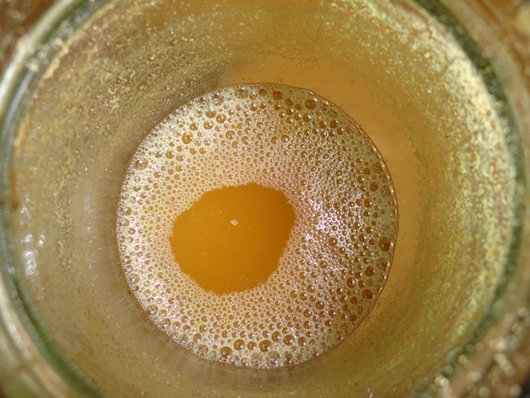
The green bottle above is my latest batch of ginger beer.  I've been experimenting with glass bottles and it's worked well.  If the gas builds up too much in the drink, it pops the cork.
Well, you could knock me down with a feather.  This blog won best Australian or New Zealand blog in the 2011 Bloggies, announced today in Los Angeles.  Thank you all so much for your votes. I appreciate your support very much.  I'd like to congratulate the other blogs in the category for being nominated:

  • The Design Files
  • Three Ring Circus
  • The Frugal Kiwi
  • Babyology

If you haven't visited these blogs before, I recommend them to you.

I'm still working on my book today, scratching my head and making sure it's all in there because it will be sent to Penguin tomorrow.  Exciting times!  I'll be back with you as normal on Wednesday.

♥
This is a Friday photo feature that anyone with a blog can join. It opens the door to us sharing our lives through these photos and gives us all a new way to discover each other, and maybe form new friendships. Your photo should show something at home that you're thinking about TODAY. If you're in another country you should join in when you read this, even if it's still Thursday.

To take part, all you have to do is post a photo, write a short caption explaining it, and link it back to here. Write a new post, don't link to an older one. When your photo is published, come back and add a comment below, with a link to your blog photo. Please visit all the blogs that appeal to you and leave a comment. If you are wondering why no one has commented on your On my mind post, maybe it's because you haven't commented on anyone else's. Slow down, take the time to cruise around and enjoy your cyber visits.


I washed and ironed the kitchen curtains last week and it's been on my mind since then that soon I'll have more time to do some hand sewing, or what our grandmas called "Fancywork".  I made these curtains about 18 months ago.  They're off white cotton, hand stitched with two tea cups in red embroidery thread over my pencil drawing.  They cost less than five dollars but each morning, as I pull them back to greet the day, they remind me of the simple beauty of handmade linens.
Thank you for your encouraging comments yesterday.  I appreciate them all very much.  It is very heartening to know that something I enjoy so much is helping you live the life you've chosen.  We are all part of a big family, you know, a family that, I think, is growing every week.

Most of you know I'm writing a book based on my blog and I'm in the final stages of the writing.  My deadline is 1 March, just over a week away.  I'll be away from the blog until then so I can concentrate fully during this last week. I still have a bit of writing to do, I need to read the entire book through a couple of times and I have to supply 100 photos.  I have over 20,000 photos here that I have to search through and I'll probably end up taking new photos as well.  I still have a couple of months of editing to do with my Penguin editor, Jo, but I'll be fine blogging while I do that.

These are exciting times for us.  March is not only the time I deliver the manuscript, it's also when our first grandchild will be born.  I wonder if I'll be able to type a post on that day. We'll have to wait and see.

While I'm away I'll still be doing our Friday feature - on my mind, so get your photos ready.  Take care everyone.  I'll be back before you know it.

with love
Rhonda Jean xxx

When I started blogging I felt like a bit of an outcast.  Many of the people who were blogging about simplifying then had a political agenda wrapped around peak oil or climate change and almost no one was blogging about simplifying their homes.  But I kept plodding along, developing my style and just writing about our transformed lives.  I didn't expect too many people would notice what we were doing and it didn't matter much.  What I was aiming for in that first year of blogging was to record a faithful and, hopefully, interesting account of how two ageing hipsters, turned their backs on mainstream life and built an unconventional but decent simple alternative.


Most of the books on simplifying then focused on debt, mindfulness, or going back to the land.  I wanted to write about everyday activities, the practical side of life - those things we all do during the course of a normal day.  So I wrote about getting out of debt, slowing down and producing food from our land but I also added how I made my bed every morning, the ins and outs of washing up by hand, hanging washing on the line, making dog food, aprons, dishcloths and soap at home, farming fish, fermenting, recycling jars and a hundred other things.  For me, they were the actions of my day, I was interested in the mundane tasks of my home, I wanted them to be part of our simple transformation, and if they were that, to write about it.  I wanted to write from the heart, to be open and non-judgmental, to show rather than tell, and to support and encourage those who wanted these things too.  


For some reason people started writing and asking my opinion about many things and when I thought I could help, I answered.  I don't like giving advice unless I'm asked for it and I really dislike reading blogs that preach a narrow one size view of simple life.  As far as I'm concerned, if there are 5000 people reading this blog today, then there are probably 5000 different interpretations of how a simple life may be lived.  Sure, there are points of overlap, but on the whole, we're all different, have different values and should not expect, nor want, to be carbon copies of each other.  Difference and contrast are part of the appeal.

I'm often asked why I think my blog is popular and I never have an answer.  If I were to guess, I'd say that I put the everyday tasks of a simple life in context and, hopefully, write about them so that others feel they're accessible and doable.  I still love blogging, we continue to learn new skills and ways of doing our work and soon we'll have two new babies in our family to get to know, marvel at and to write about.  I once thought there would be a certain short lifespan for my blog but if I continue to faithfully record the day to day lives of those two ageing hipsters, I cant see it stopping any time soon.


When you're an organic gardener, it pays you to work in with the natural ecosystem in your backyard.  Try to stay away from sprays, because even the organic options sometimes kill beneficial insects and have withholding periods. There will be times when you'll have to use a commercial organic spray, bait or powder, but make sure it's the last option. I don't think that every recommended organic methods works. For instance, over the 30+ years we've been growing vegetables, I've tried companion planting every so often, but it's never worked for us.  However, there are other organic techniques  that do work and we rely on them year after year.


Marigolds alongside bok choy, tomatoes and cucumbers.

One of the things we do here is to plant flowers in the vegetable garden.  Almost any flower will be suitable because most flowers bring in the bees, but there are a group of flowers that attract beneficial insects.  Not all bugs are bad and if you go around killing every insect you see, you will be doing completely the wrong thing.  Some bugs eat other bugs, or their eggs, and some of them lay their eggs in the bodies of other insects.  It sounds pretty gruesome but it's how the natural world works and it can help you.


Yarrow flowers - this plant is also good for activating compost.


Dill flowers 

Please be aware that the insects in each country may be different.  Some will be the same everywhere, but others specific to certain countries or regions.  In Australia, these insects are always a pest: the European wasp - these are aggressive and dangerous; ticks - the paralysis tick can kill dogs and cats; mosquitos - carry disease; the large earth bumble see - these were accidentally released in Tasmania and have been an environmental disaster, completing with native bees for food; fire ants - a relatively new pest but a serious threat in the areas they've colonised.


Daisies next to cos lettuce.

These are the beneficial bugs: most bees - in Australia there are two solitary native bees: the teddy bear bee and blue banded bee, and our little native bee, the sugar bag bee. We also have the honeybee, introduced into Australia in 1822 because the English thought there were no bees here. All those bees are good and if you have bees visiting your garden, particularly the native bees, you're very lucky.  There are photos here showing some of our bees, including the pest large earth bumble bee.  Ants are sometimes good and sometimes not.  If they start farming scale for the honeydew, find the nest and get rid of them.  Predatory wasps, hoverflies and most ladybugs are good fellows.  You can see photos of these bugs here.  It's a good idea to learn how to identify the beneficial bugs.   For the American and Canadian gardeners, here is a site for you.  Again, learn how to identify these insects.  They will help you produce all those vegetables you want.  For my UK friends, here is a site for you.  Other insects that you want in your garden include:
  • assassin bugs
  • lacewings
  • stink beetles
  • parasitic wasps and predator wasps like paper wasps and mud daubers
  • many spiders
  • dragonflies
  • praying mantises
  • robber flies
  • lady beetles, but not the 28 spot beetle that looks like a lady beetle - they eat plants  Photo here
  • ant lions
If you have children, you'll have to be careful if you have wasps visiting.  Our rule of thumb here is that if they start building a nest close to where we are, such as the one the paper wasps started building on our front verandah last year, we remove the nest.  Otherwise, they stay.  If you see the occasional wasps in your garden, it is nothing to worry about, it's  a healthy sign.  Predatory and parasitic wasps are not aggressive and will only sting if you disturb their nest or attack them.


Flowering lettuce also help attract insects.

If you're going to create a garden and be outside in the sunshine you have to expect to come across other living creatures.  Don't be scared of them.  Like us, they're a part of the beautiful natural scheme of things and have a role to play in our world.  If you're a new gardener, do some online research to educate yourself about what to expect in your region.  Work with the natural elements, not against them and you'll be rewarded.


Nasturtiums and yarrow.

Now you know what bugs you want in your garden, how do you get them there.  Flowers!  The insects will come if you plant the flowers they love.  Beneficial flowers include:
  • Cosmos
  • Daisies, including echinacea, feverfew, chrysanthemums, gerberas and chamomile  
  • Red clover
  • Queen Anne's Lace
  • Carrot flowers
  • Dill flowers
  • Marigolds
  • Alyssum
  • Nasturtiums
  • Yarrow
Most insects need water, so put out a small container, off the ground, full of pebbles or stones so the insects can land and leave the water safely. It would be best placed in a protected area, like under a tree, or close to some herbs. They'll need some pebbles to land on so they don't drown.  That would be an excellent project for the children.  It would get them involved in the garden and it could be their job to refill the water container, keep it clean and make sure there is the right amount of water and pebbles.

Gardening, particularly organic gardening, is not just planting seeds and watering; it's more involved than that.  It's all these little things that make the difference between a garden and a productive healthy garden.  And the thing about gardening is you learn something new every year, you never know it all, but even in those first few years, it gives rewards and pleasures that will bring you back year after year.

My sister recently moved into a new home - a cute little two bedroom cottage that is about 60 or 70 years old.  There are many things to love about her house but one of them is the larder.  It's set off the old kitchen where the original fuel stove still sits.  We don't build houses with larders now and few people have cellars but the good news is that the pantry is making a comeback.  It's one of the most requested spaces in new homes.  Food storage is back!


But here in the real world most of us have to deal with what we have and adjust our food storage to suit what's actually in our homes.  I'm lucky that I have a pantry in my kitchen and a stockpile cupboard just around the side of the fridge.  We also stockpile various items, mainly toiletries, frozen goods and bulk flour in our second bathroom.  It's cool in there most of the year, just like a larder would be. Over the years I've stored grains and flour there, we've only had one problem with mildew and mould, and that was with our extended period of recent rain last last year.


In the old days a larder was traditionally situated on the side of the house that got the least amount of sunshine but our second bathroom/larder is in the middle of our house and has no outside windows.  Our house is fully insulated so it remains at a fairly stable temperature and except for the hottest of hot days in summer, that bathroom is suitable for cool storage.  The floor is tiled so sitting bags of oats or flour there, after they've spent a day or two in the freezer keeps them cool, dry and safe.  When I start making cheese again, that is where they will be stored.  I'm going to ask Hanno to make two long shelves with hooks underneath so I can place the cheeses along the shelves and hang garlic, herbs and other odds and ends under them.  If I lived in a colder climate and I didn't have a room for cold storage, I'd be tempted to build a brick or block storeroom outside.  I'd completely seal every ventilation slot and window with wire mesh to prevent any nasties getting in.  It would be an excellent place to store vegetables, cheese, homemade wine, grain and flour.


Above is a variety of grains, pasta and small bags of SR flour being stored in the freezer.  Below, bulk flour for breadmaking.  I buy my flour from Simply Good at Morayfield, there is also a shop at Alderley. 


Your biggest enemy when storing food is humidity, sunlight and pests.  If you keep having problems with mould in your pantry, it may be too humid and you might be wise to look further away from your kitchen to store those foods.  I have found that if I always freeze dry foods when they come into the house, then store them in their unopened bags or in a glass container, I have almost no bug problems.  Sunlight on food dries it out and bleaches the colour.  If you've put up jams or fruits in jars, even though they look pretty on the shelf, they won't last as long as they would in a dark dry and cool cupboard. One thing is for sure, if you're like me and always cook from scratch, have a garden and a stockpile, it is worth all the time you put into making sure your food remains fresh and safe.  How have you set up your food storage areas?

This is a Friday photo feature that anyone with a blog can join. It opens the door to us sharing our lives through these photos and gives us all a new way to discover each other, and maybe form new friendships. Your photo should show something at home that you're thinking about TODAY. If you're in another country you should join in when you read this, even if it's still Thursday.

To take part, all you have to do is post a photo, write a short caption explaining it, and link it back to here. Please write a new post, don't link to an older one. When your photo is published, come back and add a comment below, with a link to your blog photo. Please visit all the blogs that appeal to you and leave a comment. If you are wondering why no one has commented on your On my mind post, maybe it's because you haven't commented on anyone else's. Slow down, take the time to cruise around and enjoy your cyber visits.


Meryl asked yesterday for a map of our garden, so that's been on my mind.  This photo was taken two years ago from the roof of the house.  When we set up our garden, fences were a priority.  Naturally, Hanno built them and put them up. I meant to add yesterday too, that the garden is his territory.  I plant seeds, water and harvest but Hanno does the bulk of the gardening work. 

The small backyard outside our back door is where Alice is fed, she also used to play in the main backyard but now she sleeps inside most of the time.  When we have guests, we often set up tables and chairs in the small backyard and we can lock out the dog and the chooks.  The chooks have got a big run attached to their house; sometimes they spend their days in there, sometimes they're let out to free range in the main backyard.  At the moment though, they're cleaning up the vegetable gardens for us in preparation for our March plantings - Hanno took out a piece of fence between their run and the garden so they can just wander in.  The main backyard is also fenced, we have a gate to go down to the creek and around the side of the house.  In my view, fences are necessary in a productive backyard.  Without them chooks will run amok and pets can go wherever they want to.  If you want to produce food, you have to be in control of the entire productive area.
Newer Posts Older Posts Home


My books were all published by Pengiun, and are available at Amazon US, Amazon UK and Amazon Au

Search here

Total Pageviews

Translate


I'm Rhonda Hetzel and I've been writing my Down to Earth blog since 2007. Although I write the occasional philosophical post, my main topics include home cooking, happiness and gardening as well as budgeting, baking, ageing, generosity, mending and handmade crafts. I hope you enjoy your time here.

MY FAVOURITE PLACES

  • Grandma Donna's Place
  • Grandma Donna's YouTube
  • Grandma Donna's Instagram
  • This Simple Day
  • Nicole's Instagram

Give More

Give More

Popular posts last year

Making ginger beer from scratch

We had a nice supply of ginger beer going over Christmas. It's a delicious soft drink for young and old, although there is an alcoholic version that can be made with a slight variation on the recipe. Ginger beer is a naturally fermented drink that is easy to make - with ginger beer you make a starter called a ginger beer plant and after it has fermented, you add that to sweet water and lemon juice. Like sourdough, it must ferment to give it that sharp fizz. To make a ginger beer plant you'll need ginger - either the powdered dry variety or fresh ginger, sugar, rainwater or tap water that has stood for 24 hours to allow the chlorine to evaporate off. You'll also need clean plastic bottles that have been scrubbed with soap, hot water and a bottle brush and then rinsed with hot water. I never sterilise my bottles and I haven't had any problems. If you intend to keep the ginger beer for a long time, I'd suggest you sterilise your bottles. MAKING THE STARTER In a...
Image

NOT the last post

This will be my last post here.  I've been writing my blog for 18 years and now is the time to step back. I’ve stopped writing the blog and come back a couple of times because so many people wanted it, but that won’t happen again, I won’t be back.  I’ll continue on instagram to remain connected but I don’t know how frequent that will be. I know some of you will be interested to know the blog's statistics. 
Image

How to make cold process soap

I'm sure many of you are wondering: "Why make soap when I can buy it cheaply at the supermarket?" My cold process soap is made with vegetable oils and when it is made and cured, it contains no harsh chemicals or dyes. Often commercial soap is made with tallow (animal fat) and contains synthetic fragrance and dye and retains almost no glycerin. Glycerin is a natural emollient that helps with the lather and moisturises the skin. The makers of commercial soaps extract the glycerin and sell it as a separate product as it's more valuable than the soap. Then they add chemicals to make the soap lather. Crazy. Making your own soap allows you to add whatever you want to add. If you want a plain and pure soap, as I do, you can have that, or you can start with the plain soap and add colour, herbs and fragrance. The choice is yours. I want to add a little about animal and bird fat. I know Kirsty makes her soap with duck fat and I think that's great. I think t...
Image

Preserving food in a traditional way - pickling beetroot

I've had a number of emails from readers who want to start preserving food in jars but don't know where to start or what equipment to buy.  Leading on from yesterday's post, let's just say up front - don't buy any equipment. Once you know what you're doing and that you enjoy preserving, then you can decide whether or not to buy extra equipment. Food is preserved effectively without refrigeration by a variety of different methods. A few of the traditional methods are drying, fermentation, smoking, salting or by adding vinegar and sugar to the food - pickling. This last method is what we're talking about today. Vinegar and sugar are natural preservatives and adding one or both to food sets up an environment that bacteria and yeasts can't grow in. If you make the vinegar and sugar mix palatable, you can put up jars of vegetables or fruit that enhance the flavour of the food and can be stored in a cupboard or fridge for months. Other traditional w...
Image

Cleaning mould from walls and fabrics

With all this rain around we've developed a mould problem in our home. Usually we have the front and back doors open and that good ventilation stops most moulds from establishing. However, with the house locked up for the past week, the high humidity and the rain, mould is now growing on the wooden walls near our front door and on the lower parts of cupboards in the kitchen. Most of us will find mould growing in our homes at some point. Either in the bathroom or, in humid climates, on the walls, like we have now. You'll need a safe and effective remedy at some point, so I hope one of these methods works well for you. Mould is not only ugly to look at, it can cause health problems so if you see mould growing, do something about it straight away. The longer you leave the problem, the harder it will be to get rid of it effectively. If you have asthma or any allergies, you should do this type of cleaning with a face mask on so you don't breathe in any spores. Many peopl...
Image

Five minute bread

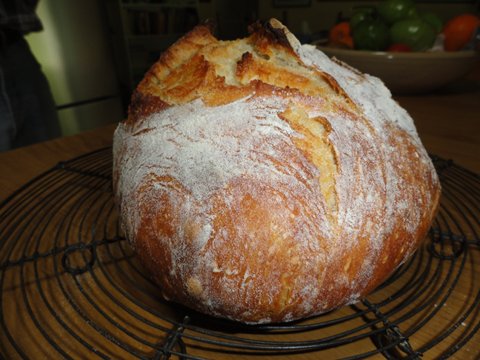
Bread is one of those foods that, when made with your own hands, gives a great deal of satisfaction and delight. It's only flour and water but it symbolises so much. I bake bread most days and use a variety of flours that I buy in bulk. Often I make a sandwich loaf because we use most of our bread for lunchtime sandwiches and for toast. Every so often I branch out to make a different type of loaf. I have tried sour dough in the past but I've not been happy with any of them. I'll continue to experiment with sour dough because I like the idea of using wild yeasts and saving the starter over a number of years to develop the flavour and become a part of the family. However, the loaf I've been branching out to most often is just a plain old five minute bread. By five minutes I mean it takes about five minutes actual work to prepare but it's the easiest of all bread to make and to get consistently good loaves from. If you're having people around for lunch or...
Image

This is my last post.

I have known for a while that this post was coming, but I didn't know when. This is my last post. I'm closing my blog, for good, and I'm not coming back like I have in the past.  I've been writing here for 16 years and my blog has been many things to me. It helped me change my life, it introduced me to so many good people, it became a wonderful record of my family life, it helped me get a book contract with Penguin, and monthly columns with The Australian Women's Weekly and Burke's Backyard . But in the past few months, it's become a burden. In April, I'll be 75 years old and I hope I've got another ten years ahead. However, each year I'll probably get weaker and although I'm fairly healthy, I do have a benign brain tumour and that could start growing. There are so many things I want to do and with time running out, leaving the blog behind gives me time to do the things that give me pleasure. On the day the blog started I felt a wonderful, h...
Image

What is the role of the homemaker in later years?

An email came from a US reader, Abby, who asked about being a homemaker in later years. This is part of what she wrote: "I am a stay-at-home mum to 4 children, ages 9-16. I do have a variety of "odd jobs" that I enjoy - I run a small "before-school" morning drop-off daycare from my home, I am a writing tutor, and I work a few hours a week at a local children's bookstore. But mostly, I cherish my blissful days at home - cooking, cleaning (with homemade cleaners), taking care of our children and chickens and goats, baking, meal-planning, etc. This "career" at home is not at all what I imagined during my ambitious years at university, but it is far more enriching. I notice, though, that my day is often planned around the needs of my family members. Of course, with 4 active kids and a husband, this is natural. I do the shopping, plan my meals, cook dinner - generally in anticipation of my family reconnecting in the evening.  I can't h...
Image

Every morning at home

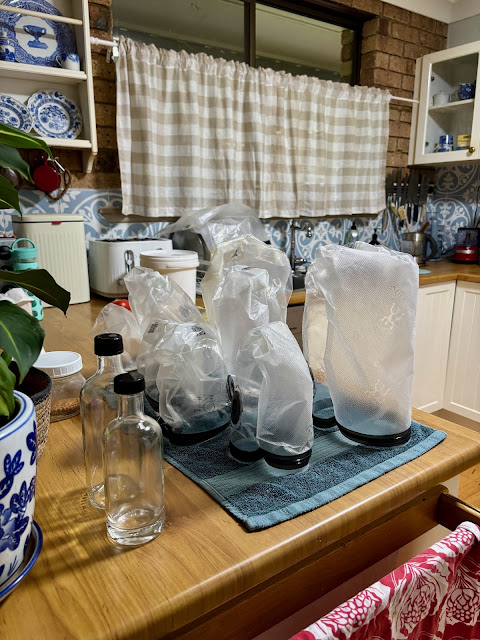
Every morning when I walk into my kitchen it looks tidy and ready for a day's work. Not so on this morning (above), I saw this when I walked in. Late the previous afternoon when I was looking for something, I came across my rolled up Zwilling vacuum bags and decided they had to be washed and dried. So I did that and although I usually put them outside on the verandah to dry it was dark by then. I turned the just-washed bags inside out and left them like this on a towel. It worked well and now the bags are ready to use when I bring home root vegetables, cabbages or whatever I buy that I want to last four or five weeks.
Image

You’ll save money by going back to basics

When I was doing the workshops and solo sessions, I had a couple of people whose main focus was on creating the fastest way to set up a simple life. You can't create a simple life fast, it's the opposite of that It's not one single thing either - it's a number of smaller, simpler activities that combine to create a life that reflects your values; and that takes a long to come together. When I first started living simply I took an entire year to work out our food - buying it, storing it, cooking it, preserving, baking, freezing, and growing it in the backyard. This is change that will transform how you live and it can't be rushed.  
Image


Trending Articles

NOT the last post

This will be my last post here.  I've been writing my blog for 18 years and now is the time to step back. I’ve stopped writing the blog and come back a couple of times because so many people wanted it, but that won’t happen again, I won’t be back.  I’ll continue on instagram to remain connected but I don’t know how frequent that will be. I know some of you will be interested to know the blog's statistics. 
Image

Every morning at home

Every morning when I walk into my kitchen it looks tidy and ready for a day's work. Not so on this morning (above), I saw this when I walked in. Late the previous afternoon when I was looking for something, I came across my rolled up Zwilling vacuum bags and decided they had to be washed and dried. So I did that and although I usually put them outside on the verandah to dry it was dark by then. I turned the just-washed bags inside out and left them like this on a towel. It worked well and now the bags are ready to use when I bring home root vegetables, cabbages or whatever I buy that I want to last four or five weeks.
Image

You’ll save money by going back to basics

When I was doing the workshops and solo sessions, I had a couple of people whose main focus was on creating the fastest way to set up a simple life. You can't create a simple life fast, it's the opposite of that It's not one single thing either - it's a number of smaller, simpler activities that combine to create a life that reflects your values; and that takes a long to come together. When I first started living simply I took an entire year to work out our food - buying it, storing it, cooking it, preserving, baking, freezing, and growing it in the backyard. This is change that will transform how you live and it can't be rushed.  
Image

Creating a home you'll love forever

Living simply is the answer to just about everything. It reduces the cost of living; it keeps you focused on being careful with resources such as water and electricity; it reminds you to not waste food; it encourages you to store food so you don't waste it and doing all those things brings routine and rhythm to your daily life. Consciously connecting every day with the activities and tasks that create simple life reminds you to look for the meaning and beauty that normal daily life holds.  It's all there in your home if you look for it. Seemingly mundane tasks like cleaning and cooking help you with that connection for without those tasks, the home you want to live in won't exist in the way you want it to.  Creating a home you love will make you happy and satisfied.
Image

Time changes everything

I've been spending time in the backyard lately creating a contained herb and vegetable garden. My aim is to develop a comfortable place to spend time, relax, increase biodiversity and encourage more animals, birds and insects to live here or visit. Of course I'd prefer my old garden which was put together by Hanno with ease and German precision. Together, we created a space bursting at the seams with herbs, vegetables and fruity goodness ready to eat and share throughout the year. But time changes everything. What I'm planning on doing now, is a brilliant opportunity for an almost 80 year old with balance issues. In my new garden I'll be able to do a wide range of challenging or easy work, depending on how I feel each day. It’s a daily opportunity to push myself or sit back, watch what's happening around me and be captivated by memories or the scope of what's yet to come.
Image

It's the old ways I love the most

I'm a practical woman who lives in a 1980’s brick slab house. There are verandahs front and back so I have places to sit outside when it's hot or cold. Those verandahs tend to make the house darker than it would be but they're been a great investment over time because they made the house more liveable. My home is not a romantic cottage, nor a minimalist modern home, it's a 1980’s brick slab house. And yet when people visit me here they tell me how warm and cosy my home is and that they feel comforted by being here. I've thought about that over the years and I'm convinced now that the style of a home isn't what appeals to people. What they love is the feeling within that home and whether it's nurturing the people who live there.
Image

Making ginger beer from scratch

We had a nice supply of ginger beer going over Christmas. It's a delicious soft drink for young and old, although there is an alcoholic version that can be made with a slight variation on the recipe. Ginger beer is a naturally fermented drink that is easy to make - with ginger beer you make a starter called a ginger beer plant and after it has fermented, you add that to sweet water and lemon juice. Like sourdough, it must ferment to give it that sharp fizz. To make a ginger beer plant you'll need ginger - either the powdered dry variety or fresh ginger, sugar, rainwater or tap water that has stood for 24 hours to allow the chlorine to evaporate off. You'll also need clean plastic bottles that have been scrubbed with soap, hot water and a bottle brush and then rinsed with hot water. I never sterilise my bottles and I haven't had any problems. If you intend to keep the ginger beer for a long time, I'd suggest you sterilise your bottles. MAKING THE STARTER In a...
Image

An authentic look at daily life here — unstaged and real

Most days Hanno was outside happily working in the fresh air. It may surprise you to know that I started reading my book,  Down to Earth , yesterday - the first time since I wrote it 13 years ago.  I had lent it to my neighbor, and when she returned it, I started reading, expecting to find surprises. Instead, I realised the words were still familiar—as if they were etched into my memory. As I flipped through the pages, I was reminded of how important it was for me to share that knowledge with others. The principles in Down to Earth changed my life, and I truly believed they could do the same for others. After just 30 minutes of reading, I put the book down, reassured that its message still holds true: we can slow down and reshape our lives, one step at a time.
Image