down to earth

  • Home
  • About Us
  • Down To Earth Book
  • Privacy Policy

I usually don't look forward to the electricity bill arriving, especially since the prices have gone up so much and look like increasing even more. However, I wanted to see what my bill was because over the past months I made a few choices to lower it. I knew it would be lower and I wanted to see how much I'd saved.


This is the new solar unit - 18 panels.


There's a bit of a story behind this so let me start at the beginning. Our old solar system stopped working in September last year. It was installed 11 years ago and when I finally got a technician to check it, 3 months later, he said the solar panels were corroded and the system was a fire hazard. So instead of the expected repair job, everything was removed. I was so busy looking after Hanno, I didn't even think about it again for a few months and after weighing up the pros and cons of solar and the certainty of increased electricity rates in the future, I had a new 6.66 kW system installed at the end of February. The bill I've just received is the first bill which is fully covered by the new solar system. We also have a solar hot water system. We've used these for almost 50 years and one of the first things we did when we moved to this home was install solar hot water. If you can't afford to get solar panels, go for a solar hot water system instead. If you live in Victoria or South Australia, there are government rebates.


This is the old solar unit - 7 panels.   In the background is the solar hot water unit.

Of course solar energy helped lower this current bill and in December, when Hanno was still at home we replaced our 10 year old fridge. New appliances are much more efficient than older ones so that was another reason our bill started to decrease. When an appliance we own starts getting old or shows signs of problems, we usually update it with an energy efficient model because it does help with energy costs. We have a dishwasher, oven, toaster, food processor, mixer, iron, computers, sewing machine and overlocker/edger, washing machine and dryer - most with energy efficient technology. Our air conditioners have inverter/heat pump technology which cuts the cost of electricity.   All our lights have LED globes, I turn off TVs at the wall so they're not running on standby and often I don't turn on the TV or lights at night because I prefer it that way. I have to say though, it's much easier to do that when there's no one else here. Over the years, Hanno thought I was crazy for wanting to do it. 😵‍💫

You'll notice on my bill there are a couple of government rebates. One is the $175 cost of living rebate that most of us got and the other is the pensioner discount. But I'm looking at the electricity usage rather than the dollar cost here. I'm celebrating decreasing my usage from 300 kWh to 5 kWh.


I knew, on average, air conditioning/heating and cooling consumed about 40 percent of each electricity bill, so when I was here alone over winter, I chose to not use the air conditioning. I made myself comfortable with an extra layer of clothes, an over the knees electric blanket and an electric blanket on my bed. But it's not always the appliances you have in your home, it's how you use them that makes the difference. All the little things like turning off lights when not in use, washing up by hand when there are only a few dishes, not having appliances on standby, always washing a full load in the dishwasher and washing machine - all this became part of my normal housework. One other change was I went from using our appliances at night on the old solar system because our feed-in tariff was 44 cents and it was cheaper for us to sell to the grid during the day. Now I use our appliances as soon as the sun hits the roof and I'm using solar energy generated here instead of energy from the grid. When the sun goes down all my cooking, sewing and cleaning have been done and I might just have a solo light or the radio on. My choices have made an impact on what I pay for electricity and saved a lot of carbon emissions.


I hope you to see that there are things you can do to decrease costs at home and all it takes is for you to make your particular choice and stick to it. I know many of you won't be able to do it even if you want to because you have family members who come home late and need to eat dinner, children who have to do homework and those who relax in front of the TV for entertainment.  But if you can't do it now, you can do it when your family grows older and you're in a new season of life.  


For every thing there is a season.


This is the Australian Government's Guide to Sustainable Homes. Lots of good information here.


There are probably a few things I've forgotten to write about here but one thing I want to add is to wash all your clothes in cold water.  If you have greasy work clothes or badly stained items, wash in cold water, don't overload the machine and add a scoop of oxybleach to the wash. (I think the Vanish Oxy Advance brand is the best for this). I always keep an eye open for their half price specials at Woolworths and only buy it then. 


I like to think I’ve got a pretty good grip on the work I do here in my home but now when I sit down to write to you, I can’t think of what I did this past week.   Luckily I have photos I took along the way and after seeing them it all comes back to me.  I’m still sorting through drawers and cupboards and getting rid of things I no longer have any reason to keep. It’s part of my general housekeeping now - a couple of times a week I bring in a little trolley, fill it with things I once thought I’d keep forever. Now my priority is to have a home that encourages me to be the person I am now, not the other Rhonda who was part of a couple. Every week life moves slowly away from the home of a happily married couple and towards a place when an independent woman lives.  I hope I find the same level of satisfaction I had back then but it’s still early days and the practical work of rebuilding needs to be complete before I can make any judgements about contentment and happiness.  Will the glass be half-full or half-empty? 


This is the area where I sit and think with Gracie at my feet. Sometimes I read here and sometimes I just listen to the radio and potter around. Gracie follows me everywhere now. If I go inside, so does she, if I wander outside, she follows. And if she’s sniffing around the yard and doesn’t see me go inside, she stands at the door and gives one loud bark and I know she wants me to open the door for her NOW.  


Waiting for the postman. She doesn't bark at him, I think she just wants him to know she's there. 🙄

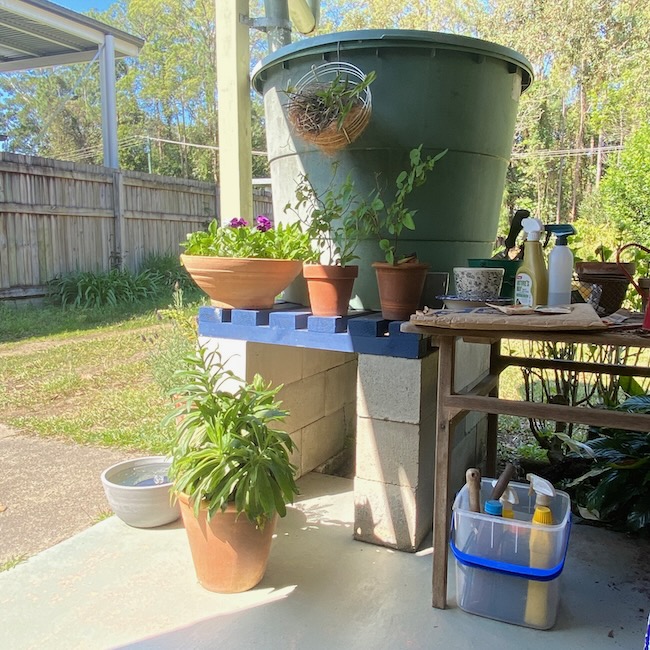
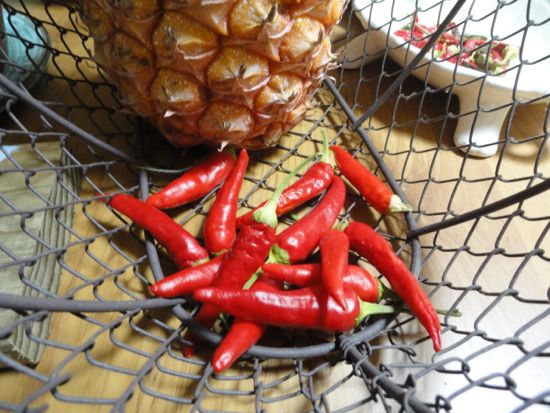
I’m building a flower, spice and herb garden on the sunny corner of the front verandah. It’s always nurtured ferns and tropical plants in the past, and I still have them, but I’m introducing flowers - roses, nasturtiums, foxgloves, yarrow, lavender, pansies and penstemon, as well as green onions, chilli, parsley and ginger. 


This area changes almost every day. I used to be able to make instant decisions, now I have to look at my changes to decide if they suit me.  ðŸ¤” 😵‍💫


That's a digiplexis foxglove in the pot. It's a soft orange colour with several flower spikes. I'll take a photo for you when the flowers are open.


Plants waiting to be put somewhere. This area is a little further along the verandah. 

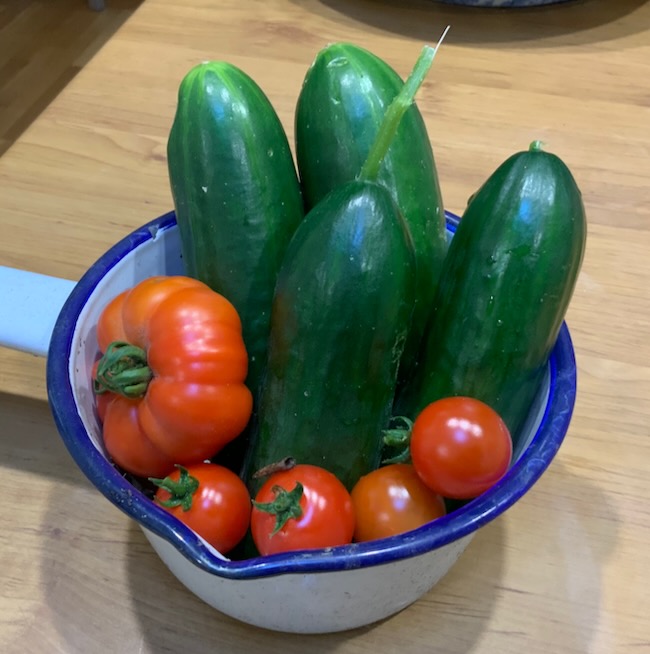
Like most of you, I'm always trying to save the food I buy from being wasted. Now that I'm single this is more difficult. I bought a long cucumber last week, had one salad and knew the cucumber might sit in the fridge and waste away. So I grabbed the vinegar and pickling spices to make bread and butter cucumbers. The idea with this is to remove as much water as possible from the cucumber so I sprinkled a tablespoon of salt over thinly sliced cucumbers and left it a few hours. Then I washed the salted water away and squeezed the water off with a cucumbers in a clean tea towel. Don't forget to do this because if you add your pickling liquids and spices to the cucumbers in the jar, they'll release their water into the pickling liquid and will dilute the pickles.


They'll taste wonderful if you let the flavours develop but you can eat them straight away if you want to.


To make the pickling liquid, add the following to a small saucepan: 1 cup vinegar, ½ cup sugar, pickling spices, pepper and little pieces of onion or chilli if you have them on hand. Bring to the boil, simmer for 30 minutes and let it sit on the stove until slightly cooler. Taste it and if liquid is a bit strong for you, add ½ cup water. Then add the cucumbers and the still-hot pickling liquid to a sterilised jar and store it in the fridge. I have one serve of pickled cucumbers left but I'll buy another cucumber to pickle on my next shopping trip. I don't like oil in my salad dressing so I always make enough of this so I have some for salad dressing. I use the leftover liquid as salad dressing too. It keeps well in the fridge.


Parsley salt and dried parsley

Two other quick herby tips for you here - parsley salt and dried parsley. I harvested most of my parsley on Tuesday, washed it thoroughly and removed the stalks (they're bitter when dried). Preheat your oven for the dried parsley now - 180C/350F and when it reaches temp, turn it down to 120C/250F. Make the parsley salt while your oven is heating up.


This is what the sink full of parsley looks like now. 

Parsley salt
To a food processor, add 1 cup salt, I used pink Himalayan salt but rock salt or pure cooking salt is also good.

Add two cups of parsley with no stalks.

Process the mix until the parsley is flecked through the salt but don't overprocess because the salt will be too fine. Lay it out on a plate to dry for about an hour then add it to a jar. Store in the fridge and give it a gentle shake every couple of days so it doesn't clump together.

It's great to use in scrambled eggs, sprinkled over the top layer of lasagne or any pasta, mashed potatoes, salads, roast meats, steak and, of course, fish. You can do this with a variety of herbs - oregano, sage, bay leaves, coriander/cilantro, fennel, rosemary or finely grate lemon or orange zest and add it to the salt. All of them store well in the fridge.

Dried parsley
Then go on to your dried parsley. Dry the leaves as much as possible, preheat eat your oven to 180C/350F and when it reaches temp, turn it down to 120C/250F. 

Lay the washed, dried parsley, with stalks removed, onto baking paper in a baking tray, place the tray in the oven making sure you have your temps right. Leave it in the oven for about 25 minutes then remove from the oven. When it cools down, crush the parsley with your hands and add it to a jar. Two well loaded large oven trays gave me the amount you see in the small jar.  Store this alongside your herbs and spices in a cupboard.

🌿 💚 🌿

The creation of my new life is a slow process. I could sit back and let it make its own way but I want my life to include diversity and creativity as the the main building blocks; and I want moments of joy liberally mixed throughout each ordinary day. I'm so thankful that Hanno and I prepared well for this part of life because if I had to go from what we had five years ago to what I'm capable of now and in the future, I'd be in a worse space. I guess I've done the difficult part of working out what I want in my life now. It's important to me to continue with the housework I've done in the past. I will still cook from scratch - for Gracie and me, preserve, bake occasionally, keep a small stockpile, make my own cleaners and laundry liquid. I will continue to look for opportunities to be kind and generous. Those ordinary everyday tasks help define my life giving each day structure and purpose and a reason to get up every morning.  Of course, family is a significant part of my life and while my family has changed, it's still on top of the priority list. 


What fits into the rest of my life is what I'm focusing on now. It will be made up of creativity, productivity, sharing what I know and being grateful for each new day. It's a complex model of a simple life but I guess every life is complex in its own way. I'm glad I have the freedom to create life in the way I want it to be and I have the time now try different things to fit into the mix I already have.


Kerry and Jamie bought Gracie a dogie donut (with bacon topping) and a bone biscuit. She wasn't sure what to make of it first but she didn't hesitate in eating both of them.
 

My main new thing will be painting and drawing. I used to be quite artistic when I was young and I want to examine that again. I also want to do some final getting published/writing workshops. Of all the workshops I've done, I enjoyed the writing ones the most. I need to earn some money to build up my nest egg again after I spent so much during Hanno's final months. I want to have some workshops here, maybe with lunch included, and maybe some on Zoom. If you're interested in this, let me know because it will help me make the decision on whether to go ahead or not.

But that's all in the future and today is just as important. When I finish here, I'll tidy the kitchen, harvest chard, set some aside for lunch and freeze the rest. My bed is made but I have to put away yesterday's washed clothes and sheets. Two toilets must be cleaned and I'll finish off reorganising the laundry. After lunch Gracie and I will be out in the garden fertilising, cleaning up, weeding and repotting. We're expecting rain this afternoon so I want both verandahs clean and tidy before the wind and rain starts.

And that's it for me, another ordinary day done and dusted. I hope things are going well for you. Home life is usually busy when seasons change. What are you doing? I send my love across the miles. xx

I've never seen financial conditions like those we have now. The cost of living is increasing in Australia, I'm affected by it and I'm guessing you are too. I'm in the good position of being debt-free, we paid our home off many years ago but I still have to watch every penny.


Make your own laundry liquid and cleaners - it will will save you an extraordinary amount of money.

Hanno and I have lived on a pension for some years and we built a nest egg that provided a feeling of security but when he died, that changed. I went from a couples pension to a single pension which is more money but when you calculate all the goods and services over the course of a year, the single pension doesn't look so good.  I've spent the past six months learning what needs to be paid and when, and I'm also paying small amounts frequently on the large bills like rates and car registration, instead of being hit with a big bill every six months.

Hanno always organised our finances and he was very good at it. So, I turned my back on all of it and lived in that oblivious state for over 40 years. When he got sick, the last bills he paid were in November and I didn't even think about paying bills until four months later, when they were overdue! When I looked in his email account, there they all were, waiting for me like a ton of bricks.  I should have know exactly what he was doing, I should have shared that role with him and had I done that I might be in a better financial state than I am right now.

When Hanno was in hospital, there were no expenses - everything was covered and we had private health insurance for the extras. But before he went to hospital, when I was looking after him at home, I bought a number of high priced items - wheelchair, walker, bed rails and incontinence items. He also had speech therapy for swallowing and physiotherapy for walking. We paid for all of that while he was at home even though we had a level 4 home care plan.  That plan looked good when he got it but the funds dribbled in and it was eaten up with services - people coming to help shower him etc., and there was never enough money to buy the equipment he needed.


Cook no-meat meals.

To make a long story short, now that I look back on the past six months, I realise I should have been aware of my financial position much sooner. Had I been sharing that work, I would have been. However, now the nest egg has decreased a lot and with the cost of living higher than ever before, I'm trying to stretch dollars.  As you know, we got our finances in shape by stockpiling groceries, cooking from scratch, growing food in the backyard, monitoring our electricity and water. We stopped TV we had to pay for and buying magazines, drinks and lunches when we went out. I've already done all the big changes, now it's down to the list below. The steps are small but they're all worth doing and like buying a cup of coffee every time you go out and realising that cost adds up to hundred of dollars a year. Stopping those small things to save money takes time too but it's really worth it.


Mend and make do.

I'm lucky, I don't have to pay rent or a mortgage, we paid that off, in eight years, a long time ago. But interest rates are rising now after being low for many years and that is hurting a lot of people and for some, it's not sustainable. If you're in that situation, I urge you to hold on and start working on these lists below. Times will be tough for you, you'll have to stop buying your favourite things, stop holidays and stop shopping without your budget in mind. You will have to sacrifice to survive.

If you don't have a budget, go to https://moneysmart.gov.au/budgeting/budget-planner now. It’s the Australia government's site which holds a lot of useful information about debt, mortgage repayments and budgets.  Forget the freedom of spending in the past, think of the future and how you can save your home. It will be hard but most of you will be able to do it.  And don't forget to talk to your bank to find out how you might be able to reduce your payments for the time being. You'll have to make up for it later when things return to normal - and they will - but that one thing may help you keep your home.


CONSERVING YOUR RESOURCES

In times like these you should be mindful of everything you do that will save money. Try to cut back on the amount you will have to pay in utility bills and for transport. That money is much better in your pocket than profits for Energex, Telstra or Shell. So let’s go through a few things you can do to keep money in your pocket.

ELECTRICITY
  • Use your electrical appliances like washing machines, vacuum cleaners, dishwashers in off-peak times. Phone your electricity provider and ask if you have peak times and when they are.
  • If you have solar panels, use your appliances as soon as the sun hits the roof - that way you'll use the solar power you generate instead of buying from the grid.
  • Wash your clothes in cold water and dry them outside in the sun. I always wash in cold water using homemade laundry liquid and our clothes look fine. Over the years, this has saved us hundreds of dollars.
  • Use compact fluorescent light bulbs. Fluorescent bulbs are more efficient than traditional bulbs. A 60-watt fluorescent bulb has the same lighting capability as a standard 75-watt bulb and it will last for years. Light bulb buyers guide.
  • Turn off the lights when you leave a room.
  • Turn off the TV when no one is watching it.
  • Turn off appliances at the power point, not just at the appliance on/off button.
  • Fill the kettle with just enough water for your tea or coffee. Boiling water you won’t use, is an expensive waste. If there is hot water left over, pour it into a thermos flask and use that for your tea or coffee during the day.
  • Buy a power board and plug in all the appliances you have close together into that one power board. When they aren’t being used, and especially at night, turn off the power board. That will stop all those appliances using stand-by power. It is estimated that 10 percent of the power used in Australia is for appliances on stand-by.
  • When you boil food, either on a gas or electric cooktop, put the lid on your saucepans because it retains heat. Your food will come to the boil faster, and then you can turn the power down to cook on a simmer.


If you can, grow food in the backyard - or in containers.


WATER
  • Fill a bowl with water to wash vegetables. Letting the tap run while you wash wastes litres of water.
  • While you’re waiting for the shower water to warm up, fill a bucket with the cold water and use it on your garden or in the washing machine (top loader only).
  • Have shorter showers.
  • Turn the tap off when brushing teeth.
  • Flush the toilet only when necessary.
  • When washing your hands, wet your hands, turn the tap off, apply soap and lather, turn the tap on again to rinse.
  • Install water tanks if you have a vegetable garden, or at least set up some water barrels at the down pipes to catch what rainwater you can.

COOKING
  • Cook larger portions of food and freeze the leftovers for use on other days. This will enable you to cook meals for more than one day and use only the electricity to warm the food again.
  • When you boil something on the stove, bring it up to the boil, then turn it down to a fast simmer.
  • When boiling on the stove, always keep the lid on the saucepan. This reduces the time it takes to come to the boil.
  • If you’re using your oven, cook more than one thing.
  • If you’re baking bread, do more than one loaf and freeze a couple of loaves for later.
  • If you have a small convection oven, use that instead of your large oven.


If you have a small convection oven, use that instead of your larger oven.


Cook from scratch.


Preserve your excess.


Bake bread, cakes and biscuits from scratch.

PHONE
  • If you're not on the cheapest plan right now, do some research to find out what you can do to reduce your phone costs.
  • If you're on a contract, never let your contract go from one year to the next without negotiating a better deal with your phone company.
  • While you’re saving, use the phone only when absolutely necessary. Stay in touch with your friends online instead.
  • Use Skype or Zoom for your long distance calls. Make sure you download the right version for your equipment - there are versions for Apple phones, ipads and computers as well as for Android smartphones and computers.

TRANSPORT
  • Plan your trips so you're not using the car to go to one place. Work out what you have to do and plan your trip going to multiple places to use the least amount of petrol.
  • If you have to take the children to school – share that with other parents in your neighbourhood. Even if you share with your next door neighbour so that you take them and she/he picks them up, it will halve your school trips.
  • Start a walking bus. Parents take it in turns to take a group of children to school by walking with them.
  • Download the motormouth app to find the cheapest petrol in your area.
  • If you run a business, make sure you keep a diary of your business and private car expenses so you can claim what you're entitled to at tax time. 

REGULAR BILLS
  • At least once a year, look at the details of all your regular bills. Bills such as phone, internet, electricity, phone and insurance should all be checked. Ring up the opposition and ask what they would charge you for the same service. When you have a good idea, phone the company you deal with and tell them you could get a better deal with a rival – and tell them the company name. Say you’re ringing to ask if they can equal or better that because you’d rather stay, but as you’re on a tight budget you must go with the best deal. Often this pays off and it should become part of your financial practice each year to test these boundaries. 


This is one of our old gardens. We were vegetarians then and we grew most of the food we ate. 


GENERALLY THERE ARE A FEW WAYS TO CUT BACK.
  • Separate your wants from your needs and be firm with this.
  • Ask yourself if you really need it.
  • If you do need it, can you barter something for it instead of spending money? Bartering used to be quite a common way of obtaining goods in small communities. Ask around, you’ll probably find people who are keen to barter. See if your neighbours or work colleagues are interested in bartering.
  • If you can’t do without it and can’t barter for it, can you make it yourself? One of the skills you’ll develop in your simple life will be to hand-make many things from food to clothes. Maybe you could learn to make what you want.

Try to live on less than you earn.  If you can't do that, you'll be paying off debt all your life.  But now in these current difficult times, with high interest rates, unemployment, increasing food and fuel prices, there ARE things you can do to reduce your expenses. This won't last forever but it will last a few years. So if you start helping yourself, following a budget and reducing costs, you'll come out of it in reasonable shape, and hopefully still living in your own home.  How are you tackling this problem, please share what you're doing and we might all learn something.  I wish you all the best of luck,  Now, let's get to work and start reducing our expenses.

I've been organising my home over the past few weeks but this time it's not the same as what I've done in the past. I don't think of it as decluttering anymore because to me, clutter is a group of unwanted items making a room look untidy; most of what I let go of was hidden in drawers, cupboards and sheds and taking up space that I wanted to reclaim.


I gave away the foods Hanno liked but I didn't and when I go through this cupboard, there'll be fewer things. 


This was way overdue - my spices.  I only had one bottle that was passed its use-by date but that date was 2018!


I was much more mindful this time. Now it's only me who lives here, I didn't have to consider anyone else's ideas or choices - I was creating the spaces where I would live in the coming years. The thought of cupboards and drawers containing unwanted clothes and shoes, unneeded bed linens, tools, manuscripts, fabrics, timber, paper work, photos and who knows what else forced me to sort through it all.  It was a horrible job, it took a lot longer than I thought it would but it was liberating, satisfying and SO worthwhile. If you've been thinking of doing something like this, I urge you to go ahead with it. It's life changing.


It made me think of my parents and my grandmother's homes. Back then, houses generally didn't have spare rooms, garages or sheds packed full of "stuff".  Now, in a world where most families need storage space for all the things they buy, we also have the newish business of storage sheds where you can buy space to store things you own but never use. 🤔 My mother, like most parents back then, packed summer or winter clothes away in the top of the linen press and used the clothes appropriate for that season.  At the end of the season, they were washed, folded and put away again. That was the only kind of storage I can remember. 


Hanno's office. I spent a long time here working out how to pay things on time, what accounts could go and shredding papers.


Sadly, we've fallen into a trap of buying what we like because it's cheap. We've surrendered our dollars to China/India who make what we want while they become stronger and we are weakened. We need OUR OWN manufacturing industries so that our people have jobs and we stop giving money to other countries. When we pay our own populations to make the goods we need, they'll be paid a fair and decent wage and the products will be priced appropriately. It's a good way to cut rampant consumerism.


While I was at it, I made a new ironing board cover.


I started reorganising our home soon after Hanno died. Tricia organised Hanno's clothes so I didn't have to deal with them and I started on the kitchen cupboards, Hanno's office, laundry, bathrooms and garage.  I thought about doing this for about three weeks and I decided to keep what I love as well as what I absolutely need, and remove the rest.  And when I say remove, that doesn't mean it's now in the garage or in the car boot, it's ALL GONE from my life and my home.  For instance, I got rid of my old china, cutlery, glassware, pots, pans, bakeware and some furniture and small appliances.  But I kept the dinner set Hanno gave me for our 25th wedding anniversary - a Villeroy and Boch Petite Fleur set that I love and had on display in a cupboard. We only used it at Christmas and birthdays, now I use it every day and it makes me SO happy. I got rid of my bread maker and slow cooker. If I want bread I'll knead it by hand and I can easily use my old cast iron pot on the induction top for slow cooking.  I'm currently working on my wardrobe and the linen press. I'll be finished next week. 🙃


I use my Petite Fleur dinner set every day now and wish I'd done it years ago. I just kept a few extra dinner plates and bowls because when all my family are here, there are ten of us.


It took a long time because I wanted to be sure of my decisions and I was dealing with my stuff as well as Hanno's, but now can see the light at the end of the tunnel. Most of my reorganisation is done, 90 percent of what I want gone is gone and I feel that the work I've done is an investment in my future. There were SO many things I could have been doing instead of sorting through rubbish, getting stuck with pins, sneezing because of the dust, and having to decide where to put what was in my hand (most of the time it went to recycle and sometimes the rubbish bin). 


I resolved that from now on I'll deal with excess by not buying it in the first place and if something I already have becomes superfluous, I'll get rid of it. No more putting things in a box or a cupboard to gather dust for years simply because I couldn't decide, or was too lazy to deal with it there and then.  This has been life changing for me and it makes me happy every day to get out of bed and look at what I've done. I'm not looking after junk I don't need now, I have extra space inside my home, it feels right and I'm SO glad I did it. If you've got a lot of stuff you're not using and have stored away, I hope my story will help you to do what I did. It's not easy but it will make your future life easier.


Mooroopna Park Primary School wins award as free food transforms behaviour, attendance <- this is a wonderful article!

Grandma Donna always has good tips for cutting back and focusing on the home

Delicious basic recipes to help with your grocery bill

A new world: small-town life in early 20th-century America – in pictures

Sometimes readers ask me how I keep going and why housework isn't boring for me.  It is boring sometimes but boredom doesn't stop me from doing anything. I keep going because of the rewards I get from doing my house work - it gives me the life I want. There are a lot of things we have to take responsibility for when we're adults and one of them is creating a home that you feel comfortable in. If you don't have the drive to regularly do the work that gives you that home, push yourself.  If you keep at it you'll see the benefits and the work you do in your home will change you. It did that for me. It made me slower, more generous and thoughtful and I'm glad for that.


Cleaning up the kitchen.


When you get stuck in, you'll be surprised that it doesn't take much to make a really warm and comfy home. Nothing has to be perfect, it just has to be to the standard that makes you feel comfortable. And remember, housework never ends. So when you have enough, stop and come back to it the next day. The sky won't fall in and you'll feel better for it.


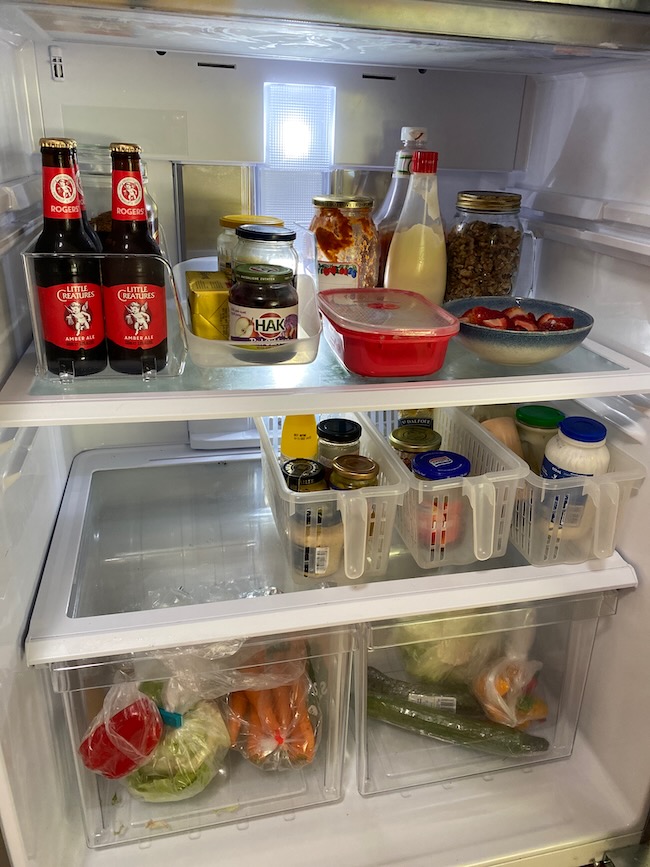
I think you'd be surprised at how much you can get done in a short time.  For instance, when I'm waiting for the kettle to boil or the toast to cook, I clear the kitchen bench. If I still have time, I wipe the bench too. If the bench is already clean but the kitchen bin is full, I empty it. If you have 15 minutes to spare, empty everything out of the fridge, wipe the shelves and put it back in. It's a good habit to get into the day before you do the grocery shopping. 


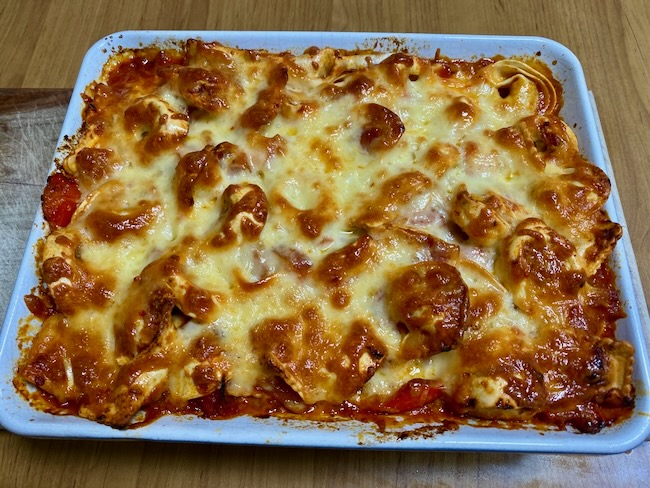
I've got a couple of meal ideas for you today. I had these two meals this week and they're ideal for one or two or five or ten. If, like me, you're living alone, the ravioli bake makes four portions, the omelette makes two. 


Ravioli Bake

This will take less than an hour to cook. You can put it all together and have it ready to cook in the fridge and just heat it up when you come home from work. It will be ready in about 20 minutes.  Just enough time to make a nice salad. 


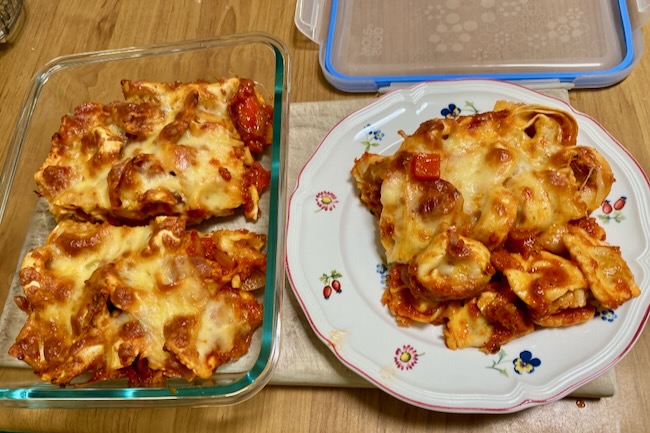
When you freeze the leftovers, put it in a container already cut into portions but without them touching so you can remove them easily if you only want one piece. I had one on the day of cooking, the second portion the following day and I froze two portions for next week. 


Buy a bag of ravioli or make a batch of ravioli. I bought a bag because I wanted this to be a fast meal.

Make a tomato sauce. I made mine with a 400ml bottle of tomato passata that was on special that week. I fried off an onion, half a capsicum/pepper, diced two sticks of celery and added oregano and parsley from the garden.  Season with salt and pepper and cook for 20 minutes.

Add the uncooked ravioli to a small oven-proof dish and pour the tomato sauce over it. Sprinkle on some cheese if you like it. and bake in the oven at 180C until the top is golden. Mine took 20 minutes.


Spanish Omelette 


This recipe takes two eggs per serve. I used four eggs and it served me for two days.


Peel a medium potato and slice it into thickish slices. Microwave for four minutes and cool.

Use a non-stick frying pan you can put in the oven. Add a tablespoon of olive oil, sliced onions, capsicums/peppers, garlic and any vegetable you have in the fridge or backyard. I picked baby silverbeet/chard and added that after the onions and peppers were cooked.  Remove the vegetables and keep the pan on the stove.


Break the eggs into a bowl, add salt and pepper and about a quarter cup of cream.  If you want a spicy version, add some chilli flakes. Pour that into the frying pan, add the vegetables - potatoes and onion mix - making sure they're distributed well over the top of the eggs. 

Cook on the stove top on medium heat for five minutes then put the pan in a preheated oven at 180C. Cook in the oven until the top is golden and the eggs are set. 

I used a small frying pan - 150mm and I cut the omelette in two for two meals. I like this when it's cooled rather than hot from the oven.


Here is my constant companion. Gracie and I sit out on the front verandah most afternoons and watch the world go by. She's an easy dog to live with. She likes to stay by my side but does go a bit mental running around the house with a lamb fleece in her mouth.  It's her seventh birthday on Wednesday. How time flies.


Of all the simple pleasures waiting for us in our homes, my favourite is sleeping on newly washed sheets that have been dried in the sun. Last night I drifted off into a deep sleep, cuddled by warm sheets smelling of sunshine. Bliss! Sometimes these small simple pleasures are what keep you going on hard days. Having the capacity and awareness to plan your days, your budget and to keep yourself focused on your goals. Being able to sit down to a good meal cooked from scratch, or to defrost one from your stash of meals that you keep exactly for such a day. Enjoying what you have right there in your home and working to a routine and rhythm that carries you through each day without having to think what comes next. They are some of the simple pleasures I've built into my life.


However, now that I’ve written that I realise my rhythm has gone!  Hanno and I were together for 45 years and we each chose what housework and yard work we wanted to do. It wasn’t set in stone because life is never predictable and when things changed we had to be flexible (without whinging about it). When I was writing books, Hanno did more housework than I did. In the last nine months of his life, I did most of his outside work.  Over the years, with the repetition of our various chores, we developed rhythm to our days and that helped us carry out those chores. In fact it made it easier.  I realise now that since Hanno died I've been struggling with the rhythm of my housework - knowing by experience when to do what and how it fits in with the overall scheme of things. That was one of the many things shaken to the core when Hanno died. He was part of that rhythm. I'll have to restore it because for me, that's one of the main keys to tending a home and enjoying it.


My inside work this week has been in the kitchen and dining area. I've simplified both spaces and I'm happy with the outcomes.  I'm still working on the dresser and book case but I have plenty of time to finish them off before I move on to another part of the house. I love moving things around, it gives a fresh, new look to a room and a feeling of contentment, productivity and renewal. I wonder if you feel that too.


I can't say I've had a busy couple of weeks. I worked steadily on decluttering, started building a flower garden on the front verandah, I cooked and cleaned and watched YouTube. I clipped Gracie and removed a large bucket full of her thick black fur. But at the end of the clipping, I got tired and so did she so I didn't get around to doing her head or legs. When I look at her legs now she's got a kind of poodle cut - smooth body with puff balls on her legs and head.  LOL. I hope to finish the job tomorrow and bring back a more balanced look. 


Here she is!  Gracie with her French poodle cut. Eek!


Like the rest of you, I've been horrified by the wild fires in America and Europe and the house fires in London. Seeing family homes and wild habitats burn is heartbreaking.  All those years of building a house and creating a home - for humans and wildlife, gone. It must be the strongest reminder to us all that we have to change the way we live or those weather extremes will become part of our "normal" world. We all have to start at home, doing what we can to stop spending, cutting down on the use of single-use plastics, saving water and energy and simplifying everything we can while we still live a good life. It can be done. 


I hope you're well and safe.  Covid is a big problem again in Australia so I've been staying at home and wearing a mask when I go out.  Take care.  xx


Newer Posts Older Posts Home


My books were all published by Pengiun, and are available at Amazon US, Amazon UK and Amazon Au

Search here

Total Pageviews

Translate


I'm Rhonda Hetzel and I've been writing my Down to Earth blog since 2007. Although I write the occasional philosophical post, my main topics include home cooking, happiness and gardening as well as budgeting, baking, ageing, generosity, mending and handmade crafts. I hope you enjoy your time here.

MY FAVOURITE PLACES

  • Grandma Donna's Place
  • Grandma Donna's YouTube
  • Grandma Donna's Instagram
  • This Simple Day
  • Nicole's Instagram

Give More

Give More

Popular posts last year

Making ginger beer from scratch

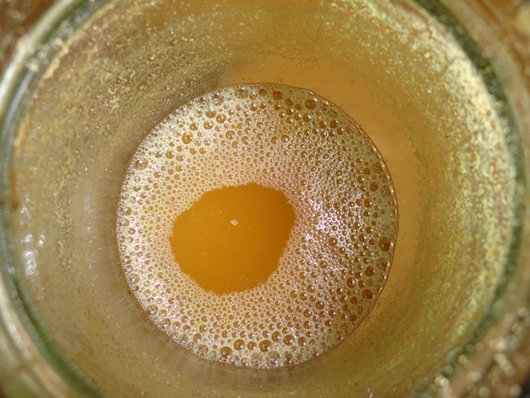
We had a nice supply of ginger beer going over Christmas. It's a delicious soft drink for young and old, although there is an alcoholic version that can be made with a slight variation on the recipe. Ginger beer is a naturally fermented drink that is easy to make - with ginger beer you make a starter called a ginger beer plant and after it has fermented, you add that to sweet water and lemon juice. Like sourdough, it must ferment to give it that sharp fizz. To make a ginger beer plant you'll need ginger - either the powdered dry variety or fresh ginger, sugar, rainwater or tap water that has stood for 24 hours to allow the chlorine to evaporate off. You'll also need clean plastic bottles that have been scrubbed with soap, hot water and a bottle brush and then rinsed with hot water. I never sterilise my bottles and I haven't had any problems. If you intend to keep the ginger beer for a long time, I'd suggest you sterilise your bottles. MAKING THE STARTER In a...
Image

NOT the last post

This will be my last post here.  I've been writing my blog for 18 years and now is the time to step back. I’ve stopped writing the blog and come back a couple of times because so many people wanted it, but that won’t happen again, I won’t be back.  I’ll continue on instagram to remain connected but I don’t know how frequent that will be. I know some of you will be interested to know the blog's statistics. 
Image

How to make cold process soap

I'm sure many of you are wondering: "Why make soap when I can buy it cheaply at the supermarket?" My cold process soap is made with vegetable oils and when it is made and cured, it contains no harsh chemicals or dyes. Often commercial soap is made with tallow (animal fat) and contains synthetic fragrance and dye and retains almost no glycerin. Glycerin is a natural emollient that helps with the lather and moisturises the skin. The makers of commercial soaps extract the glycerin and sell it as a separate product as it's more valuable than the soap. Then they add chemicals to make the soap lather. Crazy. Making your own soap allows you to add whatever you want to add. If you want a plain and pure soap, as I do, you can have that, or you can start with the plain soap and add colour, herbs and fragrance. The choice is yours. I want to add a little about animal and bird fat. I know Kirsty makes her soap with duck fat and I think that's great. I think t...
Image

Preserving food in a traditional way - pickling beetroot

I've had a number of emails from readers who want to start preserving food in jars but don't know where to start or what equipment to buy.  Leading on from yesterday's post, let's just say up front - don't buy any equipment. Once you know what you're doing and that you enjoy preserving, then you can decide whether or not to buy extra equipment. Food is preserved effectively without refrigeration by a variety of different methods. A few of the traditional methods are drying, fermentation, smoking, salting or by adding vinegar and sugar to the food - pickling. This last method is what we're talking about today. Vinegar and sugar are natural preservatives and adding one or both to food sets up an environment that bacteria and yeasts can't grow in. If you make the vinegar and sugar mix palatable, you can put up jars of vegetables or fruit that enhance the flavour of the food and can be stored in a cupboard or fridge for months. Other traditional w...
Image

Cleaning mould from walls and fabrics

With all this rain around we've developed a mould problem in our home. Usually we have the front and back doors open and that good ventilation stops most moulds from establishing. However, with the house locked up for the past week, the high humidity and the rain, mould is now growing on the wooden walls near our front door and on the lower parts of cupboards in the kitchen. Most of us will find mould growing in our homes at some point. Either in the bathroom or, in humid climates, on the walls, like we have now. You'll need a safe and effective remedy at some point, so I hope one of these methods works well for you. Mould is not only ugly to look at, it can cause health problems so if you see mould growing, do something about it straight away. The longer you leave the problem, the harder it will be to get rid of it effectively. If you have asthma or any allergies, you should do this type of cleaning with a face mask on so you don't breathe in any spores. Many peopl...
Image

Five minute bread

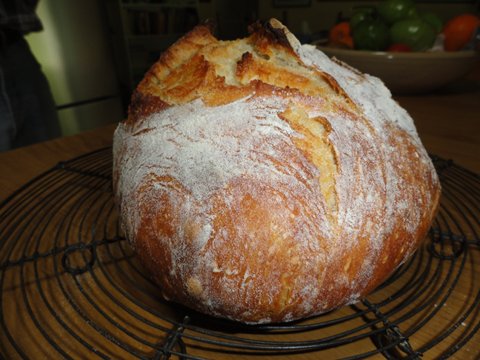
Bread is one of those foods that, when made with your own hands, gives a great deal of satisfaction and delight. It's only flour and water but it symbolises so much. I bake bread most days and use a variety of flours that I buy in bulk. Often I make a sandwich loaf because we use most of our bread for lunchtime sandwiches and for toast. Every so often I branch out to make a different type of loaf. I have tried sour dough in the past but I've not been happy with any of them. I'll continue to experiment with sour dough because I like the idea of using wild yeasts and saving the starter over a number of years to develop the flavour and become a part of the family. However, the loaf I've been branching out to most often is just a plain old five minute bread. By five minutes I mean it takes about five minutes actual work to prepare but it's the easiest of all bread to make and to get consistently good loaves from. If you're having people around for lunch or...
Image

This is my last post.

I have known for a while that this post was coming, but I didn't know when. This is my last post. I'm closing my blog, for good, and I'm not coming back like I have in the past.  I've been writing here for 16 years and my blog has been many things to me. It helped me change my life, it introduced me to so many good people, it became a wonderful record of my family life, it helped me get a book contract with Penguin, and monthly columns with The Australian Women's Weekly and Burke's Backyard . But in the past few months, it's become a burden. In April, I'll be 75 years old and I hope I've got another ten years ahead. However, each year I'll probably get weaker and although I'm fairly healthy, I do have a benign brain tumour and that could start growing. There are so many things I want to do and with time running out, leaving the blog behind gives me time to do the things that give me pleasure. On the day the blog started I felt a wonderful, h...
Image

What is the role of the homemaker in later years?

An email came from a US reader, Abby, who asked about being a homemaker in later years. This is part of what she wrote: "I am a stay-at-home mum to 4 children, ages 9-16. I do have a variety of "odd jobs" that I enjoy - I run a small "before-school" morning drop-off daycare from my home, I am a writing tutor, and I work a few hours a week at a local children's bookstore. But mostly, I cherish my blissful days at home - cooking, cleaning (with homemade cleaners), taking care of our children and chickens and goats, baking, meal-planning, etc. This "career" at home is not at all what I imagined during my ambitious years at university, but it is far more enriching. I notice, though, that my day is often planned around the needs of my family members. Of course, with 4 active kids and a husband, this is natural. I do the shopping, plan my meals, cook dinner - generally in anticipation of my family reconnecting in the evening.  I can't h...
Image

Every morning at home

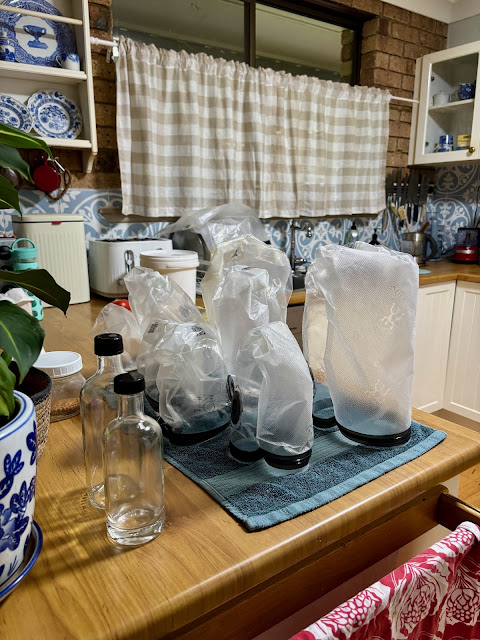
Every morning when I walk into my kitchen it looks tidy and ready for a day's work. Not so on this morning (above), I saw this when I walked in. Late the previous afternoon when I was looking for something, I came across my rolled up Zwilling vacuum bags and decided they had to be washed and dried. So I did that and although I usually put them outside on the verandah to dry it was dark by then. I turned the just-washed bags inside out and left them like this on a towel. It worked well and now the bags are ready to use when I bring home root vegetables, cabbages or whatever I buy that I want to last four or five weeks.
Image

You’ll save money by going back to basics

When I was doing the workshops and solo sessions, I had a couple of people whose main focus was on creating the fastest way to set up a simple life. You can't create a simple life fast, it's the opposite of that It's not one single thing either - it's a number of smaller, simpler activities that combine to create a life that reflects your values; and that takes a long to come together. When I first started living simply I took an entire year to work out our food - buying it, storing it, cooking it, preserving, baking, freezing, and growing it in the backyard. This is change that will transform how you live and it can't be rushed.  
Image


Trending Articles

NOT the last post

This will be my last post here.  I've been writing my blog for 18 years and now is the time to step back. I’ve stopped writing the blog and come back a couple of times because so many people wanted it, but that won’t happen again, I won’t be back.  I’ll continue on instagram to remain connected but I don’t know how frequent that will be. I know some of you will be interested to know the blog's statistics. 
Image

Every morning at home

Every morning when I walk into my kitchen it looks tidy and ready for a day's work. Not so on this morning (above), I saw this when I walked in. Late the previous afternoon when I was looking for something, I came across my rolled up Zwilling vacuum bags and decided they had to be washed and dried. So I did that and although I usually put them outside on the verandah to dry it was dark by then. I turned the just-washed bags inside out and left them like this on a towel. It worked well and now the bags are ready to use when I bring home root vegetables, cabbages or whatever I buy that I want to last four or five weeks.
Image

You’ll save money by going back to basics

When I was doing the workshops and solo sessions, I had a couple of people whose main focus was on creating the fastest way to set up a simple life. You can't create a simple life fast, it's the opposite of that It's not one single thing either - it's a number of smaller, simpler activities that combine to create a life that reflects your values; and that takes a long to come together. When I first started living simply I took an entire year to work out our food - buying it, storing it, cooking it, preserving, baking, freezing, and growing it in the backyard. This is change that will transform how you live and it can't be rushed.  
Image

Creating a home you'll love forever

Living simply is the answer to just about everything. It reduces the cost of living; it keeps you focused on being careful with resources such as water and electricity; it reminds you to not waste food; it encourages you to store food so you don't waste it and doing all those things brings routine and rhythm to your daily life. Consciously connecting every day with the activities and tasks that create simple life reminds you to look for the meaning and beauty that normal daily life holds.  It's all there in your home if you look for it. Seemingly mundane tasks like cleaning and cooking help you with that connection for without those tasks, the home you want to live in won't exist in the way you want it to.  Creating a home you love will make you happy and satisfied.
Image

Time changes everything

I've been spending time in the backyard lately creating a contained herb and vegetable garden. My aim is to develop a comfortable place to spend time, relax, increase biodiversity and encourage more animals, birds and insects to live here or visit. Of course I'd prefer my old garden which was put together by Hanno with ease and German precision. Together, we created a space bursting at the seams with herbs, vegetables and fruity goodness ready to eat and share throughout the year. But time changes everything. What I'm planning on doing now, is a brilliant opportunity for an almost 80 year old with balance issues. In my new garden I'll be able to do a wide range of challenging or easy work, depending on how I feel each day. It’s a daily opportunity to push myself or sit back, watch what's happening around me and be captivated by memories or the scope of what's yet to come.
Image

It's the old ways I love the most

I'm a practical woman who lives in a 1980’s brick slab house. There are verandahs front and back so I have places to sit outside when it's hot or cold. Those verandahs tend to make the house darker than it would be but they're been a great investment over time because they made the house more liveable. My home is not a romantic cottage, nor a minimalist modern home, it's a 1980’s brick slab house. And yet when people visit me here they tell me how warm and cosy my home is and that they feel comforted by being here. I've thought about that over the years and I'm convinced now that the style of a home isn't what appeals to people. What they love is the feeling within that home and whether it's nurturing the people who live there.
Image

Making ginger beer from scratch

We had a nice supply of ginger beer going over Christmas. It's a delicious soft drink for young and old, although there is an alcoholic version that can be made with a slight variation on the recipe. Ginger beer is a naturally fermented drink that is easy to make - with ginger beer you make a starter called a ginger beer plant and after it has fermented, you add that to sweet water and lemon juice. Like sourdough, it must ferment to give it that sharp fizz. To make a ginger beer plant you'll need ginger - either the powdered dry variety or fresh ginger, sugar, rainwater or tap water that has stood for 24 hours to allow the chlorine to evaporate off. You'll also need clean plastic bottles that have been scrubbed with soap, hot water and a bottle brush and then rinsed with hot water. I never sterilise my bottles and I haven't had any problems. If you intend to keep the ginger beer for a long time, I'd suggest you sterilise your bottles. MAKING THE STARTER In a...
Image

An authentic look at daily life here — unstaged and real

Most days Hanno was outside happily working in the fresh air. It may surprise you to know that I started reading my book,  Down to Earth , yesterday - the first time since I wrote it 13 years ago.  I had lent it to my neighbor, and when she returned it, I started reading, expecting to find surprises. Instead, I realised the words were still familiar—as if they were etched into my memory. As I flipped through the pages, I was reminded of how important it was for me to share that knowledge with others. The principles in Down to Earth changed my life, and I truly believed they could do the same for others. After just 30 minutes of reading, I put the book down, reassured that its message still holds true: we can slow down and reshape our lives, one step at a time.
Image