down to earth

  • Home
  • About Us
  • Down To Earth Book
  • Privacy Policy
After 50 years of wearing glasses, soon they'll be off, for good.

This is the first post I've written since my eye surgery and I have to tell you, I'm feeling great.  There is a new, sharply-focused world out there that I've been rediscovering but so far my discoveries have only been inside the house.  I still have a problem with glare so my outdoor adventures will have to wait a few more days. In another day or two, I'll take my glasses off for good and will only need reading glasses. I'll have the other eye done next month and I'm looking forward to having two good eyes again.  I'm so glad I had it done.

Thanks to everyone who took the time to write comments on The Simple Home posts, although I'm a bit disappointed there are so few. The comments feature your ideas and opinions, often different to mine, and they are a big help to those who are struggling with change or not sure about what to do or how to do it.  If you have the time, please add to the discussions, what you write may be just the thing to help fellow readers.

I hope you have a lovely weekend. I've been sent a book to review so I'll be starting that and trying to keep the plants alive in the hot weather.  See you next week. xx

A stitch in time saves stress down the line
Four easy winter lunch recipes for busy people
20 recipes like grandma used to make
Simple recipe for old fashioned cooking
Foods that can help and harm your brain
'Ultra-processed' products now half of all UK family food purchases
How to make your own panties - tutorial and free pattern
Hands: Fermanagh Country  I love this
Pursuing happiness: why we should let go of being perfect
Watching my children, I think back to a particular suburban mystery
Oh yes! Did you read about the Finnish team knitting at the Olympics?  Well this is the story behind that.
20 Recipes Like Grandma Us
d to Make20 Recipes Like Grandma Used to Make

February, week 2 in The Simple Home

While I knew from a young age that I would work when I was older, it didn’t occur to me until much later how vital work is. Work builds character, families, neighbourhoods and nations. I can say without a doubt that I am the person I am because of the work I’ve done – both in the work force and at home. The daily effort of earning a living and keeping a home operating builds layer upon layer of experience, skill, confidence, trust, character, responsibility, understanding and common sense.


There are several distinct stages we go through in life, each has it's own rewards and challenges and going through one stage often helps prepare you for the next.  I've written about this in The Simple Home but I'll highlight how each stage is slightly different and the financial aspects that can make a real difference as you grow older.


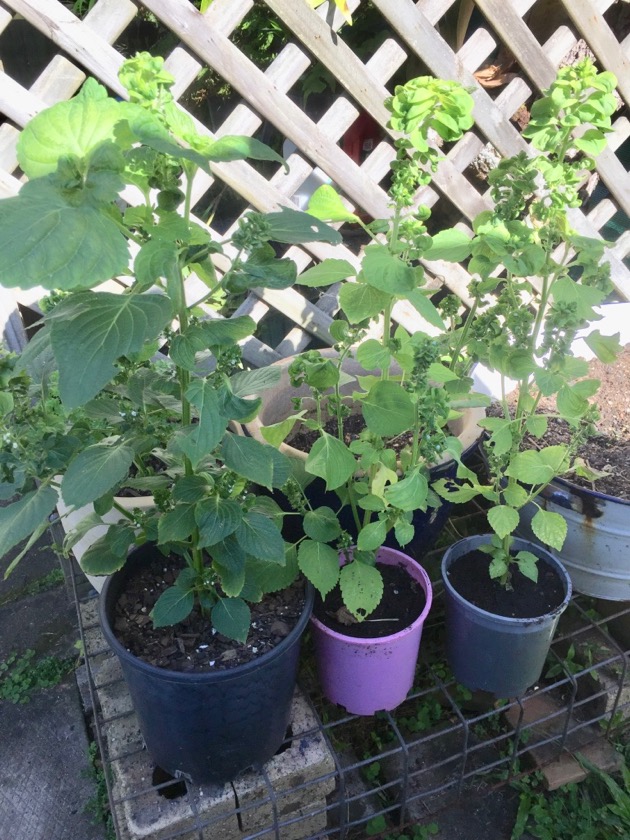
I meant to show you Sunny's sesame plants the other day when I did the herb post. We started growing them in the bush house when a friend gave her three small bushes. I potted them up and they're growing fast.  Although they're known in Korea as sesame, they're not the true sesame plant.  These are correctly known as perilla and if you click on the link you'll see why we're growing it.  Sunny, and many Korean people, use the leaves to wrap around small portions of food.  Apparently the plant also produces a beneficial oil if it's crushed but these haven't produced seeds yet. As you can see in the photo, they've got a lot of flower head so the seeds are probably close.

I'm having my first eye op next week so I'm not sure of what I'll be doing here apart from The Simple Home post on Monday. Next week will be hot so I guess I'll be inside most of the time.  I hope this is the last of the really hot weather.  I'd love to experience some cold nights again.

Thanks for your visits this week. I hope you have a peaceful and relaxing weekend.  See you soon. xx

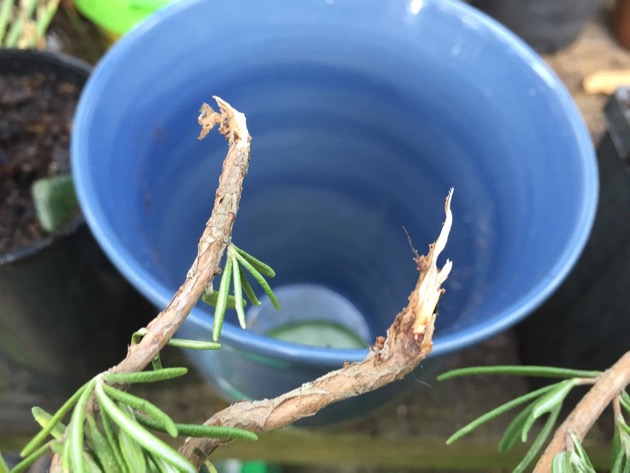
One of the many ways to cut costs in your kitchen garden is to take herb cuttings. I do it at this time of year but you should do a bit of research and see if it's viable in your area now. My common sense tells me, but I don't know for sure, that if you provide a protected light position, out of the sun and wind, cuttings taken now, in most warm climates, would grow. Out northern hemisphere friends would need to wait till later in the year. I take cuttings now because they're starting to look a bit ragged after summer, they need cutting back and the weather is still warm - it's hot but not as firece as it was a few weeks ago.

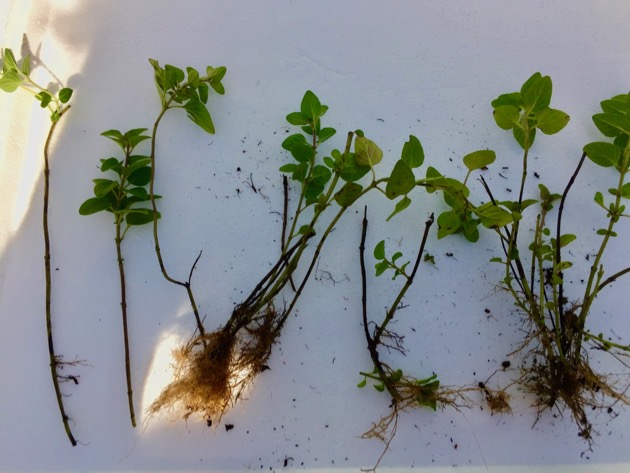
These are oregano cuttings. Even the ones on the left side, with very few roots, will probably grow well. I got about 12 cuttings from these clumps.

If you lift up the oregano at the side of the pot, you'll notice a lot of fibrous roots.  Just cut out a clump and divide it up to plant.

If you have herbs growing and you don't want to take cuttings, now is a good time to cut them back and give them a drink of whatever delicious organic fertiliser you have on hand.  Comfrey, seaweed or any of the liquid commercial feeds are good for this.  If you buy a commercial fertiliser, try to get a good organic one - it's better for the soil, the plant and you.

February, week 1 in The Simple Home

We make a living by what we get, but we make a life by what we give.  
Winston Churchill

Hanno and I made the transition from a frenzied working life to a more simple and beautiful one almost 20 years ago. Now we save what we can, care for what we own and we mend, recycle, reuse and repurpose. Using these principles, we've gone from being thoughtless spenders who bought everything we wanted, to mindful, self-reliant people living on a fraction of what we once did. We are also much happier.


We live on a low income so it's vital that we spend our money wisely, but it's equally important for those who have more than enough to cut back when they can. Mindless consumption has become the norm and if we continue to surround ourselves with products we think of as disposable, we will hand our grandchildren a planet that is not worth living on.

We still hear from politicians and business leaders about unlimited economic growth. I don't think there is such a thing. Our government tells us that our spending supports the economy, and, conversely, that we should be saving more.  I agree, we should save more by cutting back on spending. Our support for the economy is evident when we buy and rent our homes, buy cars, furniture and groceries, and by working for a living. Supporting the economy by buying things we don't need is wasteful and focuses on one aspect of the nation's viability at the expense of others. Of course we need a healthy economy but strong nations are built on people. I think it's better to work hard when you're young to buy a home and pay it off quickly, then, when you've paid off your mortgage, step into a more frugal lifestyle and focus on family and living. That is when you get to enjoy what you've worked so hard for.


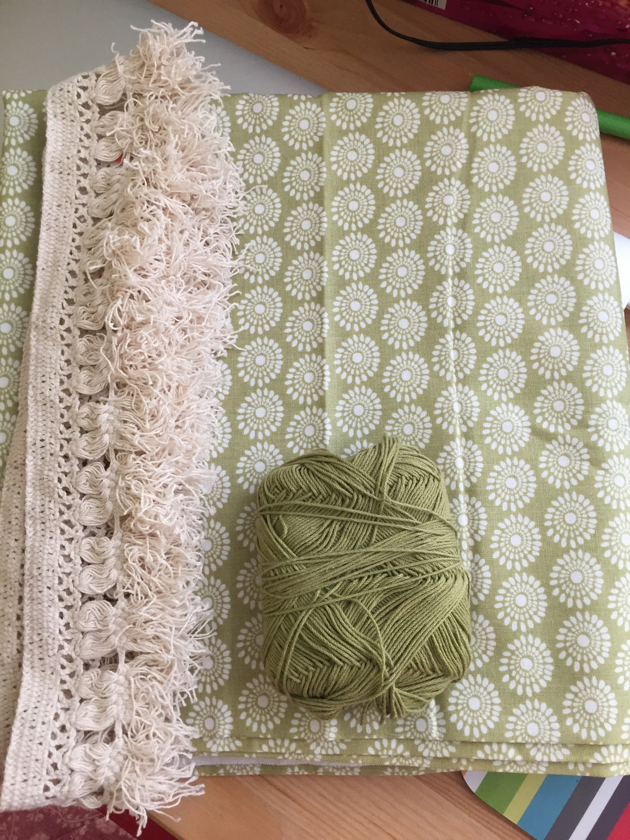
I'm making a lamp skirt to cover a very drab beige lamp shade in our lounge room. The fringe will be at the bottom and the green cotton is to crochet around the top.  I'll show you when it's finished but don't hold your breath- we are back in busy mode here. 

We're settling nicely into the year with the very hot temperature easing off a bit and two days of rain just passed.  I love rain and the cool weather that sometimes comes with it. The tanks are full again,  and frequent showers are filling the soil with much needed liquid.  It's a good sign for our vegetable garden which will be planted up in March.

Hello everyone.  Last year I developed an online blogging course and had great success with it.  It's a course for beginners, or bloggers who've started a blog but haven't developed it. It is open to anyone no matter where you are in the world. The cost is US$100.

Creating a blog is a fairly easy thing to do but to present the best blog you're capable of, well, that's more difficult. As you know, I've been blogging since 2007 and was fairly successful in the first few months. As the years went by, Penguin offered me the opportunity to publish my work with them, I became a monthly columnist for the Women's Weekly and Burke's Backyard and I won a lot of awards.  I started off as a novice, knowing nothing about blogging, but I was a fast learner and I'd like to share the secrets of that success with you. I always use Blogger. It's free, easy to use and customise, it's the biggest blogging platform in the world and as it's owned by Google, it's usually trouble-free.

January, week 4 in The Simple Home

This is the final post for January, so let's recap what we've done so far.  This month has been all about planning and organising the year ahead as much as we can.  Hopefully you've been able to set up a home admin area - it might be a dedicated office or it could be the kitchen table with box of your admin things that can be used on the table then put away. Much of your home organisation can be done in your home admin area where you have what you need at hand. If you need to write something down or look something up, it's right there. Your calendars should be set now with all the known 2018 appointments and events, your food planning should be done and, if you're doing them, menu plans created. It will help a lot if you have a list of 2018 gifts organised and you've written a list of home maintenance that can be carried out during the year. These lists, menus, calendars and plans can be stored in your home folder and left in the admin area so all your bits and pieces, the things you need to run your home, are in one place. I hope you've had time to organise a drop zone, charging station and your work spaces to better suit how you work because that will be very useful as you progress through the year.  Some of those places might have to be modified in the coming weeks, so don't be afraid to adjust as you go.

ROUTINES
Now it's time to think about how you do your housework, what works and what doesn't, and when is the best time to do your work. A routine is a sequence of actions that are performed in the same way and at the same time. Routines will help you develop the habits of a working home and will make life easier. There are many ways of establishing your routines. For example, my morning routine is to have everything - breakfast, cleaning the kitchen, getting the lunch ready, making beds, laundry and watering the garden finished by 9am. Then I go on to do other things like craft work or writing until lunchtime - our main meal.  I try to get the active tasks done in the morning because I get tired in the afternoon.  If you go out to work or work at home, you could make up a list of tasks you want to complete before you leave for work or start work at home. These might include breakfast, packing the dishwasher or washing up, getting the children off to school and workers off to work - with lunches packed the night before, and having something either in the slow cooker or defrosting for dinner that night. And while everyone else in the house is getting ready for the day ahead, they should be doing their routines too.  Children should make their bed, dress for school, put PJs away, have breakfast, pack their lunch and homework in their school bag and clean their teeth.

Part of the routine is that everyone knows what they have to do and you don't have to prompt them to do what they have to do.

I think this is the most significant group of reads I've collected and presented to you so far.  One site here has been life changing for me, I won't tell you which, I hope you discover it in your own way. As usual, the links are listed in the order I find them in, not in order of their importance or readability. I'm interested in hearing what you think of this group so if you have time, drop me a line or two in the comments.


It's been hot and humid here so we've been trying to get our work done early and then we turn on the air-conditioner mid-morning and stay indoors until late afternoon. That works well for us but I'm always mindful of our sons working in hot conditions and the many working people who make their living outdoors or in hot environments. 


I've been taking herb cuttings and potting them up but I'll write a post about that next week. It's an important skill and a good way of increasing the plants you have in your garden and to give away or barter with. Indoors, I made more lemon cordial a few days ago. It's such an easy thing to do and a good drink to have on hand on these hot summer days.

I know many of you will already be doing this, or at least know about it, but cooking in a saucepan with a steamer on top is a frugal and nutritious way to prepare your daily vegetables.  


I bought this set of three saucepans plus steamer about ten years ago and I use the steamer a few times every week. I put the hard vegetables, such as potatoes, carrots, turnips etc., in water in the saucepan to boil, and softer vegetables: spinach, cabbage, broccoli, cauliflower etc., in the steamer on top of the saucepan.  The lid from the largest saucepan in the set fits the steamer.


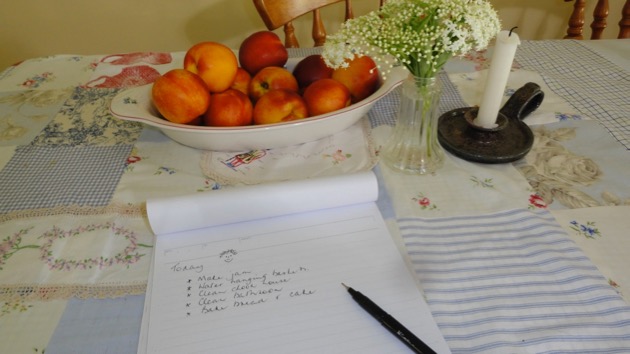
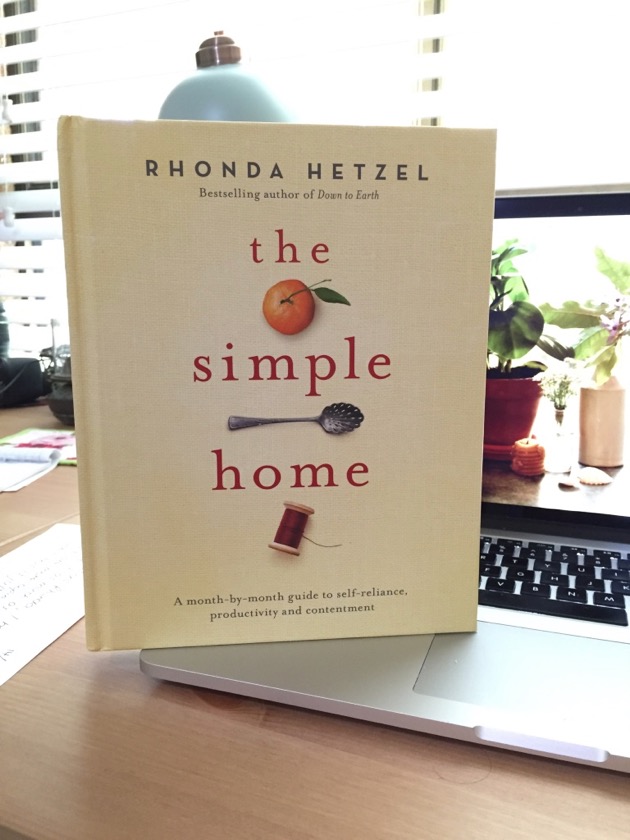
Good morning friends. The lovely Ben at Penguin has given me two The Simple Home books to give away.  I'll give one away in June and the other in December. They'll go to two readers of my blog who consistently make interesting or helpful comments on The Simple Home month-by-month posts.  My memory isn't the best lately so I've got my handy notebook here at the computer now and I'll be making notes over the months.  Hanno said he'll help too, so between us we'll decide who will win the books.


I wrote The Simple Home as a sister book to Down to Earth and poured myself into both of them. All the bits and pieces that wouldn't fit into Down to Earth are there - all the significant life-changing events and the small and simple tasks that make up our lives. The Simple Home contains many of the ordinary things we do here every day that make the life we live so unique. There is nothing fancy on those pages, it's normal day-to-day stuff that has been carried on for many years but it's all in a modern context and, I hope, explained in a way that will encourage you to try it too.  

So keep commenting, or start if you haven't so far, and not only will you be connecting with the many like-minded souls who read this blog, you might also win a copy of the book.  xx

ADDED LATER: I know some of you don't know how to get a name to comment under and some have tried but it didn't work but I want you to be in this too.  If you comment as "anonymous", you'll have to put your name in every post so I know who you are; so Barb from NYC, Trudy from Germany or Mary from Victoria will help me identify you.  Thanks!

January, week 3 in The Simple Home

Thinking back on all the houses I've lived in as an adult, I've never walked into one that was exactly what I needed to work efficiently. I always want to make my work, especially the work that is repeated daily, to be as easy as it can be.  For that to happen, I've had to modify my work spaces. Modern houses in particular are set up with an emphasis on contemporary style and modern finishes and while older houses are more likely to have pantries, laundry rooms and a dedicated place for the ironing, they often lack storage and bench space.  We need to modify those larger spaces to support us in the work we do in our homes. This is something you'll do more than once. As you and your children grow older, needs change and so should your home.

DROP ZONE
Start by looking around your home in the areas when you spend the most time and do the majority of your housework.  For me, that is the kitchen, and my work room, but now we have Kerry and his family staying with us, it also includes a drop zone where they leave their bags, phones and keys, and a place where everyone can charge their devices. Hanno and I charge ours on our computers.

If you have children in the family, it's a good idea to have a drop zone near the front door where they leave their school bags, hats and shoes. If you give them a bench to sit on they can drop everything where it should be, empty their school bag - putting their lunch box and water bottle in the kitchen to be washed, and leave their jackets/hats hanging on a hook or hanger right where they'll find them again the following morning.  This will help with your morning routine too. If you don't have to join the search every morning to find shoes, hats or books, you'll save time and energy at the very time you need it most.

Here are some ideas for drop zones near the front door.  Remember, it doesn't have to be fancy, it just has to work. If all you have is a table or cupboard, make that work.

Newer Posts Older Posts Home


My books were all published by Pengiun, and are available at Amazon US, Amazon UK and Amazon Au

Search here

Total Pageviews

Translate


I'm Rhonda Hetzel and I've been writing my Down to Earth blog since 2007. Although I write the occasional philosophical post, my main topics include home cooking, happiness and gardening as well as budgeting, baking, ageing, generosity, mending and handmade crafts. I hope you enjoy your time here.

MY FAVOURITE PLACES

  • Grandma Donna's Place
  • Grandma Donna's YouTube
  • Grandma Donna's Instagram
  • This Simple Day
  • Nicole's Instagram

Give More

Give More

Popular posts last year

Making ginger beer from scratch

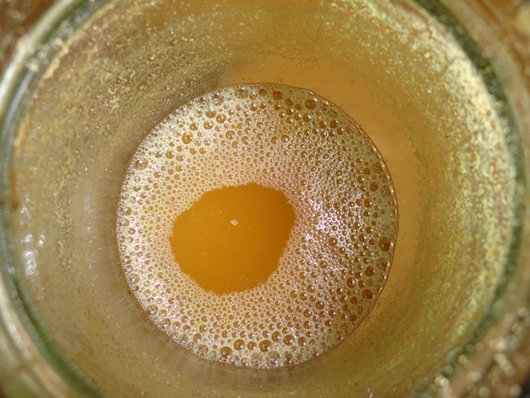
We had a nice supply of ginger beer going over Christmas. It's a delicious soft drink for young and old, although there is an alcoholic version that can be made with a slight variation on the recipe. Ginger beer is a naturally fermented drink that is easy to make - with ginger beer you make a starter called a ginger beer plant and after it has fermented, you add that to sweet water and lemon juice. Like sourdough, it must ferment to give it that sharp fizz. To make a ginger beer plant you'll need ginger - either the powdered dry variety or fresh ginger, sugar, rainwater or tap water that has stood for 24 hours to allow the chlorine to evaporate off. You'll also need clean plastic bottles that have been scrubbed with soap, hot water and a bottle brush and then rinsed with hot water. I never sterilise my bottles and I haven't had any problems. If you intend to keep the ginger beer for a long time, I'd suggest you sterilise your bottles. MAKING THE STARTER In a...
Image

NOT the last post

This will be my last post here.  I've been writing my blog for 18 years and now is the time to step back. I’ve stopped writing the blog and come back a couple of times because so many people wanted it, but that won’t happen again, I won’t be back.  I’ll continue on instagram to remain connected but I don’t know how frequent that will be. I know some of you will be interested to know the blog's statistics. 
Image

How to make cold process soap

I'm sure many of you are wondering: "Why make soap when I can buy it cheaply at the supermarket?" My cold process soap is made with vegetable oils and when it is made and cured, it contains no harsh chemicals or dyes. Often commercial soap is made with tallow (animal fat) and contains synthetic fragrance and dye and retains almost no glycerin. Glycerin is a natural emollient that helps with the lather and moisturises the skin. The makers of commercial soaps extract the glycerin and sell it as a separate product as it's more valuable than the soap. Then they add chemicals to make the soap lather. Crazy. Making your own soap allows you to add whatever you want to add. If you want a plain and pure soap, as I do, you can have that, or you can start with the plain soap and add colour, herbs and fragrance. The choice is yours. I want to add a little about animal and bird fat. I know Kirsty makes her soap with duck fat and I think that's great. I think t...
Image

Preserving food in a traditional way - pickling beetroot

I've had a number of emails from readers who want to start preserving food in jars but don't know where to start or what equipment to buy.  Leading on from yesterday's post, let's just say up front - don't buy any equipment. Once you know what you're doing and that you enjoy preserving, then you can decide whether or not to buy extra equipment. Food is preserved effectively without refrigeration by a variety of different methods. A few of the traditional methods are drying, fermentation, smoking, salting or by adding vinegar and sugar to the food - pickling. This last method is what we're talking about today. Vinegar and sugar are natural preservatives and adding one or both to food sets up an environment that bacteria and yeasts can't grow in. If you make the vinegar and sugar mix palatable, you can put up jars of vegetables or fruit that enhance the flavour of the food and can be stored in a cupboard or fridge for months. Other traditional w...
Image

Cleaning mould from walls and fabrics

With all this rain around we've developed a mould problem in our home. Usually we have the front and back doors open and that good ventilation stops most moulds from establishing. However, with the house locked up for the past week, the high humidity and the rain, mould is now growing on the wooden walls near our front door and on the lower parts of cupboards in the kitchen. Most of us will find mould growing in our homes at some point. Either in the bathroom or, in humid climates, on the walls, like we have now. You'll need a safe and effective remedy at some point, so I hope one of these methods works well for you. Mould is not only ugly to look at, it can cause health problems so if you see mould growing, do something about it straight away. The longer you leave the problem, the harder it will be to get rid of it effectively. If you have asthma or any allergies, you should do this type of cleaning with a face mask on so you don't breathe in any spores. Many peopl...
Image

Five minute bread

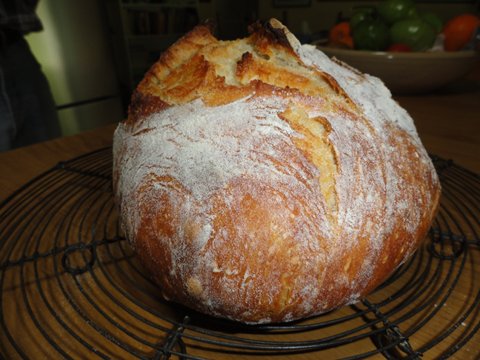
Bread is one of those foods that, when made with your own hands, gives a great deal of satisfaction and delight. It's only flour and water but it symbolises so much. I bake bread most days and use a variety of flours that I buy in bulk. Often I make a sandwich loaf because we use most of our bread for lunchtime sandwiches and for toast. Every so often I branch out to make a different type of loaf. I have tried sour dough in the past but I've not been happy with any of them. I'll continue to experiment with sour dough because I like the idea of using wild yeasts and saving the starter over a number of years to develop the flavour and become a part of the family. However, the loaf I've been branching out to most often is just a plain old five minute bread. By five minutes I mean it takes about five minutes actual work to prepare but it's the easiest of all bread to make and to get consistently good loaves from. If you're having people around for lunch or...
Image

This is my last post.

I have known for a while that this post was coming, but I didn't know when. This is my last post. I'm closing my blog, for good, and I'm not coming back like I have in the past.  I've been writing here for 16 years and my blog has been many things to me. It helped me change my life, it introduced me to so many good people, it became a wonderful record of my family life, it helped me get a book contract with Penguin, and monthly columns with The Australian Women's Weekly and Burke's Backyard . But in the past few months, it's become a burden. In April, I'll be 75 years old and I hope I've got another ten years ahead. However, each year I'll probably get weaker and although I'm fairly healthy, I do have a benign brain tumour and that could start growing. There are so many things I want to do and with time running out, leaving the blog behind gives me time to do the things that give me pleasure. On the day the blog started I felt a wonderful, h...
Image

What is the role of the homemaker in later years?

An email came from a US reader, Abby, who asked about being a homemaker in later years. This is part of what she wrote: "I am a stay-at-home mum to 4 children, ages 9-16. I do have a variety of "odd jobs" that I enjoy - I run a small "before-school" morning drop-off daycare from my home, I am a writing tutor, and I work a few hours a week at a local children's bookstore. But mostly, I cherish my blissful days at home - cooking, cleaning (with homemade cleaners), taking care of our children and chickens and goats, baking, meal-planning, etc. This "career" at home is not at all what I imagined during my ambitious years at university, but it is far more enriching. I notice, though, that my day is often planned around the needs of my family members. Of course, with 4 active kids and a husband, this is natural. I do the shopping, plan my meals, cook dinner - generally in anticipation of my family reconnecting in the evening.  I can't h...
Image

Every morning at home

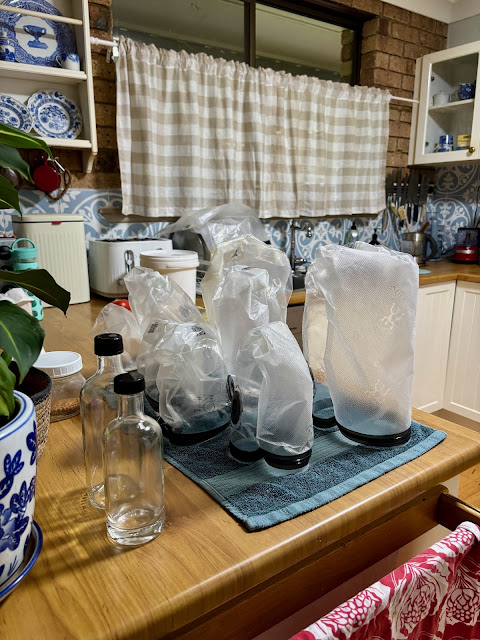
Every morning when I walk into my kitchen it looks tidy and ready for a day's work. Not so on this morning (above), I saw this when I walked in. Late the previous afternoon when I was looking for something, I came across my rolled up Zwilling vacuum bags and decided they had to be washed and dried. So I did that and although I usually put them outside on the verandah to dry it was dark by then. I turned the just-washed bags inside out and left them like this on a towel. It worked well and now the bags are ready to use when I bring home root vegetables, cabbages or whatever I buy that I want to last four or five weeks.
Image

You’ll save money by going back to basics

When I was doing the workshops and solo sessions, I had a couple of people whose main focus was on creating the fastest way to set up a simple life. You can't create a simple life fast, it's the opposite of that It's not one single thing either - it's a number of smaller, simpler activities that combine to create a life that reflects your values; and that takes a long to come together. When I first started living simply I took an entire year to work out our food - buying it, storing it, cooking it, preserving, baking, freezing, and growing it in the backyard. This is change that will transform how you live and it can't be rushed.  
Image


Trending Articles

NOT the last post

This will be my last post here.  I've been writing my blog for 18 years and now is the time to step back. I’ve stopped writing the blog and come back a couple of times because so many people wanted it, but that won’t happen again, I won’t be back.  I’ll continue on instagram to remain connected but I don’t know how frequent that will be. I know some of you will be interested to know the blog's statistics. 
Image

Every morning at home

Every morning when I walk into my kitchen it looks tidy and ready for a day's work. Not so on this morning (above), I saw this when I walked in. Late the previous afternoon when I was looking for something, I came across my rolled up Zwilling vacuum bags and decided they had to be washed and dried. So I did that and although I usually put them outside on the verandah to dry it was dark by then. I turned the just-washed bags inside out and left them like this on a towel. It worked well and now the bags are ready to use when I bring home root vegetables, cabbages or whatever I buy that I want to last four or five weeks.
Image

You’ll save money by going back to basics

When I was doing the workshops and solo sessions, I had a couple of people whose main focus was on creating the fastest way to set up a simple life. You can't create a simple life fast, it's the opposite of that It's not one single thing either - it's a number of smaller, simpler activities that combine to create a life that reflects your values; and that takes a long to come together. When I first started living simply I took an entire year to work out our food - buying it, storing it, cooking it, preserving, baking, freezing, and growing it in the backyard. This is change that will transform how you live and it can't be rushed.  
Image

Creating a home you'll love forever

Living simply is the answer to just about everything. It reduces the cost of living; it keeps you focused on being careful with resources such as water and electricity; it reminds you to not waste food; it encourages you to store food so you don't waste it and doing all those things brings routine and rhythm to your daily life. Consciously connecting every day with the activities and tasks that create simple life reminds you to look for the meaning and beauty that normal daily life holds.  It's all there in your home if you look for it. Seemingly mundane tasks like cleaning and cooking help you with that connection for without those tasks, the home you want to live in won't exist in the way you want it to.  Creating a home you love will make you happy and satisfied.
Image

Time changes everything

I've been spending time in the backyard lately creating a contained herb and vegetable garden. My aim is to develop a comfortable place to spend time, relax, increase biodiversity and encourage more animals, birds and insects to live here or visit. Of course I'd prefer my old garden which was put together by Hanno with ease and German precision. Together, we created a space bursting at the seams with herbs, vegetables and fruity goodness ready to eat and share throughout the year. But time changes everything. What I'm planning on doing now, is a brilliant opportunity for an almost 80 year old with balance issues. In my new garden I'll be able to do a wide range of challenging or easy work, depending on how I feel each day. It’s a daily opportunity to push myself or sit back, watch what's happening around me and be captivated by memories or the scope of what's yet to come.
Image

It's the old ways I love the most

I'm a practical woman who lives in a 1980’s brick slab house. There are verandahs front and back so I have places to sit outside when it's hot or cold. Those verandahs tend to make the house darker than it would be but they're been a great investment over time because they made the house more liveable. My home is not a romantic cottage, nor a minimalist modern home, it's a 1980’s brick slab house. And yet when people visit me here they tell me how warm and cosy my home is and that they feel comforted by being here. I've thought about that over the years and I'm convinced now that the style of a home isn't what appeals to people. What they love is the feeling within that home and whether it's nurturing the people who live there.
Image

Making ginger beer from scratch

We had a nice supply of ginger beer going over Christmas. It's a delicious soft drink for young and old, although there is an alcoholic version that can be made with a slight variation on the recipe. Ginger beer is a naturally fermented drink that is easy to make - with ginger beer you make a starter called a ginger beer plant and after it has fermented, you add that to sweet water and lemon juice. Like sourdough, it must ferment to give it that sharp fizz. To make a ginger beer plant you'll need ginger - either the powdered dry variety or fresh ginger, sugar, rainwater or tap water that has stood for 24 hours to allow the chlorine to evaporate off. You'll also need clean plastic bottles that have been scrubbed with soap, hot water and a bottle brush and then rinsed with hot water. I never sterilise my bottles and I haven't had any problems. If you intend to keep the ginger beer for a long time, I'd suggest you sterilise your bottles. MAKING THE STARTER In a...
Image

An authentic look at daily life here — unstaged and real

Most days Hanno was outside happily working in the fresh air. It may surprise you to know that I started reading my book,  Down to Earth , yesterday - the first time since I wrote it 13 years ago.  I had lent it to my neighbor, and when she returned it, I started reading, expecting to find surprises. Instead, I realised the words were still familiar—as if they were etched into my memory. As I flipped through the pages, I was reminded of how important it was for me to share that knowledge with others. The principles in Down to Earth changed my life, and I truly believed they could do the same for others. After just 30 minutes of reading, I put the book down, reassured that its message still holds true: we can slow down and reshape our lives, one step at a time.
Image