down to earth

  • Home
  • About Us
  • Down To Earth Book
  • Privacy Policy
Every so often I receive an email from a reader asking for ideas about something they're struggling with.  Here we have one such query which I present below and hopefully, between all of us, we can give Amy a range of possible solutions.

I hope you don't mind me asking a question...
I wrote to you around 3-4 years ago about wanting to quit my job and stay home and you addressed it in a November blog post. Well, it's taken me awhile...but I've done it...I finally quit my job. I'm burnt out (from my job) and have no direction right now. How in the world did you find your "way" around your home and get into a routine after working for so long? I've only been home for 2 weeks and need to adjust to it all...but how?
What is my first step?
Where do I start?
How do I plan?
I wake up each day with good intentions...but find myself aimlessly wondering around.
Can you offer any suggestions?


I'm sorry to hear you're burnt out. I remember that feeling and it's not nice. I hope you're spending time doing nothing but the basics so that when you're rested and ready you can take the next step in your new life with optimism and confidence. What you need is a plan.


Sit down with a coffee, paper and pencil and work out what changes you need and want.  Remember, this is about a new life for you and your family so the only ones you have to please are yourselves.  The priorities are to keep a clean and tidy house, feed everyone, work to a budget so you live the life you choose without running up debt, maintain the house and garden and possibly to make a few things you currently buy. I'm thinking mainly of laundry liquid, cleaners, dishcloths, napkins, aprons, bread, cakes, preserves etc. But keep in mind that you make the items that will make a difference in your home.  We're all different.

I would start by dividing your day into three sections: 
  • Morning, which will be from when you get up till around 9am - remember, all this is adjustable.
  • Daytime, 9am - 4pm. This is the bulk of your time when you'll do your shopping, ironing, cleaning, sewing and whatever you choose to do for your own pleasure. That might be reading, gardening, talking to friends and neighbours, sewing etc but it includes what YOU love doing.
  • Evening, 4pm - bedtime. Evening meal, cleaning up, thinking about tomorrow's meals.


In the morning and evening you'll usually do the same thing most days. In the morning it will be cooking, breakfast, getting other family members off to work or school, laundry, cleaning up, making the bed, feeding animals, watering plants, general tidy up.  In the evening it will be preparing the evening meal, washing up, packing the dishwasher, thinking about tomorrows lunches and possibly preparing them, or deciding on what you'll cook the next day so you can defrost what you need.  The more you can get done at night the less you'll have to do the following day but you don't have to push yourself because you'll be at home and you can do extras during the day.


The rest fits into the main part of your day.  It might help you to list all the large tasks you have to do in your home that aren't covered in your morning and evening routines. Tasks such as cleaning bathrooms, doing the washing and ironing, food shopping, vacuuming and mopping floors, dusting, cleaning the fridge and oven, washing windows etc. If you can make a list of these tasks and assign them to a certain day, that will help you cover your housework by doing your morning routine, your daily routine, which will include one of those larger tasks, and your evening routine. The main thing I urge you to do is to take it slow. You have many tomorrows ahead of you and as long as you're making yourself happy by the changes you're making, you'll be on the right track.


When you have these life essentials sorted out, or at least on their way, you can fine tune the other things that need it and add what you enjoy doing.  I found when I started my new life that when I started changing things, one thing lead to another and I just followed along.  If might not be that way for you so just see what happens and do what you think is right.

Other things you can look into include:
  • make a list of your priorities, values and how you would like your life to change. When you have that in place, it will show you what you need to do, change and learn to make the life you want; 
  • create a budget; 
  • work out a shopping strategy, including reasearching where you'll get the best value for money;
  • look at the rooms in your home and working out if you're making the best use of the space, 
  • menu plan; 
  • start a stockpile cupboard; 
  • make up a rag bag; 
  • if you don't know how, teach yourself to sew, mend, knit and garden;
  • work out how you can remove cleaning chemicals from your home.

Life will be slower now. What you're about to do is to make a new life and to redefine what a normal day is for you. It's different for everyone so start by getting the essentials of food and shelter sorted out and then concentrate on the rest. Once you settle on a way to organise your days that suits you, you'll probably find that housework is less of a burden and more about making your home a place that supports and comforts you and your family.  There is no need to fret about moving all this along fast. It will take it's own time and it will change as the years pass by. Homelife is never static, there's always something to do as well as time to sit quietly and appreciate what you have.


Don't be pressured into having a rubber stamp of a life. One of the benefits of living this way is that you no longer have to live to a rigid timetable or one where recreational shopping has any importance.  Good luck!  I'm sure our readers will have more suggestions for you. Now, my friends, it's over to you.

I've been thinking of going through The Simple Home book with you next year.  The book sets out, month by month, various ways of dealing with home organisation, housework and family food from January through to December.  Rose wanted to do this on her blog and we talked about it a lot. Then she got sick, the focus and energy went elsewhere, and when she died I just couldn't face it. I know she'd want me to finish what she was determined to start so I thought a few of you who have the book, and those who don't, would like to waltz through it with me. I still have to think about how to do it but before I start doing that I want to know if anyone is interested. Let me know in the comments. Thank you.

I'll see you again next week. I hope you enjoy your weekend. ❤️

ADDED FRIDAY AFTERNOON:
Thank you all for being so enthusiastic about working through the new year with The Simple Home. I think it will be fun and we can all share our ideas.  I'll start making notes on how it will slot into the blog. I'm thinking we might do a different aspect of each chapter on all the Mondays of each month. That will enable us to cover more territory. There'll be more news on this when I formulate a plan.

And just a note about one of my sponsors, Odgers and McClelland. I've just received my monthly newsletter and it lists the top ten items in the shop.  I'm pleased to say I have the teapot, set of spoons,  the enamelware and the Opinel knife and use them all constantly. If you have a hard to buy for person on your Christmas list, grab one of those Opinel knives. They are so handy, they fold up to go into a pocket or purse and will last for a long time. I use mine in the garden and I also have one tucked away in the car's glovebox. If you've never looked at the online shop, do it now and see real products that will really help you create a lovely home.  While you're there you can signup for the free newsletter. BTW, I always smile when I see those pudding bowls. :- ) 

Something between compulsion and comfort: the quiet therapy of counting
Bush fruit Christmas cake, milk jellies and other Australian Christmas food
Recipe for Switchel
My father's tools
Mynas v miners: they might be swooping menaces but they're not all bad
How to sew basics
Make your own reusable hand warmers
A cute little Christmas colour-in
How to draw and sketch cats
14 surprising things you can clean in the washing machine


SaveSaveSaveSaveSaveSave
Most of the time I potter away here doing things that make life easier for us.  Hanno does the same, although he usually works outside. My daily tasks include cleaning, organising, mending and looking after the vegetable garden. I gather herbs for cooking, I peel vegetables and fruit, I make stock and sauces and place a home-cooked meal on the table every day at 12 midday.  I don't watch the clock to do that, it just happens that way.


Every day I make our bed and instead of thinking about getting through it fast and what I'll do next, I think about the bed and how to make it comfortable. We all spend a lot of time in bed and it helps us relax and sleep so we have the energy to do the work we need to do each day.  All those thoughts help me to not just pull up the doona/quilt, they make me slow down, fluff up pillows, adjust crooked sheets, make sure the side tables are dust-free and that when I walk away, job done, I've done the best I can do and we have a clean and comfortable bed waiting for us every night. I wonder if there are other mindful bed makers out there.

Apple and cinnamon butter cake.
I set a task for myself two weeks ago to change my work room. I want to move all my ironing gear in there so it's out of the bedroom and in a space where I work already. I moved the ironing to the bedroom two years ago as a temporary measure and it's stayed there, reminding me of work when I'm trying to relax. If I just ploughed through it I would have had it moved in one day, but as I'm sure you know housework is rarely a linear activity, it is often interrupted, so the move is only partly done.  Back in the day I would have been disappointed in myself for being so slow but now I accept it. I'm in a season of slowness, I'm not the fast and efficient workhorse I used to be and I'm fine with that. Self-acceptance, it's a fine thing and something we have to learn, and sometimes relearn. None of us will stay in our prime, if you live long enough you'll lose some of your strength, you won't work at the same pace all your life. All of us who live that long need to adjust our thinking to know that is okay, and that a slower rhythm is part of life and part of the balance most of us accept as we age.


And now acceptance of another kind.  I'm very pleased that recently we Australians voted to accept same-sex marriage as part of our legal and social lives. I don't know why we had to vote to allow fellow citizens the right to marry the person they love. I don't know why it took us so long to do it but I do know that if I have the right to marry the person I love, everyone else should have that same right.  So thank you my fellow Australians for knowing that love is love and saying yes to it. ❤️
I've had quite a few readers ask about Gracie's food. What we feed our animals is important to me because I want them to have a good life and be in good health all through their lives. I've never fed our dogs supermarket food. If you look at the labels you'll see that it's full of rubbish and it's expensive. I prefer to give homemade food.  I know what's in it, it smells good and it's value for money.  We had Airedale Terriers before Gracie and I made them a meat-based stew with rice. The dogs grew well on that food and my vet said they were the healthiest Airedales he'd seen.  There are a number of recipes for dog food here and here is my recipe for what I used to cook for Rosie and Alice.

From baby Gracie to today's Gracie, I've always done my best to feed her healthy food.

Gracie is a Scottish Terrier and she's half the size of Alice and Rosie so it made me think again about how we'd feed her. When she was a puppy, she had ½ cup Black Hawk biscuits for breakfast followed by a small amount of beef mince or chicken for lunch and dinner. When she was 12 months old, we cut her back to two small meals a day. Now she's 18 months old, the vet advised me to take her off the biscuits and have one meal. She has it around 2pm every day.  That gives her time to run around in the afternoon to aid digestion but not be hungry overnight.

This is our beautiful girl, Alice.

I thought a lot about that one meal. I have one chance to give Gracie something she'll enjoy eating, and help keep her healthy. It needed to be within our budget, easy to prepare, and give us value for money.  This is what I came up with:

Day 1. Chicken and vegetables in chicken jelly stock
Day 2. 125 grams raw beef mince
Day 3. 1 raw chicken drumstick - dogs should never have cooked bones
Day 4. 1 tin of sardines OR tuna in springwater

After day 4, we start with day 1 again.

This is how I prepare the chicken and vegetables in chicken jelly stock. Add 5 chicken drumsticks to a pot and just cover the chicken with water. Don't add salt, pepper or any other additive.  During the cooking process, the chicken, bones and connective tissue start breaking down, collagen is released, and when it's cold, jelly forms. I think it gives Gracie the feeling that she's eating a bigger meal. 

Cook the chicken gently for about 45 minutes, then add the vegetables and cook for another 15 minutes. I generally use about a cup of sweet potato and carrots, cut into chunks, but you can use whatever you have on hand. Never give your dog onion or leeks. Allow this to cool, remove all the bones, then divide up into 5 even portions. I use zip lock bags and freeze them flat so they don't take up too much space in the freezer.  Of course you could cook up batches of 25 drumsticks so you only have to cook it once a month. When its defrosted, don't let it go to room temperature. Feed the dog when the liquid is still jelly. It will go back to a water consistency if you leave it sit for too long but even if you do, the nutrition is still the same.


Feeding this 4 day menu rotation gives Gracie variety and different textures as well as bones to crunch for healthy gums and teeth. I think she's enjoying her food and it takes almost no time at all.  For those in Australia, I buy the 3 star beef mince from Aldi and the chicken drumsticks from Woolworths - in the deli section, not the meat section. Last week the RSPCA-approved ones were on special for $3 a kilo, generally I pay about $5 a kilo for them.  Using the drumsticks, I don't have to cut up any chicken, the portions are easy and clean to deal with and they have the nutritional value I'm looking for. BTW, Gracie weighs 10kg and these amounts suit her size. Make sure you work out how much food your dog needs per day so you give the correct amount.

Food is such a personal thing. I don't expect everyone to change how they feed their dogs but I hope if you're looking for new ideas, this might might work for you and your dog.


We went out to vote in our state election last Monday and took Gracie with us.  Many of the people there supporting the politicians patted Grace and offered to hold her while we went in to vote. Dogs can certainly draw a crowd. After voting, we picked up a few odds and ends, then bought fish and chips and headed for the beach.  Sun, surf and an almost empty beach, bliss! It was a great way to spend a few hours away from home.  I think Gracie enjoyed meeting all her new fans too.

Things are still busy here.  We have all three grandkids here tomorrow and who knows what on Sunday. There's always something happening. I hope you have fun and enjoy what you do over the weekend.  I'll see you again next week.  xx

Old Time Farm Day - fixed
Make your own dishwasher powder
Inspiration for your nest: Vintage Sheets
No-sew clothes hanger craft
Easy DIY phone charger holder for beginner sewers
DIY mini ironing board for sewing room
Why you should never store your eggs in the fridge door
Recycling coat hangers
The 5 most costly cleaning mistakes
Using leftovers to create another meal has been part of my food management for as long as I can remember. One of our favourite meals is corned beef hash and I made it this week with the leftovers of a meal of corned beef, fried cabbage, mashed potatoes and mustard and parsley sauce.


I needed to add more vegetables because there are five of us eating here nowadays and the leftovers just wouldn't stretch that far.  So I peeled more potatoes, one and a half sweet potatoes, a large onion and some cabbage. It's easier to develop that nice brown crispy coating on the hash if the potatoes and sweet potatoes you use are cold so cook then well before you cook the meal so they have time to cool down. The leftovers were a large cup of mashed potatoes, half a cup of cooked cabbage, half a cup of mustard and parsley sauce and about 300 grams of cooked corned beef. 


In a  large frying pan, I cooked the uncooked vegetables first, when they were softened I added the cooked vegetables and the diced corned beef. These cooked slowly on a low heat to develop brown crispy bits. This took about 30 minutes and during that time I turned the mix a few times.  Some of us had a fried egg with our hash, some didn't but everyone enjoyed it.


So, another easy meal without adding too much strain to the food budget.  This is my favourite leftovers meal.  What's yours?
Here at our place Mondays are the same as Thursdays, Thursdays the same as Sundays; each day we get up and usually know what we have to do. If you don't live this way, you'd probably think it's a bit slow and possibly dull. But when I tell someone what I'm doing on any given day they're usually surprised and I think they wonder why I bother.

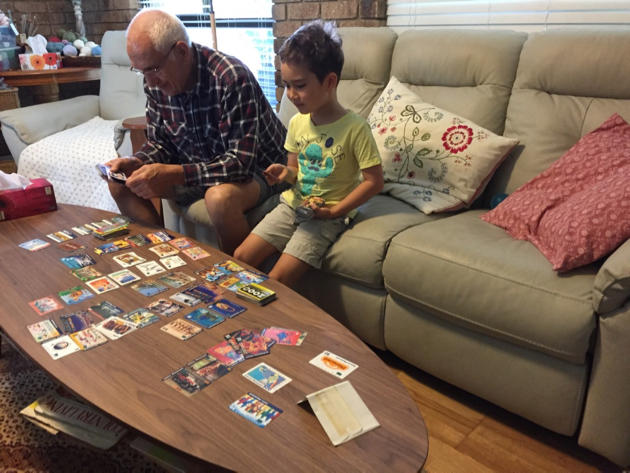
 Hanno and Jamie sorting out the phonecards Kerry used to collect when he was young.
 Sunny's birthday lunch on Saturday.

Above and below: a recent lunch - stuffed capsicums/peppers and corn.

When we were in Tasmania last year, Hanno bought a pair of cashmere and merino gloves from the wool shop at Salamanca. They're so soft and light and very warm. Hanno has had a problem keeping his right hand warm since he had an accident a couple of years ago and gloves help a lot during winter.
During a recent clean-up, I found the gloves and noticed they both had a few moth holes. I didn't have wool that matched exactly, but I had grey wool, so I set out to darn the gloves so they could be used in years to come. Darning is simply a matter of providing a surface to work on under the hole - I used a darning mushroom - and then with a darning needle, threading the needle through the threads that are still there and slowly rebuilding stitches over the hole.  If you want to learn this valuable skill, there are many videos online but I like this one because it clearly shows the process.
You can see the repaired hole above right in the middle of the glove but you can't see the other five holes I repaired. Finishing off the repair with a damp cotton cloth and a hottish iron, helps the repair blend in a bit more because it flattens the stitches.  Now I'm storing the gloves in a plastic bag and hopefully, every time they're brought out to be used in winter, they'll be ready to wear again. And again.

Most people now throw out clothing that might be saved with a small repair. And yes, I used to be one of those people, but now I'm more prudent and I understand the reason for spending a little bit of time to keep using what we have for as long as we can.  For me, it has very little to do with economics. It's more about doing as much as I can and investing my time and effort into activities which enrich to our lives here without adding to the increasing burden being shouldered by our planet.

If you visit us on any given day, we'll be repairing things around the house, cleaning, cooking, baking, growing food and generally taking care of ourselves and what we own. We could go to the shop and replace what is broken or torn but there is an exquisite art to life and I don't think consumerism is part of it. I think the art in all our lives is developed by exercising our creativity, developing our techniques and using the talents we have to sustain ourselves, even when the force of modern life tries to break through to disturb the serenity and simplicity of each day. It is an incredibly satisfying way to spend the life hours we have but a great shame that not nearly enough of us are doing it. 
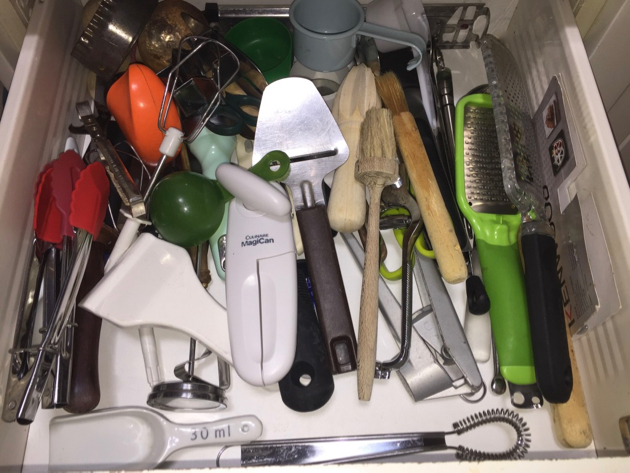
Yesterday, Clare commented on how difficult it is to keep her utensil drawer clean and tidy.  I think it's a problem for many of us. I know my drawer is always untidy and here is a photo of it.  I've tried several ways to make it a bit more organised but it never lasts so now I just frequently take everything out, clean the drawer, then put it all back in. It takes five minutes. When I do this, I take the chance to cull anything that shouldn't be there. And even though it looks untidy, it is clean and it works for me. 

Clare, I think it's good to remember that the work we do in our homes will often look like what everyone else does, but sometimes it's nothing like it, and that is okay.  When you find a solution that works for you, it doesn't matter if you're the only person who does it like that, you stick to the solutions that work. I hope you get your home set to support the way you have chosen to live. Once you've done all that work setting up, it's much easier to carry out daily chores and be content doing it.  Good luck!

It's still a busy time here at Hetzel House. We have Sunny's birthday lunch tomorrow and many days of contented activity after that. We're all getting along well together, Gracie hasn't caught Ec yet and Sunny and I are still going through cupboard, tile and floor samples and colours. No doubt Sunny will ask Sarndra's opinion tomorrow when she's here. I'm sure we'll come up with a simple and lovely home that they'll be very happy in.

I hope you have a wonderful weekend. Thanks for visiting me here during the week. xx

Young Americans turn to old-fashioned living
Modest dressing, as a virtue
How to make a cup of tea - The Victorian Way
Off grid living in a tiny cabin
Lacto-fermented hot sauce
School lunch in Japan
Leftovers
To cure affluenza, we have to be satisfied with the stuff we already own
New great ape discovered
An ode to the Aussie milk bar
A trip to Lehman Brothers store
One of the things we did during the blog break was to continue on our quest to make things accessible and easy in our home. I'd been thinking about how I could rearrange my pots, pans and baking trays to have them at hand and easy to get at. They've been sitting in a corner blind cupboard next to the dishwasher for many years and many of them were shoved to the back well out of my reach. I didn't use those pots and trays and was surprised by a few of them when they saw the light of day again.

Like many of the readers here, I do a lot of cooking and baking and my equipment must be easy to reach in the storage space I have available.  The need for that will be greater in coming years. I don't want to give up baking just because I can't reach my trays and baking tins.


We always try to use what we have here and happened to have a set of metal drawers that I bought years ago at Howards.  I've been using it to store various types of clothing and colours waiting to be washed. Hanno fit it into the cupboard space and with minor tweaking, it fit - giving me four good sized drawers to fill with my pots and pans.

But I still had bakeware and frying pans to deal with. I cleaned out the lower large drawer under the stove and placed all the frying pans in there.  They're easy to get at as they're just under the stove. Perfect!  


Then the toughest group, the bakeware. They're all different sizes - bread pans, biscuit trays, cake pans of all shapes and sizes, pizza trays, wire racks, muffin trays, quiche and tart tins. I had these in a lower cupboard but few of them were the same shape or size so they were very difficult to store. Often when I needed something, the whole lot toppled over and I felt like throwing them out. So, simple solution, I went to Howards and bought two heavy metal racks like this, and they're working brilliantly on the top and bottom shelves. Now I can see everything I have in there and it's only my bread and loaf tins that are stacked on top of each other.

This system is so easy. I can see myself working with it well into the future.  All it cost was time and effort in cleaning out the drawers and cupboards, and about $30 for the racks. I'm very pleased that I made the effort to do it because already it's made the world of difference. Do you have spaces like this in your home that need reorganising? They usually take a couple of hours work but it's time well spent if you dive into it.

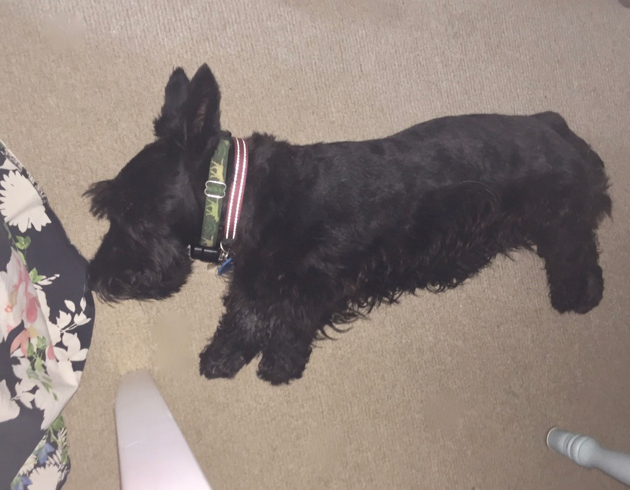
Gracie was dreaming and making little barking noises when I decided to take this photo just now. When I had the camera ready, her little eye was just slightly open, checking what I was doing. I like to think she was thinking about solving the worries of the world, or even just the neighbourhood's, but I think she was dreaming of her chicken lunch which is cooking on the stove.  ðŸ’—

BTW, that is my black floral dress near her nose.
Hello strangers. It's been like dominoes falling during these passed weeks. One thing lead to another and sometimes we didn't know if one domino or 100 would fall. But we followed our noses, did what we had to and I've come back to you with a newly renovated laundry, a freshly painted toilet, three new house guests and a cat.

I got this metal trug from Odgers and McClelland. It's very handy for storing napkins, salt, pepper and flowers on the kitchen table.

As you know, Kerry, Sunny, Jamie and his cat moved in with us to wait for work on their new home to be completed. The house is moving along nicely, the roof is on and walls are going up so that now, even if it starts raining, work can go ahead. They've been told they can move in before Christmas.  They've decluttered, cleaned out their apartment and moved in here. Their belongings are stored in our big shed, so a big portion of the work has been completed and the excitement is beginning to grow. In our newly established family of five, I've taken on the job of chief cook, not a job to be taken lightly with two chefs and a six year old to feed, and I'm slowly getting used to shopping for a family again.

Cinnamon tea cake. A great cake for lunch boxes and morning teas.

I had wondered how it would all go. I thought there'd be problems with Gracie and Ec, the cat, and I wondered how everyone would cope with me wandering around during the night when I couldn't sleep. Blending families is never easy but so far, it has been. Beds still need to be made, food cooked, shopping done, the garden and floors need tending and every day, by the time our regular home chores are done, our guests return from school and work and we all settle in again. It feels familiar and different and so far, it's been easy.

Hanno asked me to thank you all for your well wishes.  He's still not 100 percent, he's on a second course of antibiotics but says he's feeling better, although I can see he tires easily.  However, at 77 years of age, with a small amount of help from me and a handyman from Airtasker, he renovated the laundry.  That job started when I noticed that our eleven year old washing machine was leaking. Most of you know we're going through a period of reorganisation and preparedness. We're updating appliances and replacing them with water and energy efficient models so we can hopefully sail through the next decade with household equipment that supports the way we've chosen to live.


So we had a new washing machine installed, then I noticed the laundry sink and metal unit it sat on was rusting from the floor up. Hanno ripped that out and discovered there had been a leak in the wall so I was very pleased he found it and fixed the problem. A new unit was bought and he connected the waste pipes from the washing machine and air conditioner. When the new unit was up, the existing tiles didn't cover the area behind the unit so we got a handyman in to add more tiles.  He also replaced the water damaged plasterboard behind the sink unit and painted the laundry and toilet. I was so pleased to see the work completed because at one stage I was wishing we'd never started it.


We sold the old machine on Gumtree and replaced it with the Bosch model recommended by Choice magazine. For overseas readers, Choice is an Australian consumer advocacy organisation which tests and recommends products and services used in our homes.

We're all catching up on the washing that piled up for a week and the new machine is coping very well with the task. Now I'm starting to think about Sunny's 40 birthday next Saturday. We're having a cooked-from-scratch family lunch for seven adults and three children. I'm still finalising the menu and trying to decide on the birthday cake. I'll let you know more about it later and, of course, they'll be some photos on the day.

Life goes on.
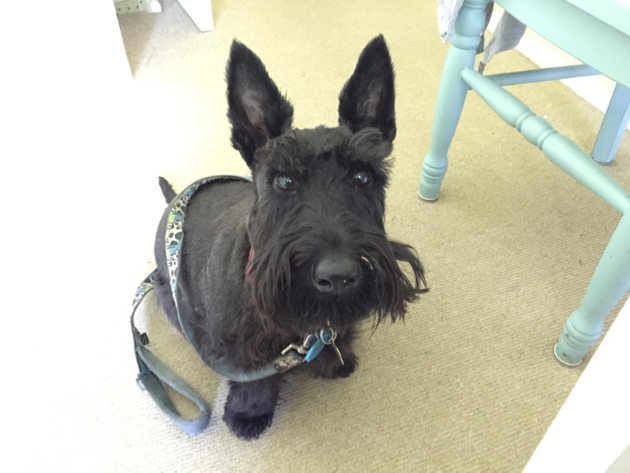
Many of you contact me about Gracie and want to know more about her. Here she is with her lead on waiting to be taken out. I'll have more Gracie news next week.

I thought I'd be back with you by now but Hanno is sick again with a bad cold that we're hoping won't turn into another bout of pneumonia. Our main focus at the moment, and what we've been preparing for these passed couple of weeks, is getting the house ready for Kerry, Sunny and Jamie to move in. I know! Big surprise, eh? Their first ever house is being built and will be ready to move into before Christmas. They're very excited about it because they've worked so hard to make it happen. The lease on the apartment they're living in now expires next week, so they'll move in with us until the house is ready for them. Both Kerry and Sunny are absolutely exhausted. They've both been working in their shops all day and taking Jamie to school and after-school activities, while working with the builders and deciding on colours and fixtures and making sure all the council requirements and paper work is done properly. And now they're packing up their apartment and decluttering after work when all they want to do is sleep. Having them here will give Hanno and I a chance to look after them during this very busy time. While they're here they won't have to do any housework, shopping or cooking and we're on hand to look after Jamie. They'll be free to work and focus on the house. I think it will be a very busy and happy time here at the Hetzel house.

I'll be back as soon as I can be. I'm not sure when that will be, possible early next week.


While I'm here I wanted to let you know that I have an article in the current edition of the PIP Australian Permaculture magazine. Here are the shops where you can pick up a copy. I'm pleased to say that the wonderful Biome shops in Brisbane stock it and if your newsagent doesn't have it, ask them to get it in for you or subscribe through the PIP website.  The magazine is full of interesting, thoughtful and educational information and it is brilliantly illustrated. My good friend Morag Gamble has her regular article on Permaculture Around the World, the feature articles are on seaweed and aquaponics, there's a family section with kids' pages and 10 Ways to Get Kids off Screens and into Nature. Add to that an excellent rundown on Crop Rotation and Rental Gardening, a Strawbale building project, Save your Seeds by Jude and Michel Fanton of the Seed Savers Network, designing a Food Forest and Homegrown Herbal Skincare. But there is much more to read for everyone interested in living our beautiful lifestyle while developing practical and traditional skills or wanting to grow food and develop self-reliance.

My congratulations to publisher/editor Robyn Rosenfeldt and the staff of PIP on the production of this excellent and practical resource. It's been published for less than three years but it has already developed into a must-read vibrant magazine.

Newer Posts Older Posts Home


My books were all published by Pengiun, and are available at Amazon US, Amazon UK and Amazon Au

Search here

Total Pageviews

Translate


I'm Rhonda Hetzel and I've been writing my Down to Earth blog since 2007. Although I write the occasional philosophical post, my main topics include home cooking, happiness and gardening as well as budgeting, baking, ageing, generosity, mending and handmade crafts. I hope you enjoy your time here.

MY FAVOURITE PLACES

  • Grandma Donna's Place
  • Grandma Donna's YouTube
  • Grandma Donna's Instagram
  • This Simple Day
  • Nicole's Instagram

Give More

Give More

Popular posts last year

Making ginger beer from scratch

We had a nice supply of ginger beer going over Christmas. It's a delicious soft drink for young and old, although there is an alcoholic version that can be made with a slight variation on the recipe. Ginger beer is a naturally fermented drink that is easy to make - with ginger beer you make a starter called a ginger beer plant and after it has fermented, you add that to sweet water and lemon juice. Like sourdough, it must ferment to give it that sharp fizz. To make a ginger beer plant you'll need ginger - either the powdered dry variety or fresh ginger, sugar, rainwater or tap water that has stood for 24 hours to allow the chlorine to evaporate off. You'll also need clean plastic bottles that have been scrubbed with soap, hot water and a bottle brush and then rinsed with hot water. I never sterilise my bottles and I haven't had any problems. If you intend to keep the ginger beer for a long time, I'd suggest you sterilise your bottles. MAKING THE STARTER In a...
Image

NOT the last post

This will be my last post here.  I've been writing my blog for 18 years and now is the time to step back. I’ve stopped writing the blog and come back a couple of times because so many people wanted it, but that won’t happen again, I won’t be back.  I’ll continue on instagram to remain connected but I don’t know how frequent that will be. I know some of you will be interested to know the blog's statistics. 
Image

How to make cold process soap

I'm sure many of you are wondering: "Why make soap when I can buy it cheaply at the supermarket?" My cold process soap is made with vegetable oils and when it is made and cured, it contains no harsh chemicals or dyes. Often commercial soap is made with tallow (animal fat) and contains synthetic fragrance and dye and retains almost no glycerin. Glycerin is a natural emollient that helps with the lather and moisturises the skin. The makers of commercial soaps extract the glycerin and sell it as a separate product as it's more valuable than the soap. Then they add chemicals to make the soap lather. Crazy. Making your own soap allows you to add whatever you want to add. If you want a plain and pure soap, as I do, you can have that, or you can start with the plain soap and add colour, herbs and fragrance. The choice is yours. I want to add a little about animal and bird fat. I know Kirsty makes her soap with duck fat and I think that's great. I think t...
Image

Preserving food in a traditional way - pickling beetroot

I've had a number of emails from readers who want to start preserving food in jars but don't know where to start or what equipment to buy.  Leading on from yesterday's post, let's just say up front - don't buy any equipment. Once you know what you're doing and that you enjoy preserving, then you can decide whether or not to buy extra equipment. Food is preserved effectively without refrigeration by a variety of different methods. A few of the traditional methods are drying, fermentation, smoking, salting or by adding vinegar and sugar to the food - pickling. This last method is what we're talking about today. Vinegar and sugar are natural preservatives and adding one or both to food sets up an environment that bacteria and yeasts can't grow in. If you make the vinegar and sugar mix palatable, you can put up jars of vegetables or fruit that enhance the flavour of the food and can be stored in a cupboard or fridge for months. Other traditional w...
Image

Cleaning mould from walls and fabrics

With all this rain around we've developed a mould problem in our home. Usually we have the front and back doors open and that good ventilation stops most moulds from establishing. However, with the house locked up for the past week, the high humidity and the rain, mould is now growing on the wooden walls near our front door and on the lower parts of cupboards in the kitchen. Most of us will find mould growing in our homes at some point. Either in the bathroom or, in humid climates, on the walls, like we have now. You'll need a safe and effective remedy at some point, so I hope one of these methods works well for you. Mould is not only ugly to look at, it can cause health problems so if you see mould growing, do something about it straight away. The longer you leave the problem, the harder it will be to get rid of it effectively. If you have asthma or any allergies, you should do this type of cleaning with a face mask on so you don't breathe in any spores. Many peopl...
Image

Five minute bread

Bread is one of those foods that, when made with your own hands, gives a great deal of satisfaction and delight. It's only flour and water but it symbolises so much. I bake bread most days and use a variety of flours that I buy in bulk. Often I make a sandwich loaf because we use most of our bread for lunchtime sandwiches and for toast. Every so often I branch out to make a different type of loaf. I have tried sour dough in the past but I've not been happy with any of them. I'll continue to experiment with sour dough because I like the idea of using wild yeasts and saving the starter over a number of years to develop the flavour and become a part of the family. However, the loaf I've been branching out to most often is just a plain old five minute bread. By five minutes I mean it takes about five minutes actual work to prepare but it's the easiest of all bread to make and to get consistently good loaves from. If you're having people around for lunch or...
Image

This is my last post.

I have known for a while that this post was coming, but I didn't know when. This is my last post. I'm closing my blog, for good, and I'm not coming back like I have in the past.  I've been writing here for 16 years and my blog has been many things to me. It helped me change my life, it introduced me to so many good people, it became a wonderful record of my family life, it helped me get a book contract with Penguin, and monthly columns with The Australian Women's Weekly and Burke's Backyard . But in the past few months, it's become a burden. In April, I'll be 75 years old and I hope I've got another ten years ahead. However, each year I'll probably get weaker and although I'm fairly healthy, I do have a benign brain tumour and that could start growing. There are so many things I want to do and with time running out, leaving the blog behind gives me time to do the things that give me pleasure. On the day the blog started I felt a wonderful, h...
Image

What is the role of the homemaker in later years?

An email came from a US reader, Abby, who asked about being a homemaker in later years. This is part of what she wrote: "I am a stay-at-home mum to 4 children, ages 9-16. I do have a variety of "odd jobs" that I enjoy - I run a small "before-school" morning drop-off daycare from my home, I am a writing tutor, and I work a few hours a week at a local children's bookstore. But mostly, I cherish my blissful days at home - cooking, cleaning (with homemade cleaners), taking care of our children and chickens and goats, baking, meal-planning, etc. This "career" at home is not at all what I imagined during my ambitious years at university, but it is far more enriching. I notice, though, that my day is often planned around the needs of my family members. Of course, with 4 active kids and a husband, this is natural. I do the shopping, plan my meals, cook dinner - generally in anticipation of my family reconnecting in the evening.  I can't h...
Image

Every morning at home

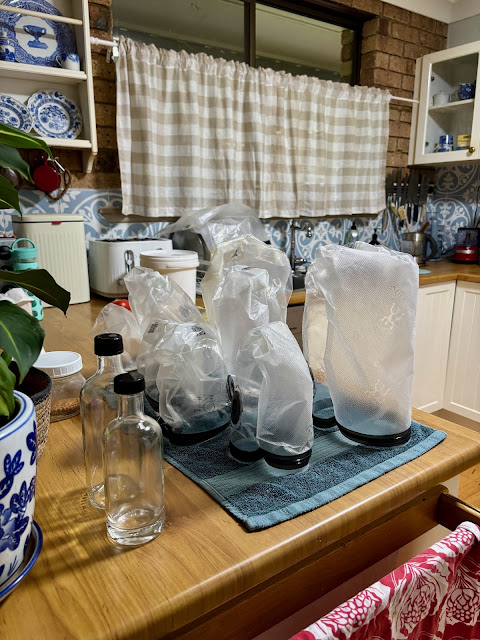
Every morning when I walk into my kitchen it looks tidy and ready for a day's work. Not so on this morning (above), I saw this when I walked in. Late the previous afternoon when I was looking for something, I came across my rolled up Zwilling vacuum bags and decided they had to be washed and dried. So I did that and although I usually put them outside on the verandah to dry it was dark by then. I turned the just-washed bags inside out and left them like this on a towel. It worked well and now the bags are ready to use when I bring home root vegetables, cabbages or whatever I buy that I want to last four or five weeks.
Image

You’ll save money by going back to basics

When I was doing the workshops and solo sessions, I had a couple of people whose main focus was on creating the fastest way to set up a simple life. You can't create a simple life fast, it's the opposite of that It's not one single thing either - it's a number of smaller, simpler activities that combine to create a life that reflects your values; and that takes a long to come together. When I first started living simply I took an entire year to work out our food - buying it, storing it, cooking it, preserving, baking, freezing, and growing it in the backyard. This is change that will transform how you live and it can't be rushed.  
Image


Trending Articles

NOT the last post

This will be my last post here.  I've been writing my blog for 18 years and now is the time to step back. I’ve stopped writing the blog and come back a couple of times because so many people wanted it, but that won’t happen again, I won’t be back.  I’ll continue on instagram to remain connected but I don’t know how frequent that will be. I know some of you will be interested to know the blog's statistics. 
Image

Every morning at home

Every morning when I walk into my kitchen it looks tidy and ready for a day's work. Not so on this morning (above), I saw this when I walked in. Late the previous afternoon when I was looking for something, I came across my rolled up Zwilling vacuum bags and decided they had to be washed and dried. So I did that and although I usually put them outside on the verandah to dry it was dark by then. I turned the just-washed bags inside out and left them like this on a towel. It worked well and now the bags are ready to use when I bring home root vegetables, cabbages or whatever I buy that I want to last four or five weeks.
Image

You’ll save money by going back to basics

When I was doing the workshops and solo sessions, I had a couple of people whose main focus was on creating the fastest way to set up a simple life. You can't create a simple life fast, it's the opposite of that It's not one single thing either - it's a number of smaller, simpler activities that combine to create a life that reflects your values; and that takes a long to come together. When I first started living simply I took an entire year to work out our food - buying it, storing it, cooking it, preserving, baking, freezing, and growing it in the backyard. This is change that will transform how you live and it can't be rushed.  
Image

Creating a home you'll love forever

Living simply is the answer to just about everything. It reduces the cost of living; it keeps you focused on being careful with resources such as water and electricity; it reminds you to not waste food; it encourages you to store food so you don't waste it and doing all those things brings routine and rhythm to your daily life. Consciously connecting every day with the activities and tasks that create simple life reminds you to look for the meaning and beauty that normal daily life holds.  It's all there in your home if you look for it. Seemingly mundane tasks like cleaning and cooking help you with that connection for without those tasks, the home you want to live in won't exist in the way you want it to.  Creating a home you love will make you happy and satisfied.
Image

Time changes everything

I've been spending time in the backyard lately creating a contained herb and vegetable garden. My aim is to develop a comfortable place to spend time, relax, increase biodiversity and encourage more animals, birds and insects to live here or visit. Of course I'd prefer my old garden which was put together by Hanno with ease and German precision. Together, we created a space bursting at the seams with herbs, vegetables and fruity goodness ready to eat and share throughout the year. But time changes everything. What I'm planning on doing now, is a brilliant opportunity for an almost 80 year old with balance issues. In my new garden I'll be able to do a wide range of challenging or easy work, depending on how I feel each day. It’s a daily opportunity to push myself or sit back, watch what's happening around me and be captivated by memories or the scope of what's yet to come.
Image

It's the old ways I love the most

I'm a practical woman who lives in a 1980’s brick slab house. There are verandahs front and back so I have places to sit outside when it's hot or cold. Those verandahs tend to make the house darker than it would be but they're been a great investment over time because they made the house more liveable. My home is not a romantic cottage, nor a minimalist modern home, it's a 1980’s brick slab house. And yet when people visit me here they tell me how warm and cosy my home is and that they feel comforted by being here. I've thought about that over the years and I'm convinced now that the style of a home isn't what appeals to people. What they love is the feeling within that home and whether it's nurturing the people who live there.
Image

Making ginger beer from scratch

We had a nice supply of ginger beer going over Christmas. It's a delicious soft drink for young and old, although there is an alcoholic version that can be made with a slight variation on the recipe. Ginger beer is a naturally fermented drink that is easy to make - with ginger beer you make a starter called a ginger beer plant and after it has fermented, you add that to sweet water and lemon juice. Like sourdough, it must ferment to give it that sharp fizz. To make a ginger beer plant you'll need ginger - either the powdered dry variety or fresh ginger, sugar, rainwater or tap water that has stood for 24 hours to allow the chlorine to evaporate off. You'll also need clean plastic bottles that have been scrubbed with soap, hot water and a bottle brush and then rinsed with hot water. I never sterilise my bottles and I haven't had any problems. If you intend to keep the ginger beer for a long time, I'd suggest you sterilise your bottles. MAKING THE STARTER In a...
Image

An authentic look at daily life here — unstaged and real

Most days Hanno was outside happily working in the fresh air. It may surprise you to know that I started reading my book,  Down to Earth , yesterday - the first time since I wrote it 13 years ago.  I had lent it to my neighbor, and when she returned it, I started reading, expecting to find surprises. Instead, I realised the words were still familiar—as if they were etched into my memory. As I flipped through the pages, I was reminded of how important it was for me to share that knowledge with others. The principles in Down to Earth changed my life, and I truly believed they could do the same for others. After just 30 minutes of reading, I put the book down, reassured that its message still holds true: we can slow down and reshape our lives, one step at a time.
Image