down to earth

  • Home
  • About Us
  • Down To Earth Book
  • Privacy Policy
Hanno asked me to pass on his thanks for all the good wishes you sent.  Reading through your comments made him feel better.  He's still weak but his chest has cleared and it looks like he's on the road to recovery. Thank you all for your thoughtfulness.

 The delicate and tiny Cecile Brunner rose.

There is no doubt about it, old roses are bullet-proof. When Hanno took down our ancient wobbly wooden arbour in the front garden, we got rid of the wisteria and moved the 20 year old Cecile Brunner rose. I hoped it would survive but I wasn't sure. The transplanting procedure was typical - we carefully dug it up and let it sit in a bucket of diluted seaweed solution. When it was planted again - this time in the vegetable garden fronting the chicken run - it was watered in with seaweed and watered every day.  That was a month ago. I hadn't seen any signs of life and took my trusty garden knife out to check the cambium layer; that is the layer under the bark where moisture and nutrients travel through the rose. It was moist and healthy so I knew Cecile was still alive, she just needed more time. Yesterday, I noticed the first shoots on both trunks and now I have visions of Cecile Brunner establishing herself along that back fence, providing me with a beautiful backdrop over the wire chook fence. Every time I see a Cecile Brunner rose, I think of my mother who grew her Cecile rose along the side fence. It's such a beautiful reminder to have in the backyard.

I transplanted some of the Welsh onions to make way for Cayenne chilli bushes. This bunch was divided into eight clumps.
Another basket of delicious tomatoes.
I've spent the last couple of weeks working in the garden and sitting in the shade thinking about the plants and the coming hot weather.  I've finished doing all I can do now. I'm hoping that as it gets hotter, the mulch will keep the weeds down and the water in the soil. Everything that needs it is cut back, tied up, fertilised and ready for Spring.  Don't forget to get out and do some pre-summer jobs in your garden if you have the time. Just about everything will benefit from a cut back, vines and tomatoes need to be supported and tied back and if you're in Australia, it's the ideal time to fertilise.  I've just added liquid potash, organic pellets and liquid seaweed and fertiliser to the entire back garden. It will make a big difference in the coming days and weeks and the plants will go into renewed growth much healthier and better able to cope with the heat.


I'll stop gardening when the humidity returns some time in November. When it's humid, there are lots of bugs and it's too hot to be outside for long periods. Then I'll put it all to bed for a few months and start up again in March next year. But until then I can keep harvesting parsley, thyme, dill, rosemary, basil, mint, oregano, bay, green leaves, tomatoes, cucumbers and chillies.  I've ripped out all the large tomato plants and we're continuing along with two cocktail tomatoes, about golf ball size, and one cherry tomato. In future years we'll only grow small tomatoes because we have too many problems with the beautiful large heirlooms.  We don't have fruit fly but we've always had a night-visiting moth that sucks juice from large tomatoes. It seems to have been worse the last couple of years so I'm giving up and staying with the smaller varieties.

This is the new edging around one of the orange trees. It's holding in the mulch.

The citrus are thriving and they're very important to us. We always get a huge return on the work we put into our lemons and oranges.  I've put up a small border around two of our Washington navels and filled in with organic sugar cane mulch. We also have a late orange - Lane's Late - which is starting to grow well and will extend our orange season by a couple of months. One of our Eureka lemons has had a boron deficiency - brown patches in the flesh - so I've given them all a dose of trace elements that should  fix it. Hanno balanced out the other side of our old lemon tree by cutting off the old branches and now it's looking better than it has for many years.


I was going to plant cucumbers in the trellis garden where we grew berries last year but I don't have the will or the strength to dig up the hard soil there. I'll plant the cucumbers over the garden arch this year and let the berries come through again. I'm learning to be very flexible with my gardening plans. ;- )


The garden looks quite bare now although there are still lots of greens. I've harvested a lot of tomatoes and herbs and pruned back the roses. Everything should start growing strongly when the warmer weather starts again. It feels good to have done this garden work. It's a long time since I've had sole responsibility for the garden but when I packed up my trolley and brought in the garden tools and hose, it felt good. It was certainly time well spent.

Have you done any work in your garden lately?
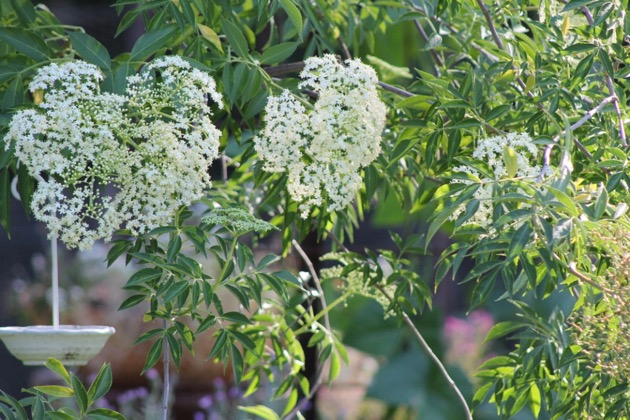

There are a lot of elderflowers this year.

Hanno hasn't been well and during the week he was diagnosed with pneumonia, again. This is the second time in 18 months. He also had an internal bleed due to his Warfarin levels being too high - apparently a side effect of the antibiotics. He's going through the process of healing now, taking it slow, breathing in clean air, eating nourishing food and getting back in shape for his birthday next month. He'll be 77.

With Hanno out of action I've been doing a bit more work here which, of course, takes more time.  At the moment I'm trying to get the garden and bush house ready for summer. I'm on target to do that which will make things easier for us later when the hot weather returns.  We've had a sneak preview of that the past couple of days with our temperature here rising to 31C yesterday after a very warm week.

I hope things have been good in your neck of the woods. Thanks for your visits this week, enjoy your weekend and don't forget to stop a few times during the day to appreciate what it is you're working for.  See you next week. 💕

Is it safe to reuse plastic containers for food shopping and takeaway meals?
Ham and cheese lunch box muffins
How cooking can change your life - Michael Pollan
Fact sheets - pests, diseases and weeds - Australia
Identify the pest
Sandwich spreads
Inner Pickle blog is back! For those of you who know Fiona, she's blogging again, for those who have no idea, click on the link and get acquainted. She returns with her passionfruit slice recipe. Yum!
Laundry line tips from an old hat
Simply by the beach blog
Amy left this comment a few days ago:
Can you do a post or point me to resources about how to love hard work? I'm finding that being a wife, mother, and grown up is frankly a lot harder than I thought it would be! I keep trying to look for solutions (usually via some gadget/ something convenient to buy) but I'm realizing it's just plain hard. Need some help "digging in" and expecting/ enjoying the work...even the small stuff.

Amy, I doubt you can be taught how to love hard work. You either love it or you don't. I think the real point of this post will be to work out how you get to the point where you want to do the work. I know nothing of your circumstances but I do know this. If you want to live in a clean house you have to clean it, if you want to get into a comfy bed at night, you have to make it in the morning, if you want clean clothes, you have to do the laundry, if you want to eat nourishing food, you have to grow or buy it and learn how to store and cook it. And when you've finished cooking, you have to clean up. Unless you're wealthy and can pay others to look after you, the time has come for you to step up, work out what you want for yourself and your family, and then do the work to make it happen.


From what I can see, you have two choices. Either decide it's all too hard and stay as you are, or think about the kind of life you want, decide on what values are important to you and start changing.  The first option will be easy now and become more difficult later, the second option will be difficult now but will become easier as you learn more. Being a grown up is hard, being a mother is the toughest thing I've ever done, but the rewards are significant and beautiful. If I can do it, you can too.  So sit down with your partner and work out your priorities.


The main things you'll need to focus on are living on a budget, saving for a home and creating a sustainable and thrifty home and lifestyle. And within that framework, you'll simplify your mindset, live a slower life and show your child, by example, that you don't have to work until you drop to pay for products, produced in their millions, which end up in landfill. You don't say if you're going out to work but if you are, the housework is something you should share with your partner.  If you're at home looking after your child, make that and your home your career. Run your home like a small business, with your partner earning the money and you using that money to build the life you both want. There are many ways you can move away from the mainstream model of what "normal" life is nowadays. You'll be able to make things you used to buy, use fewer chemicals in your home, cook from scratch, mend and recycle. By doing those things, slowly but surely, you'll create a new life.


As you do all those things, you'll develop routines and become more organised.  If you read through my blog and a few others, you'll learn how to make shortcuts that will make you more efficient. You'll develop a new strategy for your grocery shopping, set spending targets that are lower than what you're used to and then use the money you'll save for a home deposit or to pay off debt you may already have. It's all within your reach but you'll have to have a clear vision of the life you want to live and you'll have to change your attitude. I've listed a few of my older posts below to help you get started but there are a lot of other posts there that are exactly what all this is about. I hope you take the time to read some of them and then put your plan in action.  It won't be easy but it will get easier and I think you'll grow to love your new life. Good luck and keep in touch.

The secret life of a happy homemaker
I want to die happy
Housework
Daily routines and seasonal rhythms
The warm embrace of self reliance

Last week Donna commented that she and her husband will soon be first time grandparents and wondered if I had any tips to pass on.  Of course I'm happy to share my own experience of being a grandma but I think that every grandmother-grandchild relationship is unique and even though there are many similarities, there are just as many differences. Children are wildly different too. What works with one grandchild, won't work on another, so you tear up the guide book and reinvent the strategy for each child. It's also worth remembering that times have changed since we raised our children and while that doesn't mean that everything is different, most things are and you'll need to be guided by the parents and do a bit of reading yourself.

These are my boys at age four and five.

It's a wonderful thing to live long enough to be able to hold your grandbaby in your arms. You get a sense of pleasure and duty but it also gives you an extremely clear perspective on your place within your family, both living and dead. I started researching my genealogy 37 years ago when my children were born but I didn't understand my significance in my family's story until my grandchildren came along. It's good for your grandchildren to know how they fit in their family history too.

Becoming a grandmother is overwhelming, mysterious, thrilling, exciting, terrifying, the most unimaginable thing and the most natural thing all at the same time. Everyone has their own take on it but no one forgets that first look on the day it all starts. I think it's my responsibility to love each of my three grandchildren, to show them respect, kindness, strength, intelligence and unconditional acceptance and love. I try harder and walk taller when they're here with me. I try to show them that I'm a hard worker, that I do what I can for myself, that I'm optimistic and content and that they make me happy. I help them solve problems, I show them how to do practical things and I teach by example.


But in those first few months, it's not only the new baby that needs nurturing; it's the parents too. They're learning how to be parents, they have the bulk of the work and they usually don't get much sleep. If you can offer practical help in the form of babysitting so they can have some time together, catch up on sleep, or just do the housework, those gestures help develop better relationships while providing practical help.

You don't need to keep much at your place but I've found it's wise to have a spare baby bottle and sippy cup in the cupboard. Buy a couple of books to read and a little teddy bear and if you have a quiet space where baby can sleep in those first few months, it will help. Take the lead from the parents on nappies - it's quite common for parents to use disposable nappies so don't lecture them if you'd prefer they used cloth nappies. Remember, this is not your baby. Think back to how you would have felt if you mother or mother-in-law told you you should be doing X when all you could manage was Y. New parents need support and help, not confrontation.


But having said that, don't be a doormat for your children either. If you're asked to babysit and you can't do it, or don't want to do it, let them know. We have a really good relationship with our kids and even now, after six years of babysitting when we're needed, our kids still ring and ask if we can look after our grandkids. They never take it for granted, and they always thank us when they leave.

I guess to sum it up, give as much as you can in the form of practical help without feeling miserable about it.  Remember that generally the more time you spend with your grandchildren the closer you'll be. Don't expect them to feel instant love, they'll have to get used to you, they'll have to spend time with you and if you can develop a strong bond with them without it involving toys and gifts, you'll be on the right track. But most of all just enjoy those new babies as they arrive and be the kind of help you'd wished for when you were a new mum. Congratulations new grandma. You're in for the ride of your life.

I wonder what the other grandmothers here will tell you.

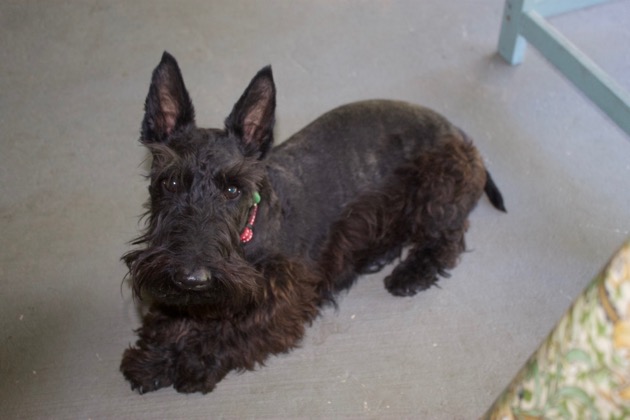
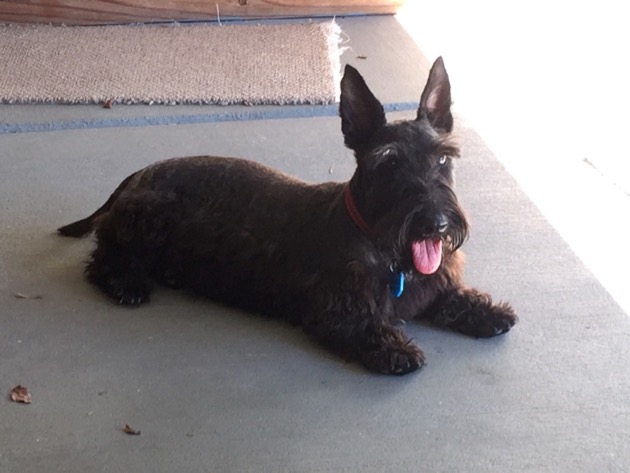
This photo was taken yesterday afternoon as Gracie was posing on the verandah.

Happy birthday to our dear Gracie who is one year old today.  We're taking her to the beach for lunch and a run around. Despite her outbursts of craziness, we both love her dearly. She's unlike any other dog we've had before and we're looking forward to many years of Gracie antics ahead.

==  ❤️ ==

If I had to name this dish I'd probably call it chicken fricassee but it's not the traditional recipe for fricassee.  This is, however, a lightish, delicious and easy to cook chicken stew which makes its own stock as it cooks.  It's popular with children as well as adults, it's a good winter all rounder.

You can use either chicken pieces with the bone in or a whole chicken. I use a whole chicken because it's cheaper; I always use free range chicken. If you have a whole chicken, using a sharp knife and chicken shears, cut along both sides of the spine, then snip it along the cut to remove the spine. Don't discard it, it goes in the stew to help develop flavour in the stock. If you have boneless chicken pieces, use them with a good homemade chicken stock.


INGREDIENTS:
1 whole chicken cut into portions, or 8 chicken pieces with bone in. After removing the spine, cut off the wings, cut each of the breasts in half, cut the legs from the thighs. This will give you 8 portions plus the wings.

1 cup plain/all purpose flour
salt and pepper to taste (about 1 teaspoon salt and ½ teaspoon pepper)
1 tablespoon paprika
Olive oil for cooking
1 large onion, diced
2 medium carrots, chopped
2 celery sticks, chopped
4 medium potatoes, cut in quarters
½ cup parsley, finely chopped
3 sprigs thyme
2 bay leaves

Mix the flour, salt, pepper and paprika together and coat each chicken piece. Place olive oil in frying pan and brown each coated chicken piece. Add the chopped vegetables and all the bones removed when you portioned the chicken. Add a litre of water and mix. Add the herbs.

Put the lid on, bring to the boil, and then place in the oven to cook slowly (about 150C/300F) for two hours. About an hour later, add some potatoes.  Yes, you can use the slow cooker instead of the oven.

As it cooks the sauce will thicken. Make sure you cook this slowly to retain the moisture. A fast cook will dry out the meat.  Serve with a green vegetable.

I hope you enjoy it.

I fear there is a dumbing down battle going on. It's there in food - why would we want to cook for ourselves when there are constantly changing, easy products to buy and heat up? It's there in clothes - most of us have lost the dressmaking and mending skills our great grandmothers had. It's there in general daily life where there is a constant buzz from the social media peanut gallery made up of criticism, self-rightiousness, inane comments and fake concern for, well, you name it, just about everything.  Busyness and distractions are highly prized, shopping is an entertainment rather than a necessity and there is constant pressure to follow instead of lead. Gone are the days when we were encouraged by our elders, friends, politicians and neighbours to do our best, help out, create community, cherish uniqueness and try to do better and be better. We are now learning you are what you own.

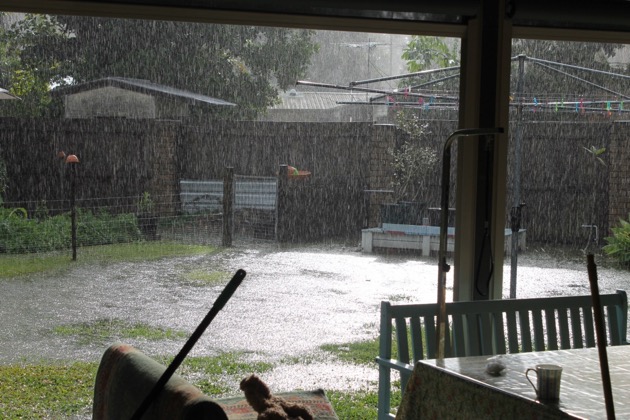
A torrential downpour on Sunday afternoon.

I think simple life is a safe haven for those of us who refuse to be dumbed down and who want to continue learning and developing ourselves all through life. School and university are the launching pads for learning but it certainly doesn't stop there. Once we have our basic education, then we have the abilities and reason to learn about the things we want in our lives. That might be home skills, traditonal skills, craft skills, developing creativity and productivity or nurturing a family, but it could also be a career with an emphasis on calmness and sustainability at home. There are always choices along the way and it is only through building your skills and knowledge that you'll be able to make the best choices for you and your family. If you take learning and self-development seriously and if you use it to enrich your home and career then you're well on your way to living the kind of splendid life that we dream about in our younger years.


The choices are key here. Instead of following a straight and monotonous "normal" path, we can step away from that to embrace learning, independence, daily contemplation, critical thinking and individual choice. Sometimes we take the easy path, sometimes the difficult one, and each day, small step by small step, we move through life. There are times when we stop and reevaluate what we're doing, sometimes small adjustments or huge leaps are made but if we resist the noise of modern life and stay focused on our own life being a work in progress, then these periods of adjustment help us continue along the road less travelled.


Having lived through six decades I'm about to move into the most challenging one. It's not easy growing old but it's certainly better than dying young. I don't want to live a fake life where I buy everything I need and take the path of least resistance. That kind of life is always partnered by the work it takes to pay for it and a huge amount of waste. I want a life that is challenging and interesting. I want to work for what I get. I want to sit in the sun when I feel like it, grow food, take cuttings, mend the things I love and do as much for myself as is possible. I'm slowing down now because of my age but I'm not ready now, or ever, to be non-productive. 


What stage of life are you at?  What are you doing with your days? Remind me of that exhilarating phase, that lasted many years for me, when I went to bed thinking about tomorrow's plans and wanting the hours to pass quickly so I could be catapulted out of bed to face the new day. I miss that.

 Who?  Me!

Hanno's been been hit with a bad cold this week so things have been quietly busy here.  I'm hoping  I don't get sick too, so far it's looking good. We're still having trouble with Gracie at night when we're asleep. Most nights are good but then she'll go crazy and destroy whatever she can find. She's now sleeping in the kitchen in her dog box and she's tethered to the wall. Luckily she loves her new bed so we'll just have to keep our fingers crossed and hope she settles down.

This week I'm delighted to give you the blog addresses of a group of women who did an online blog workshop with me recently.  I think they've all started off well and present interesting blogs, which show us, yet again, how different we all are while being very similar. Please visit these new blogs and take the time to leave a comment. Comments encourage bloggers to continue writing and help build online communities of like-minded people. The list is below, I hope you enjoy these blogs and add them to your daily reads.

A Simple Living Journey
A Truly Content Life
Fig Tree Creek Permaculture
Life after 50, Fitness, Leisure
Diva Farm Days
Home is my Haven
The Awakened Soul
Sock Knitting Mama
Creativity Grows Here

Regular news links ...
The 13 step digital declutter
Life skills all school kids should learn
What are you really getting if you buy "free-range"?
Turmeric pickled eggs
How many times can you reheat leftovers?
Last Friday morning we set off up the mountain to buy vegetable seeds at Green Harvest. After driving through Maleny we were surrounded by rolling hills and many small homesteads along the way.  So many of these homes are on large blocks where the owners take advantage of the space with chooks, goats or a house cow, as well as a thriving kitchen garden. It's a lovely drive. I've visited Green Harvest many times over the years when the shop was in Maleny, this was to be the first visit to their new store and garden at Witta.  What a treat it was. The garden is bigger than I expected it to be and we happily wandered the garden paths looking, touching and smelling a very wide range of plants. You would not see many of these plants in a regular nursery.

Gracie will lead you around the Green Harvest garden.  Hold on to your hat.

The garden wraps itself around the side of the shop.


Red/purple kale.

These are pigeon peas. We used to grow these up until a few years ago. They're a great addition to the backyard especially if you have chooks. They make a great feed for chickens and you can use the dried peas to make pea soup, in much the same way you use yellow split peas.

I loved that the garden was very much a productive kitchen and medicinal garden. I'm disappointed when I visit a garden that is manicured and clipped to within an inch of its life.  I want authenticity in the gardens I visit. A wild and thriving garden is much more interesting and satisfying to me than a neat and clipped one. As we walked around I saw plants I knew as well as many I didn't know. If you're new to gardening, I'm sure a visit to this garden would help you. The plants in the garden are named, the staff are keen to help and as well as the seeds, there are a number of seedings and cuttings on display that you can buy.

When you grow open pollinated or heirloom vegetables, you can collect the seeds to sow the following season.  Above and below are the basil seeds I collected from our plants last week. Not only is it a cheaper option to garden this way, but the plants you grow from open pollinated seeds from your own garden will be better adapted to your local conditions.   

When you visit the Green Harvest website, you'll see it's not just an online shop, it's a valuable resource built to help new and seasoned gardeners. Green Harvest is owned and run by Frances and Jeff Michaels and Frances has been writing and encouraging fellow gardeners with her vast horticultural knowledge since they opened in 1992. There is a wide range of information about vegetables, herbs, fruit and permaculture online and Frances has always maintained accurate and relevant information there for all to read.  But visiting the garden where many of the seeds come from is enlightening and a great encouragement to go home and start digging.  I have visited a few heirloom seed gardens in other states but none came close to the motivation I felt at this wonderful place.

These are the seeds I bought at Green Harvest, along with the Give Bees a Chance collection of flower seeds Jeff wanted me to try. They would be fabulous if you have a bee hive or two but also a valuable addition to the collection of local flowers bees visit near your home.

You can sign up for the annual Australian Organic Gardening Resource Guide here and find many of the answers you're searching for here in Green Garden Notes. Both of these invaluable guides are provided free by Green Harvest. The Green Harvest shop is located at 9 Gumland Drive Witta, which is on the western side of Maleny, and is open Monday to Friday from 9am - 5pm.  It would be a great day out if you drove up from Brisbane or the Sunshine Coast. Don't forget to pack a thermos and a sandwich because there are plenty of places along the way to pull off the road, but there is a coffee shop next door if you get caught short.

I am not affiliated with Green Harvest at all but have found Frances, Jeff and their staff to be generous and genuine with a fine community spirit.  I have bought goods from them online and in person and recommend them to you as a business that always provides excellent products and service.


This season's first tomato harvest. I pick these when they're green to avoid the tomato grub. We can leave the cocktail tomatoes on the plants longer, but these are better ripening on the kitchen bench.

Gracie struck again. 😧  I got up at 3am a couple of nights ago and when I walked into the hallway, I walked on something odd. It was rice! Gracie found the rice bag I made for Hanno's balance exercises, tore into it and sprayed rice over three rooms. She also climbed onto the couch so she could reach my knitting basket, pulled out three circular knitting needles, chew them so the plastic broke, chewed an embroidery hoop and embroidery, narrowly missing a sharp needle, played with some knitting cotton and chewed on a number or pamphlets sitting on the coffee table. She was manic, running up and down the hall and only calmed down when I sat down at the computer and ignored her. After ten minutes of running, she sat down and went to sleep. She can't roam the house when we're in bed now. Last night she spent the first night on her bed in my craft room with the door closed. It went well. I have a few adjustments to make today, mainly moving electrical cables. From now on, she'll be confined to that one space overnight. Fingers are crossed.

Thanks for your comments this week. I do enjoy reading them and appreciate the time you take connecting with me. I hope to see you again next week. 

The Wartime Kitchen and Garden
Superannuation: Women on track to retire with half as much as men
Goats, bonfires and eggs: four city slickers head for the farm
This made me feel a bit sick and very disappointed: How tea bags are made
Tomato caterpillar
Gardening jobs for August (Australia)
Hokkaido Milk Toast
Top 10 embroidery blogs
Learn hand embroidery with helpful stitch instructions
Appalachian English
Laundry line tips from an old hat


Many of us are trying to cut back on plastic by looking for substitutes for plastic wrap to cover food that is stored in the fridge. If you have a look in your local op shop or antique shop, you'll probably find china lids that used to sit on top of old serving pots. Usually, you can buy them for a couple of dollars. They make excellent covers for modern bowls and can be used over and over again. Or just look in your saucepan cupboard. You might find a saucepan lid just the right size for your bowl of leftover potato salad or fresh strawberries. If the seal isn't quite right, cover the top of the bowl with a square of moist cloth or a piece of baking paper and then place the lid on it. Most food will store well in the fridge for a couple of days using this method.
Newer Posts Older Posts Home


My books were all published by Pengiun, and are available at Amazon US, Amazon UK and Amazon Au

Search here

Total Pageviews

Translate


I'm Rhonda Hetzel and I've been writing my Down to Earth blog since 2007. Although I write the occasional philosophical post, my main topics include home cooking, happiness and gardening as well as budgeting, baking, ageing, generosity, mending and handmade crafts. I hope you enjoy your time here.

MY FAVOURITE PLACES

  • Grandma Donna's Place
  • Grandma Donna's YouTube
  • Grandma Donna's Instagram
  • This Simple Day
  • Nicole's Instagram

Give More

Give More

Popular posts last year

Making ginger beer from scratch

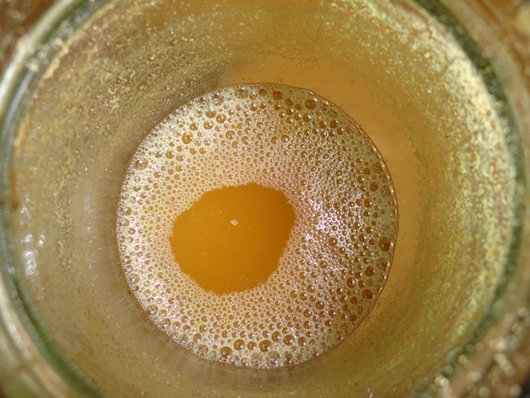
We had a nice supply of ginger beer going over Christmas. It's a delicious soft drink for young and old, although there is an alcoholic version that can be made with a slight variation on the recipe. Ginger beer is a naturally fermented drink that is easy to make - with ginger beer you make a starter called a ginger beer plant and after it has fermented, you add that to sweet water and lemon juice. Like sourdough, it must ferment to give it that sharp fizz. To make a ginger beer plant you'll need ginger - either the powdered dry variety or fresh ginger, sugar, rainwater or tap water that has stood for 24 hours to allow the chlorine to evaporate off. You'll also need clean plastic bottles that have been scrubbed with soap, hot water and a bottle brush and then rinsed with hot water. I never sterilise my bottles and I haven't had any problems. If you intend to keep the ginger beer for a long time, I'd suggest you sterilise your bottles. MAKING THE STARTER In a...
Image

NOT the last post

This will be my last post here.  I've been writing my blog for 18 years and now is the time to step back. I’ve stopped writing the blog and come back a couple of times because so many people wanted it, but that won’t happen again, I won’t be back.  I’ll continue on instagram to remain connected but I don’t know how frequent that will be. I know some of you will be interested to know the blog's statistics. 
Image

How to make cold process soap

I'm sure many of you are wondering: "Why make soap when I can buy it cheaply at the supermarket?" My cold process soap is made with vegetable oils and when it is made and cured, it contains no harsh chemicals or dyes. Often commercial soap is made with tallow (animal fat) and contains synthetic fragrance and dye and retains almost no glycerin. Glycerin is a natural emollient that helps with the lather and moisturises the skin. The makers of commercial soaps extract the glycerin and sell it as a separate product as it's more valuable than the soap. Then they add chemicals to make the soap lather. Crazy. Making your own soap allows you to add whatever you want to add. If you want a plain and pure soap, as I do, you can have that, or you can start with the plain soap and add colour, herbs and fragrance. The choice is yours. I want to add a little about animal and bird fat. I know Kirsty makes her soap with duck fat and I think that's great. I think t...
Image

Preserving food in a traditional way - pickling beetroot

I've had a number of emails from readers who want to start preserving food in jars but don't know where to start or what equipment to buy.  Leading on from yesterday's post, let's just say up front - don't buy any equipment. Once you know what you're doing and that you enjoy preserving, then you can decide whether or not to buy extra equipment. Food is preserved effectively without refrigeration by a variety of different methods. A few of the traditional methods are drying, fermentation, smoking, salting or by adding vinegar and sugar to the food - pickling. This last method is what we're talking about today. Vinegar and sugar are natural preservatives and adding one or both to food sets up an environment that bacteria and yeasts can't grow in. If you make the vinegar and sugar mix palatable, you can put up jars of vegetables or fruit that enhance the flavour of the food and can be stored in a cupboard or fridge for months. Other traditional w...
Image

Cleaning mould from walls and fabrics

With all this rain around we've developed a mould problem in our home. Usually we have the front and back doors open and that good ventilation stops most moulds from establishing. However, with the house locked up for the past week, the high humidity and the rain, mould is now growing on the wooden walls near our front door and on the lower parts of cupboards in the kitchen. Most of us will find mould growing in our homes at some point. Either in the bathroom or, in humid climates, on the walls, like we have now. You'll need a safe and effective remedy at some point, so I hope one of these methods works well for you. Mould is not only ugly to look at, it can cause health problems so if you see mould growing, do something about it straight away. The longer you leave the problem, the harder it will be to get rid of it effectively. If you have asthma or any allergies, you should do this type of cleaning with a face mask on so you don't breathe in any spores. Many peopl...
Image

Five minute bread

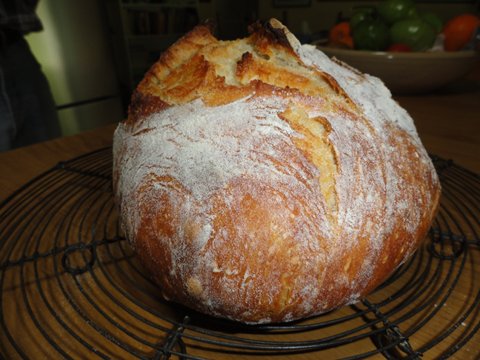
Bread is one of those foods that, when made with your own hands, gives a great deal of satisfaction and delight. It's only flour and water but it symbolises so much. I bake bread most days and use a variety of flours that I buy in bulk. Often I make a sandwich loaf because we use most of our bread for lunchtime sandwiches and for toast. Every so often I branch out to make a different type of loaf. I have tried sour dough in the past but I've not been happy with any of them. I'll continue to experiment with sour dough because I like the idea of using wild yeasts and saving the starter over a number of years to develop the flavour and become a part of the family. However, the loaf I've been branching out to most often is just a plain old five minute bread. By five minutes I mean it takes about five minutes actual work to prepare but it's the easiest of all bread to make and to get consistently good loaves from. If you're having people around for lunch or...
Image

This is my last post.

I have known for a while that this post was coming, but I didn't know when. This is my last post. I'm closing my blog, for good, and I'm not coming back like I have in the past.  I've been writing here for 16 years and my blog has been many things to me. It helped me change my life, it introduced me to so many good people, it became a wonderful record of my family life, it helped me get a book contract with Penguin, and monthly columns with The Australian Women's Weekly and Burke's Backyard . But in the past few months, it's become a burden. In April, I'll be 75 years old and I hope I've got another ten years ahead. However, each year I'll probably get weaker and although I'm fairly healthy, I do have a benign brain tumour and that could start growing. There are so many things I want to do and with time running out, leaving the blog behind gives me time to do the things that give me pleasure. On the day the blog started I felt a wonderful, h...
Image

What is the role of the homemaker in later years?

An email came from a US reader, Abby, who asked about being a homemaker in later years. This is part of what she wrote: "I am a stay-at-home mum to 4 children, ages 9-16. I do have a variety of "odd jobs" that I enjoy - I run a small "before-school" morning drop-off daycare from my home, I am a writing tutor, and I work a few hours a week at a local children's bookstore. But mostly, I cherish my blissful days at home - cooking, cleaning (with homemade cleaners), taking care of our children and chickens and goats, baking, meal-planning, etc. This "career" at home is not at all what I imagined during my ambitious years at university, but it is far more enriching. I notice, though, that my day is often planned around the needs of my family members. Of course, with 4 active kids and a husband, this is natural. I do the shopping, plan my meals, cook dinner - generally in anticipation of my family reconnecting in the evening.  I can't h...
Image

Every morning at home

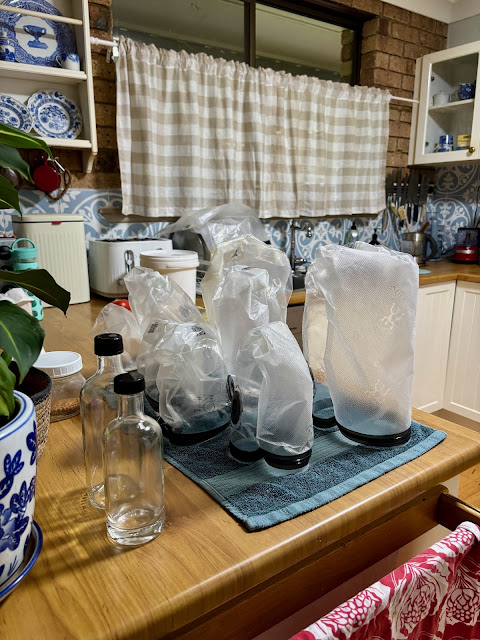
Every morning when I walk into my kitchen it looks tidy and ready for a day's work. Not so on this morning (above), I saw this when I walked in. Late the previous afternoon when I was looking for something, I came across my rolled up Zwilling vacuum bags and decided they had to be washed and dried. So I did that and although I usually put them outside on the verandah to dry it was dark by then. I turned the just-washed bags inside out and left them like this on a towel. It worked well and now the bags are ready to use when I bring home root vegetables, cabbages or whatever I buy that I want to last four or five weeks.
Image

You’ll save money by going back to basics

When I was doing the workshops and solo sessions, I had a couple of people whose main focus was on creating the fastest way to set up a simple life. You can't create a simple life fast, it's the opposite of that It's not one single thing either - it's a number of smaller, simpler activities that combine to create a life that reflects your values; and that takes a long to come together. When I first started living simply I took an entire year to work out our food - buying it, storing it, cooking it, preserving, baking, freezing, and growing it in the backyard. This is change that will transform how you live and it can't be rushed.  
Image


Trending Articles

NOT the last post

This will be my last post here.  I've been writing my blog for 18 years and now is the time to step back. I’ve stopped writing the blog and come back a couple of times because so many people wanted it, but that won’t happen again, I won’t be back.  I’ll continue on instagram to remain connected but I don’t know how frequent that will be. I know some of you will be interested to know the blog's statistics. 
Image

Every morning at home

Every morning when I walk into my kitchen it looks tidy and ready for a day's work. Not so on this morning (above), I saw this when I walked in. Late the previous afternoon when I was looking for something, I came across my rolled up Zwilling vacuum bags and decided they had to be washed and dried. So I did that and although I usually put them outside on the verandah to dry it was dark by then. I turned the just-washed bags inside out and left them like this on a towel. It worked well and now the bags are ready to use when I bring home root vegetables, cabbages or whatever I buy that I want to last four or five weeks.
Image

You’ll save money by going back to basics

When I was doing the workshops and solo sessions, I had a couple of people whose main focus was on creating the fastest way to set up a simple life. You can't create a simple life fast, it's the opposite of that It's not one single thing either - it's a number of smaller, simpler activities that combine to create a life that reflects your values; and that takes a long to come together. When I first started living simply I took an entire year to work out our food - buying it, storing it, cooking it, preserving, baking, freezing, and growing it in the backyard. This is change that will transform how you live and it can't be rushed.  
Image

Creating a home you'll love forever

Living simply is the answer to just about everything. It reduces the cost of living; it keeps you focused on being careful with resources such as water and electricity; it reminds you to not waste food; it encourages you to store food so you don't waste it and doing all those things brings routine and rhythm to your daily life. Consciously connecting every day with the activities and tasks that create simple life reminds you to look for the meaning and beauty that normal daily life holds.  It's all there in your home if you look for it. Seemingly mundane tasks like cleaning and cooking help you with that connection for without those tasks, the home you want to live in won't exist in the way you want it to.  Creating a home you love will make you happy and satisfied.
Image

Time changes everything

I've been spending time in the backyard lately creating a contained herb and vegetable garden. My aim is to develop a comfortable place to spend time, relax, increase biodiversity and encourage more animals, birds and insects to live here or visit. Of course I'd prefer my old garden which was put together by Hanno with ease and German precision. Together, we created a space bursting at the seams with herbs, vegetables and fruity goodness ready to eat and share throughout the year. But time changes everything. What I'm planning on doing now, is a brilliant opportunity for an almost 80 year old with balance issues. In my new garden I'll be able to do a wide range of challenging or easy work, depending on how I feel each day. It’s a daily opportunity to push myself or sit back, watch what's happening around me and be captivated by memories or the scope of what's yet to come.
Image

It's the old ways I love the most

I'm a practical woman who lives in a 1980’s brick slab house. There are verandahs front and back so I have places to sit outside when it's hot or cold. Those verandahs tend to make the house darker than it would be but they're been a great investment over time because they made the house more liveable. My home is not a romantic cottage, nor a minimalist modern home, it's a 1980’s brick slab house. And yet when people visit me here they tell me how warm and cosy my home is and that they feel comforted by being here. I've thought about that over the years and I'm convinced now that the style of a home isn't what appeals to people. What they love is the feeling within that home and whether it's nurturing the people who live there.
Image

Making ginger beer from scratch

We had a nice supply of ginger beer going over Christmas. It's a delicious soft drink for young and old, although there is an alcoholic version that can be made with a slight variation on the recipe. Ginger beer is a naturally fermented drink that is easy to make - with ginger beer you make a starter called a ginger beer plant and after it has fermented, you add that to sweet water and lemon juice. Like sourdough, it must ferment to give it that sharp fizz. To make a ginger beer plant you'll need ginger - either the powdered dry variety or fresh ginger, sugar, rainwater or tap water that has stood for 24 hours to allow the chlorine to evaporate off. You'll also need clean plastic bottles that have been scrubbed with soap, hot water and a bottle brush and then rinsed with hot water. I never sterilise my bottles and I haven't had any problems. If you intend to keep the ginger beer for a long time, I'd suggest you sterilise your bottles. MAKING THE STARTER In a...
Image

An authentic look at daily life here — unstaged and real

Most days Hanno was outside happily working in the fresh air. It may surprise you to know that I started reading my book,  Down to Earth , yesterday - the first time since I wrote it 13 years ago.  I had lent it to my neighbor, and when she returned it, I started reading, expecting to find surprises. Instead, I realised the words were still familiar—as if they were etched into my memory. As I flipped through the pages, I was reminded of how important it was for me to share that knowledge with others. The principles in Down to Earth changed my life, and I truly believed they could do the same for others. After just 30 minutes of reading, I put the book down, reassured that its message still holds true: we can slow down and reshape our lives, one step at a time.
Image