down to earth

  • Home
  • About Us
  • Down To Earth Book
  • Privacy Policy

There are fashions in foods as well as clothes. At the moment the food fads seem to be kale, bone broth, any "new" grain such as quinoa, spelt or amaranth, toast (yes, toast), kimchee and other ferments and coconut oil. I'm sure there are others I've failed to notice. If you've been reading here for a while, you'll know I'm not a follower of fashion. I think fashion cheats us. It makes us want something, then when we have it, it says you can't like it anymore, there is something better. Throw out the old, buy this, it's better. Pfffftt! When you've been around as long as I have, you'll realise that most things go in and out of fashion and you should just like what you like, regardless.

If you think I don't care for any of the food fads I've mentioned, think again, because I think they're all great foods. The thing is though that I don't see them as something new, like most of our ancestors, yours included, I've been using all of them for many years and will continue on, even when they've gone out of fashion (again). If you could phone your great grandma right now and ask her about food, she wouldn't know what Big Macs, Pop Tarts or Yoghurt Tubes are but she would know every one of those foods. She might know kimchee as sauerkraut, but she'd not only know fermented cabbage but would be able to show you how to make it.


Overall, having these old foods as fads shows that the trend now is towards healthier foods. Food that needs time, thought and preparation. This is not food you'll find being prepared by teenagers in a fast food joint, this is for home cooks because it's food for growing children and food for families. When I was growing up, there weren't packets of stock on supermarket shelves, most home cooks made their own stock. Bones would be saved from a roast or bought raw from the butcher and a 24 hour slow cooking session would result in the most nutritious stock to make into a soup. That long slow cooking brings the minerals - calcium, phosphorous, magnesium, sulphur, and others, out of the bones, it dissolves the gristle and gives you a form of glucosamine and chondroiton that is easily digestible and beneficial.  Usually you see that being sold as a supplement to help treat arthritis.

Stock can be made out of most bones but if you can add bone marrow to the mix, you've got yourself a super soup. Try to buy free range, grass fed or organic bones if you can but don't fuss over it. Buy what you can afford. You'll have to get the butcher to cut the bones for you because many marrow bones are long bones and won't fit into your stockpot. This is my recipe for winter vegetable soup. It's made of bone stock, bone marrow, root vegetables and barley - my favourite grain of all time. Roasting the bones until they're brown will add to the flavour of the soup but isn't necessary. You could roast the barley too if you wanted to, it will add more flavour but also adds to the time needed to make the soup.

My recipe for this soup isn't really my recipe, it's my family's recipe.; it might even be your family's recipe. My parents made it, my grandmother made it and I have no doubt she watched as her mother and granny made it too. Into a large stockpot (about 8 litres/quarts) add the bones and cover them with water. Add about half a teaspoon of pepper, two tablespoons of vinegar (that helps extract the minerals from the bones), a handful of parsley, two bay leaves and an onion. Bring it to the boil and let it slowly simmer all day. You could let this cook for a couple of days if you wanted to but 24 hours will give you good stock. The larger the bones, the longer you'll need to cook them. You can turn it off overnight if you want to and start it up the following morning. If you have a wood stove, leave it on the stove for the entire cooking time. If you notice scum develop and rise to the top, skim it off with a slotted spoon. When the stock is cooked, strain it through a sieve to remove the bones, herbs and onion. If the bones are marrow bones, put them to the side, you'll use them again soon.


The night before making the soup, pour two cups of barley into a bowl, cover with water and rinse the grains. Grains aren't really dirty but they are stored in silos and transported around and they pick up dust. Rinse them off, run clean water over them and let them sit overnight soaking in a covered bowl. This will soften the grains and start off the sprouting process. 


To make the soup: pour your stock into the stockpot, add the soaked barley and about half a kilo/one pound of diced lean gravy beef, shin beef or any of the cheaper cuts that contain gristle. The gristle will break down during the cooking and add more nutrients to the soup. Bring the mix to the boil, turn the heat down to a simmer, and with the lid on, simmer for an hour or two to soften the meat. Peel and chop or grate one swede/rutabaga, two parsnips, three carrots, three sticks of celery, one chopped onion, a hand full of parsley. Test taste the stock for seasoning and add what you think it needs. As the vegetables are cooking, remove as much marrow as you can from the bones and add it to the soup. Cook for another 30 - 40 minutes or until the vegetables are cooked. You'll often find pockets of marrow that will easily slip out, sometimes you have to dig around with the end of a spoon.  Back 200 years, they routinely had marrow spoons in kitchens. Now you only find them in antique shops, although I've looked for many years and never found one. I use the end of a sharp small spoon - see above.

Often the bones you use will add fat to the stock. You can get rid of it by cooling the stock in the fridge so the fat forms a layer on the top. When it forms it's easy to scrape it off with a spoon.

This is a very hearty and nutritious soup that will fill up even staunch meat eaters. Add some bread on the side if you wish. If the family still need filling, make a nice simple pudding or pie. I made a coconut and blueberry impossible pie last week that would be ideal but custard and fresh banana or milk pudding would be just as good. If you need recipes for puddings, let me know and we can do some recipes for them next week. I hope you love the soup as much as we do. It will certainly be a healthy addition to your winter menu.

We're eating soup but I haven't changed the bed linen to flannel yet; the sun rises at 6 and night falls at 6; I haven't yet reached for a cardigan but it's still warm enough to dry my just-washed hair with the desk fan. Oh autumn, how I have missed you. This quiet and peaceful season is truly my favourite. I love everything about it, not least the fact that it means summer is behind us, there are months of cool weather ahead and outside, our vegetable garden is slowly erupting into a crazy mish-mash of green and ever increasing trellises.

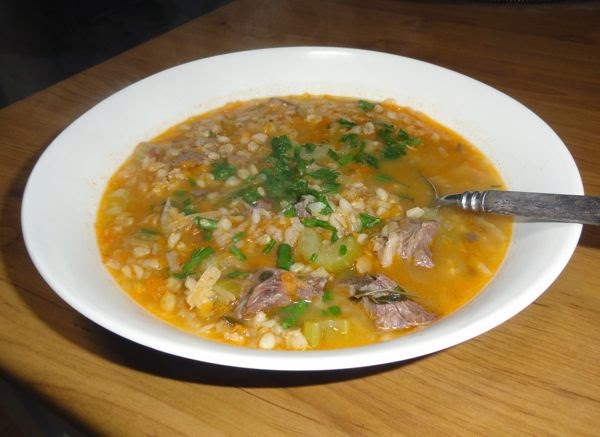
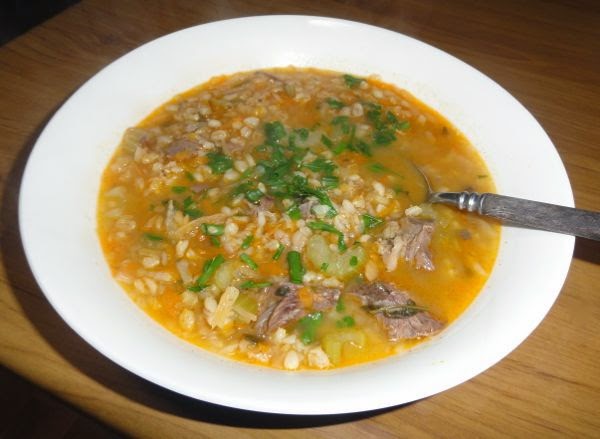
Barley, root vegetable and bone marrow soup. Recipe coming later in the week.

Hanno was up early to go to the market yesterday. He wanted to buy seedlings and came back with more kale, kohl rabi, turnips, red onions, green climbing beans, borage, lettuce and a small, potted bay tree. I was already at my desk writing when he came back but I went outside for a while to help him decide where everything should go. I planted the borage close to the cucumbers but I'll tell you more about that when I've had the chance to take some photos so you can see it for yourself.


We had an escapee on the loose last week when Miss Tammy Wyandotte discovered she could fly over the fence. She was swanning around on the lawn when Hanno caught her and I cut the flight feathers on one of her wings. I didn't think she'd be able to fly that high because she's a big bird but I know how wily chooks can be and when they get an idea in their heads about what they want, there is no stopping them.

I prepared a small shoulder of lamb for lunch yesterday. Shoulder of lamb is quite a thrifty cut of meat and by the look of this one, it will do us for three days, plus sandwiches. I cooked it with the usual suspects - potatoes, sweet potatoes, pumpkin and onions - all baked, with lightly boiled green cabbage on the side. I cooked it all in the oven, the cabbage sitting in a lidded Pyrex dish alongside the other vegetables. I wanted to serve Brussel sprouts but the cabbage was getting old and needed to be used.  I did more than enough baked vegetables to make sure I had enough for today's bubble and squeak, and that should use up the rest of the cabbage.


On Sunday morning there was the delicious aroma of baked lamb wafting through our home. Back when I was young in the 1950s, a roast was something most of us had for our sit down Sunday lunch. On those Sunday mornings you could walk through most suburbs of Sydney and smell lamb cooking away. Lamb was a cheap meat then and Australia had yet to discover the dubious pleasures of eating mass produced roast chicken. Back then, chicken was a celebration meat and most of us only had it when a backyard chook was sacrificed for a special event.


I was writing at my desk for most of yesterday but we had time out for morning tea on the front verandah. The day had that relaxed Sunday feel that I took full advantage of during the afternoon when I sat with my knitting. When I finished Jono's cardigan I started on another Lark Rise to Candleford shawl. This time, in a soft camel organic cotton called Patience. Last year, I wore my grey one on almost every one of the cold days. When I'm not knitting, the shawl sits in a very pretty cotton bag my sister made for me when she was here. I am a very lucky woman to be surrounded by generous, productive people. Who else has just started a new project? I usually have several on the go at the same time, but writing takes up most of my brain power these days. Sigh.

I have entered the Australian Writing Centre's blogging competition, which runs for a month. If you feel inclined to vote for me and my blog, I'd appreciate it. You can vote by clicking on the competition tag on my side bar. My warmest thanks to the readers who have voted so far. As a side benefit, I've enjoyed seeing some new names commenting in the previous post, along with some oldies I haven't seen for a while. xxx


Hello everyone, I hope you're enjoying the weekend. 


I've been reading the Australian Writers' Centre newsletters for the past few months. If you're interested in writing, they're a great resource. They run a blogging competition every year and this year I decided to join in. There are a couple of categories, one of them is a People's Choice Award that you can vote for. I hope you'll vote for me if you have the time and the inclination to. The badge is over on my right side bar. Just click on it and you'll go to the voting site. There are a lot of entries so you've have to click a couple of times and look for Down to Earth. Thank you. I appreciate you taking the time to do it.  I noticed a few familiar names on the lists, so if you've entered too, I wish you the best of luck. Voting closes in one month - 5 May.

I'm very pleased to tell you that my book The Simple Life has been reprinted and should be available very soon - either online or at your local book store. Thank you for your patience.

I have two outdoor photos for you today, taken here at home in the past couple of days.

This little fellow, a common tree snake, was passing by when I saw him outside the window, from my computer. He noticed me too and looked at the camera while I took the photo. He had such beautiful colouring - green top and yellow belly. These snakes eat those ghastly Asian house geckos so it was good to see him out looking for food. There are plenty of Asian geckos on our verandahs.  Hanno found a blind snake the other day too, when he was shovelling pine bark mulch in the garden. It was eating its way through the ants' nest there.

This is my bat flower in full bloom. It only has a couple of flowers a year but each one is spectacular. Those whiskers extend about a metre. The green leaves below are part of the plant.

"We are now in an era where climate change isn't some kind of future hypothetical.” - read about the latest UN report on climate change released last Monday
Not five, now it's seven a day
Maple syrup makers going high tech
Homemade chalk paint
Queen Elizabeth's childhood toys on display at Buckingham Palace  Thanks Tricia!
Leftover sausage recipes
The fermenting revolution - recipes
The buyers guide to bed linen
The story of bottled water - video
The original kindergarten
How to decoupage fabric onto tiles
Home decorating from plain to pretty
Grow your ethics workshops coming up in early May

I hope you enjoy the weekend. There is so much to do at this time of year now the seasons are changing. See you next week, friends. xx


An email arrived last week asking a question that I know a lot of people think about. There are a couple of different parts to this question so lets see if we can come up with an answer. 

The email from 'Madam X' said in part:

I know you don't give advice freely; however, I am four years from retirement. I feel that I am in a box without a hole even to breath through! And, the Mister isn't nearly on board with the values evolving within me. So.... I know Hanno became convinced when you quietly started your own "revolution" within your lifestyle. How did you keep your focus?

Retirement and other major life events often make us stop and think about what we're doing. Retirement seems to be the one milestone when we ask ourself some big questions and it makes us question where we are and where we're going. BTW, I think we should ask ourselves these questions at the turn of every decade but I don't think many people do it. Retirement is when changes are made. We either think about changing and plan to do it, or realise that if we are even going to change, this is the prime time to do it, but something stops us. There are also questions about capability, sustainability and responsibility. We hope that what we want to do with be within our capabilites, will last for a long, long time and that we do what we should be doing - for ourselves and our family.


But how did I focus on my revolution? Looking back now it seems like a difficult thing to do but at the time it was so easy. I was absolutely convinced that what I wanted to do made the best kind of sense. It would solve the dilemma of me not returning to work and it would allow us to significantly lower our cost of living. I believed early on that if I could work at home and make my home and life productive, that would supply many of our needs, and then just living life would provide structure, interest and purpose. In that early stage I didn't think that I would dive so deeply into home life but as I started working in my home and new possibilities starting opening up ahead of me my days became more interesting and my plans more achievable.


The main reason we could live that way was because we had no debt. We owned our home and we had no other debt so we didn't have to earn as much as we once did to get by. If we could reduce the cost of living by making a lot of what we used to buy, we'd both be able to give up working full time and we could spend much more time doing what we wanted to do. How could we not want to live this quiet, gentle and simple life? But...

When I told Hanno what I wanted to do, he thought I'd lost my marbles. =: - 0

When he rejected my plan outright, I decided to keep going alone. I had seen the possibilities, I'd thought about this a lot, I was convinced it could be done. Hanno was still working, he hadn't had the opportunity to see first-hand what my day-to-day life had become and he still believed that to live to our standard, we needed to work. With the help of one of my sons, we'd already enlarged the vegetable garden, we got a few more chooks to ensure a continuous supply of eggs and then it was up to me to see how much I could reduce our grocery bill. I didn't need anyone to help me with that. It was a matter of teaching myself how to make bread, soap, laundry liquid, sauces, relish etc. and taking up the needles again to sew and knit my way into a new life. It was only when I did all those things that I realised simple life was also frugal, healthy and environmentally friendly. Even more reasons to change!

:- )

You see, Madam X, I was absolutely convinced that living this kind of life was possible, and in many ways, was a reward for all the years of hard work we'd put in along the way. Knowing you're doing the right thing and sticking to it sounds difficult, but it's not. It was the life I wanted and it was so exciting to wake every morning with another day ahead where anything was possible.  It was exciting to see how much I could make and change and how much I could reduce our grocery bill. I did all that alone and quietly for a few months, with Hanno delighted that there was home cooking every night and occasionally the smell of fresh bread and cakes when he came home, I built up my skills and kept thinking about this life being part of the future for both of us. After a few months, I told Hanno what I'd been doing and showed him how much money we'd saved and how we could continue doing that if we both worked in our home. He had loved the changes I'd made at home. He loved the fresh vegetables, the home cooking and the savings, and he saw that working at home had changed me in significant ways. I was happy again! Soon after, he closed his business and came home to work alongside me.

Success and self belief is a powerful thing. I am lucky that much of what I did early on was modelled on how my mother and grandmother worked in their homes - when I started doing the work, it felt familiar to me. Not everything went according to plan, I had bad experiences along the way, I made mistakes, but my belief in my ability and the lifestyle itself kept me working away at it. When I started one thing, many other projects opened up to follow. Now I tell those I talk to to just start one thing and the rest takes care of itself. What you start with will always open up something else to try or learn.

You have to remember that you're convinced your retirement will be better if you live like we do. I think you're probably right. But your husband doesn't read the blogs you read every day, he doesn't read the books. You have to remain convinced and keep working at it, just like I did. Let him see what your plans are, show him the savings, cook his favourite meals, talk about your future. If it works well in your life, and he sees it makes you happy and reduces your cost of living, he'll probably come around. But you have to keep the faith and be the driving force until he develops an understanding of what you're trying to do and the benefits it will bring both of you.  Good luck!

If you've been in this position, how did you convince your partner?

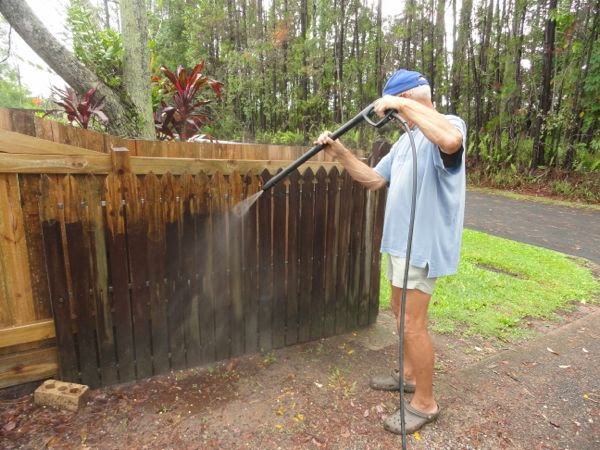
Hanno has an appointment with a rheumatoid specialist in early May and in the meantime he's trying to get back into his normal routine that has been interrupted by pain so many times in the past months. He's on a mission to catch up with a few home maintenance projects and so took advantage of the soaking rain on the weekend to pressure clean the old picket fence out front.  There is a strip of pine trees over the road so sunlight doesn't hit the front fence much during the winter months. Over the years that has caused a lot of discolouring in the wood which was put into sharp contrast when we put up that new side fence. That didn't worry me but Hanno didn't like it. He's very happy now that the fence is clean and it's all matching again.


When the fenced was clean and dry again, Hanno attached a new letter box.

 This is the lichen that grows here in the fresh clean air.


A few weeks ago, just before the rain started he cleaned out one of our water tanks. We live at the edge of a forest so we have usually got pretty clean air here. Nevertheless, dust and leaves settle on the roof and that gets swept into the tanks when the rain starts falling. After a while it builds up a sediment that settles in the bottom of the tanks.  The only way of cleaning it out properly is to disconnect the whole system and hose the tanks out. We're thinking about getting a third large tank now. It will sit on the eastern side of the house, collect rain from the front of the house and be used on the front garden. We are still talking it over, whether we'd get full use of it, and whether it would make up for the cost of buying it.

We're also discussing the future of mowing the lawn here. Mowing with the self-propelled mower is getting too much for Hanno now. Although he never wanted a ride-on mower in the past, now he does. My preference is to get a handy man in to do the mowing for us. We can still manage the gardens, but the summer mowing in particular causes a problem now.

Over the years the home maintenance done by Hanno in our house and yard have saved us a lot of money by keeping systems operating and looking good. It's a similar thing to cleaning and organising the interior of the house. Everything we have here has been bought with money we worked hard for. I'm sure it's the same at your place. Looking after what we own helps keep everything going for as long as possible and that's good for us and the environment.  Who does your outdoor home maintenance and mowing? If you've already gone from doing the mowing yourself to some other way of getting it done, please tell me what you did and how that went.


This is one of my favourite photos of Jamie, taken on the evening of his first birthday. Look at that tummy!

He was out in the garden with his dad yelling at the potatoes before he could walk. LOL
And this one is with opa, both having a quiet drink on the front verandah.

It's Jamie's third birthday today. It doesn't seem that long ago when we got a long awaited phone call to tell us that Sunny and Kerry were at the hospital and to come down. I can't imagine not being a grandma now but it was only three years ago that I made that very happy transition. Jamie, Sunny and Kerry are all in Korea at the moment but we'll have some Facetime with them later today. I'm really looking forward to it. Happy birthday, Jamie! We love you.

::::::::❤:❤::::::::

It makes no sense to me to try to relax after being massaged from head to toe when you know you're going to pay for the "relaxation experience". Relaxation to me doesn't involve people I don't know. I have a better way - it's more simple, it involves the great outdoors, it doesn't come as a bottled essence and it's there for the taking whenever I need or want it. Our backyards grow relaxation. If you let it and if you're completely present, with no phone or tablet, out there fresh air will fill your lungs and bring you back to yourself. The sweet, almost silent breeze, the insects and birds will welcome you back to nature, tranquility and gentle self-awareness.


 Blueberries are still growing.

There is a touch of autumn in the air now. I was out in my backyard yesterday afternoon, sitting, watching, picking, cutting, digging and tying. The temperature is at that perfect state of balance where it is neither cool nor warm. The wind blew the tops of distant pine trees I could see, but in the sheltered confined of our yard, the fences and shrubs kept the wind at bay. I tried not to think about anything other than what I was doing and that feeling of presence stayed with me when I eventually came back inside again. Relaxed.

Sunny, those are daikons front left.


Last week we had a lot of rain so the garden is growing strongly now. Little cucumbers are forming and pak choy is ready for picking. When I share some with the chickens, they go a bit crazy at first trying to reach the green and white crispness first, then they run away to a quite corner to eat their prize. I've pulled up most of the pumpkins and the vine has been added to the compost. They weren't a great success but I think I left it too late to plant the seeds. Next time, they'll go in two months earlier. We have two pumpkins from the vines, another one other was rotten and another still was only half grown and not worth picking. The 'Rouge de Marmande' tomatoes are going like the clappers and the first of the prolific cherry tomatoes are red and plump. Even though the rain brought a lot of growth to the garden, it stopped us planting out our seeds and seedlings. There is still a lot of bare ground out there. No doubt more planting will be done this week. There is always something to be done here. It's one of the benefits of living in a productive home.


It a wonderful time of the year now and I feel the optimism that only autumn brings. I'm writing every day to get the last three books finished and every so often I slip out into the garden to renew my energy and spirit. I hope you have a place like that where you can go to recover from normal life, whatever that is for you, although your relaxation place might not be a garden. It could be a room, your patio, a beach or any place where you feel safe and can just enjoy and appreciate the time you spend there.

Remember that relaxation is an activity you have to engage with. You don't just walk out there and wait. You consciously focus on the space you're in, you stop thinking other thoughts about what happens next or what you're having for dinner. You have to be really present in that space, at that time. If you can do that you'll have one of the many natural things that money can't buy.


I thought I may have been dreaming but no, it's true. I was told by Penguin yesterday that The Simple Life is being reprinted, already! Published on Wednesday and reprinted on Thursday. Thanks to everyone who helped make that happen. :- )  I hope you enjoy it. If you bought it online and have time, would you mind writing a review at the shop you bought it from. It does help spread the word. Thank you. xx

We've had a lot of well needed rain here in the passed couple of days. The tanks are full and the vegetables are growing like Topsy.  I finally finished off Johnathan's cardigan and sent that down to him with Tricia. Johnathan is Tricia's grandson.

Johnathan's cardigan in Eco-organic cotton, 8 ply,  from Eco Yarns.

I've got a weekend of housework ahead and then back to writing next week. I usually feel a bit disconnect from my books until people start reading them and now The Simple Life is out, it's fired me up again for the three remaining books. I hope the series will help many of you in your journey towards a simpler life. Have a wonderful weekend. 

The powerful belief of a loving mother
Photographing a sweet town that never was
Your own backyard emagazine
http://www.permaculturedesigntraining.com from Lorrie
The Edwardian Larder from Nickie
How to cure your own corned beef
Wasting meat and dairy
The wonderful David Leibowitz calling a spade a spade
The health benefits of honey
I'm longing to return to a state of relaxed normality but it's been a busy few weeks here. We've all been waiting for yesterday when the book was published. Thank you so much for the warm support you've given me with your comments and emails and by purchasing the book. Those comments encourage me to continue here because I know people are reading and are connected enough to comment. It is good to have the book out and on the shelves so now I can concentrate on getting the last three written and out to you.

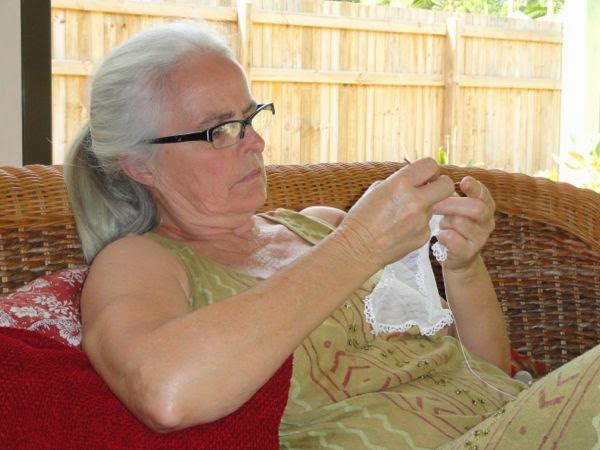
Tricia crocheting a jug cover.

My sister has been here for the past week, and flies home today. While she was here, she helped me organise the Mending, Repurposing and Household Linens book and she made up the cutest, sheer, patchwork kitchen curtain and a jug cover for the book. It was good to sit and talk to someone who understands what I'm trying to do with the linens. I want to encourage mending and recycling instead of buying new, as well as help develop traditional sewing and mending skills for some of the younger women and men. This is work such as replacing zippers, sewing on buttons, making dishcloths, mending rips and general maintenance of clothes and household linens. If you have these skills it allows you to keep trousers, shirts, jumpers, jeans, dresses, pyjamas, night dresses, skirts and school uniforms going for much longer, as well as save money by not buying disposable products such as dishcloths and dusters, which helps a lot with the budget.

The patchwork kitchen curtain. I saw this idea originally in Pinterest - it's on my page there.

The final reason for my busyness has been the continuation of Hanno's illness. Since early December he's had long periods of gout pain that have come every month and only let up for a week or two, only to return again. We went back to the doctor yesterday and have a referral to a new rheumatology specialist at Greenslopes, which is a large hospital in Brisbane. The GP is changing his diagnosis too, from gout to gouty arthritis, and possibly to rheumatoid arthritis. So bear with us. We're a bit slow at the moment but we're getting there.


Over the next couple of days, I'll take the opportunity to catch up on a few things not done while Tricia was here. I don't know why but I find it impossible to stick to my routine when she's here. I haven't made bread for a week, we bought bread from the local bakery and while I did continue feeding the chooks and letting them out each morning, then quickly watering the garden before going back inside, there were quite a few things I should have done but didn't. I did cook from scratch each day but we also went out for lunch twice. Once was Tricia's treat and the other was yesterday when we celebrated the book with a beer, fish and salad at the local pub. I did make the bed everyday, I did wash up but I didn't sweep the floor.  I feel like I've been on a little holiday. I'm not feeling guilty about it. It is what it is. I just have to pick up where I left off a week ago and get things done now.


So to get me back into gear and to help those of you who struggle with this sort of thing, I recommend Rose's 28 day organising challenge at the forum. These are small challenges for common household tasks that can be done in a few minutes. You can do the entire challenge or pick and choose the tasks you struggle with. Either way it's a great refresher for all of us who've fallen off the wagon, or never got on it. ;- )  

Rose's discussion thread. Look below the discussion thread for the individual day challenges. For example, this is the entry for day six:

Day 6 will essentially repeat Day 5, if you've been sticking to this challenge you may find a rhythm emerging especially with your morning and evening routines. Today, keep to those routines, do the tasks for today from your weekly routine, continue to put away dry washing, declutter at least one item and identify an undone thing that is niggling at you. You may decide to do this on the spot, if it's going to take a while then note it in your journal and break down the whole task into smaller steps.

Day 6 challenge:

  • do your morning and evening routines, keep to the essentials.
  • do today's tasks from your weekly routine.
  • put away clean dry washing.
  • declutter one item.
  • identify an undone thing that is niggling you.

I love how Rose talks about a rhythm developing when you carry out these challenges. That rhythm often comes in when you repeat these kinds of tasks and it's that rhythm that helps you get through the work. If you've been struggling with your house or yard work, I recommend this challenge to you. They are easy and quick tasks that can be slotted into most days and will keep you on target in your simple life.
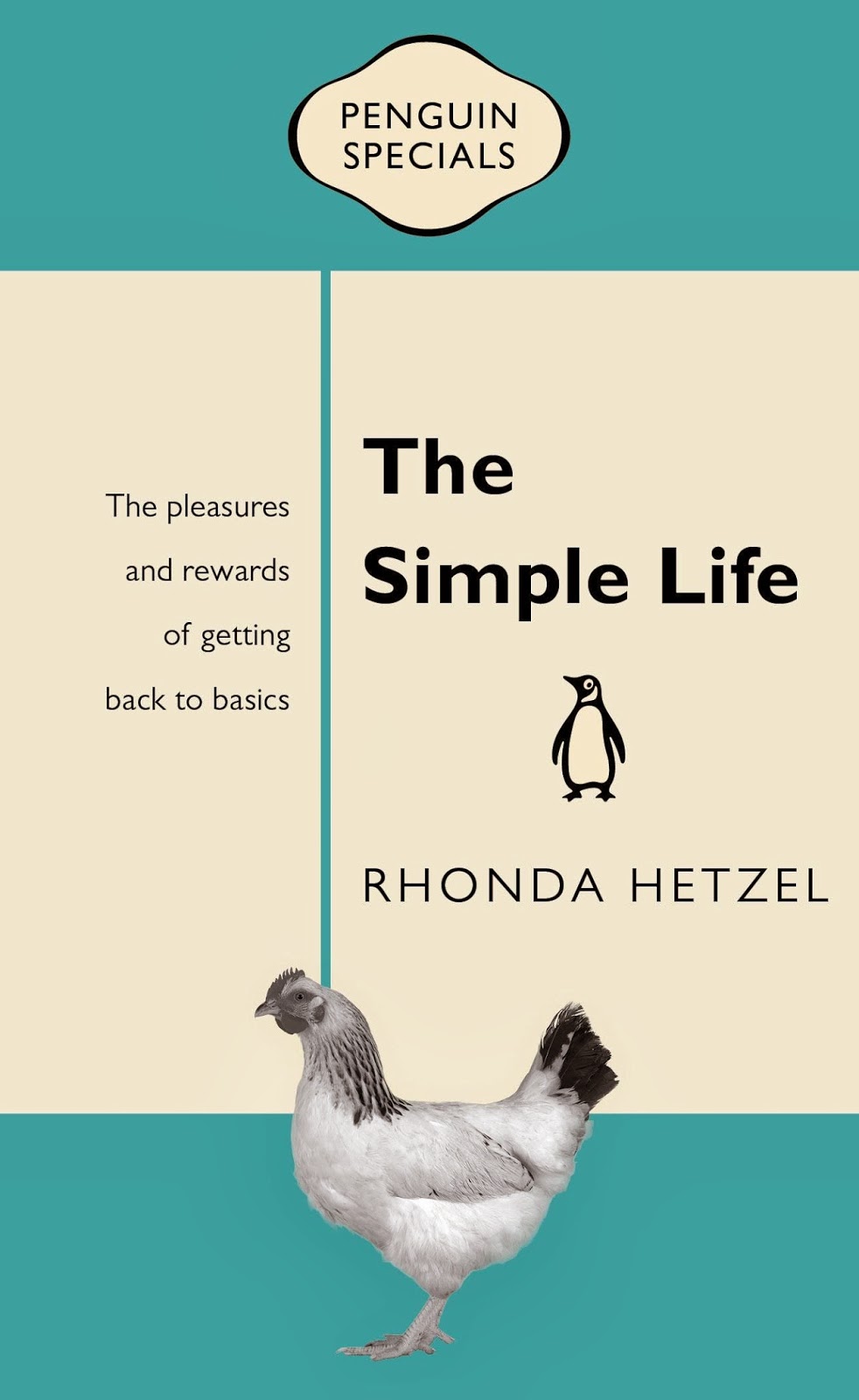
My second book, The Simple Life, the first in a series of six, is published by Penguin today. I am one of those writers who never thought I'd publish one book, let alone two. So today is a special one for me. The Simple Life is a Penguin Special, with the distinctive Penguin cover. Their aqua blue series is for works of non-fiction. While it's not the same kind of book as Down to Earth, with pictures and beautiful design, it still contains my heart and soul and I truly hope you enjoy it. Everyone can buy either the print or ebook version of it and while it will be available from Amazon and iTunes, you can buy it from the Penguin site here. The book is light so postage will be fairly cheap.  Added later: Apparently the Penguin site is experiencing problems. Please make your purchase here at Bookworld. Several readers have said it's cheaper there and you can order today.

Once again my sincere thanks goes to Penguin for their support of writers world-wide. In particular I want to thank my editor, Daniel Hudspith, who cleverly guided me through the editing process and to my publisher, Andrea McNamara, whose grace and wisdom have seen me through The Simple Life and Down to Earth.


Price: AU $9.99 - print book and AU $7.99 - ebook.
This is from the back cover:
Rhonda Hetzel feels passionately that living simply leads to a richer, more fulfilling existence. Having made the decision to live frugally, embrace sustainability and opt out of the capitalist consumerist mindset, she set about working out how to achieve her goal, learning traditional skills, reducing her spending and environmental impact and focusing on the simple things that make life worth living: family, friends, and a home-cooked meal. This is the story of her journey and the lessons she has learned along the way. Rhonda relates why she wanted to change her lifestyle, what simple living means to her, and offers guidance to those thinking about taking the same path.

I'll be back tomorrow with a post about organising and routines.


Another busy week here. It's probably been the same at your place too. I hope all is well in your home and that you'll have a chance this weekend to slow down and look after yourself.  Thanks for your visits this week and for your help with the shopping questions. XXX

If you can't keep hens in your backyard, here are some webcam chooks for you to watch.
NASA-funded study: industrial civilisation headed for 'irreversible collapse'?
Farm to table living takes root
How to be fashionable with no money
Over-scheduling children may rob them of a life worth living
Joel Salatin on Converting people to sustainable food
Lost trades fair - coopering, chair and knife making and a lot more
Leftovers? Ask the dinner doctor
Lady's work mittens - free Revelry pattern
Food photography 101
Urban Sketchers
How to make a herbal salve


sustainable mum
Simple crafty life
Homestead in Africa

Hello everyone! A late post today because we just got Kerry on the plane to Korea, and Tricia is here. It might be a bit hit and miss with the posts over the coming week. But I wanted to do this post because we've been talking about products and shopping all week and I want you to share your experience of shopping at Costco.  

We are fairly new to Costco in Australia. I think there are five Costcos here, one currently being built fairly close to where we live and another in Adelaide.  So if you've been a shopper at Costco, what I'd like to know:

  • What products are they selling?
  • Where are they sourcing their products from?
  • What are the prices like?
  • What is the service like?
  • And any general comment you'd like to make.
I know there are websites to go to to read about these things but I prefer hearing from real customers who share my values. Thanks for taking the time to do it. 

Newer Posts Older Posts Home


My books were all published by Pengiun, and are available at Amazon US, Amazon UK and Amazon Au

Search here

Total Pageviews

Translate


I'm Rhonda Hetzel and I've been writing my Down to Earth blog since 2007. Although I write the occasional philosophical post, my main topics include home cooking, happiness and gardening as well as budgeting, baking, ageing, generosity, mending and handmade crafts. I hope you enjoy your time here.

MY FAVOURITE PLACES

  • Grandma Donna's Place
  • Grandma Donna's YouTube
  • Grandma Donna's Instagram
  • This Simple Day
  • Nicole's Instagram

Give More

Give More

Popular posts last year

Making ginger beer from scratch

We had a nice supply of ginger beer going over Christmas. It's a delicious soft drink for young and old, although there is an alcoholic version that can be made with a slight variation on the recipe. Ginger beer is a naturally fermented drink that is easy to make - with ginger beer you make a starter called a ginger beer plant and after it has fermented, you add that to sweet water and lemon juice. Like sourdough, it must ferment to give it that sharp fizz. To make a ginger beer plant you'll need ginger - either the powdered dry variety or fresh ginger, sugar, rainwater or tap water that has stood for 24 hours to allow the chlorine to evaporate off. You'll also need clean plastic bottles that have been scrubbed with soap, hot water and a bottle brush and then rinsed with hot water. I never sterilise my bottles and I haven't had any problems. If you intend to keep the ginger beer for a long time, I'd suggest you sterilise your bottles. MAKING THE STARTER In a...
Image

NOT the last post

This will be my last post here.  I've been writing my blog for 18 years and now is the time to step back. I’ve stopped writing the blog and come back a couple of times because so many people wanted it, but that won’t happen again, I won’t be back.  I’ll continue on instagram to remain connected but I don’t know how frequent that will be. I know some of you will be interested to know the blog's statistics. 
Image

How to make cold process soap

I'm sure many of you are wondering: "Why make soap when I can buy it cheaply at the supermarket?" My cold process soap is made with vegetable oils and when it is made and cured, it contains no harsh chemicals or dyes. Often commercial soap is made with tallow (animal fat) and contains synthetic fragrance and dye and retains almost no glycerin. Glycerin is a natural emollient that helps with the lather and moisturises the skin. The makers of commercial soaps extract the glycerin and sell it as a separate product as it's more valuable than the soap. Then they add chemicals to make the soap lather. Crazy. Making your own soap allows you to add whatever you want to add. If you want a plain and pure soap, as I do, you can have that, or you can start with the plain soap and add colour, herbs and fragrance. The choice is yours. I want to add a little about animal and bird fat. I know Kirsty makes her soap with duck fat and I think that's great. I think t...
Image

Preserving food in a traditional way - pickling beetroot

I've had a number of emails from readers who want to start preserving food in jars but don't know where to start or what equipment to buy.  Leading on from yesterday's post, let's just say up front - don't buy any equipment. Once you know what you're doing and that you enjoy preserving, then you can decide whether or not to buy extra equipment. Food is preserved effectively without refrigeration by a variety of different methods. A few of the traditional methods are drying, fermentation, smoking, salting or by adding vinegar and sugar to the food - pickling. This last method is what we're talking about today. Vinegar and sugar are natural preservatives and adding one or both to food sets up an environment that bacteria and yeasts can't grow in. If you make the vinegar and sugar mix palatable, you can put up jars of vegetables or fruit that enhance the flavour of the food and can be stored in a cupboard or fridge for months. Other traditional w...
Image

Cleaning mould from walls and fabrics

With all this rain around we've developed a mould problem in our home. Usually we have the front and back doors open and that good ventilation stops most moulds from establishing. However, with the house locked up for the past week, the high humidity and the rain, mould is now growing on the wooden walls near our front door and on the lower parts of cupboards in the kitchen. Most of us will find mould growing in our homes at some point. Either in the bathroom or, in humid climates, on the walls, like we have now. You'll need a safe and effective remedy at some point, so I hope one of these methods works well for you. Mould is not only ugly to look at, it can cause health problems so if you see mould growing, do something about it straight away. The longer you leave the problem, the harder it will be to get rid of it effectively. If you have asthma or any allergies, you should do this type of cleaning with a face mask on so you don't breathe in any spores. Many peopl...
Image

Five minute bread

Bread is one of those foods that, when made with your own hands, gives a great deal of satisfaction and delight. It's only flour and water but it symbolises so much. I bake bread most days and use a variety of flours that I buy in bulk. Often I make a sandwich loaf because we use most of our bread for lunchtime sandwiches and for toast. Every so often I branch out to make a different type of loaf. I have tried sour dough in the past but I've not been happy with any of them. I'll continue to experiment with sour dough because I like the idea of using wild yeasts and saving the starter over a number of years to develop the flavour and become a part of the family. However, the loaf I've been branching out to most often is just a plain old five minute bread. By five minutes I mean it takes about five minutes actual work to prepare but it's the easiest of all bread to make and to get consistently good loaves from. If you're having people around for lunch or...
Image

This is my last post.

I have known for a while that this post was coming, but I didn't know when. This is my last post. I'm closing my blog, for good, and I'm not coming back like I have in the past.  I've been writing here for 16 years and my blog has been many things to me. It helped me change my life, it introduced me to so many good people, it became a wonderful record of my family life, it helped me get a book contract with Penguin, and monthly columns with The Australian Women's Weekly and Burke's Backyard . But in the past few months, it's become a burden. In April, I'll be 75 years old and I hope I've got another ten years ahead. However, each year I'll probably get weaker and although I'm fairly healthy, I do have a benign brain tumour and that could start growing. There are so many things I want to do and with time running out, leaving the blog behind gives me time to do the things that give me pleasure. On the day the blog started I felt a wonderful, h...
Image

What is the role of the homemaker in later years?

An email came from a US reader, Abby, who asked about being a homemaker in later years. This is part of what she wrote: "I am a stay-at-home mum to 4 children, ages 9-16. I do have a variety of "odd jobs" that I enjoy - I run a small "before-school" morning drop-off daycare from my home, I am a writing tutor, and I work a few hours a week at a local children's bookstore. But mostly, I cherish my blissful days at home - cooking, cleaning (with homemade cleaners), taking care of our children and chickens and goats, baking, meal-planning, etc. This "career" at home is not at all what I imagined during my ambitious years at university, but it is far more enriching. I notice, though, that my day is often planned around the needs of my family members. Of course, with 4 active kids and a husband, this is natural. I do the shopping, plan my meals, cook dinner - generally in anticipation of my family reconnecting in the evening.  I can't h...
Image

Every morning at home

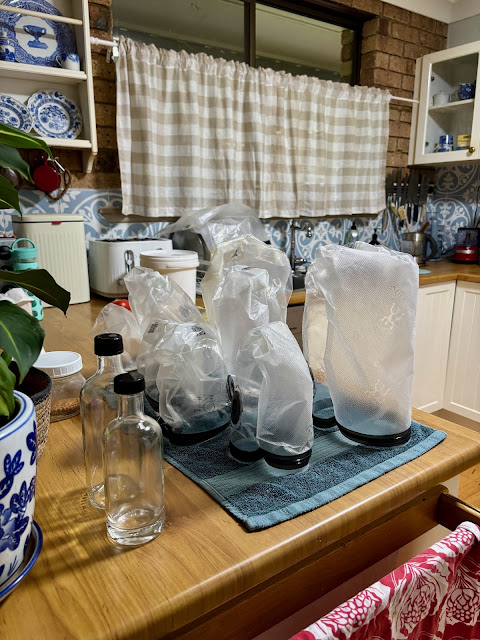
Every morning when I walk into my kitchen it looks tidy and ready for a day's work. Not so on this morning (above), I saw this when I walked in. Late the previous afternoon when I was looking for something, I came across my rolled up Zwilling vacuum bags and decided they had to be washed and dried. So I did that and although I usually put them outside on the verandah to dry it was dark by then. I turned the just-washed bags inside out and left them like this on a towel. It worked well and now the bags are ready to use when I bring home root vegetables, cabbages or whatever I buy that I want to last four or five weeks.
Image

You’ll save money by going back to basics

When I was doing the workshops and solo sessions, I had a couple of people whose main focus was on creating the fastest way to set up a simple life. You can't create a simple life fast, it's the opposite of that It's not one single thing either - it's a number of smaller, simpler activities that combine to create a life that reflects your values; and that takes a long to come together. When I first started living simply I took an entire year to work out our food - buying it, storing it, cooking it, preserving, baking, freezing, and growing it in the backyard. This is change that will transform how you live and it can't be rushed.  
Image


Trending Articles

NOT the last post

This will be my last post here.  I've been writing my blog for 18 years and now is the time to step back. I’ve stopped writing the blog and come back a couple of times because so many people wanted it, but that won’t happen again, I won’t be back.  I’ll continue on instagram to remain connected but I don’t know how frequent that will be. I know some of you will be interested to know the blog's statistics. 
Image

Every morning at home

Every morning when I walk into my kitchen it looks tidy and ready for a day's work. Not so on this morning (above), I saw this when I walked in. Late the previous afternoon when I was looking for something, I came across my rolled up Zwilling vacuum bags and decided they had to be washed and dried. So I did that and although I usually put them outside on the verandah to dry it was dark by then. I turned the just-washed bags inside out and left them like this on a towel. It worked well and now the bags are ready to use when I bring home root vegetables, cabbages or whatever I buy that I want to last four or five weeks.
Image

You’ll save money by going back to basics

When I was doing the workshops and solo sessions, I had a couple of people whose main focus was on creating the fastest way to set up a simple life. You can't create a simple life fast, it's the opposite of that It's not one single thing either - it's a number of smaller, simpler activities that combine to create a life that reflects your values; and that takes a long to come together. When I first started living simply I took an entire year to work out our food - buying it, storing it, cooking it, preserving, baking, freezing, and growing it in the backyard. This is change that will transform how you live and it can't be rushed.  
Image

Creating a home you'll love forever

Living simply is the answer to just about everything. It reduces the cost of living; it keeps you focused on being careful with resources such as water and electricity; it reminds you to not waste food; it encourages you to store food so you don't waste it and doing all those things brings routine and rhythm to your daily life. Consciously connecting every day with the activities and tasks that create simple life reminds you to look for the meaning and beauty that normal daily life holds.  It's all there in your home if you look for it. Seemingly mundane tasks like cleaning and cooking help you with that connection for without those tasks, the home you want to live in won't exist in the way you want it to.  Creating a home you love will make you happy and satisfied.
Image

Time changes everything

I've been spending time in the backyard lately creating a contained herb and vegetable garden. My aim is to develop a comfortable place to spend time, relax, increase biodiversity and encourage more animals, birds and insects to live here or visit. Of course I'd prefer my old garden which was put together by Hanno with ease and German precision. Together, we created a space bursting at the seams with herbs, vegetables and fruity goodness ready to eat and share throughout the year. But time changes everything. What I'm planning on doing now, is a brilliant opportunity for an almost 80 year old with balance issues. In my new garden I'll be able to do a wide range of challenging or easy work, depending on how I feel each day. It’s a daily opportunity to push myself or sit back, watch what's happening around me and be captivated by memories or the scope of what's yet to come.
Image

It's the old ways I love the most

I'm a practical woman who lives in a 1980’s brick slab house. There are verandahs front and back so I have places to sit outside when it's hot or cold. Those verandahs tend to make the house darker than it would be but they're been a great investment over time because they made the house more liveable. My home is not a romantic cottage, nor a minimalist modern home, it's a 1980’s brick slab house. And yet when people visit me here they tell me how warm and cosy my home is and that they feel comforted by being here. I've thought about that over the years and I'm convinced now that the style of a home isn't what appeals to people. What they love is the feeling within that home and whether it's nurturing the people who live there.
Image

Making ginger beer from scratch

We had a nice supply of ginger beer going over Christmas. It's a delicious soft drink for young and old, although there is an alcoholic version that can be made with a slight variation on the recipe. Ginger beer is a naturally fermented drink that is easy to make - with ginger beer you make a starter called a ginger beer plant and after it has fermented, you add that to sweet water and lemon juice. Like sourdough, it must ferment to give it that sharp fizz. To make a ginger beer plant you'll need ginger - either the powdered dry variety or fresh ginger, sugar, rainwater or tap water that has stood for 24 hours to allow the chlorine to evaporate off. You'll also need clean plastic bottles that have been scrubbed with soap, hot water and a bottle brush and then rinsed with hot water. I never sterilise my bottles and I haven't had any problems. If you intend to keep the ginger beer for a long time, I'd suggest you sterilise your bottles. MAKING THE STARTER In a...
Image

An authentic look at daily life here — unstaged and real

Most days Hanno was outside happily working in the fresh air. It may surprise you to know that I started reading my book,  Down to Earth , yesterday - the first time since I wrote it 13 years ago.  I had lent it to my neighbor, and when she returned it, I started reading, expecting to find surprises. Instead, I realised the words were still familiar—as if they were etched into my memory. As I flipped through the pages, I was reminded of how important it was for me to share that knowledge with others. The principles in Down to Earth changed my life, and I truly believed they could do the same for others. After just 30 minutes of reading, I put the book down, reassured that its message still holds true: we can slow down and reshape our lives, one step at a time.
Image