down to earth

  • Home
  • About Us
  • Down To Earth Book
  • Privacy Policy
Knitting is, by far, my favourite pastime, although maybe I shouldn't call it a pastime because that implies I do it only for pleasure. Knitting is a pleasure for me but I do it for necessity - to provide clothing, warmth, household cloths and gifts for my family and friends. Knitting is one of my household chores. I have written about this subject before because I could see women online blogging about taking a lot of time with their "crafts" and often feeling guilty about it. I see craft work as part of a simple home. If you want handmade dish or face cloths, organic cloths for baby, tea towels, tablecloths, jug covers, various muslins for straining, napkins, curtains, homemade nappies/diapers and clothes, then you, or someone in your home, will be making them. Those items are not made for pleasure then, although there certainly is a lot of pleasure in the hours spent making them, they are made for the purpose of self-reliance and frugality.
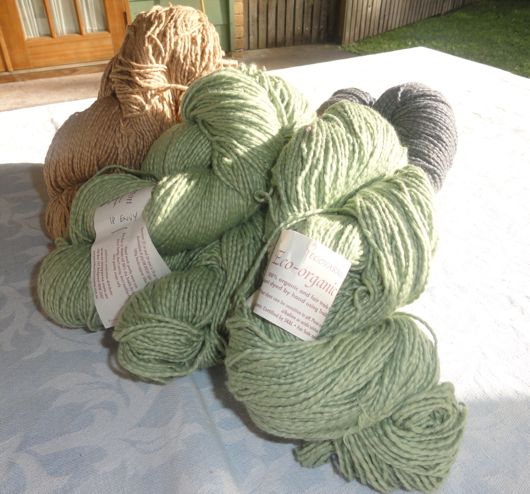

When I knit I always use the best quality cotton or wool I can find. I am so fortunate to have EcoYarns as one of my sponsors and I know that without doubt, Vivian always sends me yarns that are an absolute pleasure to work with. If you're looking to stock up on winter wools, alpaca yarn, organic cotton or wool, Vivian is having a sale at the moment so you can take advantage of that and stock up on the finest quality for  a good price. One of my favourite products of hers is the organic 100% cotton (above and below). Vivian tells us on her site:  By buying EcoOrganic Cotton, you are helping to revive ancestral techniques of hand spinning and hand dyeing of the Peruvian dyers, especially of the Paracas Culture. You are also contributing to the welfare of the women (and their families) who work to bring you this yarn. The women often come from the poorest localities in Lima. They are given Fair Trade conditions and a litre of milk per day that they work. The money that they make helps their children obtain an education.


When you buy the eco cotton it's in a loose coil called a skein. You'll need two arms to hold it for you while you roll it into  ball, which is much easier to knit with. Or you can use a swift, like mine below. I found this one in a local antique shop.


 These red skeins are super fine, machine-washable merino.
 Baby alpaca.

I've knitted quite a few baby garments with this cotton and all of them knitted up beautifully. I could give those gifts absolutely sure they would be safe on a baby's skin. You can't always say that about wool or cotton because quite often harsh chemicals are used in the processing of them. Vivian has reduced the cotton by 50 percent, it's now only $7.50 a skein.

 The tall cone of yarn in the middle is the Qoperfina.

When you have a spare 15 minutes, pop over to Vivian's site and have a good look around. You may find something you like. There is a fine selection of fleece, fine wools and cottons and yarns you won't find elsewhere else. At the moment Vivian has a 2ply Qoperfina which is 50% alpaca, 48% cotton, 2% copper. She sent me some to try but I haven't decided what I should use it on yet. Any suggestions?  It's 2 ply.

You know what I really love about knitting with Vivian's yarns? It's knowing I will spend all that time finding a pattern and knitting it up and that will result in a quality garment that I'm proud to give away or use myself. Before I found EcoYarns, I knitted up wool that looked worn out when I finished knitting it and a year later looked five years old. I want the time I put into my knitting to produce something that I can happily use for many years. I want quality. I recommend EcoYarns to you, I'm sure you won't be disappointed.

I finished it!

And now I'm going to, hopefully, finish off a cotton shawl/scarf I've been working on for a few weeks. I wanted one similar to these but I didn't want to tie it and I didn't want a pointed back, so I just made the pattern up as I went. I want to use it at home to keep my neck warm on cold winter mornings. I was half way through this shawl when up popped Kate at Purple Pear with hers, almost the same as what I was knitting (great minds). Mine is made using the steel grey EcoCotton and when I wrap it around my neck it's so soft and comfortable, I feel like I'm wrapped in a bunny rug. I hope I can finish it before I post this tomorrow morning so you can see what it looks like.

I've got this on my to do list.
Beautiful patterns

Happy knitting everyone!
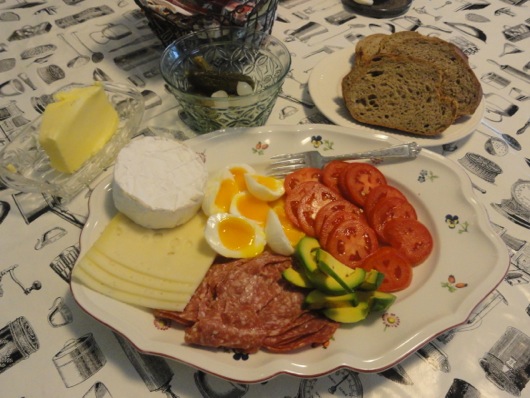
Over the past year or so Hanno and I have been slowly changing our eating habits. We started by having smaller servings because our appetites have changed. This has worked well for us and we've been satisfied with the meals we're eating. Now we've moved on to a change in when the main meal is served. We're now eating it at lunchtime.

Hanno is quite used to this style of eating. In Germany that is how they serve food, many places of work serve a hot meal at lunchtime and in the evenings appetites are satisfied with abend brot - or evening bread. I have fond memories of abend brot when we lived in Germany. The table was always laid with knives and forks for everyone, either a plate or a small bread board each, drink - usually beer, tea or coffee and a delicious selection of cold cuts, cheeses, salads, pickles and tomatoes.

Unusually, when we have abend brot it's at midday. We're having a pot of tea with it. We didn't do that when we had our main meal in the evening because I don't sleep well if I drink tea or coffee after 4pm. As usual, I set the table for the two of us. Knives, forks, a plate for each of us, and cups for tea. In the middle of this is the main plate - a magnificent assortment of whatever I have on hand or have bought for the plate.


Abend brot can be made up of anything. The one we had the other day (above) was a combination of camembert and Swiss cheese, salami, boiled eggs, tomatoes, avocado, pickled cucumbers and onions. We had rye sourdough and black bread - the very dense German rye bread. Everyone makes their own sandwich so you can do whatever suits you. Usually in Germany, you'd have either cheese or cold cuts on one sandwich but I had Swiss cheese, salami, tomato, avocado and pickled onions on my slice, but I could only eat one and a half slices. 

Mayonaisse-based salads are also popular for abend brot. Next time we have it, I'll poach a chicken breast and we'll have chicken salad and possibly kassler instead of salami. Tuna salad or egg salad would also be great additions. It sounds like a light option but it certainly fills you up and it's great, as long as you have the makings of it, for those nights, or lunchtimes, when you don't feel like cooking.

When do you serve meals throughout the day? Have you changed how you eat recently? Our change is due to our ages but I'm guessing there are some who have changed to include more organic and local foods and some who have changed for financial reasons. 


Thank you for the love, thoughts and prayers sent to us yesterday.

- - ♥ - -

I never thought of myself as being a grandmother until it was almost upon me. I didn't think too far into my future, I just planned for the coming year and left it at that. I didn't think much about my sons' futures. I could see they were well adjusted, ambitious and sensible and I was content to stand back and wait to see what developed. Grandmothering came slowly sneaking into my thoughts when I met Sarndra and Sunny. I liked them both immediately and it wasn't long before I grew to love them. I knew they were right for my boys and maybe, one day, anything could happen .......  :- )

Jamie was born in March 2011. We'd been hopping around all morning rushing to answer the phone  and when we got the news, we took off like two rockets, driving 200 kms to see him. My world changed forever when I saw him for the first time. Sunny was holding him close and when she asked me: "do you want to hold him, mum?" I held out my arms and opened my heart as wide as it had ever been. I had to fit Jamie in there and I needed a much bigger space for Sunny. This was an entirely different feeling to holding my own sons. There was no pain involved for me with this precious delivery, this was all pleasure and pride. The pride I felt when I looked at him and the pride and love I felt for Kerry and Sunny. 

A few months later, in July 2011, Alex was born, to Sarndra and Shane, in the same hospital. We drove down again, crazy with excitement, full of anticipation and wonder about this new cherished member of our family. Again my heart was pounding when I saw him for the first time and again my already full heart made room for another part of it to be permanently and profoundly altered by this tiny baby. I thought it was impossible, but I loved Shane and Sarndra more on that day. Nothing has changed now. We see much less of Alex because they live so far away but I think of him every day and look forward to the time when we spend time with him, learn more about him and share some of our world with him.

Two more links in our family chain.


We looked after Jamie yesterday while Kerry and Sunny went out for lunch and a movie. They went to see the new Ironman movie and during the morning there was a Facebook update from Sarndra, with a photo of her and Shane, also going out to see Ironman, while Alex was being cared for. Precious alone time for both couples. That is what grandparents are good at - being the on-standby carers that help when they can with babysitting or whatever is needed. If Shane and Sarndra lived closer we'd happily look after both boys. We have a safe and interesting yard they can run around in, a sandpit and clean fresh air to fill their young lungs. I'm looking forward to those days when we look after both boys and they get to know each other, and us.

I love seeing sippy cups and brightly coloured plates and bowls in my kitchen again. Peeling apples and bananas isn't the same anymore. It's more than it used to be. Sure, there are times when I want the running or loud noises to stop, or I don't want to read that same book again or change a nappy, but they're fleeting moments. Not everything is perfect. Everything has a downside and this is no different. But when you see small arms outstretched before you, when you hear one, two, ten, run!, when you see a contented face asleep, or watering the plants, or smiling at you, it's all worthwhile.

Parenting is tough. It is, without a doubt, the hardest thing I've ever done. There are the difficult first few months, the weaning, toilet training, getting ready for school, getting used to the friends, the powerful protective feelings that mothers and fathers feel. There are the difficult talks, wanting to give them enough freedom and the courage to see the beauty and the evil in the world and then two minutes later wanting to keep them protected, away from everything that might harm them. There is that important balancing act of giving them all they need but not all they want, and trying to stay on speaking terms while you do it. And at every stage there are the sometimes overwhelming feelings of responsibility and the ongoing task of developing trust - on both sides. And sometimes having to do it all over again.

Then everything you tried to put into your children starts to pay off. You stand back, proud of your efforts, but you know in your heart that it's as much to do with luck than with anything else - the good fortune to meet the right friends or ditch the dangerous ones, the ability to give them the time they need when they need it, the good sense to show them they were loved unconditionally. Being able to forgive and be forgiven. There is so much you have no control over.

But time passes, they find someone, love develops, babies are born and grandparents are created. It's all part of your circle of life. No one can ever explain to you what it feels like being a grandparent and I guess it's different for all of us. For me it is similar to being a parent in that I feel all the love, but I have a very small share of the work and responsibility. And while parenting was as tough as it gets, grandparenting is easier. Much easier. I feel important in this role, that what I have to share, while different to what Jamie and Alex will learn from their parents, is significant and valuable nonetheless. But to tell you the truth, most of it is just plain fun.


We had a sad and slow weekend. We received news that Hanno's sister, Angelica, died suddenly in Hamburg so there were long phone calls across oceans, talks about Angelica and lots of memories of her. She was Hanno's only sibling. Our family is always special but the importance of family is always magnified when we lose someone special. RIP Angelica.

- - ♥ - -

Over the weekend I did a bit of work but mainly took things slow and almost finished off some knitting I've been concentrating on for a while. I'll show you later in the week. Kerry and Jamie dropped in on Saturday and had lunch with us. It wonderful hearing them drive down the driveway and knowing we can see them so frequently.  We're looking after Jamie this afternoon while Kerry and Sunny have some time alone over lunch and a movie. I should really say that Hanno will look after him. They'll be out in the backyard feeding the chooks and gardening. Hanno will give Jamie some "jobs" such as moving a bucket full of dirt from one garden bed to the next, or picking green leaves. One thing is for sure, he won't leave Hanno's side and he'll want to "work" alongside Opa.

I watched an interesting program on SBS the other night - Food Safari, featuring Danish cuisine. Hamburg is quite close to Denmark so the food is similar and sure enough, they had a recipe for frikadeller (called frikadellen in Germany), and pickled cucumbers. I decided to make the meal for us yesterday and it was delicious. I'd describe it as meatballs, fast pickled cucumbers and I added potato salad, which worked perfectly. I didn't stick to the exact recipe but what I made what close to it and delicious enough to make again ... soon.

This is a good meal for a large family or for those trying to reduce the cost of living. I used 1 kilogram of meat - a mixture of organic beef and pork, that was the most expensive part of the meal and I have enough for three meals. My guesstermation would be $12 for the meal and if you devide that by three, that's four dollars a meal for the two of us. I'll have to make another batch of the pickled cucumbers because we almost wiped out the first lot in one meal.

Here are the recipes in the order I did them, making sure I reused pots and bowls so I didn't have too much washing up.

Meatballs
500 grams beef mince
500 grams pork mince
1 large onion, chopped
salt and pepper to taste
½ cup breadcrumbs
¼ cup plain/all purpose flour
2 eggs
¼ cup  milk


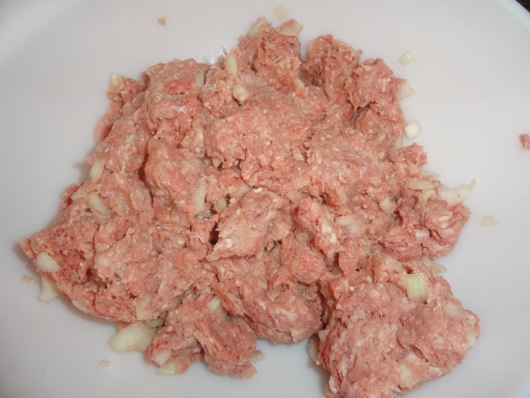
Place the meat and onions in a bowl and with clean hands, mix it all together until it's thoroughly combined. Add the remaining ingredients and mix them in the same way. Then, using a tablespoon, measure about a spoon full of meat mixture and with wet hands, form it into round balls. Place them on a plate and put in the fridge for 15 minutes to firm up. Then start the potato salad.

Potato Salad
4 large potatoes
1 small onion, chopped
2 poached eggs
salt and pepper
mayonnaise
Peel and slice the potatoes into thick slices. Add these two cold water in a saucepan, add a pinch of salt, bring to the boil, turn it down to a fast simmer. They're ready when the potatoes are softish and can be easily pierced with a fork.  When the potatoes are cooked, drain them in a colander and allow to cool.  While the potatoes are cooking, get on to the pickled cucumbers.

Unsalted cucumber and onion above, salted below.

Easy and quick pickled cucumbers and onions
Peel one cucumber (you can leave the peel on if you prefer) and slice the cucumber very thinly. I used a mandolin. Peel one red onion and slice that thinly as well. Place the cucumber and onion in a bowl and sprinkle enough salt over it to cover all the slices - about a heaped teaspoon. Don't worry about the salt - later you'll wash it all off and pour the salty liquid down the drain. Mix the cucumbers and onions around to make sure it's all in contact with the salt or salty liquid and leave for 15 minutes. While that is happening, check the potatoes, drain them if cooked and allow to cool.


Cook the meat balls
To cook, add olive oil to a pan and when it's hot, add the meatballs. I had to do mine in two batches. Cook, turning them when they're brown. They'll take about 10 - 15 minutes to cook over a medium heat. Then turn out onto a paper towel on a plate to drain off any excess oil.

Cool the potatoes and eggs
Wash the bowl the meat was in and use it again for the potato salad. Put some more water into the saucepan you cooked the potatoes in and poach two eggs. You can boil them if you prefer but poaching does the same job and it's quicker. When they're cooked, allow them to cool.

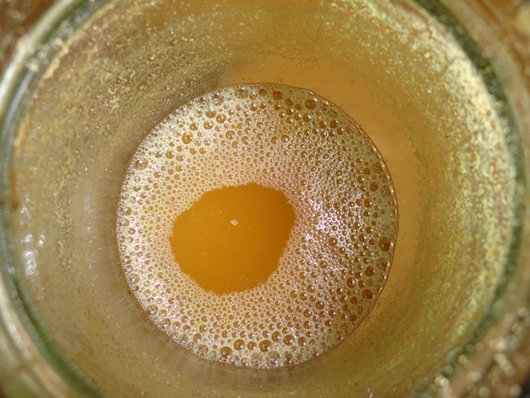
This is the pickled cucumber after the vinegar had been added.

Make up the pickles
Under a slow tap, wash the salt from the cucumbers and onions. Squeeze as much liquid from them as you can and then place them back in the bowl, that you've rinsed out and dried. Sprinkle over 1½  tablespoons of sugar, two tablespoons of good white vinegar and salt and pepper. Taste it and adjust to your liking. That's the pickled cucumbers and onions finished.

Make up the potato salad. I didn't take photos of this process.
Take the cooled potatoes, it doesn't matter if they're still slightly warm, added a small chopped onion, salt and pepper, two finely diced gherkins or a small amount of diced cornichons and enough mayonnaise to coat it all. Taste it and adjust the seasoning if needed.


And that's it. You can serve it with a mild German mustard but it has enough taste without it. The sharp taste of the pickled cucumbers and onions cut through the creaminess of the mayonnaise nicely. The meatballs have a fine texture that go well with the full flavours of the salads. I hope you enjoy this as much as we did. Do you have a favourite meat ball recipe?


Growing Old in the New Normal - Countryside mag - thanks for the link, Sander.

The Baby Boomers at 65 - The Age

Carcinogens found in some baby bath products 1  - 2012
Carcinogens found in some baby bath products 2 - 2009

Sourdough Bread Variations - Countryside mag

Low cost raised bed garden - Backwoods Home mag

Baby shoes and bootees and how to make them - I think Julia sent me this link. Thanks Julia.

Four Green Acres

Other bloggers nominated with me in the Kidspot Creative and Home category
The Daily Smudge

74 Lime Lane

At Home with Ali

From the comments here this week
Charlotte at The Old Milk Can

Frances at City Views, Country Dreams

Jennifer at Beyond the Trolley

The weather continues to cool here and we've made more progress with our vegetable garden. I'm going to spend some time over the weekend finishing off some knitting and selecting a new project. I hope your weekend is restful and you spend time with those you love.  See you next week. :- )   ♥

I’m not sure if it’s a sign of my age or the era I grew up in but when I hear: "Would you like a cup of tea?”, "I'll put the kettle on." or “Let’s have a cuppa.” I feel as if I’m being cared for. I grew up in a time when fizzy drink was always ginger beer. Coke was around then but it seemed out of place, sort of unAustralian, and we didn’t drink it, although as a Christmas treat, mum would buy a crate of 12 "mixed fruit drinks", delivered to our door by horse and cart. Yes, that was Sydney in the 1950s. Bread and milk was delivered every day like that too, right to our door. Our cold drink of choice was cordial and when a hot drink was called for, it was tea. Although all through my life, my mother drank the strongest black coffee that looked like liquid tar and I think was made with chicory. I clearly remember drinking milky, sweet tea with my grandmother. She had hers black and now that is how I drink my tea. There is a lot I don’t recall about my childhood but I clearly remember the feeling of being loved when I was called in for tea. 


We didn’t always have cake with our tea but when we did it was homemade and often it was fruit cake. Biscuits were bought then, a new convenience, at the local corner shop from Arnott’s tins that contained a single variety of biscuit like Monte Carlo, Spicy Fruit Rolls, Honey Jumbles, Iced Vo Vos, Milk Arrowroot or Custard Creams. Biscuits in packets were yet to surprise us but it was always a treat to go with mum to the shop while she chose biscuits that were put in a plain brown paper bag to be brought home to our biscuit barrel. When we went to the zoo, a very rare treat, we used to go to that same shop to buy a small bag of broken biscuits to feed to the animals. The Arnott family who produced those biscuits lived not far from us in a huge mansion house. It’s still there but they are long gone.  Their factory, which I think was built around 1900, was located near where the Sydney Olympics was held at Homebush.

These are the little floating tea balls Sunny gave us.

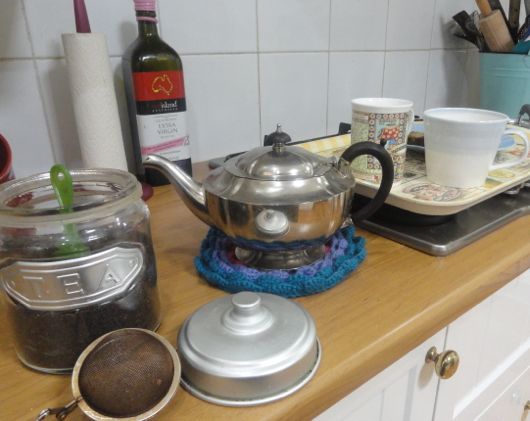
I haven’t lost my affection for tea. Hanno loves a cup around 10am and we sit together on the back verandah in the summer and the front verandah in winter and talk while we drink our tea. I always use loose tea to make a single cup or a pot and always use a little tea ball. Sunny bought us some nifty new tea balls recently. They float around in the tea until it’s time to take them out and sit them in their little drainer saucer. Tea bags are like Coke to me, they don’t exist.


My favourite tea memory is from Sunday evenings in winter, before TV started, so pre-1956. I would have been seven or eight then and Tricia nine or ten. We, along with the entire neighbourhood, would have had a roast for Sunday lunch and a small amount of the remaining meat would have been put aside for toasted sandwiches in the evening.  Around 4pm, dad would light the open fire in the lounge-room, all the windows and doors would be closed, and at around 6pm, he would load up our tea trolley with roast lamb or chicken, along with a small bowl of salad, bread, butter, mugs of milky tea and mum's strong black coffee. Mum would test Tricia and I on our spelling as we sat by the fire in our pyjamas, dressing gowns and slippers, and then we'd toast bread over the hot coals and everyone would make up their own sandwich. This was mum's night off cooking. At about 7.30pm, mum would lay out two woollen blankets by the fire so they were nice and warm, and Tricia and I would each lay on one and get rolled up like big cigars. Then dad would carry us in to bed and tuck us in. It sounds incredibly innocent now but it is what we did and I still recall it with a lot of affection.


In my mind, offering hospitality and being cared for seems to go hand-in-hand with a cup of tea or a glass of cold cordial. I’m sure it’s deeply ingrained into my being and will remain there forever. They aren’t as fancy as the iced or flavoured teas and sparkling mineral waters on sale now but they quench the thirst as well as anything else and they provide that warm and comfortable feeling of yesteryear for me. A time when there were few alternatives and everyone thought that was just fine.

What is your favourite tea memory?


Over the years, generally in response to hard times, people move away from the habit of material consumption, make use of the land they live on and begin to provide for themselves. The back to the land movement happened in repsonse to the Great Depression, again for a short period after the second World War and again in the 1970s, right after the oil crisis.  We're back again now with many people using their backyards for vegetables, fruit and chickens but this time it's a little different. In the past, the emphasis was simply on producing food for the table. Now we have that, as well as people who want to eat local, organic food and find that it's easier to grow it themselves than to buy it - either through lack of supply or money. We also have a lot of people much more aware of their health now. They see gardening as a form of exercise and the food that comes from it as superior to what is bought at a shop.

Our backyard in the late afternoon sun. You can see Hettie there, asleep under the elder tree.

I tend to agree with that. Everything you grow yourself will be better than what you buy. When you buy fruit and vegetables at the supermarket, or at the green grocer, you don't know how they were grown, what sprays where applied, if herbicides were used or if they were radiated after picking or gassed to ripen them. You don't know how old they are. Many fruits and vegetables can last a long time in cold storage. And I ask myself when I buy fruit and vegetables, even when they look perfect (especially then) - how much nutrition is left in this? Have all the vitamins and minerals vanished with time?

Look closely, there is an enemy lurking.

We have a garden here that we tend almost all year. We have a break in summer because battling the heat and the bugs is too much for us then. We grow our own food for many of the reasons I've written about but mainly because we can and it makes sense to us. I would much prefer to eat a potato that was dug from my garden that afternoon, that I know has never had contact with pesticides or harsh chemicals and has had the time for the green tops to die back rather than having herbicide sprayed on to hasten that process. I'd rather eat a tomato that I've watched grow and ripen than one that is bullet-hard and tastes of nothing. I like to grow enough to share or barter with. I like having more than enough so I can preserve some for later and instead of eating from the garden only when everything is fresh, we also  have that food months later when new crops have taken over and a new season has started. It makes sense financially and sustainably.

Here is Hanno (Sunday afternoon) weeding and planting that last bit of garden. There was a time when he could easily weed and plant the entire garden in a day. Now it's wiser to do it in stages. It takes longer but it's still able to be managed and enjoyed. Don't be afraid to garden the way it suits you. The gardening police won't come in and arrest you if you take longer than you used to or if you try something new.

I hope I can encourage you to think about growing a few herbs and vegetables. Gardening is one of those activities that is more than it appears to be. It will give you a chance to spend meaningful time outdoors, it will get your hands into the dirt and help you reconnect with nature. It's honest and reliable and will not only feed your belly it will feed your soul too. If you've never done it before, it's easy and difficult because it takes time and effort and you have to learn as you go. I am still learning after being a gardener for more years than I care to remember.

Bok choy, ginger and zucchini.

Your first task is to choose the area to locate your garden. It will require eight hours of full sun per day, it's best if it's clear of trees and tree roots, the soil will need to drain well and if you have animals or chickens, it will have to be fenced off. It will need to be close to a water supply. We use only the water that we harvest from our roof to water our vegetables and if you decide to get into vegetable gardening and carry on with it every year, it's worthwhile thinking about setting up your own water collection systems.

You can tell by our planting that we have keen Asian cooks in our family. Here we have bok choy and daikon growing.

Below is a list of older posts that may help you get started or encourage you to continue on if you've already planted your crops. There is always help available at the forum as well. There are a lot of excellent gardeners there so if you're stuck and don't know what to do, go to the forum, click here, and ask some questions.

Enriching your soil
Making compost
Make your own liquid fertilisers
Vegetable gardening for beginners
Random thoughts on planting

The ever-productive chilli bush is still going strong.

My last bit of advice is probably the most important. You must learn about your climate. All gardens are part of a particular zone but in those zones, microclimates exist and not every part of the zone is the same. Learn what your garden is and if you can modify it to suit your purposes. You may be able to add a poly-tunnel to extend your season if you're in a cold zone or a shade tunnel if you're in a hot climate.  You must always be guided by the information you get with the plant or the seeds and no matter how much you want it, you will probably never be able to grow tomatoes when it's extremely hot or cold and even if you want to grow bananas or walnuts you won't be able to unless you're in the right climate for them. I would love to be able to grow apricots, apples and walnuts but they're cold climate crops so I got over it and I know I can grow macadamias and we have a pecan tree. Climate is everything.


The garlic bulbs have all grown strong shoots.

We're still in the process of planting our garden. We started our main planting last month and while we're already eating from part of it, the last bed to be planted is now being weeded and the first seedlings are going in. Are you growing in your backyard this season? Are you trying anything new this year?


I'm often asked what can be done in the home to live a more sustainable, simple life. I find it difficult to answer a question like that because I don't think there is only one way to live like this. There is not one answer, there are many. Everyone is different, we're all at different ages, we don't have the same ambitions or goals. The best I can do it to give general guidelines and hope that everyone marches to the beat of their own drummer while finding the place that feels comfortable for them. Here are those general guidelines:

Money is not, and should not be, the most important thing in your life but it is the glue that holds everything together. Develop a spending plan and always live within your means. I find I'm better with money if I use cash. Cash is real to me and I'm reluctant to hand it over. When I buy with a card, it's different. I try to use cash, always. If you don't know how much money you're spending in a week or a month, it's a very worthwhile exercise to track what you spend. You don't have to tell anyone you're doing it but at the end of the month it will show you, with no doubt, how much you've spent. You can then identify how much you spend on things you don't need, and that money can then be redirected towards debt repayment or your real needs.


Organise yourself. We all have our own ways of doing organising. Some will want to declutter and live with fewer possessions, others will get rid of a few things but be at ease with what they keep. There is no right way to organise and declutter, do what feels comfortable. I have found it very helpful to make a weekly list of the things I have to do. Each morning I  transfer tasks from that list onto my daily list. That helps me get through the work I need to do without me forgetting just what it was I was going to do. If something doesn't get done on the daily or weekly lists, they're simply allocated to the follow-up list. Your work shouldn't make you feel guilty. If you can't do it, you can't do it, get over it and move on.


Getting rid of disposables. This can be paper plates, cups, knives, forks, tissues, menstrual pads or tampons, baby nappies/diapers, dishcloths or cleaning cloths. It could be anything. If you know you're frequently buying a product that you could replace with something you already have on hand, do it. It's an excellent way to recycle.


Recycle, reuse, repair. This will save you money and cut down on the amount of rubbish you have to send to the dump. Of course, you can separate your recyclables from your general garbage and have it recycled at the dump, but you can do a certain amount of recycling at home too. A sensible home recycling program starts with wise shopping choices. For instance, if your family uses tomato sauce, dish liquid, shampoo etc. in a squeeze bottle, keep the last squeeze bottle, buy a large container of that product, wash the last squeeze bottle and refill it. You can do that  number of times before you need to replace the smaller bottle. When one of your sheets or towels is worn out, cut it up into cleaning cloths. Not only will you have a good supply of very absorbent cleaning rags, you'll extend the life of the sheet or towel and get the full value of the money you spent on it. When it really is threadbare, put it in the worm farm or compost to finish its life off there.


Grow what you can. There are several reasons to do this. We all know how expensive it is to buy or rent a house nowadays. You will get better value for your mortgage or rental dollars if you use your land to grow food. You'll be able to grow and eat organic vegetables without the expense of buying organic. You'll teach yourself and your family valuable like skills. You'll become more self reliant. I'll write a post later in the week about starting a vegie patch.


Learn to cook from scratch and use what is in your garden. This includes bread, snacks, cakes and biscuits/cookies, jams, sauces and whatever else your family enjoys on a regular basis. Cook once and eat twice. I am an expert at this. It saves time and energy on the second day and often the flavours have developed and the dish tastes much better on the second day. If you're trying to build up a stash of home-cooked frozen food in your freezer, this is a good way of doing it, especially if you don't seem to have the time for a dedicated cooking session just for the frozen food. So still cook enough for everyone for two meals but instead of eating the second portion on the next day, freeze it. It will only take one week to build one week's supply of frozen food.

 Celery will remain crisp and ready to use in your fridge for six weeks if you wash it and wrap it in foil.

Don't compare yourself with anyone else. You are unique. What someone else does may not suit you. Even if some of the points in this post don't sit well with you, don't do them. Invent your own way or follow what others do only when it makes complete sense to you and you trust the person telling you. There is no such thing as perfect. Never try to be better than anyone else, try to do your best instead. And when you do change the way you do something, examine what you're doing and customise it to suit you and how you work.


This way of living will make you calm and content as long as you're doing it because you want to change. If you're doing it because you think you should or all your friends are making changes, it will seem too difficult. One thing is for certain, living this way will probably give you more work to do, not less. But it is satisfying work and you can see the results of changing quite soon after you do. You won't see the merit of everything I do and that's a good thing. We all come to our own changes when our time is right. When you get there and you decide that you're ready to become more self reliant and live a more sustainable life, that's when it all makes sense and you see many of the benefits.

What tip would you add to this list?


Jen at Decisive Cravings is a food blogger who wrote a wonderful critique on my book during the week. When I read it, I discovered a wonderful blog full of Melbourne restaurant and cafe reviews and photos of food. A must-read if you live in Melbourne. 

Transitioning to local food supplies 

Zapping tomatoes

Real food shopping at modern alternative mama

The new domestic

Three bloggers nominated with me in the kidspot.com.au 100 top Bloggers

Vintage Movement

The Novocastrian Files

The Painted Hive


Three bloggers who commented here during the week


Kathy at Our Simple and Meaningful Life

Melissa at Frugal and Thriving

Robyn at Essex Hebridean

The end of another busy week. If you don't know already, the forum is back up and although we still have some issues to address, that feeling of community and friendship is still thriving there. I hope you enjoy the weekend and spend it with those you love.  ♥
Chicken is such a versatile meat. It's not too heavy, most children seem to like it and it will easily make up into soups, casseroles, schnitzels, finger food and curries, and who doesn't love a good, old-fashioned roast chicken with vegetables and gravy.  We buy free range chicken from Aldi. It's not expensive and it tastes good. I've bought other free range and organic chicken but I always come back to Aldi because I haven't found anyone to match their quality and price. Generally, we have two or three frozen chickens in the freezer. They're handy to keep in case visitors arrive out of the blue or if we need to have a few pre-cooked meals on hand in the freezer.


This dish is really versatile. I make it as a casserole but by adding more chicken stock or water, along with ½ cup barley or lentils, you can turn it into a hearty soup. Served with homemade herb dumplings, it makes the ideal winter warmer. Served with rice and salad, it makes the perfect autumn or spring evening meal.

Let's call it Down to Earth Chicken. If you eat it all on the first day the sauce is delicious and complex because it's cooked with bones and real stock, but like all dishes cooked in a sauce, it will improve on the second day. This recipe calls for chicken stock or chicken bone broth. I usually keep this in the freezer in one litre/quart containers. I make it with the bones left from roast chicken or when I bone a whole chicken.

Bone broth/chicken stock
Chop the bones with a cleaver or cut them with poultry shears, that allows more marrow to be released. Adding a tablespoon of apple cider vinegar to the broth will help draw out more minerals from the bones. You can add vegetables, such as onion, leek, carrots or celery, in with the bones for extra taste and vitamins, but that's optional. Bring the bones to the boil and then turn down and simmer for two to three hours, or add them to the slow cooker and cook on low for 24 hours. Remove any scum should it develop. Allow it to cool, add it to your containers and freeze, or store in the fridge for up to 48 hours. The stock should develop a jelly effect when it's cold. This is a good sign it's full of nutrients. You can cook the bones twice and get two portions of stock. I find if I try for a third time, the flavour doesn't come through.

Ingredients for the chicken casserole
  • Start with a whole chicken, defrosted or fresh OR about 1.5kg/3.3 lbs chicken pieces
  • ½ cup plain flour seasoned well with salt, pepper and 1 tablespoon of paprika
  • 1 large onion, chopped
  • 3 carrots, cut into chunks
  • 2 sticks celery, sliced finely
  • herbs - what's in the garden or the fridge? Either parsley, sage, chives, thyme or oregano would be good in this. Go with what you have on hand. Whatever it is, chop it finely, add most to the dish but leave a sprinkling to be added just before serving.
  • 1 litre/quart homemade chicken stock or chicken bone broth. 

Method
  1. You can either cut the chicken in half or in pieces. You don't want to serve the chicken on the bones but you do want to cook it with the bones. If you debone the chicken, include the bones in with the flesh and remove them later.
  2. Coat the chicken all over with the seasoned flour.
  3. Add a small amount of olive oil to the pan and fry the chicken until it's brown. You don't want to cook the chicken, just develop the flavour and a good colour.
  4. Add the vegetables and brown them for a few minutes.
  5. Add the herbs.
  6. Pour in the chicken stock, stir the chicken and vegetables to incorporate the stock.
  7. Bring to the boil and then place the covered dish in a slow oven on about 180C/350F for about 1½ hours, or cook in the slow cooker.
The chicken will be ready when it's tender and the sauce has thickened. Serve with mashed potato, rice or herb dumplings.

Ingredients for herb dumplings
  • 2 cups of self raising flour OR 2 cups of plain flour with 2 teaspoons of baking powder added
  • salt and pepper
  • Rub into the flour about two tablespoons of softish butter. Rub the butter in with your finger tips, just like you would when making scones, until it resembles breadcrumbs
  • Chopped parsley, chives or the green tops of spring onions
  • Add enough water to make a firm dough.
Forms small balls and drop them into the casserole and put the lid back on. They will take about 15 minutes to cook so if you're going to add them, do so 20 minutes before the end of your casserole cooking time.

Feeding the baby
Babies thrive on this sort of nourishing food and it will make food preparation easier for you if the baby eats what the family is eating. If you're already feeding your older baby a variety of fruits and vegetables, this meal would be a good one to introduce at around 9 months. Take a small portion - about two or three tablespoons full out of the pot - making sure you have small amounts of chicken, vegetables and sauce. Cut the chicken into very small pieces and mash the vegetables. Make sure there are no big chunks and the baby will probably love this food as much as the older members of the family do.

I hope you enjoy this dish as much as we do. Apart from portioning the chicken, it's very straight forward, even for new cooks. It freezes well so it's a good dish to make up in advance to serve up on those busy nights when you need just a bit of extra help. If you make it, let me know what you think or post about it on your own blog and send me the link. I think this is a real winner, I hope you do too.


Newer Posts Older Posts Home


My books were all published by Pengiun, and are available at Amazon US, Amazon UK and Amazon Au

Search here

Total Pageviews

Translate


I'm Rhonda Hetzel and I've been writing my Down to Earth blog since 2007. Although I write the occasional philosophical post, my main topics include home cooking, happiness and gardening as well as budgeting, baking, ageing, generosity, mending and handmade crafts. I hope you enjoy your time here.

MY FAVOURITE PLACES

  • Grandma Donna's Place
  • Grandma Donna's YouTube
  • Grandma Donna's Instagram
  • This Simple Day
  • Nicole's Instagram

Give More

Give More

Popular posts last year

Making ginger beer from scratch

We had a nice supply of ginger beer going over Christmas. It's a delicious soft drink for young and old, although there is an alcoholic version that can be made with a slight variation on the recipe. Ginger beer is a naturally fermented drink that is easy to make - with ginger beer you make a starter called a ginger beer plant and after it has fermented, you add that to sweet water and lemon juice. Like sourdough, it must ferment to give it that sharp fizz. To make a ginger beer plant you'll need ginger - either the powdered dry variety or fresh ginger, sugar, rainwater or tap water that has stood for 24 hours to allow the chlorine to evaporate off. You'll also need clean plastic bottles that have been scrubbed with soap, hot water and a bottle brush and then rinsed with hot water. I never sterilise my bottles and I haven't had any problems. If you intend to keep the ginger beer for a long time, I'd suggest you sterilise your bottles. MAKING THE STARTER In a...
Image

NOT the last post

This will be my last post here.  I've been writing my blog for 18 years and now is the time to step back. I’ve stopped writing the blog and come back a couple of times because so many people wanted it, but that won’t happen again, I won’t be back.  I’ll continue on instagram to remain connected but I don’t know how frequent that will be. I know some of you will be interested to know the blog's statistics. 
Image

How to make cold process soap

I'm sure many of you are wondering: "Why make soap when I can buy it cheaply at the supermarket?" My cold process soap is made with vegetable oils and when it is made and cured, it contains no harsh chemicals or dyes. Often commercial soap is made with tallow (animal fat) and contains synthetic fragrance and dye and retains almost no glycerin. Glycerin is a natural emollient that helps with the lather and moisturises the skin. The makers of commercial soaps extract the glycerin and sell it as a separate product as it's more valuable than the soap. Then they add chemicals to make the soap lather. Crazy. Making your own soap allows you to add whatever you want to add. If you want a plain and pure soap, as I do, you can have that, or you can start with the plain soap and add colour, herbs and fragrance. The choice is yours. I want to add a little about animal and bird fat. I know Kirsty makes her soap with duck fat and I think that's great. I think t...
Image

Preserving food in a traditional way - pickling beetroot

I've had a number of emails from readers who want to start preserving food in jars but don't know where to start or what equipment to buy.  Leading on from yesterday's post, let's just say up front - don't buy any equipment. Once you know what you're doing and that you enjoy preserving, then you can decide whether or not to buy extra equipment. Food is preserved effectively without refrigeration by a variety of different methods. A few of the traditional methods are drying, fermentation, smoking, salting or by adding vinegar and sugar to the food - pickling. This last method is what we're talking about today. Vinegar and sugar are natural preservatives and adding one or both to food sets up an environment that bacteria and yeasts can't grow in. If you make the vinegar and sugar mix palatable, you can put up jars of vegetables or fruit that enhance the flavour of the food and can be stored in a cupboard or fridge for months. Other traditional w...
Image

Cleaning mould from walls and fabrics

With all this rain around we've developed a mould problem in our home. Usually we have the front and back doors open and that good ventilation stops most moulds from establishing. However, with the house locked up for the past week, the high humidity and the rain, mould is now growing on the wooden walls near our front door and on the lower parts of cupboards in the kitchen. Most of us will find mould growing in our homes at some point. Either in the bathroom or, in humid climates, on the walls, like we have now. You'll need a safe and effective remedy at some point, so I hope one of these methods works well for you. Mould is not only ugly to look at, it can cause health problems so if you see mould growing, do something about it straight away. The longer you leave the problem, the harder it will be to get rid of it effectively. If you have asthma or any allergies, you should do this type of cleaning with a face mask on so you don't breathe in any spores. Many peopl...
Image

Five minute bread

Bread is one of those foods that, when made with your own hands, gives a great deal of satisfaction and delight. It's only flour and water but it symbolises so much. I bake bread most days and use a variety of flours that I buy in bulk. Often I make a sandwich loaf because we use most of our bread for lunchtime sandwiches and for toast. Every so often I branch out to make a different type of loaf. I have tried sour dough in the past but I've not been happy with any of them. I'll continue to experiment with sour dough because I like the idea of using wild yeasts and saving the starter over a number of years to develop the flavour and become a part of the family. However, the loaf I've been branching out to most often is just a plain old five minute bread. By five minutes I mean it takes about five minutes actual work to prepare but it's the easiest of all bread to make and to get consistently good loaves from. If you're having people around for lunch or...
Image

This is my last post.

I have known for a while that this post was coming, but I didn't know when. This is my last post. I'm closing my blog, for good, and I'm not coming back like I have in the past.  I've been writing here for 16 years and my blog has been many things to me. It helped me change my life, it introduced me to so many good people, it became a wonderful record of my family life, it helped me get a book contract with Penguin, and monthly columns with The Australian Women's Weekly and Burke's Backyard . But in the past few months, it's become a burden. In April, I'll be 75 years old and I hope I've got another ten years ahead. However, each year I'll probably get weaker and although I'm fairly healthy, I do have a benign brain tumour and that could start growing. There are so many things I want to do and with time running out, leaving the blog behind gives me time to do the things that give me pleasure. On the day the blog started I felt a wonderful, h...
Image

What is the role of the homemaker in later years?

An email came from a US reader, Abby, who asked about being a homemaker in later years. This is part of what she wrote: "I am a stay-at-home mum to 4 children, ages 9-16. I do have a variety of "odd jobs" that I enjoy - I run a small "before-school" morning drop-off daycare from my home, I am a writing tutor, and I work a few hours a week at a local children's bookstore. But mostly, I cherish my blissful days at home - cooking, cleaning (with homemade cleaners), taking care of our children and chickens and goats, baking, meal-planning, etc. This "career" at home is not at all what I imagined during my ambitious years at university, but it is far more enriching. I notice, though, that my day is often planned around the needs of my family members. Of course, with 4 active kids and a husband, this is natural. I do the shopping, plan my meals, cook dinner - generally in anticipation of my family reconnecting in the evening.  I can't h...
Image

Every morning at home

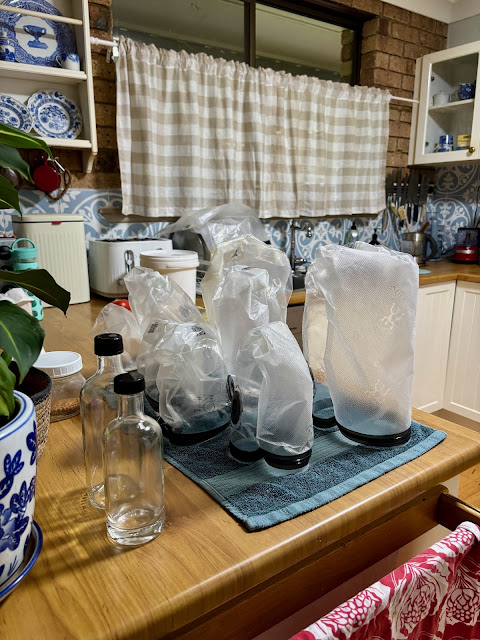
Every morning when I walk into my kitchen it looks tidy and ready for a day's work. Not so on this morning (above), I saw this when I walked in. Late the previous afternoon when I was looking for something, I came across my rolled up Zwilling vacuum bags and decided they had to be washed and dried. So I did that and although I usually put them outside on the verandah to dry it was dark by then. I turned the just-washed bags inside out and left them like this on a towel. It worked well and now the bags are ready to use when I bring home root vegetables, cabbages or whatever I buy that I want to last four or five weeks.
Image

You’ll save money by going back to basics

When I was doing the workshops and solo sessions, I had a couple of people whose main focus was on creating the fastest way to set up a simple life. You can't create a simple life fast, it's the opposite of that It's not one single thing either - it's a number of smaller, simpler activities that combine to create a life that reflects your values; and that takes a long to come together. When I first started living simply I took an entire year to work out our food - buying it, storing it, cooking it, preserving, baking, freezing, and growing it in the backyard. This is change that will transform how you live and it can't be rushed.  
Image


Trending Articles

NOT the last post

This will be my last post here.  I've been writing my blog for 18 years and now is the time to step back. I’ve stopped writing the blog and come back a couple of times because so many people wanted it, but that won’t happen again, I won’t be back.  I’ll continue on instagram to remain connected but I don’t know how frequent that will be. I know some of you will be interested to know the blog's statistics. 
Image

Every morning at home

Every morning when I walk into my kitchen it looks tidy and ready for a day's work. Not so on this morning (above), I saw this when I walked in. Late the previous afternoon when I was looking for something, I came across my rolled up Zwilling vacuum bags and decided they had to be washed and dried. So I did that and although I usually put them outside on the verandah to dry it was dark by then. I turned the just-washed bags inside out and left them like this on a towel. It worked well and now the bags are ready to use when I bring home root vegetables, cabbages or whatever I buy that I want to last four or five weeks.
Image

You’ll save money by going back to basics

When I was doing the workshops and solo sessions, I had a couple of people whose main focus was on creating the fastest way to set up a simple life. You can't create a simple life fast, it's the opposite of that It's not one single thing either - it's a number of smaller, simpler activities that combine to create a life that reflects your values; and that takes a long to come together. When I first started living simply I took an entire year to work out our food - buying it, storing it, cooking it, preserving, baking, freezing, and growing it in the backyard. This is change that will transform how you live and it can't be rushed.  
Image

Creating a home you'll love forever

Living simply is the answer to just about everything. It reduces the cost of living; it keeps you focused on being careful with resources such as water and electricity; it reminds you to not waste food; it encourages you to store food so you don't waste it and doing all those things brings routine and rhythm to your daily life. Consciously connecting every day with the activities and tasks that create simple life reminds you to look for the meaning and beauty that normal daily life holds.  It's all there in your home if you look for it. Seemingly mundane tasks like cleaning and cooking help you with that connection for without those tasks, the home you want to live in won't exist in the way you want it to.  Creating a home you love will make you happy and satisfied.
Image

Time changes everything

I've been spending time in the backyard lately creating a contained herb and vegetable garden. My aim is to develop a comfortable place to spend time, relax, increase biodiversity and encourage more animals, birds and insects to live here or visit. Of course I'd prefer my old garden which was put together by Hanno with ease and German precision. Together, we created a space bursting at the seams with herbs, vegetables and fruity goodness ready to eat and share throughout the year. But time changes everything. What I'm planning on doing now, is a brilliant opportunity for an almost 80 year old with balance issues. In my new garden I'll be able to do a wide range of challenging or easy work, depending on how I feel each day. It’s a daily opportunity to push myself or sit back, watch what's happening around me and be captivated by memories or the scope of what's yet to come.
Image

It's the old ways I love the most

I'm a practical woman who lives in a 1980’s brick slab house. There are verandahs front and back so I have places to sit outside when it's hot or cold. Those verandahs tend to make the house darker than it would be but they're been a great investment over time because they made the house more liveable. My home is not a romantic cottage, nor a minimalist modern home, it's a 1980’s brick slab house. And yet when people visit me here they tell me how warm and cosy my home is and that they feel comforted by being here. I've thought about that over the years and I'm convinced now that the style of a home isn't what appeals to people. What they love is the feeling within that home and whether it's nurturing the people who live there.
Image

Making ginger beer from scratch

We had a nice supply of ginger beer going over Christmas. It's a delicious soft drink for young and old, although there is an alcoholic version that can be made with a slight variation on the recipe. Ginger beer is a naturally fermented drink that is easy to make - with ginger beer you make a starter called a ginger beer plant and after it has fermented, you add that to sweet water and lemon juice. Like sourdough, it must ferment to give it that sharp fizz. To make a ginger beer plant you'll need ginger - either the powdered dry variety or fresh ginger, sugar, rainwater or tap water that has stood for 24 hours to allow the chlorine to evaporate off. You'll also need clean plastic bottles that have been scrubbed with soap, hot water and a bottle brush and then rinsed with hot water. I never sterilise my bottles and I haven't had any problems. If you intend to keep the ginger beer for a long time, I'd suggest you sterilise your bottles. MAKING THE STARTER In a...
Image

An authentic look at daily life here — unstaged and real

Most days Hanno was outside happily working in the fresh air. It may surprise you to know that I started reading my book,  Down to Earth , yesterday - the first time since I wrote it 13 years ago.  I had lent it to my neighbor, and when she returned it, I started reading, expecting to find surprises. Instead, I realised the words were still familiar—as if they were etched into my memory. As I flipped through the pages, I was reminded of how important it was for me to share that knowledge with others. The principles in Down to Earth changed my life, and I truly believed they could do the same for others. After just 30 minutes of reading, I put the book down, reassured that its message still holds true: we can slow down and reshape our lives, one step at a time.
Image