down to earth

  • Home
  • About Us
  • Down To Earth Book
  • Privacy Policy
This is one of our Biggest Kitchen Table discussions.

We have been scrutinising our lives again. While sitting on the verandah yesterday, Hanno and I talked about slipping slowly away from our ideals. Auditing is necessary for us. We don't want to turn around one day and find ourselves back on the spending merry-go-round, so regular audits keep us on track. We must continue our mindfulness, make sure we remain on track and stay focused on our values. It is so easy to become complacent and lazy.


There are times in our lives when we make momentous decisions that are life changing, but we also have times when we need to take stock and make sure we have stayed true to our changes and remain on the right path. This is such a time for us. We are reaffirming that our life choice is working for us and going through our home to decide if there are things we can do without, or tasks we can do differently. We want to be sure we are doing all we can to live simply. It's a healthy activity that will enable us to be fully aware of our past choices while making sure what we have here is working for us.

So during our own review, I thought it would be a good idea to gather as many of you as I can and together we can check our homes to see if improvements or changes are needed. We'll be checking a number of things like disposable products and food, to see if they can be replaced with home made products. We'll be checking our household cleaners, aprons, stockpile cupboards and a few other things I'll tell you about later in the week. We'll also include a no spending week, that will start on Friday 3 July and continue till Thursday night, July 9. That will give you a chance to buy milk or whatever else you need if you're at the end of your grocery cycle. Then, it will be absolutely no spending for the week.

Who will join us in our simple home audit? This will be a no guilt audit. We all have past mistakes we'd rather forget about. The aim of this audit is to keep us on track, or, for some of us, to start living more simply. We will just take stock, make adjustments, move towards a fresh beginning and get on with it.

Each day for a week, I will set a simple task to be completed. They won't take long so those of you working outside the home can join in or save the tasks for your days off. We will start tomorrow. Today I want you to add your name if you want to be included in this task. If you wish to, please capture the badge at the top of this post so you can show what you're doing on your own blog. Who will join us?

ADDITION: Shane and Sarndra have returned from their little honeymoon now and Sarndra just has left a comment for all of us here.

I can't believe it's all over. Our big event, which was minuscule by most standards, has been put to bed in our memories now to be thought about every so often when we're sitting on the verandah or when we see another bride. I guess there are times in our lives that stand out as being important occasions and this certainly was one of those for me. It was a time of welcome - for Hanno and I to welcome Sarndra to our family and to become part of a larger combined family. And it was a time of hospitality, when we opened our home to family, friends and strangers to celebrate an important occasion in all our lives. But for me, it was also a time when I thought a lot about who I am. I am defined by my family now. I am a wife because of Hanno and a mother because of my children, but I am also a sister, friend, neighbour, co-ordinator, gardener, craftswoman, cook, cleaner, writer and a woman and all of those things make me who I am and guide my days.


And today I am guided towards my own home again, this piece of land where Hanno and I work to provide as much as we can for ourselves. Today I'll be focused on getting things back to how they were before. Cleaning up for a wedding gives you good reason to do some deep cleaning but it also makes you hide things you don't have time for and want out of the way. My little writing room was that place for me. Everything that didn't fit was put in there and now needs to be put back to where it usually sits. I bet you all have a place like that where you can quickly get things out of the way and close the door. It won't take me long to put things right and then I'll have my writing space back. I am still waiting for my book proposal to come back and when it does I want to be ready.

The pantry and stockpile cupboard need reorganising too. Opening our home for the wedding also meant opening my kitchen to other cooks who didn't know where food is kept and now my stockpile cupboard looks like a bomb has gone off in there. It needs to be emptied, cleaned and put back. The pantry cupboard is a little better, but not much. I'll clean out both those cupboards in the next few days. We have some fundraising coming up at work too so I'll have to do some baking and pot up some cuttings to sell at the stalls we'll have over the coming months.


Luckily, Hanno did all the washing (5 loads!) while I have been at work these past two days and all the glasses, plates and cutlery, as well as the marquee, that were in the backyard have been taken away by the hire company. Our chooks where allowed out to free range yesterday for the first time in a couple of weeks and when I came home last night they were happily scratching through the hay that was laid down over the wet grass.


So I guess today will help me get back into the normal rhythm of my days. There will be tea taken on the front verandah and dinner cooked tonight and all those activities in between will bring me back home and focus my mind again on our simple life.

Sarndra, Shane, Hanno and I want to thank you sincerely for all your good wishes and kind words. It showed Sarndra and Shane for the first time how wonderful the blog world can be and I think they were surprised at how uplifting it is to receive kind and friendly messages from all over the world.

Oh, and for the few people who asked, I use a Sony Cybershot camera - 6 mega pixels. It's a few years old now but I use it every day and it's still working like a Trojan. It has a little rechargeable battery that I charge up once a week and it never fails me. I am no great photographer but my camera helps me create some good photos. I generally take a few photos of the same subject and then choose which one to use when they're on the computer. I use Photoshop to crop and resize the photos but never alter them in any other way.

I will try to answer some of the many emails today, and to those two lovely ladies who are still waiting for their gift from my last give away, I'll have it in the mail this week. Thank you for your patience. Take care, everyone. I'll see you again tomorrow.


Trip Around the World Wedding Quilt in blues and greens, with grey border.

I've told you well before this that I'm no great sewer. Oh, I get by, but it's not what I would call a natural talent of mine. And let me tell you I'm not being coy writing that, just truthful. There are some things I am good at, sewing is not one of them, I wish I was better at it. So it should go to show you that patch working, once you know the rules and short cuts, is quite easy. If you haven't tried it yet, and would like to make things like quilts, bags and cushion covers, find a mentor or a good book and dive right in. It is a wonderful way to recycle old fabrics and make fabulous gifts. It's so satisfying when you see the finished article that was once a jumble of assorted fabrics. The most difficult part is working out your combination of fabrics and piecing your pattern together.


I started it in late March, and got stuck after I had cut all the fabric and decided on a pattern. When I put it together, I didn't like my colour combination. So I waited until Tricia came up and she helped me look at it in different ways. She also told me I didn't have to cut all my squares, I could have done it in strips. I will do that next time.


This is the most difficult part - choosing fabrics and matching colours and patterns.


Working with an experienced quilter made the whole process much easier. It was still time consuming and repetitive, but when we got to the end, with all the hand stitching, I really loved sitting with the quilt over my knees, stitching the edges. My DIL Cathy teaches patchwork and sewing so we took advantage of her offer to come over and use her huge table for pinning the layers together. She then kindly offered to do the quilting on her quilting machine - you can see this best on the grey border - it's the squiggly lines, called stippling.


The backing is a pure cotton sheet that I bought when I first left home in the 1960s. It's white with a tiny flower pattern and is still in good condition. On the advice of Tricia and Cathy, I made a linen hand stitched label that I attached to the back of the quilt. It states: Trip Around the World Wedding Quilt, their names, date, and where it was made by Rhonda, Tricia and Cathy. Sarndra was overwhelmed when we gave it to them and she cried. It was a very special moment.

And for those of you who wanted to see a close up photo of the cake, here it is.


Shane and Sarndra with Hanno and Tricia in the background.

It was a beautiful day full of beautiful people. Shane and Sarndra made me so proud as they progressed through their day. Shane worked hard right up until 2pm when we all realised we had to have showers and get dressed. Guests started arriving shortly afterwards and Sarndra arrived at 3pm.


Flower girl, Isabella.

The ceremony was conducted in the front garden under the rose arch and luckily, even though it was the midst of winter, a hand full of perfect tiny pink roses swayed gently in the breeze. Flower girl, Isabella, and ring boy, Noah, led the bride, with her parents, Sue and Chris, into the garden to the waiting groom.


Ring boy, Noah, getting to know a very shy Isabella.

We circled the couple while they were exchanging vows and when the ceremony was over, Shane and Sarndra went up the mountain to have more photos taken (a wedding gift from Jens and Cathy) while we invited our guests into the backyard for wine and snacks. It was still light then so many of them wandered through the vegetable garden and looked at the chooks. It definitely was an unusual setting for a wedding but many of the guests commented how lovely our home and garden is.

The snacks were sausage and vegetable rolls with sesame seeds, hummus, baba ganoush, a selection of French and local cheeses, pickled onions and cucumbers with crackers. The main meal was roasted Black Angus beef fillet and roast lamb cooked on a spit roast in the backyard with roasted vegetables, potato bake, peas, corn and gravy. There was spinach and ricotta pie for the vegetarians. Dessert was the wedding cake, made by Shane - a white chocolate and almond cake (no flour) with white ganash and marzipan, served with raspberry coulis and vanilla ice cream. Many people complemented us on the food and I have to say it was delicious. Best man, Nathan, was a great help. He worked the previous night with Shane prepping vegetables and on the day cooking the meat. There were a half a dozen fine dining chefs there, so we had no problem serving up the menu.


After the main meal we had some lovely speeches, followed by the dessert and dancing. And then babies were being bedded down in the house, Alice wandered around being fed with the leftovers and our home was full to over-flowing with laughing and good cheer. I will never forget that night.


Tricia did a wonderful job with the flowers, it was her gift to Shane and Sarndra. Sarndra's bouquet was made up of white roses, white orchids and white hyacinths, the bridesmaid had one similar. White flower circlets surrounded candles on the tables and a beautiful arrangement in my antique long vase sat on the bride and groom's table. There were fairy lights on the back verandah and rice paper lanterns in the marquee and all that soft light added to the magical feeling of the evening. It was quite a day. The next morning, for the first time in years, I slept until seven. I'm still tired now, but I have to go back to work today and even though I'm tired, I've missed being there and I'm looking forward to it.


Shane explaining the flowers to Noah.

On the night before the wedding there was a program on TV about backyard weddings. :-) They said the average cost of an Australian wedding now is $40,000! Ours cost a small fraction of that and it was just so beautiful. Many guests said it was a wonderful wedding and a couple said it was the most beautiful garden wedding they'd been to. It was nice to have those comments to affirm what we were thinking.

And the special project I was working on before the wedding was a wedding quilt that Hanno and I presented to Shane and Sarndra as their wedding gift. I'll write about that another day. I hope you enjoy the photos.


Shane and Sarndra, just before they said: I will.
Rhonda and Hanno, as well as her sister Tricia, are busy preparing for Shane and Sarndra's wedding, so there will be no new post from Rhonda for the next few days. I am sure all of you want to send best wishes for a long and wonderful life together to Shane and Sarndra. Leave a comment below for them to read together after the festivities are over (a very long distance e-wedding card, so to speak)! Hugs to all, Sharon


I bring a message of hope. There are signs of change on the horizon. I noticed these signs about six months ago, as I'm sure many of you did, but thought they held little promise. However, it looks like things are different this time, this seems to be more deeply embedded in mainstream culture, and now I believe change is on the way. And the change is the belief of ordinary men and women that they can modify their materialist lifestyle to that of a more prudent and accountable one.


I remember back a couple of years ago when I heard a report about climate change and peak oil on the 6pm news. Well, that nearly flattened me. I was so surprised that the report was on, I called Hanno to see it. He probably thought I was a bit mad but there it was, what we'd been talking about for so long but in all that time I'd never heard one word of it on the mainstream media. Ha!, I thought, fancy that, never dreaming those reports would become commonplace in just a few short months.


And now on Oprah, I find that back in January an article called: Back to Basics, Living with Voluntary Simplicity. was featured in the O magazine. Far out! That is about as close to middle America as you can get. And in February she did a TV program on What can you live without?, in March, she did another on Simplify your Life. I mean no disrespect but America was the last major player to arrive at this change; European countries and some of the Commonwealth countries - Canada, NZ, Australia had been working towards cutting back, simplifying, gardening etc, well before the US, en masse, saw the need. However, I have always believed that without America, any change it would be short lived. The amount of wealth in America, coupled with the potential to spend it, as well as the amount of energy consumed there, made it imperative that the US saw the need for change as well. And it took the economic crisis to bring that change to the people.


Those of us who have lived this way for a few years would know that five years ago, the only literary references to living a simple life were in books and blogs. Now there are magazines and TV programs and all sorts of references in popular culture. I know mainstream media don't lead, they are followers, so it's very heartening to know they now providing what their audiences are asking for - more information about living more simply.


I'd be interested to know what you've seen in the popular media about cutting back, living within your means and being at home. I'm sure there's a lot more out there that I'm aware of. I don't buy magazines any more so things do pass me by. So tell me please, who is writing about what? I think we all have our favourite simple living blogs, so I'm not interested in blogs at the moment, what have you seen on TV, in newspapers and magazines? Please give us some links if you can so we can build up a point of reference that we can all read through as time allows.

Do you think, like I do, that the times they are a'chanin'? I have no doubt that when the economy improves, many of the new frugalistas will go back to spending but I think there are millions of people now who have seen that the grass can be greener on the other side of the fence and when they have more money to spend, they may not be tempted back. I think a genuine change has happened, do you?

Life can be hard sometimes. We're working towards our big event this weekend. Hanno's done a lot of gardening and preparation outside, I've worked inside and that will continue until Saturday when we get the most wonderful pay-off for that hard work by seeing our son marry right here in our own home. You rarely get the good things without the work. It's like the simple tasks of soapmaking and composting - you put the ingredients in, add the energy and out comes something much better than what you started with. The hard work pays off, in soap making, composting and life.


I'm a working class woman. I might not slip easily into that category in terms of my education and previous earning capacity but in my mind I am, and will always be, working class. It is my heritage and my inclination, and I wear the badge with pride because I believe I have become the person I am because of the work I do. I have to tell you though, I don't enjoy all the work I do, but I enjoy most of it because I can see the rewards it brings, and it makes me who I am. I would be a lesser person without the work.

Maybe that was one of the reasons I was drawn to this simpler kind of life; maybe it was the work that attracted me, because there certainly is a lot more to do living this way. But I see that as a gift. Having productive work to fill the hours is not the hardship some make it to be. It is simply what it is - the work of life. I would rather spend my energy sweeping my floor, hanging the laundry on the line and gardening than walking around a shopping mall looking for things to buy, and then battling traffic to bring my bounty home. I would rather work to help provide a warm and loving venue for our family wedding than pay someone to do that for me. Our work this week is part of the wedding and we won't have the wedding we want without it.


I had an email from a young woman last week who wrote that she wants to live simply but she doesn't like the work and is there an easier way to do it? I'm not sure how to answer that question because for me, no, there isn't an easier way to do it, but my way won't suit everyone. I've said this over and over again, there are many ways to live life - simply or not, and you should all live how it suits you. There are role models that you can learn from but in the end it is your life and you should live it as you see fit.

But I encourage you all to try this coat on for size - this simple life coat may not fit all comers but if it does sit well on your shoulders it is a fine way to live. Of course, not everything I do will fit into your life, and some of the things you do wouldn't fit into mine. But that's good - that is part of the whole idea of it, that we are all different and we live accordingly. Don't be hoodwinked into believing that fashionable clothes or household goods are the answer. You will be forever buying the newest must have and paying for the privilege of it. Don't look at your neighbours with envy because they've just installed a pool or drive that new car - they probably have debt as big as their egos. And don't feel bad because you're working hard - it might be the making of you, just as it has been for me.


And for those of you who can't work as hard as you would like, do what you can and be pleased with that. We all know there are times, for all of us, when you just can't do the work ahead of you and if you are at that point now, accept it and do what you can, when you can. But if you are capable and healthy, embrace the work you do, either at home or at your paid job, and know that what you do not only produces it's own reward, it makes you stronger and will, over time, change you for the better.

How do you feel about the work you do? Is it part of you or do you see it as a necessary evil?

RELATED POST:
The button box

x


It's a mystery to me why all gardeners don't make their own compost. It is an important part of gardening, will help enrich your soil, and it cuts down on the amount of rubbish that sits decomposing in the council rubbish dump. Why send your kitchen and garden waste to the dump to decompose when it would help you grow vegetables and flowers while contributing to the health of your soil? Of course, the way you compost will be determined by your climate, how much waste you have to compost and how much time you have to do it. If you aren't composting now in some form, and have the means to do it, I hope you'll think about it now and give it a go. I have written about compost a few times before here and here, so this post will be the odds and ends associated with composting and, hopefully, a motivation for you to start composting if you haven't done so already.


Our compost bin surrounded by volunteer cherry tomato seedlings.

There is a hierarchy of household waste that I've written about here. When you think about this hierarchy, also think about the wildlife you have in your backyard. If you have rats, mice, possums, foxes, coyotes, bears or wild cats, you'll have to be careful not to put food in your compost heap that will attract those animals. Generally it's a rule that you don't put meat or dairy products in the compost heap as this will certainly attract animals even if you've never had any in the past. Attracting animals with your compost is a problem in the country and in semi rural areas, but even if you live in the middle of the city or in the suburbs, you'll attract cats and rats if you continue to put meat out.


Flowering comfrey. This herb helps speed up decomposition.

Remember there is more than one way to recycle waste. You could also build a worm farm, or use your chickens or dogs to recycle some of your kitchen scraps. Chooks love to eat meat and chicken, and they love eggs, old bits of toast and cake and all forms of dairy. If you give these tasty morsels to your chooks, it will increase their level of protein food and, hopefully, their egg production.


Bathrub worm farm in the bushhouse.

If you have chickens, dogs or worms, you'll need to decide where your kitchen waste will go. The hierarchy again! If you have meat scraps or any other food that would attract the wildlife in your backyard, give those scraps to the chooks or dogs straight away, it will supplement the food you generally feed them. If you're going to compost, start by putting a small container, with a lid, in the kitchen in which to put your compostable kitchen waste. This will hold all your fruit and vegetable peelings, crushed or pulverised egg shells, tea leaves or tea bags and coffee grinds. Empty the little container every day into the compost heap or bin.


Our stockpile of dry material - shredded paper.

You will need a lot more dry material for your compost than wet material. Read about the importance of this in the links above. Dry material can be old newspapers, cardboard, old telephone books, junk mail, worn out cotton dishcloths or clothes, hair, feathers, wool or any other worn out item that is not man-made. Plastic and polyester will not decompose. You'll need about two thirds dry to one third wet material, so if you can gather a lot of these dry materials, you'll have the beginnings of a good compost heap. You'll need to keep your compost moist, not wet and you'll speed up decomposition if you add comfrey or comfrey tea to your heap. Make the compost according to the information provided and your own climate and conditions, add your kitchen scraps, and turn the material over to incorporate air and you're on your way to good compost.

Composting is an ideal activity for those of us who live simply. It reduces household waste and it helps us use what we have to its fullest extent - from new, right through until it decomposes and returns to the earth. It helps us see waste in a more productive way, instead of giving it to someone else to take care of. It encourages us to feel responsible for what we bring into our homes - we look for natural products that will be compostable in a few years time instead of buying plastic or polyester. But most of all, I love composting because it allows me to take full responsibility for what I buy. If it comes here, I want it to stay here and not be part of the growing problem of landfill. I hope I've encouraged you to think about composting in some form. There are few hard and fast rules for composting, each climatic zone tends to come up with it own innovative solutions. If you're composting already, I'd love to know what you're doing. I am always open to new ideas and keen to learn.

Good morning! This time next week it will all be over. Our wedding is next Saturday and we are calmly (I think) moving towards the big day. My special project will be finished tomorrow, we've ordered everything that needs to be ordered, the flowers will be picked up on Wednesday and the cold room and food on Thursday. On Friday we'll have a working bee, with people coming to help prepare and peel vegetables and make "things". Yes, it's all going to plan.

I've had a few people ask if we're stressed and I can truthfully say we aren't. We're working to a plan and doing a few things each day and, so far, nothing has gone wrong. My sister Tricia is here helping us and as we get closer to the big day, we are all looking forward to it very much.

I'll tell you more about it after the wedding but I can tell you this right now. I am very proud of Shane and Sarndra because even though they have friends who have had recent "big" weddings, they have kept to their budget, bought a few things each week as they were paid and they are on track for a beautiful wedding, surrounded by people who love them, that will be celebrated without a financial hangover. We only have a few important celebrations during our lives - new babies, weddings, graduations, I am thankful that this wedding has been handmade from scratch by our family and friends. This truly is a family wedding and it promises to be a beautiful one.

I hope you're enjoying your weekend. Take some time for yourself whenever you can to recharge your batteries for your work next week. I'll see you again tomorrow.
If you planted a tomato into virgin Australian soil (and probably most other virgin soils) and watered it, it might live and produce small tomatoes, but it wouldn't thrive. To get the best from your plants you need to help them along. The old saying of organic farmers world wide is "feed the soil, not the plant" and by this they mean it's best to add old cow, horse, sheep, goat, pig manure, compost or organic matter to improve soil structure and add microbes to the soil, than it is to fertilise plants in unimproved soil. If you're going to be gardening for many years, even sandy and clay soil will improve with these additions, and it's better to garden in soil that's alive and healthy rather than just use the top layer that you add each year.


Once you've improved your soil, and even when you're in the process of doing it, you'll be able to plant up a wide variety of vegetables that will take advantage of your work and result in healthy, organic produce for your table. Fertilising is one of the skills of organic vegetable gardening. It's worthwhile giving this a bit of thought because if you get this right, you'll be looking at abundant crops rather than meagre ones.

One of the good things about organic fertilisers is that many of them can be made in your own backyard, and will therefore cut down the cost of your garden. Garden and kitchen waste can be turned into compost or fed to worms, you can grow comfrey to make a nitrogen-rich tea. Comfrey also breaks down the soil it grows in by sending down a long tap root to mine the minerals contained deep within the soil. Most of those minerals will be in your fertiliser. Aged chicken or animal manure, and manure mixed into compost, make fantastic soil additives and will increase the amount of available nitrogen and microbes in your soil.

Foliar feeding is the fertilising of plants through their leaves. You do it by making or buying a liquid fertiliser to the required strength and, using a watering can, pour the liquid over the plant. Plants can absorb a large amount of their nutrients through their leaves. However, some plants do not like this form of fertilising - tomatoes, pumpkins and zucchini come to mind, but most leafy green vegetables love liquid fertiliser.

When making up a commercial liquid fertiliser, be guided by the instructions on the bottle, but make it weaker than they suggest. A weaker brew, applied more frequently, is a better option. So, for example, if they recommend 1 cap full of fertiliser in 10 litres (quarts) of water, applied every month, make yours ½ cupful in 10 litres and apply it every two weeks. You will get better growth that way.


Leafy greens
Leafy greens usually need to grow fast for better taste. Lettuce, spinach, silverbeet, cabbage etc will do really well if you plant them in rich soil, full of compost, aged animal manures and organic matter, and water them every week or two with a weak compost, worm or comfrey tea, or fish emulsion. So with leafy greens you can give them nitrogen in the soil and a foliar feed over their leaves to keep them growing fast.


Fruiting vegetables - tomatoes, cucumbers, pumpkins etc
They will do better if you plant them in rich soil with an application of sulphate of potash to the planting hole. When you plant the seedling or when the seedling emerges, water it with a solution of seaweed tea, made according to the instructions on the bottle. This is more a plant tonic than a fertiliser and it will help your plants cope with a wide range of conditions as well as help them access the available nutrients in the soil and grow good root systems. Don't give fruiting vegetables too much nitrogen and don't give them foliar fertiliser because they'll grow a lot of leaves but give you no fruit. The line is fine here - you want a good healthy plant capable of supporting strong growth and fruit but you don't want to over do it. So good soil + seaweed + watering around the base of the plants - don't water these plants over their leaves, you'll be inviting trouble if you do.

If you have any worm castings, put some in the planting hole or around the base of the plant later on, and cover it with mulch, or make worm tea. The instructions for doing that is in the link below for home made fertilisers.


Comfrey

If you're hoping to make your own nitrogen fertilisers, I encourage you to get some comfrey root and plant it at the edge of your garden or in a large pot. Comfrey leaves can be used for several purposes in the garden - to make nitrogen fertiliser tea, as a mulch for potatoes and to accelerate decomposition in the compost heap. It's a valuable herb. Many people think it's an invasive plant, and it is in a way but it won't take over your garden. It's a clumping plant and it will stay in the area you give it, but if you decide to remove it, any little piece left behind will reshoot. So make sure you give it a permanent position, or plant in a container.

Organic fertilisers
My home made fertiliser recipes
Growing tomatoes from seed

There are many other nutrients necessary in the garden but the fertilisers above are the main ones and they'll get you started. In a couple of years, when you want to learn more about fertilisers, find a good book about organic fertilising and do some reading. It's an interesting subject. And remember, soil improvement and fertilising are ongoing tasks, just like watering and pruning, and are part of every gardening season.
I think it's wonderful that there are a lot of new vegetable gardeners now. Growing food is part of a new way of living for some, it helps others keep to their budget, and some people see it as a healthy activity producing organic food for the table. Whatever the reason, producing some of your own food is a good thing. It gives us life skills, it's a great activity to enjoy with the kids and it takes us into the natural world outside our door everyday. But vegetable gardening is a complex simple activity. It requires an amount of expertise and skill to be good at it. That comes with time, by simply gardening every season. Each year you learn new things, it's an activity for the brain as much as it is those other wonderful things. If you're a new gardener, I encourage you to buy a very good organic vegetable gardening book that is suitable for your area. The one I use here most often is Lyn Bagnall's Easy Organic Gardening and Moon Planting, but I also like, and often read, Linda Woodrow's The Permaculture Home Garden. You don't want a book full of pretty pictures, you need one that has good practical information about gardening in your climate.


If you have no reference book yet, check out your local library to see what they have or ask your local gardening club which of the organic vegetable gardening books suits your area best. Once you have your book, read about soil types, worms, compost etc, but about what you're about to plant. If you're doing the 3x3 method, read as much as you can about those nine vegetables. A good book will give you information about soil conditions, seed or seedling spacing, fertilising, plant growth, plant maintenance and harvesting specific to each of your vegetables.


The thing that will help most with growing vegetables is to plant them in good soil. You don't have to start off with good soil, we didn't, our soil is clay, but over the years, because we added compost and organic matter each year, it's turned into the most beautiful loam. The range of soil goes from sandy, to loam, to clay. Sandy soil has very little organic matter and will therefore be unable to hold water, support worms and microbes or provide a suitable growing medium for your plants. Treat it with organic matter and compost - mulch your plants with straw or hay, it will break down and add organic matter to the soil. Loam is good for most vegetables. It has an amount of organic matter, good structure and will support the unseen life of microbes and worms. To keep it that way, add compost every year, and mulch your plants with straw or hay. Clay is full of nutrients but the structure is so dense, it doesn't allow air in or water to drain away. The solution? You guessed it - add compost and organic matter, with a bit of gypsum. That will break up the clay and give you excellent soil after a couple of years.

If you have deficient soil that you want to plant in this season, there is a way. Either build a no dig garden or dig compost and organic matter into your entire garden and plant into pockets of pure compost. The second option would be my preference. After a few seasons doing this, you'll eventually improve even the worst soil - either sandy or clay, and you'll get wonderful healthy vegetables. BTW, organic matter can be many things like old grass clippings, worm castings, shredded newspaper, vegetable peels, straw etc, or a combination of all of them - you need to dig it in well. The best kind of organic matter is compost which is all those things previously mentioned that have been wet and allowed to decompose. The structure of compost is very similar to that of loam so it gives the tiny seedling roots a good medium in which to grow. If you're serious about your gardening, I encourage you to build a compost heap. Not only will it give you valuable compost, it will help you reduce the amount of "rubbish" you put in the garbage bin.


Tomorrow, I'll write about fertilising leafy green vegetables and fruiting vegetables because some of you mentioned recently that you over fertilised. The following day I'll write about making compost in the backyard.

Don't expect to have perfection or success with every thing you grow. Gardening is a natural process that we can assist but not control. The best way to approach gardening in the first few years is to plant only what you can manage, plant what you eat, and learn as you go. I learn new things every year and I've been gardening for yonks. Being a gardener is like joining a secret club full of generous people who will help you whenever they can. Your part of the bargain is to help others in years to come. If you can do that, you'll be a true gardener and worthy of the title.

Newer Posts Older Posts Home

MY BOOKS

MY BOOKS


My books were all published by Pengiun, and are available at Amazon US, Amazon UK and Amazon Au

Search here

Total Pageviews

Translate


I'm Rhonda Hetzel and I've been writing my Down to Earth blog since 2007. Although I write the occasional philosophical post, my main topics include home cooking, happiness and gardening as well as budgeting, baking, ageing, generosity, mending and handmade crafts. I hope you enjoy your time here.

MY FAVOURITE PLACES

  • Grandma Donna's Place
  • Grandma Donna's YouTube
  • Grandma Donna's Instagram
  • This Simple Day
  • Nicole's Instagram

Give More

Give More

Popular posts last year

Making ginger beer from scratch

We had a nice supply of ginger beer going over Christmas. It's a delicious soft drink for young and old, although there is an alcoholic version that can be made with a slight variation on the recipe. Ginger beer is a naturally fermented drink that is easy to make - with ginger beer you make a starter called a ginger beer plant and after it has fermented, you add that to sweet water and lemon juice. Like sourdough, it must ferment to give it that sharp fizz. To make a ginger beer plant you'll need ginger - either the powdered dry variety or fresh ginger, sugar, rainwater or tap water that has stood for 24 hours to allow the chlorine to evaporate off. You'll also need clean plastic bottles that have been scrubbed with soap, hot water and a bottle brush and then rinsed with hot water. I never sterilise my bottles and I haven't had any problems. If you intend to keep the ginger beer for a long time, I'd suggest you sterilise your bottles. MAKING THE STARTER In a...
Image

NOT the last post

This will be my last post here.  I've been writing my blog for 18 years and now is the time to step back. I’ve stopped writing the blog and come back a couple of times because so many people wanted it, but that won’t happen again, I won’t be back.  I’ll continue on instagram to remain connected but I don’t know how frequent that will be. I know some of you will be interested to know the blog's statistics. 
Image

How to make cold process soap

I'm sure many of you are wondering: "Why make soap when I can buy it cheaply at the supermarket?" My cold process soap is made with vegetable oils and when it is made and cured, it contains no harsh chemicals or dyes. Often commercial soap is made with tallow (animal fat) and contains synthetic fragrance and dye and retains almost no glycerin. Glycerin is a natural emollient that helps with the lather and moisturises the skin. The makers of commercial soaps extract the glycerin and sell it as a separate product as it's more valuable than the soap. Then they add chemicals to make the soap lather. Crazy. Making your own soap allows you to add whatever you want to add. If you want a plain and pure soap, as I do, you can have that, or you can start with the plain soap and add colour, herbs and fragrance. The choice is yours. I want to add a little about animal and bird fat. I know Kirsty makes her soap with duck fat and I think that's great. I think t...
Image

Preserving food in a traditional way - pickling beetroot

I've had a number of emails from readers who want to start preserving food in jars but don't know where to start or what equipment to buy.  Leading on from yesterday's post, let's just say up front - don't buy any equipment. Once you know what you're doing and that you enjoy preserving, then you can decide whether or not to buy extra equipment. Food is preserved effectively without refrigeration by a variety of different methods. A few of the traditional methods are drying, fermentation, smoking, salting or by adding vinegar and sugar to the food - pickling. This last method is what we're talking about today. Vinegar and sugar are natural preservatives and adding one or both to food sets up an environment that bacteria and yeasts can't grow in. If you make the vinegar and sugar mix palatable, you can put up jars of vegetables or fruit that enhance the flavour of the food and can be stored in a cupboard or fridge for months. Other traditional w...
Image

Cleaning mould from walls and fabrics

With all this rain around we've developed a mould problem in our home. Usually we have the front and back doors open and that good ventilation stops most moulds from establishing. However, with the house locked up for the past week, the high humidity and the rain, mould is now growing on the wooden walls near our front door and on the lower parts of cupboards in the kitchen. Most of us will find mould growing in our homes at some point. Either in the bathroom or, in humid climates, on the walls, like we have now. You'll need a safe and effective remedy at some point, so I hope one of these methods works well for you. Mould is not only ugly to look at, it can cause health problems so if you see mould growing, do something about it straight away. The longer you leave the problem, the harder it will be to get rid of it effectively. If you have asthma or any allergies, you should do this type of cleaning with a face mask on so you don't breathe in any spores. Many peopl...
Image

Five minute bread

Bread is one of those foods that, when made with your own hands, gives a great deal of satisfaction and delight. It's only flour and water but it symbolises so much. I bake bread most days and use a variety of flours that I buy in bulk. Often I make a sandwich loaf because we use most of our bread for lunchtime sandwiches and for toast. Every so often I branch out to make a different type of loaf. I have tried sour dough in the past but I've not been happy with any of them. I'll continue to experiment with sour dough because I like the idea of using wild yeasts and saving the starter over a number of years to develop the flavour and become a part of the family. However, the loaf I've been branching out to most often is just a plain old five minute bread. By five minutes I mean it takes about five minutes actual work to prepare but it's the easiest of all bread to make and to get consistently good loaves from. If you're having people around for lunch or...
Image

This is my last post.

I have known for a while that this post was coming, but I didn't know when. This is my last post. I'm closing my blog, for good, and I'm not coming back like I have in the past.  I've been writing here for 16 years and my blog has been many things to me. It helped me change my life, it introduced me to so many good people, it became a wonderful record of my family life, it helped me get a book contract with Penguin, and monthly columns with The Australian Women's Weekly and Burke's Backyard . But in the past few months, it's become a burden. In April, I'll be 75 years old and I hope I've got another ten years ahead. However, each year I'll probably get weaker and although I'm fairly healthy, I do have a benign brain tumour and that could start growing. There are so many things I want to do and with time running out, leaving the blog behind gives me time to do the things that give me pleasure. On the day the blog started I felt a wonderful, h...
Image

What is the role of the homemaker in later years?

An email came from a US reader, Abby, who asked about being a homemaker in later years. This is part of what she wrote: "I am a stay-at-home mum to 4 children, ages 9-16. I do have a variety of "odd jobs" that I enjoy - I run a small "before-school" morning drop-off daycare from my home, I am a writing tutor, and I work a few hours a week at a local children's bookstore. But mostly, I cherish my blissful days at home - cooking, cleaning (with homemade cleaners), taking care of our children and chickens and goats, baking, meal-planning, etc. This "career" at home is not at all what I imagined during my ambitious years at university, but it is far more enriching. I notice, though, that my day is often planned around the needs of my family members. Of course, with 4 active kids and a husband, this is natural. I do the shopping, plan my meals, cook dinner - generally in anticipation of my family reconnecting in the evening.  I can't h...
Image

Every morning at home

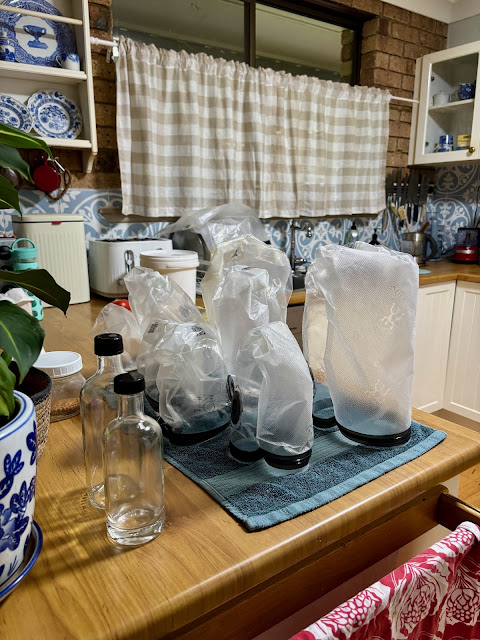
Every morning when I walk into my kitchen it looks tidy and ready for a day's work. Not so on this morning (above), I saw this when I walked in. Late the previous afternoon when I was looking for something, I came across my rolled up Zwilling vacuum bags and decided they had to be washed and dried. So I did that and although I usually put them outside on the verandah to dry it was dark by then. I turned the just-washed bags inside out and left them like this on a towel. It worked well and now the bags are ready to use when I bring home root vegetables, cabbages or whatever I buy that I want to last four or five weeks.
Image

You’ll save money by going back to basics

When I was doing the workshops and solo sessions, I had a couple of people whose main focus was on creating the fastest way to set up a simple life. You can't create a simple life fast, it's the opposite of that It's not one single thing either - it's a number of smaller, simpler activities that combine to create a life that reflects your values; and that takes a long to come together. When I first started living simply I took an entire year to work out our food - buying it, storing it, cooking it, preserving, baking, freezing, and growing it in the backyard. This is change that will transform how you live and it can't be rushed.  
Image


Trending Articles

NOT the last post

This will be my last post here.  I've been writing my blog for 18 years and now is the time to step back. I’ve stopped writing the blog and come back a couple of times because so many people wanted it, but that won’t happen again, I won’t be back.  I’ll continue on instagram to remain connected but I don’t know how frequent that will be. I know some of you will be interested to know the blog's statistics. 
Image

Every morning at home

Every morning when I walk into my kitchen it looks tidy and ready for a day's work. Not so on this morning (above), I saw this when I walked in. Late the previous afternoon when I was looking for something, I came across my rolled up Zwilling vacuum bags and decided they had to be washed and dried. So I did that and although I usually put them outside on the verandah to dry it was dark by then. I turned the just-washed bags inside out and left them like this on a towel. It worked well and now the bags are ready to use when I bring home root vegetables, cabbages or whatever I buy that I want to last four or five weeks.
Image

You’ll save money by going back to basics

When I was doing the workshops and solo sessions, I had a couple of people whose main focus was on creating the fastest way to set up a simple life. You can't create a simple life fast, it's the opposite of that It's not one single thing either - it's a number of smaller, simpler activities that combine to create a life that reflects your values; and that takes a long to come together. When I first started living simply I took an entire year to work out our food - buying it, storing it, cooking it, preserving, baking, freezing, and growing it in the backyard. This is change that will transform how you live and it can't be rushed.  
Image

Creating a home you'll love forever

Living simply is the answer to just about everything. It reduces the cost of living; it keeps you focused on being careful with resources such as water and electricity; it reminds you to not waste food; it encourages you to store food so you don't waste it and doing all those things brings routine and rhythm to your daily life. Consciously connecting every day with the activities and tasks that create simple life reminds you to look for the meaning and beauty that normal daily life holds.  It's all there in your home if you look for it. Seemingly mundane tasks like cleaning and cooking help you with that connection for without those tasks, the home you want to live in won't exist in the way you want it to.  Creating a home you love will make you happy and satisfied.
Image

Time changes everything

I've been spending time in the backyard lately creating a contained herb and vegetable garden. My aim is to develop a comfortable place to spend time, relax, increase biodiversity and encourage more animals, birds and insects to live here or visit. Of course I'd prefer my old garden which was put together by Hanno with ease and German precision. Together, we created a space bursting at the seams with herbs, vegetables and fruity goodness ready to eat and share throughout the year. But time changes everything. What I'm planning on doing now, is a brilliant opportunity for an almost 80 year old with balance issues. In my new garden I'll be able to do a wide range of challenging or easy work, depending on how I feel each day. It’s a daily opportunity to push myself or sit back, watch what's happening around me and be captivated by memories or the scope of what's yet to come.
Image

It's the old ways I love the most

I'm a practical woman who lives in a 1980’s brick slab house. There are verandahs front and back so I have places to sit outside when it's hot or cold. Those verandahs tend to make the house darker than it would be but they're been a great investment over time because they made the house more liveable. My home is not a romantic cottage, nor a minimalist modern home, it's a 1980’s brick slab house. And yet when people visit me here they tell me how warm and cosy my home is and that they feel comforted by being here. I've thought about that over the years and I'm convinced now that the style of a home isn't what appeals to people. What they love is the feeling within that home and whether it's nurturing the people who live there.
Image

Making ginger beer from scratch

We had a nice supply of ginger beer going over Christmas. It's a delicious soft drink for young and old, although there is an alcoholic version that can be made with a slight variation on the recipe. Ginger beer is a naturally fermented drink that is easy to make - with ginger beer you make a starter called a ginger beer plant and after it has fermented, you add that to sweet water and lemon juice. Like sourdough, it must ferment to give it that sharp fizz. To make a ginger beer plant you'll need ginger - either the powdered dry variety or fresh ginger, sugar, rainwater or tap water that has stood for 24 hours to allow the chlorine to evaporate off. You'll also need clean plastic bottles that have been scrubbed with soap, hot water and a bottle brush and then rinsed with hot water. I never sterilise my bottles and I haven't had any problems. If you intend to keep the ginger beer for a long time, I'd suggest you sterilise your bottles. MAKING THE STARTER In a...
Image

Back where we belong

Surprise! I'm back ... for good this time. Instagram became an impossible place for me. They kept sending me messages asking if I'd make my page available for advertisers! Of course, I said no but that didn't stop them. It's such a change from what Instagram started as. But enough of that, the important part of this post is to explain why I returned here instead of taking my writing offline for good. For a few years Grandma Donna and I have talked online face-to-face and it's been such a pleasure for me to get to know her. We have a lot in common. We both feel a responsibility to share what we know with others. With the cost of living crisis, learning how to cook from scratch, appreciate the work we do in our homes, shop to a budget and pay off debt will help people grow stronger. The best place to do that is our blogs because we have no advertising police harassing us, the space is unlimited, we can put up tons of photos when we want to and, well, it just feels li...
Image