down to earth

  • Home
  • About Us
  • Down To Earth Book
  • Privacy Policy
We live in a bit of a retro world here. Most of the time it's not like we're living in the 21st century, it's more like a time from the past when neighbours knew each other and people say hello as you walk down the street. When we close our gate, time doesn't matter at all and we could be living anywhere, at any time. We make our own experiences and memories within our boundary fences with little influence from whatever is outside. There is a special feeling of isolation living here in the hinterland but when we cross that line that cuts our hinterland off from what is known as "the coast" it's like stepping nervously into another world.

We went out shopping yesterday. = :- O

I'm glad I don't do that too often. There have been lots of changes since I was last at the mall, the crowds of wandering people are still there but we bought what we went for - some clothes for Hanno to wear at the wedding, ribbons and lights, and then we were out of there. It felt good to cross back over the main highway again and thread our way through the pine forests, back to familiar territory.

We travelled up the mountain late in the afternoon to collect the little bus from the Centre I work at so Hanno can be off early this morning. Today we'll have another day out. Hanno will drive into Brisbane soon to collect 11 international visitors who are attending the Building Community Centred Economies conference. They have chosen to spend the day in our town to see how we live. We have a community bank that invests in the community instead of taking profits, we have several co-operative trading enterprises, a permaculture village as well as a couple of other communal living villages, a co-op restaurant and generally a well functioning, self-supporting town. The delegates will visit several of these enterprises, then my Centre, and after that we'll take them to a heritage listed park, with gorgeous views, for a BBQ lunch.

It will be a busy day but one that I think we'll enjoy. We'll be showcasing our community and providing hospitality to our visitors and even though these people will just see us as helpers on a bus tour they've decided to take in a foreign land, today they will be part of our simple lives and I think we'll be better for the experience of it.

And now I'd better get a wriggle on. I can hear Hanno making a cup of tea so I'd best start my chores, one of which is making a ricotta and spinach pie for any vegetarians we have in our company today. I hope you enjoy your day too. Take care.


When you first take up your trowel and fork and start planting vegetable seeds for the first time there is a very strong tendency to overdo it or to dive in with no thought of order, outcome or orthodoxy. When the gardening bug grabs you, you're in it for production, nothing else matters. Or does it?

It will help you considerably if you can think a little about what you're about to plant, because if you're in your early years of gardening and you over do it, or go through a season with few vegetables making it to your kitchen table, you might give up. And I don't want that to happen. NEVER give up because it's too difficult - in gardening or anything else. You just need to think about your planting in a different way, work out your strategy and start again. You learn the best lessons from your own mistakes or when times are tough.


The first thing to do if you're planning your first vegetable garden is to decide what you'll plant. To do that effectively, get yourself a good organic vegetable gardening book suitable for the climate you live in, a couple of pieces of paper and a pencil and a cup of tea. Your first step is to write a list of the vegetables you commonly eat over the course of a month. Your list might look something like this:
  • Onions
  • Potatoes
  • Beans
  • Peas
  • Garlic
  • Leeks
  • Swiss chard
  • Pumpkin
  • Zucchini
  • Cabbage - white
  • Tomatoes
  • Avocado
  • Lettuce
  • Cucumbers
  • Beets
  • Carrots
  • Celery
  • Cauliflower
  • Kale
  • Asparagus
Of your listed vegetables, work out, by reading your book, what can be easily grown in your climate at this particular time of year. Remember, no matter how dearly you want something to grow, it won't grow out of season.

Your list might now look like this:
  • Onions
  • Potatoes
  • Beans
  • Peas
  • Garlic
  • Leeks
  • Swiss chard
  • Cabbage - white
  • Tomatoes
  • Lettuce
  • Beets
  • Carrots
  • Celery
  • Cauliflower
  • Kale
This list is still too long for an inexperienced gardener. Of these remaining vegetables, which are the ones that cost the most when you have to buy them, and which ones are your favourites? Now your list might look like this:
  • Onions
  • Potatoes
  • Beans
  • Peas
  • Garlic
  • Leeks
  • Swiss chard
  • Tomatoes
  • Lettuce
  • Celery
  • Cauliflower
So let's imagine that you love tomatoes, beans and peas, the others are vegetables you eat often and they are quite expensive. Let's take potatoes off the list, because although they're an excellent backyard crop, and it's much healthier to eat organic potatoes than store bought non-organic ones, potatoes take a lot of room and it's best to start off potatoes when you know a bit more about gardening. We'll put garlic, onions and leeks in the one category - they are all in the same family and can be planted together. We'll take celery off the list as well unless you have a lot of water to give them. Now our list looks like this:
  • Beans - favourite
  • Peas- favourite
  • Tomatoes- favourite
  • Onions - all
  • Garlic - same
  • Leeks - family
  • Swiss chard - easy
  • Lettuce- easy if you're not in the tropics
  • Cauliflower- easy
That, my friends, is a good novice vegetable gardener's list. They could be different in your garden but if you have three vegetables that you are really keen on, three from the same family, so they require similar care; and three easy crops, you'll be eating your own produce before too long with a minimum of fuss.


Our little French hen Heather (salmon Faverolles) with her best friend Martha (buff Orpington).

Before planting though, you have to work out how many of each plant you need. As well as being eaten fresh, your tomatoes, beans and peas can all be either blanched and frozen or made into delicious sauce or relish, so plant as many of them as you can manage. The onions and garlic will store well and when you harvest the leeks, just cut them at ground level and they'll keep growing. So plant plenty of garlic and onions and not so many of the leeks. Swiss chard can be frozen, as can cauliflower, as well as being eaten fresh, so plant plenty of them. And with the lettuces, if you eat two per week, plant six for three weeks, and plant your follow up seeds two weeks after planting. If you intend to grow lettuce all season, plant eight seeds every three weeks - throw out your two weakest seedlings.


And for the rest of it? Don't fret about what you can't grow. Appreciate your successes and focus on growing as many of your favourites as you can. Find a market where you can buy fresh inexpensive produce and buy what you can't grow. However, always keep in the back of your mind that as your gardening skills develop, you may be able to progress to the more difficult crops later. Creating micro-climates can sometimes protect a crop that normally might not grow in your area. Each year add a new batch of three, read your gardening book so you know what conditions they need and aim at producing good quality vegetables using organic methods.

Happy gardening everyone!


Comfort food usually makes a comeback whenever the economy does a nose dive. We also tend to use more of the cheaper cuts of meat, waste less and shop more for bargains. I was reading an article from Australian Food News about 2009 food trends recently. All the above were mentioned as this year's trends, as well as an increase in entertaining at home, more community food projects and, paradoxically, more food delivered by mail. Hmmm. Many of the trends in that article are strategies that Hanno and I use and it reaffirmed for me that living simply is generally a sensible way of life. Being frugal in all manner of things - our shopping, growing food, mending, knitting, sewing, being satisfied at home, paying off debt and cutting back whenever we can, helps us through a recession like nothing else, and it makes sense not only in bad times but also in good.

It made me think about how much we have changed; that we are conservers now instead of consumers. We were due for that change, overdue, in fact. All that money wasted, it makes me shudder just to think of it. But now Hanno and I are well and truly embedded in this way of life. It feels natural to us now to economise, save, reuse, mend and recycle. It is now part of how we live and who we are. There is no going back for us. We are here for good.

But what about you? When all this kerfuffle is over, when the credit is flowing freely again, when McMansions are once again being touted as "THE place to live", will you be there knocking at the door? According to this article: "Three quarters of shoppers who have made changes to their food and grocery shopping due to the economic climate say that they will stick with their new habits even when the economy recovers, according to new research from the UK." That's great news. But what about you?

All these months of learning how to grow food, bake bread and shop wisely, all the talk about "saving the planet", peak oil, climate change, frugality and slowing down, will that all be forgotten, or if not forgotten, at least crushed and broken in the rush to the Christmas sales? How committed are you? Have you skilled yourself just for the recession or have you done it for life? Often when I asked questions here I already know, or think I know, the answer. I have no idea about this. All I know is that my feet are cemented to the position I take today - that we are in this for life. But I really don't know about you. How firm are your feet planted? Please, let's have an honest discussion about this. I find it very interesting and I'd love to know your opinion.

The work of the homemaker is getting tougher. We are battling hard economic times and trying to stick to our budgets while food and fuel prices are increasing almost every week. Some homemakers who work outside the home as well are faced with cutbacks and job losses. SAHMs are raising children and running their homes, some are doing that easily and gracefully, others feel guilt that they aren’t contributing to the family’s income, or suffering the criticism of “friends” that they should get a job.


Let me say this clear. Homemakers - women and men, are an essential and significant part of who we are as a society. Whether there is recognition to attest to that fact or not, they are the glue that holds us all together. Yes, we need commercial enterprise and entrepreneurs to keep our nations moving forward and commercially viable. We need big business to provide some of the products we use. We need to maintain our civic responsibilities, support our law enforcement and armed services organisations, we need to elect honest politicians. But unless we form stable families on which to build those civic institutions, we won’t amount to much. Families are the foundation of our nations.

Commonsense and CWA (Barossa edition) cookbooks.
The CWA cookbook was my mothers.

It is tough, no one is denying that, but we can make it better by supporting other homemakers. Be proactive. Invite a new neighbour in for coffee. Take a magazine and flowers to your sick neighbour. Encourage other homemakers in their work. Share recipes and tactics. Take the washing off your neighbour's line if it starts to rain while they're out. Show younger homemakers that while this job is difficult, never-ending and unpaid, it is also incredibly satisfying, enriching and wonderful. Lead by example, guide others with your strengths and accept assistance when you need it. Be the friend you want to find.


Make your mark, stand tall and know that your contribution is important. Providing comfortable and secure homes for ourselves and our families places our children and working people on solid ground. We are the ones sending them out willing and capable of making the most of their work and school; we are the ones setting the tone for what they will become. I am not stupid enough to believe that our children grow up to be our mirror image, but we can have a significant input into the type of people they become. Model the behaviour you want to see in them - teaching kindness, generosity, tenderness and humility help build character and form a stable foundation on which to build a life. Show your children that you enjoy life and that your family makes you happy. That will be your greatest gift to them. Show them the benefits of hard work. Be proud of your work and show it. Not everyone is cut out to be a homemaker, so for those of us who do this important job it’s essential that we understand that it’s not inferior to any other job. It is nation building.

I hope there will be many things of which you will be proud when you’re my age. If you can say you launched your children into the world as decent people; if you can say, that most of the time, you did your best; if you know that you supported and encouraged other men and women in their tasks; if you know that you helped build a strong and supportive community, you will have done a fine job, not only for yourself and your family, but for your country as well.

Fairy cakes were baked last week.

We've had a few busy days here. I sent my book proposal off to New York again yesterday afternoon after doing the corrections suggested. I really love working with my agent, Abby. She has some wonderful ideas and we are working very well together. I'm not sure when the book will be out, it's at least a year away. During that time, I'll be working hard to produce the most interesting, helpful and motivational book I can, so bear with me.


Scones for Sunday's lunch.

As usual, many other things are happening in the background. Last Saturday I spoke about blogging at the Reality Bites non-fiction book festival. There were two other speakers with me - Matthew Cashmore from Lonely Planet and Sarah Stewart, who has an educational blog on midwifery. In the days before that, I was interviewed a couple of times on local radio to publicise the event. I'm not sure how I came to be spokesperson, and I did forget about one of the interviews until they rang to do it, but overall, it went over well.


Our black girls on insect patrol in the backyard on Saturday morning.

I am still working on my special project and am really pleased that my sister Tricia will be here next week for the wedding, and will help me finish it off. When I have time, I'm knitting. I have about 30 squares for my shaker style rug now and I'm just finishing off a pair of long fingerless mittens.


Hydraganea cuttings for Spring.

We have a wedding rehearsal this Saturday that I'm looking forward to. As well as the rehearsal, we'll be checking the lighting and showing Shane and Sarndra the garden that Hanno has prepared; today we expect almost 300 panolas (they're like pansies) to arrive from the wholesaler. Hanno wants to plant them along the driveway, with a few out the back beneath the lattice. The lattice at the end of the front verandah, and where the passionfruit and grapes grow at the back, will have fairy lights threaded through them. I think it will look really pretty. But today Hanno is driving into Brisbane's Foodbank to pick up supplies for our Neighbourhood Centre and I am mending, sewing and tidying the house. An acquaintance of mine told me recently that she was bored and hated retirement. I can't imagine that, there is so much to do, so many opportunities. Hanno and I are having the time of our lives and for those of you moving closer to retirement, I recommend it to you as a time of renewal, activity and generosity. Don't be afraid to change your life when you retire. There are no rules now, your days are your own, and what you spend your time on can fill you with joy and hope for the future.


Strange mushrooms growing on the wood in the chook house. Do you know what they are?

And finally today I have two recipes for the same biscuit - the Anzac. Anzac stands for Australian and New Zealand Army Corps and these biscuits have a very interesting history which you can read here. If you have a loved one deployed in a foreign land, maybe you'd like to send them some Anzacs, along with the printed history of them. I am sure any soldier would welcome an Anzac biscuit and enjoy reading about fellow soldiers from long ago. A photo of my Anzacs is here.

Recently Cath in Sydney sent me her late grandmother's Commonsense Cookery Book. Thanks to Cath, and her mum, who posted the book to me. I am very happy to have added it to my collection of cook books and I'm slowly reading my way through all the recipes. I used the Commonsense recipe for my biscuits.

COMMONSENSE ANZAC BISCUITS
  • 1 cup rolled oats
  • 1 cup plain flour (all purpose)
  • 1 cup sugar
  • ¾ cup shredded coconut (unsweetened)
  • 2 tablespoons golden syrup (or maple syrup)
  • ½ cup butter
  • ½ teaspoon bicarb (baking soda)
  • 1 tablespoon boiling water
  • pinch salt
METHOD
  1. Mix oats, flour, sugar and coconut together.
  2. Melt syrup and butter together.
  3. Mix bicarb with boiling water and add to melted butter and syrup.
  4. Add to dry ingredients.
  5. Place tablespoons of mixture on greased slide.
  6. Bake in slow oven 150 - 160C (300 - 320F) for 20 minutes.
CWA (Country Women's Association) ANZAC BISCUITS (as written in their book)
1 cup sugar, 1 cup coconut, 1 cup rolled oats, 1 cup self raising flour. Put 2 tablespoons water, 1 tablespoon golden syrup, 2 oz (¼ cup) butter in a saucepan and bring to boil. Then add ½ teaspoon baking soda. Pour over the dry ingredients while hot (care must be taken that it doesn't boil over), put teaspoon of the mixture on greased slides and bake in slow over for 30 minutes.

Substitute the self raising flour with 1 cup plain (all purpose) flour + 1 teaspoon baking powder and the golden syrup with maple syrup.

Cool the biscuits before storing in an airtight container.


It didn't take us long to realise that raised vegetable garden beds were better for the type of gardening we do than anything else. We tried flat beds and no dig beds, raised beds that we could dig into and fluff up the soil gave us the best results. So for a long time, at least the last 12 years but probably closer to 20 years, we've grown our vegetables in raised beds.


A container of worm castings waiting to be added to the garden.

A raised bed can be anything from what we have - blocks built up about 15cm (6 inches), to large container beds with earth foundations 2 or 3 feet up from the ground, which are accessible by people in wheel chairs, the frail and elderly. Raised beds also enable you to rotate your crops, so if you have six beds, you'd only plant the same vegetable in that bed once every six year. Crop rotation is a system where you plant up each bed in a block of the same or similar vegetables, such as leeks, onions, garlic, shallots and chives together, or squash, cucumbers, corn, pumpkin and zucchinis together, then the following year, move them all to the next bed. The rotation usually goes something like this:
  1. leeks, onions, garlic, shallots and chives - add lime and compost
  2. legumes (the bean and pea family) - will use up the remaining lime from the previous year and add compost and nitrogen to the soil
  3. leaf vegetables like lettuce, brassicas (the cabbage family), silver beet and spinach - add nitrogen such as blood and bone or aged manures and compost
  4. root vegetables - carrots, parsnips, turnips, radishes etc - add compost
  5. squash, cucumbers, corn, pumpkin and zucchinis - add a little aged manure, compost and potash
  6. tomatoes, eggplants, capsicums (peppers) and chilli - add compost and potash


Potatoes can be part of the rotation but can be difficult to place because they are in the same family as tomatoes, so can't be planted for a couple of years before or after in the same bed. Often potatoes are planted in a their own separate bed, but again, they (or tomatoes) can't be planted in the same bed for another couple of years.


We started off with crop rotation, and while we think it's a great system, it doesn't' work for us. We try to keep our garden going all year and often finish a crop and plant a little fill in crop to keep the soil productive until the season changes. So while we often start off with neat rows, we usually end up with patches of different vegetables. We have found that if we continue to add abundant compost, this system usually works.

Our raised beds are edged with cement blocks. You could also use bricks or untreated timber. Make sure the timber is untreated because chemicals will leech out into the surrounding soil and vegetables. A raised bed will contain the soil well, even in a torrential downpour of rain and the soil will warm up, even in winter here, to allow us to plant all manner of vegetables and fruit.


The true value for me in a raised bed is that you can dig into the soil, worms can infiltrate your garden and the drainage is excellent. However, you can also build your raised bed on a cement slab if you wanted to and fill the frame with compost and soil. Raised beds are also good on top of clay. You can built the level up a bit with soil and over the years, the continual addition of compost and organic matter will break the clay down. Our garden is built on clay but over the years we've developed excellent fertile soil simply by adding compost and digging it into the soil that's there.


If you're starting out new this year with your garden, start with one or two beds, work out your gardening style and practise, then in following years, add more beds, until you have the garden space you need.


Leeks grown from seed in a tray and planted out.

Hanno planted out some new seedlings yesterday - leeks, zucchini and lettuce. Our garden is slow to start this year but is now taking shape. I can see another productive year coming up and I look forward to strolls in the garden in the late afternoon, picking snow peas and eating them in the garden surrounded by creeping vines and ripe fruit and listening to the birds.

Happy gardening everyone.

How to start a vegetable garden

Raised garden beds in the city - video
How to build a raised bed with timber edging - video

Hello all- I am happy to report that so far we only have a handful of ladies who did not receive their parcels. It is the best we have ever done! The swap buddies who failed to send their parcel will not be allowed to swap again. That may sound mean, but really, one must be sure to live up to their obligations-just as we teach our children to take responsiblity for their actions. I had meant to pair up swappers with their swap angels today, but it turned out to be a very odd day and my toe ended up having a disagreement with a large, heavy falling object and lost-I am off to bed with a broken toe (having done this before-can you say KLUTZ- I know that you really can't do anything about it, either) and some Tylenol. I shall pair each buddy and angel up tomorrow and a big hug and thanks to our swap angels, who will be listed tomorrow.
Simple life is usually about the little things - small steps, tracking small amounts of money spent during the day, taking time for yourself, cooking from scratch, cutting back, recycling instead of buying new, saying no to wasting time. It's all those small things adding up that will make or break you. So let's focus on small money matters today to help us with our budgeting and hopefully those small steps will add up to make a real difference in your life.


All graphics from allposters.com

Most of us think budgeting is a real pain. I know I used to. A good way to get around that is to set some financial goals for yourself. Doing that will give you a real reason to cut back on your spending. It doesn't take the pain out of it but it will be the light at the end of the tunnel. So what is it you need to do? Will your goal be to pay off your mortgage faster that you initially agreed to? Do you want to pay off your credit cards? Does the thought of reducing your grocery/electricity/water bill in half appeal to you? Do you want to save an extra $200 a month to go into a vacation fund? You really want chooks, don't you? You'll need a couple of hundred dollars to build a coop and to buy your girls. Whatever it is, decide on a firm goal, write it down, think about it and then make a plan to change your spending habits to achieve your goal.

Here is a list of things that have worked well for us. See if you can use a few of these ideas, and read the comments on this post because I know the smart cookies who read this blog will have a lot of good ideas for you. Sharing our ideas not only affirms what we are doing it also shows others that they are not alone in this quest to reduce debt.

I've already mentioned money tracking. This is an amazingly helpful way of showing you just how much money you spend during the month. You may think you know what you spend but until you track your money, you're only guessing. I have written a post about how to track money here. It's a small thing and you'll be tracking small amounts, but all those small amounts add up and they may be what is pushing you outside your comfort zone when it comes to money.


Stockpiling. This is a great way to save money and time. Once you've built a stockpile cupboard you'll be able to 'shop' at your little convenience store, right there in your home, and most of your stock items will have been bought at a reduced price. My main posts on stockpiling are here and here.

Make the decision today to change the way you spend and teach yourself to save. I have written a post about that here.

Make your own cleaners, the recipes are here and they will cost you a lot less than the chemical bombs that are sold at the supermarket. You win on two levels here - you save money and you have fewer chemicals in your home.

If you have the space and a bit of time, start growing some of the vegetables you eat. Vegetable gardening is a really enriching pastime and it will help build your independence. If you have an excess, see if you can barter for some of your other needs with your neighbours - eggs for honey, tomatoes for cabbages, cheese for fresh organic bread etc. Click on the 'organic vegetables' button above to find information about how to.


Stop using disposables - invest in cloth nappies/diapers, menstrual pads or a cup. (Check my sponsor buttons for suppliers - a cloth nappy/diaper sponsor will be up next week) Don't buy water in plastic bottles, fill a bottle at home and take it with you. Refuse plastic shopping bags, make yourself some tote bags and take them with you when you go shopping. Make cloth napkins and knit some dishcloths. All these little actions will save you money, will reduce the amount of plastic you have around you and will help cut your carbon emissions. I have written a post about disposables here.

Write up a budget and stick to it. This is difficult to start with but when you settle into it, it gets easier. Stop spending on items not in your budget and get rid of a few things you want but don't need - like a cell phone, second car or cable TV. If you can stop buying a few things that you used to buy every month, you'll be on the road to good savings.

These are just a few things you could be doing to save money for your goal, there are many more. The most important thing for you to recognise is that unless you change your spending behaviour, you'll stay the same. I know we all work hard and often buy things to reward ourselves for that, but although you might deserve those little rewards along the way, I believe you deserve to live a life free of debt, or at the very least, debt that is reducing. The first step here might be difficult, recognising that you need to change will be hard too, but if you can change and make that first step, if you can reduce your spending and spend your hard earned money on needs instead of wants, you'll be on your way to a life that is less pressured, you will have more time to do what you want and you won't have to work your entire life to pay off debt.

I invite you to share how you budget and pay off your debts. I think these comments will be very interesting and helpful and I am looking forward to reading what you do - both your spending and your budgeting.

Charlene, could you e-mail me (Sharon) at cdetroyes at yahoo dot com so that I can get you connected to Suzen, your swap angel. I seem to have an incorrect e-mail address. If there is anyone else tho has not received their parcels yet, please get in touch with me ( I have not heard from my two swap buddies and am wondering if my parcels went astray). If anyone wishes to help out and get those who never received their parcels a tea towel and pot holder ( and become a swap angel) please let me know also. I would like to close this swap up and then start thinking about the next swap.
Hanno comes home today and I begin my short break from work. I'm taking three weeks off to concentrate on writing. But the big news is that Hanno will be home and both Alice and I are very pleased about that. Alice has stopped watching for him at the front door. She must think it's like when Rosie went away and didn't come back. She'll be so happy when she sees him, and so will I. I'm going to take Alice to the train station when I pick him up. She'll like that, so will he.


I'm so pleased Hanno could help my sister with her house. He did a lot of things that she's very grateful for and put her mind at rest that the insurance assessors and tradespeople are doing what they should. It is a wonderful thing to be married to a capable man and I am truly grateful that he is generous and kind, especially to my family.

So tomorrow I'll be back into the normal rhythm of my days. I've missed that this past week and have done my chores, and Hanno's, at all sorts of odd times; I've lived on eggs and toast and generally gone a bit wonky without him here. It's funny how the way you live on a day to day basis reflects who you live it with. Hanno and I have been together over 30 years, our 30th wedding anniversary is in September, and over that time, without either of us knowing it, we've become reliant on each other in so many ways. My weaknesses have become his strengths and I have become strong where he is weak. I guess it is obvious when you think about it, but until he went away, I hadn't.


I know he'll be tired when he comes home because he never sleeps well when he's away, but he'll be pleased at the job he's done and the help given to Tricia and that will see him through. He will have missed my cooking too, so I'll have a pot of food on the stove when he comes home, it will be after dark when I collect him, so he'll appreciate a hot meal.

Soon I'll have some breakfast - tea and cinnamon toast, then I'll make warm porridge for the chooks and let them out to free range for the day. It's been raining here the past few days and while I was at work, they were locked in the coop, which they complained loudly about whenever they saw me. I've been making Alice and Hettie a warm breakfast too, and as I walked away each morning I could hear Hettie purring until I got back inside. LOL I'll be planting some vegetable seeds in trays today, our garden is way behind this season and it needs a pick-me-up. Some new cabbages, tomatoes, leeks and lettuces will do the trick. There is bread to bake, maybe a cake too if I have time, and slowly, through the day, things will return to normal.

Answers to some questions: I used about 4 or 5 long cucumbers and a couple of smaller ones in the bread and butter pickles. Just use what you have and adjust the vinegar dressing to suit your amounts. If you have dressing left over, use it on your salads.

Karen, I'll be making lemon cordial and freezing lemon juice soon too. People are starting to bring their excess lemons into the Centre I work at. It's a great time of year.

Suzan, thanks again for your help. I really appreciate it. {hugs}

Jenn, I'll be doing sweet pickles in a couple of months when I have an excess of cauliflowers. I'll dig up a recipe soon.

Elaine, you could do peppers in the same way and I think they'd be very tasty. I always use sea salt. I don't like pouring salt.

Marg, I didn't see the program, I'll try and catch it on ABC2. Thanks.

I am really touched when people comment that they've read through all my posts. I have tried to do that on a couple of blogs but I always get distracted, so thank you to those who read everything here. I know it's quite a commitment.


And finally, I have some more good news. I was contacted by the wonderful team at Burke's Backyard recently, they found me through the blog, and I've agreed to write a monthly column in the Burke's Backyard magazine. For the overseas readers, Don Burke had the first lifestyle program on Australian TV about 25 years ago. He now produces other programs, has his magazine, he writes a variety of books, does a TV segment each week, as well as four hours of national radio on the weekends. I couldn't start as soon as they wanted because of the fast approaching wedding, but I'll be there in the Spring edition. I hope you enjoy it as much as I hope to.


The Energy Monitor a couple of days after installation.
(Click on photos to enlarge.)

We had an energy and water audit done a few weeks ago. These audits are subsidised by the Queensland Government to help us cut down on our energy and water consumption. It cost us $50 and was well worth every cent of that. If you're in Queensland and haven't had one done yet, ring up today and book, I promise you will not regret it. I was at work when our audit electrician inspected our home but from what Hanno told me, he looked at a wide range of things.

He checked that the fridge was running at the correct temperature - between 3* - 5* C and gave us a thermometer for future checks. He also checked our freezer - which needs to run between -15 and -18*C. This thermometer can also be used to test the temperature of the hot water system. If it's too high, the thermostat can be adjusted to a more conservative setting. All these checks will save money if you're running too high.

Another check he made was in the bathrooms. He checked the shower heads to make sure ours reduced the flow to save water, and the energy to heat it, but gave an adequate amount for showering. Both our shower heads were fine, and we have solar hot water, so we were looking good in the bathrooms. He would have given us new shower heads if we needed them. He checked all the light fittings and as we'd already switched to compact fluros bulbs a couple of years back, most of our lights were okay but our small lamps weren't. The last time we checked, probably two years ago, we couldn't find compact fluros for our bedside table lamps nor the lamp on my desk. He installed new little CFs in those lamps and gave us eight new CF globes for future use.


This is the monitor this morning.

The best part of the entire audit though is the Wireless Energy Monitor (above), this was also given to us as part of the audit. The electrician installed it on our power board outside, then programed the monitor that sits in our kitchen. The monitor picks up wireless signals from our power board and updates constantly, telling us how much electricity is being consumed, if it is peak hour or not, the temperature in the house, the time and date and how much our electricity has cost us so far. The monitor can also be programed to ring an alarm if you go over a certain level. You can see in the photo soon after it was installed it was, now it's on $29.33. I watched a local TV program about these monitors last night and I was absolutely shocked to see their monitors showing in excess of $400, and one woman's electricity was around $750! Crikey, thankfully ours has never been that high. Ours is usually hovering between $100 and $200, per three months. According to the monitor, our bill this period will be around $180. Even so, now we're working to reduce that.

The way we're doing that is that we use the monitor to see how much it goes up or down according to what we're using. For instance, I now know that it costs much less to use our laptop than the desktop computer. We had not used our clothes dyer for years, but we had to use it the other day and now I know it costs around 30 cents an hour to run it. When we're operating at full capacity here at night, we're using around 70 cents an hour, most of the time our monitor sits between 5 - 9 cents. I will eventually get round to testing all our appliances to see which ones chew up the energy. If I can, I'll get rid of the energy gluttons.

The Climate Smart web site is here and there's quite a bit of good information there about cutting back on electricity and water. Apparently we will soon receive a customised Electricity and Water Efficiency Plan that was made up using the data the electrician collected while he did the audit. That may give us other ideas about cutting back even more.

Do these audits happen anywhere else? If not, why not? This service will help us cut our carbon emissions as well as save us money, it needs to be done all over Australia and in every country. If you don't have this service provided locally, email or phone your local state politician and ask WHY?

On the same day the auditor came, we had insulation installed - again subsidised by our government, this time the Federal government, as part of the economic stimulus. Since we had it done the temperature in the house has remained constant, around 20 - 22*C, with no heating or cooling needed. This will also save us money and carbon. I don't always have much that is good to say about our politicians but this time, they got it right.

PS: With Hanno away, and me working these two days, I'm running behind on a lot of things but I wanted to recognise the lovely comments this week. I will respond to them as soon as I can.

I am sure I have the most generous readers here. Thanks to all the experienced gardeners who have offered to mentor our inexperienced gardeners. Michelle, thanks for your comment. I'll partner you with Jules in Alabama. Jules would you contact Michelle please. I just have one more request for Nicci in Sydney who would like a permaculture mentor. If you can help, let me know. And that's it for the garden mentors for now. We might do it again later in the year but for now, the offer is closed.

It was a lonely old place here on the weekend. I took Alice for a walk, wrote a lot, made some pickled cucumbers, vacuumed the floors, did some washing and had a long talk on the phone with my good friend Diane, whose daughter Casey (my god daughter) is back in hospital after collapsing last week. Casey is in her early 20s and was hit by a drunk driver about two years ago. She still struggles to walk, her career in child care is over and at the very time she should be looking forward to a happy life, she's flat on her back in the spinal unit of a big city hospital. It's so sad.

Hanno renovated the benches he found on the side of the road last week. I have a series of photos of them as they progressed through his skilled hands.


On arrival, fresh from the roadside.


Old timbers removed, metal sanded back and repainted.


New timbers going on.


And here they are! Two benches for the front garden. They're sitting on the front verandah at the moment and will be put out in time for the wedding (which is only a few weeks away now).

I make these bread and butter pickles all the time and usually have at least one jar of them in the fridge. They're cold packed pickles so if you have no preserving/canning experience or equipment, you can still make them. They're a good first recipe to try your hand at if you want to make some of your own preserves and pickles.


Slice the cucumbers really thin, these were cut on a mandolin. Add some thin sliced onions to the bowl. Pour over three tablespoons of good salt and mix it in so the salt is covering most of the cucumbers and onions. Let this sit for 3 - 4 hours to allow the liquid to run out of the vegetables then place it all in a colander and wash the salt off. Allow them to remain in the colander to drain while you make the pickling liquid.


Place 350 ml (12ozs) cider or white wine vinegar, 350g (12.5ozs) sugar, 2 level tablespoons mustard seed, 2 level tablespoons celery seed, ½ level teaspoon turmeric, ¼ level teaspoon cayenne pepper in a saucepan and bring to the boil. I threw in a hand full of onion and a whole red chilli into my pickling liquid as well. Use the best vinegar you have, not the cleaning vinegar. ;- )


When the liquid has simmered for a minute or so, turn off the heat. Get some recycled jars - yes, it's fine to use them for this, make sure they're not chipped and that the lids are in good condition, clean them thoroughly and then stand them in your sink and pour boiled water in them. With a tea towel, pick up one jar, pour out the water and add some cucumbers, right up to the top of the jar. When all the jars are full, pour the pickling liquid into a jug and then into each jar, making sure the liquid covers all the cucumbers.

Put the lids on the jars and allow them to sit on the bench to cool completely. When they're cool, store them in the fridge. Leave them to mature for about 3 - 4 weeks. before eating They should last for at least 3 - 4 months in the fridge. The vinegar helps prevent bacteria from growing.

These pickles are really delicious with cheese, on sandwiches or in a salad. BTW, if you have any pickling liquid left over like I did, put it in a jar and use it as salad dressing. I have a previous post about these pickles here.

I hope you had a wonderful weekend. It seems to be a busy time for many people so don't forget to take care of yourself while you work. I'm looking forward to a full and productive week. I hope yours is a good one too.

ADDITION: Nicci in Sydney, Chookie has offered to mentor you. Please add your email address to the comments so she can contact you.


Newer Posts Older Posts Home

MY BOOKS

MY BOOKS


My books were all published by Pengiun, and are available at Amazon US, Amazon UK and Amazon Au

Search here

Total Pageviews

Translate


I'm Rhonda Hetzel and I've been writing my Down to Earth blog since 2007. Although I write the occasional philosophical post, my main topics include home cooking, happiness and gardening as well as budgeting, baking, ageing, generosity, mending and handmade crafts. I hope you enjoy your time here.

MY FAVOURITE PLACES

  • Grandma Donna's Place
  • Grandma Donna's YouTube
  • Grandma Donna's Instagram
  • This Simple Day
  • Nicole's Instagram

Give More

Give More

Popular posts last year

Making ginger beer from scratch

We had a nice supply of ginger beer going over Christmas. It's a delicious soft drink for young and old, although there is an alcoholic version that can be made with a slight variation on the recipe. Ginger beer is a naturally fermented drink that is easy to make - with ginger beer you make a starter called a ginger beer plant and after it has fermented, you add that to sweet water and lemon juice. Like sourdough, it must ferment to give it that sharp fizz. To make a ginger beer plant you'll need ginger - either the powdered dry variety or fresh ginger, sugar, rainwater or tap water that has stood for 24 hours to allow the chlorine to evaporate off. You'll also need clean plastic bottles that have been scrubbed with soap, hot water and a bottle brush and then rinsed with hot water. I never sterilise my bottles and I haven't had any problems. If you intend to keep the ginger beer for a long time, I'd suggest you sterilise your bottles. MAKING THE STARTER In a...
Image

NOT the last post

This will be my last post here.  I've been writing my blog for 18 years and now is the time to step back. I’ve stopped writing the blog and come back a couple of times because so many people wanted it, but that won’t happen again, I won’t be back.  I’ll continue on instagram to remain connected but I don’t know how frequent that will be. I know some of you will be interested to know the blog's statistics. 
Image

How to make cold process soap

I'm sure many of you are wondering: "Why make soap when I can buy it cheaply at the supermarket?" My cold process soap is made with vegetable oils and when it is made and cured, it contains no harsh chemicals or dyes. Often commercial soap is made with tallow (animal fat) and contains synthetic fragrance and dye and retains almost no glycerin. Glycerin is a natural emollient that helps with the lather and moisturises the skin. The makers of commercial soaps extract the glycerin and sell it as a separate product as it's more valuable than the soap. Then they add chemicals to make the soap lather. Crazy. Making your own soap allows you to add whatever you want to add. If you want a plain and pure soap, as I do, you can have that, or you can start with the plain soap and add colour, herbs and fragrance. The choice is yours. I want to add a little about animal and bird fat. I know Kirsty makes her soap with duck fat and I think that's great. I think t...
Image

Preserving food in a traditional way - pickling beetroot

I've had a number of emails from readers who want to start preserving food in jars but don't know where to start or what equipment to buy.  Leading on from yesterday's post, let's just say up front - don't buy any equipment. Once you know what you're doing and that you enjoy preserving, then you can decide whether or not to buy extra equipment. Food is preserved effectively without refrigeration by a variety of different methods. A few of the traditional methods are drying, fermentation, smoking, salting or by adding vinegar and sugar to the food - pickling. This last method is what we're talking about today. Vinegar and sugar are natural preservatives and adding one or both to food sets up an environment that bacteria and yeasts can't grow in. If you make the vinegar and sugar mix palatable, you can put up jars of vegetables or fruit that enhance the flavour of the food and can be stored in a cupboard or fridge for months. Other traditional w...
Image

Cleaning mould from walls and fabrics

With all this rain around we've developed a mould problem in our home. Usually we have the front and back doors open and that good ventilation stops most moulds from establishing. However, with the house locked up for the past week, the high humidity and the rain, mould is now growing on the wooden walls near our front door and on the lower parts of cupboards in the kitchen. Most of us will find mould growing in our homes at some point. Either in the bathroom or, in humid climates, on the walls, like we have now. You'll need a safe and effective remedy at some point, so I hope one of these methods works well for you. Mould is not only ugly to look at, it can cause health problems so if you see mould growing, do something about it straight away. The longer you leave the problem, the harder it will be to get rid of it effectively. If you have asthma or any allergies, you should do this type of cleaning with a face mask on so you don't breathe in any spores. Many peopl...
Image

Five minute bread

Bread is one of those foods that, when made with your own hands, gives a great deal of satisfaction and delight. It's only flour and water but it symbolises so much. I bake bread most days and use a variety of flours that I buy in bulk. Often I make a sandwich loaf because we use most of our bread for lunchtime sandwiches and for toast. Every so often I branch out to make a different type of loaf. I have tried sour dough in the past but I've not been happy with any of them. I'll continue to experiment with sour dough because I like the idea of using wild yeasts and saving the starter over a number of years to develop the flavour and become a part of the family. However, the loaf I've been branching out to most often is just a plain old five minute bread. By five minutes I mean it takes about five minutes actual work to prepare but it's the easiest of all bread to make and to get consistently good loaves from. If you're having people around for lunch or...
Image

This is my last post.

I have known for a while that this post was coming, but I didn't know when. This is my last post. I'm closing my blog, for good, and I'm not coming back like I have in the past.  I've been writing here for 16 years and my blog has been many things to me. It helped me change my life, it introduced me to so many good people, it became a wonderful record of my family life, it helped me get a book contract with Penguin, and monthly columns with The Australian Women's Weekly and Burke's Backyard . But in the past few months, it's become a burden. In April, I'll be 75 years old and I hope I've got another ten years ahead. However, each year I'll probably get weaker and although I'm fairly healthy, I do have a benign brain tumour and that could start growing. There are so many things I want to do and with time running out, leaving the blog behind gives me time to do the things that give me pleasure. On the day the blog started I felt a wonderful, h...
Image

What is the role of the homemaker in later years?

An email came from a US reader, Abby, who asked about being a homemaker in later years. This is part of what she wrote: "I am a stay-at-home mum to 4 children, ages 9-16. I do have a variety of "odd jobs" that I enjoy - I run a small "before-school" morning drop-off daycare from my home, I am a writing tutor, and I work a few hours a week at a local children's bookstore. But mostly, I cherish my blissful days at home - cooking, cleaning (with homemade cleaners), taking care of our children and chickens and goats, baking, meal-planning, etc. This "career" at home is not at all what I imagined during my ambitious years at university, but it is far more enriching. I notice, though, that my day is often planned around the needs of my family members. Of course, with 4 active kids and a husband, this is natural. I do the shopping, plan my meals, cook dinner - generally in anticipation of my family reconnecting in the evening.  I can't h...
Image

Every morning at home

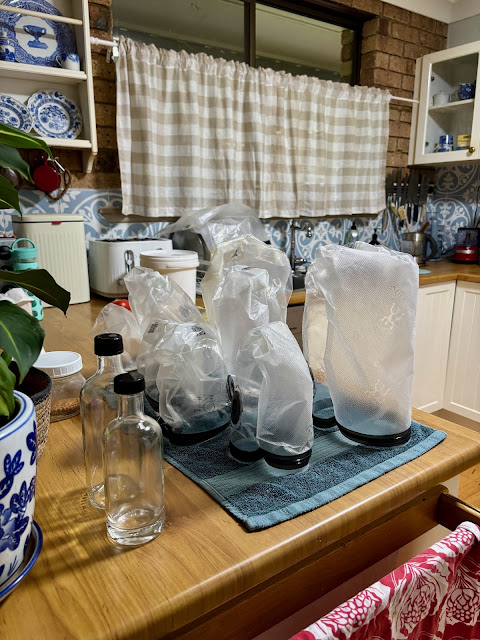
Every morning when I walk into my kitchen it looks tidy and ready for a day's work. Not so on this morning (above), I saw this when I walked in. Late the previous afternoon when I was looking for something, I came across my rolled up Zwilling vacuum bags and decided they had to be washed and dried. So I did that and although I usually put them outside on the verandah to dry it was dark by then. I turned the just-washed bags inside out and left them like this on a towel. It worked well and now the bags are ready to use when I bring home root vegetables, cabbages or whatever I buy that I want to last four or five weeks.
Image

You’ll save money by going back to basics

When I was doing the workshops and solo sessions, I had a couple of people whose main focus was on creating the fastest way to set up a simple life. You can't create a simple life fast, it's the opposite of that It's not one single thing either - it's a number of smaller, simpler activities that combine to create a life that reflects your values; and that takes a long to come together. When I first started living simply I took an entire year to work out our food - buying it, storing it, cooking it, preserving, baking, freezing, and growing it in the backyard. This is change that will transform how you live and it can't be rushed.  
Image


Trending Articles

NOT the last post

This will be my last post here.  I've been writing my blog for 18 years and now is the time to step back. I’ve stopped writing the blog and come back a couple of times because so many people wanted it, but that won’t happen again, I won’t be back.  I’ll continue on instagram to remain connected but I don’t know how frequent that will be. I know some of you will be interested to know the blog's statistics. 
Image

Every morning at home

Every morning when I walk into my kitchen it looks tidy and ready for a day's work. Not so on this morning (above), I saw this when I walked in. Late the previous afternoon when I was looking for something, I came across my rolled up Zwilling vacuum bags and decided they had to be washed and dried. So I did that and although I usually put them outside on the verandah to dry it was dark by then. I turned the just-washed bags inside out and left them like this on a towel. It worked well and now the bags are ready to use when I bring home root vegetables, cabbages or whatever I buy that I want to last four or five weeks.
Image

You’ll save money by going back to basics

When I was doing the workshops and solo sessions, I had a couple of people whose main focus was on creating the fastest way to set up a simple life. You can't create a simple life fast, it's the opposite of that It's not one single thing either - it's a number of smaller, simpler activities that combine to create a life that reflects your values; and that takes a long to come together. When I first started living simply I took an entire year to work out our food - buying it, storing it, cooking it, preserving, baking, freezing, and growing it in the backyard. This is change that will transform how you live and it can't be rushed.  
Image

Creating a home you'll love forever

Living simply is the answer to just about everything. It reduces the cost of living; it keeps you focused on being careful with resources such as water and electricity; it reminds you to not waste food; it encourages you to store food so you don't waste it and doing all those things brings routine and rhythm to your daily life. Consciously connecting every day with the activities and tasks that create simple life reminds you to look for the meaning and beauty that normal daily life holds.  It's all there in your home if you look for it. Seemingly mundane tasks like cleaning and cooking help you with that connection for without those tasks, the home you want to live in won't exist in the way you want it to.  Creating a home you love will make you happy and satisfied.
Image

Time changes everything

I've been spending time in the backyard lately creating a contained herb and vegetable garden. My aim is to develop a comfortable place to spend time, relax, increase biodiversity and encourage more animals, birds and insects to live here or visit. Of course I'd prefer my old garden which was put together by Hanno with ease and German precision. Together, we created a space bursting at the seams with herbs, vegetables and fruity goodness ready to eat and share throughout the year. But time changes everything. What I'm planning on doing now, is a brilliant opportunity for an almost 80 year old with balance issues. In my new garden I'll be able to do a wide range of challenging or easy work, depending on how I feel each day. It’s a daily opportunity to push myself or sit back, watch what's happening around me and be captivated by memories or the scope of what's yet to come.
Image

It's the old ways I love the most

I'm a practical woman who lives in a 1980’s brick slab house. There are verandahs front and back so I have places to sit outside when it's hot or cold. Those verandahs tend to make the house darker than it would be but they're been a great investment over time because they made the house more liveable. My home is not a romantic cottage, nor a minimalist modern home, it's a 1980’s brick slab house. And yet when people visit me here they tell me how warm and cosy my home is and that they feel comforted by being here. I've thought about that over the years and I'm convinced now that the style of a home isn't what appeals to people. What they love is the feeling within that home and whether it's nurturing the people who live there.
Image

Making ginger beer from scratch

We had a nice supply of ginger beer going over Christmas. It's a delicious soft drink for young and old, although there is an alcoholic version that can be made with a slight variation on the recipe. Ginger beer is a naturally fermented drink that is easy to make - with ginger beer you make a starter called a ginger beer plant and after it has fermented, you add that to sweet water and lemon juice. Like sourdough, it must ferment to give it that sharp fizz. To make a ginger beer plant you'll need ginger - either the powdered dry variety or fresh ginger, sugar, rainwater or tap water that has stood for 24 hours to allow the chlorine to evaporate off. You'll also need clean plastic bottles that have been scrubbed with soap, hot water and a bottle brush and then rinsed with hot water. I never sterilise my bottles and I haven't had any problems. If you intend to keep the ginger beer for a long time, I'd suggest you sterilise your bottles. MAKING THE STARTER In a...
Image

Back where we belong

Surprise! I'm back ... for good this time. Instagram became an impossible place for me. They kept sending me messages asking if I'd make my page available for advertisers! Of course, I said no but that didn't stop them. It's such a change from what Instagram started as. But enough of that, the important part of this post is to explain why I returned here instead of taking my writing offline for good. For a few years Grandma Donna and I have talked online face-to-face and it's been such a pleasure for me to get to know her. We have a lot in common. We both feel a responsibility to share what we know with others. With the cost of living crisis, learning how to cook from scratch, appreciate the work we do in our homes, shop to a budget and pay off debt will help people grow stronger. The best place to do that is our blogs because we have no advertising police harassing us, the space is unlimited, we can put up tons of photos when we want to and, well, it just feels li...
Image