down to earth

  • Home
  • About Us
  • Down To Earth Book
  • Privacy Policy
Rose and I (Sharon) would like to remind all the ladies who are in the dishtowel and hot pad swap that the deadline is Saturday, April 25. I know that Saturdays are busy family days and that some of you may not get to the Post Office until early in the next week. That usually happens and so do not worry about it. Just let your swap buddy know that you are posting a bit late. I have heard already from some of you who have posted and some of you who will be a few days late and I would like to thank you for letting us know; when you touch base with either Rose or myself it really helps us to keep up-to-date with the swappers! I hope everyone has enjoyed this swap and would love to hear from you with ideas for our next swap.


I've been thinking about bags lately. Cotton storage bags to be precise. I was given a bread bag for my birthday. It's a cotton bag that has been lined with thin rubber to keep the bread fresh. I have written about covering food and food bags before here but the bags I'm thinking about now can hold food, soap, toys, buttons, knitting or any number of fine things.


These recycled bags are perfect carriers when I buy my bulk foods.

I use cotton bags here for storing various things, but the bags I use are recycled calico flour bags. I intend to make some purpose-made bags. I would like to have a drawstring bag to take my knitting to work. At the moment I just put it in my basket and usually have to search for the loose needle. I think I'll make a little cheese bag too so I can store my cheddar cheese in the fridge, sitting on a plate, covered by the bag.

I'd love to have an embroidered cotton bag as a gift wrap. I want to give a couple of luffas and soap as gifts this year. They're always difficult to wrap, but a little cotton bag containing a luffa and homemade soap would be ideal. If I embroidered a shower of rain over some flowers on the bag, that would be perfect.

Another lovely gift would be a long tube bag containing knitting needles and a couple of balls of pure wool or cotton, all contained in a linen bag with a stitched ball of wool and needles on the front. Imagine giving a new sewer an embroidered bag full of buttons. Bliss!


I use a little drawstring bag to carry my pencils, pens, eraser, pencil sharpener and calculator to work with me. I love using it and people often remark on how sweet it is. I'm going to make a new bag for my digital camera. It will be a little padded drawstring bag that will protect my camera, especially when I take it out with me.

I think these bags would be a very good way of carrying toys and books in the car. When my boys were little, they had a Lego sack that they would open out to a circle playmat on the floor and when you pulled the drawstrings, the Legos would be scooped up and put away again. I just did a google search for them but it seems Lego no longer make them, this is something similar and would be really easy to make. Picking up Legos is a real pain. This will help you reduce the number of Legos to be picked up, the kids will only have to pick up those that spill outside the circle.

Here are some links with more ideas. Please check out the first two especially for some fine inspiration. They show that a simple drawstring bag can be beautiful and delicate as well as practical.

Deb @ Homespun Living - drawstring pouches
SouleMama's bread bags.
Fabric bucket tutorial.
How to make a drawstring bag. 1
How to make a drawstring bag. 2
Organic cotton bags with see through windows from Etsy.
Calico fruit and vegie bags.

When you think about it, cotton bags have been around since Adam was a boy and they still provide a very sound, practical and often beautiful way of storage and carrying things. It proves once again that the simple ways are often the best.


Despite my gentle reminder about slowing down, I've been very busy of late and today will be no exception. I have a few other things I should be doing, but I have made a commitment to you and to this blog, and it's incredibly enriching for me to write for you, so here I am again, albeit with a shorter post.


There are two plants here. The climber is a Richmond green cucumber, which is an old Australian variety that I grew up with; the larger leaves in the foreground belong to an unidentified squash.

I have some good news about our lovely chooks. Lulubelle, who is the barred Plymouth Rock chook on the sidebar has recovered and Margaret Olley, our buff Sussex, is not yet better, but is on the road back to good health. Hanno is doing a really good job looking after them. He lifts Margaret onto the nest to sleep instead of having her on the roost with the others. Margaret has an ear infection which is slowly getting better. BTW, in chook talk, barred is a colour - it's a black and white stripe, and buff is a dark blonde colour.

I have been meaning to write more about knitting and when someone asked about the knitalong rug, I knew I had to make a knitting post. The rug is still going well, in fact, it's a good project to do because the knitting can be done at any time. I'm just doing plain knit now so I can be knitting while I talk to people as I don't have to look at what I'm doing. For those of you who missed the original posts about the knitalong, you can find a link to them in the right sidebar. It's a knitted blanket - Shaker style. The blanket is made up of knitted squares so it's perfect for a beginning knitter and even though the knitalong has been going a few weeks now, I've still only done a small number of squares, so joining in at this point is no problem. I have made a Flickr page for the knitalong photos if you'd like to show what you're doing, you can load some of your own photos. That's also in the right side bar. I have done three more squares since I last posted about my rug and I'll update my photos next week after I do a few more squares.


I haven't put a lot of time into my squares lately because I've been working on a sewing project and then started this pair of mittens for one of my sons. There is something about the coming of the cooler weather that draws me back to winter knitting. It must be something to do with either the mothering instinct or the nesting instinct, both very strong impulses that reside deep within me.


This pattern for fingerless mittens is so easy, even I can do it. I am not a great knitter. I hope to be one day and that is why I keep going with my knitting. All these little projects help build my skills while I become more proficient with the needles.

I have used UK size 8 metal needles - a vintage pair an older lady gave me that I find are really easy to knit with.
3 balls of the yarn pictured above - Panda machine washable 8 ply crepe. Probably about 2½ balls. It's pure Australian wool. I bought this at Spotlight for around $3.50 a ball. Any worsted weight yarn would do but try to use pure wool, or another natural fibre like alpaca or cashmere. Natural fibres are much better at keeping the warmth in than acrylic yarn.

Cast on 52 stitches, leave a tail of yarn a few inches long for sewing up later. This is for a man's hand, you would do 40 or 44 for a woman's.
Make the wrist band by knitting a rib - two plain and two purl for the entire row and continue that until you have the length of wrist band you like. Try to find a spare hand to measure on as you're knitting.
Then knit plain for most of the mitten. Keep building it up until you come to half way between the base of the index finger and the first joint.
Go back to the rib knit to finish off - two plain, two purl, until you knit up to the first joint on the middle finger, then cast off.

Sew the mitten along the side seam with the strands of yarn at both ends of your mitten, leaving a hole for the thumb to poke through.

Depending on how much time you have it will only take a day or two to complete. If you're knitting for a woman, you might like to add some buttons or wool embroidery to the finished mittens.

Are there any men who are knitting at the moment? The last time I wrote about men knitters, two men emailed saying they were keen knitters. I wonder if they're still reading.

So, how are you going with your knitting? Please let me know what you're up to, it inspires me to keep going. Also, if you'd like to join in on the knitalong, do so. The instructions are in the knitting link in the right sidebar. Add your name to the comments so I know who is in the knitalong, I'll make a list of the knitters' names and add it to the sidebar. I'd also love to know if you're knitting other projects. If you have your current project pictured on your blog, please give me the link so we can all have a look.

HA! So much for a shorter post. Happy knitting everyone!


New readers often send emails asking about how to start a simple life. This question is almost impossible to answer because we are all so different - different ages, countries, family situations, expectations, assets, desires etc., so I think the best way to help is to tell you how I started and go on from there.

Simple living surprised me. I didn't know there was such a thing but when I looked back I realised how far from "normal" I'd drifted. When I closed down my business to 'retire', I wanted to return to my home in the most complete and pure way. I went looking for ways to lessen the impact that me not working would have on my family. I wanted to save money by being a more economical shopper and I wanted to go back to cooking from scratch. Years before this transformation we had put in a water tank, a solar hot water system, had an organic vegetable garden and chickens, but now I wanted more. However, I didn't want just the material things that helped us live this way, I wanted to reinvent myself as well.

I hoped to leave behind the commercial world and immerse myself in being a housewife again. I knew my happiness was lurking here in my home somewhere, I just had to find it. I had an inkling that providing as much as we could with my own hands would make me happy and I thought that collecting eggs and picking fresh produce every day would calm me and help readjust my life. But I didn't realise then that I'd become a proud homemaker, and that I would define my success by the size and colour of tomatoes, the taste of a well made loaf, how happy simple things would make me or how well I slept at night. I didn't know I'd be proud of what I do here, and I didn't know, until I did it, how important the everyday work of a homemaker is.

So I guess the short answer to part of the question is to say that living a more simple life is all those things you want to include in your day to day activities, but it is also readjusting the way you think. Simplicity is a mindset as well as the everyday actions of the common home.


The first major thing I did was to shop in a different way and to build a stockpile. This was important for me because I believed if I could save money on my groceries, because I was buying them every week, that would be a considerable, ongoing saving. It took me about four or five months to build my stockpile, then I wanted to do some preserving (canning) to add my home grown produce to the stockpile cupboard. I had done some preserving in the past but had to relearn it. Then I thought it might be a good idea to get rid of the preservatives in our food, so one of the first things I did then was to learn to make a good loaf of bread. This lead me to buying flour and other dry goods in bulk, and I had to learn more about food storage.


Getting rid of the preservatives in our food made me think about getting rid of them in our home too, so I stopped buying household cleaners and started making soap, laundry powder and the other cleaners I needed. When we started making soap, we added luffas to the garden. Homemade olive oil soap and an organic luffa is a gift you can give to woman, man or child alike and they will appreciate it. Christmases and birthdays came and went and I had to think a lot about gift giving. I started knitting and sewing again, this helped me with our own clothes too, as well as those soft furnishings I wanted in our home. I found that when I did anything new, it always opened up other areas I needed to work on and think about.


I started to slow down, to concentrate on what I was doing and I tried to do everything to the best of my ability. Slowing down was enough to let me see a number of things that I didn't notice when I skipped over my housework and tried to do it as fast as possible. I realised I liked doing a lot of the tasks when they were carried out in a mindful manner, and slowly, over time, I reorganised myself and my home to reflect this new way of being. That change showed me that being at home had the potential to nourish my soul and if I could make my home a place of comfort for everyone who lived here, and for those who visited, that would be a significant and valuable gift. It's not easy, in fact there is more work to be done, but the next day always brings it's own challenges and joys and, by taking one small step at a time, I got to where I am now. This journey is never over. Simple living is not a destination or a reward that you move toward, the journey itself is the prize.

But I must remind you that living simply isn't just a series of tasks and actions that are completed over the course of the day. I believe you need to slow down, be mindful, develop generosity, be kind, give more, expect less and live your life as an example to those around that happiness and fulfilment can be found almost anywhere, in a city skyscraper, a suburban house, a farm or anywhere in between. Don't fall into the trap of thinking you need to be living in a serene rural location to live this way. It can be done anywhere.

One word of caution, you do need to be organised to live simply. Get yourself an old journal or binder and write down your new recipes, your meters readings, rainfall totals, your wish list for your garden, seed catalogues, your stockpile list - both what you have on hand and what you need to buy, any patterns you may find. Add to it the simple cleaners I've written about here, and you will have made your first step towards simplicity.


And finally, there is no one size fits all prescription for simple living. Each person does their own version of it. So be guided by me and all the other blogs you read but make the way you do it reflect you. This is about authenticity, not conformity. Do it your way and do one small thing today and another new thing tomorrow. Don't let anyone tell you you're not doing the right things. And if you find new pleasures in how you carry out your work, it is okay to feel pride in that. Open up yourself to new experiences and push your envelope. Be the person you always wanted to be, show your children, by example, how wonderful life is. These things, as well as making your home a place of warmth and security, are part of your simple life.


Anna S by Carl Larsson from here.

I really enjoyed reading a comment from Elizabeth yesterday. She said, in part, “I have been reading your blog for some time but until last week I just read and wished but did not action in anyway. That is, until this last weekend when I thought 'just do it!' So, I have started knitting a cardigan, knitted three squares for a throw for this winter, and made a chicken soup using up a chicken carcass for the very first time!" It is obvious to me that Elizabeth has been thinking about how she wants to change her life for some time, and now she's just dived right in. Living deliberately, there is nothing like it.

When Thoreau wrote his book, Walden, he had left his job and set up in a small cabin to live alone in the woods. He wrote: "I went to the woods because I wished to live deliberately, to front only the essential facts of life, and see if I could not learn what it had to teach, and not, when I came to die, discover that I had not lived. I did not wish to live what was not life, living is so dear; nor did I wish to practise resignation, unless it was quite necessary. I wanted to live deep and suck out all the marrow of life, to live so sturdily and Spartan-like as to put to rout all that was not life, to cut a broad swath and shave close, to drive life into a corner, and reduce it to its lowest terms, and, if it proved to be mean, why then to get the whole and genuine meanness of it, and publish its meanness to the world; or if it were sublime, to know it by experience ..." I think that is one of the most profound pieces of writing I've ever read and since I discovered Walden, many years ago, I have tried to live to the spirit of what Thoreau wrote in that one passage.

So what exactly is living deliberately? I guess there may be several different interpretations but to me it means taking control of my life, thinking about what it is I want my life to be, knowing what I want to do every day, or what I have to do to achieve my goals, and then living that life. Very few people have their life planned out for them and handed over on a silver platter. But what many people do is to just react to life. They have no real plans, they live each day doing what is expected of them, then, when something out of the ordinary happens, they react to it. There is no real plan, no map to follow, just reactions to what life throws.

Deliberate living is deciding what you want your life to become, working out the steps you need to take to make that happen, then, as Elizabeth said, just do it. You will still get life throwing the unexpected at you, but when it happens, you work to solve the problem, then you get back on track.

Those three little words, just do it, are the best advice for anyone hovering on the edge of a simple life. You might be hovering because you don’t know what to do first, because you feel you can’t do it all so why bother with a little bit, or you’re waiting for just the right time – until you move, you get that pay rise, you retire, the kids move out – whatever the right time will be for you, let me tell you there will be no right time. The only right time is now.

The other thing Elizabeth said was that she feels renewed now when she wakes up. I feel that way too. Every day you continue along the path you’ve chosen, you feel you have purpose and you feel renewed.

I think the economic crisis will bring a lot more people to this way of living but living simply is much more than a financial strategy, it's more than your location, it's more than how you manage your home or plant your vegetables. It's about you, how you think about your life and how you express your values day by day. Anyone can learn to make yoghurt, budget, knit dishcloths and grow tomatoes, the real trick is for your actions to reflect how you think and how you want to live. What good is it to list the hundred things you've accomplished if you're not made happy by what you do, if you aren't renewed by it, and if you don't do it with grace, humility and generosity.

When you deliberately choose this way of life, you will be doing things that bypass the conveniences of your old life, there will be many things you'll do differently, but if you do it well, if you really throw yourself into your life, if you live deep and suck out all the marrow of life, not only will you be living deliberately, you will be changed by it. Just do it.


NUT SLICE RECIPE

Combine the following dry ingredients in a bowl:
1 cup self raising flour OR one cup plain (all purpose) flour + 1 teaspoon baking powder
1 cup rolled oats
1 cup walnuts
½ cup brown sugar

Melt 125 grams butter (1 stick/4 ozs)
Add 1 lightly beaten egg

Mix the dry ingredients with the wet and press the dough into a slice tin. Firm it down before baking on 180C (350F) for about 2o minutes. Don't leave it in too long or the outer sides will be very hard. When cooked, cut into slices. You could substitute the walnuts for a cup of sultanas (golden raisins) or choc chips or any nuts you have on hand.


This is our 10,000 litre poly tank. It collects water from the shed that it sits next to and also from the house. The photo below shows how it's connected to the house.

I love rain. I love knowing it's watering the vegetables, being harvested from the roof and stored in our water tanks. Storing water is the same as storing an abundance of vegetables or fruit. You collect it when there is too much and store it to use when there is none. I have written about harvesting rain water before here, here and here, but I want to revisit the topic to encourage all the new gardeners out there towards some sort of water harvesting system. It can be as simple or sophisticated as you like, but if you're growing a garden, you should think about storing water. Water is precious and if there is no rain, your efforts at harvesting water will allow you to keep your plants going for a while longer before you have to rely on town water.


Hanno hooked up the house to the poly tank by running this downpipe underground and over to the collection tank.

Harvested water fits well within a preparedness strategy as well. If you have stockpile cupboards inside that will see you and your family through a crisis, then water barrels containing harvested water will fit right in with that way of thinking. Just like your stockpile, you can be using your rainwater throughout the year, but if there is a need for it, that water will be there to use more sparingly throughout the crisis.

We installed our first water tank as soon as we moved into this house about 11 years ago. That one was a steel tank that holds 5000 litres. A couple of years ago, when the rebates came in, we got ourselves a 10000 litre poly tank and those two tanks have not been empty at the same time since we installed the second one. We only use the water in our tanks for the garden, the animals and outside cleaning.

It will cost some money to buy the materials but over time you'll recoup that cost because you won't use as much tap water. It's also an environmentally sound practice. Instead of wasting that water that would go down the storm water drainage system, or into a creek or river, you'll capture that amount and use it when there is no rain.

Water tanks come in all shapes and sizes. There are poly tanks and steel tanks, all with food grade lining, that can fit into just about any space. They're usually round but some are oval, and some are like a wine cask bladder that will sit, out of sight, under decks. You'd be well advised to buy the largest tank you can afford, depending on the rainfall in your area.

I can't give general guidelines about water tanks or barrels because climate differences really do effect how and where you install your system. For instance, where we live, in summer there are torrential downpours which means we must have our overflow going to an area where it runs directly into our creek. We don't have to empty our barrels in winter to avoid the water freezing and cracking the barrels. Climate plays a big part in the size of the tanks but also in how you hook up your system. If you buy a larger tank, the store you buy it from will have instructions for that particular type of tank ans you should be guided by that. But overall, you must make sure your tank or barrel cannot be accessed by children or animals.


This diagram is from the Rapid Plas Sales catalogue - 2006. Click on the image to enlarge it.

To find water tanks in your area, simply google "water tank xxxx" xxxx=your area.
There is a lot of information on these websites.
Bluescope water tanks USA
Water tanks California
Water tanks North Carolina
UK Tank Shop
UK Water butts
Information about tank foundations
Rainwater harvesting
How to install a rain barrel
Rain barrel system - with photos
What size tank? Where do I position the tank?
Installation guide
How rain barrels work


Click on this guide to enlarge it. It is from the Rapid Plas Sales catalogue - 2006.

If you choose a large water tank it must sit on a stable well compacted base free of rocks, sharp objects or stones. Hanno put our last tank on a compacted base of crusher dust, with retaining walls, and it's withstood torrential rain unharmed for the past couple of years.

Traditionally in Australia, the old timers sited their tanks high on tank stands which assisted in the gravity feed of water. We have our large tanks on solid ground and use a pump on each tank to deliver water to the gardens. However, our newest tank, a small 500 litre barrel, sits on a stand, just off the front verandah, that is high enough for us to place watering cans or buckets under the tap.

You don't have to spend a lot of money to harvest rain water. If you can find suitable second hand containers they will do very nicely as your tanks/barrels and all you'll have to do then is connect it to the downpipe with some plumbing pipes - you might already have these on hand. Don't think that it's not worth doing unless you can have a brand new state of the art system. Water harvesting is a big part of any self-reliance strategy and as such, made from scratch with second hand materials will do just fine.

If you have any problems with your tank or barrels, or are unsure about installation or purchase, ask your question in the comments and I am sure Hanno will be happy to answer your queries.

Patricia: This is Hanno's advice. To get water into the large tank you have to make sure the inlet on the tank is lower than the gutter on your house. You can easily check this by taking a garden hose full of water to the tank's inlet and get someone to hold it at that level. Take the other end over to the building and mark the height where it overflows. When the water pipe from the roof to the tank is low enough, it will empty into the tank. Regardless of how deep you bury the pipe, it will be full all the time and the water will flow whenever it rains. Make sure all the underground pipes are glued properly so no water leaks into the ground. This is explained in the installation guide link above.


ADDITIONAL READING
Australians paying more for water but using less


I've come full circle again, back to April 15, the day of my birth. I know of some people my age who don't celebrate their birthday. How sad. I grew up with a mother who made our birthdays special and although there was never a lot of money for gifts, my sister and I always knew it was a day when we would be queens for the day and our friends and family would be there to celebrate. Hanno wants to take me out to lunch today and later in the day, Kerry and his friend Sunny will be here for dinner and to stay the night. More celebrations. It looks like my mother was right (yet again), birthday are not days to forget, they are days to remember.

I have a few things to be done today, although I will make it my duty to sit and relax and have tea brought to me. I went to work yesterday so there is a bit of tidying up to be done and I have dinner to prepare later but overall, it will be a day of subdued, but ongoing, celebration.


Our vegetable garden is giving us grief this season. We've had so much rain, much of it falling as sudden bursts of hard rain, then on Easter Monday, we had heavy rain for 24 hours. I don't know how much we had because our rain gauge overflowed, but it was a lot. I just looked at our official readings and we've had 324.2mm (12.7 inches) this month alone.


The back creek through the trees. Late Monday afternoon, it was really flooding but it's quickly flowing away now.

I looked at the vegetable garden when I came home from work yesterday afternoon and it's not looking good. One of the loofahs has to be thrown out because it's rotting, so today I'll collect all of them, even the green and unripe ones, and allow them all to dry out on the back verandah. Then I'll pull out the vines add compost and plant some vanilla vines.


Bok choi and new beefsteak tomatoes. These are seedlings bought at the market but luckily I still have seeds to grow more brandywines and moneymakers, and will sow them today.

Our three types of tomatoes - brandywines, Amish paste and moneymakers, will all be pulled out as they've developed what looks like mosaic virus. I'm not sure if it is mosaic because that is usually spread by people who smoke or touch tobacco, but it might also be spread by insects. Whatever it is, the tomatoes have had it, so we'll pull them out, put them in a plastic bag to sweat and die for a couple of weeks, then send them to the rubbish tip. I have my doubts about the corn too. It looks wonderful now, but with all the rain it might go mouldy. So with that, we'll just have to stand back and wait. We are lucky that all this happened so early in our growing season and although it has put us back a few weeks, it's not a total disaster.


Kylie Black, Mary Black and Cocobelle Black. Cocobelle is the matriarch of the tribe, she is about five years old now.

Some of the chooks are sick too and it wouldn't surprise me if Margaret Olley, Lulubelle and Martha die. We'll have to clean out their coop and keep an eye on the flock, but the signs are not good for some of them.


It's very sad seeing birds fall ill that we've cared for and who have been a productive part of our backyard. We will take care of them and hope they survive this but if they don't they'll be kept comfortable till the end.

From tomorrow on, it will be full steam ahead with writing again. I'll be working on my book again, it's due back tomorrow after a reading, so there will be changes made and suggestions to think about. But today all that will be put aside. Today I have a lunch to eat, visitors to prepare for and celebrations to revel in, for today I am queen. :- )


Fifteen years ago, when Hanno and I first bought this little house, we drove along a one lane street, turned onto a dirt driveway and saw a very basic house on a magnificent piece of land surrounded by pine and rainforest. We didn't know it at the time, but this home, of all those we have shared over the years, would nurture us, bring us closer together and ease us along the path to a more simple life. We made some improvements as soon as we moved in to better suit our family, and put up fences to keep the dogs in, and in the time since then, apart from an interior paint job, we've been happy here and content to wake up each day within these walls.

I am still in awe of the land we live upon. I never say we own it because as far as I'm concerned, we are merely the custodians here until we pass it on to our sons; and in truth, the land probably owns us. We wake up surrounded by trees, sometimes we hear the rushing of the creek that is our back boundary, and when I walk into our back yard, even after living here 11 years, I often just stop and look, amazed at what I see. All my life's roads have lead to this place.

Our gate has been closed these past few days and if I didn't know better, I would say we had been cast adrift, completely cut off from the rest of the world. There is peace here, we hear birds call, sometimes a train in the distance, but apart from that, it's a wind rushing through the trees type of silence that feels alive with activity and energy.


There has been the undeniable whiff of self-reliance in the air over Easter. I've baked bread and nut slices, made a simple evening meal each night, set the table numerous times, washed dishes and clothes, swept, lit candles, watered plants on the verandah, watched rain fall and thought about my life here, on this land with my family, and you, my blog family. I also worked on my project, did some writing, knitting and a stocktake of the soap, yarn and fabric I have on hand. There are a hundred things I could do, and one by one I get to those that need my attention, all else can wait until its time. It's been a beautiful Easter when we both worked to produce what we need here and mended a couple of things to keep them going a while longer. After such days, it's easy to go to bed pleased with the work we've completed and tired enough to sleep deeply until the next morning.


The simple life, full of the home tasks of cooking, mending, cleaning and growing has been the way of life for the majority for many hundreds of years. But now, in the context of our modern times, when shops are full of fashions, leaf blowers, designer dog collars and pre-cooked food, when it's compared to what is available to us now, now it feels like it's in sharp contrast to how most people live. Working with one's own hands and producing the goods we need to live is truly empowering but the wonder of it is that is so easy to do - for me and for you too. These are just life skills that are easily passed on to all of us by example, by just watching others.

I look at TV sometimes and I wonder if what they show is real. Are the streets really that mean in cities? Do people really kill each other over drugs and money, and for no reason at all? Is road rage real? What life skills are being passed on by watching all that? I suppose I know the answers to all those questions and for now, on this Easter weekend, I've been content and well and truly happy to stay cocooned here, listening to the rain, stitching and knitting, and wondering if living simply can make a significant and real difference outside my gate. I wonder if Hanno thinks these same thoughts. I wonder if you do.

Thank you for coming here to share our days, it still amazes me that you do. Thank you for sharing your thoughts and lives with us here too. Welcome to the new readers, warm hugs to all the older ones. Let's all work towards getting the simple message out to all those who surround us in the normal course of our lives, and show, by example, that this way of living not only empowers and enriches us, it builds contentment and greater expectations.

Yesterday was a diamond of a day. The weather was warm, the rain had stopped, the sun poured down and everything seemed right. We had our gate closed most of the day - that symbolises to me that we're content to be here alone and we're cut off from the rest of the world. Letting go of the world occasionally is enriching and restorative for me and it allows me to reconnect entirely with everything that is here.


We had minor flooding recently. Here we got about 6 inches, but further over on the coast they had 12 inches in one day. Click on the photos to enlarge them.

Hanno planted more vegetables, did some work in the front garden and then pottered around doing this and that. I wrote in the morning, made the bed, swept, did some baking, then set about making a casserole that slow cooked in the oven most of the afternoon. The aroma of that floating out into the neighbourhood was just wonderful. Late in the day I went over to see my DIL Cathy who is helping me with ... erm...something. These secret things happen when there is a family wedding coming up. ;- ) It was a beautiful day, filled with simple tasks, nothing was planned but it all fell into place, one thing after another. It was all I needed yesterday, the rest didn't matter.


More work done in the front garden. The petunias have been planted.

Today will be a busy one for me and I want to make the most of it. I have to go to the local fabric store and will be there when it opens, then home to bake bread and work on "the project". I am having a week off book writing because my proposal is with my agent now and won't come back till next week. I am hoping I can finish the bulk of what I have to do with my sewing, because after next week, I'll be back writing again.

So I hope you will bear with me while I take a few day off from my blog. I want to do my best work on this project, I want to focus my thoughts and actions on it, give it my heart and soul, undiluted by anything else. Of course I'll show it to you, after Shane and Sarndra have seen it.


Without their crosses - delicious hot cross buns.

There are certain times in the year when there seems to be no way out - you have to bake something that is symbolic of the time. That time for me came yesterday, right after the sweeping and before the casserole - hot cross buns. What else would you dare to bake at Easter? Hot cross buns are traditionally served on Good Friday but in Australia you can buy them in the shops for about a month before and after Easter. No matter, I am a homemade gal so I can make mine whenever I want a spicy light bun. Hanno loves these buns, in fact, they might be his favourite. Oh, hang on, I forgot about apple cake, pikelets, fruit cake etc etc etc LOL. If you have a spare few minutes I hope you try these buns. They're delicious as they are, but also lovely with a bit of butter melting into their spicy goodness. They also freeze well and I have a bag of them to be eaten in the next day or two, plus another couple of bags in the freezer.

This is the recipe I used but I didn't add flour paste crosses, you can drizzle on white icing crosses if you like. I make mine in the breadmaker. I just put everything, except the sultanas (golden raisins), which were added about ¾ of the way through. I used the dough setting and baked the buns in the oven.

The Spring edition of Small Town Living magazine is online now, I hope you have time to read it over your Easter break. It's always a good read. In this edition, there are some beautiful photos, great recipes and excellent articles, including one of urban homesteading which I found very interesting. Thanks to Paul and Tina for reminding me the new edition is out.

I think I'll be back next Tuesday, but if I get everything done, I'll be back Monday. I will try to answer some of this week's comments today. I hope you have a lovely Easter with your family. Take some time out for yourself, and for those you love, and don't forget to close your gate for a while, it makes all the difference.


I hope I've fixed my feedburner and have now added the feedburner subscription icon and email to the right and left sides of the blog. If you've subscribed in the past, please use these new facilities to update your subscription. If you've never subscribed, you may do so by using the same facilities.

Thanks everyone. I hope this works. And thanks to Melinda for putting me onto the feedburner email which has no advertising.


Green beans and peas growing together.
All photos will enlarge if you click on them.


Legumes - peas and beans - are very versatile and valuable crops. Different varieties of legumes can be grown in hot or cold climates, they're quite easy to grow, the seeds are large so saving seeds isn't difficult and both peas and beans can be eaten fresh or dry. I see them as an excellent backyard crop because you can feast on them fresh as they grow through the season, but if you have too many (and you will) they can be blanched and frozen, canned with a pressure canner or, my favourite, dried and stored in the cupboard. I don't have a pressure canner so when we have too many beans or peas, they're either frozen or dried outside, with no special equipment, and stored in the pantry.

If you have a problem growing peas or beans it will usually be in the first week. Both seeds do not like being wet and they don't like being transplanted, so sow directly into the ground, when all chance of frost has passed. Sow your seeds into moist, not wet, soil, when you know it won't rain for a few days. Apart from that, you might get a bit of rust in very humid weather, otherwise they'll probably grow quite well for you. If your season is short, grow dwarf beans or snow peas, they take less time to grow to maturity. Do not grow either peas or beans near onions, leeks or garlic, they're not good companions.


Snow peas.

There are so many different varieties of peas and beans it's difficult to know which to grow. So if you're not sure, decide what you want to use the legumes for and go from there. For example, if you want fresh green beans there are a large variety available. We tend to plant Blue Lake or Lazy Housewife beans if we want a climbing green bean, and dwarf beans for a delicious green bean that doesn't take long to mature and doesn't need staking. All those beans are fine as a fresh bean and for drying, but the Lazy Housewife bean dries really well. So I guess my preference for a good all round bean is Lazy Housewife. Be aware though that it will need a study support - if you grow beans well, the vine and the growing beans become very heavy.


Beans newly germinated and starting to attach to their supports.

In most soils, legumes fix atmospheric nitrogen in the soil. Which means it processes the nitrogen in the atmosphere and stores it in the roots, where it eventually moves into the soil. So when your crops have been harvested, cut the vines off and leave the roots in the ground. You can plant any nitrogen loving plant - like spinach, lettuce or chard, as a companion plant or a follow up crop.


Madagascar beans.

Peas are always a favourite here. I love peas and often eat them raw in the garden. We plant a lovely snow pea called Oregon Sugar, our green peas are usually Telephone peas; both these peas are climbers and need strong support to grown on. We also grow pigeon peas. These are a large bush/small tree pea that will grow well in drought conditions. When dried, the peas can be used to make pea soup, but when they're green you can eat them like a fresh cooked pea. Chickens love pigeon peas and so do parrots. When we have pigeon peas growing here the King parrots send out the message that "peas are on at the Hetzels!" and they come to eat in the late afternoon. We love seeing them eating our peas because so much of their natural habitat has been "developed", we're happy to help them find food they like.


Green and yellow split peas, chick peas and poppy seeds in the front row.

If you want to store beans or peas in the pantry, wait until they go brown on the vine, if there is chance of rain or snow, pick them all and lay them in a sheltered position until they go brown and crack open. Make sure they're all completely dry before storing in a glass jar in the pantry. For the best nutrition, use your dried legumes within three months. You can still use them after that but the nutrition in them will lessen unless you can seal them in a pack with no air. You can also freeze dried legumes.


Madagascar beans are the wall of beans in the top middle of this photo, green beans and peas are growing alongside.

If you have no room nor the time, to garden, you can buy a wide variety of dried beans and peas very cheaply. They make a good substitute for meat, because when you combine legumes with a grain - baked beans on toast or cracked wheat salad with green beans, they are a complete protein.

My favourite dry pea recipe is pea and ham soup. I think I could live on that and never want for anything else. We have recently come back to eating a little bit of meat after many years of not eating it. The reason we now eat meat is for the natural gelatine and enzymes in some meat. This meat tends to need long slow cooking, just like the recipe for pea and ham soup.

Pea and ham soup
Water
Ham bone or ham hock
Salt and pepper
700 grams (1½ lb) yellow and/or green split peas
Two large onions - chopped
Two carrots - sliced
Two sticks celery - chopped
One bay leaf

If possible, soak the peas in plain water overnight. Add all the ingredients to a large stockpot, filling it almost to the top with water. Bring to the boil, then simmer with the lid on, for two hours. Remove the bone from the soup, continue to cook the soup while the soup bone cools down. When it's cool enough to handle, take the meat off the bone, cut it into smaller pieces and add to the soup. The peas will have dissolved to make a thick soup. Test for seasoning, add more if necessary - it tends to need a fair bit, but remember it is a large amount of soup. Remove the bay leaf and serve.

If you have chickens, give them the soup bone to pick on, they'll love you for it.

MORE INFO AND RECIPES

General information about legumes - storage, types etc.
Green bean recipes.
Vegetarian bean recipes.
Bean basics
Photos and uses for various beans.
Photos and uses for various peas.
Pea recipes.
Chick pea curry.
Two pea salad.
Plump pea dumplings.
Storage life of dried foods.
Pebbledash picked it up, I am turning 61, not 62! Thanks Diana. Meryl, one of the volunteers I work with picked it up too. When I mentioned at lunch yesterday that my birthday was coming up, she said it didn't seem so long ago we celebrated my last birthday. Then it hit me, they gave me a morning tea for my 60th, I'm still a mere slip of a girl - I'm going to be 61.
:- )

I removed the email subscription yesterday. I have to apologise for mucking you around. Those 30 or so people who subscribed yesterday will have to do so again when I find another widget. When I went to change a setting on the old one yesterday, I found they send advertising with the email. I won't be a party to that. Apart from not wanting to promote things you might spend money on, I don't know what sort of advertisement they might send. It could be anything. So I will look for a new widget but I can't do it today. And again, I'm sorry for this inconvenience.

..................................................................................................................

I have been touched by the number of emails I've received lately from new readers wanting to live a life similar to ours here. I'm asked all sorts of questions about the type of chooks we have, how many water tanks, what food we eat on a day-to-day basis and how many loads of washing I do each week. Some people ask about when I go to bed, when I get up in the morning, do I drink green tea or black, what would I buy if I had the money and how do I cope with living on a restricted budget. It seems to me that these questions are about one thing - they are trying to find "the formula", they want to know how to live simply. But simple life is different for everyone, there is no formula, no one way to do it. The secret is to decide how you want to live, work out what values are important to you, then work towards the goals you set.

If you do that, if you develop a set of values that support how you want to live, it will be easier to pinpoint areas you can change in your life to reflect your values. For example, if you decide that one of the values you want to embrace is to live a more healthy life and buy local, you'd probably have to look at what you're eating and change how you shop. Instead of shopping only at the supermarket, you'd also need to go to local markets, find out with other local food is produced and then work out a way to buy it. You'd also look at the chemicals you have in the house, get rid of them and work out what alternatives you could use. If one of your values was to be more frugal, and through that work towards paying off your debt, then you'd probably start by tracking how you spend your money and work out a budget. Then you'd go through your bills and work out what you could do without - pay TV, the second car, ballet lessons for the children, your magazine subscriptions etc. Then you'd work out ways to save money in the home.


Shhhh, it's a worker in the front garden.

A few days ago, I made a big pot of pea soup that will keep us going for about seven evening meals, plus the occasional work lunch. That soup cost me four dollars to make and works out to be about 57 cents for the two of us each dinner time. Some people will look at that and think eating pea soup for a few nights in a row is boring and some would just refuse because they want to eat steak and three veg or roast pork. But I don't think like that anymore. That soup supports our simple values in many ways. The truth of it is that eating that soup helps us stay on budget, it frees up other money so we can buy fresh local milk, cheese and fish, it saves us money on utility bills because we only have to heat it up each day, it saves time because I don't have to cook a meal each night and it's a nourishing and delicious meal that we both enjoy.


Native violets have naturalised in the gardens and are spilling over into the lawn.

Some of the things many of us do during the normal course of a day include baking bread, walking to the shops, sweeping the floor instead of vacuuming, washing up by hand instead of using the dishwasher, stockpiling to save money and time, making yoghurt from scratch and growing some of our own food in our backyard. Now if I were new to this way of living, and I saw many of those common tasks of a simple home, I'd probably think it was too much work and why bother. Why do all that work when I can easily buy what I need. But the fact is that doing those things support the life I want to live, so doing them is not a bother to me. So you see, working out what is important to you, knowing what you want to include in your own life, and then doing those things on a daily basis, will help you live more simply and even though it will be tough at times, you'll stick with it because you're working towards your goals.


Hanno is preparing the front garden for the wedding.

Simplifying will never be about the colour of the chickens in your backyard, the brand of breadmaker you own, how many jars of jam and relish you put up each year or how many acres you 'own'. It is always about the way you think about your life and how you express those thoughts by how you live. I am flattered that many of you want to do things in a similar way to how we do them here and maybe some of you will settle into a life very similar to mine, but I encourage you think about your life, think about what is important to you and then set about building your life to support your values. We don't all have to be carbon copies of each other. In fact that is one of the things that is so appealing about this way of life - we can all express it in differing ways and still be part of the whole.


A Cecile Brunner rose, a tiny rose the size of a finger nail, is growing over the garden arch.

I don't want to put you off your changes, and I'm not saying don't copy what I do. I am encouraging you to be very clear about what is important to you. Before you start changing your life, you'll have to think about it a lot. Don't just dive in and do what others are doing. Think about what you hope you life will become, think about what you consider to be important, then the path you need to take will be clear. Often the first step is the most difficult, in this case it isn't. Your first step is to make a cup of tea, gather a pen and paper, then sit in your favourite spot and think about what you want and how you would like to live, write it down in bullet points. You might need a few sessions - just you, your thoughts and your pen and paper. When you have a list, go through it a couple of times and cross off what's not really important, keeping only those points you think will make you happy, fulfilled and content. That is your map, my friends. Once you have your map, then come back here and ask questions that will help you follow your map. I am happy to answer your questions, and many of the other readers are too. If you ask something in the comments, you'll get opinions from a few of us. But that's one of the beauties of a simple life. It's about communities working together to help each other, and we have a wonderful community here willing to help you.


Newer Posts Older Posts Home

MY BOOKS

MY BOOKS


My books were all published by Pengiun, and are available at Amazon US, Amazon UK and Amazon Au

Search here

Total Pageviews

Translate


I'm Rhonda Hetzel and I've been writing my Down to Earth blog since 2007. Although I write the occasional philosophical post, my main topics include home cooking, happiness and gardening as well as budgeting, baking, ageing, generosity, mending and handmade crafts. I hope you enjoy your time here.

MY FAVOURITE PLACES

  • Grandma Donna's Place
  • Grandma Donna's YouTube
  • Grandma Donna's Instagram
  • This Simple Day
  • Nicole's Instagram

Give More

Give More

Popular posts last year

Making ginger beer from scratch

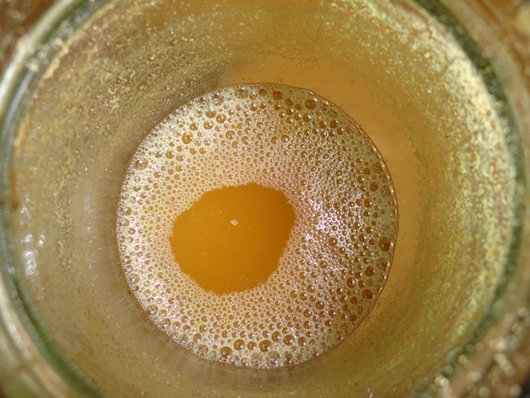
We had a nice supply of ginger beer going over Christmas. It's a delicious soft drink for young and old, although there is an alcoholic version that can be made with a slight variation on the recipe. Ginger beer is a naturally fermented drink that is easy to make - with ginger beer you make a starter called a ginger beer plant and after it has fermented, you add that to sweet water and lemon juice. Like sourdough, it must ferment to give it that sharp fizz. To make a ginger beer plant you'll need ginger - either the powdered dry variety or fresh ginger, sugar, rainwater or tap water that has stood for 24 hours to allow the chlorine to evaporate off. You'll also need clean plastic bottles that have been scrubbed with soap, hot water and a bottle brush and then rinsed with hot water. I never sterilise my bottles and I haven't had any problems. If you intend to keep the ginger beer for a long time, I'd suggest you sterilise your bottles. MAKING THE STARTER In a...
Image

NOT the last post

This will be my last post here.  I've been writing my blog for 18 years and now is the time to step back. I’ve stopped writing the blog and come back a couple of times because so many people wanted it, but that won’t happen again, I won’t be back.  I’ll continue on instagram to remain connected but I don’t know how frequent that will be. I know some of you will be interested to know the blog's statistics. 
Image

How to make cold process soap

I'm sure many of you are wondering: "Why make soap when I can buy it cheaply at the supermarket?" My cold process soap is made with vegetable oils and when it is made and cured, it contains no harsh chemicals or dyes. Often commercial soap is made with tallow (animal fat) and contains synthetic fragrance and dye and retains almost no glycerin. Glycerin is a natural emollient that helps with the lather and moisturises the skin. The makers of commercial soaps extract the glycerin and sell it as a separate product as it's more valuable than the soap. Then they add chemicals to make the soap lather. Crazy. Making your own soap allows you to add whatever you want to add. If you want a plain and pure soap, as I do, you can have that, or you can start with the plain soap and add colour, herbs and fragrance. The choice is yours. I want to add a little about animal and bird fat. I know Kirsty makes her soap with duck fat and I think that's great. I think t...
Image

Preserving food in a traditional way - pickling beetroot

I've had a number of emails from readers who want to start preserving food in jars but don't know where to start or what equipment to buy.  Leading on from yesterday's post, let's just say up front - don't buy any equipment. Once you know what you're doing and that you enjoy preserving, then you can decide whether or not to buy extra equipment. Food is preserved effectively without refrigeration by a variety of different methods. A few of the traditional methods are drying, fermentation, smoking, salting or by adding vinegar and sugar to the food - pickling. This last method is what we're talking about today. Vinegar and sugar are natural preservatives and adding one or both to food sets up an environment that bacteria and yeasts can't grow in. If you make the vinegar and sugar mix palatable, you can put up jars of vegetables or fruit that enhance the flavour of the food and can be stored in a cupboard or fridge for months. Other traditional w...
Image

Cleaning mould from walls and fabrics

With all this rain around we've developed a mould problem in our home. Usually we have the front and back doors open and that good ventilation stops most moulds from establishing. However, with the house locked up for the past week, the high humidity and the rain, mould is now growing on the wooden walls near our front door and on the lower parts of cupboards in the kitchen. Most of us will find mould growing in our homes at some point. Either in the bathroom or, in humid climates, on the walls, like we have now. You'll need a safe and effective remedy at some point, so I hope one of these methods works well for you. Mould is not only ugly to look at, it can cause health problems so if you see mould growing, do something about it straight away. The longer you leave the problem, the harder it will be to get rid of it effectively. If you have asthma or any allergies, you should do this type of cleaning with a face mask on so you don't breathe in any spores. Many peopl...
Image

Five minute bread

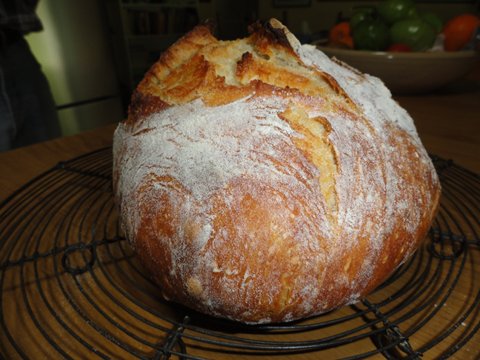
Bread is one of those foods that, when made with your own hands, gives a great deal of satisfaction and delight. It's only flour and water but it symbolises so much. I bake bread most days and use a variety of flours that I buy in bulk. Often I make a sandwich loaf because we use most of our bread for lunchtime sandwiches and for toast. Every so often I branch out to make a different type of loaf. I have tried sour dough in the past but I've not been happy with any of them. I'll continue to experiment with sour dough because I like the idea of using wild yeasts and saving the starter over a number of years to develop the flavour and become a part of the family. However, the loaf I've been branching out to most often is just a plain old five minute bread. By five minutes I mean it takes about five minutes actual work to prepare but it's the easiest of all bread to make and to get consistently good loaves from. If you're having people around for lunch or...
Image

This is my last post.

I have known for a while that this post was coming, but I didn't know when. This is my last post. I'm closing my blog, for good, and I'm not coming back like I have in the past.  I've been writing here for 16 years and my blog has been many things to me. It helped me change my life, it introduced me to so many good people, it became a wonderful record of my family life, it helped me get a book contract with Penguin, and monthly columns with The Australian Women's Weekly and Burke's Backyard . But in the past few months, it's become a burden. In April, I'll be 75 years old and I hope I've got another ten years ahead. However, each year I'll probably get weaker and although I'm fairly healthy, I do have a benign brain tumour and that could start growing. There are so many things I want to do and with time running out, leaving the blog behind gives me time to do the things that give me pleasure. On the day the blog started I felt a wonderful, h...
Image

What is the role of the homemaker in later years?

An email came from a US reader, Abby, who asked about being a homemaker in later years. This is part of what she wrote: "I am a stay-at-home mum to 4 children, ages 9-16. I do have a variety of "odd jobs" that I enjoy - I run a small "before-school" morning drop-off daycare from my home, I am a writing tutor, and I work a few hours a week at a local children's bookstore. But mostly, I cherish my blissful days at home - cooking, cleaning (with homemade cleaners), taking care of our children and chickens and goats, baking, meal-planning, etc. This "career" at home is not at all what I imagined during my ambitious years at university, but it is far more enriching. I notice, though, that my day is often planned around the needs of my family members. Of course, with 4 active kids and a husband, this is natural. I do the shopping, plan my meals, cook dinner - generally in anticipation of my family reconnecting in the evening.  I can't h...
Image

Every morning at home

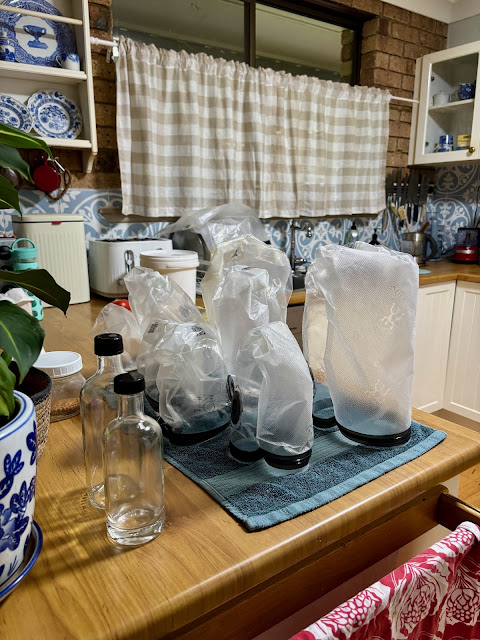
Every morning when I walk into my kitchen it looks tidy and ready for a day's work. Not so on this morning (above), I saw this when I walked in. Late the previous afternoon when I was looking for something, I came across my rolled up Zwilling vacuum bags and decided they had to be washed and dried. So I did that and although I usually put them outside on the verandah to dry it was dark by then. I turned the just-washed bags inside out and left them like this on a towel. It worked well and now the bags are ready to use when I bring home root vegetables, cabbages or whatever I buy that I want to last four or five weeks.
Image

You’ll save money by going back to basics

When I was doing the workshops and solo sessions, I had a couple of people whose main focus was on creating the fastest way to set up a simple life. You can't create a simple life fast, it's the opposite of that It's not one single thing either - it's a number of smaller, simpler activities that combine to create a life that reflects your values; and that takes a long to come together. When I first started living simply I took an entire year to work out our food - buying it, storing it, cooking it, preserving, baking, freezing, and growing it in the backyard. This is change that will transform how you live and it can't be rushed.  
Image


Trending Articles

NOT the last post

This will be my last post here.  I've been writing my blog for 18 years and now is the time to step back. I’ve stopped writing the blog and come back a couple of times because so many people wanted it, but that won’t happen again, I won’t be back.  I’ll continue on instagram to remain connected but I don’t know how frequent that will be. I know some of you will be interested to know the blog's statistics. 
Image

Every morning at home

Every morning when I walk into my kitchen it looks tidy and ready for a day's work. Not so on this morning (above), I saw this when I walked in. Late the previous afternoon when I was looking for something, I came across my rolled up Zwilling vacuum bags and decided they had to be washed and dried. So I did that and although I usually put them outside on the verandah to dry it was dark by then. I turned the just-washed bags inside out and left them like this on a towel. It worked well and now the bags are ready to use when I bring home root vegetables, cabbages or whatever I buy that I want to last four or five weeks.
Image

You’ll save money by going back to basics

When I was doing the workshops and solo sessions, I had a couple of people whose main focus was on creating the fastest way to set up a simple life. You can't create a simple life fast, it's the opposite of that It's not one single thing either - it's a number of smaller, simpler activities that combine to create a life that reflects your values; and that takes a long to come together. When I first started living simply I took an entire year to work out our food - buying it, storing it, cooking it, preserving, baking, freezing, and growing it in the backyard. This is change that will transform how you live and it can't be rushed.  
Image

Creating a home you'll love forever

Living simply is the answer to just about everything. It reduces the cost of living; it keeps you focused on being careful with resources such as water and electricity; it reminds you to not waste food; it encourages you to store food so you don't waste it and doing all those things brings routine and rhythm to your daily life. Consciously connecting every day with the activities and tasks that create simple life reminds you to look for the meaning and beauty that normal daily life holds.  It's all there in your home if you look for it. Seemingly mundane tasks like cleaning and cooking help you with that connection for without those tasks, the home you want to live in won't exist in the way you want it to.  Creating a home you love will make you happy and satisfied.
Image

Time changes everything

I've been spending time in the backyard lately creating a contained herb and vegetable garden. My aim is to develop a comfortable place to spend time, relax, increase biodiversity and encourage more animals, birds and insects to live here or visit. Of course I'd prefer my old garden which was put together by Hanno with ease and German precision. Together, we created a space bursting at the seams with herbs, vegetables and fruity goodness ready to eat and share throughout the year. But time changes everything. What I'm planning on doing now, is a brilliant opportunity for an almost 80 year old with balance issues. In my new garden I'll be able to do a wide range of challenging or easy work, depending on how I feel each day. It’s a daily opportunity to push myself or sit back, watch what's happening around me and be captivated by memories or the scope of what's yet to come.
Image

It's the old ways I love the most

I'm a practical woman who lives in a 1980’s brick slab house. There are verandahs front and back so I have places to sit outside when it's hot or cold. Those verandahs tend to make the house darker than it would be but they're been a great investment over time because they made the house more liveable. My home is not a romantic cottage, nor a minimalist modern home, it's a 1980’s brick slab house. And yet when people visit me here they tell me how warm and cosy my home is and that they feel comforted by being here. I've thought about that over the years and I'm convinced now that the style of a home isn't what appeals to people. What they love is the feeling within that home and whether it's nurturing the people who live there.
Image

Making ginger beer from scratch

We had a nice supply of ginger beer going over Christmas. It's a delicious soft drink for young and old, although there is an alcoholic version that can be made with a slight variation on the recipe. Ginger beer is a naturally fermented drink that is easy to make - with ginger beer you make a starter called a ginger beer plant and after it has fermented, you add that to sweet water and lemon juice. Like sourdough, it must ferment to give it that sharp fizz. To make a ginger beer plant you'll need ginger - either the powdered dry variety or fresh ginger, sugar, rainwater or tap water that has stood for 24 hours to allow the chlorine to evaporate off. You'll also need clean plastic bottles that have been scrubbed with soap, hot water and a bottle brush and then rinsed with hot water. I never sterilise my bottles and I haven't had any problems. If you intend to keep the ginger beer for a long time, I'd suggest you sterilise your bottles. MAKING THE STARTER In a...
Image

Back where we belong

Surprise! I'm back ... for good this time. Instagram became an impossible place for me. They kept sending me messages asking if I'd make my page available for advertisers! Of course, I said no but that didn't stop them. It's such a change from what Instagram started as. But enough of that, the important part of this post is to explain why I returned here instead of taking my writing offline for good. For a few years Grandma Donna and I have talked online face-to-face and it's been such a pleasure for me to get to know her. We have a lot in common. We both feel a responsibility to share what we know with others. With the cost of living crisis, learning how to cook from scratch, appreciate the work we do in our homes, shop to a budget and pay off debt will help people grow stronger. The best place to do that is our blogs because we have no advertising police harassing us, the space is unlimited, we can put up tons of photos when we want to and, well, it just feels li...
Image