down to earth

  • Home
  • About Us
  • Down To Earth Book
  • Privacy Policy
It looks like a really good swap. I think it's wonderful that so many of you are taking part and I hope you enjoy it. Swapping is a good way of developing new friendships and learning new skills, even if it's straight machine sewing or hand stitching. For the experienced sewers, it's a small project to work on that has a surprise element attached to it, and it helps use up those little bits and pieces of fabric that might otherwise be left unused. I would like to take part but I'm really snowed under at the moment so I'll just watch from the sidelines and enjoy the photos when they come in. To Sharon and Rose, I thank you sincerely for the work you are putting into this. I have organised many swaps and I know how time consuming they can be. So thank you both for you work and time.

To answer a couple of queries from yesterday: Mike, the tree was already planted when we decided to let the chooks free range around it so we couldn't bury the wire. Instead, Hanno covered the root area, on top of the ground, with chicken wire and held it down with a few bricks and pieces of wood. Initially we covered the wire with straw mulch, but the girls soon scratched it off so we didn't replace it. Since the wire has been there with no straw on top they've ignored the area and only walk under the tree on their way to somewhere else.

Margaret: don't plant potatoes in old tyres. Tyres contain cadmium and overtime it will leach out, possibly contaminating the potatoes. If you want to grow potatoes in a small space, use a wire cage. You can make it by surrounding some star pegs with chicken wire. The principle is the same but instead of adding more tyres, you start with an empty cage and as the potatoes grow, add more straw. Sometimes we hill our potatoes, sometimes we don't. We get a good yield either way.

Autumn, I use a fair bit of lemon in cooking - cakes, dressings, fish etc. I make some of the lemon juice into cordial, the rest is frozen and used over winter.

Maryanne, that's great news! It's always so exciting when the first of your fruit or vegetables start producing. I hope you get a great harvest from those tomato bushes.

And to everyone else who left a comment yesterday, I thank you. It's always very interesting for me to read what you write. I like knowing how others are living, doing the same household tasks I carry out here. It's a little bit like a friendly chat over the back fence.


One of the things I did last weekend was to clean the pantry. Pantry cleaning is one job that needs to be done every few months so I can check my containers and clean up any spilt food. A few years ago, before we bought our deep freezer, we had a couple of outbreaks of pantry moths that wiped out quite a few kilos of flour. We haven't had pantry moths since we started freezing all the dried grains and flour that come into the house, but I'm still on the look out for them. If you haven't seen pantry moths, and I'm not sure if those we have here are the same world-wide, they are a small brown moth, about the size of a fly. They get into flour, rice, lentils etc, when they're being processed, or in storage, or in the shop, and unknowingly you bring them home. When the product has been sitting on your shelf for a week or two, the moths emerge and fly around the house, where eventually they will find more flour or rice and lay eggs. To prevent this happening, if you can, put all your dried grains and flour in the freezer for a couple of days as soon as you bring it home. That will kill any larvae that might be present.


Cleaning the pantry is a simple, but essential, job. The way I do it is to empty everything out of the cupboard, clean the shelves from top to bottom with a terry cloth rag and white vinegar. If anything is spilt - we had a small molasses spill, it is cleaned up with a terry rag and homemade soap and wiped over with a clean moist cloth. If you've spilt any flour or rice in the cupboard, it's a good idea to vacuum the cupboard, making sure you do the edge, where the shelf meets the side wall, to make sure no flour or grain is lurking in the join. Leaving those little bits of food in crevasses attracts moths and weevils and it's best to vacuum them to completely remove any trace.


When you have the containers out, check them and wipe them over before placing them back in the pantry. If you notice anything going off or with bugs in it, discard it and wash the container thoroughly. If you do see moths in your container, take it outside to open it. Check that container too and make sure there are no cracks in it and that the lid is still capable of sealing properly.


And don't be like me. You can see in the photo above that the potatoes we bought at the market are still in a plastic bag. Tut tut, Rhonda. Potatoes should always be removed from the plastic bag and stored in a basket or similar open, but away from the light, container. Potatoes stored in a plastic bag will sweat and start to rot if left too long.

It's not the most glamorous of jobs but when you finish, it's very satisfying. I wonder how many pantry cupboards out there need a good clean. How often do you clean your cupboards? Do you have any tips to share with us? I'd be very interested if you have.

I've been too busy to write the second Biggest Kitchen Table post but I think I can do it this Friday. The topic this time is preserving/canning. Hopefully we can dispel a few myths and encourage the younger girls and those who haven't ventured into the world or jars, seals and clips to learn a new skill.


Hello Ladies,
UPDATE: We have had one swapper who has had to drop out due to a sudden move from one state to another. I have changed her swap buddy and want to remind everyone to make contact with their swap buddy as soon as possible. If there are any other problems, please let Rose or myself (Sharon) know about it so we can get it all the kinks worked out and everyone can start their projects!!
Rose and I are happy to bring you the Dish/Tea Towel and Hot Pad swap list.
We must ask each of you to contact your assigned swap buddy without delay. Please add your swap buddy’s email address to your contact list so her emails to you do not end up in your junk or spam folder.
If you do not hear from your swap buddy this week, please contact Sharon (cdetroyes at yahoo dot com) if you are in one of the pairs numbered 1 through 29, or contact Rose (rosmar at 1earth dot net) if you are in one of the pairs numbered 30 through 58).
We are asking each of you to make at least one dish or tea towel and two hot pads (it is safer to carry hot items with both hands!).
The completion date is Saturday, April 25, 2009, at which time you should have mailed your parcel. We are also asking each of you to include a favorite recipe or two. Please do not forget to say whether temperatures are in Fahrenheit or Celsius.
Have fun with this swap and contact us with any questions or problems.
Hugs,
Sharon and Rose

SHARON'S SWAPPERS
contact email: cdetroyes at yahoo dot com
1
Leigh

rikleigh at hotmail dot com
Hannah
han underscore ysic at hotmail dot com
2
Victoria Donnelly
vdonnelly at internode dot on dot net
Kathryn Marks
kathrynmarks at bigpond dot com
3
Emma Berry

emma dot berrypatch at gmail dot com
Fiona
goldwen at bigpond dot com
4
Vickie LeBlanc
vickie(dot)leblanc(at)usainteanne(dot)ca
Sharon
cdetroyes at yahoo dot com
5
Jo Shields
shields dot jo82 at googlemail dot com
Denise
ecotrace at yahoo dot co dot uk
6
Janet Anderson
janet dot anderson2 at gmail.com
Kim Murray
k dot murray at sympatico dot ca
7
Elizabeth Quigley
djquigley at sbcglobal dot net
Mary Anne Staker
maryannestaker at yahoo dot com
8
Evangeline Snyder
ecsnyder75 at comcast dot net
Jera
dragonpetals at gmail dot com
9
Lisa Egan

elisabethegan[at]gmail[dot]com
Michelle Waxler
mwaxler at care2.com
10
Shelley Wilson
sewilson at cull dot twcbc dot com
Kim Cranson
kim[dot]cranson[at]tesco[dot]net
11
Pippa Ibbotson
ibbotson6 at btinternet dot com
Mia
mia at runbox dot com
12
Kate Morrison
morrison 6012 at kinect dot co dot nz
Barbie Clements
bcc063 at yahoo dot com
13
Bettina Lauth
bettina dot lauth (at)bachstrasse57 dot de
Kris Bair
tkjtbair at gmail dot com
14
Stephanie Bond
steph dot martyn at btopenworld dot com
Cyndi Fouquette
foket5 at hutchtel dot net
15
Tracie Yan
styan at optusnet dot com dot au
Lisa
dltscj at juno.com
16
Shirley Hewitt
miandadh at westnet dot com dot au
Ann
ann dot lynaghbland at tiscali dot co dot uk
17
Sharon
cdetroyes at yahoo dot com
Rebekka Hartmann
rebekkahartmann at gmail dot com
18
Sandra Tolley
skc240 at gmail dot com
Mandy
auroraathebrides dot net
19
Annette Lanniee
tribalgrl at gmail dot com
Jackie Thomas
jackie68 at mchsi dot com
20
Linda J Smith
lindajsmith at btinternet dot com
Amber
leighdoris at gmail dot com
21
Karyn Bennett
karenbennett (at) metrocast (dot) net
Nanette Gilbert
belleg9 at gmail dot com
22
Tamara Bell
tlb81003 at normalonline dot com
Naomi Douglas
aomisuegrace at yahoo dot com dot au
23
Lisa Kartanou
lisakartanou at hotmail dot com
Cindy Rutledge
cynthiamrutledge at aol dot com
24
Angelique Arroyo
themerchantship at gmail dot com
Jen
info AT thewoollenearth DOT com
25
Shannon Harris
doulashannon at yahoo dot com
Rowena Gledhill
rowenac at tiscali dot co dot uk
26
Charlene Long
longs_ccej at verizon dot com
Jacqui Jones
djon7593 at bigpond dot net dot au
27
Chris Clark
cmjacobs76 at gmail dot com
Anita
recycle_1971 at yahoo dot co dot uk
28
Kimberly Lawson
kalawson1 at sbcglobal dot net
Sarah Lock
alifeofriley at optusnet dot com dot au
29
Daisymum
daisymum7 at gmail dot com
Heather J
indigo52 at cox dot net

ROSE'S SWAPPERS
contact email: rosmar at 1earth dot net
30
Eileen Lannon
etlannon at gmail dot com
Tracy G
sunnycorner2340 at yahoo dot com dot au
31
Jeanna Morgan
jeanna4m at verizon.net
Melissa
mjmoorhead at yahoo dot com dot au
32
Donna Hamby
dkhamby at msn dot com
Carmell Politte
mrspolitte at gmail dot com
33
Suzan Steele

rsteele at hughes dot net
Lynda Robinson
lynda at domino-oaks dot com dot au
34
Francine
jesuschickfl at hotmail dot com
Jennifer
penofjen at yahoo dot com
35
JoAnna Jensen
bananariverquilts[at]yahoo[dot]com
Lichtlein
frauknopf at gmx dot de
36
Stephanie Hall

stephanie underscore k underscore hall at msn dot com
Elizabeth Bjorge
jebjorge at msn dot com
37
Rose Marshall
rosmar at 1earth dot net
Nicci
niccis (underscore) mailbox (at) yahoo (dot) com (dot) au
38
Melissa
wheelersrabbithillfarm at yahoo dot com
Roxanne Scelp
rscelp at yahoo dot com
39
Kristy
kjalics at rocketmail dot com
Bec
jamie at ipstarmail dot com dot au
40
Kelley McDonald
kelleymcdonald at gmail dot com
Summer
amulekbird at gmail dot com
41
Tracy Henwood
pthenwood at bigpond dot com
Gina Card
neko_loco at comcast dot net
42
Gail Firenze
gail dot firenze at bigpond dot com
Devon
justmedevon at gmail dot com
43
Wendy

robhan at hisabode dot freeserve dot co dot uk
Melanie Bourque
melanie_sykes at hotmail dot com
44
Heather Kibiger
gtdunbar at insightbb dot com
Jennie Tanovic
jennifer dot tanovic at three (word) dot com dot au
45
Cindi Chenault
chenaultcb at cox dot net
Lisa Higgs
lhiggs at shaw dot ca
46
Sunny Baldwin
unnybaldwin at earthlink dot net
Jodi Mann
sjmann at aapt dot net dot au
47
Cee Lew
cjrlewis (at) gmail (dot) com
Susan Womersley
swomersley at gmail dot com
48
Cheryl Sosebee

tootbloom at hotmail dot com
Holde Siebke
h dot siebke at gmx dot net
49
Sharon Skantz

Sharonskan at aol dot com
Jennie Powell
jennie dot powell at ntlworld dot com
50
Carolyn Rial
cjrial at gmail dot com
Chris Webb
chuckw at cut dot net
51
Wendy Snow
wyndesnow at yahoo dot com
Serena Bates
serenab2008 at gmail dot com
52
Catherine Moffat

katykanuk at yahoo dot ca
Sandy Pereira
to underscore sandstone at yahoo dot com
53
Jenny Hughley
jennyhughley at embarqmail dot com
Peggy Car
haileys underscore meeme at yahoo dot com
54
Lisa Anaya
blueknitter at yahoo dot com
Sue Stamper
suezoos1 at aol dot com
55
Valerie Shoates

shoates at windstream dot net
Bettina
dancestothebeetofherowndrum at gmail dot com
56
Amy Jean
hallhighland at gmail dot com
Kathy Grothe
sawnsew at verizon dot net
57
Ann
Athomestill at gmail dot com
Eileen
emhemh at tiscali dot co dot uk
58
Teresa
andrew (underscore) charlton (at) hotmail (dot) com
Judy
rcathmom23 at yahoo dot com


The hours spent at home during Autumn are the sweetest of the year. It's almost here, I feel the change of seasons upon us, and it calls us to do that seasonal work reserved for this, our busiest time. We plant our main eating crop in March, so as February draws to a close, I plant seeds in trays and Hanno prepares the gardens with compost, worm castings, blood and bone, cow manure and old chicken poo mixed with lawn clippings. It's a healthy brew and it's loosely dug and raked in to enrich the gardens for another year of backyard organic vegetables and fruit. One plant we never fertilise is the lemon tree (above). It's planted in the chook run and with its roots protected from scratching claws with wire, it produces bucket loads of lemons every year.


The first of the new seedlings went in yesterday. Above are some corn seedlings - we are hoping for a quick crop before it gets too cold, next to them more bok choy, which we grow for the chooks. They love all the brassicas - the cabbage family - and anything with a sharp, strong taste. Bok choy grows really fast so it's a good one for them. In the photo above you can also see THE pineapple plant. Hanno will transplant that to the front garden soon and we will see if it gives us another pineapple from the new shoot its grown.


Here is the potato patch. They still need another month or so before they'll be ready to dig. Beyond that is the bed that was under shade over summer. The shade tunnel was removed yesterday, folded up and put away in the shed. The garden looks untidy now but Hanno likes to start with a clean slate each March, and while some beds still have crops growing, they're all given their feed of compost, worm castings etc, weeded and raked to straight, lump-free perfection.


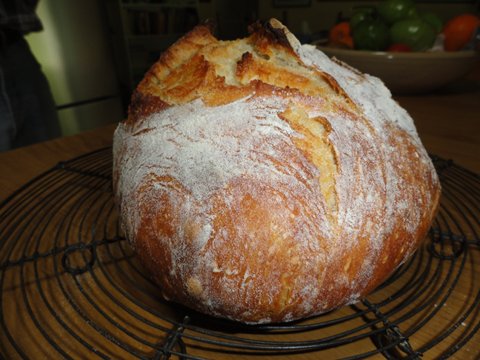
Inside, bread is set to rise so it will be ready for lunch. Yesterday's loaf was wholemeal with a sprinkling of cornmeal. While it was rising and baking, we had a visit from Jens and Cathy, my step-son and daughter-in-law, who live nearby. It gave us the chance to have a break and to sit and catch up with their news and talk about, what else, the wedding. ; - )


I also bottled up some hot bread and butter cucumbers which finished off the last of the summer cucumbers. These will be stored in the fridge and will probably last until the end of winter.


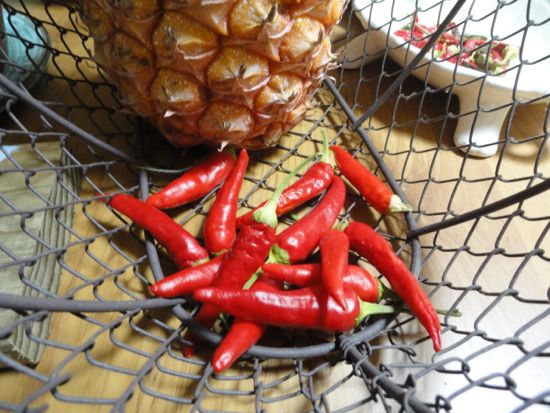
Those red blobs in with the cucumbers are hot chilli peppers, which we grow in the backyard. I have a hand full of them to pick and dry for use over Autumn and Winter because now the cooler weather is upon us, the bush will stop producing. I'll cut the bush back and it will probably give us another crop later in the year.


We have some new tomatoes coming in. These are oxhearts and they're filling in a gap until the Brandywines, Moneymakers and Amish Pastes tomatoes are producing.


And here are the tomato seedlings growing happily in the bushhouse. On the left are the potato leaf Brandywines, my favourite tomato, next is the medium sized Moneymaker, with its regular tomato leaf. Moneymaker is larger than a cherry tomato but smaller than a regular tomato. and it grows bunches of little tomatoes that hang on the plant like really big grapes. Next to them, and out of the picture, are the Amish Pastes which I use for cooking because of their deep rich flavour. They make a really good sauce because they don't produce as much juice as most other tomatoes. We will also grow cherry tomatoes - we have Tommy Toe here, but they are rarely planted and just come up wherever they feel like it and are left to grow for Alice. My Airedale Terrier, Alice, loves to pick her own tomatoes, and she likes the cherry tomatoes most of all.


And what would a post about the garden be without photos of our girls. Here are best friends Martha (buff Orpington) and little Heather (salmon Faverolles). They always do things together and although Heather looks like a sweet and fragile little thing, she is like a machine when it comes to turning over leaves and scratching in the undergrowth down by the creek. She has those little feathered legs but no matter how much digging and scratching she does, she always manages to look clean. I wish I knew her secret.


You know when the cooler weather is here when we start giving the girls oatmeal porridge. They love eating it and it gives them a protein boost that keeps most of them laying over the colder months. The grass looks really green, much of the back yard is that lovely shade of natural green you get after good rain. This summer we have gone back to the good old fashioned wet season. Like the tropics, here in the sub tropics, we get most of our rain in summer. So over the past couple of months, we've had a good fall of rain a few times a week. It's freshened up all the trees, water tanks are overflowing, the creek is running fast and it feels like the cycle of heat is over for another year.

Thank you to everyone who helped Frogdancer's friend Jarryd. This is more than just sending a book. It's helping a young man, via the kindness of strangers and the power of books, rediscover that life is not always so cruel and unpredictable.

Welcome to all the new readers who have come this way. Please say hello if you have time. I hope you enjoy reading here.


How often do we get the chance to help someone whose life has been completely turned upside down? Not often. We do favours for people, we give to charities, but when is an act of kindness given to someone who loses everything in the space of one single day?

Jarryd needs your help.

I just received this comment from Frogdancer and I am happy to help her. This is what she wrote:

I was wondering if you'd like to let your readers know about a book drive I'm organising for my friend's son. They were totally burnt out in the bushfires near Traralgon (literally drove away with nothing but the clothes on their backs and their cat and dog).

He's 17, a real literature nut, and we're sending him books to help replace all of the ones that he lost. Plus a few more to broaden his horizons. If any of your readers are book lovers then they'd know how lost he is without his library.

The list of novels we're working from as a base is on my blog, along with how I'm organising it. (I'm crossing them off as people comment.)

My aim is to make his postman curse the day that blogging was ever invented!!

If you can help, please do. A random act of kindness will lift your spirits and make your heart feel good, but more than that it will help a young man regain his faith in the goodness of people and give him books to fill his brain and form his future. I am so pleased to see James Joyce and Thomas Pynchon on the list!

Read frogdancer's post and book list here. Apparently her email is down so leave a comment at her blog, or here and I'll pass it on to her. If you were wondering if you could help after the fires, this is a quick and simple way to make a real contribution - grab a suitable book, slip it in an envelope, write a note telling Jarryd that you're thinking of him, and pop it in the post. How easy is that!

Thank you for doing this.


Hello ladies. The sign-up deadine for the swap is now over. I am glad so many of you have joined our new swap. I am especially happy that there are so many first time swappers and even novice sewers and crafters who have joined in-this is what a swap is all about! Swapping is about learning a new skill or practicing an old skill and making new friends. Rose and I have made lists, are sorting buddies out, and will be back to post the swap buddies at the end of this week-end. I will tell you that there will have plenty of time for this swap (the deadline will be towards the end of April), and I have also been thinking about asking everyone to include a favorite recipe or two with their kitchen creations-it is a wonderful way to share a family or traditional food with far-away friends and to get to know their favorite foods. Until Sunday, Sharon and Rose


Our luffas (loofahs) are almost ready to pick. They have snaked their way up a very high trellis, grown in the sun and rain of summer, and are now almost ready for harvest. Our season this year has been very disappointing. All the vines grew strong and healthy but there was a lot of rain and lower than normal temperatures, which resulted in very few female flowers. There are only about six good ones there this year. In a good year, we can grow enough luufas to see us through the year, but no matter, there will be another harvest next year. Those we have now will be harvested soon and all will be put to good use.

Luffas are gourds, and the only source of vegetable sponge. Although they can be eaten like zucchinis or cucumbers when young and tender, allowed to grow to their full maturity, they will give you a very good exfoliating sponge. The seeds and leaves are also edible.


They are usually used in the shower but are also very handy in the kitchen when cut into discs and used as pot scrubbers.

Luffas grow well in hot climates, according to the hardiness zone below, I live in zone 4, but I think you could grow them in any area where you don't have frosts. Even then, I'd try them in a sheltered area, possibly up against a brick wall that you attach a trellis to. Remember, the lower the temperature, the fewer luffas you'll get. You may be able to get them to eating stage in the cooler climates but they usually fail to develop to sponge stage.

It's best to germinate the seeds in trays or pots and transplant the seedlings. Soak the seeds for 24 hours before planting, they will germinate four or five days later if you're in a hot climate, or up to seven days later in a cooler one. Grow the seedlings in a tray or pot until they're a reasonable size, then transplant to the garden. To grow luffas, you'll need well drained, rich soil with a high content of compost and organic matter. When you transplant them, water in with a seaweed solution to help with transplant shock and to help them establish. They need a trellis or fence to grow on as they need to be off the ground.


When they're growing well in the garden, give them a drink of weak organic tea - like comfrey tea, or compost tea, once a week, to help them along. About eight weeks after planting, flowers start to form. When the flowers start, stop feeding them and give them a dose of sulphate of potash. That will give you the best chance of flowers and fruit. The male flowers will appear first then, slowly, the females appear; they bear the fruit. The hotter your climate, the more female flowers you'll get. Make sure you have bees around to pollinate the luffas, otherwise you'll have to hand pollinate them.  They'll probably attract ants too but generally, they aren't a problem.

Don't overwater.
Don't over fertilise.
Don't fuss over them.

If you're in a warm or hot climate, they're easy to grow but they do take three to four months to grow to a decent size. They're a good plant to grow in a sustainable garden because in addition to being edible, they will replace your kitchen sponge and pot scrubber and can be used like a sea sponge in the shower.

I'll do another post on my luffas when I harvest and skin them. I'll show you then how to process them after picking and how to harvest the seeds.

BUYING SEEDS
In Australia
In the UK
In USA

MORE INFO

Plant hardiness zones for Australia
Hardiness zones - USA, UK


I must have done something good in the past to deserve the wonderful group of readers I have here. I was overwhelmed by the response to yesterday's post and the jump in visitor numbers. Thank you. Those of you who read here regularly know that Mondays and Tuesdays are the days I do my voluntary work and on those days I'm always busy, rarely able to comment during the day. Usually, all I can manage is to read the comments and okay them for publication. I sometimes have good intentions and resolve to answer when I come home, but when I get here and there are emails waiting and a husband to talk to, I walk away from the computer so I can relax and recover from what are always mentally and physically challenging days.


But now I've had a good night's sleep and I'm ready to face the world again. Today's post will be a bit of a patchwork affair. I want to show you a very quick milk jug cover made last week and I hope to answer the questions asked in the comments this week. Before I go on though, Sharon will be posting on Friday, after the deadline closes on the swap on Thursday. She will then give you all the details you need about the swap and let you know when the list of partners will be ready.

I made this little cover to show you how to make a jug cover using something you might already have at home. I used a small old doily, stitched this little posy of roses on it and tied on some weights in the form of pearlised dangling buttons. You could also use shells from the beach that you drill a hole in, or just your average buttons. I think buttons of different sizes would be fine. The stitches used here are backstitch and French knots; the entire thing was finished in an hour. It's just right for a weekend craft or a weekday one for those of you who are working outside the home or have littlies and need a small project that you can pick and and put down.


Now, to answer some queries. Sarena, I grew the pineapple by cutting the top off a bought pineapple. I let the top dry out a little and then just planted it in the vegetable garden. Hanno fed and watered it, and, I have to tell you, complained about it for two years. He didn't like it in the middle of the vegie patch where he wanted to plant other things. But for those two years, he cared for it. In Spring of the first year it sent up a spike that turned into a fat pineapple. It took a long time to ripen and when I picked it, after it had fallen over due to its weight, it sat on the kitchen bench for about a month. It slowly turned that lovely golden yellow that screams ripeness, but I kept testing it by trying to pull a leaf from the top. That is the true test of a ripe pineapple. When I could pull a leaf out, I cut it open. And yes, it was worth the wait.

CM, I'll ask Hanno to help me with a raised bed post. Just last week he took photos when he cleaned out one of the water tanks and he'll help with that post soon too.

Carmell, don't aim for perfection, love. Nothing needs to be perfect, just good enough for you to enjoy your home. And get the kids to help you, it is their home too and they should at least keep their rooms clean and tidy, depending on their ages, of course. When my boys were very young (4 and 5), I taught them to get their own breakfast - just cereal and milk, not toast or anything cooked. They enjoyed that independence and it lead to other things. I think children benefit from having to help in the home. It teaches them how to look after themselves and it allows them to contribute to the home, and that gives them self respect. I hope you find some enjoyment in your homemaking. I send you warm hugs.

It's good to see you back, Gail. I was wondering where you were.

Attilathehen, I too like seeing others living as we are. It's comforting to know there are many others out there who are doing it or working towards it.

jenniepowell, I'm sorry to hear of your illness and hope today is a bright one for you. I don't claim to understand depression but I have a couple of people very close to me who suffer from it and I see others at my work. I send my best wishes to you and hope you find true and lasting happiness in your home life. Don't ever expect, or aim for, perfection. All you need is to do what needs doing on that particular day and if you can't manage that, there is always tomorrow. Look after yourself, love.


Joanne, thank you for your thoughts and for reaching out. Yours are wise words and I appreciate you sharing them here.

Hello Colleen, yes, I get the picture. I had days and weeks like that when my sons were little. As I said before, don't aim to be perfect, just do what you can do and be satisfied with that. Everyday strive to do a little more, if you can't, then you can't, but try again the next day. Big hugs to you. I hope you like your hot chocolate today.

Alecat, thank you for the award. I appreciate you thinking of me. However, I have to tell you that I stopped accepting awards a few months ago because I never have the time to pass them on. Thank you anyway. I left a comment on your blog.

Sarah, yes that's fine. :- )

And to all of you who needed the encouragement of this post, to those who stopped and reflected on how they do their work, and to those who are struggling with illness, I send my best wishes to you and hope today is a good one.

SOAP POST
Rachel, I've never tried soap nuts but I've heard of them. I'd be interested in knowing how you go with them. Good luck growing them too.

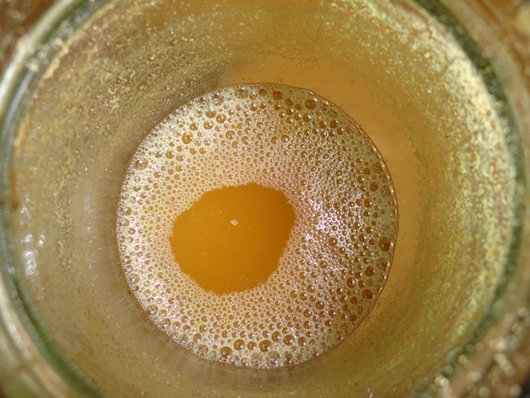
Hi Donetta, it's good to hear the sourdough is a great success. I'll start another one as soon as I can.

Blossom, leave the borax out if you use your grey water. It can build up in the soil. Make sure you use the washing soda with the soap, you might even like to increase the amount. I'm sure it will be fine.

Ajoyfilledlife, you can use water from the washing machine on your garden but don't add borax to your washing powder or liquid. However, you can't store grey water because the bacteria, which quickly die in the garden, will multiply in a rain barrel. Many people in Australia, run a hose from the laundry straight onto the garden, and move the hose to different areas in the garden when they do the laundry. So if you drain the grey water into a barrel, make sure you use it that day or the next. And good luck with your gardens.

Jan Hatchett, adding caustic soda to your laundry mix is not a good idea. It will clean, but it will also harm your clothes, sheets and towels. It's too strong. The caustic soda in soap is neutralised in the process of soap making, and that removes the ability of caustic soda to burn - both clothes and skin. You may not notice it straight away but the fibres in your fabrics will be weakened by it. Use washing soda, not caustic soda. Vinegar is not necessary as a rinse aide. I rarely use vinegar in my washing machine and my clothes are fine. If you do use vinegar, usually the smell goes when the clothes/sheets/towels dry. If you're concerned about soap buildup in your washing machine - and usually the addition of washing soda and borax stop that build up - run an empty short cycle with a cup full of vinegar. That will clean everything out.

Hi Angela, Hanno used to be a diesel mechanic so I know about greasy work clothes. There is a heavy duty laundry powder recipe in the green cleaners link that should work for you. Make up two batches of powder - one for your normal washes, and one for your husband's work clothes. The ingredient in the heavy duty mix that makes the difference is it uses as stain removing soap and if you can let the load soak for an hour or two, all the better. Our stain removing soap here is called Napisan but I'm sure there is a similar overseas if that's where you are. Another way to deal with this is to make up the normal washing powder and add a cup of powdered oxygen bleach. That is also called Napisan here but I use the Aldi verson of it because it's much cheaper.
Here is that recipe:

HEAVY DUTY WASHING POWDER
For use on worker’s greasy or dirty overalls, football and sports uniforms or fabric that has food spills.
  • 2 cups grated Napisan soap (or one cup of powdered oxygen bleach like Napisan or Clorox)
  • 2 cups grated soap or soap flakes
  • 2 cups borax
  • 2 cups washing soda
Mix all the ingredients thoroughly and store in a plastic container with a lid. Use two tablespoons per wash. The powder will not make suds.

For a very heavily stained load of washing or tradesperson’s clothes, if you have a top loader turn the machine off when the powder is completely dissolved. In a front loader, operate the machine to dissolve the powder and then stop the machine for an hour to soak the clothes. Leave to soak for an hour, or overnight, and then turn the machine on and continue washing as normal.

If there are any readers who have a good and reliable source where you buy washing soda and borax, would you please share that information with us. There are quite a few readers, particularly in the US and UK who have trouble finding those products.

Leann, the ingredients for soap making do need to be accurately weighed. I use an old postal scale and it does a very good job but any scale that is accurate would do.

Linda, washing soda is sodium carbonate. Does anyone know where Linda can buy washing soda in South Africa?

Hi Kim, it's good to see you tried the soap and it's working well for you.

Elaine, the homemade soap is more expensive than commercial "supermarket" soap, but less expensive than the natural soaps you buy online or in little stores.

I was interested to read your comment, Billie. I sometimes use emu oil or olive oil as moisturiser on my skin, both work well. I'll be experimenting with some lotions soon so I hope you keep in touch and let me know how yours work out.

Hi Ellen, yes, I really like rice bran oil. Adding it to soap makes a noticable silky difference.

Maureen, I'm sorry I can't help you with an air freshener, I never use them. I wonder if any of our readers here have something to share with us. Hopefully there is someone who can help.

Barbie, it's good to see the family on board with this!

Kim, how great your dad is helping. I think the soap will be good for your baby's skin. I have two washcloths and some homemade soap ready to give my next door neighbour who is due any day now.

Lady Katherine, it's fine to share the recipe, the more people using it, the better. Hopefully we'll have some readers today who will tell us where they buy their supplies for soap making. I love the Back to Basics book too and have written about it somewhere way back. It's a great book with a lot of very helpful information.

Robyn, I've written above about leaving the borax out, it's fine. Cornstarch and water makes a good starch but you could also use wheat flour and water. I used to love making the starch for my mother when she did the washing. In those days, almost everything was starched. LOL!

Que, you can't use the aluminium forms unless they are lined (with plastic) - it will ruin the soap and the forms. The soap makes about 10 or 12 cakes, depending on how large you make your cuts.

This post is very long, I'd best stop. Thanks for the comments. It is really interesting reading about the lives being lived in Australia and far off places.


Don't let them fool you, there is joy to be found at home. If you listen to the people who don't know that, you'll be thinking that being at home, and the chores to be done there, are demeaning, demanding and disgusting. If you read magazines, they'll tell you all about how to do this and that, they'll give you lists of "the best 10 holidays ..." and tell you 20 different ways to serve a chicken leg, but they never write about the satisfaction of homemaking, or the joy to be found by making your home a safe and cosy haven for all who live there. That is my job. ;- )


I used to be one of those people who looked down on housework as something to be avoided at its best, and demeaning at its worst. But when I came to live a simpler and gentler life, I discovered along the way that doing the work needed in my home, slowed me down and made me think about my daily work in a different way. The work remade me.


Instead of whizzing through the housework as fast as I could, I slowed myself to do each job well. That slowness allowed me to think about the task as it was being done and how that task connected to the others that followed. I realised then that all those connected tasks made our home what it is - and that it could either be the comfortable and nourishing place I wanted to live in, or a chaotic jumble of disconnected and generally unfinished chores that didn't encourage anyone to relax and put their feet up. I wonder now if having that chaotic home caused me to go out shopping for things to fill our home - I think I might have been looking for comfort in the shops instead of hand making it at home. That's what we've been encouraged to believe - that if we need something we will find it in a shop somewhere. We are taught at a young age that we buy happiness.

I'm wiser now, I know now that my happiness is made with what I already have at home. There are no special requirements needed; rearranging, keeping everything clean, changing with the seasons and making odds and ends, gives me more satisfaction than shopping ever did.


So how is happiness and joy found in the normal course of the everyday? Shhhh, it's a secret, but I'll let you in on it. It's found by slowing down, focusing on what you're doing, taking pride in a job well done, and repeating that on a daily basis. When you get into the rhythm of your home and work towards making every square inch of it comfortable, the work itself gives the reward because you make your home exactly what you want it to be. Housework isn't difficult, and remove all thoughts from your head about it being completed every day. Every woman knows that housework never ends, so take your time. Slow down and do it well, stop thinking about getting on to the next task, just do what you're doing, then take a short break. Don't make it tougher than it is. Look at your work when you've finished and think about how that space works for you, could it be changed? Could you rearrange things to make it better? Is it just right? Good! Then tell yourself you've done a good job and feel happy that you did that. It is okay to be proud of your work, despite what anyone tells you.

Working slowly through your work will slow you down too. If you stop rushing, so will your brain and heart. Slow down and enjoy what you do, well, most of it, I doubt too many people enjoy cleaning the toilet or washing nappies. But even those things are part of us, so carry our those chores as best you can and enjoy the ones you like.


I don't have children to look after now, but I used to and I know that my routine now would have suited that time of my life very well. Now I do my every day chores slowly throughout the day - I make the bed, sweep the floor, bake bread, tidy up and cook, and alongside those everyday chores are others that are peppered through the hours. They make the day interesting because they are different every day. All of the photos here today were taken in my home during the course of one day. On this particular day, I cut open THE pineapple - the one that has been growing for two years in the back yard, and we tasted the finest, juiciest, sweetest pineapple ever. Brussel sprouts, two packs bought at Aldi at a very good price, were blanched divided up into four meals and added to the freezer. A handsome worker in the backyard removed an unstable frangipani and allowed co-workers to scratch in the bare soil, hoping for some fat grubs to eat. Tea was taken on the front verandah. The sewing room was tidied and a tablecloth made with fabric from the stash.

It's nothing special, is it? But it makes me feel good and it satisfies me. Making your home a place that sustains you and your family is one of the most important jobs you can do. Times are tough, there are all sorts of things going on in the world that are difficult to understand, but if you make your home a place that comforts, a place where you can relax and be your true self, a place where your children feel safe and warm, a place where you show your family the joy of living simply, then you are doing a really significant and essential job that takes the hard edge off the outside world. So when you shake open the sheets to make up that clean bed, when you set the table with knives and forks, water glasses and a flower in a cup, when your beef stew and dumplings is slowly bubbling away welcoming your family as they come home with the smell of home cooking, when you sit with your tea, when you sweep the floor, when you sew or knit or cook, I hope you find happiness in your home, because I know it's there. You might not have discovered the mother lode yet, you might just be picking up fragments every so often, but keep at it and you will be rewarded.


Having the time and the inclination to make many of the things we use here is one of the most satisfying things about living this way. I love making soap, cooking from scratch, making cordials and fermented drinks, I love to sew and knit, and those activities result in products that are usually superior in quality to those bought in today's shops. It also give me the peace of mind of knowing that only the ingredients I put in with my own hands are in there; there are no nasties lurking. I add safety and certainty in with my other ingredients so I know that what I'm making is healthy, and not a product that might look good but is laden with chemicals I can't pronounce.

And so for all those reasons, I love making my own soap and laundry powder. I'm currently luxuriating in a lovely olive oil-rice bran oil-coconut oil soap that is creamy and lathers well. It's my favourite soap and if I never tried another home made soap, recipe I'd be happy with this one. I'm washing my hair with it too and it does a wonderful job, as good as the best organic shampoo.


Soap combines lye (caustic soda) with fats - I use only vegetable fats but it is also made with animal or bird fat. The chemical process that takes place, saponification, pulls the ingredients together and over the course of the next three or four weeks, the caustic elements in the soap neutralise, leaving a mild and soothing soap. Skin is the body's largest organ so it makes sense that whatever we rub onto our skin, especially if that is done many times during the course of the day, is safe and nourishing. Home made soap nourishes skin because it contains the natural glycerin, unlike commercial soap. Glycerin is extracted from commercial soap and sold as a separate product - it's more expensive than the soap, but removing it leaves the soap depleted. To counteract this, manufacturers add ingredients to make up for its lost and in doing so, make soap that is not so good for your skin.

Homemade laundry powder is another product that can easily be made at home. It's the combination of three ingredients - soap flakes, washing soda and borax, although if you use your grey water on your garden, you should leave out the borax. If you check the ingredients list on your commercial laundry detergent, you'll find a list of chemicals commonly used in many commercial cleaners that you have no idea about. I have been using homemade laundry powder in my front loader washer for many years now and have never had a problem. It cleans our clothes well and they come out smelling clean, not of artificially produced perfumes. Be warned, if you make up the recipe for laundry liquid, it can separate. If that happens, it's fine to use, you'll just need to mix it up to incorporate the liquid with the gel before you use it.

If you've never stepped into the world of homemade soap and laundry powder before now, why not give it a try. The powder in particular is easy and quick to make, MUCH cheaper than your commercial powder and does a good job without harming you or your clothes. My post about it and the recipe for it, and many other green cleaners, is here.

To make your own soap you'll need to step up a notch. It's more difficult, because you're handling a caustic product that burns, but if you make it when you're alone with no children or pets to distract you, it's easily done. My recipe for cold pressed soap is here.

I want to encourage you to start making some of your own products. Not only will it save you money, it will allow you the peace of mind of knowing what you're putting on your skin and on your clothes. There is a feeling of satisfaction that comes with this that you don't get when buying another box of soap or laundry powder. If you want it to, it will help you move further away from commerce and closer to an independent home. I know many people who read here are already doing this, but many are not. So if you're using your own non-commercial soap or laundry powder, please share your experiences with us.

MORE READING
This is a very good soap page with recipes and troubleshooting.

PS: I'm really pleased to see so many people interested in the swap. The deadline for joining is Thursday, so there is still time to sign up.


Hello all, Sharon here. I am a bit late in announcing a new swap today. I have decided that we will be swapping something very useful and something that can be very creative- kitchen towels and hot pads. I was going to put up my own tutorial for this, but after doing some research on the internet I found many so good tutorials that I will instead give you links to great ideas. For those who like to embroider here is Alicia Paulson of Posy gets Cozy great Polish Folk towels:http://aliciapaulson.com/Pleasant_Kitchen_Dishtowels.pdf. Her great site is: http://rosylittlethings.typepad.com/posie_gets_cozy/. Here is a sweet and very different kitchen towel: http://calamitykim.typepad.com/photos/whip_up_a_darlin_dress_to/index.html . For a fun quilted project I have several links: http://lindamade.wordpress.com/2007/08/28/hot-stuff-patchwork-oven-mitts/ , http://supamb.com/supafine/2007/10/24/how-to-sew-a-patchwork-kitchen-towel/ , http://writemamawrite.typepad.com/blog/2008/09/patchwork-kitchen-towel-tutorial.html , and http://sewmamasew.com/blog2/?p=550. I also found a felted hot pad at : http://www.purlbee.com/stars-stripes-felted-hot-pads/ . For those who want to practice their crochet I found this link which will take you to many many links!http://home.inreach.com/marthac/holder.html
To sign up for the swap please leave me (as a comment) :
1. your name
2. your e-mail (written out to stop those nasty spammers),
3. your country
4. whether you want to swap within your country, or internationally. Remember that if you swap internationally it many cost you a wee bit more in postage, but it is also so much fun!
The deadline for sign up is Thursday, Feb. 19
Rose will be helping me with the organization and the tracking of the swappers, and I have had many ladies who have signed up as my angels-those who will help me make sure that everyone gets a parcel. A great big thank-you and hug to everyone who is helping!
I also wanted to link you to a set of videos on You Tube. They are of Clara, a woman who lived through the Great Depression. She is seen in these videos talking about cooking and giving recipes that her family lived on during those hard years. I found these to be incredibly interesting. Clara is in her 90's now and all I can say is wow! I hope you all enjoy these as much as I did.
Episode 1: http://home.inreach.com/marthac/holder.htm
Episode 2 : http://www.youtube.com/watch?v=yREFkmrrYiw&feature=related
Episode 3: http://www.youtube.com/watch?v=yREFkmrrYiw&feature=related
Episode 4: http://www.youtube.com/watch?v=P4IjNV3lZkQ&feature=related
Episode 4 (part 2): http://www.youtube.com/watch?v=1IEWJmm4Tms&feature=related
Episode 5: http://www.youtube.com/watch?v=qptfhu9R0WI&feature=related
Episode 6:http://www.youtube.com/watch?v=9zXqkHvs0po&feature=related
Episode 7: http://www.youtube.com/watch?v=c5tXODF4of0&feature=related
Episode 8 (part 2) : http://www.youtube.com/watch?v=YhBZrPk2xaY&feature=related
Please keep all those who have lost so much in the bushfires in your prayers. Donations can be made online to the Australian Red Cross at :http://www.redcross.org.au/vic/services_emergencyservices_victorian-bushfires-appeal-2009.htm#Information_about_your_donation
I don't have time to post today but Eilleen at Consumption Rebellion has written a very interesting and intelligent post at the co-op about Children and the pressure to buy. It's well worth a read.

Sharon will be posting later about the new swap. I hope you all jump in and have some fun with it.

Changing old habits and establishing new routines is one of the hardest things you'll do when you move from a consumerist mindset to a more frugal and homemade one. When I first changed from my old life, I knew I had to do a lot more for myself but for the life of me I couldn't find the motivation to get all those new chores done. After a period of trial and error, I stumbled onto a good routine that established a rhythm to my days and I have not looked back. I like doing my housekeeping now - it grounds me and remind me every day that all the work both Hanno and I do, helps create a home we love spending time in and a relationship that grows stronger each year. Those home tasks carried out each day remind me that a simple life is a journey, not a destination.

Establishing a housekeeping routine can be a daunting task but is made easier by small actions repeated regularly. I didn't know it then, but when I made myself do my daily chores a little bit at a time, before too long, I got into a rhythm that carried me through what I had to do. When I took up the broom and pegs as my tools of trade, I started with a little list of jobs I would do within a certain amount of time. For instance, I would get up, shower, write, feed the animals and chooks, make breakfast, make the bed, clean the kitchen and make bread all before my unofficial time limit of 9 am. By 12 o'clock I had to have swept the floor, cleaned the kitchen benches and stove, and any laundry that needed doing that day. Keeping a list of tasks within a flexible time frame helped and I was surprised that, in the space of about a month, I had established a routine for myself that felt comfortable and easy to work with; and it got my housekeeping done. That surprised me because I hadn't liked doing housework before then, I thought it was boring. When I had that rhythm, I started thinking about what I was doing, how my work connected me to my female ancestors and how it made my life better. When I made that connection, I started liking most of what I did, I began looking for new things to learn and I settled into my home. At last, I felt truly comfortable in my own home.

Now that I look back on it, I know that getting into the rhythm of doing a certain number of chores each day, and repeating those actions, changed my habits and established positive new ones. So I'd like to share with you five things to do every day to help a establish a routine. As you can see, they're five very common things that most of us would need to do each day. I hope you you will add another five things that are required in your own life. This second set of five things will be those things specific to you and your circumstances - whether you have children or not, work outside the home or not, and possibly would change according to where you live. For example, if you live in an apartment, your chores would be different to those you would need to do in a house with a garden and chooks.
  1. Make the bed/s. When the children are old enough, this should be one of the chores they learn so they contribute to the running of the home.
  2. Sweep the floor.
  3. Wash up or run the dishwasher.
  4. Organise and tidy one area a day. This might be the laundry, kids' rooms, the family room or your finances and mail.
  5. Know what you'll eat tomorrow.
And when you have your daily routine working for you, add one weekly activity: learn or teach one new skill every week. A new recipe, new pattern, new stitch, or work though something over the weeks - like building a compost heap, learning about vegetable gardening, experimenting with sourdough or other fermented foods, teaching your children simple, practical skills like how to sew on a button, tie their shoe laces, tell time or read the sky - during the day for changes in the weather and at night for interest.

Learning new skills is something we all need to do and you need to make time for it and put in the effort to do it. At almost 61 years of age, I still look for new discoveries, and I hope I never lose the interest in doing that. I believe that when we lose the will to learn, we stop flourishing.

I hope this way of establishing housekeeping routines works for you. It is said that new habits need about three weeks to set up and become part of you. I never timed my changes so I wonder if that is true. Hopefully in a few weeks time, some of you tell me that it is.

Newer Posts Older Posts Home

MY BOOKS

MY BOOKS


My books were all published by Pengiun, and are available at Amazon US, Amazon UK and Amazon Au

Search here

Total Pageviews

Translate


I'm Rhonda Hetzel and I've been writing my Down to Earth blog since 2007. Although I write the occasional philosophical post, my main topics include home cooking, happiness and gardening as well as budgeting, baking, ageing, generosity, mending and handmade crafts. I hope you enjoy your time here.

MY FAVOURITE PLACES

  • Grandma Donna's Place
  • Grandma Donna's YouTube
  • Grandma Donna's Instagram
  • This Simple Day
  • Nicole's Instagram

Give More

Give More

Popular posts last year

Making ginger beer from scratch

We had a nice supply of ginger beer going over Christmas. It's a delicious soft drink for young and old, although there is an alcoholic version that can be made with a slight variation on the recipe. Ginger beer is a naturally fermented drink that is easy to make - with ginger beer you make a starter called a ginger beer plant and after it has fermented, you add that to sweet water and lemon juice. Like sourdough, it must ferment to give it that sharp fizz. To make a ginger beer plant you'll need ginger - either the powdered dry variety or fresh ginger, sugar, rainwater or tap water that has stood for 24 hours to allow the chlorine to evaporate off. You'll also need clean plastic bottles that have been scrubbed with soap, hot water and a bottle brush and then rinsed with hot water. I never sterilise my bottles and I haven't had any problems. If you intend to keep the ginger beer for a long time, I'd suggest you sterilise your bottles. MAKING THE STARTER In a...
Image

NOT the last post

This will be my last post here.  I've been writing my blog for 18 years and now is the time to step back. I’ve stopped writing the blog and come back a couple of times because so many people wanted it, but that won’t happen again, I won’t be back.  I’ll continue on instagram to remain connected but I don’t know how frequent that will be. I know some of you will be interested to know the blog's statistics. 
Image

How to make cold process soap

I'm sure many of you are wondering: "Why make soap when I can buy it cheaply at the supermarket?" My cold process soap is made with vegetable oils and when it is made and cured, it contains no harsh chemicals or dyes. Often commercial soap is made with tallow (animal fat) and contains synthetic fragrance and dye and retains almost no glycerin. Glycerin is a natural emollient that helps with the lather and moisturises the skin. The makers of commercial soaps extract the glycerin and sell it as a separate product as it's more valuable than the soap. Then they add chemicals to make the soap lather. Crazy. Making your own soap allows you to add whatever you want to add. If you want a plain and pure soap, as I do, you can have that, or you can start with the plain soap and add colour, herbs and fragrance. The choice is yours. I want to add a little about animal and bird fat. I know Kirsty makes her soap with duck fat and I think that's great. I think t...
Image

Preserving food in a traditional way - pickling beetroot

I've had a number of emails from readers who want to start preserving food in jars but don't know where to start or what equipment to buy.  Leading on from yesterday's post, let's just say up front - don't buy any equipment. Once you know what you're doing and that you enjoy preserving, then you can decide whether or not to buy extra equipment. Food is preserved effectively without refrigeration by a variety of different methods. A few of the traditional methods are drying, fermentation, smoking, salting or by adding vinegar and sugar to the food - pickling. This last method is what we're talking about today. Vinegar and sugar are natural preservatives and adding one or both to food sets up an environment that bacteria and yeasts can't grow in. If you make the vinegar and sugar mix palatable, you can put up jars of vegetables or fruit that enhance the flavour of the food and can be stored in a cupboard or fridge for months. Other traditional w...
Image

Cleaning mould from walls and fabrics

With all this rain around we've developed a mould problem in our home. Usually we have the front and back doors open and that good ventilation stops most moulds from establishing. However, with the house locked up for the past week, the high humidity and the rain, mould is now growing on the wooden walls near our front door and on the lower parts of cupboards in the kitchen. Most of us will find mould growing in our homes at some point. Either in the bathroom or, in humid climates, on the walls, like we have now. You'll need a safe and effective remedy at some point, so I hope one of these methods works well for you. Mould is not only ugly to look at, it can cause health problems so if you see mould growing, do something about it straight away. The longer you leave the problem, the harder it will be to get rid of it effectively. If you have asthma or any allergies, you should do this type of cleaning with a face mask on so you don't breathe in any spores. Many peopl...
Image

Five minute bread

Bread is one of those foods that, when made with your own hands, gives a great deal of satisfaction and delight. It's only flour and water but it symbolises so much. I bake bread most days and use a variety of flours that I buy in bulk. Often I make a sandwich loaf because we use most of our bread for lunchtime sandwiches and for toast. Every so often I branch out to make a different type of loaf. I have tried sour dough in the past but I've not been happy with any of them. I'll continue to experiment with sour dough because I like the idea of using wild yeasts and saving the starter over a number of years to develop the flavour and become a part of the family. However, the loaf I've been branching out to most often is just a plain old five minute bread. By five minutes I mean it takes about five minutes actual work to prepare but it's the easiest of all bread to make and to get consistently good loaves from. If you're having people around for lunch or...
Image

This is my last post.

I have known for a while that this post was coming, but I didn't know when. This is my last post. I'm closing my blog, for good, and I'm not coming back like I have in the past.  I've been writing here for 16 years and my blog has been many things to me. It helped me change my life, it introduced me to so many good people, it became a wonderful record of my family life, it helped me get a book contract with Penguin, and monthly columns with The Australian Women's Weekly and Burke's Backyard . But in the past few months, it's become a burden. In April, I'll be 75 years old and I hope I've got another ten years ahead. However, each year I'll probably get weaker and although I'm fairly healthy, I do have a benign brain tumour and that could start growing. There are so many things I want to do and with time running out, leaving the blog behind gives me time to do the things that give me pleasure. On the day the blog started I felt a wonderful, h...
Image

What is the role of the homemaker in later years?

An email came from a US reader, Abby, who asked about being a homemaker in later years. This is part of what she wrote: "I am a stay-at-home mum to 4 children, ages 9-16. I do have a variety of "odd jobs" that I enjoy - I run a small "before-school" morning drop-off daycare from my home, I am a writing tutor, and I work a few hours a week at a local children's bookstore. But mostly, I cherish my blissful days at home - cooking, cleaning (with homemade cleaners), taking care of our children and chickens and goats, baking, meal-planning, etc. This "career" at home is not at all what I imagined during my ambitious years at university, but it is far more enriching. I notice, though, that my day is often planned around the needs of my family members. Of course, with 4 active kids and a husband, this is natural. I do the shopping, plan my meals, cook dinner - generally in anticipation of my family reconnecting in the evening.  I can't h...
Image

Every morning at home

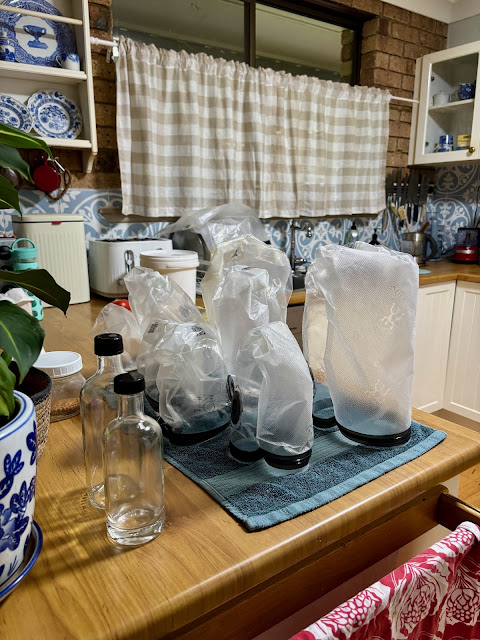
Every morning when I walk into my kitchen it looks tidy and ready for a day's work. Not so on this morning (above), I saw this when I walked in. Late the previous afternoon when I was looking for something, I came across my rolled up Zwilling vacuum bags and decided they had to be washed and dried. So I did that and although I usually put them outside on the verandah to dry it was dark by then. I turned the just-washed bags inside out and left them like this on a towel. It worked well and now the bags are ready to use when I bring home root vegetables, cabbages or whatever I buy that I want to last four or five weeks.
Image

You’ll save money by going back to basics

When I was doing the workshops and solo sessions, I had a couple of people whose main focus was on creating the fastest way to set up a simple life. You can't create a simple life fast, it's the opposite of that It's not one single thing either - it's a number of smaller, simpler activities that combine to create a life that reflects your values; and that takes a long to come together. When I first started living simply I took an entire year to work out our food - buying it, storing it, cooking it, preserving, baking, freezing, and growing it in the backyard. This is change that will transform how you live and it can't be rushed.  
Image


Trending Articles

NOT the last post

This will be my last post here.  I've been writing my blog for 18 years and now is the time to step back. I’ve stopped writing the blog and come back a couple of times because so many people wanted it, but that won’t happen again, I won’t be back.  I’ll continue on instagram to remain connected but I don’t know how frequent that will be. I know some of you will be interested to know the blog's statistics. 
Image

Every morning at home

Every morning when I walk into my kitchen it looks tidy and ready for a day's work. Not so on this morning (above), I saw this when I walked in. Late the previous afternoon when I was looking for something, I came across my rolled up Zwilling vacuum bags and decided they had to be washed and dried. So I did that and although I usually put them outside on the verandah to dry it was dark by then. I turned the just-washed bags inside out and left them like this on a towel. It worked well and now the bags are ready to use when I bring home root vegetables, cabbages or whatever I buy that I want to last four or five weeks.
Image

You’ll save money by going back to basics

When I was doing the workshops and solo sessions, I had a couple of people whose main focus was on creating the fastest way to set up a simple life. You can't create a simple life fast, it's the opposite of that It's not one single thing either - it's a number of smaller, simpler activities that combine to create a life that reflects your values; and that takes a long to come together. When I first started living simply I took an entire year to work out our food - buying it, storing it, cooking it, preserving, baking, freezing, and growing it in the backyard. This is change that will transform how you live and it can't be rushed.  
Image

Creating a home you'll love forever

Living simply is the answer to just about everything. It reduces the cost of living; it keeps you focused on being careful with resources such as water and electricity; it reminds you to not waste food; it encourages you to store food so you don't waste it and doing all those things brings routine and rhythm to your daily life. Consciously connecting every day with the activities and tasks that create simple life reminds you to look for the meaning and beauty that normal daily life holds.  It's all there in your home if you look for it. Seemingly mundane tasks like cleaning and cooking help you with that connection for without those tasks, the home you want to live in won't exist in the way you want it to.  Creating a home you love will make you happy and satisfied.
Image

Time changes everything

I've been spending time in the backyard lately creating a contained herb and vegetable garden. My aim is to develop a comfortable place to spend time, relax, increase biodiversity and encourage more animals, birds and insects to live here or visit. Of course I'd prefer my old garden which was put together by Hanno with ease and German precision. Together, we created a space bursting at the seams with herbs, vegetables and fruity goodness ready to eat and share throughout the year. But time changes everything. What I'm planning on doing now, is a brilliant opportunity for an almost 80 year old with balance issues. In my new garden I'll be able to do a wide range of challenging or easy work, depending on how I feel each day. It’s a daily opportunity to push myself or sit back, watch what's happening around me and be captivated by memories or the scope of what's yet to come.
Image

It's the old ways I love the most

I'm a practical woman who lives in a 1980’s brick slab house. There are verandahs front and back so I have places to sit outside when it's hot or cold. Those verandahs tend to make the house darker than it would be but they're been a great investment over time because they made the house more liveable. My home is not a romantic cottage, nor a minimalist modern home, it's a 1980’s brick slab house. And yet when people visit me here they tell me how warm and cosy my home is and that they feel comforted by being here. I've thought about that over the years and I'm convinced now that the style of a home isn't what appeals to people. What they love is the feeling within that home and whether it's nurturing the people who live there.
Image

Making ginger beer from scratch

We had a nice supply of ginger beer going over Christmas. It's a delicious soft drink for young and old, although there is an alcoholic version that can be made with a slight variation on the recipe. Ginger beer is a naturally fermented drink that is easy to make - with ginger beer you make a starter called a ginger beer plant and after it has fermented, you add that to sweet water and lemon juice. Like sourdough, it must ferment to give it that sharp fizz. To make a ginger beer plant you'll need ginger - either the powdered dry variety or fresh ginger, sugar, rainwater or tap water that has stood for 24 hours to allow the chlorine to evaporate off. You'll also need clean plastic bottles that have been scrubbed with soap, hot water and a bottle brush and then rinsed with hot water. I never sterilise my bottles and I haven't had any problems. If you intend to keep the ginger beer for a long time, I'd suggest you sterilise your bottles. MAKING THE STARTER In a...
Image

Back where we belong

Surprise! I'm back ... for good this time. Instagram became an impossible place for me. They kept sending me messages asking if I'd make my page available for advertisers! Of course, I said no but that didn't stop them. It's such a change from what Instagram started as. But enough of that, the important part of this post is to explain why I returned here instead of taking my writing offline for good. For a few years Grandma Donna and I have talked online face-to-face and it's been such a pleasure for me to get to know her. We have a lot in common. We both feel a responsibility to share what we know with others. With the cost of living crisis, learning how to cook from scratch, appreciate the work we do in our homes, shop to a budget and pay off debt will help people grow stronger. The best place to do that is our blogs because we have no advertising police harassing us, the space is unlimited, we can put up tons of photos when we want to and, well, it just feels li...
Image