down to earth

  • Home
  • About Us
  • Down To Earth Book
  • Privacy Policy


There was good news here recently. A couple of weeks ago I told you that my elder son Shane and his lovely girlfriend, Sarndra, will marry this year. Their original plan was to go to New Zealand for a few months, return here in September, marry and go to Spain to live for a while. Well, things have changed. The wedding will now be in June!

And it will be here at our home. : - )

I was really proud of them when they told us they wanted a frugal wedding. The price of the average wedding in Australia now is $35,000. I doubt I'm the only one who thinks that is madness. All that money for a one day event, all that thought and preparation going into a dress and a celebration, all that debt starting a new life. I think they should focus less on the wedding and more on the marriage.


~ Source ~

So, Shane and Sarndra started talking about being married in a park or on the beach but after Hanno and I talked about it, and offered our home as the venue, they jumped at the chance. Sarndra was a bit hesitant, thinking it would be too much for us, but we quickly talked her around. Here they can fashion a day exactly to their liking; we have three fine dining chefs to cook - Shane, Kerry and Shane's friend Nathan; my sister is a florist and she has offered to do the flowers and my step son is a photographer. I can bake a good cake. If we can't create a wedding, who can?


But it must be beautiful too. There is no point in it being a frugal wedding if it's not a day they'll enjoy and be proud of. So now I'm trying to come up with some ideas to help them plan their big day. I started looking online and I thought, why not ask my blog friends! I'm sure many good ideas will spring from here.

The wedding will be at the beginning of winter, although we have mild winters here, no snow, very little rain and it shouldn't be too cold. We'll hire a marquee and have that set up in the backyard, with tables and chairs for about 50 people. The ceremony will be in the front garden, probably under our wisteria/rose arch - being winter, the wisteria will be bare, but the Cecil Brunner rose might be flowering at that time. Our next door neighbour, who is a florist, said we can use her coldroom for food and drinks.

Do you have any ideas you'd like to share with me? I'm starting an ideas book to show Shane and Sarndra when they visit. They're going to New Zealand at the beginning of March and will return at the end of May, so I'd like them to decide on the look they want before they go so we can work on making it happen while they're away. Remember, it must be frugal, beautiful and simple. So now it's over to you - all links, flickr photos and your ideas are welcome and appreciated. I want this to be really special. :- )


Bev welcoming everyone with her clapping sticks.
(click on the photos to enlarge them)

We had a wonderful weekend. I hope you did too. Saturday morning we were up and dressed early to go to our local annual aboriginal gathering - the Bunya Dreaming Festival, a celebration of the local Gubbi Gubbi people and aboriginal culture. It's held when the Bunya pines produce their delicious nuts and for thousands of years, the local aboriginal people gathered at this place to eat and share the nuts. In the old times, the coastal clans were invited up to the mountains, they brought fish with them and when they met, they feasted, had games and challenges, dancing and corroboree.


Message stick invitations went out to many people and about 700 attended as family groups. The festival wasn't advertised and only those invited could come along. I was invited as part of my Centre's family, and as part of this family, we helped cook and serve the food and drinks. My wonderful friend Bev, the organiser of the festival and elder of the Gubbi Gubbi, spoke to me about six months ago about us helping and we jumped at the chance to be part of this event.


Bev wanted the food to be simple and easy to walk around with. She supplied us with an amount of money and asked for something like sausages on bread, fruit, and drinks. On the invitation she asked people bring a plate of food to share. What we ended up with was the sausages on bread, onions, sauce, barbecued bunya nuts with wattleseed and wild tomato dressing, oranges, watermelon, rockmelons (cantaloupe), grapes, bananas, peaches, soup, scones and jam, tea, coffee, spring water and fruit juice, plus the shared food people brought along. There was also a bunya cooking competition and when that was judged, the pies, bread and cakes, were sliced up and shared as well. With over 700 people there, there was not one drop of alcohol, which I thought was wonderful and amazing. I'm no wowzer but it is commonplace in Australia now for alcohol to be a part of almost every social gathering so when no one turned up with beer or wine, well, I was shocked.


Aboriginal artifacts on the dance area.

Oh, and part of the culture is that everything is shared, so Bev asked me to ask the volunteers who helped cook and serve, to give whatever people asked for. No one paid for anything and no one was to be refused anything. I had visions of giving out 20 sausage sandwiches but that didn't happen, we just had a few kids coming to ask for extras for the old aunties and the old people who had sent them to collect food for them. There is a very strong tradition of respect for the elders and it shone through on that day. It was a privilege to see it in action.


Bev's clapping sticks.

The main part of the day was opened up by Bev welcoming us all to her ancestral lands. She explaining what happened at the Bunya gatherings in the past, as told to her by her mother from the stories passed down over thousands of years from mother to child. Then she invited aboriginees from other places throughout Australia to come and introduce themselves to us. While she was talking, she used clapping sticks, and a man next to her played the didjeridu. I wish I could have listened more intently but I was serving food and couldn't hear everything she said.


A box of bunya nuts.

During the rest of the time we were there we saw some artifacts poked into the sand in the dance area, and there were challenges and games. After we left the Gubbi Gubbi dancers performed and there was a corroboree and fire ceremony at sunset, where a canoe brought fire from one side of the water to the other. But we were long gone by then.


The view from the car on the trip home. These are the Glasshouse Mountains.

Hanno and I went home after lunch, totally exhausted. When we got home, we went to sleep on the couch. But it was a fine day, one of the best I've spent in my local area, and we were thankful that we'd been a part of it.


This is where the fire ceremony took place.


Teaming up to scour the backyard for insects - Kylie, Heather and Ann Shirley.

I often write about the natural world that lays waiting for me outside our back door. However, the part I focus on most often is that most unnatural part of our backyard - the vegetable garden. That, my friend, even with the natural bounty it delivers to us, even though it's organic and healthy and a green oasis for birds and reptiles, it's a fake rearrangement of natural elements. Those vegie out there would never grow in this area of their own accord; they are only there because they've been planted. Another instance of humans fashioning nature to suit ourselves.


The potatoes planted on January 18 have sprouted and poked their heads up through the mulch.

And I make no apologies for that, I am happy to have a productive garden. The trick in making the natural environment work to suit us is to make sure we do no harm doing it. We don't use artificial fertilisers on our garden, we don't spray insecticides around, we don't kill snakes or lizards; we manipulate our environment knowing that we must be careful doing it.


One of those gentle manipulations is this water collection system Hanno rigged up. It's simply a 200 litre open trough that collects rain water from a down pipe attached to the roof of the chook shed. Those 200 litres are used fairly quickly, always in the space of a week, before any mosquito larvae have a chance to hatch, but it's 200 litres less that we have to take from our water tanks.


Red paw paw (papaya) growing next to the chook shed iron wall which radiates heat and helps the plant to grow.

It's a similar thing on our roof. We have solar panels there which use the sun's rays to heat our water, and skylights which direct sunlight into our house to light two rooms inside without the use of electricity. I am hoping that we will buy more solar panels in the next year and not have to use any electricity from the grid, in fact, our solar generated electricity could very well go back into the grid. A very small collection point in that vast network.


Bok choi.

If you have a vegie patch, one of the things you could easily do to become part of the natural system is to grow comfrey and keep chooks. They will provide most of your fertilisers. Comfrey is richer in nitrogen than chook poo and is easily made into a nitrogen-rich tea, although, be warned, it stinks to high heaven. If you can't do that but still want to garden organically, buy fertilisers like blood and bone (bone meal) and seaweed concentrate. Seaweed is a wonderful boost for plants and provides them with the potassium required to flower well. More flowers, more fruit and vegetables.


It's fallen over on its side because it's so heavy. It's time to pick.

We're getting ready for our main planting which happens here in March. There are seeds growing in the green house and THE pineapple will soon be picked so Hanno can prepare that bed with chook poo, compost, worm castings and blood and bone. We do that every year, and in between each planting so we always have rich soil for our vegetables. I know many of our northern hemisphere friends will be planning their gardens now. Don't forget to treat the soil in your garden with respect, because unless it's healthy and teaming with microbes, your garden will be a disappointment to you.


Gardening is a wonderful use of human energy. It will provide you with nutritious food that is much fresher than anything you can buy. It does cost money to set up a garden, but once that initial investment is made, and if you buy or barter for heirloom seeds, you will continue gardening for years without having a huge amount of expense. We have budgeted $30 a month for our garden (and many months don't use that much), and that allows us to buy straw mulch, the occasional bags of cow manure, fencing wire and the like. It's a wise investment.

So who is planning a vegetable garden this year, and how many of you are first time gardeners?


Things are grim down south. They're in the middle of a heatwave and the area right along the bottom of the Australia continent, that part closest to Antarctica, is sweltering in 45 C (113 F) heat. And it will continue for several days. Ugh. There are quite a few readers from southern Australia and I send my best wishes to all of you. I know how debilitating that kind of constant heat is. Have they closed the schools?

I spent a pleasant day here yesterday and did everything I had planned for myself. We are having frequent showers of rain, so the tanks are all full, and the garden is looking as good as it gets during summer.


One of the extra things I did yesterday was to start a sour dough sponge. I usually make bread with commercial yeast, and have often made the NY Times quick sour dough, but I want to get back to a traditional sour dough that will develop in flavour over the months, and hopefully years, that I keep it going. I'll write more about sour dough as the starter matures.


All I did yesterday was to add one cup of wholemeal spelt flour to one cup of warm filtered water then mixed it together. It's now sitting in a wide mouthed glass jar on the kitchen bench. Overnight I covered it with a cotton cloth but I'll remove that soon so the wild yeasts in the air here will mix in the starter and help with the fermentation.


One of today's tasks will be to make a jar or two of plum jam. I bartered some eggs for a bowl full of Davidson's plums, they're a plum that is an Australian native rainforest plant. They're very sour when raw but make up into a nice jam that isn't too sweet.


Still in the kitchen, here is last night's (and tonight's) dinner - a tomato and caramelised onion tart. Simply made with whatever pastry you care to make, or have on hand, I had two sheets of butter puff pastry in the freezer and used them. I blind baked the tart for about 15 minutes before adding the filling.


To make the filling, peel and slice two onions and slowly fry them to caramelise. In a bowl mix together four eggs, about ½ cup of cream, one clove of garlic, about ¾ cup of finely shredded Parmesan cheese and salt and pepper to your taste. Pour that into the pastry shell, add some thick slices of ripe tomato and the caramelised onions into the mix, careful not to overflow it. Then just bake until it's golden brown on top - 20 - 25 minutes on 190 C (375F). I used a flan tin to bake my tart. It's delicious.

I am always surprised by the generosity of some of the people who read here. The lovely Rose told me she had send some cotton yarn and sure enough, it turned up yesterday. It's called Down to Earth! Thank you Rose. I appreciate your warm, kind heart.

Hello to all the new readers who have come to read over the past couple of weeks. There has been a sharp increase in readership since Christmas so I hope you're all enjoying the posts and the archives. If you have the time, I'd love you to say hello.
After a long time writing, editing and obsessing, I'll send in my book proposal at the end of this week. I'll continue to work on it until I send it to New York on Saturday, then I'll have a few days off, and start writing again; this time, the book itself. It's not the end of the proposal though. They will appraise it and make suggestions, I'll make my changes and it will go to be sold in mid-March. It's a long drawn out process but I have absolute faith in my agent and I'm grateful she's guiding me along this unknown path.


This, and the photo below, are photos of our little permaculture vegetable garden at work. People who come in for food, are encouraged to pick fresh vegetables of their choice from these gardens.

The book proposal has changed the way I go about my day-to-day activities because I fit my chores in around the writing. Of course, not everything gets done but we cope with that by either ignoring that I haven't ironed for weeks or we do patch up jobs to quickly take care of something that used to be part of a regular routine. We humans are incredibly adaptable and right here in my home, that propensity for adaptability has held me in good stead over the past few months. It's helped that Hanno is quite happy with however I choose to structure my days, and if the bathroom doesn't get cleaned for a week or two, he doesn't mind. Or at least he hasn't said he does. :- ) But this morning, that is the first thing on my agenda after I have breakfast. I will deep clean the bathroom.


I will also make a loaf of soy and linseed bread, check on my seedlings, and the garden, because for the past two days (yes, also on Australia Day) I was at work. This first morning after those days at work is always the time that helps me readjust my thoughts and attitude from being out there - mixing with everyone else, talking, socialising, having lunch with lots of people around a kitchen table, laughing, counselling, organising, managing and leading, to being here, just the two of us, mostly silent as we go about our chores. It's a good balance for me, I have two days of absolute full on bedlam, especially when our Flexischool students are there (they returned from school holidays yesterday), to my five days of housekeeping, quiet writing and gentle home tasks. I get a lot of satisfaction from the work I do on those two days, it is the icing on my lifecake, but to return again to my home for five days here with Hanno is my real joy. I am indeed a fortunate woman to be able to live this way and to have the work that I do.


There has been no sewing done for a long time, although I've been toying with a pot holder. I knitted the back of it while watching the cricket a few weeks ago, and although I've cut out the front, I haven't yet sewn it on. I'm continuing with my knitting though and do some every day. It's like a meditation to me now and I feel a bit wonky if I miss a day. I'm currently working on matching fingerless gloves and scarf. It's a lilac/pink merino blend from my stash and it's knitting up quite well.


This work I do makes me what I am; it defines my character. My voluntary work teaches me humility, and being in a position to help always encourages me to be a better person than I am. Housekeeping and gardening help keep the practical side of me focused and interested in my day-to-day life. Having something meaningful to do every day is a great gift and although there were days in my long distant past when I hated those days I had to stay home and clean up, now I see the true value of it.

So now that I've had a good sleep, I will balance that with a day's work. Another day of plodding along on the proposal, a few odds and ends along the way, and with the added bonus of a clean bathroom at the end of the day. Life's good. :- )


A reader asked recently if I'd write a post about what we eat during the week. I'm happy to do that but I think you'll see by our list that we're plain and simple people. I always cook from scratch and I tend to cook in a similar way to my mother and grandmother. We do have the occasional meal they wouldn't have known how to cook, but they're rare and I feel most comfortable with old-fashioned foods.

If you're still learning to cook, I've written a post here about developing flavour in food without adding anything artificial. I believe it's best to understand how flavours work together and how food cooks than to follow a recipe to the letter. If you have that deeper understanding, you'll be able to expand beyond your recipes and create meals that suit your family and your budget while getting the best from the food.

We usually have the same lunch - homemade bread sandwiches with salad, plus either cheese, tuna, salmon or boiled egg. Once a week we'll have scones instead of bread. We drink either tea or a cold cordial or water. I won't keep repeating that in the list below.

MONDAY
Morning
Tea and toast

Night
Macaroni and cheese with garden salad. Made enough for two nights.
Orange buttermilk cake


TUESDAY
Morning
Fried eggs on toast and tea

Night
Macaroni and cheese with garden salad
Orange buttermilk cake with buttermilk ice cream

WEDNESDAY
Morning
Scrambled eggs with herbs on toast and tea

Night
Homemade pizza with cheese, tomato, mushrooms, caramelised onions on top, and a beer
Fresh peaches

THURSDAY
Morning
Baked beans on toast and tea

Night
Boiled eggs with fresh garden salad and potatoes
Buttermilk ice cream with a spoon of freshly made strawberry jam on top

FRIDAY
Morning
Crumpets and honey with tea

Night
Fresh snapper (fish) with potato salad and garden salad
Yoghurt with strawberries

SATURDAY
Morning
Boiled eggs and toast soldiers, and tea

Night
Beef stew with mashed potatoes and wax beans - made enough for two nights


SUNDAY
Baked beans on toast, and tea

Night
Beef stew with herb dumplings. The recipe for beef stew is in the developing flavours link above.
Canned peaches and ice cream

As you can see our vegetables were mostly in the form of salads and potatoes. We don't have much growing at the moment but this will improve when we do our big March planting. We still have potatoes from the last harvest, golden nugget pumpkins, wax beans, bok choi, lettuce, cucumbers, capsicum (peppers) and herbs, so our meals are fashioned around what we have produced. The salads are supplemented with home preserved beetroot and bread and butter cucumbers. I am buying tomatoes and onions at the moment.

So, there you have it. It's not fancy but it's usually fresh and delicious and it keeps us going. We are both pretty healthy. Hanno takes medication for high blood pressure but I'm not on any medication. I hope you get some ideas for your own meals from this meagre sample. Cooking from scratch, especially if you have fresh produce, is a very healthy way to cook.

ADDITION: Margaret has written a post about setting up a buddy system to help people learn how to carry out various household tasks, It's well worth a read.


There is no doubt about it, things are grim. Jobs and homes are being lost, prices are rising and it looks like it won't improve for a long time yet. I know there are as many different financial situations out there as there are readers but one thing is common to us all, we need to save what we can. If you've never been in the position before of having to cut back and watch your money it's very confronting. But don't be anxious about it, this is just another skill you need to learn, and when you do, you'll get better at it.

If you haven't yet worked out how much you earn and spend in a week or a month, now is the time to do that. You need to work out your current financial situation, start to track your money and then, with your partner, write out a budget that you both stick to. The most important thing to remember is that most of your savings will be small amounts. Don't worry that they are small, they all add up and will make a huge difference over the course of a month and a year. I promise you that when you get to the end of that first month, and when you look back on a full year of cuting back and saving, you'll be as proud as punch. And you should be, you will have made a big difference to your life.

So what are all those small savings you need to teach yourself about? Start at the supermarket because that's where we spend money every week. If you have several supermarkets in your immediate area, go to each one and compare the regular shelf prices, not the specials When you're satisfied that you have the cheapest one that is where you should do your regular shopping each week. But then you should check out the specials and loss leaders of each store by looking at their advertising and flyers - a loss leader is the super special a store will advertise to get you into the store. If the loss leader is something you need, buy it, and leave. Remember, you'll be doing your shopping at the cheapest supermarket from now on. If you have enough money, buy extras of those things you use all the time when you see them on special and start a stockpile.

Other supermarket/food things you can do are:
  • cut down on the number of meat meals you serve during the week.
  • buy generic or store brands - always check the country of origin before buying these and buy from your own country.
  • check your local farmers market, if you have one, they often have the best and cheapest food.
  • use your leftovers.
  • cook two or more meals at once to save the cost of energy, and your time.
  • serve smaller portions if you think your portions are too big.
  • instead of serving a large portion of meat to everyone, serve a small portion and add a dessert at the end of the meal. A nice rice pudding or fruit cobbler will fill them just as much as meat will.
  • Don't buy too much. Make use of everything you buy and don't waste one thing.
  • Make your own bread - it's healthier, cheaper and tastes better.
  • Make your own cleaners - buy pure soap, washing soda, borax and bicarb at the store and make what you need at home. The recipes are here.
  • Pack lunches for work and school.
Other money saving strategies in the home include monitoring your electricity and water meters. Turn off the TV and lights when you leave the room and ask your family to do the same. Turn off the computer when it's not being used. Change your light globes to the energy saving ones.

If you have space, plant a small vegetable garden. Grow what you eat but if you only have a small amount of time for gardening, grow those vegetables you eat that are expensive, like tomatoes. If you do grow tomatoes, barter some of them with a neighbour to get things like honey or eggs.

It's not easy saving money but it's very rewarding. When you have a successful month you'll take pride in a job well done. And it will bring you closer to your goal of living simply - all the things I've written about here are the practical day-to-day tasks of a simple life. So don't be scared of doing this, don't think it's too hard or that you really want those new shoes. Now is the time for action and if you can do this, if you can cut back and teach yourself to save, you'll put yourself and your family in a much better situation if the economic situation gets worse.

If you're doing something a bit unusual and it's helping you save, please tell us about it. There are many readers here who need help and a bit of encouragement, so if you can help with your suggestions, please do. We are all in this together.

And before I go ... happy Australia Day to all my fellow Australians. :- )


Here is some delightful Sunday reading for you. Ang lives off the grid in an old Amish farm with her husband and seven, soon to be eight, children. She writes here about cutting ice with her Amish neighbours and how she and her family had lunch in one of the Amish homes. The next post up, Ice Cutting Day two, tells of the following day when the Amish came to her home. They are wonderful posts, showing a peek at another way of life where sharing and helping are just the way things are.


This is my recipe for scones. I have to warn you, I never measure anything so if these aren't quite to your liking, tweak the measurements a bit to get exactly what you like. I encourage you to do that with all your recipes. A recipe is a starting point, not an end point.

INGREDIENTS
4 cups self raising flour OR 4 cups of plain (all purpose) flour with 6 teaspoons of baking powder
pinch of salt
1 tablespoon of sugar
100 grams (4 oz) room temp butter
enough buttermilk or milk to make a dough

All flours are different and flour will take more liquid on a dry day than on a humid or rainy day, so add a cup of milk to start, then add it in small amounts until you have a dough you're happy with.

METHOD
Sift the flour (and baking powder if you're using it), salt and sugar into a bowl. Rub the butter into the flour with your fingertips until it's crumbly like breadcrumbs. Add the milk and mix.

IMPORTANT
The one thing that will mean success or failure is the way you mix your scones. Over-mixing (and over-kneading) will kill them. You need what used to be called "a light hand" when making scones. That means that when you add the milk, you mix - I use a butter knife to mix - only until the flour and milk are just combined. Then stop.

METHOD (continued)
Take the mixed dough from the bowl and place it onto a clean floured bench. Knead the dough very gently, maybe only four or five times, until the dough is smooth. Over-kneading will ruin the scones. When the outside of the dough ball is floured and smooth, pat it down with you hand to about 4 or 5 cm ( 1½ - 2 inches) in height. Cut with a wine glass and place the scones , almost touching, on a baking sheet. Place in a pre-heated hot oven to cook until golden.

OVEN TEMPERATURES
Another factor that helps scones rise is oven temperature. Baked goods have two kinds of lift - the lift they get from the raising agent you use (baking powder, yeast, bicarb etc) and also "oven lift" which comes from the hot temperature when the dough first goes into the oven. What you are aiming for is a hot oven for the first five minutes, then turn it down. So, set your oven to it's highest - mine is 250C (480F) - while you're mixing your scones. Put the scones into the high heat oven for five minutes, then turn it down to about 200C (390F) and cook until the scones are golden on top - about 15 - 20 minutes.

Just a note about the strawberry jam recipe. If you like a firm jam, add pectin to the recipe when you add the sugar. Also, in the US, make sure you use 100% pure cane sugar, not beet sugar in your jam. You need cane sugar to help jam set properly.

Happy baking everyone! Let me know how you went with your scones if you bake some.

Welcome to all the new readers who have joined us over the past week or two. I hope you enjoy reading here. Thanks to everyone who left comments, it's wonderful getting feedback, but more than that, I really love interacting with all of you and knowing that Hanno and I are not alone in our quest for a simple life.


The jam jars have cooled, I checked that all the poptop lids popped down, one didn't, and now nine jars of jam are in the stockpile cupboard ready for eating or gift giving. That one jar that didn't seal properly is in the fridge and will be the first one Hanno and I eat. Yesterday I made buttermilk scones for lunch and had some jam on a warm scone. That, my friends, was delicious. By the way, what we call scones here and in the UK are called biscuits in the US.

While I was eating that scone, I thought back to the many scones with homemade jam I've had over the years. My grandma was a frequent scone maker, so was my mother, but when I was about 10, she taught me to make scones, and from then on, always had a willing baker because she praised my scones as being the best she'd eaten. She knew that praising a child brought it's own rewards. I learnt that from her.

In my family, scones were used as a kind of poor man's bread. If we didn't have bread from the bakery, we would make scones to eat for lunch. On those days we didn't have bread we would top our scones with a slice of tomato and cucumber, or cheese, or Vegemite or peanut butter. Some times we would add cheese or dates to the ingredients, for variety, when we made up our scones. No matter what we added though, they were always welcomed by all who joined the table and usually washed down with tea, for the adults, and either water or cordial for us kids.

It's interesting for me now to work out why we thought of scones as a poor alternative to white sliced bread. I doubt it had much to do with price as my father was a baker and our bread didn't cost us anything. I am guessing that in those days, back in the 1950s, when things were starting to be packaged in plastic, having that 'new' bread in plastic was seen as modern and therefore more desirable, than the old tissue paper wrapped unsliced bread or, for that matter, hot homemade scones.


Here is my quick calculation on the cost of making scones. This will make about 10.
Flour $1 - 500 grams (1 lb)
Butter 50 cents - 100 grams (4oz)
Milk - 15cents - 100 mls (3.5 oz) I usually use buttermilk in my scones but I can't find a price online for it and I can't remember how much it is.
Pinch of salt - 1 cent
Tablespoon of sugar - 5 cents
Energy to cook them - 5 cents

So all up that comes to $1.76, which is probably similar to the same amount of homemade bread. A loaf of Buttercup Country Split White Bread costs $3.60, half a loaf would cost $1.80, I think 10 scones would be the equivalent of between ½ and ¾ of a loaf. So it may be slightly less in dollar value, but a lot better for you health-wise (no preservatives), and for taste.


We're all counting our pennies. Some of us do it to pay off debt, some to live in a certain way, some because we have to. Doing these little calculations for those products we buy frequently is a very good way of managing your money. But when you do your calculations, also calculate in the health benefits too, and if something is the same in price, or almost the same, it's best to go for the healthier alternative.

There are plenty of recipes for scones/biscuits online but I use self-raising flour, butter (never margarine), a pinch of salt, a tablespoon of sugar and enough buttermilk to make the dough. Buttermilk makes a very light scone and has fewer calories than ordinary milk. If you are making yoghurt, you could also use the whey from your yoghurt instead of the buttermilk. If you don't have enough whey, mix in a little milk to make it up. I never add eggs to my scones.


I always cut my scones with a wine glass, my grandma did that and so did my mother. A wine glass is just the right size. When you make your scones, you want a cut edge, not a rolled or a hand formed edge. A cut edge will rise better every time.

We eat scones for lunch about once a week; the other days I usually bake bread. Scones are much quicker than bread, they take less than five minutes to make and about 15 - 20 minutes to bake. There is no waiting for the dough to rise, or mixing of yeast, so it's a quick alternative and certainly a recipe you should have in your armoury of common household recipes. By the time you've cleaned the kitchen and made your pot of tea, the scones will be ready. And if you have a little homemade jam to top your scone, you'll set a smile on your face that will be hard to move.


I don't do nearly as much preserving (canning) as I used to. Since we made the decision to keep our garden going year round, there has been no need. Now I preserve only those foods I want to make into jams, relishes and cordials, and generally I freeze the juice for cordials when we have an excess. But we had a windfall of strawberries the other day so yesterday Hanno washed and cut the fruit for me and I cooked up a pot of strawberry jam. Cut up and ready for cooking we had 2.6kg (5.7 lb) of strawberries. When you're making strawberry jam it's good to have the mass of strawberries fully ripe, for a deep and full flavour, and a small number that aren't so ripe, because they contain more natural pectin to thicken the jam.
I can't let today pass by without writing something about the wonderful inaugural poem and commenting on Dianne Feinstein. Before today, I had never laid eyes on Dianne Feinstein but each time she appeared on the inaugural podium to introduce this person and that, I was impressed by her outgoing personality and a little jealous that we in Australia have no comparable older women role models. I hope I am so together and in control when I'm 75.

And that poem...

Praise song for the day by Elizabeth Alexander

Each day we go about our business, walking past each other, catching each others' eyes or not, about to speak or speaking. All about us is noise. All about us is noise and bramble, thorn and din, each one of our ancestors on our tongues. Someone is stitching up a hem, darning a hole in a uniform, patching a tire, repairing the things in need of repair.

Someone is trying to make music somewhere with a pair of wooden spoons on an oil drum with cello, boom box, harmonica, voice.

A woman and her son wait for the bus.

A farmer considers the changing sky; A teacher says, "Take out your pencils. Begin."

We encounter each other in words, words spiny or smooth, whispered or declaimed; words to consider, reconsider.

We cross dirt roads and highways that mark the will of someone and then others who said, "I need to see what's on the other side; I know there's something better down the road."

We need to find a place where we are safe; We walk into that which we cannot yet see.

Say it plain, that many have died for this day. Sing the names of the dead who brought us here, who laid the train tracks, raised the bridges, picked the cotton and the lettuce, built brick by brick the glittering edifices they would then keep clean and work inside of.

Praise song for struggle; praise song for the day. Praise song for every hand-lettered sign; The figuring it out at kitchen tables.

Some live by "Love thy neighbor as thy self."

Others by "first do no harm", or "take no more than you need".

What if the mightiest word is love, love beyond marital, filial, national. Love that casts a widening pool of light. Love with no need to preempt grievance.

In today's sharp sparkle, this winter air, anything can be made, any sentence begun.

On the brink, on the brim, on the cusp -- praise song for walking forward in that light.

On this day when 'anything can be made, any sentence begun,' I am pleased to remember this seemingly simple poem as one of its many highlights. I got up at 2am to watch the inauguration, and I am still now thinking of various parts of the ceremony and the words delivered. Hope is a great reward at the end of such a momentous day.

Newer Posts Older Posts Home

MY BOOKS

MY BOOKS


My books were all published by Pengiun, and are available at Amazon US, Amazon UK and Amazon Au

Search here

Total Pageviews

Translate


I'm Rhonda Hetzel and I've been writing my Down to Earth blog since 2007. Although I write the occasional philosophical post, my main topics include home cooking, happiness and gardening as well as budgeting, baking, ageing, generosity, mending and handmade crafts. I hope you enjoy your time here.

MY FAVOURITE PLACES

  • Grandma Donna's Place
  • Grandma Donna's YouTube
  • Grandma Donna's Instagram
  • This Simple Day
  • Nicole's Instagram

Give More

Give More

Popular posts last year

Making ginger beer from scratch

We had a nice supply of ginger beer going over Christmas. It's a delicious soft drink for young and old, although there is an alcoholic version that can be made with a slight variation on the recipe. Ginger beer is a naturally fermented drink that is easy to make - with ginger beer you make a starter called a ginger beer plant and after it has fermented, you add that to sweet water and lemon juice. Like sourdough, it must ferment to give it that sharp fizz. To make a ginger beer plant you'll need ginger - either the powdered dry variety or fresh ginger, sugar, rainwater or tap water that has stood for 24 hours to allow the chlorine to evaporate off. You'll also need clean plastic bottles that have been scrubbed with soap, hot water and a bottle brush and then rinsed with hot water. I never sterilise my bottles and I haven't had any problems. If you intend to keep the ginger beer for a long time, I'd suggest you sterilise your bottles. MAKING THE STARTER In a...
Image

NOT the last post

This will be my last post here.  I've been writing my blog for 18 years and now is the time to step back. I’ve stopped writing the blog and come back a couple of times because so many people wanted it, but that won’t happen again, I won’t be back.  I’ll continue on instagram to remain connected but I don’t know how frequent that will be. I know some of you will be interested to know the blog's statistics. 
Image

How to make cold process soap

I'm sure many of you are wondering: "Why make soap when I can buy it cheaply at the supermarket?" My cold process soap is made with vegetable oils and when it is made and cured, it contains no harsh chemicals or dyes. Often commercial soap is made with tallow (animal fat) and contains synthetic fragrance and dye and retains almost no glycerin. Glycerin is a natural emollient that helps with the lather and moisturises the skin. The makers of commercial soaps extract the glycerin and sell it as a separate product as it's more valuable than the soap. Then they add chemicals to make the soap lather. Crazy. Making your own soap allows you to add whatever you want to add. If you want a plain and pure soap, as I do, you can have that, or you can start with the plain soap and add colour, herbs and fragrance. The choice is yours. I want to add a little about animal and bird fat. I know Kirsty makes her soap with duck fat and I think that's great. I think t...
Image

Preserving food in a traditional way - pickling beetroot

I've had a number of emails from readers who want to start preserving food in jars but don't know where to start or what equipment to buy.  Leading on from yesterday's post, let's just say up front - don't buy any equipment. Once you know what you're doing and that you enjoy preserving, then you can decide whether or not to buy extra equipment. Food is preserved effectively without refrigeration by a variety of different methods. A few of the traditional methods are drying, fermentation, smoking, salting or by adding vinegar and sugar to the food - pickling. This last method is what we're talking about today. Vinegar and sugar are natural preservatives and adding one or both to food sets up an environment that bacteria and yeasts can't grow in. If you make the vinegar and sugar mix palatable, you can put up jars of vegetables or fruit that enhance the flavour of the food and can be stored in a cupboard or fridge for months. Other traditional w...
Image

Cleaning mould from walls and fabrics

With all this rain around we've developed a mould problem in our home. Usually we have the front and back doors open and that good ventilation stops most moulds from establishing. However, with the house locked up for the past week, the high humidity and the rain, mould is now growing on the wooden walls near our front door and on the lower parts of cupboards in the kitchen. Most of us will find mould growing in our homes at some point. Either in the bathroom or, in humid climates, on the walls, like we have now. You'll need a safe and effective remedy at some point, so I hope one of these methods works well for you. Mould is not only ugly to look at, it can cause health problems so if you see mould growing, do something about it straight away. The longer you leave the problem, the harder it will be to get rid of it effectively. If you have asthma or any allergies, you should do this type of cleaning with a face mask on so you don't breathe in any spores. Many peopl...
Image

Five minute bread

Bread is one of those foods that, when made with your own hands, gives a great deal of satisfaction and delight. It's only flour and water but it symbolises so much. I bake bread most days and use a variety of flours that I buy in bulk. Often I make a sandwich loaf because we use most of our bread for lunchtime sandwiches and for toast. Every so often I branch out to make a different type of loaf. I have tried sour dough in the past but I've not been happy with any of them. I'll continue to experiment with sour dough because I like the idea of using wild yeasts and saving the starter over a number of years to develop the flavour and become a part of the family. However, the loaf I've been branching out to most often is just a plain old five minute bread. By five minutes I mean it takes about five minutes actual work to prepare but it's the easiest of all bread to make and to get consistently good loaves from. If you're having people around for lunch or...
Image

This is my last post.

I have known for a while that this post was coming, but I didn't know when. This is my last post. I'm closing my blog, for good, and I'm not coming back like I have in the past.  I've been writing here for 16 years and my blog has been many things to me. It helped me change my life, it introduced me to so many good people, it became a wonderful record of my family life, it helped me get a book contract with Penguin, and monthly columns with The Australian Women's Weekly and Burke's Backyard . But in the past few months, it's become a burden. In April, I'll be 75 years old and I hope I've got another ten years ahead. However, each year I'll probably get weaker and although I'm fairly healthy, I do have a benign brain tumour and that could start growing. There are so many things I want to do and with time running out, leaving the blog behind gives me time to do the things that give me pleasure. On the day the blog started I felt a wonderful, h...
Image

What is the role of the homemaker in later years?

An email came from a US reader, Abby, who asked about being a homemaker in later years. This is part of what she wrote: "I am a stay-at-home mum to 4 children, ages 9-16. I do have a variety of "odd jobs" that I enjoy - I run a small "before-school" morning drop-off daycare from my home, I am a writing tutor, and I work a few hours a week at a local children's bookstore. But mostly, I cherish my blissful days at home - cooking, cleaning (with homemade cleaners), taking care of our children and chickens and goats, baking, meal-planning, etc. This "career" at home is not at all what I imagined during my ambitious years at university, but it is far more enriching. I notice, though, that my day is often planned around the needs of my family members. Of course, with 4 active kids and a husband, this is natural. I do the shopping, plan my meals, cook dinner - generally in anticipation of my family reconnecting in the evening.  I can't h...
Image

Every morning at home

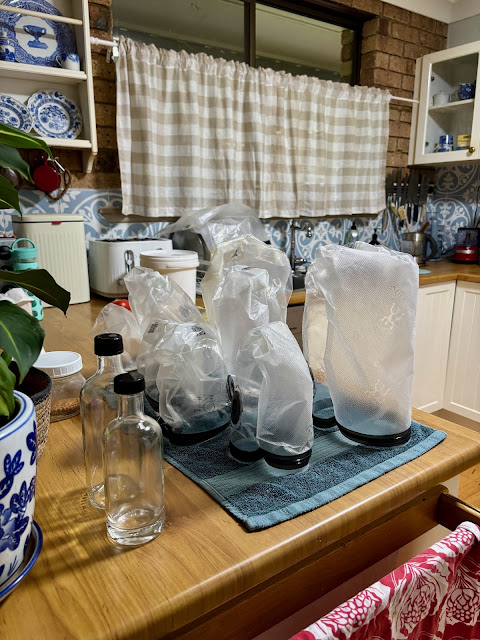
Every morning when I walk into my kitchen it looks tidy and ready for a day's work. Not so on this morning (above), I saw this when I walked in. Late the previous afternoon when I was looking for something, I came across my rolled up Zwilling vacuum bags and decided they had to be washed and dried. So I did that and although I usually put them outside on the verandah to dry it was dark by then. I turned the just-washed bags inside out and left them like this on a towel. It worked well and now the bags are ready to use when I bring home root vegetables, cabbages or whatever I buy that I want to last four or five weeks.
Image

You’ll save money by going back to basics

When I was doing the workshops and solo sessions, I had a couple of people whose main focus was on creating the fastest way to set up a simple life. You can't create a simple life fast, it's the opposite of that It's not one single thing either - it's a number of smaller, simpler activities that combine to create a life that reflects your values; and that takes a long to come together. When I first started living simply I took an entire year to work out our food - buying it, storing it, cooking it, preserving, baking, freezing, and growing it in the backyard. This is change that will transform how you live and it can't be rushed.  
Image


Trending Articles

NOT the last post

This will be my last post here.  I've been writing my blog for 18 years and now is the time to step back. I’ve stopped writing the blog and come back a couple of times because so many people wanted it, but that won’t happen again, I won’t be back.  I’ll continue on instagram to remain connected but I don’t know how frequent that will be. I know some of you will be interested to know the blog's statistics. 
Image

Every morning at home

Every morning when I walk into my kitchen it looks tidy and ready for a day's work. Not so on this morning (above), I saw this when I walked in. Late the previous afternoon when I was looking for something, I came across my rolled up Zwilling vacuum bags and decided they had to be washed and dried. So I did that and although I usually put them outside on the verandah to dry it was dark by then. I turned the just-washed bags inside out and left them like this on a towel. It worked well and now the bags are ready to use when I bring home root vegetables, cabbages or whatever I buy that I want to last four or five weeks.
Image

You’ll save money by going back to basics

When I was doing the workshops and solo sessions, I had a couple of people whose main focus was on creating the fastest way to set up a simple life. You can't create a simple life fast, it's the opposite of that It's not one single thing either - it's a number of smaller, simpler activities that combine to create a life that reflects your values; and that takes a long to come together. When I first started living simply I took an entire year to work out our food - buying it, storing it, cooking it, preserving, baking, freezing, and growing it in the backyard. This is change that will transform how you live and it can't be rushed.  
Image

Creating a home you'll love forever

Living simply is the answer to just about everything. It reduces the cost of living; it keeps you focused on being careful with resources such as water and electricity; it reminds you to not waste food; it encourages you to store food so you don't waste it and doing all those things brings routine and rhythm to your daily life. Consciously connecting every day with the activities and tasks that create simple life reminds you to look for the meaning and beauty that normal daily life holds.  It's all there in your home if you look for it. Seemingly mundane tasks like cleaning and cooking help you with that connection for without those tasks, the home you want to live in won't exist in the way you want it to.  Creating a home you love will make you happy and satisfied.
Image

Time changes everything

I've been spending time in the backyard lately creating a contained herb and vegetable garden. My aim is to develop a comfortable place to spend time, relax, increase biodiversity and encourage more animals, birds and insects to live here or visit. Of course I'd prefer my old garden which was put together by Hanno with ease and German precision. Together, we created a space bursting at the seams with herbs, vegetables and fruity goodness ready to eat and share throughout the year. But time changes everything. What I'm planning on doing now, is a brilliant opportunity for an almost 80 year old with balance issues. In my new garden I'll be able to do a wide range of challenging or easy work, depending on how I feel each day. It’s a daily opportunity to push myself or sit back, watch what's happening around me and be captivated by memories or the scope of what's yet to come.
Image

It's the old ways I love the most

I'm a practical woman who lives in a 1980’s brick slab house. There are verandahs front and back so I have places to sit outside when it's hot or cold. Those verandahs tend to make the house darker than it would be but they're been a great investment over time because they made the house more liveable. My home is not a romantic cottage, nor a minimalist modern home, it's a 1980’s brick slab house. And yet when people visit me here they tell me how warm and cosy my home is and that they feel comforted by being here. I've thought about that over the years and I'm convinced now that the style of a home isn't what appeals to people. What they love is the feeling within that home and whether it's nurturing the people who live there.
Image

Making ginger beer from scratch

We had a nice supply of ginger beer going over Christmas. It's a delicious soft drink for young and old, although there is an alcoholic version that can be made with a slight variation on the recipe. Ginger beer is a naturally fermented drink that is easy to make - with ginger beer you make a starter called a ginger beer plant and after it has fermented, you add that to sweet water and lemon juice. Like sourdough, it must ferment to give it that sharp fizz. To make a ginger beer plant you'll need ginger - either the powdered dry variety or fresh ginger, sugar, rainwater or tap water that has stood for 24 hours to allow the chlorine to evaporate off. You'll also need clean plastic bottles that have been scrubbed with soap, hot water and a bottle brush and then rinsed with hot water. I never sterilise my bottles and I haven't had any problems. If you intend to keep the ginger beer for a long time, I'd suggest you sterilise your bottles. MAKING THE STARTER In a...
Image

An authentic look at daily life here — unstaged and real

Most days Hanno was outside happily working in the fresh air. It may surprise you to know that I started reading my book,  Down to Earth , yesterday - the first time since I wrote it 13 years ago.  I had lent it to my neighbor, and when she returned it, I started reading, expecting to find surprises. Instead, I realised the words were still familiar—as if they were etched into my memory. As I flipped through the pages, I was reminded of how important it was for me to share that knowledge with others. The principles in Down to Earth changed my life, and I truly believed they could do the same for others. After just 30 minutes of reading, I put the book down, reassured that its message still holds true: we can slow down and reshape our lives, one step at a time.
Image