down to earth

  • Home
  • About Us
  • Down To Earth Book
  • Privacy Policy


Good morning from Lulubelle and Martha!
Clicking on the photos will enlarge them.


This first bare patch is being prepare for potatoes.

When I had a look back on yesterday's post I realised it doesn't give a true picture of our garden at the moment. I showed only the bits with plants growing and most of the garden is empty right now. So here it is from both angles, so you see for yourself that abundance is worked for and in every garden there are periods of standing still.

In the photo above you can see the garden from one angle, in the photo below it's from the opposite angle. Note the black plastic compost bin, you can see it in both photos. Please excuse the washing LOL!


Our garden is fenced off from the chickens, although we do let all of them in there at certain times of the year. We set the garden up next to the chook house because we feed the chooks from the garden every day and didn't want to walk too far to do that.


I'll try to answer some of the questions in yesterday's comments. Emma, tomatoes stop setting their flowers in high temperatures, and by that I mean the flowers stop turning into tomatoes. I think the cut-off point is around 35 C. So if you're planting tomatoes and the weather is very hot, don't expect them to give too many tomatoes.

Kristi, we have problems with things like pumpkins, grapes, melons etc in the high humidity. We've been experimenting lately and found that a dose of copper oxychloride or copper hydroxide (it's organic) when planting helps quite a bit. Don't over do it though as copper stays in the soil for a long time.

Melanie, how exciting! I hope the house offer is accepted and you get your garden.

Donetta, we always ripen our tomatoes off the vine. We wait till they're a good size, pick them, and put them in an open bowl on the kitchen bench. They ripen beautifully.


Nikowa, we have a very unorthodox way of planting. We decide where to put the potatoes and everything else gets put in wherever we have room. We do a big planting in March, then as we eat our way through the produce, we have little patches that we fill in with whatever we need to grow or whatever has just come into season. The only problems we have when doing this is with tomatoes. We sometimes get wilt if we plant the tomatoes in any area the tomato family (potatoes, eggplant, peppers etc) has recently been planted in. However, the addition of a lot of new compost and old chicken manure, mixed, often lets us get away with it. Here is some information about crop rotation, and here.

Monkey Funk, you just want the beds raised slightly to give that extra help with drainage. We have clay soil here and needed to raise our beds but we've had this garden in for almost 11 years now and we've never had any problems. Over the years, the addition of lots of compost, manure and decomposed straw mulch has given us perfect soil.

kmaree warren, I'm sorry to hear about that storm wrecking your garden. Can you rig up something to protect your new seedlings? Maybe a small shade tunnel? Jerry Colby from Gardening Australia talked about protecting plants by surrounding them with hay bales recently. Maybe you could try that. Jerry's home is in Brisbane and he has a very good blog, you might find some good ideas here.

As a gardener, you need to think about how to modify the conditions in your garden to prevent loss of valuable growing time. Shade cloth structures, cloth and glass cloches, hay bales, bamboo poles with cloth skirts are all ways of protecting plants that don't cost a lot but do help. I'll post about these later.

Christine, one pineapple per plant. When we harvest THE pineapple, we'll pull that plant out.

Tricia and Dani with empty water tanks, I hope you get rain soon. Hanno will be doing a post about small water tanks soon. Maybe you could look at adding another small tank. It's such a worry, isn't it.

Good luck with the luffas, Laurie.

Joyceann, Dani, Mindy, and everyone wondering about the upturned pots - traditionally, upturned pots on top of garden stakes are used to stop people taking out an eye with a stake they don't see as they bend down. We use ours for that but I also love the look of them. Yes, it's a bit of whimsy and adds interest to the garden.

Mindy, I haven't hear of the Abraham Lincoln tomatoes. What are they like?

Sandra, I'll write about soil preparation in the next week or so.

I want to give my friend Lyn Bagnall a plug. Lyn wrote the best book on Australian vegetable gardening that I've ever read. It's called Easy Organic Gardening and Moon Planting and you can buy the book on her blog. Lyn's blog is well worth a visit, there is a lot of information about vegetable gardening there and she will answer questions. Lyn owns a small organic farm in NSW.

Happy gardening everyone!


Clicking on the photos will enlarge them.

It may seem strange to our northern hemisphere gardeners, and even to some in southern Australia, but summer is a time of low production in our garden. In fact, it's our worst time. This summer is fairly mild and we've only had a few very hot days so we have kept the lettuce going. That is usually the first to turn to seed. In the photo above you can see one small garden full of wax beans, bok choi, cucumbers, green onions, parsley, oregano, marjoram and yarrow. Almost everything else has been eaten and it's too early to plant our main crop.


Hanno decided to put up one of his shade tunnels to protect the seedling lettuce, silverbeet (chard) and cucumber. This is a very good protection from the sun and the heavy rain we get at this time of the year. November to March is our storm season and we can expect anything from hail to strong winds at any period in those months. Generally the storms will be on the afternoon of a hot day. The heat builds up during the day and in the afternoon, the thunder and lightning rolls in, we get torrential rain for 30 minutes, then all is quiet, and cooler.


Hanno has planted the cucumbers at the entrances to the tunnel to entice the bees to pollinate. Just behind the shade tunnel, on the other side, bush beans have been planted. The shade tunnels just slide over some small star pickets so they're easy to put up and remove.


The metal cucumber trellis at both ends are recycled greeting card holders from our shop. In fact, many materials we use in the garden are off cuts or someone else's throw aways.


Here, and in the top photo, we have more recycled metal in the form of concrete reinforcing steel that Hanno has secured with a metal star peg for the cucumbers to climb up. Garden construction can be very simple indeed.

We had to buy fruit and vegetables from the market this week. We've still got a couple of our own tomatoes but we bought a bag of tomatoes, some peaches, pineapples, bananas (ours are not ripe yet), onions, cucumbers, celery, garlic and carrots. I'm looking forward to our major planting in March, because soon after that we'll have vegetables galore in our backyard again. I'll start sowing some of our seeds at the end of January and take a lot of photos so it can be a subject of discussion at our kitchen table.


And for those of you who said you've missed seeing the chickens, I haven't taken any photos since this one just before Christmas.


And for good measure, THE pineapple as of yesterday afternoon. It's reached a nice size but it's not ripe yet. I'm going to give it another three weeks. I have four other pineapple tops to plant our when this one is ready. We'll be planting them in the front garden this year so they don't hold up vegetable production during their two year growth period.

As we are looking forward to March, I'm sure many other gardeners are too. And I know you'll all be looking through your seed catalogues and probably putting your orders in. The planning of a garden is such a joy. I hope there are many new gardeners this year. Don't worry that you have no experience, if you have some space, you are half way there. I'm sure we'll have a lot of gardening discussions around the kitchen table during the year, so if your inexperience is stopping you, don't let it. Work out what you want to plant - and don't go overboard in the first year, and I'm sure we can get you through it.

Just before I go, I'd like to point you in the direction of the long thread, the most wonderful craft blog. Today Ellen has listed 100 tutorial posts from all over the web - all from 2008. I've looked at some of them and I just know the entire list will be fabulous. While you're there, if you have small children, take a look at yesterday's post on the tooth fairy cushion. It's so cute. : - )


Regular readers will probably be pleased to know the white Christmas tablecloth is washed and back in the cupboard. ; - )

No one will hand you the life you want to live on a silver platter. The only life that is there for the taking, without modifications, is today's "normal" life of spending, debt, credit cards and never ending work to pay the bills. Most people, including me, usually fall for that one. A simple life needs work and requires that you step up and build, for yourself, the life you want. And because it is self made, simple lives are always slightly different to each other - anything home made and one of a kind is like that; it's one of the many charms of the unique when you don't settle for mass production.

When I envisioned what I wanted my life to become, I wanted to be as independent as possible from the shops and provide as much as I could from my own home. To do that I undertook a period of solo reskilling, usually with my friends telling me I'd gone a bit loopy. They didn't understand the need for sourdough, or any other kind of home baked bread, when there was plenty of bread available for the taking at the supermarket. They didn't understand making soap or jam or cordials or growing food and preserving it. They only started to understand when they were invited around and were delighted by the taste and freshness of what I served them.

When I stopped using cleaning products and started using vinegar, bicarb and washing soda, they really thought I'd lost it. I didn't care. I was on a roll by then, I knew what I was doing was good for us and saving a lot of money. I also started feeling pleased with the progress we'd made and that I didn't have to run to the shop for everything. As the months progressed into years, I could quite easily produce most of what we needed here in my home. It felt good and it inspired me on to keep going.

But a simple life can be many things. It doesn't have to include gardening, sewing or baking, there are many ways to build a simple life that suits you exactly. That is one of the benefits of it, you build the life you want to live.

Inspiration is a wonderful thing. You get it from your successes and by seeing other people work towards the same goals you have set for yourself. There will always be naysayers around and people who don't want you to change or succeed. Never listen to them, listen to your heart instead, it will keep you true to your purpose. I hope the biggest kitchen table will provide the inspiration and knowledge you need to take that next step, whether it be the first one in your simple life, or one much further down the track.

Linda, I think the gardening posts will work because gardening is the same world-wide. Yes, the severity of our seasons is different, but we will have many northern hemisphere gardeners taking part and I'm sure they'll fill in any gaps in my knowledge. And I will encourage them, and all others, to post about what works for them.

There is the facility in Blogger to disallow anonymous comments and after some recent anonymous comments I was tempted to use it. However, I am aware there are many people who read here who do not have a blog, nor do they want one. I am also aware that some people with blogs hide under 'anonymous' when they want to criticise. I have enabled comment moderation, and will keep it on from now on, but out of courtesy to me and to the other readers here, when you comment as anonymous, please add you name to the end of the comment so we have a rough idea of who you are. Thank you.

And now, with that unpleasantness out of the way, let's all work towards a better life for ourselves and our families. We have some wonderful people reading here and I know the biggest table will be a great way for us to share our knowledge, to support one another and to encourage all of us to live to our true potential.


I've had a very relaxed time since Christmas day just lounging around, knitting, watching cricket and thinking. I sometimes wish my brain would take a holiday but it keep churning out thoughts for me to reflect on. Oh well, it's better than the alternative. In the midst of a knitting frenzy yesterday, just after Ricky Ponting's duck (!), which is a cricket term for zero score, I started hatching this plan.

I've said previously that I wish I could wander into your homes and talk to you about various things; sometimes I have long and involved emails conversations with you; some of you have said you'd like me as a neighbour, a mum or a grandma. I remember those times when families and friends sat around the kitchen table discussing problems and learning how to do various things. I started thinking about how that dynamic could be replicated here, where we could all share our experiences and skills and pass that knowledge on to the younger and more inexperienced folk.

Despite what you read and see in the media, us older people aren't sitting around twiddling our thumbs. We are doing what we've done most of our lives - we're living each day, learning what we can learn, and passing on what we know to those who want to learn it too. I am over 60. I don't feel that age, in fact I don't feel any particular age, and yet when I look at my hands and face they tell me that much time has passed by. Happily, over those many years I've built up a collection of information that isn't always valued by our society but I think is worthwhile repeating. It's mainly the practical stuff that most lives are built upon. A lot of it has already been written about here, however, I intend to revisit topics like bread and soap making, preserving/canning, food storage, budgeting and stockpiling, composting, what to expect when you buy your first chickens and how to care for them, growing from seeds, how to build a garden from scratch, how to cook from scratch, how to develop flavour in food without adding anything artificial, the value of productive work, developing satisfaction in being a homemaker and other things as they cross my mind. I've talked to Hanno about this and he said he'd help me with some posts on outdoor chores and maintenance - how to attach a rain barrel to your house, cleaning out a water tank, simple car and lawn mower maintenance and whatever other things he thinks of.

I will write on these subjects and add photos for tutorials, then it's over to you to take up whatever is of interest to you and carry out your version of it in your own home, and post about it too. Add your photos so we can all see what you've done, if you've improved on what I did, or made a mistake. I'll link to everyone who takes part, you link back to every one in the group and we will create the world's largest metaphorical kitchen table, all discussing the one subject and how we all do it. I think it will be a great way for us all to expand our ways of doing things at their best The novices will learn from a range of different people, the more experienced will share their knowledge and, hopefully, improve on what they're already doing.

At the moment I'm thinking I'll do that post on a Friday, maybe once a month (or fortnight) to start, so you have the time over the weekend to add your post. Monday I can answer questions and link to whomever has joined in. So what do you think? Is it a good idea? I hope it's a way to share the knowledge we all need to live simple enriched lives, it's a way to more independence and it's a way to forge friendships and make a community around a very big (virtual) kitchen table.

It's been a lazy time for me this past week. I haven't made any bread or swept the floor for a few days. There are little balls of dog fur under the kitchen table. : - ) The weather's been hot and humid and I'm listening to my head when it tells me to take it easy. It's going to be a very busy year for me so I'm taking advantage of these slow summer days and you know what? I feel no guilt, I'm happy to tell you about my dirty floor, and I might even take it easy again today.

I do have to do some washing today. I've had my white cotton table cloth, used on Christmas day, soaking in a bucket of oxy-bleach water. It's time to wash it and hang it out to dry. It's been in the bucket for a week, another sign of this deliberate, delightful laziness.

As a writer I sometimes find things that I wish I'd written. Many of you, like myself, are admirers of Jewels and read each posts as soon as it's there. Of all the things Jewels has written about that beautiful life of hers, this paragraph is the one I admire the most, the one I keep returning to, and the one I wish I'd written:

"I hope your day is beautiful. Hold your children, your husband, those you love and care for, tenderly, close. Kiss them and hug them. Smile often-- a soft, bright, loving, accepting, approving, smile. Be thankful for those you love, and be sure and express your pleasure with them, to them--through words, through your touch, so they know what your heart holds, towards them. Sincerely praise for even the smallest things that are praise-worthy, and with eyes open wide, take note of, and be thankful for, each kindness shown to you. Life is fleeting, and the only moments we can be entirely sure of, are those that we're presently in, right here, right now. Let us live our lives deliberately, purposefully, making every one of those precious fleeting moments matter, for now, and for eternity, in our life and in the lives of those we love."

I feel those words right down to my bones, I hope you do too and I hope your day today is beautiful.

Although I've been deliberately lazy these past few days, I'm still working on my book and will continue to do that for months yet. It is just those chores in my home that are being put aside until I feel like doing them, or I am forced into action for fear of mildew - as in the case of the white tablecloth.

Another delicious part of my day today will be to finish off a book my friend Sharon sent as a surprise Christmas gift. It arrived new year's eve, quite out of the blue, there is was - Little Heathens by Mildred Armstrong Kalis. I'd hadn't heard of the book before I laid eyes on it but it's such a charming, well written account of growing up on a farm during the Great Depression, I'm sure it will remain one of my favourite books and will be reread over and over again. Thank you Sharon and Claude.

There are few pleasures I enjoy more than that moment I realise the book I've just started reading it something really special. That moment came to me on new year's eve. I'd just had a cool shower, was reclining on the bed in my white cotton nightie, the fan was buzzing overhead and I was surrounded by a half moon of pillows. Sheer luxury! After the first couple of pages I recognised the beauty of Little Heathens and was beginning to see glimpses of the familiar in it. I could see my own mother, and myself, in her mother, and reading through those pages made me realise that even though we were on different sides of the world and were not the same age, we had a similar childhood growing up in working class families in those long ago, hard, but simple, times. One of the themes of the book is hard times build character. I firmly agree with that and while I don't see myself as living in hard times now - even though I am - I see instead that I am what I am because of my childhood, those parts of it I choose to remember and those parts I choose to forget.

Little Heathens is one of those books you read slowly because you don't want it to end, I will finish it today but keep it in my knitting basket to browse through when I remember favourite parts of it over the next week or two. And one of the enduring memories I'll have of this lazy summer will be reading that book on a hot summer night, with my ceiling fan buzzing and smiling when I read "... the Urmys [her family] could easily have served as models for the source of H.L. Menchen's definition of Puritanism as 'the haunting fear that someone, somewhere, may be happy.' ... " : - )


Happy New Year!

Last year was such an exciting time for me. This blog developed beyond my wildest dreams and as I saw more of you trickle in, I realised what a powerful tool the internet is. Just think, anyone of us with a blog has the potential to reach thousands of people with the press of a button. I want to thank you for the support you've given over this past year and for the wise and interesting comments you left. It is my privilege to go into this newest of years with you at my side. I think we'll discover many more things to interest us and help us live to our full potential.

Thank you also for adding my feed to your readers, for reviewing me on blogged, for linking to me, or whatever you did, and for just being so willing to help.

I have been asked by a couple of people in the past week to talk more about my home management journal. I have written about this in the past but it's an ever evolving thing, always taking me to new places, recording different things and it deserves another outing.


When I first started living as I do now it took me a very short time to realise that unless I organised myself and recorded all the new things I was hoping to do, I would sink like a stone without a hope. Enter my notebook. It was my first journal. But less than a week into it, I knew I had to find another way. Some of the things I started doing, I didn't continue with, or changed a lot, and my notebook was turning into a real mess. So I grabbed an old ring binder I had here and started punching holes in sheets to enter then into the binder. I also added a few plastic envelopes. I had these left over from my old office, I would never have bought more plastic. Anyhow, the envelopes have proved to be very handy to hold smaller bits of paper like receipts and old seed packages.

Your home management journal will hold the written information you need to run your home efficiently. It will change as you progress and you might update it quite often. That is good! It shows you're changing and thinking about your changes as you go. All our journals will be different because, ideally, they'll reflect the stage of life we're at, the way we live, the number of people in our family and all the hopes and plans we have for the future. Include computer printouts as well as your hand written notes, receipts, meters readings and contacts lists.


Here is a list of what I have in my journal and what you might have in yours. Remember though, make your journal suit your life, and don't be tied down to a list.

If you have a statement about what you want your life to be, how you hope to change, or your dreams for the new year, this should be the first thing in your journal so you see it all the time. After that, any written statement that inspires you. I have this in mine, it's from Walden by Henry David Thoreau:

"I went to the woods because I wished to live deliberately, to front only the essential facts of life, and see if I could not learn what it had to teach, and not, when I came to die, discover that I had not lived. I did not wish to live what was not life, living is so dear; nor did I wish to practise resignation, unless it was quite necessary. I wanted to live deep and suck out all the marrow of life, to live so sturdily and Spartan-like as to put to rout all that was not life, to cut a broad swath and shave close, to drive life into a corner, and reduce it to its lowest terms, and, if it proved to be mean, why then to get the whole and genuine meanness of it, and publish its meanness to the world; or if it were sublime, to know it by experience ..."

Good eh? It takes my breath away whenever I read that. So, on to the list...

FOOD
Recipes - main meals, jams and spreads, bread, sourdough starters etc.
Preserving/canning recipes and when you put up your jams and preserves.
A table of volume, weights and temperature conversions.

GARDEN and PETS/ANIMALS
Seed catalogues.
Fruit and nut tree catalogues.
Your garden plan.
Ideas for the next planting season.
Moon planting calendar.
Record of planting - fruit trees and vines, vegetables etc.
Record of rainfall
A record of your vegetable and fruit harvests.
Number of eggs collected.
List of hen's names and when they were added to the flock.
Livestock vaccinations.
Reminders for tick and flea treatments.

HOME
Your budget.
If you have a price book, that can go into a plastic pouch next to your budget so you'll always know where it is when you go shopping.
Grocery flyers and coupons.
This year's calender - with room to record various important events like birthdays, anniversaries and graduations.
Current bills that need paying, as well as older bills you want to compare with the next bill that comes - like water, gas, phone and electricity bills.
Recipes - green cleaners.
Ideas for gifts.
Knitting and crochet patterns.
List of knitting abbreviations.
School newsletters and info about school
In your plastic pouches - letters and cards received, seed packages, receipts.
Any ideas you're currently working on, written out or mapped.
Meters readings for water or electricity.
Cost estimates for future projects.
Emergency phone list - doctor, hospital, ambulance, police etc
The name and contact details of your local politicians and councillors.

As you can see, your home management journal can hold whatever you need to run your home efficiently. Your journal will document not only your transition to a simpler life, it will also record your history, and as you look back through it, you will see for yourself just how far you've come.


I was shocked to see a Labor Party politician on the TV news yesterday say that now we've had our retail therapy over Christmas (his words, not mine) we should all go off and book a holiday. I won't be taking his advice, I, instead, thought of how sad it is when people bend and compromise their values for the sake of power. Despite what our politicians tell us, now is not the time to spend. We should all be in squirrel mode with our stockpile of food and some cash savings firmly packed away ready to help us out a bit further down the track.

We're being told that the coming 12 months will be very difficult for the average family. Apparently jobs will be lost, homes will be repossessed and businesses will close. I really feel for anyone who will suffer over this period of time but instead of just doing that, let's try to make the best of it. There are ways to prepare your family for hard times so let's get to it. You have to start NOW - today. The earlier you start with this, the better prepared you'll be.


How quickly you prepare really depends on how much money you have available. If you're like many families now you'll have a limited amount of money that has to cover many different areas. I want you to sit down with your partner and work out a plan. Of course, no one can predict what will happen. There will be some people who feel very secure in their job who will lose it, and others who think they're on the edge and will sail through the year. But everyone needs to prepare because no one knows who will be effected or how bad it will get.

I wrote yesterday that your priorities are to keep your home, feed your family and keep paying off your debts. That applies here too. If you can do those three things and come out of this at the other end, it doesn't matter if you didn't have cable TV for a year or those shoes you like went in and out of fashion without you buying them. When it comes down to it, the frills don't matter and you might discover that living on less is really a great way to live.

But first things first. You need to track your money to see where it's going. My post on that is here. It will take a month of tracking to discover your spending patterns so start that today. Each partner should have a little notebook to record every cent of spending.

And then go through what I listed yesterday. See if you can get cheaper rates for the bills you pay like your phone, internet, insurance etc. Check every bill that comes in to make sure you haven't been overcharged. If you haven't been saving, now is the time to get some money into a savings account. After you've tracked your money you'll probably find some money leaks that you can stop. If you come home with some change in your pocket or purse, grab a jar and put the change in the jar. Start saving your change. A small step, but it will add up over time.

Try to save a small emergency fund so that if something happens during the year, you'll have the cash to pay for it and don't have to put more debt on your credit cards. About $500 would be a good amount to aim for, but that might be too much for some families. Just save as much as you can and set it aside for an emergency. Believe me, it will make you feel better knowing you have that buffer there.

If possible, pay a bit more on your regular mortgage payment, or change from monthly payments to fortnightly. If you can do that while things are still going well, IF your circumstances change, you'll be better off. Stop using your credit cards, pay for everything in cash but continue to pay off your credit cards. Now is not the time to spend. If you can, live off one income and use the second income for the emergency fund and for debt payments.


If you haven't started a stockpile yet, now is the ideal time to do it. My posts on how to build a stockpile are here and here. Southhavenjen and Tracy asked in the comments yesterday about Aldi food miles. This will vary in most countries, what happens here will be different to what happens in the UK or USA. I deal with that like this: we buy mainly Australian products at Aldi. The exceptions being tinned salmon from Alaska and Italian parmesan cheese. We buy the rest of our products from our local IGA (independent grocer) and our bulk food store. We haven't shopped at Woolworths or Coles (our main supermarkets) for many years now but I'm told by my friends that they are stocking a lot of imported foods now. I wholeheartedly agree with Tracy's comment about not buying imported products and I have written in the past about how we should be building our own clothing, shoe and whitegoods factories and not sending our money overseas. But I believe, at least here in my state, that you can buy a lot of your groceries at Aldi, as long as you take the time to pick and choose local products.

So, the important points today are to:
  • stop spending on non-essentials,
  • track you money,
  • start saving an emergency fund,
  • increase payments on your mortgage and credit card debts,
  • start a grocery stock pile.
Most of you know that Hanno and I have no debt. We are currently living on $300 a week, and we save $100 a week into a savings account. That $300 allows us to live well, we have private health insurance and generally we are able to do what we want to do. I guess people might think of us as poor, but that doesn't worry us. We live according to our values, we can do whatever we want to most days and we have the kind of productive work here at home that makes each day feel worthwhile.

What I'm trying to say is that cutting back and living through tough times isn't all bad. It can be the start of a new way of living for you. You can gain great satisfaction out of providing for your family by changing how you save, shop and cook. I am old enough to remember when everyone lived as Hanno and I live now. The past 50 years has brought us some wonderful things, but it's also taken so much away. So don't worry if you feel you're getting back to the way your granny lived, I'm here to tell you you will gain a lot from those old ways of doing things and you'll save money in the process.


It was a strange Christmas in Australia. The expected shopping downturn didn't happen and people kept spending just like they always do. I know in the UK, in Europe and the US, Christmas sales were down, which I believe is a truer reflection of the economic situation than what we saw here in Australia. From what I read and see on the TV news and from what I see at my job, 2009 will be a tough year for many people.

There are predictions of job loses, hundred of thousands of them, as many countries go into recession. That will mean families who currently live quite well on two incomes will have to change and survive on one income. So what do you do if you need two incomes to survive and one of you loses your job?


Your main goal is to keep your home, feed your family and pay off your debt. It won't be easy, but you'll learn a lot and grow strong because of it.

When I closed my business down I didn't know if I could keep us going on what Hanno was earning but I was sure going to give it a try. We had already paid off our mortgage but we had a small amount of debt on our credit cards. I have to tell you now that my decision to close my business, although we were walking in unknown territory and had absolutely no clue about what would happen, was one of the best decisions of my life. It pushed us toward this beautiful life we now live. You may find you thrive living with less. So keep an open mind and remember it's not the end of the world. What I'm writing here is what worked for us, and still works for us now.
  • Start tracking your money so you know what you both spend. I have written about it here. Start that immediately because it will take you a month to know where you money is going.
  • Sit down with your partner and work out a plan. Both of you need to be working towards the same goal. Financial problems can break marriages apart, you'll have to talk to each other and stay strong. Promise each other that you won't use your credit cards. When you get through this, you'll be a stronger couple for it.
  • If you have children, depending on their ages, explain the situation to them. Work out ways they can help cut costs. The loss of income will effect them too, so respect them enough to talk it over with them and see what they can do to help.
  • You must continue paying off your debts but if this becomes difficult, go to your bank and talk about what you can do. There will be solutions, many other couples will be in the same predicament and your bank may already have programs up and running. Talk to your bank, don't hide, that will just get you in trouble.
  • Make up a budget, both of you, sit down and expect to take a couple of hours doing it. There are many posts on budgeting here. This will be your working plan for the coming months; both of you need to contribute to it, both of you need to know what it is. What you're hoping for with your budget is to cover all your expenses and have a bit of money left over. That's probably not going to happen so you'll have to cut your cost of living.
  • Get rid of everything that is not essential. Cable TV, phones, eating out, convenience food, downloading music and movies. If you have a second car, sell it. Be strong.
  • And keep talking to each other. Tough times bind people together. You will see each other's strengths and help each other with your weaknesses.
  • Have a look at all the accounts you have and try to get better deals on your phone, Internet, insurance etc.
  • Check every bank and credit card statement that comes in. Banks make mistakes, so make sure they haven't overcharged you.
  • You will both have distinctive roles to play. The person who goes out to work must take lunch, coffee and snacks from home. That person must not spend anything while they're at work, no matter how tempting the coffee smells that your colleague is drinking, don't buy one for yourself. That magazine only costs a few dollars, but you still can't buy it. Every cent counts.
  • The person staying at home has a very important job. It is their job to save as much money as possible at home. Check what food you have on hand. Are you a good cook? If you aren't, now is the time you'll learn. When I came back to my home I took great pride in being able to lay our table with tasty nutritious food that cost a fraction of what we used to spend. It can be done. There are many frugal recipes on my blog and millions of them online. Start looking for those you know your family will enjoy.
  • Make up a menuplan.
  • Get the flyers and work out the best place to shop. If you have an Aldi nearby that will probably be the cheapest supermarket. Don't reply on supermarkets for your fruit, vegetables and meat. Often the green grocer and butcher will have better prices. Check out all your options.

  • Stop buying chemical cleaners, it's much cheaper cleaning with vinegar, borax, washing soda and bicarb. Recipes for cleaners are here on my blog.
  • Try to cut down on the number of times you go out. Can you set up a car pool to get the children to school? Shop once a week, but try to go two weeks without grocery shopping. When you are out, do everything you need to do, like go to the library, post office, doctor, or whatever.
  • Learn how to read your electricity and water meters and use them to help you cut down your usage.
  • If you have the space, plant vegetables.
  • Learn how to make bread. Not only will your bread be healthier, it will be cheaper.
  • Forget brand loyalty and buying something because you always buy it. Buy generic brands, buy in bulk, buy whole foods. Find a farmer's market nearby and check out their fresh produce.


  • Organise yourself. Make up a home management journal where you keep all your new information.
  • Don't waste anything.
  • Rediscover your library. If it's been a while, you'll find a nice variety of media available like books, DVDs, comics, magazines, talking books, the internet, games and music CDs. This will provide you with some cheap entertainment.

I know my frugal friends here will have great tips to add to this, so come back later and read the comments too, they'll also help.

Tomorrow I'll write about preparing for the recession.

ADDITIONAL READING
Where to buy Australia's cheapest groceries

Household survival tips - part 1
Household survival tips - part 2
Recipes and meal plans from Aldi products
What does cooking on a budget mean?

How to eat organic on the cheap (USA)
Saving at the Supermarket
Frugal Food - UK


Hanno and Kerry cooking up a storm.

Voluntary work is a big part of my life now that I have the time for it. I am the co-ordinator of my local neighbourhood centre where a bunch of us volunteers work for the disadvantaged and homeless, and to provide information about various government agencies and helping hand organisations to people in our community. We also have a permaculture garden that supplements the food staples we give those who need them. I teach budgeting there, we have a sewing circle and a new knitters group and we have just partnered with our local relocalisation group to provide life skills workshops for our community. We'll teach things like vegetable and fruit gardening, worm farming, bamboo construction, bread and jam making, preserving and dehydrating and a lot more.


One of the seasonal things we do is to provide Christmas breakfast for our community. It's the one day we don't focus solely on our disadvantaged folk but instead invite our community to come together for one special meal - Christmas day breakfast. It is such a great event and all morning I meet with people happy to be there and who want to help in some way. Honestly, we had more people asking if they could help that I ever imagined. In the end, I'd say half the people who wanted to help, couldn't, and had to be content having a freshly cooked free breakfast in the warm sunshine.


Almost all the food we consumed was donated by local businesses - we had locally made yoghurt from our cheese maker and fresh milk from our local dairy, the egg farm gave us hundreds of eggs, the local butchers gave sausages and bacon. Restaurants gave juice and mushrooms, the green grocer gave fresh fruit and the local food co-op gave organic muesli. It was a feast! And it was all enjoyed by everyone who came along. Our disadvantaged folk mingled with those we didn't know so well, and most filled their bellies up and helped clean up. We catered for 500 and ran out of hot food, but we still had organic muesli, yoghurt, fresh fruit, tea and coffee to offer.

We had a couple of raffles and our donations tins ran hot. When I came home I counted up about $700 that will go towards providing more programs and services next year.


It took about a month to organise our breakfast, I worked closely with my good friend Bernadette and other volunteers, and picking up the donations, transporting it all to the park and co-ordinating the morning was really hard work. But oh the payoff. When I came home from that breakfast I was as full of the Christmas spirit as I could possibly be. I didn't have any breakfast apart from a wedge of watermelon because I was too busy talking with people who wanted to thank us for the breakfast and those who wanted to help. Representatives of our local churches came over and said hello and thanks, and a couple of people from the RSL (Returned Servicemen's League), Lions and Apex talked about how we could all help each other during the year. An older man said: "Mrs Hetzel, I'm pleased to see you have food covers this year." LOL (Our sewing circle made us net food covers.) Kids kept asking when Santa would arrive - he came on his Harley. There were people everywhere and they met people they didn't know before. It looked like everyone enjoyed themselves. I know I did.

I was really pleased that both my sons came to the breakfast. They saw for themselves that Christmas is really about giving of yourself, and that generosity is its own reward. And that's a fine thing to be reminded of in these times of crass consumerism, over indulgence and keeping up with the Joneses.


Christmas

I see a twinkle in your eye.
So this shall be my Christmas star
And I will travel to your heart:
The manger where the real things are.

And I will find a mother there
Who holds you gently to her breast;
A father to protect your peace;
And by these things you shall be blessed.

And you will always be reborn;
And I will always see the star
And make the journey to your heart:
The manger where the real things are.

Michael Leunig

I found this Michel Leunig poem on The Duck Herder's blog last Christmas and have read it many times since. It's the perfect poem for the perfect day. Merry Christmas, Duckie.


Yes, I know I said I wouldn't be blogging over Christmas but I just had to tell you this.

I entered a giveaway draw at the lovely blog - the long thread a few days ago and have just been told I won! The giveaway is a pair of beautifully embroidered white linen hand towels. Many of you know I love such very simple linens so I'm really happy to have won them. Thank you Ellen!

If you have some spare time over the holidays, make sure you visit this site because Ellen is a very talented craftswoman and I'm sure she'll inspire some wonderful projects for your home. I have linked to Ellen before but she has much more than the little recycled fabric Christmas trees I showed you previously. Your small children will love the free paper toys she blogged about today.


When I gave up work and returned to my home I promised myself that all the days of multitasking, doing too much in a half-hearted way, and second best were in my past. I decided that I wanted to live deliberately, that the decisions I made would be carried out with care, and from then on, I would do my best, no matter what the task was.

It took a while to get used to that change. I had to slow down and concentrate on what I was doing. I had to focus on one thing at a time and do it to the best of my ability. The pace of my work slowed down and, after a while, so did I. My mind stopped racing and I adopted a slow and mindful approach to everything I did. The strange thing to me was that even though I slowed everything down, I still got my house work done, and I came out the other end of it much more relaxed and pleased with what I achieved. I realised then that putting housework off, or not doing it at all, added to the stress of it. Doing it slowing, one task at a time, gave a rhythm to the day that helped the work flow.

But it wasn't only the housework that I applied this new philosophy to. It was also my relationships with people. I found that when I slowed down and concentrated on the person I was with, it made a difference. When I stopped thinking about what I would do later in the day, or tomorrow, and gave my thoughts as well as my time to the person I was with, I gave more and got a lot more in return. When I gave my best, they gave their best too.

When I started writing this blog I wanted it to be the best. Not the best blog, but the best that I could do. Some days I struggle with what I should write, mainly because I think it's too mundane to be a subject. Some days I use my blog to work out things in my own head - like thinking aloud. Some days the words flow like honey from a honey pot and I have to stop myself for fear of overwhelming you. It's been up and down, but I think I can say that every day I've written here has been the best I could give on that particular day; I have not written half-heartedly.

That has paid off handsomely. I gave my best and got your best in return. Sure, there have been a couple of hiccoughs, but over the year the comments have become a genuine and substantial part of this blog. You give a lot when you comment, it's like a payment for the writing, it not essential but when it happens it rewards me because I know my words are finding you and not just floating out there. That is true of everyone's blog, not just mine.

I am looking forward to Christmas because all my boys will be here, one with his special girl. We are having a family dinner on Christmas Eve with seven of us sitting down to eat, the first time we've all been together for a long, long time. On Christmas morning, we'll all help cook and serve at the free Christmas breakfast I have been organising at work this past month. Last year we served 450 breakfasts, I wonder how many there will be this year. I hope this year will be our best.

This is the last post I'll write for a while because I need to have a break. I'll be enjoying my family, working on my book, watching the cricket, knitting, relaxing and generally getting ready for another good year. A special thank you to Sharon who has been such a help to me throughout the year, both here and at the co-op blog. Thank you for your visits and comments during the year, you have made this blog writing thing a real joy for me. Have a merry Christmas, stay safe and enjoy your holidays. I send you and your family my best.


Newer Posts Older Posts Home

MY BOOKS

MY BOOKS


My books were all published by Pengiun, and are available at Amazon US, Amazon UK and Amazon Au

Search here

Total Pageviews

Translate


I'm Rhonda Hetzel and I've been writing my Down to Earth blog since 2007. Although I write the occasional philosophical post, my main topics include home cooking, happiness and gardening as well as budgeting, baking, ageing, generosity, mending and handmade crafts. I hope you enjoy your time here.

MY FAVOURITE PLACES

  • Grandma Donna's Place
  • Grandma Donna's YouTube
  • Grandma Donna's Instagram
  • This Simple Day
  • Nicole's Instagram

Give More

Give More

Popular posts last year

Making ginger beer from scratch

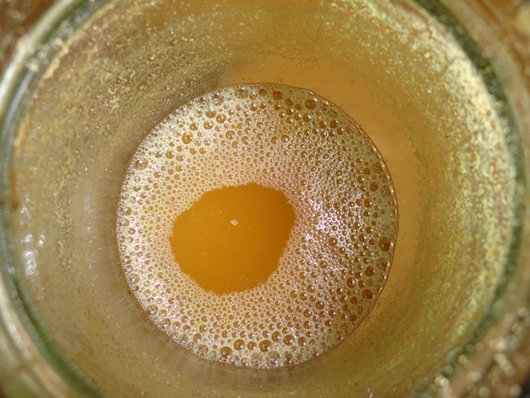
We had a nice supply of ginger beer going over Christmas. It's a delicious soft drink for young and old, although there is an alcoholic version that can be made with a slight variation on the recipe. Ginger beer is a naturally fermented drink that is easy to make - with ginger beer you make a starter called a ginger beer plant and after it has fermented, you add that to sweet water and lemon juice. Like sourdough, it must ferment to give it that sharp fizz. To make a ginger beer plant you'll need ginger - either the powdered dry variety or fresh ginger, sugar, rainwater or tap water that has stood for 24 hours to allow the chlorine to evaporate off. You'll also need clean plastic bottles that have been scrubbed with soap, hot water and a bottle brush and then rinsed with hot water. I never sterilise my bottles and I haven't had any problems. If you intend to keep the ginger beer for a long time, I'd suggest you sterilise your bottles. MAKING THE STARTER In a...
Image

NOT the last post

This will be my last post here.  I've been writing my blog for 18 years and now is the time to step back. I’ve stopped writing the blog and come back a couple of times because so many people wanted it, but that won’t happen again, I won’t be back.  I’ll continue on instagram to remain connected but I don’t know how frequent that will be. I know some of you will be interested to know the blog's statistics. 
Image

How to make cold process soap

I'm sure many of you are wondering: "Why make soap when I can buy it cheaply at the supermarket?" My cold process soap is made with vegetable oils and when it is made and cured, it contains no harsh chemicals or dyes. Often commercial soap is made with tallow (animal fat) and contains synthetic fragrance and dye and retains almost no glycerin. Glycerin is a natural emollient that helps with the lather and moisturises the skin. The makers of commercial soaps extract the glycerin and sell it as a separate product as it's more valuable than the soap. Then they add chemicals to make the soap lather. Crazy. Making your own soap allows you to add whatever you want to add. If you want a plain and pure soap, as I do, you can have that, or you can start with the plain soap and add colour, herbs and fragrance. The choice is yours. I want to add a little about animal and bird fat. I know Kirsty makes her soap with duck fat and I think that's great. I think t...
Image

Preserving food in a traditional way - pickling beetroot

I've had a number of emails from readers who want to start preserving food in jars but don't know where to start or what equipment to buy.  Leading on from yesterday's post, let's just say up front - don't buy any equipment. Once you know what you're doing and that you enjoy preserving, then you can decide whether or not to buy extra equipment. Food is preserved effectively without refrigeration by a variety of different methods. A few of the traditional methods are drying, fermentation, smoking, salting or by adding vinegar and sugar to the food - pickling. This last method is what we're talking about today. Vinegar and sugar are natural preservatives and adding one or both to food sets up an environment that bacteria and yeasts can't grow in. If you make the vinegar and sugar mix palatable, you can put up jars of vegetables or fruit that enhance the flavour of the food and can be stored in a cupboard or fridge for months. Other traditional w...
Image

Cleaning mould from walls and fabrics

With all this rain around we've developed a mould problem in our home. Usually we have the front and back doors open and that good ventilation stops most moulds from establishing. However, with the house locked up for the past week, the high humidity and the rain, mould is now growing on the wooden walls near our front door and on the lower parts of cupboards in the kitchen. Most of us will find mould growing in our homes at some point. Either in the bathroom or, in humid climates, on the walls, like we have now. You'll need a safe and effective remedy at some point, so I hope one of these methods works well for you. Mould is not only ugly to look at, it can cause health problems so if you see mould growing, do something about it straight away. The longer you leave the problem, the harder it will be to get rid of it effectively. If you have asthma or any allergies, you should do this type of cleaning with a face mask on so you don't breathe in any spores. Many peopl...
Image

Five minute bread

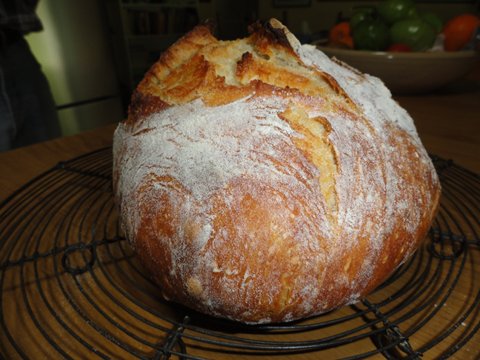
Bread is one of those foods that, when made with your own hands, gives a great deal of satisfaction and delight. It's only flour and water but it symbolises so much. I bake bread most days and use a variety of flours that I buy in bulk. Often I make a sandwich loaf because we use most of our bread for lunchtime sandwiches and for toast. Every so often I branch out to make a different type of loaf. I have tried sour dough in the past but I've not been happy with any of them. I'll continue to experiment with sour dough because I like the idea of using wild yeasts and saving the starter over a number of years to develop the flavour and become a part of the family. However, the loaf I've been branching out to most often is just a plain old five minute bread. By five minutes I mean it takes about five minutes actual work to prepare but it's the easiest of all bread to make and to get consistently good loaves from. If you're having people around for lunch or...
Image

This is my last post.

I have known for a while that this post was coming, but I didn't know when. This is my last post. I'm closing my blog, for good, and I'm not coming back like I have in the past.  I've been writing here for 16 years and my blog has been many things to me. It helped me change my life, it introduced me to so many good people, it became a wonderful record of my family life, it helped me get a book contract with Penguin, and monthly columns with The Australian Women's Weekly and Burke's Backyard . But in the past few months, it's become a burden. In April, I'll be 75 years old and I hope I've got another ten years ahead. However, each year I'll probably get weaker and although I'm fairly healthy, I do have a benign brain tumour and that could start growing. There are so many things I want to do and with time running out, leaving the blog behind gives me time to do the things that give me pleasure. On the day the blog started I felt a wonderful, h...
Image

What is the role of the homemaker in later years?

An email came from a US reader, Abby, who asked about being a homemaker in later years. This is part of what she wrote: "I am a stay-at-home mum to 4 children, ages 9-16. I do have a variety of "odd jobs" that I enjoy - I run a small "before-school" morning drop-off daycare from my home, I am a writing tutor, and I work a few hours a week at a local children's bookstore. But mostly, I cherish my blissful days at home - cooking, cleaning (with homemade cleaners), taking care of our children and chickens and goats, baking, meal-planning, etc. This "career" at home is not at all what I imagined during my ambitious years at university, but it is far more enriching. I notice, though, that my day is often planned around the needs of my family members. Of course, with 4 active kids and a husband, this is natural. I do the shopping, plan my meals, cook dinner - generally in anticipation of my family reconnecting in the evening.  I can't h...
Image

Every morning at home

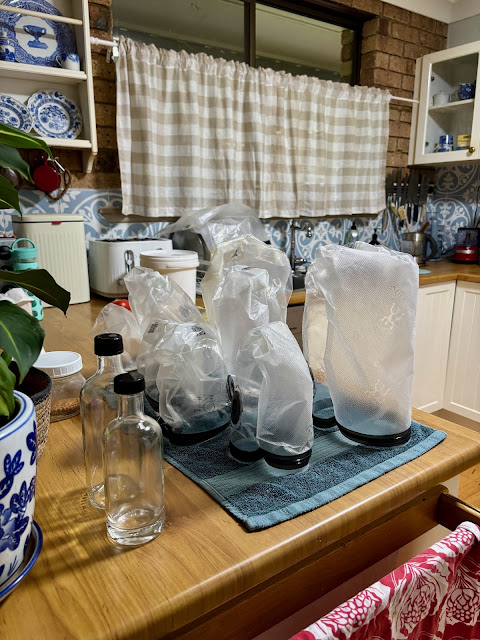
Every morning when I walk into my kitchen it looks tidy and ready for a day's work. Not so on this morning (above), I saw this when I walked in. Late the previous afternoon when I was looking for something, I came across my rolled up Zwilling vacuum bags and decided they had to be washed and dried. So I did that and although I usually put them outside on the verandah to dry it was dark by then. I turned the just-washed bags inside out and left them like this on a towel. It worked well and now the bags are ready to use when I bring home root vegetables, cabbages or whatever I buy that I want to last four or five weeks.
Image

You’ll save money by going back to basics

When I was doing the workshops and solo sessions, I had a couple of people whose main focus was on creating the fastest way to set up a simple life. You can't create a simple life fast, it's the opposite of that It's not one single thing either - it's a number of smaller, simpler activities that combine to create a life that reflects your values; and that takes a long to come together. When I first started living simply I took an entire year to work out our food - buying it, storing it, cooking it, preserving, baking, freezing, and growing it in the backyard. This is change that will transform how you live and it can't be rushed.  
Image


Trending Articles

NOT the last post

This will be my last post here.  I've been writing my blog for 18 years and now is the time to step back. I’ve stopped writing the blog and come back a couple of times because so many people wanted it, but that won’t happen again, I won’t be back.  I’ll continue on instagram to remain connected but I don’t know how frequent that will be. I know some of you will be interested to know the blog's statistics. 
Image

Every morning at home

Every morning when I walk into my kitchen it looks tidy and ready for a day's work. Not so on this morning (above), I saw this when I walked in. Late the previous afternoon when I was looking for something, I came across my rolled up Zwilling vacuum bags and decided they had to be washed and dried. So I did that and although I usually put them outside on the verandah to dry it was dark by then. I turned the just-washed bags inside out and left them like this on a towel. It worked well and now the bags are ready to use when I bring home root vegetables, cabbages or whatever I buy that I want to last four or five weeks.
Image

You’ll save money by going back to basics

When I was doing the workshops and solo sessions, I had a couple of people whose main focus was on creating the fastest way to set up a simple life. You can't create a simple life fast, it's the opposite of that It's not one single thing either - it's a number of smaller, simpler activities that combine to create a life that reflects your values; and that takes a long to come together. When I first started living simply I took an entire year to work out our food - buying it, storing it, cooking it, preserving, baking, freezing, and growing it in the backyard. This is change that will transform how you live and it can't be rushed.  
Image

Creating a home you'll love forever

Living simply is the answer to just about everything. It reduces the cost of living; it keeps you focused on being careful with resources such as water and electricity; it reminds you to not waste food; it encourages you to store food so you don't waste it and doing all those things brings routine and rhythm to your daily life. Consciously connecting every day with the activities and tasks that create simple life reminds you to look for the meaning and beauty that normal daily life holds.  It's all there in your home if you look for it. Seemingly mundane tasks like cleaning and cooking help you with that connection for without those tasks, the home you want to live in won't exist in the way you want it to.  Creating a home you love will make you happy and satisfied.
Image

Time changes everything

I've been spending time in the backyard lately creating a contained herb and vegetable garden. My aim is to develop a comfortable place to spend time, relax, increase biodiversity and encourage more animals, birds and insects to live here or visit. Of course I'd prefer my old garden which was put together by Hanno with ease and German precision. Together, we created a space bursting at the seams with herbs, vegetables and fruity goodness ready to eat and share throughout the year. But time changes everything. What I'm planning on doing now, is a brilliant opportunity for an almost 80 year old with balance issues. In my new garden I'll be able to do a wide range of challenging or easy work, depending on how I feel each day. It’s a daily opportunity to push myself or sit back, watch what's happening around me and be captivated by memories or the scope of what's yet to come.
Image

It's the old ways I love the most

I'm a practical woman who lives in a 1980’s brick slab house. There are verandahs front and back so I have places to sit outside when it's hot or cold. Those verandahs tend to make the house darker than it would be but they're been a great investment over time because they made the house more liveable. My home is not a romantic cottage, nor a minimalist modern home, it's a 1980’s brick slab house. And yet when people visit me here they tell me how warm and cosy my home is and that they feel comforted by being here. I've thought about that over the years and I'm convinced now that the style of a home isn't what appeals to people. What they love is the feeling within that home and whether it's nurturing the people who live there.
Image

Making ginger beer from scratch

We had a nice supply of ginger beer going over Christmas. It's a delicious soft drink for young and old, although there is an alcoholic version that can be made with a slight variation on the recipe. Ginger beer is a naturally fermented drink that is easy to make - with ginger beer you make a starter called a ginger beer plant and after it has fermented, you add that to sweet water and lemon juice. Like sourdough, it must ferment to give it that sharp fizz. To make a ginger beer plant you'll need ginger - either the powdered dry variety or fresh ginger, sugar, rainwater or tap water that has stood for 24 hours to allow the chlorine to evaporate off. You'll also need clean plastic bottles that have been scrubbed with soap, hot water and a bottle brush and then rinsed with hot water. I never sterilise my bottles and I haven't had any problems. If you intend to keep the ginger beer for a long time, I'd suggest you sterilise your bottles. MAKING THE STARTER In a...
Image

An authentic look at daily life here — unstaged and real

Most days Hanno was outside happily working in the fresh air. It may surprise you to know that I started reading my book,  Down to Earth , yesterday - the first time since I wrote it 13 years ago.  I had lent it to my neighbor, and when she returned it, I started reading, expecting to find surprises. Instead, I realised the words were still familiar—as if they were etched into my memory. As I flipped through the pages, I was reminded of how important it was for me to share that knowledge with others. The principles in Down to Earth changed my life, and I truly believed they could do the same for others. After just 30 minutes of reading, I put the book down, reassured that its message still holds true: we can slow down and reshape our lives, one step at a time.
Image