down to earth

  • Home
  • About Us
  • Down To Earth Book
  • Privacy Policy
No wonder I love Wyandotte chickens. Read this! It could be a description of me (LOL) but it is a description of Wyandotte chickens from the fabulous Henderson's Handy Dandy Chicken Chart:

"well adaptable to confinement or free range; calm, industrious, usually docile, but can be aggressive; some are aloof, others friendly."

We are getting more eggs to hatch. Helen emailed a few days ago to tell me her chickens are laying again and she will collect some eggs to send. This time a neighbour lady, Margaret, will hatch them for me. I'm really looking forward to raising these beautiful chicks.

Photo from this site that has very good information about chickens in general but most particularly Wyandottes. This chicken is a partridge Wyandotte bantam, which is what I hope we hatch from the eggs Helen is sending.

Raising pure breed chooks is similar to growing heirloom seeds. They both need backyarders like all of us to keep the irreplaceable and important stocks going, they are both unchanged since our great, great, great grannies day and they both add that wonderful old-fashioned dimension of sustainability to our backyards. Heirloom seeds and pure breed chooks are just like they were 100s of years ago and have managed to survive, so that we too can enjoy their true and genuine nature. They both have big business doing their best to modify and change them to suit the market place so I intend to do my bit in helping them survive my generation so that my grandchildren can also know the pleasure of eating real vegetables and raising pure chickens for eggs.

I'll be home alone all day today because Hanno is driving to Warwick with Shane. Shane will start work at his new job tomorrow. They'll have an early breakfast soon at 6am and then start the drive. I'll make scrambled eggs on toast for breakfast, with tea and juice. While they're eating, I'll pack some food for the trip. I have leftover potato pancakes, walnut and choc chip biscuits, grapes, tea and water. That should keep them going to a while.

At home here I'll make the bed, do some laundry, tidy my linen cupboard, sweep the floors and clean the kitchen. I have six Brandywine tomato seeds left from last year so they'll be carefully planted so I have some for the aquaponics garden and some for the soil garden. Three more fish died yesterday. :- ( Before lunch I want to tidy up the bushhouse and make room for seedling trays. There will be more trays planted up soon and they need to be placed in a sheltered position that gets a little sunshine but mostly shade.

It's been a very mild summer here with very few days over 30C (86F) but there are some hot days predicted. I'll get all my outside work done today and when it's hotter, I'll stay inside, sewing.

This afternoon I plan on resting and knitting. I had three very busy days at work this week organising our move and I'm feeling quiet tired. I might have a nap after lunch. It looks like a good day ahead for me. I hope yours is a pleasant one too.

I've been slowly sorting through the vegetable seeds I have here - those saved from my own garden and those bought from places like Green Harvest and Eden Seeds. I now have a list of the vegetables we'll grow this season, I don't have all the seeds yet, and some of the seeds I have I'm not sure of. If you're not sure of your seeds, it's best to test the viability of them before you plant. There is nothing more frustrating than planting rows and rows of seeds that never germinate.

There's a simple and old-fashioned way to test for viability. Recently I tested several packs of seeds that were over their use by dates or were saved seeds that I'd forgotten to write a date on. I threw some out as they didn't pass the test and some had a slow and patchy germination rate, so I threw those out too because I want strong and healthy seeds. However, there were quite a few packs that had a very good germination rate, even though some of them were over their use by dates. It pays to check.

This is how to check old seeds for freshness and to see if they will germinate and grow in your garden.

  1. Write the name of the seed and the date on a piece of paper towel or paper napkin (this is a good way to use up your old stock if you're now using fabric napkins in place of paper towels). You'll need a separate piece of paper for each lot of seeds you're testing. Eight lots of seeds - eight pieces of paper towel.
  2. Moisten the paper towel. It needs to be moist, not wet.
  3. Sprinkle about 10 seeds onto the surface of the towel and roll it into a loose cigar shape. The seeds should be inside the towel and firmly held by the paper.
  4. Get a large plastic bag - and old plastic shopping bag would suit very well - and place all your rolled up paper towels in the bag.
  5. Gently twist the top of the bag so it keeps the humidity inside the bag and place the bag in a warmish spot, like on top of the TV or near the stove. You want to provide warmth, not heat.
  6. Leave for four days.
  7. On the fifth day carefully unwrap the bag and check each roll. If they haven't germinated, reroll the paper carefully and place it back in the bag. If they have started to germinate, mark that roll so you know it's already start germinating.
  8. Check the rolls every day now, but be careful not to dislodge any seeds.
  9. Now you have to use your common sense. If, after a period of a week or so, no seeds in a particular roll have shown any signs of life, Google the germination time of that seed and if that time has passed with no signs of life, those seeds are probably dead. Some seeds like parsley and carrots take longer to germinate so make sure you check the germination time for the seeds you're testing. If the germination time has passed and less than half have germinated, the seeds have a low germination rate and are probably not worth planting, but you be the judge about whether you want to try them or throw them on the compost heap.

    Germination guide for some popular vegetable seeds.

If you need to buy new seeds this year, try to find heirloom or open pollinated seeds. These are the old-fashioned seeds that have been passed down through the ages and not modified in any way by seeds companies. If you see "F1" on the package, those seeds have been modified. Here is a good explanation of heirloom and F1 seeds from the Gardening Australia site:
"Heirloom varieties of vegetables usually predate World War 2. They are open pollinated, which means that you can save the seed from year to year and from generation to generation. Heirloom varieties have been bred in the first place for flavour, and then for other qualities such as growing well in short summers, or dry summers, or wet summers or long winters etc., so they are much more useful for the home gardener. By contrast modern F1 hybrids are bred for qualities like their ability to be harvested by machine, their ability to withstand the transporting process over long distances and their ability to be refrigerated. They are bred for qualities that give them longevity in the processes before and during their life in the consumer market place. They are in fact bred for almost everything except flavour. The other disadvantage of F1 hybrids is that you can’t save the seed from generation to generation. Gardeners can’t save their own seed at home, and neither can farmers who have to go back to seed companies year after year. Allowing these heirloom varieties to set seed enables the seed to be collected and distributed, ensuring that it has a wide dispersal and so preserving them for future generations. Heirloom varieties have good disease resistance and the yields are often higher than the F1 counterparts. Hybrids are often bred so that they crop all at once so that they can be harvested by machine efficiently, whereas heirloom varieties crop over a longer season making them much more beneficial to home gardeners because it means that they won’t get a glut of fruit or vegetables all at once."

This link has a list of the average time various vegetable seeds remain viable.
How to save seeds.
Heirloom seeds - USA
Heirloom seeds - UK
List of heirloom tomato types
List of tomatoes - Australia
American seed site

Happy gardening everyone!
We have been having terrible trouble with our aquaponics system and the fish have been dying. About two weeks ago we noticed the water going a revolting shade of pea green. The fish were fine but something was happening with the water. When it started getting worse, we changed the water. We put the fish back into the clean water, the next day is was brown.

Our aquaponics system is made up of two grow beds that sit above a 3000 litre fish tank. One of the grow beds was cleaned out recently and replanted. When the water didn't improve, we changed it again. Luckily it's been raining a lot, and as we use only rain water in our system, we had the tanks replenished every night.

But replacing the water didn't improve the situation,
so we ripped out all the plants and cleaned the second grow bed. It was full of green slime, roots and duck weed. This is an all day job that involved shovelling out the gravel, washing it in a sieve, placing it in the wheelbarrow and buckets, cleaning out the galvanised container and shovelling it all back in again.

When we did that, there still wasn't much of an improvement so we changed the water again and waited. Overall, the water was changed three times and it's been every colour from bright green to a mid brown.

Every day a few fish died. It was horrible. I felt really bad that we had these fish and we didn't know enough to keep them alive and healthy. We did a lot of reading and realised the increased temperature and the afternoon summer sun on the water caused an algal bloom. The algae consumed a lot of the dissolved oxygen, and that is what made the fish sick. They didn't have enough oxygen, even though we had four bubblers running all the time and water was falling from the grow beds that created more bubbles.

We now have a cover over the water to protect it and the fish from the sun. They like living in dark water so I think they're happier than they were when it was unprotected. Over the past two weeks we've gone from about 80 fish to around 50. Yesterday was the first day we had no fatalities. I think the balance has been restored. We've lost a few of the larger fish we were hoping to eat fairly soon. The largest of the fish that died was about 22cm (8½ inches).

So now we're starting from scratch again. We'll have to replant the grow beds and wait until the beneficial bacteria in the gravel starts growing again. Luckily it has been kick started with a couple of buckets of unwashed gravel. The bacteria converts the fish waste into nutrients for the plants.

My hope is that the fish remain healthy and we repeat the success with the plants that we had last year. The brandywine tomatoes we grew in the system last year were the best tomatoes I've even eaten - they were sweet and juicy and had that old-fashioned flavour of real tomato.

It's still too dark to see anything outside but if, when I go out, I find the fish well, I think we'll be over this horror session. This lesson has taught me there is still a lot to learn about aquaponics but I hope we can continue learning and provide a clean and healthy environment for our fish.

Hello swappers- I just wanted to remind everyone that most of the tea cosies should be winging their way to their new homes this week. When you receive your parcel please let us know and e-mail a photo to me (Sharon) cdetroyes at yahoo dot com so in a bit I can post a "parade" of the tea cosies. The photos I have received so far are a reminder of what a creative and artistic blog "family" we have. Every time I open a swap parcel sent to me it is like a long distance hug and the talent is just amazing!! We are already thinking of the next swap, so be ready for more fun! Sharon
As I clicked away on the needles yesterday I tried to compose a blog post in my head that would help those much younger than me work towards their own version of a simple life. I would really like to visit each and every one of you and discuss various approaches to simplicity and help you all get started on this path. Needless to say I didn't compose that blog post and although I would love to give you all a step-by-step guide to simple living, there isn't a one size fits all approach to this.

I am acutely aware that many of you read my blog to find a way of starting, and some of you want to find the motivation to keep at it, but I can't give you a magic formula, I can't say how I would live if I had small children, I am what I am and this is all I offer. I hope that by reading here about my daily life, and all the joys and disappointments it holds, you will see me as all too human role model who shows that life is not always easy, but there is joy to be found in the simple tasks of daily life.

If you look for it, you will find beauty and joy lurking in the ordinary.

I believe there is no one way to live simply. I have lived in Europe, in the Australian bush and in the city, in houses, flats and caravans, and I know with no doubt, I could have lived simply in all those places. Whatever your circumstances are, you can fashion a life that will simplify your daily tasks, help you nurture yourself and your family and lead you to discover that a simple life is like a patchwork - it's pieced together slowly, unpicked sometimes, composed of a mish-mash of colours and textures and is different for everyone, depending on the fabric of your life. But when one stands back from a completed patchwork, it's complexity becomes apparent. It's no longer pieces of this and that, it builds into a functional piece that gives warmth, beauty and comfort. That's how your simple life will build too.

So here are some general suggestions, some things that I have done, that have helped me find this happiness. I encourage you to pick your pieces from this list, and discover fresh pieces from your own life and surroundings, and make them work for you in your circumstance. You might use only one thing here, or you might use all of them, there are no rules, except the one to live well.

This is in no particular order, it's just the order they fall into my brain:

  • Keep your family close and teach your children, by example, both the little and the adult, that happiness is not on sale at any store, it is a homemade commodity.
  • Reduce your spending, pay off your mortgage as fast as you can, but enjoy life as you do it.
  • Learn to cook from scratch.
  • Learn to garden- even if you live in a flat or an apartment you can do this with sprouting, window boxes or a mushroom farm. If you have some space in the backyard, your options are greatly increased.

  • Simplify your laundry routines with homemade laundry powder, soap and green cleaning.

  • Cut down on the time you spend in the supermarket with stockpiling, menu planning and mindful shopping.
  • Don't listen to the naysayers.
  • Teach yourself to knit and sew.

  • Make your own rules. Don't listen to me when you know your own way is better.
  • Find the everyday beauty that surrounds you.
  • Make your bed every day. Make your home the kind of comfortable you enjoy. Fluff up your nest everyday so that your home is a haven and the place you want to come home to.

  • Push the envelope. Your life will probably not be the same as those around you. Try to find a role model but if you don't, walk your own path with confidence and know that you're teaching those who come behind you.
  • Learn to grow some of your food in your backyard. Eggs and fish are the obvious ones for me, but there are other options like meat chickens, milk cows, goats, quail and much more.


  • Develop simple values like generosity and kindness, then be amazed at how they will change you.
  • Look after your local environment. Get rid of all the poisons in your home. This must be done responsibility after contacting your local council or rubbish tip for guidance.
  • Save water, gas and electricity. Learn how to read your meters.

  • Slow down and learn how to appreciate the ordinary aspects of your life. About 90% of your life will be ordinary, the trick is to appreciate it.
  • Develop your independence. This will involve stepping away from the mainstream to reskill or learn how to look after yourself with a minimum of outside input.
  • Help others by volunteering some time to your community or school.
  • Be kind to yourself. Work out what it is that will make you happy, then do it.
This list is not nearly complete, nor could it ever be because all our lives as so different. If you have a tip that has worked for you, please add it to your comment as you may open a door for someone else by sharing it.

Thank you for stopping by
, I hope you're enjoying your weekend.

It's almost Autumn, so for me, it's time to knit with wool instead of cotton. I went to the shops yesterday - yes, I know, it's scary out there - to buy a longer set of circular needles. I'm going to make a cowl for the cold days of winter. I have two balls of very soft 100% fine merino wool in my stash, all I needed was the needles.

I took my camera to the store.

Knitting is a really interesting activity. It's like a mediation, in that it's often a solitary repetition that calms and slows you down. But it's also something that, when you do it in public, will connect you to all the other knitters in the vicinity. Knitters like watching and talking to other knitters. It's like being in a club. When you knit in public, you make a statement. You're silently saying that you like to be productive, you prefer homemade to mass production and your modern creative spirit is satisfied by an age old craft. When you knit at home alone, you're nurturing your soul with the doing of it and giving yourself, or whomever the knitting is for, the warm and generous gift of the handmade.

On to the store. I thought I'd be able to buy needles at the big department store here - Myer. I drove over there, searched high and low, and guess what! You probably already know what I will write - NO needles, no wool, no cotton, no materials of any kind that would allow me to make for myself what I wanted. They only sell pre-made everything. Pfffffffft! I did get some photos though. Can you imagine, they're already selling Easter eggs!

Clicking on the photos will enlarge them

I went to Spotlight. For those readers not in Australia, Spotlight is our big chain craft store. I knew they had needles and all the yarn to go with them, but it's really impersonal there. You scan the aisles, much like in a supermarket, and then take your purchase to a checkout. I would love to find a small local shop that sells a good range of wool and cotton, where I could talk about my purchase to someone with knowledge and advice, where they had swatches of knitting done in various patterns using a variety of yarns, where my love of the handmade was affirmed.

I bought my needles, and two balls of 100% cotton in the bargain bin for $1 each. One of them is red! I don't know why but red cotton is as scarce as hen's teeth here, so when I saw it sitting there I picked it up without hesitation. Click Click with the camera, much to the surprise of the women shopping there, and off I went.

I felt like the cat with all the cream as I drove home with visions of the cowl and the many knitting sessions in store for me. I've already written that I don't see knitting and sewing as a craft but rather a part of the work I do for my home. No matter what it is called though, knitting is always pure pleasure and the starting of a new project is a time of happy anticipation. And when I settle down on the front verandah later this morning and settle into the rhythm of this new knitting, it will provide the satisfaction and enjoyment of the making as well as a warm garment for me to wear in winter. You can't get much better than that.

“Focus on the journey, not the destination. Joy is found not in finishing an activity but in doing it.”
I just have to tell you about my two favourite blogs - SouleMama and Path to Freedom. I've been reading Path to Freedom since forever and still marvel at their ability to produce a consistent supply of fruit and vegetables from their 1/5 acre suburban garden. If you're an aspiring gardener, or wanting some inspiration for your new season garden, look no further than here and here. I was pleased to discover today that Little Jenny Wren and my blog have both been listed on Path to Freedom website as fellow travellers.

If you're a home spirit with a love of family, knitting and sewing, you can't go past SouleMama. What a wonderful writer Amanda is. It's a joy to read about her life with her family. I discovered the blog only a couple of months ago and read it every chance I get. I'm currently reading through her substantial archives. Please check her out if you haven't already. You won't be disappointed.

I just remembered this very special post so I'm adding it too. I haven't had time to read the rest of Kim's blog but I will, when time is there for it. My most favourite blogs are those that are written well and therefore I might have to add Kim's blog because I do like the way she writes - and the exposure that comes with that.


I had to hang the laundry undercover yesterday as it was raining.


There are a few things I do in my daily life that I think are unchanged since Adam was a boy. One of those things is hanging washing out to dry. Drying clothes outside is a chore that connects you to all your great grandmothers. We might have plastic pegs now but most of the other requirements are unchanged over hundreds of years.

Line drying your laundry is remarkably efficient. All you need is the time and a bit of effort to do it - sun and breeze are supplied free to all with the will to use them. You'll need a clothes line, and that can be rope or wire, and pegs. If there is no wind, you could even do without the pegs and just place the clothes neatly over the line - or a fence or large bush. In the old days many women used lavender bushes to dry their clothes.

Start your task by shaking the item before hanging it. That will take out obvious folds and some of the creases. If you can hang your pillow slips, tea towels, T shirts, aprons, napkins etc. well, so that they hang straight without creases, you won't have to iron them. The more creases and folds you remove at the hanging stage, the more work you save yourself later. Even most jeans and some shirts can be hung like this so you won't have to iron them. Shaking is essential.

If you have a rotary line, start with your underwear and the smaller items in the middle and work out to your larger sheets and towels. If you have a long line, hang the smaller items in the middle and the heavier things on the ends of the line. If you have a lot of shirts it might we worth your while to shake them, hang them on plastic clothes hangers then attach the hanger to the line for drying. This might cut down on your ironing as well. If you live in a wet or humid climate, it is better to use plastic pegs as the wooden ones will develop mould over time, and a mouldy peg on wet fabric could stain your clothes.

When the clothes are dry and full of the smell of sunshine, unpeg them, place them in your basket, take them inside straight away and fold them. I do this on the kitchen table as it gives me enough room to work and stack the clothes. It's also a central place from where I can easily put away tea towels, napkins, dishclothes, towels and sheets as soon as they're folded and stacked. Never put off your folding because if you do you'll have creased clothes that will have to be ironed. I have been able to cut my ironing by fifty percent by shaking wet clothes at the line, careful hanging and folding as soon as the clothes are off the line.

Hanging laundry is a wonderful thing to do. You might think of it as yet another chore but it allows you to take advantage of the outdoors, the fresh air and sunshine. You are using the natural elements of your surrounding environment to help keep your clothes clean. It's one of those things we can do that doesn't rely on electricity - it's just you and the pegs.

If you haven't tried line drying yet, give it a go. Your clothes and household linens will last longer as they aren't subject to the heat and constant tumbling action of a dryer. Yes, it does take more effort on your part to do it, but these gentle exercises are good for all of us. Hanging laundry is one of those little things that gives you the chance slow down and to be mindful of the many simple things you can do at home.


I had a load of moist hand towels from the Centre that needed to be washed straight away. These dried well yesterday under the cover of the back verandah roof.

TOP REASONS TO HANG OUT YOUR CLOTHES from this site.
Electric dryers use five to ten percent of residential electricity in the United States!

Save money (more than $100/year on electric bill for most households).
Conserve energy and the environment.
Clothes and sheets smell better.
Clothes last longer. Where do you think lint comes from?
It is physical activity which you can do in or outside.
Sunlight bleaches and disinfects
Indoor racks can humidify in dry winter weather
Clothes dryer fires account for about 15,600 structure fires, 15 deaths, and 400 injuries annually. The yearly national fire loss for clothes dryer fires in structures is estimated at $99 million.

MORE READING
Washing and drying clothes - Australia

Hanging Items Upon a Clothesline - UK

How to dry your clothes outside - USA

To Fight Global Warming, Some Hang a Clothesline - Canada

How to make a clothes line

I rarely follow recipes. I use them as a starting point and change it to suit our tastes. Scones need to be made in a similar way all the time though. I do add other things to my scones, mostly dates, but usually we have them like this.

  • 2 cups self raising flour OR plain/all purpose flour with one teaspoon of baking powder for each cup
  • Pinch salt
  • 1 tablespoon sugar
  • 30g butter chopped
  • 1 cup buttermilk
  1. Preheat oven to very hot, 220C. Get your tray ready by greasing it or adding parchment paper.
  2. Sift flour into a large bowl. Add butter and rub in lightly until it looks like breadcrumbs.
  3. Pour in buttermilk and mix in using a butter knife, mix to a soft and sticky dough.
  4. OVER MIXING at this point will result in tough scones.
  5. Turn onto a lightly floured surface. Knead lightly for 30 seconds. Press out the dough to form a round about 2cm (1 inch) thick. Cut into rounds using a cutter or floured wine glass.
To make 50 scones, you will need 2 kg (5 lb) of SR flour.
After all the hoopla, I didn't watch the apology. When it was being said, I was driving to the Centre, when it was streamed from the internet during the morning tea, I was on the phone and dealing with clients. : - (
The morning tea was a great success. About 30 people attended and everyone was moved by the speech and the coverage of the event. The Flexi students and teachers joined us and the kids helped with chairs and moving things around to accommodate everyone. I was really pleased with the kids. When I invited them I asked that they respect the importance of the day and the other people, and they did just that. When everyone was gone there were a few scones and biscuits left over so I told them to help themselves to the food and the last of the coffee. There is never leftover food or drink when there are teens around.
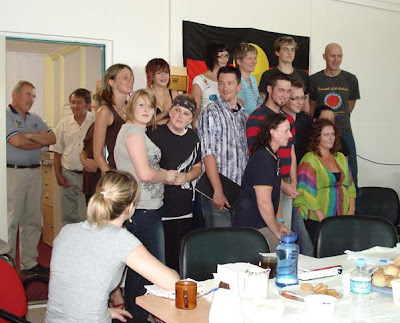
I had a few periods during the day when I could have watched the speech but I decided to save it for later. When I got home I saw some of it on the news and watched the rest on the internet and I was really pleased I waited to have the time to really take in what was said.

It was a very emotional day. The TV coverage of the event showed black and white Australians celebrating, embracing and quietly wiping away tears while they listened to the apology. It has made some truly wonderful promises - that the health, literacy and numeracy of indigenous Australians will improve, that indigenous life expectanacy will move closer to that of white Australians and that we, as a nation, will move towards reconciliation.

My family has lived in Australia since 1797 but I doubt any of my ancestors ever felt as proud of being Australian as I did yesterday when I heard that apology. And when I saw our Prime Minister welcome individual black Australians as they came to Parliament House with the words: hello, I'm Kevin, and a handshake or an embrace, I knew that I was watching something really significant happen.

There are times that we look back on, and with the benefit of hindsight, know that time was important. We don't need time to know that what happened in Australia yesterday was significant, decent, honest and long overdue. Along with all the tears, a lot of joy came from that apology and I believe we've been changed by it. I hope we remain as united as we are right now. As the first item of business in our new parliament, this set the tone for what will come, and I for one am very optimistic about what will follow.


Here is a part of Kevin Rudd's apology speech:

It is time to reconcile. It is time to recognise the injustices of the past. It is time to say sorry. It is time to move forward together.

To the stolen generations, I say the following: as Prime Minister of Australia, I am sorry.

On behalf of the Government of Australia, I am sorry.

On behalf of the Parliament of Australia, I am sorry.

I offer you this apology without qualification.

We apologise for the hurt, the pain and suffering that we, the parliament, have caused you by the laws that previous parliaments have enacted.

We apologise for the indignity, the degradation and the humiliation these laws embodied.

We offer this apology to the mothers, the fathers, the brothers, the sisters, the families and the communities whose lives were ripped apart by the actions of successive governments under successive parliaments.

In making this apology, I would also like to speak personally to the members of the stolen generations and their families: to those here today, so many of you; to those listening across the nation - from Yuendumu, in the central west of the Northern Territory, to Yabara, in North Queensland, and to Pitjantjatjara in South Australia.

I know that, in offering this apology on behalf of the Government and the Parliament, there is nothing I can say today that can take away the pain you have suffered personally.

Whatever words I speak today, I cannot undo that.

Words alone are not that powerful; grief is a very personal thing.I ask those non-indigenous Australians listening today who may not fully understand why what we are doing is so important to imagine for a moment that this had happened to you.

I say to honourable members here present: imagine if this had happened to us. Imagine the crippling effect. Imagine how hard it would be to forgive.

My proposal is this: if the apology we extend today is accepted in the spirit of reconciliation, in which it is offered, we can today resolve together that there be a new beginning for Australia.

And it is to such a new beginning that I believe the nation is now calling us. Australians are a passionate lot. We are also a very practical lot.
For us, symbolism is important but, unless the great symbolism of reconciliation is accompanied by an even greater substance, it is little more than a clanging gong.
It is not sentiment that makes history; it is our actions that make history. Today's apology, however inadequate, is aimed at righting past wrongs. It is also aimed at building a bridge between indigenous and non-indigenous Australians - a bridge based on a real respect rather than a thinly veiled contempt.
Our challenge for the future is to cross that bridge and, in so doing, to embrace a new partnership between indigenous and non-indigenous Australians - to embrace, as part of that partnership, expanded Link-up and other critical services to help the stolen generations to trace their families if at all possible and to provide dignity to their lives.
But the core of this partnership for the future is to close the gap between indigenous and non-indigenous Australians on life expectancy, educational achievement and employment opportunities.
This new partnership on closing the gap will set concrete targets for the future: within a decade to halve the widening gap in literacy, numeracy and employment outcomes and opportunities for indigenous Australians, within a decade to halve the appalling gap in infant mortality rates between indigenous and non-indigenous children and, within a generation,to close the equally appalling 17-year life gap between indigenous and non-indigenous in overall life expectancy.
The truth is: a business as usual approach towards indigenous Australians is not working.
Most old approaches are not working.
We need a new beginning, a new beginning which contains real measures of policy success or policy failure; a new beginning, a new partnership, on closing the gap with sufficient flexibility not to insist on a one-size-fits-all approach for each of the hundreds of remote and regional indigenous communities across the country but instead allowing flexible,tailored, local approaches to achieve commonly-agreed national objectives that lie at the core of our proposed new partnership; a new beginning that draws intelligently on the experiences of new policy settings across the nation.
However, unless we as a Parliament set a destination for the nation, we have no clear point to guide our policy, our programs or our purpose; we have no centralised organising principle.

Let us resolve today to begin with the little children, a fitting place to start on this day of apology for the stolen generations.
Let us resolve over the next five years to have every indigenous four-year-old in a remote Aboriginal community enrolled in and attending a proper early childhood education centre or opportunity and engaged in proper pre-literacy and pre-numeracy programs.
Let us resolve to build new educational opportunities for these little ones, year by year, step by step, following the completion of their crucial pre-school year.
Let us resolve to use this systematic approach to build future educational opportunities for indigenous children to provide proper primary and preventive health care for the same children, to begin the task of rolling back the obscenity that we find today in infant mortality rates in remote indigenous communities up to four times higher than in othercommunities.
None of this will be easy. Most of it will be hard, very hard. But none of it is impossible, and all of it is achievable with clear goals, clear thinking, and by placing an absolute premium on respect, cooperation and mutual responsibility as the guiding principles of this new partnership on closing the gap.
The mood of the nation is for reconciliation now, between indigenous and non-indigenous Australians. The mood of the nation on indigenous policy and politics is now very simple.
The nation is calling on us, the politicians, to move beyond our infantile bickering, our point-scoring and our mindlessly partisan politics and to elevate this one core area of national responsibility to a rare position beyond the partisan divide.
Surely this is the unfulfilled spirit of the 1967 referendum. Surely, at least from this day forward, we should give it a go.
Let me take this one step further and take what some may see as a piece of political posturing and make a practical proposal to the opposition on this day, the first full sitting day of the new Parliament.
I said before the election that the nation needed a kind of war cabinet on parts of indigenous policy, because the challenges are too great and the consequences are too great to allow it all to become a political football, as it has been so often in the past.
I therefore propose a joint policy commission, to be led by the Leader of the Opposition and me, with a mandate to develop and implement, to begin with, an effective housing strategy for remote communities over the next five years.

It will be consistent with the Government's policy framework, a new partnership for closing the gap. If this commission operates well, I then propose that it work on the further task of constitutional recognition of the first Australians, consistent with the longstanding platform commitments of my party and the pre-election position of the opposition.
This would probably be desirable in any event because, unless such a proposition were absolutely bipartisan, it would fail at a referendum. As I have said before, the time has come for new approaches to enduring problems.
Working constructively together on such defined projects would, I believe, meet with the support of the nation. It is time for fresh ideas to fashion the nation's future.
Mr Speaker, today the Parliament has come together to right a great wrong. We have come together to deal with the past so that we might fully embrace the future. We have had sufficient audacity of faith to advance a pathway to that future, with arms extended rather than with fists still clenched.
So let us seize the day. Let it not become a moment of mere sentimental reflection.
Let us take it with both hands and allow this day, this day of national reconciliation, to become one of those rare moments in which we might just be able to transform the way in which the nation thinks about itself, whereby the injustice administered to the stolen generations in the name of these, our parliaments, causes all of us to reappraise, at the deepest level of our beliefs, the real possibility of reconciliation writ large: reconciliation across all indigenous Australia; reconciliation across the entire history of the often bloody encounter between those who emerged from the Dreamtime a thousand generations ago and those who, like me, came across the seas only yesterday; reconciliation which opens up whole new possibilities for the future.
It is for the nation to bring the first two centuries of our settled history to a close, as we begin a new chapter. We embrace with pride, admiration and awe these great and ancient cultures we are truly blessed to have among us cultures that provide a unique, uninterrupted human thread linking our Australian continent to the most ancient prehistory of our planet.
Growing from this new respect, we see our indigenous brothers and sisters with fresh eyes, with new eyes, and we have our minds wide open as to how we might tackle, together, the great practical challenges that indigenous Australia faces in the future.
Let us turn this page together: indigenous and non-indigenous Australians, government and opposition, Commonwealth and state, and write this new chapter in our nation's story together.
First Australians, First Fleeters, and those who first took the oath of allegiance just a few weeks ago. Let's grasp this opportunity to craft a new future for this great land: Australia. I commend the motion to the House.


Above is the Australian Aboriginal flag, created in 1971 by Harold Thomas.

It's been a long time coming but this morning, the Australian Prime Minister, Kevin Rudd, will apologise to the aboriginal people and the stolen generations, for the injustices and hurt caused by government policies of the past.

There is a full story
about it here, but for those of you who know little of our history it used to be government policy to take some aboriginal children from their parents and have them raised by church institutions or white families. About 100,000 families were affected between 1910 and 1970.

Australia is divided on this issue. Many people think we should not apologise for something we didn't do but I agree with Kevin Rudd. I think it is the right thing for him, as the current Prime Minister, to apologise for the actions of former governments that we now know to be wrong and which caused a lot of pain and sorrow.

Today, the Neighbourhood Centre I work at is hosting a morning tea for our town's residents so we can watch the apology together. I have an Aboriginal flag to hang as a sign of respect for our fellow Australians.

This is an historic day in Australia. I hope the apology will help heal the stolen generations and their families. We have a long way to go but hopefully this will be the first step towards reconciliation
.

I'm bad. Here I am telling every one who will listen to stop spending on all those little bits and pieces that make your dollars disappear, and I go and buy lunch for myself when I was at work yesterday. I bought a cheese and salad multigrain roll and a piece of fruit cake from the lovely Swiss bakery in Maleny.

It cost me $6.50! If I did that every day I worked it would cost almost $20 a week for lunch. Doing it all year, would cost almost $1000.

I was running late again yesterday and I was supposed to be going to a lunch meeting where I thought sandwiches would be served, so I didn't bother taking lunch. The meeting was cancelled. No problems, I'll just have some of the crackers and cheese I put in the fridge last week. The cheese was gone! I went to the bakery.

There always seems to be a good excuse for spending. When I am in the shop it feels like the most natural thing in the world to buy what I have my sights set on, but I always regret it later. I have been very slack with my money lately. Last month we decided to live off the stockpile to make sure we rotated the stock properly. I only took a small amount of grocery money for milk and vegies and we left the bulk of the grocery money in the bank. However, instead of dividing up the rest of the money into my plastic bags as I always do, I just put it in my purse. We ran out of money for the first time in a couple of years.

If I am to save money and cut down on everything, I need to organise myself so it is easy to do. Having all the money in my purse is the worst way for me to organise my money. It's too difficult to budget that way. Having money ready to spend when you go out is too much of a temptation, and when these things are just a few dollars I talk myself into the spending by telling myself it's just a few dollars, it won't matter.

It matters.

Today I'm taking a backup lunch to work with me and if I don't take my lunch again, then I will have to go without. It will do me good. I've also reminded myself how easy it is to let money just slowly leak away. I need to be mindful of that all the time. I don't need another reminder for a while. I'll stay on track now.

How are you going with your budgeting? Do you fall off the edge of your budget sometimes? And if you do, how do you recover from it. How are you organising your cash so that you don't spend it when you go out? I'd be interested to know how others organise their money and how they stay on track.
Newer Posts Older Posts Home


My books were all published by Pengiun, and are available at Amazon US, Amazon UK and Amazon Au

Search here

Total Pageviews

Translate


I'm Rhonda Hetzel and I've been writing my Down to Earth blog since 2007. Although I write the occasional philosophical post, my main topics include home cooking, happiness and gardening as well as budgeting, baking, ageing, generosity, mending and handmade crafts. I hope you enjoy your time here.

MY FAVOURITE PLACES

  • Grandma Donna's Place
  • Grandma Donna's YouTube
  • Grandma Donna's Instagram
  • This Simple Day
  • Nicole's Instagram

Give More

Give More

Popular posts last year

Making ginger beer from scratch

We had a nice supply of ginger beer going over Christmas. It's a delicious soft drink for young and old, although there is an alcoholic version that can be made with a slight variation on the recipe. Ginger beer is a naturally fermented drink that is easy to make - with ginger beer you make a starter called a ginger beer plant and after it has fermented, you add that to sweet water and lemon juice. Like sourdough, it must ferment to give it that sharp fizz. To make a ginger beer plant you'll need ginger - either the powdered dry variety or fresh ginger, sugar, rainwater or tap water that has stood for 24 hours to allow the chlorine to evaporate off. You'll also need clean plastic bottles that have been scrubbed with soap, hot water and a bottle brush and then rinsed with hot water. I never sterilise my bottles and I haven't had any problems. If you intend to keep the ginger beer for a long time, I'd suggest you sterilise your bottles. MAKING THE STARTER In a...
Image

NOT the last post

This will be my last post here.  I've been writing my blog for 18 years and now is the time to step back. I’ve stopped writing the blog and come back a couple of times because so many people wanted it, but that won’t happen again, I won’t be back.  I’ll continue on instagram to remain connected but I don’t know how frequent that will be. I know some of you will be interested to know the blog's statistics. 
Image

How to make cold process soap

I'm sure many of you are wondering: "Why make soap when I can buy it cheaply at the supermarket?" My cold process soap is made with vegetable oils and when it is made and cured, it contains no harsh chemicals or dyes. Often commercial soap is made with tallow (animal fat) and contains synthetic fragrance and dye and retains almost no glycerin. Glycerin is a natural emollient that helps with the lather and moisturises the skin. The makers of commercial soaps extract the glycerin and sell it as a separate product as it's more valuable than the soap. Then they add chemicals to make the soap lather. Crazy. Making your own soap allows you to add whatever you want to add. If you want a plain and pure soap, as I do, you can have that, or you can start with the plain soap and add colour, herbs and fragrance. The choice is yours. I want to add a little about animal and bird fat. I know Kirsty makes her soap with duck fat and I think that's great. I think t...
Image

Preserving food in a traditional way - pickling beetroot

I've had a number of emails from readers who want to start preserving food in jars but don't know where to start or what equipment to buy.  Leading on from yesterday's post, let's just say up front - don't buy any equipment. Once you know what you're doing and that you enjoy preserving, then you can decide whether or not to buy extra equipment. Food is preserved effectively without refrigeration by a variety of different methods. A few of the traditional methods are drying, fermentation, smoking, salting or by adding vinegar and sugar to the food - pickling. This last method is what we're talking about today. Vinegar and sugar are natural preservatives and adding one or both to food sets up an environment that bacteria and yeasts can't grow in. If you make the vinegar and sugar mix palatable, you can put up jars of vegetables or fruit that enhance the flavour of the food and can be stored in a cupboard or fridge for months. Other traditional w...
Image

Cleaning mould from walls and fabrics

With all this rain around we've developed a mould problem in our home. Usually we have the front and back doors open and that good ventilation stops most moulds from establishing. However, with the house locked up for the past week, the high humidity and the rain, mould is now growing on the wooden walls near our front door and on the lower parts of cupboards in the kitchen. Most of us will find mould growing in our homes at some point. Either in the bathroom or, in humid climates, on the walls, like we have now. You'll need a safe and effective remedy at some point, so I hope one of these methods works well for you. Mould is not only ugly to look at, it can cause health problems so if you see mould growing, do something about it straight away. The longer you leave the problem, the harder it will be to get rid of it effectively. If you have asthma or any allergies, you should do this type of cleaning with a face mask on so you don't breathe in any spores. Many peopl...
Image

Five minute bread

Bread is one of those foods that, when made with your own hands, gives a great deal of satisfaction and delight. It's only flour and water but it symbolises so much. I bake bread most days and use a variety of flours that I buy in bulk. Often I make a sandwich loaf because we use most of our bread for lunchtime sandwiches and for toast. Every so often I branch out to make a different type of loaf. I have tried sour dough in the past but I've not been happy with any of them. I'll continue to experiment with sour dough because I like the idea of using wild yeasts and saving the starter over a number of years to develop the flavour and become a part of the family. However, the loaf I've been branching out to most often is just a plain old five minute bread. By five minutes I mean it takes about five minutes actual work to prepare but it's the easiest of all bread to make and to get consistently good loaves from. If you're having people around for lunch or...
Image

This is my last post.

I have known for a while that this post was coming, but I didn't know when. This is my last post. I'm closing my blog, for good, and I'm not coming back like I have in the past.  I've been writing here for 16 years and my blog has been many things to me. It helped me change my life, it introduced me to so many good people, it became a wonderful record of my family life, it helped me get a book contract with Penguin, and monthly columns with The Australian Women's Weekly and Burke's Backyard . But in the past few months, it's become a burden. In April, I'll be 75 years old and I hope I've got another ten years ahead. However, each year I'll probably get weaker and although I'm fairly healthy, I do have a benign brain tumour and that could start growing. There are so many things I want to do and with time running out, leaving the blog behind gives me time to do the things that give me pleasure. On the day the blog started I felt a wonderful, h...
Image

What is the role of the homemaker in later years?

An email came from a US reader, Abby, who asked about being a homemaker in later years. This is part of what she wrote: "I am a stay-at-home mum to 4 children, ages 9-16. I do have a variety of "odd jobs" that I enjoy - I run a small "before-school" morning drop-off daycare from my home, I am a writing tutor, and I work a few hours a week at a local children's bookstore. But mostly, I cherish my blissful days at home - cooking, cleaning (with homemade cleaners), taking care of our children and chickens and goats, baking, meal-planning, etc. This "career" at home is not at all what I imagined during my ambitious years at university, but it is far more enriching. I notice, though, that my day is often planned around the needs of my family members. Of course, with 4 active kids and a husband, this is natural. I do the shopping, plan my meals, cook dinner - generally in anticipation of my family reconnecting in the evening.  I can't h...
Image

Every morning at home

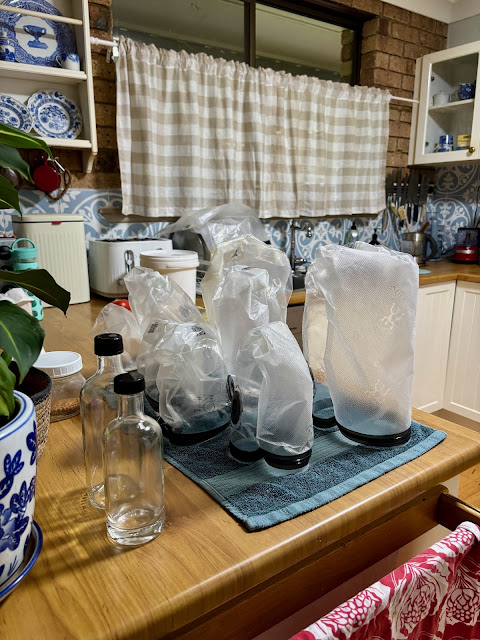
Every morning when I walk into my kitchen it looks tidy and ready for a day's work. Not so on this morning (above), I saw this when I walked in. Late the previous afternoon when I was looking for something, I came across my rolled up Zwilling vacuum bags and decided they had to be washed and dried. So I did that and although I usually put them outside on the verandah to dry it was dark by then. I turned the just-washed bags inside out and left them like this on a towel. It worked well and now the bags are ready to use when I bring home root vegetables, cabbages or whatever I buy that I want to last four or five weeks.
Image

You’ll save money by going back to basics

When I was doing the workshops and solo sessions, I had a couple of people whose main focus was on creating the fastest way to set up a simple life. You can't create a simple life fast, it's the opposite of that It's not one single thing either - it's a number of smaller, simpler activities that combine to create a life that reflects your values; and that takes a long to come together. When I first started living simply I took an entire year to work out our food - buying it, storing it, cooking it, preserving, baking, freezing, and growing it in the backyard. This is change that will transform how you live and it can't be rushed.  
Image


Trending Articles

NOT the last post

This will be my last post here.  I've been writing my blog for 18 years and now is the time to step back. I’ve stopped writing the blog and come back a couple of times because so many people wanted it, but that won’t happen again, I won’t be back.  I’ll continue on instagram to remain connected but I don’t know how frequent that will be. I know some of you will be interested to know the blog's statistics. 
Image

Every morning at home

Every morning when I walk into my kitchen it looks tidy and ready for a day's work. Not so on this morning (above), I saw this when I walked in. Late the previous afternoon when I was looking for something, I came across my rolled up Zwilling vacuum bags and decided they had to be washed and dried. So I did that and although I usually put them outside on the verandah to dry it was dark by then. I turned the just-washed bags inside out and left them like this on a towel. It worked well and now the bags are ready to use when I bring home root vegetables, cabbages or whatever I buy that I want to last four or five weeks.
Image

You’ll save money by going back to basics

When I was doing the workshops and solo sessions, I had a couple of people whose main focus was on creating the fastest way to set up a simple life. You can't create a simple life fast, it's the opposite of that It's not one single thing either - it's a number of smaller, simpler activities that combine to create a life that reflects your values; and that takes a long to come together. When I first started living simply I took an entire year to work out our food - buying it, storing it, cooking it, preserving, baking, freezing, and growing it in the backyard. This is change that will transform how you live and it can't be rushed.  
Image

Creating a home you'll love forever

Living simply is the answer to just about everything. It reduces the cost of living; it keeps you focused on being careful with resources such as water and electricity; it reminds you to not waste food; it encourages you to store food so you don't waste it and doing all those things brings routine and rhythm to your daily life. Consciously connecting every day with the activities and tasks that create simple life reminds you to look for the meaning and beauty that normal daily life holds.  It's all there in your home if you look for it. Seemingly mundane tasks like cleaning and cooking help you with that connection for without those tasks, the home you want to live in won't exist in the way you want it to.  Creating a home you love will make you happy and satisfied.
Image

Time changes everything

I've been spending time in the backyard lately creating a contained herb and vegetable garden. My aim is to develop a comfortable place to spend time, relax, increase biodiversity and encourage more animals, birds and insects to live here or visit. Of course I'd prefer my old garden which was put together by Hanno with ease and German precision. Together, we created a space bursting at the seams with herbs, vegetables and fruity goodness ready to eat and share throughout the year. But time changes everything. What I'm planning on doing now, is a brilliant opportunity for an almost 80 year old with balance issues. In my new garden I'll be able to do a wide range of challenging or easy work, depending on how I feel each day. It’s a daily opportunity to push myself or sit back, watch what's happening around me and be captivated by memories or the scope of what's yet to come.
Image

It's the old ways I love the most

I'm a practical woman who lives in a 1980’s brick slab house. There are verandahs front and back so I have places to sit outside when it's hot or cold. Those verandahs tend to make the house darker than it would be but they're been a great investment over time because they made the house more liveable. My home is not a romantic cottage, nor a minimalist modern home, it's a 1980’s brick slab house. And yet when people visit me here they tell me how warm and cosy my home is and that they feel comforted by being here. I've thought about that over the years and I'm convinced now that the style of a home isn't what appeals to people. What they love is the feeling within that home and whether it's nurturing the people who live there.
Image

Making ginger beer from scratch

We had a nice supply of ginger beer going over Christmas. It's a delicious soft drink for young and old, although there is an alcoholic version that can be made with a slight variation on the recipe. Ginger beer is a naturally fermented drink that is easy to make - with ginger beer you make a starter called a ginger beer plant and after it has fermented, you add that to sweet water and lemon juice. Like sourdough, it must ferment to give it that sharp fizz. To make a ginger beer plant you'll need ginger - either the powdered dry variety or fresh ginger, sugar, rainwater or tap water that has stood for 24 hours to allow the chlorine to evaporate off. You'll also need clean plastic bottles that have been scrubbed with soap, hot water and a bottle brush and then rinsed with hot water. I never sterilise my bottles and I haven't had any problems. If you intend to keep the ginger beer for a long time, I'd suggest you sterilise your bottles. MAKING THE STARTER In a...
Image

An authentic look at daily life here — unstaged and real

Most days Hanno was outside happily working in the fresh air. It may surprise you to know that I started reading my book,  Down to Earth , yesterday - the first time since I wrote it 13 years ago.  I had lent it to my neighbor, and when she returned it, I started reading, expecting to find surprises. Instead, I realised the words were still familiar—as if they were etched into my memory. As I flipped through the pages, I was reminded of how important it was for me to share that knowledge with others. The principles in Down to Earth changed my life, and I truly believed they could do the same for others. After just 30 minutes of reading, I put the book down, reassured that its message still holds true: we can slow down and reshape our lives, one step at a time.
Image