down to earth

  • Home
  • About Us
  • Down To Earth Book
  • Privacy Policy
I had a lovely day yesterday working away quietly in my home. Hanno was up on the roof cleaning 10 years worth of dirt off with Jens' pressure cleaner hose and as he stayed up there most of the day, I think he enjoyed every minute of it. I started off my day watching the end of a DVD one of the ladies here sent me. It was the BBC program It's Not Easy Being Green - 2 DVDs, eight programs. It's the true story of an English family who moved from a city to a small village in Cornwall on the road to a greener life. We started watching it the night before and I very really keen to see their progression from normal suburban family life to being self sufficient in water, electricity, biodiesel and much of their food. What a wonderful program! They installed a water wheel, solar and wind power, used water from their own spring, grew organic vegetables and kept pigs and chickens. None of which they'd done before. Their website is here with recipes, a great forum and lots of info.

I did the ironing when I finished watching and thought about that family while I worked. They were quite inspiring and when the DVD ended they were starting to conduct school groups through their farm to teach children the importance of a green lifestyle. That part is significant, I think. It's not just the doing of it, we have to be showing others what is possible and how we can all play a part, even if that part is small.

Our garden is looking pretty grim at the moment. Most of the garden beds are empty or just hold the last sad remnants of our summer garden. I cut into our last pumpkin yesterday, we are eating store bought tomatoes again and bitter, tasteless lettuces from the market. I even bought canned tomatoes to make some tomato and chilli relish! I usually have enough tomatoes to make sauce, whole tomatoes in jars and lots of relish but this summer's rain knocked the tomatoes on the head early in the season and we scraped by with fresh tomatoes for a short time and then started buying them from the store. I really dislike buying tomatoes because they are invariably perfect looking but lack taste. Nothing beats the fresh organic vegetables we grow in our backyard.

I started planting seeds yesterday afternoon. So far I have a tray of Siberian kale, a short bush variety of cucumber, zucchinis, pink farmstyle pumpkin - the seeds from a local friend, and sugarloaf cabbage. I'll go to Green Harvest during the week and see what goodies they have for the new season, and to the green grocer for organic potatoes to plant. I hope they have Dutch Creams as I fancy a garden bed full of them.

This is the recipe for the tomato and chilli relish:
  • 6 chillies, chopped finely - the type you choose will determine how hot the relish is
  • 1 large onion - finely chopped
  • 2 tablespoons olive oil
  • 3 tablespoons brown sugar or palm sugar
  • 150 mls white vinegar
  • 1 kg (2.2lbs) tomatoes - I used canned tomatoes, chopped finely
  • large piece of fresh ginger - chopped finely
  • 2 tablespoons mustard seeds

Sweat the onion and chilli in the oil, then add the rest of the ingredients. Stir until it comes to the boil and then simmer very slowly until it reduces in volume to give you a thick mix. It will thicken up more when it's cold. If you like a very thick relish, you can add a small amount of cornflour (2 tablespoons mixed in a little water) to the relish to thicken it. Make sure you cook it another minute after adding the cornflour.

Add the relish to clean hot jars. We will eat our three jars of relish in 4 or 5 weeks, so I didn't bother processing it. If I wanted to keep it in the stockpile cupboard for a few months, I would have added water to a large saucepan, placed a folded up tea towel on the bottom of the saucepan for the jars to rest on, carefully placed the jars in the water, made sure the water was over the top of the jars then brought the saucepan to the boil with the lid on. I would have kept the water on the boil for 45 minutes, then removed the jars to sit on the bench until they were cool enough to put in the cupboard. But my relish is now in the fridge and Hanno has already eaten about a quarter of one jar. It won't last long.

I felt the seasons change slightly yesterday. There was a nip in the air when I took the dogs outside early in the morning, and although it didn't stay cool for long, I know Autumn is not far away. Autumn is my favourite time of year. It's still warm in the daytime, cool at night and there is that wonderful change happening in the garden. Trees shift from green to gold and red, leaves fall, flowers bloom and we plant our main vegetable garden for the year.

There is not much growing now, just a few late eggplant and cucumbers, my experimental pineapple, herbs and fruit. It's the fruit that keeps us going at the moment, although we aren't eating much of it yet but there are lemons and bananas growing, plenty of passionfruit almost ready to pick and the blueberries arejust starting.

I wandered around the garden yesterday taking these photos for you. The first is the loquat tree. We cut this back heavily last year because it was too tall for us to pick any fruit. The bats ate the entire crop. This year I hope we get to share with them as I would love to make loquat jam. There are no loquats on the tree yet, and that may be the result of the pruning but I'll keep my eye on it for further developments.

Right next to the loquat tree is a group of about six bananas. There is only one bunch of bananas this year but if we can keep the birds and bats away, they'll be ready to eat late April. The birds love to eat the nectar from that red flower at the end of the spike. When that falls off and the bananas are a bit bigger, we can cut them off and hang the bunch in the shed to ripen.


Behind the bananas the creek is flowing slowly by. It's been much higher than it is right now but it's still holding a fair amount of water that will spill into the Pacific Ocean about 10 kms from here. Clicking on the photos will enlarge them.


Walking next to the fence that runs along the creek bed we find these golden passionfruit growing. There are about 40 fruit on the vines now. When we harvest them in the next couple of weeks, we'll cut the vines back so we have healthy growth later in the year.

And here is the aquaponics garden I planted out yesterday. In the foreground are yellow button squash, and behind are Roma tomatoes and dwarf green beans. We've had the aquaponics garden for almost a year now, so we're still novices, but we're happy with it most of the time. Hanno cleaned this grow tank out a couple of weeks ago and removed all the old roots and leaves left by past crops.

We are also growing silver perch in this system. They are swimming in a 3000 litre tank just below this grow bed. There are about 12 fat fish that are reaching 12 inches in length and I am hoping we can eat some of them for my birthday dinner in mid-April. We have about 80 perch in the tank but we haven't worked out yet when we should add the next batch of fish for next year. Our fish didn't grow much at all last winter so I wonder if it's best to restock in spring. I'll have to do some research on that.

I'll be able to do that research tomorrow as that is when we get our broadband speed back again after almost three weeks of a speed limited service. I haven't been able to visit many of my favourite blogs during that time because sometimes the pages didn't load at all, or they took so long I gave up. I will have a good time tomorrow catching up with what everyone has been doing.

Swappers, don't forget your swap deadline, Sharon wrote about it in the post below. I'm really looking forward to seeing all the photos. I am really grateful to Sharon and Lorraine for organising the swaps for me. Thanks gals!

I hope you have a great weekend. Thank you all for visiting and for your thoughtful comments.

Hello swappers! We just wanted to remind all of you that today is the deadline for mailing your parcel to your swap buddy. Don't forget to let your buddy know that you have mailed it and also drop a quick e-mail to either Lorraine or myself (Sharon) so that we can keep track of everyone's parcel. When you receive your parcel please let one of us know and send a photo to me (Sharon) so we can post a "parade of tea cosies" after all are received. Have a wonderful week-end! Sharon and Lorraine

A wild storm was brewing when I drove up the mountain to my meeting late yesterday afternoon. I wish I had taken my camera to take a photo of it for you. The sky was solid dark grey and there was a long, straight, cigar-shaped, lighter grey fluffy cloud rolling over the mountain that just took my breath away. Loud thunder claps, a few lightning strikes and a huge downpour of rain and it was all over. Ten minutes later the sun was out again drying the landscape in a steamy mist. The forces of nature certainly are intense and magnificent.

Today I'm back home again just living life. I'm going to list my chores so I have a reminder later of what my early morning intentions were. I hope I carry through on the list. I find it's a great help making a list. It makes me focus on what I'm doing and keeps me on track.
  • Blog post
  • Feed dogs, cat and fish
  • Breakfast
  • Feed chooks
  • Make the bed (sheets were changed yesterday)
  • Clean our bathroom
  • Make bread and set to rise
  • Clean out the fridge (don't ask)
  • Morning tea - the second half of the orange cake starts today (it has been frozen)
  • Write emails
  • Sweep floors
  • Plant squash, tomatoes and beans in aquaponics garden
  • Lunch
  • Sewing
  • Make dinner and leave to cook. I'm not sure what I'm making yet. It will be something baked with red salmon.
  • Tidy front veranda
  • Have dinner
  • Clean up
  • Shower
  • Read in bed

I finished off my kitchen curtains yesterday - the curtains started last November. The final piece was to make a top for them. I decided on red and white gingham, to match the curtains close by, and have edged it with a piece of white cotton and lace. I'm very pleased with the end result which is in the photo above. Although it did take its own sweet time to complete, I now have kitchen curtains that give me the sweet satisfaction of a home seamstress and make me smile when I see them.

I have been receiving some of the most thoughtful gifts recently from women who read my blog. It does my heart good to see generosity and kindness in others but I feel a bit embarrassed to receive gifts for something I love doing and feel is one of my duties to continue on with. I think we should all share what we know with others so we keep the skills of simple living alive and know we aren't alone in our own endeavours.

Yesterday I received a parcel containing an ABC local radio shopping bag, a calendar of recipes and a sweet note from Lisa at the Tin House. Lisa interviewed me for her radio program a couple of months ago and the gift is a token of thanks for that. Last week I received some tomato seeds from Mary and a set of DVDs of the program "It's not easy being green" from Annet. Thank you all for your thoughtfulness and generosity. I will sent emails to you all today. I'm sorry I haven't done it before now but life got in the way. Annet, I haven't watched the DVDs yet but hope to tomorrow.

I appreciate the comments many of you leave, I think they add a lot to this blog. Hello to all the new visitors, thanks for stopping by.


I was very busy at work this week. We're moving to a another building soon and I've been getting removalist quotes and finding out what we need to do to change our phone, internet and electricity, as well as going to the new building to work out where desks will be placed so our electrician can install new outlets. I've also been trying to get our financial records in order because our previous bookkeeper left, I'm the new bookkeeper and our treasurer is away. Add to that a report for tonight's committee meeting, dealing with our clients and interviewing new volunteers, and the three days went by in a flash. I'm going to take it slow today, go to the meeting tonight and get back to my work here tomorrow. It's good to take a day off from everything occasionally.

Some of the comments left are very special to me. I really love knowing when readers see a way to change and when they suddenly "get it". There was one such comment a couple of days ago: Jenn said...
I've been lurking about for a while now. Enjoying your posts on the simple things in life and thinking about life on the other side of the world. I have thought about this post all day! I often feel guilty for wanting to just be at home. But now I realize that is how it's supposed to be. My home is my HOME. It's where I am nourished, where I rest, where I pray and where I love.

That's right Jenn, you got it! Home is where you're nourished, it's not just a building.

When I had my eureka! moment, I suddenly knew that if I wanted to feel comfortable in my own home, if I wanted a safe and pleasant place to live where I could nurture my family and myself, I had to make that space myself. I had to make my home what I wanted it to be. This is one of the many significant and life changing things that you can't buy in any store, anywhere in the world. A home is not made with appliances, new dinner plates or big flat screen TVs. A home has a much more complex character than that. A home is the sum total of the work you put into it and the joy you get out of it.

For me, making a home meant developing a routine that met all my needs and then following that routine as well as I could. It is important to me to have a clean and comfortable bed to sleep in every night, so I make sure I make the bed every morning, the sheets are clean, there are enough pillows, we have books to read, a light to read under, cool sheets in summer and flannel sheets in winter. We also like having warm fresh bread for lunch, so I make that happen every day. Just after I make the bed, I start the bread so it's ready for lunch. Neither of us likes a dirty floor, so I sweep every day. We love having morning tea together on the front verandah, so I make sure we have a nice hot pot of tea and something home baked like pikelets, orange cake or muffins, or a million other things. I love organic fresh vegetables, so Hanno does a lot of gardening to ensure a reasonable supply. We like using good soap, so instead of buying "natural" soap for $3 a piece, I make it at home. Washing is hung out in the sun because it's lovely to look at, it smells of sunshine when it's brought in and it saves a mountain of money running the clothes dryer. I hope you get what I mean - we have identified what makes us feel comfortable and cared for and we make it happen in our own home.

But it is not only the work that defines a home. It is also the joy you find in being there. It is taking the time to relax and recover, as well as having a secure place to watch your family grow into strong and capable people.

Our home is where we are really ourselves. Sometimes we are weak here. It is where we are naked and vulnerable but it's also where we find our strength. We wear what we want, we sleep without fear, we wash, cook, eat, read, create and regenerate. We enrich our lives with our work because we know we are doing what it takes to make living here exactly what we want it to be. We see a reason for the work we do - it's not something we put off until it must be done, we do our work because it gives us our lives and our home. Whatever we put into our home in terms of housekeeping and gardening, we get back again ten fold.

So you see, your home isn't just the address you spend time at between work days and trips to the shop. Home is the place that will enrich your spirit and make it possible for you to gain the strength to live. And as Jenn so eloquently put it: "It's where I am nourished, where I rest, where I pray and where I love."

Only you know what it is that makes you and your family happy; only you can make your home the place that produces that particular kind of happiness. You don't create a home by creating a showpiece - that's just a house. A home is created first in the heart and then it is pieced together, bit by bit, with all members of the family playing their own part, to make it a home you all thrive in.


I wrote yesterday about focusing on your home and the importance of seeing your work there with respect. One of the things that helped me refocus on my life at home was to do things that I really enjoyed and that helped me live up to my new values. I taught myself to knit and sew again. I had done these things earlier in life but put them aside thinking they were irrelevant when I could buy, ready-made, whatever I needed. I've already told you, to my shame, that I used to throw away shirts and skirts rather than sew on a button or mend a small rip. I regret doing those things but it did teach me the true waste of doing it and that knitting, sewing, mending, patchwork and dressmaking are fine skills to have and necessary when I want to use everything to its full extent.

I bought my first ever sewing machine when my children were small and I wanted to repair their clothes. That didn't last long though and that sewing machine sat in the cupboard, unused, for many years. I started using it again about five years ago and when I took it to be serviced and the mechanic told me that it would stand only one more service, I decided to give it away on freecycle on buy another sewing machine. I use it frequently.

Although I knit, sew and make simple patchwork I don't regard myself as having a craft hobby, or even having the skill of a crafter. I see this work as housework. I don't sew and knit for pleasure, although there is much pleasure in it, I do it for the practical reasons of economy and maintenance, and to make unique practical items for my home.

I know some of you will be new to sewing and knitting, and some will not have taken up the needles for many years, so I want to encourage you to give it a try. I think there is a lot to be gained in learning these skills. You'll save money when you mend clothes rather than waste them, you'll be able to make unique gifts instead of buying one of a million, you'll be able to sew curtains, cushion covers, aprons, shopping bags, dishcloths, jug covers, napkins, tablecloths and tea towels. The list is long.

I've collected a number of sites that have helped me in recent years, maybe you will find help there too. I'll also include my stitchery how to and the link to my free stitchery patterns. I hope you gain a lot of enjoyment with your knitting and sewing, I have, although I'm not nearly good enough for my own liking yet. But I do get by and produce many things for my home that I'm proud of and use frequently. My hope is that you find that pleasure too.

THE LIST
Knitting
How to cast on and off, how to knit plain and purl, etc. How to knit a hat and scarf.
Another site with how to knit info and patterns.
Mrs Beeton's wrist warmers.
Fingerless gloves. I am knitting these this winter.
Knitty.com this is a nice knitting site with lots of wonderful ideas
Mittens.

Sewing
How to sew - basic instructions to get your started.
More great info about various needle crafts.
How to mend.
Homespun Living - Deb's blog is a lovely mix of sewing, knitting and cooking.
Turkey feathers - this is a lovely blog for sewing and various craft ideas.
Sew Mama Sew
The wonderful rosehip blog.
How to get started with stitchery and free patterns.

These are just a few sites where you can teach yourself how to sew, mend and knit. If you know any other links that freely givegood advice, with pictures, please add them to your comment so we can all share this important homemakers' list.

PS: I have to apologise to many of you who are waiting for a reply to your email. I hope to have the time to get to them tomorrow. I do appreciate your notes and always enjoy catching up with what everyone is doing.
I've been thinking a lot lately about what it took to kick start my simple life. I used to think it was to stop spending, but I realise now that was the consequence of something else I did. The big change was to focus on what I did at home and to make my home the most important place for me.

We grow up with advertising, it's ubiquitous, Wherever you look, there will be an advertisement telling you what to buy, where to get it and how wonderful you'll feel when you buy that product. When we wake in the morning and turn on the TV news, advertising is there to greet you. Read the paper - more ads. Go to work or to the park and you'll probably pass billboards and advertising signs along the way. You come home to relax and if you turn on the TV, every few minutes, ads will be telling you what you can't do without and how to get it. You've just spent another day in the modern world - bombarded by advertising.

Advertising make us look outside our homes to find what satisfies us. It teaches us that when we see what we like, we should have it. It never teaches prudence or patience; quite the contrary, it encourages us to go into debt to buy whatever our hearts desire.

My heart's desire is to live well, to be happy and safe and to feel satisfied by what I do each day. Since I started living as I do, I have achieved all those desires. I have never seen any of them advertised on TV or even in the slickest magazine. It's obvious you can't buy the experience of living well, the sense of being happy and safe or the inclination towards satisfaction. These, my friends are all handmade treasures, you have to make them all yourself. And you do it at home.

I believe that focusing on what you're doing at home and knowing that everything you do is a gift to yourself or your family helps build a better life. Go back to the old ways - it's healthier, cheaper and it will give you back your independence. Learning how to look after your family, yourself and your home without buying convenience foods, chemical cleaners and new appliances will liberate you. The money you earn each week will stay in your own bank account, or will allow you to pay off your debts, instead of adding to the billions we all give over to supermarkets and multi-national companies.

Advertising forces you to look outwards all the time. It constantly tells you that your happiness is waiting for you at a store. I would like to encourage you to focus on your home. Start small. You could start by making your own laundry powder (there is a recipe here) or bread (recipe in the sidebar), maybe you could start stockpiling so you don't have to shop as frequently as you do now. Start cooking from scratch or cleaning with non-chemical cleaners. It could be anything. Your start might be to make your bed each morning so that when you go to bed each night you can look forward to a lovely warm and cosy bed. Maybe you could start by making up a roster of chores for the children so that everyone helps at home and you start teaching them how to look after themselves - that is the most wonderful gift. You might start walking to work or making sure you take 20 minutes out of an otherwise busy day to make a cup of tea and sit quietly to relax for a while. You might turn off the TV or the lights more often, or start monitoring your own usage of electricity or water. Maybe you mend a ripped shirt instead of throwing it away, or cut up old towels for rags. There are so many small ways to start and once started, it's easy to add another small thing, then another.

You will find that as you do this, your focus will be on your home. Do your tasks slowly and mindfully and that will help you slow your mind too. See the work you do at home with new respect. It's not an annoyance, it will make your home, and your experience of living there, better - you're building a new way of life. As you work towards what you want for yourself and slowly, piece by piece, add to the fabric of your life, you will see that each level makes you stronger and less reliant on what you'll find outside. And once you find the true joy of being independent and capable of providing your own needs, nothing else will be good enough for you.
Clicking on these photos will enlarge them.

I had another day at home alone yesterday ... pure bliss. Hanno and the boys went off to the one day cricket match, between Australia and India, in Brisbane. I watched the start of it, I think the end was washed out but I was too engrossed in my own day to take much notice. Just after they left, I took tea and a piece of orange cake out on the verandah and read Warm Earth magazine. In January the first of my regular articles appeared and part of the payment is three copies of the magazine. The magazine comes out every two months so I'll be giving away two magazines here to regular commenters each time I receive them.
After morning tea, during brief patches of sunshine, I started clipping back the shrubs in the front garden. Our front garden is like a jungle at the moment because the regular rain over the past couple of months has made it all grow like Topsy. I guess I spent an hour or two out there clipping away, listening to the whipbirds and kookaburras. I pulled out a few wild palms and pines that planted their own seeds and while it doesn't look too controlled - I like a wild garden - it does look cared for now.
It's a lovely place to spend some time. There were no neighbours around, no kids playing, it was just me with the dogs and the sound of the birds. Every so often I sat on our garden bench to take in the morning, the dogs came over for a cuddle, the air was warm and with the sun filtering through the pines, it gave me a feeling of genuine connection with the land we live on. I don't like to say the land we own because I think it owns us, and for all the time trees have grown here, and birds, snakes, insects and marsupials have lived here, our time, in comparison, is but a heartbeat and inconsequential in the bigger picture. But it is good to know that for the short time we spend here, we are surrounded and possessed by the beauty of it. We belong here and we will keep this land healthy and fertile for those who come after us.
After lunch I took a chair and my knitting into the back yard. I sat under the shade of a fig tree, and with the clicking of my needles and the gentle clucking of the chooks, I spent a lazy hour thinking, watching and appreciating. No amount of money can buy the feeling of contentment you feel when you're truly a home in your own space.
When the rain brought me back inside I watched a bit of the cricket then did some research for my next Warm Earth article. I started the document that will become the article, making several notes about important points I want to focus on. I'm writing about feeding chickens.
The rest of the afternoon went by too soon and before I knew it the dogs, cat and fish all needed to be fed. As darkness fell I warmed up a bowl of mushroom soup I made yesterday then sat down with my knitting to watch the cricket again. It had been washed out, so I got my dog eared copy of the Encyclopedia of Country Living and took it to bed with me to see what Carla had to say about feeding chooks. Hanno woke me up when he came home just before 11pm, but I quickly went back to sleep happy that he was back home safe and sound.
MUSHROOM SOUP
  • 1 onion finely chopped
  • 1 clove garlic, crushed
  • one stick celery, finely chopped
  • about 12 mushrooms, finely chopped
  • 1 tablespoon butter + 1 tablespoon olive oil
  • vegetable stock - chopped onion, carrot, celery and parsley simmered in water, salt and pepper for an hour OR from good quality vegetable stock powder. You'll need 1½ - 2 litres.
  • chopped parsley
  • ½ cup sour cream
Add the onion, garlic and celery to the butter and olive oil in a pan and cook gently until transparent. Add the mushrooms and cook slowly for five minutes. Add salt and pepper to taste. Cover with vegetable stock, bring to the boil then simmer for 30 minutes. Just before serving add parsley and sour cream.
Today is the first of my three work days. We signed the lease on our new building last week so it's now full steam ahead with our relocation and all the preparation that goes with it. We move on February 29.
I hope you all had a lovely weekend. Thank you for taking the time to visit me and for all the helpful comments that remind me of our wonderful blog community.

I'm the first to admit that I'm not consistent with my washing up methods. I swing between using the dishwasher and washing up in the sink. I do this because I can't make up my mind which is the best way. I believe the dishwasher does a better job of cleaning, but I think I do a better job of looking after my kitchen ware if I'm actually touching it and cleaning it myself.

Of course there's also the issue of water, electricity and chemical usage. My dishwasher uses 68 litres of water per wash and I use it once a day. When I wash up in the sink, I do that after each meal, so to improve on the dishwasher I have to use less than 22.6 litres of water each time for washing and rinsing. Generally I can do that, but I don't save much. I think I'm coming in at around 18 litres, three times a day, in the sink, and a couple of litres to pre-rinse the plates. I'm probably saving about 8 litres a day by washing up in the sink. I'm going to see how I go washing up twice a day - breakfast and lunch combined and then dinner. I think I could store the breakfast dishes in the sink so they're not sitting on the sink waiting to be washed.

There haven't been very many studies done on dishwashers versus hand washing. There is a famous one that found washing in the sink used much more water, but the people they studied didn't put a plug in the sink and kept the water tap running over the dishes! How strange. I've never known anyone to wash up like that.

This is what I do. I pre-rinse the plates, removing as much food as I can. Sometimes I use a spatula to do this. I put the soap in the water as I'm filling the sink, then add enough hot water (usually around 14 litres) to suit the amount of dishes I have in the main sink. About four litres of coolish water goes in the rinse sink. I use my own homemade soap because it lathers and gives a better wash than the yellow laundry soap. I used to use one of the "green" detergents but think homemade soap is better. It makes the water look milky - that's okay.

My tools include a dish mop, handmade dishcloth, long handle brush, scrubbing brush and a steel scourer. I don't use rubber gloves. If the soap is left in the hot water while the sink fills, it becomes a bit soft. I rub the soap on the dishcloth and dish mop and use them for the glasses, cups, plates, bowls and cutlery. The soap is then put in the soap rack. The dish mop allows me to use hotter water than I could with just the dishcloth. The dish mop, and sometimes the long handled brush, are used for jars and anything that needs scrubbing inside. The steel scourer is used on pots and pans. BTW, a plastic handled scrubbing brush was almost ten dollars at the store. I bought this shoe brush instead for $2.45, it's just as good.

I wash up in this order: glasses and jars, cups, saucers, plates, bowls, cutlery, pots, pans. Everything is washed thoroughly and inspected for cracks and damage, everything is rinsed and left to dry. I only dry wine glasses because I want them to shine.

When I wash up in the dishwasher, I pre-rinse some plates, but usually just pack everything in after use. After dinner at night, I start the dishwasher up, it's unpacked the next morning. I use Finish powder every second wash and alternate it with washing soda. I don't use a rinse aid and I don't use dishwasher "fresheners". I use vinegar to clean the dishwasher every month.

On the days I work, we use the dishwasher because Hanno doesn't like washing up. I like washing in the sink so I do that on the days I spend at home. I would like to find an alternative to using my regular dishwashing powder so if you have any ideas, let me know. At the moment I use it one day and washing soda the next. I have also used half and half dishwashing powder and washing soda. It works well but using what I am now is easier and uses the same amount of both. I'm sure there would be a healthier alternative. I wonder what you're all using.

Just like everything else we look after, we also care for our cleaning tools. On the day I clean the dishwasher with vinegar, I make up a bowl of weak strength liquid bleach - about 2 litres water with ½ cup of bleach added - and I soak the brushes, scourer and dish mop in that solution for a couple of hours. They're all rinse and dried. After every wash, I shake out the dish mop so it dries out between uses. The dishcloths and tea towels are changed every day and washed with the general laundry. If the dishcloths are very dirty or greasy, I soak them in oxygen bleach (nappy soaker) before washing.

I'm sure there are many different way to clean dishes. If you've worked out a great way to save resources while cleaning effectively, please let us all know about it.
Hi swappers. Hope you are all having a wonderful week-end. Don't forget that the deadline to mail your parcel to your swap buddy is Feb. 8. Please let your swap buddy and either Lorraine or myself (Sharon) know when you post your parcel so we can keep track of everyone's tea cosy. When you receive your tea cosy please e-mail a photo of it to Sharon at: cdetroyes at yahoo dot com so that we can post a "parade" of all the pretty cosies on the blog! Thank-you so much, Sharon and Lorraine
It's always seemed a good idea to me to buy the best quality I could afford whenever I purchase anything. That is even more important when you're trying to live well on less money. It might sound strange, because the quality items are usually more expensive, but you will find that investing a bit more in what you buy will pay you back with length of service. Part of our philosophy is to look after what we own with careful laundering and storage, and when we do that, good quality items generally last longer than lower quality.

I have been guilty in the past of buying goods just because they're cheap, but I usually regretted it. They never lasted the distance. I had to buy two sheets last week as I put one of our old sheets out for rags and tomato ties around Christmas, and then last week there was a rip in another sheet. I mended that last sheet but decided to see what was still available in the January sales; sure enough, we got a nice bargain.

I always buy cotton sheets and we picked up 100% pure cotton white fitted sheets for $35 each, on sale reduced from $70. They have deep gussets at the corners, so no pulling the sheets to slip them over the mattress, and they're 450 thread count. I like to buy Australian products but they're becoming harder to find now so we settled on what Hanno found and am happy with them. They are a Chinese brand - Pure Zone. I washed them both and after drying in the sun, one went on the bed. It's lovely to sleep on, I think we made a good choice.

When I made the bed with the new sheet, I added a top cotton sheet I bought in the 1960s and a cotton duvet cover, bought in the 1970s. The pillow slips were bought in the 1990s. No, it doesn't match, but I'm not one to match anything, as long as it's clean and fresh, I'm happy enough. What I'm after is comfort, not matching colours or patterns. I think my bed looks good anyway, even though that top sheet is over 40 years old and the duvet cover is close to that. What matters is that the bedding is clean and in good order, and that the bed is comfortable.

We also had another reason to be pleased with good quality purchase made a long time ago. Our microwave broke last week. It's a Sharp convection microwave that we bought over 10 years ago. I put some kartoffel puffers in to warm up the other day and weird blue lights and strange noises started. Hanno took it to the local repair shop, we got it back the same day and it was fixed for $59.

I know it's difficult sometimes to justify extra dollars when you're buying household items. When you're making your decision to purchase, check the quality and country of origin as well as the packaging. Try to buy good quality cotton or linen if it's a fabric item. If it's an appliance, ask around and check out Choice, or your local consumers advocate for information about your purchase. Try to buy what will last and not something that just fills the gap until you have to buy the same thing again.

I'm not obsessed with cotton, really. ; - ) This is in response to one of the requests for information made a couple of days ago. The dishcloths I make are 100% pure cotton, usually from Italy. I would love to find Australian 4 or 6 ply cotton but in all my searching, I've never found it. The brand of the cotton below is Moda.

I usually do a basket weave pattern because it's easy to keep track of. Cast on 50 stitches and do two rows of plain knitting. At the beginning of a row start doing 5 plain, then 5 purl and repeat to the end of the row, do five rows of that. Then, to get the basket effect, start your row with 5 purl, then 5 plain, and repeat till the end. Do five rows of that then go back to the row starting with 5 plain. If you do ten rows of alternating plain and purl, you'll have a square. End off with a two rows of plain and cast off.

I use these cloths for washing up, wiping down the kitchen bench and as face washers. I'm also knitting a set of black cloths to use for cleaning the bathrooms. They make a lovely gift with a cake of home made soap. Last week I gave my friend Anna a gift of a handmade cloth and soap, with one of my home grown luffas. It was her birthday so I made a card and presented it all in a plain brown paper bag. She loved it.

Even when I'm knitting something else, I usually have one of these dishcloths on the go as I can easily pick it up and knit a few rows while talking to someone or when I'm sitting outside. I see these dishcloths as a symbol of my simple life. They're homemade, have various uses, last a long time, may be given
as gifts, and are one of those gentle projects that connect me with the practical, rehabilitative and creative part of daily life.

I was quite overwhelmed at the response to yesterday's post. I never fails to surprise me that so many readers enjoy reading about our very ordinary life. Thank you all so much for your comments. I will respond to every one of them in due course and have written a list to go through. Today I have a mixof two requests - a photo of the drive to work and a post about being at home in your home, for Marilyn.

Before I get to Marilyn though, I have to say that although I shouldn't be surprised at the curiosity shown about the Australian landscape, I am. I guess I'm so used to living surrounded by the beauty of this part of the world, I don't appreciate it as much as I could.

I live in a small semi-rural town called Landsborough that you can see a little bit of here. Below is the view from the top of the mountain that I drive up to go to work. Clicking on the photos will enlarge them. These are the Glasshouse Mountains, named by Captain James Cook on his voyage of discovery in 1770.

If you drive in the opposite direction, you will find yourself in Caloundra. This beach is a 20 minute drive from my home. Kings Beach is settled on the edge of the Pacific Ocean. I took this photo on the small cliff behind the surf club.

This is part of Marilyn's comment: "I would be interested to know more about you're change of attitude towards your daily tasks, from getting through the daily chores so you could enjoy yourself, to thriving on them as you do now. I wonder did this coincide with children leaving home or hubbie retiring, with possibly more input from him, perhaps a sense of combined effort? ... Our young adult daughters at home also don't really know what it takes to be wholly responsible for a home, despite being given plenty of practice. I still have to remind them to do things all the time (one has ADD which is the greater source of constant frustration). Being fussy eaters, despite relishing some, reject a lot of the meals I provide from our lovely home grown vegies. Combined with their lifestyle of burning the candle at both ends, I end up feeling taken advantage of and resentful, that at thier ages I have to work so hard at parenting. Surely I've done my bit by now. So, does it just get easier/more pleasant without all of that? What was your experience? What forces do you feel lead you to have the change of attitude?"

When I first stopped working in my little writing business, I was as far from content and focused as I could be. I didn't know that living like this was possible. I didn't know anyone who did it, I hadn't read about others living the kind of life we currently enjoy and when I closed down my business, I didn't know what I'd do. I started with the knowledge that I would have to make up for the reduced income so I started looking online for various ways of cooking, cleaning and keeping house that would help me save money. Then I remembered a lot of what I knew when I was growing up - I remembered what my mother and grandmother did and I copied their example. I realised before I stopped working that buying more things didn't make me happy, so I'd already stopped shopping for wants and just bought what we absolutely HAD to have. That lead to stockpiling, gardening, preserving, knitting and sewing etc. So they were all of the practical things - the things that kept us alive, I also needed to make myself happy.

I realised after a while that not going to the mall, not watching advertising on TV and not reading the flyers that were delivered in the letterbox removed that need to accumulate more "things". I started decluttering and as I did, it seemed that I was ridding myself of some of the bad feelings I'd had in the past. After a few weeks of just working quietly at home, cooking from scratch, green cleaning and no shopping I thought more about what it was I wanted from life. Hanno was still working at our store at that time and I had each day to myself. I used to do my morning chores quickly - make the bed, clean up, sweep, bake bread etc. so I could sit on the front verandah with a cup of tea and think about life in general.

I worked out that I had to make my own happiness. I realised I had to shape life so that both Hanno and I would be happy, without the constant spending that we once did. It suddenly dawned on me that instead of looking outward to other people, the stores, buying more crap and the outside world in general, that we could build what we wanted at home. We could fill our lives with meaningful work that would sustain not only our physical beings but our spirits as well. When I knew that our happiness was not reliant on anything "outside" I started to slow down and concentrate on doing my work well. This lead to several things. I was more relaxed as I wasn't rushing to complete tasks, I changed some of the things I was doing because I felt that I could do them better another way, I discovered that housework never ends, so I didn't try to finish it every day. I've accepted housework now as an ongoing stream of chores with no end. Knowing this took a lot of pressure off to complete everything within a certain amount of time. I hope you understand the general idea of what I've written here. I guess the message is to slow down, be mindful of what you're doing, stop multi-tasking and try to enjoy even the most simple tasks. If you look for it, there is beauty in the mundane and familiar.

There is a lot more I could write about my change but this post is getting very long and I want to write about your daughters. What I wrote about above happened while I had either one or both boys living at home. They moved in and out a few times and I forget now when those times were, but they were definitely still here at the beginning of our simply journey. I love my sons and would do anything for them, but that does not include pandering to their every whim and making special meals for them. I have always strived to give them the gift of independence. I taught them to cook and look after themselves as they were growing up, so by the time they were in their early 20s, they were ready to be launched into their own lives, living in their own apartments.

Marilyn, you are the only person who knows what will make you happy. It seems to me that the current situation with your daughters isn't doing that. You will always be their mother, but at some point, you have to stop mothering them. They aren't children now and you should treat them as adults - capable of looking after themselves. If they don't like the food you cook, they should cook their own food. You aren't running a diner where everyone gets a choice. They should be doing their own washing, ironing and cleaning up. You, my love, should step back and provide them with a space within your home, but apart from that, it's up to them. If they were living in an apartment you wouldn't be there to make their beds or their lunch. That is their job now. You've finished with that part of your life. There is a pay off at the end of the parenting phase - you get your life back to do what you enjoy, and they get to live as they wish, without your constant input.

I know they'll be upset for a while that they have to do all the things you're now doing for them, but that's okay, they'll get over it. Tough love is needed sometimes. It doesn't mean you don't love them with all your heart, it means you're giving them their lives to organise and do with as they will. I think the best way to go about this would be to talk to your husband and tell him what you propose to do - that apart from providing your girls with a safe and comfortable home, they will be looking after themselves. Then you could both sit down with your daughters and explain the new system. Expect them to not like it. : - ) But they need to discover now, before they get out into the wider world, that very few people go through life with a mum there helping every step of the way. At this stage they should not expect you to do anything other than to love them unconditionally. The rest of it is their own responsibility. So cook the family meal that you want to cook. They don't like it? Fine, they can make themselves something they would like to eat. This is not being mean, it's allowing them to develop the time and management skills to look after themselves. Better they do it while in your warm embrace than out in the world.

Marilyn, I feel this is a very condensed response to what I think it a real problem for you. Please feel free to email me and we could discuss the finer points. I think if you get the girls on the right track, you'll be able to see your own life more clearly. Overall, I guess my message is that one thing will lead to another and that stopping all you're doing for your girls will be good for them, and for you and your husband. I've found that when you simply, life slowly uncurls itself and leads you on to the next thing you need to know. So when you ask "what forces lead you to have the change of attitude", it was actually living this way, it opens up new ways of thinking and teaches that your day to day life, and how you live it, is THE most important thing you'll ever do.
Newer Posts Older Posts Home


My books were all published by Pengiun, and are available at Amazon US, Amazon UK and Amazon Au

Search here

Total Pageviews

Translate


I'm Rhonda Hetzel and I've been writing my Down to Earth blog since 2007. Although I write the occasional philosophical post, my main topics include home cooking, happiness and gardening as well as budgeting, baking, ageing, generosity, mending and handmade crafts. I hope you enjoy your time here.

MY FAVOURITE PLACES

  • Grandma Donna's Place
  • Grandma Donna's YouTube
  • Grandma Donna's Instagram
  • This Simple Day
  • Nicole's Instagram

Give More

Give More

Popular posts last year

Making ginger beer from scratch

We had a nice supply of ginger beer going over Christmas. It's a delicious soft drink for young and old, although there is an alcoholic version that can be made with a slight variation on the recipe. Ginger beer is a naturally fermented drink that is easy to make - with ginger beer you make a starter called a ginger beer plant and after it has fermented, you add that to sweet water and lemon juice. Like sourdough, it must ferment to give it that sharp fizz. To make a ginger beer plant you'll need ginger - either the powdered dry variety or fresh ginger, sugar, rainwater or tap water that has stood for 24 hours to allow the chlorine to evaporate off. You'll also need clean plastic bottles that have been scrubbed with soap, hot water and a bottle brush and then rinsed with hot water. I never sterilise my bottles and I haven't had any problems. If you intend to keep the ginger beer for a long time, I'd suggest you sterilise your bottles. MAKING THE STARTER In a...
Image

NOT the last post

This will be my last post here.  I've been writing my blog for 18 years and now is the time to step back. I’ve stopped writing the blog and come back a couple of times because so many people wanted it, but that won’t happen again, I won’t be back.  I’ll continue on instagram to remain connected but I don’t know how frequent that will be. I know some of you will be interested to know the blog's statistics. 
Image

How to make cold process soap

I'm sure many of you are wondering: "Why make soap when I can buy it cheaply at the supermarket?" My cold process soap is made with vegetable oils and when it is made and cured, it contains no harsh chemicals or dyes. Often commercial soap is made with tallow (animal fat) and contains synthetic fragrance and dye and retains almost no glycerin. Glycerin is a natural emollient that helps with the lather and moisturises the skin. The makers of commercial soaps extract the glycerin and sell it as a separate product as it's more valuable than the soap. Then they add chemicals to make the soap lather. Crazy. Making your own soap allows you to add whatever you want to add. If you want a plain and pure soap, as I do, you can have that, or you can start with the plain soap and add colour, herbs and fragrance. The choice is yours. I want to add a little about animal and bird fat. I know Kirsty makes her soap with duck fat and I think that's great. I think t...
Image

Preserving food in a traditional way - pickling beetroot

I've had a number of emails from readers who want to start preserving food in jars but don't know where to start or what equipment to buy.  Leading on from yesterday's post, let's just say up front - don't buy any equipment. Once you know what you're doing and that you enjoy preserving, then you can decide whether or not to buy extra equipment. Food is preserved effectively without refrigeration by a variety of different methods. A few of the traditional methods are drying, fermentation, smoking, salting or by adding vinegar and sugar to the food - pickling. This last method is what we're talking about today. Vinegar and sugar are natural preservatives and adding one or both to food sets up an environment that bacteria and yeasts can't grow in. If you make the vinegar and sugar mix palatable, you can put up jars of vegetables or fruit that enhance the flavour of the food and can be stored in a cupboard or fridge for months. Other traditional w...
Image

Cleaning mould from walls and fabrics

With all this rain around we've developed a mould problem in our home. Usually we have the front and back doors open and that good ventilation stops most moulds from establishing. However, with the house locked up for the past week, the high humidity and the rain, mould is now growing on the wooden walls near our front door and on the lower parts of cupboards in the kitchen. Most of us will find mould growing in our homes at some point. Either in the bathroom or, in humid climates, on the walls, like we have now. You'll need a safe and effective remedy at some point, so I hope one of these methods works well for you. Mould is not only ugly to look at, it can cause health problems so if you see mould growing, do something about it straight away. The longer you leave the problem, the harder it will be to get rid of it effectively. If you have asthma or any allergies, you should do this type of cleaning with a face mask on so you don't breathe in any spores. Many peopl...
Image

Five minute bread

Bread is one of those foods that, when made with your own hands, gives a great deal of satisfaction and delight. It's only flour and water but it symbolises so much. I bake bread most days and use a variety of flours that I buy in bulk. Often I make a sandwich loaf because we use most of our bread for lunchtime sandwiches and for toast. Every so often I branch out to make a different type of loaf. I have tried sour dough in the past but I've not been happy with any of them. I'll continue to experiment with sour dough because I like the idea of using wild yeasts and saving the starter over a number of years to develop the flavour and become a part of the family. However, the loaf I've been branching out to most often is just a plain old five minute bread. By five minutes I mean it takes about five minutes actual work to prepare but it's the easiest of all bread to make and to get consistently good loaves from. If you're having people around for lunch or...
Image

This is my last post.

I have known for a while that this post was coming, but I didn't know when. This is my last post. I'm closing my blog, for good, and I'm not coming back like I have in the past.  I've been writing here for 16 years and my blog has been many things to me. It helped me change my life, it introduced me to so many good people, it became a wonderful record of my family life, it helped me get a book contract with Penguin, and monthly columns with The Australian Women's Weekly and Burke's Backyard . But in the past few months, it's become a burden. In April, I'll be 75 years old and I hope I've got another ten years ahead. However, each year I'll probably get weaker and although I'm fairly healthy, I do have a benign brain tumour and that could start growing. There are so many things I want to do and with time running out, leaving the blog behind gives me time to do the things that give me pleasure. On the day the blog started I felt a wonderful, h...
Image

What is the role of the homemaker in later years?

An email came from a US reader, Abby, who asked about being a homemaker in later years. This is part of what she wrote: "I am a stay-at-home mum to 4 children, ages 9-16. I do have a variety of "odd jobs" that I enjoy - I run a small "before-school" morning drop-off daycare from my home, I am a writing tutor, and I work a few hours a week at a local children's bookstore. But mostly, I cherish my blissful days at home - cooking, cleaning (with homemade cleaners), taking care of our children and chickens and goats, baking, meal-planning, etc. This "career" at home is not at all what I imagined during my ambitious years at university, but it is far more enriching. I notice, though, that my day is often planned around the needs of my family members. Of course, with 4 active kids and a husband, this is natural. I do the shopping, plan my meals, cook dinner - generally in anticipation of my family reconnecting in the evening.  I can't h...
Image

Every morning at home

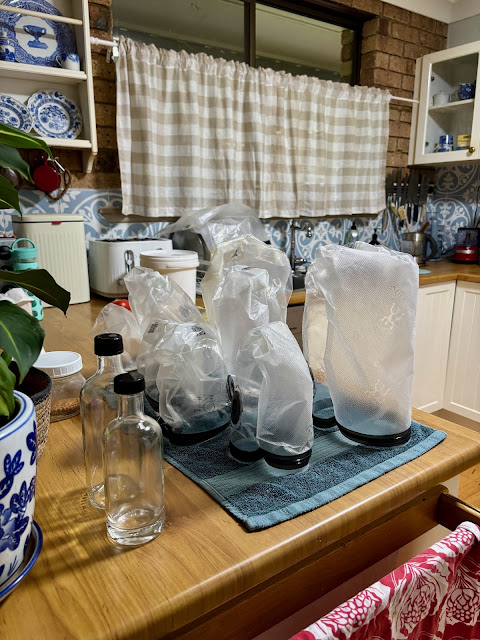
Every morning when I walk into my kitchen it looks tidy and ready for a day's work. Not so on this morning (above), I saw this when I walked in. Late the previous afternoon when I was looking for something, I came across my rolled up Zwilling vacuum bags and decided they had to be washed and dried. So I did that and although I usually put them outside on the verandah to dry it was dark by then. I turned the just-washed bags inside out and left them like this on a towel. It worked well and now the bags are ready to use when I bring home root vegetables, cabbages or whatever I buy that I want to last four or five weeks.
Image

You’ll save money by going back to basics

When I was doing the workshops and solo sessions, I had a couple of people whose main focus was on creating the fastest way to set up a simple life. You can't create a simple life fast, it's the opposite of that It's not one single thing either - it's a number of smaller, simpler activities that combine to create a life that reflects your values; and that takes a long to come together. When I first started living simply I took an entire year to work out our food - buying it, storing it, cooking it, preserving, baking, freezing, and growing it in the backyard. This is change that will transform how you live and it can't be rushed.  
Image


Trending Articles

NOT the last post

This will be my last post here.  I've been writing my blog for 18 years and now is the time to step back. I’ve stopped writing the blog and come back a couple of times because so many people wanted it, but that won’t happen again, I won’t be back.  I’ll continue on instagram to remain connected but I don’t know how frequent that will be. I know some of you will be interested to know the blog's statistics. 
Image

Every morning at home

Every morning when I walk into my kitchen it looks tidy and ready for a day's work. Not so on this morning (above), I saw this when I walked in. Late the previous afternoon when I was looking for something, I came across my rolled up Zwilling vacuum bags and decided they had to be washed and dried. So I did that and although I usually put them outside on the verandah to dry it was dark by then. I turned the just-washed bags inside out and left them like this on a towel. It worked well and now the bags are ready to use when I bring home root vegetables, cabbages or whatever I buy that I want to last four or five weeks.
Image

You’ll save money by going back to basics

When I was doing the workshops and solo sessions, I had a couple of people whose main focus was on creating the fastest way to set up a simple life. You can't create a simple life fast, it's the opposite of that It's not one single thing either - it's a number of smaller, simpler activities that combine to create a life that reflects your values; and that takes a long to come together. When I first started living simply I took an entire year to work out our food - buying it, storing it, cooking it, preserving, baking, freezing, and growing it in the backyard. This is change that will transform how you live and it can't be rushed.  
Image

Creating a home you'll love forever

Living simply is the answer to just about everything. It reduces the cost of living; it keeps you focused on being careful with resources such as water and electricity; it reminds you to not waste food; it encourages you to store food so you don't waste it and doing all those things brings routine and rhythm to your daily life. Consciously connecting every day with the activities and tasks that create simple life reminds you to look for the meaning and beauty that normal daily life holds.  It's all there in your home if you look for it. Seemingly mundane tasks like cleaning and cooking help you with that connection for without those tasks, the home you want to live in won't exist in the way you want it to.  Creating a home you love will make you happy and satisfied.
Image

Time changes everything

I've been spending time in the backyard lately creating a contained herb and vegetable garden. My aim is to develop a comfortable place to spend time, relax, increase biodiversity and encourage more animals, birds and insects to live here or visit. Of course I'd prefer my old garden which was put together by Hanno with ease and German precision. Together, we created a space bursting at the seams with herbs, vegetables and fruity goodness ready to eat and share throughout the year. But time changes everything. What I'm planning on doing now, is a brilliant opportunity for an almost 80 year old with balance issues. In my new garden I'll be able to do a wide range of challenging or easy work, depending on how I feel each day. It’s a daily opportunity to push myself or sit back, watch what's happening around me and be captivated by memories or the scope of what's yet to come.
Image

It's the old ways I love the most

I'm a practical woman who lives in a 1980’s brick slab house. There are verandahs front and back so I have places to sit outside when it's hot or cold. Those verandahs tend to make the house darker than it would be but they're been a great investment over time because they made the house more liveable. My home is not a romantic cottage, nor a minimalist modern home, it's a 1980’s brick slab house. And yet when people visit me here they tell me how warm and cosy my home is and that they feel comforted by being here. I've thought about that over the years and I'm convinced now that the style of a home isn't what appeals to people. What they love is the feeling within that home and whether it's nurturing the people who live there.
Image

Making ginger beer from scratch

We had a nice supply of ginger beer going over Christmas. It's a delicious soft drink for young and old, although there is an alcoholic version that can be made with a slight variation on the recipe. Ginger beer is a naturally fermented drink that is easy to make - with ginger beer you make a starter called a ginger beer plant and after it has fermented, you add that to sweet water and lemon juice. Like sourdough, it must ferment to give it that sharp fizz. To make a ginger beer plant you'll need ginger - either the powdered dry variety or fresh ginger, sugar, rainwater or tap water that has stood for 24 hours to allow the chlorine to evaporate off. You'll also need clean plastic bottles that have been scrubbed with soap, hot water and a bottle brush and then rinsed with hot water. I never sterilise my bottles and I haven't had any problems. If you intend to keep the ginger beer for a long time, I'd suggest you sterilise your bottles. MAKING THE STARTER In a...
Image

An authentic look at daily life here — unstaged and real

Most days Hanno was outside happily working in the fresh air. It may surprise you to know that I started reading my book,  Down to Earth , yesterday - the first time since I wrote it 13 years ago.  I had lent it to my neighbor, and when she returned it, I started reading, expecting to find surprises. Instead, I realised the words were still familiar—as if they were etched into my memory. As I flipped through the pages, I was reminded of how important it was for me to share that knowledge with others. The principles in Down to Earth changed my life, and I truly believed they could do the same for others. After just 30 minutes of reading, I put the book down, reassured that its message still holds true: we can slow down and reshape our lives, one step at a time.
Image