down to earth

  • Home
  • About Us
  • Down To Earth Book
  • Privacy Policy
This isn't a post about that greasy stuff that comes in a polystyrene box, it's about the food you eat when you're in a hurry. Yesterday I spent too much time on the computer (because Hanno used up all our internet Gbs streaming German radio stations, and now we're speed limited) and didn't have time to pack my lunch for work. I didn't get mad at him, I just showed him how to check our usage and got on with it...slowly. LOL

Anyhow, the result was I made a very quick pumpernickel cheese sandwich, grabbed some grapes and peaches and off I went. It was a delicious snack box. I grazed on the grapes in the late morning and ate the sandwich and peaches when our little group all went outside at 12.30 to watch the rain falling.

It made me think about other fast lunches I could make. I have no doubt, with the increased time I'm spending at my volunteer job, that I will have the need to make similar lunches in the near future. Yesterday's lunch took two minutes to get into a lunch box, I think I could also do a one minute lunch. If I cut the sandwich out and took just fruit and cashews, that would be the fastest food I could think of. I'd be quite satisfied with that and as long as I had a bottle of water, or tea in winter, I'd be happy.

I just know there are readers here who would make a wonderful fast lunch that could be taken to work or school, so I'm hoping you'll share your ideas with me. I'm not one to prepare anything the night before and generally our leftovers are eaten at home, but I'm happy to read all the ideas that present themselves here. I might even be convinced to try new ways, so please let me know your ideas about fast portable food.

And here is a little article about lunches from the Melbourne Age. "The older generation are very wary," he says. LOL, that's me alright. ; )

Please check
out Darlene's post about recycling here. It fits in well with yesterday's post and is very interesting.
Paula has asked me to do a post on rags, which, of course, I'm happy to do. This is her request:

"I would LOVE if you would do a post on rags. And a pattern for the adorable rag bag you made. What are rags (please don't laugh)? What do you use them for? How many do you need? Are they the same as kitchen towels (I use these as fabric "paper" towels)? Thanks for your blog. I am learning so much."


Cleaning with rags is the ultimate in fabric recycling. The older the fabric the better it is because it will be soft and very absorbent. I only recycle 100% cotton or linen fabric, again because it's so absorbent. Poly fabric and poly/cotton blends won't wipe spills as well and will never reach that soft fluffy stage cotton and linen have after many washes.

My definition of a rag is a piece of fabric that has been recycled to be used for cleaning or other household duties. I use rags for all my general house cleaning - both moist and dry, for polishing, wiping up spills and sometimes for draining fried foods. Please note: the rags used for cleaning and food prep are two different types and never cross over to do another tasks. I don't fry a lot of food - it will be the odd fried egg or potato pancakes. I use hemmed new 100% cotton instead of paper towels to drain these foods. They are used once, then washed. If there is a lot of fried food, as in the case of potato pancakes, I use three or four clean cloths drain the food. I stopped buying paper towels and napkins a while ago.

I believe the best kind of cleaning cloth is an old towel. When a towel has finished service as a towel, I cut it up into 25cm (10 inch) squares to use as rags. I am a postmodern woman and I like what I use to look like what it is. To me, a rag is a rag and should look like one. We've become used to neat edges and perfection in our store bought cleaning cloths. I usually don't worry about the edges of the terry cloths as they don't fray a lot when I cut them out with pinking shears. But if you're worried about fraying, or if you want to use the rags as dusting cloths, you could run a zigzag stitch around the border to keep the edges contained. You'll need to run the zigzag stitch around all your linen and cotton cloths to stop the fraying. You don't want to be picking up little pieces of cotton from your cloths as you dust. Generally the zigzag stitch is fine on the edges. I am aware though that there are some homemakers who like everything to be neat and tidy, so if you want neat edges, feel free to hem or edge your rags. There are no rules here, you just do what suits you.

I use these rags for my general cleaning. I have one (or more) cloth that is wet and used to clean the sink or bench (or whatever), and a number of dry cloths to dry when I'm finished cleaning. I never leave a surface wet. Drying, or in the case of metal or glass, polishing the surface after it's been cleaned with the wet cloth or scrubbing brush, will give you the best results when cleaning. So, for instance, to clean the kitchen sink, I would use one wet cloth and maybe two dry cloths.

Kitchen rags and general cleaning rags are washed, dried on the line and stored in my rag bag which hangs in the laundry. If one of my dogs is sick and has a little vomit (sorry) inside, I use a rag to wipe up and throw that rag out. That's the beauty of having a lot of rags, you can afford to throw out the odd one, and still have plenty for cleaning.

Cleaning cloths for the bathroom and toilet are never added to the rag bag; they are stored under the sink in the bathroom. I usually colour code my cleaning rags so I know not to use a bathroom cloth in the kitchen. I'm slowly knitting a number of black cloths for the bathroom and toilet. I only have two done so far, but when I have about six of them, I'll only use black cloths for bathroom and toilet cleaning.

I made a larger version of this bag. The measurements of the larger bag are in the photo below. You'll probably need a flap on the front instead of just an opening as the rags will make the bag gape open. Use your clothes hanger as a guide when cutting out the shape at the top. The rest is just straight sides.

Recycling old clothing and towels for cleaning is a really old fashioned thing that I'm sure your grandmothers, and the great grandmas who presented them, all did. Buying cloths specially for cleaning is one of those things we've been duped into. I hope you try this method and stick with it if it works for you. It will save you money, you'll use the products you do buy to their full extent and reduce landfill in the process.

This is just an update on yesterday's post. Tricia saw the bit about the lace doily. She said it was our mother's but it's not hand made. They were mass produced in the 1930s and 40s.
I'm really pleased to let you all know that Kerry is fine. He has a few bruises and sore bits, but he's fine. Hanno and Shane have gone over to see him as Shane is applying for the job Kerry is currently doing. I've spoken to Kerry a few times since the accident and apart from feeling a bit silly because he rolled the car, he's in good health. No doubt Hanno will tell me all about it when they come home. They left yesterday and will be back tonight.

I love spending time alone. I am, by nature, a solitary person so when circumstances present a chance for some time alone, I grab it with both hands. I'm not sure exactly why I love it so because I generally do exactly what I would be doing when my family is here. I still rise and sleep at the same time, I don't do anything especially out of the ordinary and yet there is a relaxed feeling of freedom to do whatever I would like to do. Strange that, as I know I can do whatever I want to do when Hanno is here too. I suppose it's knowing that I have only myself to take care of, there are no cups of tea to be made for someone else and no meals to prepare unless I get hungry.

So what did I get up to yesterday? I worked in my bush house, cleaning it up and getting ready for our main vegetable planting of the year in March. Hanno build a bush house for me shortly after we moved here 10 years ago. It's a simple construction of shade cloth and timber that gives just the right protection from sun, rain and wind. At this time every year, I ready it to hold the seeds I will plant. From late February onwards there will be trays of seedlings in there protected from the elements until they grow large and strong enough to be planted out into the main garden.

The bush house is also home to the worm farm - which you can see in the photo above in the old bathtub, bins of potting mix, pots and various fragile or sick plants. This is where I propagate plants that will later go into the ornamental or vegetable garden. Rosie sits in there on the cool stone floor when it's really hot.

Now is the time I start planning the vegetable year for us. I talk to Hanno about what we'll grow, go through my box of seeds and work out what is there and what we need to trade for or buy, and then write it all down. I generally draw up a plan of our planting so we both know what our original plan was because often when we start planting, it changes for various reasons.

I also grow orchids and maiden hair ferns in the bush house. It provides ideal conditions for their growth and when they're looking good, I sometimes bring them into the house or onto the front verandah so we can see them during the day.

Above and below is a bat flower (Tacca integrifolia) that has just flowered for the first time. This plant is native to south east Asia and Africa, and although our winter temps sometimes drop quite low, it grows well in our sub-tropical climate. I really like the long rubbery whiskers that fall from the centre of the flower.

And last, but not least, is my pride and joy. One of the many bunya seeds I had, has sprouted. It's taken almost 10 months to get to this point but the plant looks strong and healthy so we may just get our own bunya pine to grow in our garden.

The region I live in is the indigenous area of the wonderful bunya pine - a bush tucker food for the aboriginees. I was given the pine seed cone last April (see below) and I divided it up into many segments. I put a hen's egg next to a seed so you can see the size of the seeds. I sent some to my friend Chris in Belize to grow on their permaculture farm in the jungle. His should be almost at this point too so I must remember to email him to see how they're going. He wanted to trial them in their renewable timber forest.

Today I'll be organising myself for work tomorrow and writing a few things for work. It's a public holiday in Australia today and usually I would be working on a Monday. But I look forward to a slow and relaxed day that will prepare me for the week ahead. To my fellow Australians, enjoy your long weekend and to everyone else, I hope the week ahead is a good one for you.

At 11.30 last night we got the phone call no parent wants to get. It was Kerry. "Mum, I rolled the car." Kerry is out west at the moment helping an Australian friend he met in Canada. They're running the kitchen at a five star resort, with their accommodation a few kilometres down the road. Kerry finished work and drove home in the company car but lost control on the unfamiliar road and rolled it. No alcohol or drugs were involved. He told me those brief details while I was still shocked and not quite awake. My first comment was "Are you okay?". He said he was, that he'd hit his head and there was a bit of blood but he felt okay. I told him to go to the hospital to be checked over and to ring straight back if there was any problem. The phone stayed silent the rest of the night. I'll call him later this morning.

I love my boys calling me when something is wrong. It doesn't happen often, but the first thing they do if things aren't quite right, is call me. They like to talk to their mum to get reassurance that all is well and to know we'll be there for them when they need us. I feel honoured to have that trust and I am ever thankful for what has been with them and what is still to come. I can't begin to tell you how grateful I felt that Kerry survived that accident. It could so easily have been different. Just a couple of weeks ago, four boys died in a car accident near there. It is another reminder to me that life is such a brief and fleeting thing, we need to really live it, appreciate the passing of each day and know we have used every hour it gives to its full and true extent.

Yesterday was Australia Day and of course I watched the test cricket on TV. Actually I had the TV on and at times sat and watched and at other times I did chores, or worked quietly in my sewing room, only going to the TV when I heard the crowd cheer. It was a quiet and gentle day full of little organising tasks I've put off for a short while.

It looks like I need to get my scissors out and cut some of those loose threads I've just seen now in the photo below. ; - )

I went through the fabric basket Tricia brought with her when she visited a few months back. I folded and sorted, thought and matched, ironed and colour coded and generally filled the time with tiny tasks that made for a lovely day dotted with pieces of cricket.

I found an old doily that I think was my mothers. Tricia sometimes reads my blog so if you're there Tricia, was this mum's? I seem to remember it being on mum's dressing table. It's a precious piece of self sewn white cotton bordered by hand made lace. There is no seam on the lace so I think it was tatted especially for the fabric. It was hand sewn onto the cotton centre and the white embroidery seems to be hand done as well. I have removed the lace because I want to use the centre piece and the lace in different parts of a quilt I'm planning.

Another small task was to find fabric to match an old cotton jumper of mine that I will cut up and make into other things; the first of these being a tea cosy. I've got the package together now so when I have the time, I'll be set to go. Having projects packaged up and ready is a great encouragement to start and I'm thankful that I have a number of these waiting for my time.


Hanno worked outside most of the day and then went to visit Jens and Cathy. We had leftovers for dinner so I have to say my day wasn't really a work day, but rather a day of fiddling around with bits and pieces and planning for times ahead.

I hope your weekend is filled with gentle pleasures. Thank you for taking the time to visit me and thank you for sharing your thoughts in the comments box.

There is mending to be done today. When I stripped the bed yesterday, I noticed a tiny rip just under Hanno's pillow. The cotton sheet is thinning, but it's still worthy of repair. Mending will give that sheet at least another summer with us before it goes on to other duties like polishing clothes, tomato stake ties or wipes for Airedale beards.

I have to tell you I love mending. It is one of those cherished homemaker duties that really connects me to this life we are living. It is a firm reminder that Hanno and I don't want to live in a throw-away world, that we care for what we own and we reduce, reuse, repair, recycle, renovate and revive. We are renegades and rebels, we don't throw much out. We want to resuscitate the planet, we are into renewal, we want to make reparation. Okay, enough of the "re" words. LOL

I am ashamed to tell you that back in my free-spending years I would throw away a perfectly good shirt or pants rather than repair them. That included throwing away clothes that just needed a button sewn on. : - ( I wish I could take back all those wasteful times but the best I can do now is to make sure I remain a good steward. Whatever needs to be repaired here now, is, and not wasted in the ever growing piles of "landfill" rubbish dumps.


Sometimes I come across a small rip or missing button in the course of my day but I usually find mending jobs when I'm washing or ironing. I make sure now that I look carefully at the fabrics and fasteners and put aside any that need repair. I have a spot in my sewing room where broken clothes and household goods sit until I have enough for a mending session. In the past couple of weeks, I've sewn on a number of buttons, reinforced handles on cloth shopping bags, and patched an old business shirt of Hanno's so he can wear it in the garden. Today I have the sheet to repair and I will also strengthen the top of a zipper on a pair of shorts and hand stitch the hem.

If you're new to mending and repairing, there is a nice little guide here that might help you. Get into the habit of collecting any buttons you find in your home. Have a small (recycled) jar handy to collect them so that when you find the shirt or dress with the button missing, you'll know exactly where to go to the find the matching button. When you're ironing, check hems and collars so you can repair them before they get out of hand. I remember my mother removing collars to turn them over on my dad's shirts. I have no doubt this almost doubled the life of his shirts. I haven't had to turn any collars yet, but it's something I will do in the future.

Here are other guides on how to sew darn a sock or a jumper/sweater, how to sew on a button and how to mend a tear (video). This is a lovely article about mending and the art of living.

I'm off to tidy my sewing room and start my mending. I hope you're having a good week and that you enjoy your time reading here. I send warm hugs to all of you.
There's no doubt about it. Almost everyone has money problems at some time in their life. We all use the stuff, it is a requirement of modern living and for the most part, we don't get much of an education in how to handle it. Usually our lessons are by trial and error and many times we learn a lesson too late to avoid a financial disaster.

Hanno and I made the choice to live on a very meagre budget. We have no debt, an emergency fund, we have money invested and we have shares, but we choose to live frugally. Our total budget for the month is $1370, of which $765 is left in the bank to cover bills and $605 is withdrawn in cash to spend on our needs. The $765 covers car, house and private health insurance, phone, internet, electricity, house and land rates, car registration and maintenance etc.

This is the breakdown of the cash withdrawal - $605:
  • Groceries $290
  • Fuel $120
  • Health $50 (includes vitamins, doctor, pharmacy)
  • General $145 (includes garden supplies, dog and chook food, clothing, pocket money)

The only amounts that are always spent are fuel and pocket money, everything else we usually underspend on. We get $80 a month ($40 each) pocket money. That may be spent on anything we desire, or saved for a double whammy the next month.

The one thing that allows us to be so frugal, apart from our attitude to spending, is our stockpile. Stockpiling allows us to live well on food we usually buy on special and if we are running short on money, we can stop spending on food altogether and live off the stockpile. I was please to see others say they do this in the previous comments.

Let me say here loud and clear: being thrifty is not about being cheap, miserly or being poor. It's more about recognising our own needs and not exceeding them. Now for me, my needs might be that I require to eat healthy food, buy local fresh dairy products, a new car every few years, broadband internet and enough wool and cotton to knit. Your needs, on top of what you need to stay alive, might be organic food, pay TV, a motor bike and good clothes. Or maybe you're more into travel, so a trip overseas every three years, dance class for your daughter, soccer club for your son, 5 magazine subscriptions and 6 books a year. It could be anything within your means. The choice is yours, and you make that choice after you've done up your own budget to find out what money you have left over after you've paid EVERY bill you know you'll receive during the month.

Everyone makes their own choice because we all have difference circumstances, desires and needs. But when you make your choices, you stick with them and you don't add other choices on top. That is when you get yourself into hot water. Unless you're a millionaire, you have to recognise the fact that your money is limited. You have to live within your limits.

This is where personal responsibility comes in. You are aware of the choices you make and accept the consequences of them. I'm sure a lot of us would like to go through life like we did as teenagers - buying whatever we wanted, doing whatever pleased us. If something goes wrong, someone fixes it. There comes a point though that we make a transition to a more mature point, where we think carefully about what we are able to do and what we can't do. We examine our income, write up budget and make our decisions on what we can do within the means we have available to us.

I know there are some of you who will be saying: I deserve a treat every so often. Or, I want to enjoy my life! Maybe you do deserve a treat, but I think you also deserve to live a good and decent life, unburdened by debt. How much of life do you enjoy when you have too much debt? Doesn't the burden of paying off debt dampen a lot of life's joy?

A number of you have allowed me to take you by the hand with advice about other things. I wonder if I can do it with money and budgeting. Do you trust me enough to believe me when I tell you that a budget will help you organise your money? Will you follow my lead on how to manage money? I wonder. This is a tricky one.

I would like to pass on to you three things that will help you:

  • Stop spending.
  • Make a budget and stick to it.
  • Stockpile

But you have to supply the personal responsibility and you have to find the joy of life and not just the pleasure of spending. I know it's much easier for me to write these words than for anyone to act on them. I know it can be done though, because I have done it myself. I used to be a spender and now I'm not, my attitude to spending is completely different now.

I also know I'm at a different stage of life to a lot of you, but that is what I mean about making your own choices. YOU decide what your choices are and as long as those choices are within your means, and you stick to your choices and not keep adding others, then I'm sure you can manage your money well

Tough times are predicted in coming months so some good decisions now may change your life. Are you game enough for this? Can you organise your money instead of it organising you? I wonder who can do it. I'm happy to offer my help if you need help. If you get stuck on your plan or your budget, email me and we'll see what we can sort out together. Good luck everyone.

Niki at rural writings is also writing about money at the moment. Check out her post here.


There is something about January that always sends me a bit nutty. It's kind of a non-month for me. I can't quite organise myself, I'm forgetful and a bit crazy. January is a mad jumble of holidays, relaxation, cricket and the self reflection that comes at the beginning of the year, along with the excitement of new year's celebrations, Australia Day my sister's birthday and going back to school. Even though I have no children at school, when the school holidays are on, it changes the amount of traffic on the roads and the sounds I hear during the day. The last day of holidays I hear the neighbour kids making the most of the last day - there are bike jumps set up out front, crazy games being played and usually a cricket match; the next day, it's just Hanno and I with the sounds of the whip birds.

So it never surprises me to find that every January I have to reorganise my money and spend a period of time tracking what I spend. I've written about this before here, but just to recap, I generally withdraw an amount of money in cash that we use for petrol, food, doctor's bills, chook food etc. This money is put into plastic bags marked for their purpose and as I go through the month, I take cash from the bags as I need it. It really is a great way to organise our money and I always know how much we have for the various things we need to buy.

However, although this system works for us every other month of the year, in January I lose focus and usually have to borrow from one bag to pay for other things. Why am I doing this? Who knows. We usually have money - anything from $20 to $100 - left over at the end of every month, but not in January.

I need to steady this ship. I've put a small notebook in my bag and every time I spend money, I will record it. In a week or two, I'll see what I've been wasting money on and I'll be able to work out ways of stopping it. It won't be anything major, it will be little things like a sandwich when I haven't had time to pack lunch for work, or going over my postal budget - things like that.

You might think I have it together here, and generally I'm quite controlled about what I buy, but I'm not perfect and I do need to refocus occasionally and get back on track. I wonder if others have this same problem. Tell me what happens when you go over your budget. How do you recover from that before it becomes a disaster? There is no shame in this for any of us, we all do what we do. But we can help ourselves, and others, by discussing this subject honestly and sharing how we stay on track with our spending.
I couldn't get back to post this yesterday but I want to update on our three gifts challenges. I know there are a lot of you doing this, so how about letting us know what you've done so far and if you've found any difficulties.

Remember, it's not too late to join the challenge if you missed it first time around. The details are here.


My three gifts are:
  • stop accepting plastic shopping bags
  • stop buying water in plastic bottles
  • provide a suitable container for the smokers where I work and dispose of the cigarette butts correctly

I've taken water from home every time I've gone out and have kept my shopping tote pouch in my basket, so no plastic shopping bags are coming home with me. The cigarette butts have been emptied into the bin but as we're about to move to a new location at work, I'll make sure I set up a similar arrangement in the new building.

What have you done so far?

(I will be back soon with another post.)

Drum Roll .....

PEBBLEDASH

Congratulations Diana. Please email your postal address and I'll get the book in the post as soon as I can.

Don't you just love blogs! Here we all are in various parts of the world, being inspired and changed by people we don't know but feel we do because we read their blog. I guess the best part of any good blog for me is the sharing - the showing of another life in minute detail, seeing inside other homes; being privy to the thoughts of someone many miles away is strangely hypnotic and always fascinating. I feel privileged to look and meet the family, I admire and celebrate the creativity and I melt at some of the phrases and sentences that explain their life and the living of it.

There is only one blog I visit every day but I have several I visit when I have the time. My time on the computer is limited and I want to get the best value for the time I have available. When I read a blog I want to be changed by it. I want to be moved. I want it to make me think. I also want to experience the generosity of the blog - through the telling of the story, the showing of the projects and the sharing of the creativity that makes it all possible.

In my experience, bloggers are a generous bunch. There are so many who freely share and invite readers to use their ideas and patterns. There is an element of worldwide sisterhood in many of the blogs that I find charming and I have no doubt that if these women got together for real coffee rather than the cyber kind, the respect and joy would overflow for all to see.

And speaking of generosity, I am fortunate to extend the generosity of one of the readers here to everyone. A couple of weeks ago Dot sent me a book she thought I might be interested in reading. She asked that after I read it to give it to someone who reads my blog. The book is called Choosing Eden by Adrienne Langman. It's a first hand account of a middle aged couple who give up their life in the city, and all the frills that go with middle class city living, to move to the country to establish a self-sufficient farm that will support and nurture them. It's a good read.

Thank you Dot. : - ) You can check out Dot's own blog here.

If you're a regular reader here, please enter your name in the comments box. I will draw a name from a hat and post the book to the winner.

From this (above), to this (below) in a few short weeks. The picture above was the garden at Christmas time, below was last week. We were grateful for the rain but it hit the garden hard.

We've had a lot of rain here since Christmas and while that is wonderful it has really devastated our vegetable garden. We're still harvesting tomatoes, capsicums (peppers), eggplant, cucumbers, radishes, chokos, Welsh onions and herbs but most of the garden is either bare patches of dirt or weeds. Hanno and I are going to tidy it up today. We'll pull out the weeds and some old vegetables, cut back the plants we'll keep and then leave it until mid March when we'll do our main planting for the year.

This avocado is in its second year. It was one of the beneficiaries of the rain. You can see all the bronze new growth.


I was surprised at the amount of damage the rain caused. We have plants that bent over and snapped, some that died because of the water logged soil and some that grew like mad but didn't produce any fruit. We appreciate the rain so much though. It's saturated the ground that's been dry for a long time and the trees are putting on new growth and look healthier than they have in years.


The last of the potatoes were dug up two weeks ago. We still have some of these in the cupboard but I think they'll all be gone at the end of the week.

I love our vegetable garden. It gives us the freshest organic vegetables possible and if we didn't have it, we couldn't eat as well as we do. Going into the garden in the late afternoon to pick what we'll eat for dinner has become a ritual I enjoy and look forward to. I can also check out the health of the plants and plan future meals when I see vegetables almost at maturity. The garden feeds us all - the humans, the dogs, chooks, cat, worms and the fish, as well as many wild birds. Our silver Perch love munching on parsley and silver beet leaves and I sometimes give them little pieces of left over cooked food.


For the past week we've let the chickens into the garden to scratch around and find grubs, insect eggs and grasshoppers. They love it in there and so far they've been too interested in scratching around for grubs and seeds to realise there are tomatoes and cucumbers for the taking. Yesterday they focused on little green grasshoppers and while I watched, they chased several of them. I helped them a bit by shaking the pigeon peas and all of a sudden the great chase was on again with chooks and grasshoppers in a mad frenzy. Free entertainment. What can't this garden do?

This photo was taken yesterday afternoon. As you can see, there are bare patches and lots of weeds. Gardening is based on time and balance - it will grow in its own time and you get out of it what you put into it. That's how I look on weeding and the less pleasant aspects of gardening. Our work today will make way for lots of fresh vegetables to balance out the weeding and the time we put in.

Planning will start soon for our March garden. We will definitely plant the staples like potatoes, pumpkins, beans, peas and salad vegetables but what type we'll grow this year is anyone's guess. Luckily for me, Green Harvest, that fabulous Australian seed business, is just one street away from where I work. I'll get their catalogue soon, work out what seeds I have here and then my plan will take shape. I would love to try German Johnson tomatoes this year but don't know if I can get the seeds. If anyone out there in Australia has German Johnson seeds to swap, let me know and we'll do a deal. That's half the fun of gardening - swapping heirloom seeds and trying new varieties each year. I've grown the Brandywines for the past few years, along with other smaller tomatoes, it's now time to move on.

If my step son gives us some raspberry canes we'll be planting raspberries too. We had them growing well in the first year we were here but moved them to enlarge the garden. Sadly, they didn't like being relocated. The raspberry Jens has is native to Queensland (where I live) and is a sweet juicy fruit, full of flavour. I wonder if I will get my six jars of raspberry jam. I have my fingers crossed.

This is a shade structure that Hanno put up last summer. We didn't need it this summer. It is a good way of protecting your delicate vegetables from the mid-summer sun. Cucumbers, lettuce and silverbeet happily grew in this tunnel whereas they would have died without it. It might be an idea for all those readers in very hot climates to put up some shade during summer. This one is just star pegs bashed into the ground with a shade cloth top sewn on to poly pipe. The shade can be easily lifted off the pegs and be put away until it's needed again.

I suppose readers in cooler climates are planning their spring and summer gardens now. Isn't it a lovely thing to do? Everything is possible in the planning stage and if you're anything like me you want to try new fruits and vegetables as well as having the comfort of growing your old favourites. I hope we all have healthy gardens and abundance harvests this year, along with the pleasure of gardening. I feel it's a privilege to have a garden - not just the space for one but to be able to work away in the yard, tweaking this and that, cutting back, building up, mulching, making comfrey tea for the lettuces and spinach, banging in stakes and tying plants to a steady and firm support. There are many things to find pleasure in the vegetable garden but I guess my favourite time is when those tiny seeds emerge as a new green promise. That signals for me the real start of the garden and all the joys that will spring from it.
Hello swappers. We seem to have only one lost swapper now . Would Ingeborg please e-mail either Lorraine at: ma_pabarney at hotmail dot com or myself, Sharon at: cdetroyes at yahoo dot com so we can get the last of the swappers together. Thank-you so much. UPDATE: we now have only one lost swapper. Aimee, if you could e-mail me (Sharon) or Lorraine so we can get you together with your partner Maggie. Thank-you so much.
Newer Posts Older Posts Home


My books were all published by Pengiun, and are available at Amazon US, Amazon UK and Amazon Au

Search here

Total Pageviews

Translate


I'm Rhonda Hetzel and I've been writing my Down to Earth blog since 2007. Although I write the occasional philosophical post, my main topics include home cooking, happiness and gardening as well as budgeting, baking, ageing, generosity, mending and handmade crafts. I hope you enjoy your time here.

MY FAVOURITE PLACES

  • Grandma Donna's Place
  • Grandma Donna's YouTube
  • Grandma Donna's Instagram
  • This Simple Day
  • Nicole's Instagram

Give More

Give More

Popular posts last year

Making ginger beer from scratch

We had a nice supply of ginger beer going over Christmas. It's a delicious soft drink for young and old, although there is an alcoholic version that can be made with a slight variation on the recipe. Ginger beer is a naturally fermented drink that is easy to make - with ginger beer you make a starter called a ginger beer plant and after it has fermented, you add that to sweet water and lemon juice. Like sourdough, it must ferment to give it that sharp fizz. To make a ginger beer plant you'll need ginger - either the powdered dry variety or fresh ginger, sugar, rainwater or tap water that has stood for 24 hours to allow the chlorine to evaporate off. You'll also need clean plastic bottles that have been scrubbed with soap, hot water and a bottle brush and then rinsed with hot water. I never sterilise my bottles and I haven't had any problems. If you intend to keep the ginger beer for a long time, I'd suggest you sterilise your bottles. MAKING THE STARTER In a...
Image

NOT the last post

This will be my last post here.  I've been writing my blog for 18 years and now is the time to step back. I’ve stopped writing the blog and come back a couple of times because so many people wanted it, but that won’t happen again, I won’t be back.  I’ll continue on instagram to remain connected but I don’t know how frequent that will be. I know some of you will be interested to know the blog's statistics. 
Image

How to make cold process soap

I'm sure many of you are wondering: "Why make soap when I can buy it cheaply at the supermarket?" My cold process soap is made with vegetable oils and when it is made and cured, it contains no harsh chemicals or dyes. Often commercial soap is made with tallow (animal fat) and contains synthetic fragrance and dye and retains almost no glycerin. Glycerin is a natural emollient that helps with the lather and moisturises the skin. The makers of commercial soaps extract the glycerin and sell it as a separate product as it's more valuable than the soap. Then they add chemicals to make the soap lather. Crazy. Making your own soap allows you to add whatever you want to add. If you want a plain and pure soap, as I do, you can have that, or you can start with the plain soap and add colour, herbs and fragrance. The choice is yours. I want to add a little about animal and bird fat. I know Kirsty makes her soap with duck fat and I think that's great. I think t...
Image

Preserving food in a traditional way - pickling beetroot

I've had a number of emails from readers who want to start preserving food in jars but don't know where to start or what equipment to buy.  Leading on from yesterday's post, let's just say up front - don't buy any equipment. Once you know what you're doing and that you enjoy preserving, then you can decide whether or not to buy extra equipment. Food is preserved effectively without refrigeration by a variety of different methods. A few of the traditional methods are drying, fermentation, smoking, salting or by adding vinegar and sugar to the food - pickling. This last method is what we're talking about today. Vinegar and sugar are natural preservatives and adding one or both to food sets up an environment that bacteria and yeasts can't grow in. If you make the vinegar and sugar mix palatable, you can put up jars of vegetables or fruit that enhance the flavour of the food and can be stored in a cupboard or fridge for months. Other traditional w...
Image

Cleaning mould from walls and fabrics

With all this rain around we've developed a mould problem in our home. Usually we have the front and back doors open and that good ventilation stops most moulds from establishing. However, with the house locked up for the past week, the high humidity and the rain, mould is now growing on the wooden walls near our front door and on the lower parts of cupboards in the kitchen. Most of us will find mould growing in our homes at some point. Either in the bathroom or, in humid climates, on the walls, like we have now. You'll need a safe and effective remedy at some point, so I hope one of these methods works well for you. Mould is not only ugly to look at, it can cause health problems so if you see mould growing, do something about it straight away. The longer you leave the problem, the harder it will be to get rid of it effectively. If you have asthma or any allergies, you should do this type of cleaning with a face mask on so you don't breathe in any spores. Many peopl...
Image

Five minute bread

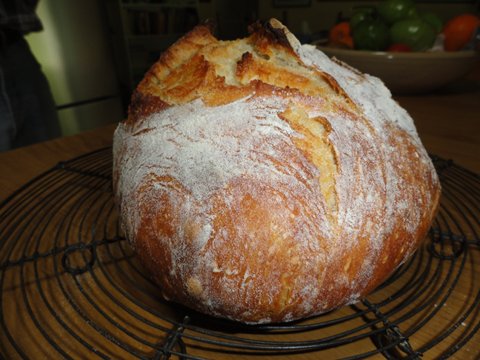
Bread is one of those foods that, when made with your own hands, gives a great deal of satisfaction and delight. It's only flour and water but it symbolises so much. I bake bread most days and use a variety of flours that I buy in bulk. Often I make a sandwich loaf because we use most of our bread for lunchtime sandwiches and for toast. Every so often I branch out to make a different type of loaf. I have tried sour dough in the past but I've not been happy with any of them. I'll continue to experiment with sour dough because I like the idea of using wild yeasts and saving the starter over a number of years to develop the flavour and become a part of the family. However, the loaf I've been branching out to most often is just a plain old five minute bread. By five minutes I mean it takes about five minutes actual work to prepare but it's the easiest of all bread to make and to get consistently good loaves from. If you're having people around for lunch or...
Image

This is my last post.

I have known for a while that this post was coming, but I didn't know when. This is my last post. I'm closing my blog, for good, and I'm not coming back like I have in the past.  I've been writing here for 16 years and my blog has been many things to me. It helped me change my life, it introduced me to so many good people, it became a wonderful record of my family life, it helped me get a book contract with Penguin, and monthly columns with The Australian Women's Weekly and Burke's Backyard . But in the past few months, it's become a burden. In April, I'll be 75 years old and I hope I've got another ten years ahead. However, each year I'll probably get weaker and although I'm fairly healthy, I do have a benign brain tumour and that could start growing. There are so many things I want to do and with time running out, leaving the blog behind gives me time to do the things that give me pleasure. On the day the blog started I felt a wonderful, h...
Image

What is the role of the homemaker in later years?

An email came from a US reader, Abby, who asked about being a homemaker in later years. This is part of what she wrote: "I am a stay-at-home mum to 4 children, ages 9-16. I do have a variety of "odd jobs" that I enjoy - I run a small "before-school" morning drop-off daycare from my home, I am a writing tutor, and I work a few hours a week at a local children's bookstore. But mostly, I cherish my blissful days at home - cooking, cleaning (with homemade cleaners), taking care of our children and chickens and goats, baking, meal-planning, etc. This "career" at home is not at all what I imagined during my ambitious years at university, but it is far more enriching. I notice, though, that my day is often planned around the needs of my family members. Of course, with 4 active kids and a husband, this is natural. I do the shopping, plan my meals, cook dinner - generally in anticipation of my family reconnecting in the evening.  I can't h...
Image

Every morning at home

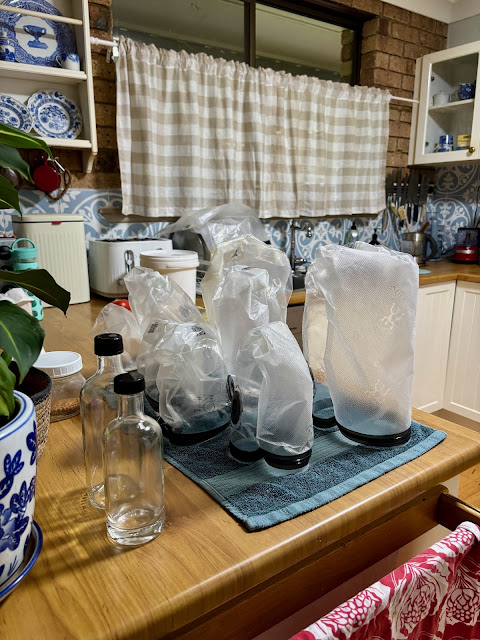
Every morning when I walk into my kitchen it looks tidy and ready for a day's work. Not so on this morning (above), I saw this when I walked in. Late the previous afternoon when I was looking for something, I came across my rolled up Zwilling vacuum bags and decided they had to be washed and dried. So I did that and although I usually put them outside on the verandah to dry it was dark by then. I turned the just-washed bags inside out and left them like this on a towel. It worked well and now the bags are ready to use when I bring home root vegetables, cabbages or whatever I buy that I want to last four or five weeks.
Image

You’ll save money by going back to basics

When I was doing the workshops and solo sessions, I had a couple of people whose main focus was on creating the fastest way to set up a simple life. You can't create a simple life fast, it's the opposite of that It's not one single thing either - it's a number of smaller, simpler activities that combine to create a life that reflects your values; and that takes a long to come together. When I first started living simply I took an entire year to work out our food - buying it, storing it, cooking it, preserving, baking, freezing, and growing it in the backyard. This is change that will transform how you live and it can't be rushed.  
Image


Trending Articles

NOT the last post

This will be my last post here.  I've been writing my blog for 18 years and now is the time to step back. I’ve stopped writing the blog and come back a couple of times because so many people wanted it, but that won’t happen again, I won’t be back.  I’ll continue on instagram to remain connected but I don’t know how frequent that will be. I know some of you will be interested to know the blog's statistics. 
Image

Every morning at home

Every morning when I walk into my kitchen it looks tidy and ready for a day's work. Not so on this morning (above), I saw this when I walked in. Late the previous afternoon when I was looking for something, I came across my rolled up Zwilling vacuum bags and decided they had to be washed and dried. So I did that and although I usually put them outside on the verandah to dry it was dark by then. I turned the just-washed bags inside out and left them like this on a towel. It worked well and now the bags are ready to use when I bring home root vegetables, cabbages or whatever I buy that I want to last four or five weeks.
Image

You’ll save money by going back to basics

When I was doing the workshops and solo sessions, I had a couple of people whose main focus was on creating the fastest way to set up a simple life. You can't create a simple life fast, it's the opposite of that It's not one single thing either - it's a number of smaller, simpler activities that combine to create a life that reflects your values; and that takes a long to come together. When I first started living simply I took an entire year to work out our food - buying it, storing it, cooking it, preserving, baking, freezing, and growing it in the backyard. This is change that will transform how you live and it can't be rushed.  
Image

Creating a home you'll love forever

Living simply is the answer to just about everything. It reduces the cost of living; it keeps you focused on being careful with resources such as water and electricity; it reminds you to not waste food; it encourages you to store food so you don't waste it and doing all those things brings routine and rhythm to your daily life. Consciously connecting every day with the activities and tasks that create simple life reminds you to look for the meaning and beauty that normal daily life holds.  It's all there in your home if you look for it. Seemingly mundane tasks like cleaning and cooking help you with that connection for without those tasks, the home you want to live in won't exist in the way you want it to.  Creating a home you love will make you happy and satisfied.
Image

Time changes everything

I've been spending time in the backyard lately creating a contained herb and vegetable garden. My aim is to develop a comfortable place to spend time, relax, increase biodiversity and encourage more animals, birds and insects to live here or visit. Of course I'd prefer my old garden which was put together by Hanno with ease and German precision. Together, we created a space bursting at the seams with herbs, vegetables and fruity goodness ready to eat and share throughout the year. But time changes everything. What I'm planning on doing now, is a brilliant opportunity for an almost 80 year old with balance issues. In my new garden I'll be able to do a wide range of challenging or easy work, depending on how I feel each day. It’s a daily opportunity to push myself or sit back, watch what's happening around me and be captivated by memories or the scope of what's yet to come.
Image

It's the old ways I love the most

I'm a practical woman who lives in a 1980’s brick slab house. There are verandahs front and back so I have places to sit outside when it's hot or cold. Those verandahs tend to make the house darker than it would be but they're been a great investment over time because they made the house more liveable. My home is not a romantic cottage, nor a minimalist modern home, it's a 1980’s brick slab house. And yet when people visit me here they tell me how warm and cosy my home is and that they feel comforted by being here. I've thought about that over the years and I'm convinced now that the style of a home isn't what appeals to people. What they love is the feeling within that home and whether it's nurturing the people who live there.
Image

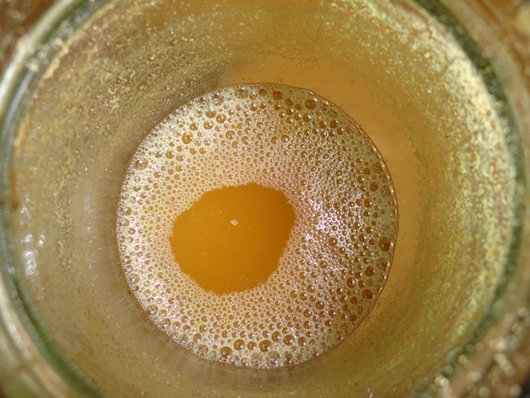
Making ginger beer from scratch

We had a nice supply of ginger beer going over Christmas. It's a delicious soft drink for young and old, although there is an alcoholic version that can be made with a slight variation on the recipe. Ginger beer is a naturally fermented drink that is easy to make - with ginger beer you make a starter called a ginger beer plant and after it has fermented, you add that to sweet water and lemon juice. Like sourdough, it must ferment to give it that sharp fizz. To make a ginger beer plant you'll need ginger - either the powdered dry variety or fresh ginger, sugar, rainwater or tap water that has stood for 24 hours to allow the chlorine to evaporate off. You'll also need clean plastic bottles that have been scrubbed with soap, hot water and a bottle brush and then rinsed with hot water. I never sterilise my bottles and I haven't had any problems. If you intend to keep the ginger beer for a long time, I'd suggest you sterilise your bottles. MAKING THE STARTER In a...
Image

An authentic look at daily life here — unstaged and real

Most days Hanno was outside happily working in the fresh air. It may surprise you to know that I started reading my book,  Down to Earth , yesterday - the first time since I wrote it 13 years ago.  I had lent it to my neighbor, and when she returned it, I started reading, expecting to find surprises. Instead, I realised the words were still familiar—as if they were etched into my memory. As I flipped through the pages, I was reminded of how important it was for me to share that knowledge with others. The principles in Down to Earth changed my life, and I truly believed they could do the same for others. After just 30 minutes of reading, I put the book down, reassured that its message still holds true: we can slow down and reshape our lives, one step at a time.
Image