down to earth

  • Home
  • About Us
  • Down To Earth Book
  • Privacy Policy
I have received quite a few emails lately asking about what I call the hierarchy of food. The questions ask how important is it to eat organic food, how can we afford to buy it on our limited budget and how does organic food fit into a simple and frugal life.

As many of you know, we grow a lot of our own fruit and vegetables and we have chooks for eggs; all that is organic. We try to grow our garden so we have a continuation of supply but that doesn't always happen so we have to buy what we need. This is how we do it and my reasoning behind where we buy what we do.

We never buy certified organic fruit and vegetables. We can't afford it, but I don't worry about it. We buy Australian fruit and vegetables from Aldi if we are due to go there for our grocery shopping, if not we'll go to the local Sunday farmers market and buy there. I have no doubt some of the produce there is organic but isn't sold as organic because it's not certified. We never buy from Coles or Woolworths but I do buy Australian produce from our local IGA and green grocer, and check out the prices at each place before buying (they are across the road from each other). If there is a choice, we buy from our our State, if not, we buy Australian. I never buy fresh fruit or vegetables from another country, I prefer to go without.


Homemade corn and barley loaf.

We buy organic bakers flour and it's the only organic product I continue to buy. It's more expensive than the ordinary flour but we eat bread every day and I think it's better that it's mainly organic. The other ingredients in the bread aren't organic, but plain cooking salt is as close to organic as you get without a certification, the butter and milk powder aren't organic and neither is the yeast. I try to not think about the milk powder, I have a lot of it in my stockpile cupboard and I'll use it all but I don't use it instead of liquid milk now, I only use it in cooking. Reading Nourishing Traditions has changed my mind on milk powder.


Homemade rosella cordial.

We usually buy local fresh Guernsey milk. I see these cows grazing on pastures around here every time I drive up the mountain. They live in a healthy natural environment. The dairy industry is a small, but important, part of the area I live in. We want to support them, so we buy local dairy foods, and that includes local cheese and yoghurt. I still make my own yoghurt when I can but when I buy it, it's locally made, but not organic.

Since we read Nourishing Traditions and have added back a small amount of meat to our diet, we buy local pasture raised, grass fed meat. This meat is usually shin beef, which I slow cook for the natural gelatine it contains. The meat is not organic, but it is local.

When you do your shopping, and if you can't afford to buy organic food, try to buy local. You might find that your local butcher or green grocer has sourced local food and will know a lot more about the food they sell than your local supermarket. If you live in an area where people are growing food, try to barter with them. If you're growing some of your own food, you might be able to barter eggs for honey, tomatoes for local milk or a box of your produce for some meat from your local butcher. Anything is possible, you just have to ask around.


Last year's winter garden.

As homemakers we are responsible for the food brought into our homes and for buying the healthiest food for the dollars we have available. I believe that if you are living on a limited income you will do more for your health if you cook from scratch, with as much fresh produce as possible, than trying to buy all organic food. Get rid of the food that contains preservatives and added flavourings and colours. Buy oatmeal instead of processed cereal, make macaroni and cheese from scratch, not from a box, encourage your family to eat fresh fruit by having a bowl of it on the kitchen table. Start your own vegetable garden if you have the space and time. Get rid of your chemical cleaners and clean instead with vinegar, bicarb and soap. Recipes for making your own cleaners are here. That will be a big step towards a healthier life.

Don't be pressured into buying organic food if you can't afford it. Of course it's great to eat organic if you can, but when you have to stretch your dollars as much as possible, all organic usually isn't an option. Like everything else in this simple life, it takes a bit of organising to discover where you'll get value for money, but always be guided by your own values, not by what someone tells you or what you read - and I include my blog and myself in that. If what I write here doesn't fit well with your value system and how you've decided to live, don't do it. Simple living is all about living an authentic and examined life and if you've thought about the values you want to live by, be confident and stick with them no matter what others around you are doing.


Pebbledash picked it up, I am turning 61, not 62! Thanks Diana. Meryl, one of the volunteers I work with picked it up too. When I mentioned at lunch yesterday that my birthday was coming up, she said it didn't seem so long ago we celebrated my last birthday. Then it hit me, they gave me a morning tea for my 60th, I'm still a mere slip of a girl - I'm going to be 61. :- )

I removed the email subscription yesterday. I have to apologise for mucking you around. Those 30 or so people who subscribed yesterday will have to do so again when I find another widget. When I went to change a setting on the old one yesterday, I found they send advertising with the email. I won't be a party to that. Apart from not wanting to promote things you might spend money on, I don't know what sort of advertisement they might send. It could be anything. So I will look for a new widget but I can't do it today. And again, I'm sorry for this inconvenience.

..................................................................................................................

I have been touched by the number of emails I've received lately from new readers wanting to live a life similar to ours here. I'm asked all sorts of questions about the type of chooks we have, how many water tanks, what food we eat on a day-to-day basis and how many loads of washing I do each week. Some people ask about when I go to bed, when I get up in the morning, do I drink green tea or black, what would I buy if I had the money and how do I cope with living on a restricted budget. It seems to me that these questions are about one thing - they are trying to find "the formula", they want to know how to live simply. But simple life is different for everyone, there is no formula, no one way to do it. The secret is to decide how you want to live, work out what values are important to you, then work towards the goals you set.

If you do that, if you develop a set of values that support how you want to live, it will be easier to pinpoint areas you can change in your life to reflect your values. For example, if you decide that one of the values you want to embrace is to live a more healthy life and buy local, you'd probably have to look at what you're eating and change how you shop. Instead of shopping only at the supermarket, you'd also need to go to local markets, find out with other local food is produced and then work out a way to buy it. You'd also look at the chemicals you have in the house, get rid of them and work out what alternatives you could use. If one of your values was to be more frugal, and through that work towards paying off your debt, then you'd probably start by tracking how you spend your money and work out a budget. Then you'd go through your bills and work out what you could do without - pay TV, the second car, ballet lessons for the children, your magazine subscriptions etc. Then you'd work out ways to save money in the home.


Shhhh, it's a worker in the front garden.

A few days ago, I made a big pot of pea soup that will keep us going for about seven evening meals, plus the occasional work lunch. That soup cost me four dollars to make and works out to be about 57 cents for the two of us each dinner time. Some people will look at that and think eating pea soup for a few nights in a row is boring and some would just refuse because they want to eat steak and three veg or roast pork. But I don't think like that anymore. That soup supports our simple values in many ways. The truth of it is that eating that soup helps us stay on budget, it frees up other money so we can buy fresh local milk, cheese and fish, it saves us money on utility bills because we only have to heat it up each day, it saves time because I don't have to cook a meal each night and it's a nourishing and delicious meal that we both enjoy.


Native violets have naturalised in the gardens and are spilling over into the lawn.

Some of the things many of us do during the normal course of a day include baking bread, walking to the shops, sweeping the floor instead of vacuuming, washing up by hand instead of using the dishwasher, stockpiling to save money and time, making yoghurt from scratch and growing some of our own food in our backyard. Now if I were new to this way of living, and I saw many of those common tasks of a simple home, I'd probably think it was too much work and why bother. Why do all that work when I can easily buy what I need. But the fact is that doing those things support the life I want to live, so doing them is not a bother to me. So you see, working out what is important to you, knowing what you want to include in your own life, and then doing those things on a daily basis, will help you live more simply and even though it will be tough at times, you'll stick with it because you're working towards your goals.


Hanno is preparing the front garden for the wedding.

Simplifying will never be about the colour of the chickens in your backyard, the brand of breadmaker you own, how many jars of jam and relish you put up each year or how many acres you 'own'. It is always about the way you think about your life and how you express those thoughts by how you live. I am flattered that many of you want to do things in a similar way to how we do them here and maybe some of you will settle into a life very similar to mine, but I encourage you think about your life, think about what is important to you and then set about building your life to support your values. We don't all have to be carbon copies of each other. In fact that is one of the things that is so appealing about this way of life - we can all express it in differing ways and still be part of the whole.


A Cecile Brunner rose, a tiny rose the size of a finger nail, is growing over the garden arch.

I don't want to put you off your changes, and I'm not saying don't copy what I do. I am encouraging you to be very clear about what is important to you. Before you start changing your life, you'll have to think about it a lot. Don't just dive in and do what others are doing. Think about what you hope you life will become, think about what you consider to be important, then the path you need to take will be clear. Often the first step is the most difficult, in this case it isn't. Your first step is to make a cup of tea, gather a pen and paper, then sit in your favourite spot and think about what you want and how you would like to live, write it down in bullet points. You might need a few sessions - just you, your thoughts and your pen and paper. When you have a list, go through it a couple of times and cross off what's not really important, keeping only those points you think will make you happy, fulfilled and content. That is your map, my friends. Once you have your map, then come back here and ask questions that will help you follow your map. I am happy to answer your questions, and many of the other readers are too. If you ask something in the comments, you'll get opinions from a few of us. But that's one of the beauties of a simple life. It's about communities working together to help each other and we have a wonderful community here willing to help you.


Some of you might remember that I did an interview with Radio National recently. That program will be broadcast tomorrow, Thursday, at 8.30 am Australian eastern time. The program is call Future Tense, here is their website, a description of the program is here.
And here is part of the Radio National email sent earlier this week:
"You can let your international readers know that they can either download the program (as a podcast) or listen to the streaming audio. All the audio options will be available on the site about 30 minutes after the program goes to air.

There will also be a transcript that will be available later in the day on Thursday.

This link might be of interest for some of your Australian readers. It lists all the different radio frequencies for Radio National across the country."

If you miss it, there will be a podcast for download about 30 minutes after the broadcast. They also interview journalist Farhad Manjoo from slate.com I hope you enjoy it.

I have to do some catch up chores this morning - I'll make the bed, tidy up, bake bread, check the garden, skin some luffas and then settle in for some more book writing. I'm in the final stages of the book proposal, which will be sold to a publisher at the end of April. I'm enjoying the process, even if the transition from my voluntary work on Mondays and Tuesdays back to home, then writing is a bit of a jolt. I think it keeps my brain working well so I'm happy for that.

Speaking of working brains, I have been reading about Blue Zones lately. You might all know a lot more than I do because when I started googling, I found it had been the subject of an Oprah show a while back. So bear with me if I'm just repeating what you already know.

I find the concept of Blue Zones fascinating. Basically, they're fairly isolated areas around the world where people commonly live very long lives, often over 100 years. The Blue Zones already identified are Okinawa, Japan, Loma Linda, California, USA, Sardinia, Italy and there may also be one in Costa Rica. The diagram demonstrates the common factors in the communities in Japan, USA and Italy. (Click on the diagram to enlarge it.)

The following passage and list, in quotes, is from Wiki:

"The people inhabiting Blue Zones share common lifestyle characteristics that contribute to their longevity. Among the lifestyle characteristics shared among the Okinawa, Sardinia, and Loma Linda Blue Zones are the following:[2]

  • Family - Family is put ahead of other concerns.
  • No Smoking - Centenarians do not typically smoke.
  • Plant-Based Diet - The majority of food consumed is derived from plants.
  • Constant Moderate Physical Activity - Moderate physical activity is an inseparable part of life.
  • Social Engagement - People of all ages are socially active and integrated into their communities.
  • Legumes - Legumes are commonly consumed."

I find it really interesting, and affirming, that the five principles above link in very nicely with the way many of us live. We have an emphasis on family, I have never written about smoking before but Hanno and I don't smoke, we eat a plant-based diet, including a lot of beans, and I love these last two - social engagement with people of all ages socially active and integrated into their communities and constant moderate physical activity.

From what I've read, the constant moderate physical activity is often associated with gardening and the work needed to run a home well. These people look after themselves, and then reap the benefits of that moderate activity and social engagement. I hope to live to a ripe old age and it looks like I might have a chance if I keep living this simple life.

And finally, I found this charming newspaper article I want to share with you. I think it shows the benefits, for both young and old, when fellowship and generosity are explored. In our youth obsessed culture it's nice to find such a wonderful and enriching account of friendship.

Hello and welcome to all the new readers. Thank you for the comments left yesterday, and for all the links to labels. I'll try to get back to them, and some emails, later today.

We had a major problem in our kitchen in 2007. Our dishwasher hose started leaking water and before we knew what was happening, the floating timber floor had a cushion of water under it. We claimed on our insurance and to make a long story short, had to have everything in the kitchen removed to dry out the flooring, then, when they realised that wasn't going to happen, the flooring was replaced and everything put back, including the cupboards. They had to replace the bench tops too because when the cupboards were taken out the bench tops split. Great news, we had a new floor and bench tops, but the truth of it was that we were without a kitchen for a week and it was a major inconvenience.

However, I always try to mine even the smallest piece of gold from every disaster. When we moved everything back in, I rearranged the way I used my kitchen. When we first moved into this beautiful home of ours, I was working outside the home, so the kitchen was set up for quick meals and teenage boys. Over the years I'd changed a few things to better suit how I worked, but when we put back the contents of our cupboards I thought about how I wanted the kitchen to work and made more changes. The large sliding drawers under the stove now hold all the plates and bowls we use every day; they used to house the saucepans. Now I can easily take a plate from a drawer as I'm cooking and the saucepans, that are needed much less often than the plates and bowls, are in a cupboard.

Now my electric kettle is sitting with my tea canister, a little cupboard just above them holds instant coffee and different types of tea, the cupboard next to that holds the tea cups and coffee mugs. The zone is right beside the sink so the water is close. The toaster and bread bin are close together, next to the sandwich toaster. My pantry and fridge are at the end of my main work bench. The pantry holds my bread flour, sugar and salt, the fridge holds the yeast and butter, so when I'm making up my bread dough, I just move from the bench to the end of the bench and for that small job, everything is within my reach. They say the best design for a kitchen is to have the stove, fridge and sink in a work triangle where each side of the triangle is no more than 9 feet and no less than 4 feet. We do have that work triangle configuration in our kitchen but having areas broken up into smaller working zones works better for me.

I wonder if it would help you too. Our kitchens are probably our main work area, we work in there a few times each day, often much more, depending on the size of the family. Setting up your kitchen according to the tasks you carry out each day may help you do your work. If you decided to try this, it would work if you did the entire kitchen in one go, but it would also work if you chose one job, like tea and coffee making, and made a zone for that. When you had more time, you could rearrange other areas into zones for their purpose. You could also rearrange your pantry to have all your baking requirements in the same place. That is my next job - the next time I clean out my pantry, I'm going to place all my regular baking requirements in one area; jars holding chick peas, lentils, beans and rice in one line; the smaller containers of different flours - self raising, plain, gluten, soy, corn and barley flour in another line. At the moment, I have a general idea where everything is, but often I'm moving jars and sealed buckets around to find exactly what I need. And that reminds me, I have just picked up five two litre size, food grade buckets with lids and I need to label them. They were free. :- ) Does anyone know a site were I can download free kitchen labels?

When everything is sorted in the way you work, all the tasks you carry out everyday will have the requirements close at hand. Those things you rarely use will be in those hard to get at spaces. My kitchen isn't perfect, for instance I'd like my cutlery drawer to be next to the plate drawer, but it's opposite it. It requires my turning around to get a spoon for stirring on the stove. But I don't worry about the things I can't move, I just move everything as close as possible to the zone it should be in, and am happy with that. I'm sure many of you have already done this but I know there will be many who haven't. So if you decide to give it a try, I hope it works as well for you as it does for me. Let me know if you do any rearranging and if you have a blog and post a picture, give me the link and I'll have a look at your handy work.

And just to finish off, I haven't done much square knitting lately because I've been writing a lot, but I will get some done later this week. I am still very interested in my rug, and yours, so how are you going with your knitting?


I spent a lovely weekend here with Hanno. Not much happened, there were a few phone calls and little else. Hanno worked on the garden, cleaned out the chook house, Lucy-proofed the garden fence and mowed. I spent most of my time either writing or cooking and a couple of times we sat together on the front porch with our tea, talked and just enjoyed the weather and the scenery. It's been raining on and off most of the weekend, so it was just the right weather for baking. I've been experimenting with a tablespoon of boiling water in my cakes lately and I have to tell you it works a treat, giving a moist cake that will last quite well. Today's recipe is for the best cake I've ever made.

Really - it's THE best cake I've ever made. I baked it last weekend, we ate it on Sunday and during the week, having the last piece on Friday. It was still moist and delicious. This is a must try recipe.

The only change I made was to use eight bananas - but they were our little Lady Finger bananas, which would have been the equivalent of the three large bananas, mashed, in the recipe. Please try it and let me know.

The boiling water trick works in other cakes too - just add it after your cake is mixed and stir in. It gives a moistness you won't have otherwise.

I baked breadrolls on Saturday and Sunday but made the dough for both on Saturday morning. I wanted four rolls on each day, so I made up the recipe below, threw it all in the breadmaker, flour first then everything else on top.


I set the machine to the dough setting and when it's done kneading, I divided the dough in two equal portions, placed one in a plastic bag in the fridge. On Saturday our topping was polenta.


Can you see the small strand of bread attaching one roll to the next. That the sign of a good dough. And here it is again the following day on our Sunday rolls.


The dough needs to return to room temperature before it will do its second rise. I removed the dough from the fridge at 6 am and it was just ready to bake at 11.30am. On Sunday I topped the rolls with oatmeal.


You will notice in the photo of the uncooked rolls, I'm using a silicone baking mat. I've been using this, on and off, for about 18 months now and it's still working well. It's non-stick, reusable and easy to clean. This is not an advert, I have no idea what brand mine is, but I want you to know there are alternatives to parchment paper that can be reused many times.

Bread roll recipe

2 level teaspoons dry yeast, proved in ½ cup warm water + 1 teaspoon sugar or honey
4 cups bakers flour
1 teaspoon cooking salt (or kosher salt)
1 tablespoon soft butter
2 tablespoons milk powder (optional)
enough water to make a good dough - about 2 cups

The amount of water you add will depend on your flour and the weather. If it's humid you'll use less. Learn the feel of good dough. You should feel EVERY dough you make between your fingers. Aim for a moist dough that holds together well, has no areas of dry flour, but is not wet. When you know the feel, you'll be able to judge the amount of water in the dough by the feel of it.

Thank you all for the comments and good wishes yesterday. Both Hanno and I read them all. I also want to thank my dear friend Sharon who has worked on Down to Earth with me for a long time now. She just offered her help one day and that was that, we are firm friends now. Sharon is the reason the swaps are still going, she organises them along with Rose now, and Lorraine in the past. Thank you all, ladies. I appreciate your help, it is a real pleasure for me to work with you.


When I turned off my computer yesterday, the counter was on 999,934. This morning it had clicked over to 1,001,100. I can't quite believe it! When I first started my blog, in those early days when I wondered about a name, what to write about and if anyone would read, I never for one second, imagined that less than two years later (started May 2007) over a million visits would be registered.

I started the blog because I'd written the beginnings of a book on simple living that had been rejected by Australian publishers. I'd earned a living as a writer for a long time and when I got those rejections, and I knew I wouldn't be writing the book, I started this blog so I could continue writing.

My hope in those early days was to create a record for us of what we were doing on a day to day basis, and if anyone visited, to encourage them by that example. Well, people did come, they asked questions, made comments and instead of me encouraging the visitors, I was encouraged to continue because of the questions and comments.

Along the way I've made many friends, met a handful of you, and all the while been amazed by the extraordinary international blogging community that has built itself from scratch. I have been challenged by the sewing and knitting blogs, affected and motivated by many of your personal blogs and, overall, been encouraged by the knowledge that like minded folk all over the world strive to live in the same simple way Hanno and I do.

Blogging has confirmed my belief that the written word is a powerful force. It has given a voice to many of us, who, without the ability to tap away on our keyboards, then press the 'publish', button, would never have our stories read or connect in the way we do. Blogging is a communication revolution in which we ordinary people bypass the restrictions and bias of the print and electronic media and say whatever it is we want to say from our own homes. Gone are the days when we rely on magazines, TV, radio and newspapers for our information, now we print our own little newspapers each day and self-publish into an ever growing community of blog readers. Never underestimate the power of that 'publish' button.

I hope my posts help you in your quest for a simple life. I want to encourage you not to copy what we do but be encouraged enough by it to build a life that suits you and your family. My hope is to challenge you to believe that you can change your life because often, our mainstream media want you to remain the same or follow what their advertisers dictate. I am not a change the world sort of blogger because I know we all have to change ourselves before any world change is possible. If there is wide spread change in the coming years it will be because backyards are filling with vegetables and chooks, because we are being prudent and selective with our spending and because we expect more and do more for ourselves.

I guess my blog has completed a circle in some ways because I am now writing a book because of it. I have a literary agent in New York, who found me through this blog, and will soon sell the north American rights to my book on simple living. You are part of the reason I am writing that book now. If you had not been reading here, if you had not challenged me to keep going by asking your questions and making your comments, I probably would have not kept writing as regularly as I did. So for your part in this blog and that book, I thank you sincerely.


We had a feeling there would not be many potatoes in that last lot we planted. Hanno dug them up yesterday and we only had about two kilos (4½ lb) from the entire bed. One end of the potato patch never flowered, the other end had a few flowers and was the area that gave us what we harvested, most of them are small potatoes. It's really disappointing when we prepare a bed, plant seeds and tend the garden to have little return for the effort. We try to live on what we grow in our backyard, it makes up the major part of the organic fruit and vegetables we eat, and when it fails, even if we work out what went wrong, it feels bad. We think we had too much rain and that adversely affected the potato crop. Rain is usually not a problem in our garden, but when it comes to root crops, too much rain over an extended period can rot the crops in the ground. Hanno is preparing another garden bed for our next potato crop.


We are also preparing the front garden for the wedding. Hanno has trimmed bushes, weeded the gardens and planted up a few new plants we bought last weekend. It's starting to look really pretty and we hope that by the end of June, the new plants will have grown and there will be a few flowers around, even though it's the middle of winter. Shane and Sarndra are in New Zealand now, working as WWOOFers (willing workers on organic farms) and moving around the country exchanging their labour for four hours a day in exchange for food and a bed. If you read this S & S, I hope you're still enjoying yourselves and meeting nice people. We miss you!


I had a comment from Julie M yesterday about our down days. In part Julie writes: "The reason I decided to post today has been on my mind for awhile. Reading everyone's posts breaks any preconceptions that leading a "simple" life is a painless and smooth journey, however no one has ever really given the stories of the "down days." Everyone has bad days, and I would imagine there is a time in this "simple" journey when it'd just be easier to chuck in the towel and give in the the tide of normality. I think what leads me to this query is that, perhaps everyone wants to highlight only the good while minimizing the dirty part of this journey, but surely this lifestyle isn't "perfect" (whatever that is?). We're all human, but I have yet to read any stories of a "bad day"... They do exist, right?"

Hi Julie, thanks for your comment. Although I have written a few times about a day not being great, or feeling down, generally our days here are actually very good. I think the common complaint is that we, the people who live this way, are not understood by those around us and are seen as a bit weird. That doesn't bother me, I've never been one to fall in with what my peers are doing, I think I must follow my own path, and usually I don't worry if others think I'm strange. Early on in my journey, before Hanno realised we really could live like this, we had a lot of discussions, sometimes heated ones, about this change and how if would affect us as a family. Even then, I felt we were on the right path and given time Hanno would see that for himself. I wrote about that yesterday and said that didn't make it more difficult, it made it more exciting.

Living this way gives you a power you don't have at other times. It's the power to take charge of your life, to learn what you need to know so you can achieve what you need to achieve on any given day. Sure, there is more work and sometimes it's hard and dirty, but it's satisfying work and it makes you feel you've really accomplished something, and that your day had meaning. I never had that feeling when I was spending and living a mainstream life. So even when things go wrong, or you have a down day, overall the prospects still look good so it doesn't impact like it used to. And so much goodness happens, it's difficult to emphasise the occasional bad thing. I haven't helped, have I? Maybe I'm the wrong person to ask.


The ladies meet for afternoon tea.

Let's see, our potato crop failing has been a downer this week, sometimes I don't feel like writing my blog, but I do it because I know people are reading and, without fail, when I finish writing, I feel better for it. Sometimes I wish we could buy something we need straight away and not have to save up for it, sometimes I'd like to go out for a drive, but I have work to do here at home, and I fuss a bit about using the fuel. But that's it for me. I am generally an optimistic person and not a lot goes wrong. I'm also much more philosophical about life's ups and downs now that I'm in my 60s. I know now that if something is wrong, it won't last, and life will return to 'normal'. I am also grateful to be surrounded by a loving family and friends. That support is always there, appreciated, and reciprocated. It makes a difference.

But let's open it up to discussion. How do others feel about Julie's question? Thanks for asking, Julie.


I want to point you towards a wonderful post written by Amanda Soule Mama. This week, Amanda wrote about a creative way to organise children. I wish I'd thought of this. It's such great simple idea and I'm sure it would work in the gentlest way while encouraging a work ethic and teaching children how a family works together for the good of all.

Thank you all for visiting me this week, and thanks for your lovely comments. I will probably be back over the weekend sometime to mark the millionth visit to Down to Earth. How crazy is that!

After receiving a dozen emails in the past day or two about starting a simple life, and having many new readers join us over the month, I thought it was a good time to write about that subject again. So how do you start living simply? The complex answer is to develop a set of simple values you want to live by and fashion your life around those values. The simple answer is that you've probably already started. If you're here looking for encouragement, ideas and motivation, I'm guessing the idea is already in your head, you just need to work out a practical way of developing your idea of simplicity.

When I started living this way, I started with myself and my home and I tried to simplify everything I could. I wanted to make my home as comfortable as possible so my family and I felt nurtured just by being at home. I wanted to rid my home of as many chemicals as possible and start cleaning with less harmful 'old-fashioned' products like vinegar, bicarb and soap. I wanted to stop serving foods containing preservatives and artificial flavourings. I wanted to return to my home in every sense and reskill myself in the arts of the homemaker. I wanted to develop my frugal living skills, cut back and modify how we lived so we wouldn't notice or care that I wasn't working. I wanted to slow down but feel more alive than I ever had. I needed to lose the person I had become while working for a living and rediscover my true self. And I hoped that living a more simple life would help me achieve all those goals.

I am happy to report that I was able to do all those things, and much more.

It will be a great help to you if your partner and family are working towards simplicity with you, but when you start, you will probably be the only one in your family who thinks it's possible. That's okay! When I started along this path, Hanno thought I'd lost my marbles. And maybe I had because I was going against the tide of everything I'd lived with and believed in the previous 50 years. But that didn't make it difficult, it make it more exciting. I felt I had a real purpose. Now my life was more than working to pay for stuff I didn't need. Now my focus was in creating a good and decent life that would sustain and nourish my family. And I wanted to do that when I had just closed down my business and I had less money than I ever had.

I love a challenge.

While acknowledging that we are all different and all have different priorities, the items in this list are those that might need your focus:
  • How you deal with money
  • Budgeting and paying off debt
  • Time management
  • Cleaning
  • House maintenance
  • Shopping
  • Cooking
  • Food storage and production
  • Home production of basics
  • Looking after yourself
  • Contributing to your community
  • Reskilling in those areas you are lacking
Money is not the most important aspect of a simple life but it is the glue that holds it all together. If you don't pay off your debts and cut back on what you buy you'll find it very hard going. So work hard on managing your money. It isn't easy, but it's necessary and I promise you that when you get a handle on your money, when you start paying off those credit cards, and stop shopping for non essentials, your life will open up in many wonderful ways.

When you do have to shop, look for bargains, ask for discounts, plan your shopping and try to buy good quality appliances that will last. Look after what you own. Learn how to mend and clean properly so you can make what you have in your home last as long as possible.

Look critically at what you do and stop waste. That might be wasted food, fuel, fabric, water, electricity, money or time. Prudent planning and watching what you do will help you minimise waste. Learn how to store food correctly.

Never stop learning. Learning new skills will help you in the coming years and whether it's learning how to bake a loaf of decent bread or how to plant a vegetable garden, it will enrich your life and make things easier for you. Pass on your skills to your children.

Never limit yourself. Life and the people around you will try to limit you, so limit what you spend but don't limit yourself.

Look after yourself, take time for yourself, get enough sleep and slow down. You will get more done.

Give to your community. A healthy community will help you thrive, so make sure you give time and effort to help your town/area develop. Give more, expect less and then stand back and watch your life change because of it.

I could continue writing much more but this post is getting way too long. So my challenge for you is to decide what it is you will change about your life right now. Don't click out of my blog today and go about your normal activities. I would like you to think for a few minutes about how you could make a simple change that will make a difference to your life. Then I want you to do it. It could be as simple as "I will sweep the floor instead of vacuuming.", "I will stop procrastinating and will go and plant those tomato seeds right now.", "I will walk to work.", "I am going to write up a budget.", "I will start collecting materials for my compost.", "I will make morning tea and ask my partner to join me.", "I will cook tonight's meal from scratch", "I will stop nagging and start encouraging.", "I will think about what values I want to live by." or "I will spend more time with my family." Whatever it is, whatever commitment you make right now, carry it out as best you can and make it part of how you live from now on.

Simple living is never fast, it is a small steps process. But over the months and years to come, by adding one thing at a time, by changing how you see yourself and others, by doing your best, by taking responsibility for yourself, by slowing down and becoming the person you know yourself to be, you will change your life and be happier for it.

It's Wednesday morning and once again I'm looking forward to being at home after two days out at work. My work days are getting busier as we move towards the building of a new Centre. We have to equip and furnish the building, having no money, but with access to various grants. The generosity of people never ceases to surprise and please me and just yesterday a man I had know for only 30 minutes donated a brand new leather sofa for us to use in the reception area of our new building. I am ever thankful that what we need seems to be provided by someone, somehow, and even though we have no funds to buy what we need right now, I have no doubt that when we open our doors on the first day, we will want for nothing.


Yesterday marked another important day on our way to the new work place - we had a cleansing ceremony on our block of land. The land was passed from one community group to ours yesterday and we marked that important day with an aboriginal cleansing ceremony, carried out by my good friend, Bev, elder of the local Gubbi Gubbi people.


Bev preparing the fire for the smoking ceremony.

So now we're back to our current topic of growing vegetables. I've just read through the two previous posts and I hope I haven't made it sound too difficult. With all new skills there is a period of learning and sometimes failing. Many of life's lessons are learnt through trial and error, and this is no exception. It's okay to fail, you learn a lot that way, I least I know I have, but the thing about failing is that you have to try again. So if you have trouble getting seeds to germinate, or they start growing, then die, that is okay, and quite normal when you first start growing your own food. Just keep going, never ever give up. Bit by bit you'll work out what to do and in a few short seasons, you'll be growing crops that will be a regular and healthy addition to your family's table.

If you have a short season - either too hot or too cold, try growing baby vegetables, or the smaller varieties of your favourites. I would dearly love to grow savoy cabbages and big white cauliflowers here, but my climate is too warm, so we settled on sugarloaf cabbages and baby cauliflowers. We can grow both of those quite easily. The sugarloaf cabbages don't have the beautiful crinkled leaves of the savoy, but it tastes just fine. And the mini cauliflowers are delicious, we just have to plant more of them spaced a few weeks apart to give us a continuation of supply. You can also buy broccolini, which is a smaller but delicious broccoli, small carrots, small pumpkins and baby squash. All of them grow to maturity in a shorter time that the regular variety, so even though you have a short season, you might be able to get a few vegetables to harvest.

So what do you do if you don't have a backyard or the space to grow vegetables? You can also grow vegies in large containers, like polystyrene boxes and rubbish bins with drainage homes. Any large container would do, and if you have a sunny spot, you could grow one tomato bush, or beans or cucumbers, using the vertical space on your patio, or a row of lettuce , chard or herbs. And for those who have no sunny spot, you could grow sprouts or mushrooms inside. I'll do a post on sprouting for you very soon.

It's sad to think that many of us have lost the ability to work the land we live on. Some of our pioneering ancestors died for, or suffered extreme hardship, for a parcel of land to live on and grow food. I hope I have encouraged you to use the land you have, to learn the skills you need to work your land and to provide your family with cheap, fresh, organic food from your own backyard. We may not be able to change the world, but we can give it a good try, reclaim our independence and slowly work towards change, one backyard at a time. Happy gardening, everyone.

ADDDIT: I have answered the questions asked in the first gardening post.


This post continues on from yesterday's. Today's topic is seeds, seedlings and planting them.

Deciding on what you will grow is one of the exciting parts of gardening. Pouring through catalogues and seed packets at the plant nursery always make me over-estimate how much ground we have and under-estimate our time. You need to be prudent, especially in the first few years of gardening. My advice is to write down a list of what vegetables you're buying and make up your garden list from that. If you're new to gardening, plant the easy things first, then work your way into the more difficult vegetables. These vegetables are easy to grow: beans, peas, tomatoes, squash, pumpkin, cucumber, zucchini (courgettes), corn, lettuce, sugarloaf cabbages, chard, kale, spinach, most herbs, carrots and radishes. If you're in a hot area, luffas, peppers and sweet potato will grow well; if you're in a cooler zone, cauliflowers, onions, broccoli and all types of cabbages will do well. If you're still undecided about what to plant, work out what you're buying, then choose the most expensive vegetables, or the ones you eat the most of.

Seeds may be planted out into the garden when the soil is warm enough (you'll find that info on the seed packet), or in trays that can be transplanted when the plant is big enough. Beans and peas and root vegetables like carrots and radishes are best planted directly into the ground because they don't transplant well. You can plant carrots and radishes seeds mixed together. The radish tops will appear within a week, showing you where the carrots and radishes are. When the radishes are ready to harvest, you pull them out and that gives the carrots more room to grow.


Most fruiting vegetables - tomatoes, zucchinis, squash, peppers, capsicum, pumpkins etc and leaf vegetables - lettuce, cabbage, kale, chard etc are easily transplanted so those seeds can be planted in trays or pots and raised in a warm place. As soon as the soil is warm enough you can transplant an already growing plant, saving the three or four weeks it would take the seed to reach that stage if you planted it straight in the ground.

A seed is a self contained unit of nutrients that only needs warmth, moisture and soil to germinate and grow. When you plant your seeds they do not need light or fertiliser to grow. Placing them into soil and watering them gently is enough to make that seed burst into life. When the seed has germinated and has grown the first couple of leaves, it then needs adequate light, moisture and light fertilising to keep it going. Compost tea, comfrey tea or organic liquid fertiliser are all ideal for this task. You make those teas by adding a quarter bucket of either compost or comfrey to a bucket of water. Stir and allow to sit for a day or two, then strain the compost or comfrey out and keep the liquid (the strainings go in the compost). This is then diluted one part tea to six parts water and used on the seedlings after they put on their first few leaves.

You plant the seeds according to their size - each seed is planted at double it's size. For instance - if your seed is 1 mm, plant it 2mm deep, or one eight of an inch, plant it one quarter inch deep - so the bigger the seed the deeper it is sown. The instructions for planting seeds are on their packets. Make sure you plant into clean containers using seed raising mix or your own light blend of garden soil, sand and old compost - is must be well draining and it must not have any lumps that might stop a seed from emerging.


When your plants are ready to plant out, plant them at the same level they were growing in the pot or tray. The only exception to this rule is when you plant tomatoes, you remove the bottom set of leaves and plant it deeper than it was growing in the pot. Tomatoes can send out roots from all along the stem, so planting them deeper allows them to grow more roots. More roots = more tomatoes.


Plant out into well prepared soil that contains a lot of organic matter. The exception to that rule are carrots - they like a bed that has little compost and no lumps. When you transplant your seedlings, water them in with a weak solution of seaweed concentrate that has been diluted according to the instructions on the pack. This eases transplant shock and will help your plants grow well from the first day. After a week, when you know the plants have settled in well, start your fertilising regime. For leaf vegetables (cabbages, lettuce, chard etc) fertilise with a weak liquid organic fertiliser. Dilute it to half the recommendation on the pack, but fertilise every week. For fruiting vegetables (tomatoes, peppers, squash etc) fertilise with the same weak fertiliser you used on your leaves, but do it every two weeks. Fruiting vegetables also need potash - so apply that in the planting hole when you plant, and apply again every four weeks. Potash encourages flowers and fruit so you will get many more tomatoes /squash/pumpkins etc if you use potash. Be careful when you fertilise and know what each one does. Nitrogen encourages green growth at the expense of fruit. If you apply too much nitrogen to a fruiting plant, like a tomato or squash, you will get a beautiful green bush with very few tomatoes or squash.

I am a bit pressed for time today, so I'll come back to this tomorrow and answer some of your questions then too. If you know of a good planting guide for north America, please let me know.


Planting guide for Australia, NZ and UK - choose from the drop down menu at top.
Vegetable planting guide Australia - Eden Seeds.
Articles on various common vegetables.
Newer Posts Older Posts Home


My books were all published by Pengiun, and are available at Amazon US, Amazon UK and Amazon Au

Search here

Total Pageviews

Translate


I'm Rhonda Hetzel and I've been writing my Down to Earth blog since 2007. Although I write the occasional philosophical post, my main topics include home cooking, happiness and gardening as well as budgeting, baking, ageing, generosity, mending and handmade crafts. I hope you enjoy your time here.

MY FAVOURITE PLACES

  • Grandma Donna's Place
  • Grandma Donna's YouTube
  • Grandma Donna's Instagram
  • This Simple Day
  • Nicole's Instagram

Give More

Give More

Popular posts last year

Making ginger beer from scratch

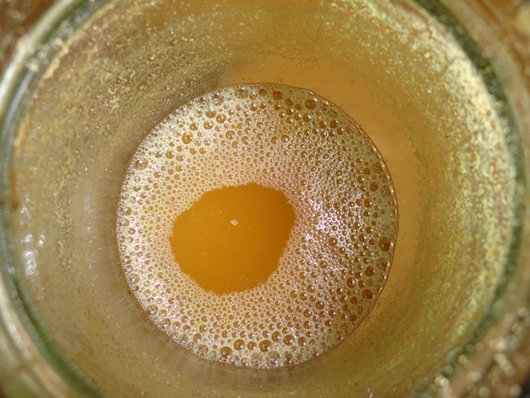
We had a nice supply of ginger beer going over Christmas. It's a delicious soft drink for young and old, although there is an alcoholic version that can be made with a slight variation on the recipe. Ginger beer is a naturally fermented drink that is easy to make - with ginger beer you make a starter called a ginger beer plant and after it has fermented, you add that to sweet water and lemon juice. Like sourdough, it must ferment to give it that sharp fizz. To make a ginger beer plant you'll need ginger - either the powdered dry variety or fresh ginger, sugar, rainwater or tap water that has stood for 24 hours to allow the chlorine to evaporate off. You'll also need clean plastic bottles that have been scrubbed with soap, hot water and a bottle brush and then rinsed with hot water. I never sterilise my bottles and I haven't had any problems. If you intend to keep the ginger beer for a long time, I'd suggest you sterilise your bottles. MAKING THE STARTER In a...
Image

NOT the last post

This will be my last post here.  I've been writing my blog for 18 years and now is the time to step back. I’ve stopped writing the blog and come back a couple of times because so many people wanted it, but that won’t happen again, I won’t be back.  I’ll continue on instagram to remain connected but I don’t know how frequent that will be. I know some of you will be interested to know the blog's statistics. 
Image

How to make cold process soap

I'm sure many of you are wondering: "Why make soap when I can buy it cheaply at the supermarket?" My cold process soap is made with vegetable oils and when it is made and cured, it contains no harsh chemicals or dyes. Often commercial soap is made with tallow (animal fat) and contains synthetic fragrance and dye and retains almost no glycerin. Glycerin is a natural emollient that helps with the lather and moisturises the skin. The makers of commercial soaps extract the glycerin and sell it as a separate product as it's more valuable than the soap. Then they add chemicals to make the soap lather. Crazy. Making your own soap allows you to add whatever you want to add. If you want a plain and pure soap, as I do, you can have that, or you can start with the plain soap and add colour, herbs and fragrance. The choice is yours. I want to add a little about animal and bird fat. I know Kirsty makes her soap with duck fat and I think that's great. I think t...
Image

Preserving food in a traditional way - pickling beetroot

I've had a number of emails from readers who want to start preserving food in jars but don't know where to start or what equipment to buy.  Leading on from yesterday's post, let's just say up front - don't buy any equipment. Once you know what you're doing and that you enjoy preserving, then you can decide whether or not to buy extra equipment. Food is preserved effectively without refrigeration by a variety of different methods. A few of the traditional methods are drying, fermentation, smoking, salting or by adding vinegar and sugar to the food - pickling. This last method is what we're talking about today. Vinegar and sugar are natural preservatives and adding one or both to food sets up an environment that bacteria and yeasts can't grow in. If you make the vinegar and sugar mix palatable, you can put up jars of vegetables or fruit that enhance the flavour of the food and can be stored in a cupboard or fridge for months. Other traditional w...
Image

Cleaning mould from walls and fabrics

With all this rain around we've developed a mould problem in our home. Usually we have the front and back doors open and that good ventilation stops most moulds from establishing. However, with the house locked up for the past week, the high humidity and the rain, mould is now growing on the wooden walls near our front door and on the lower parts of cupboards in the kitchen. Most of us will find mould growing in our homes at some point. Either in the bathroom or, in humid climates, on the walls, like we have now. You'll need a safe and effective remedy at some point, so I hope one of these methods works well for you. Mould is not only ugly to look at, it can cause health problems so if you see mould growing, do something about it straight away. The longer you leave the problem, the harder it will be to get rid of it effectively. If you have asthma or any allergies, you should do this type of cleaning with a face mask on so you don't breathe in any spores. Many peopl...
Image

Five minute bread

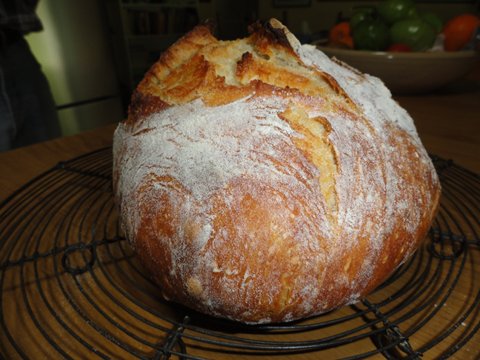
Bread is one of those foods that, when made with your own hands, gives a great deal of satisfaction and delight. It's only flour and water but it symbolises so much. I bake bread most days and use a variety of flours that I buy in bulk. Often I make a sandwich loaf because we use most of our bread for lunchtime sandwiches and for toast. Every so often I branch out to make a different type of loaf. I have tried sour dough in the past but I've not been happy with any of them. I'll continue to experiment with sour dough because I like the idea of using wild yeasts and saving the starter over a number of years to develop the flavour and become a part of the family. However, the loaf I've been branching out to most often is just a plain old five minute bread. By five minutes I mean it takes about five minutes actual work to prepare but it's the easiest of all bread to make and to get consistently good loaves from. If you're having people around for lunch or...
Image

This is my last post.

I have known for a while that this post was coming, but I didn't know when. This is my last post. I'm closing my blog, for good, and I'm not coming back like I have in the past.  I've been writing here for 16 years and my blog has been many things to me. It helped me change my life, it introduced me to so many good people, it became a wonderful record of my family life, it helped me get a book contract with Penguin, and monthly columns with The Australian Women's Weekly and Burke's Backyard . But in the past few months, it's become a burden. In April, I'll be 75 years old and I hope I've got another ten years ahead. However, each year I'll probably get weaker and although I'm fairly healthy, I do have a benign brain tumour and that could start growing. There are so many things I want to do and with time running out, leaving the blog behind gives me time to do the things that give me pleasure. On the day the blog started I felt a wonderful, h...
Image

What is the role of the homemaker in later years?

An email came from a US reader, Abby, who asked about being a homemaker in later years. This is part of what she wrote: "I am a stay-at-home mum to 4 children, ages 9-16. I do have a variety of "odd jobs" that I enjoy - I run a small "before-school" morning drop-off daycare from my home, I am a writing tutor, and I work a few hours a week at a local children's bookstore. But mostly, I cherish my blissful days at home - cooking, cleaning (with homemade cleaners), taking care of our children and chickens and goats, baking, meal-planning, etc. This "career" at home is not at all what I imagined during my ambitious years at university, but it is far more enriching. I notice, though, that my day is often planned around the needs of my family members. Of course, with 4 active kids and a husband, this is natural. I do the shopping, plan my meals, cook dinner - generally in anticipation of my family reconnecting in the evening.  I can't h...
Image

Every morning at home

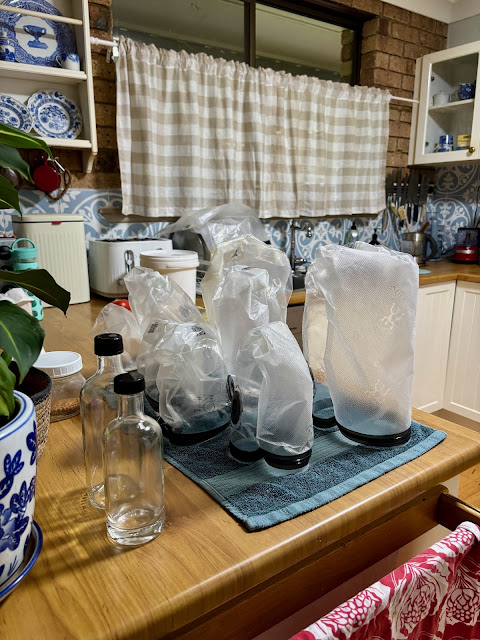
Every morning when I walk into my kitchen it looks tidy and ready for a day's work. Not so on this morning (above), I saw this when I walked in. Late the previous afternoon when I was looking for something, I came across my rolled up Zwilling vacuum bags and decided they had to be washed and dried. So I did that and although I usually put them outside on the verandah to dry it was dark by then. I turned the just-washed bags inside out and left them like this on a towel. It worked well and now the bags are ready to use when I bring home root vegetables, cabbages or whatever I buy that I want to last four or five weeks.
Image

You’ll save money by going back to basics

When I was doing the workshops and solo sessions, I had a couple of people whose main focus was on creating the fastest way to set up a simple life. You can't create a simple life fast, it's the opposite of that It's not one single thing either - it's a number of smaller, simpler activities that combine to create a life that reflects your values; and that takes a long to come together. When I first started living simply I took an entire year to work out our food - buying it, storing it, cooking it, preserving, baking, freezing, and growing it in the backyard. This is change that will transform how you live and it can't be rushed.  
Image


Trending Articles

NOT the last post

This will be my last post here.  I've been writing my blog for 18 years and now is the time to step back. I’ve stopped writing the blog and come back a couple of times because so many people wanted it, but that won’t happen again, I won’t be back.  I’ll continue on instagram to remain connected but I don’t know how frequent that will be. I know some of you will be interested to know the blog's statistics. 
Image

Every morning at home

Every morning when I walk into my kitchen it looks tidy and ready for a day's work. Not so on this morning (above), I saw this when I walked in. Late the previous afternoon when I was looking for something, I came across my rolled up Zwilling vacuum bags and decided they had to be washed and dried. So I did that and although I usually put them outside on the verandah to dry it was dark by then. I turned the just-washed bags inside out and left them like this on a towel. It worked well and now the bags are ready to use when I bring home root vegetables, cabbages or whatever I buy that I want to last four or five weeks.
Image

You’ll save money by going back to basics

When I was doing the workshops and solo sessions, I had a couple of people whose main focus was on creating the fastest way to set up a simple life. You can't create a simple life fast, it's the opposite of that It's not one single thing either - it's a number of smaller, simpler activities that combine to create a life that reflects your values; and that takes a long to come together. When I first started living simply I took an entire year to work out our food - buying it, storing it, cooking it, preserving, baking, freezing, and growing it in the backyard. This is change that will transform how you live and it can't be rushed.  
Image

Creating a home you'll love forever

Living simply is the answer to just about everything. It reduces the cost of living; it keeps you focused on being careful with resources such as water and electricity; it reminds you to not waste food; it encourages you to store food so you don't waste it and doing all those things brings routine and rhythm to your daily life. Consciously connecting every day with the activities and tasks that create simple life reminds you to look for the meaning and beauty that normal daily life holds.  It's all there in your home if you look for it. Seemingly mundane tasks like cleaning and cooking help you with that connection for without those tasks, the home you want to live in won't exist in the way you want it to.  Creating a home you love will make you happy and satisfied.
Image

Time changes everything

I've been spending time in the backyard lately creating a contained herb and vegetable garden. My aim is to develop a comfortable place to spend time, relax, increase biodiversity and encourage more animals, birds and insects to live here or visit. Of course I'd prefer my old garden which was put together by Hanno with ease and German precision. Together, we created a space bursting at the seams with herbs, vegetables and fruity goodness ready to eat and share throughout the year. But time changes everything. What I'm planning on doing now, is a brilliant opportunity for an almost 80 year old with balance issues. In my new garden I'll be able to do a wide range of challenging or easy work, depending on how I feel each day. It’s a daily opportunity to push myself or sit back, watch what's happening around me and be captivated by memories or the scope of what's yet to come.
Image

It's the old ways I love the most

I'm a practical woman who lives in a 1980’s brick slab house. There are verandahs front and back so I have places to sit outside when it's hot or cold. Those verandahs tend to make the house darker than it would be but they're been a great investment over time because they made the house more liveable. My home is not a romantic cottage, nor a minimalist modern home, it's a 1980’s brick slab house. And yet when people visit me here they tell me how warm and cosy my home is and that they feel comforted by being here. I've thought about that over the years and I'm convinced now that the style of a home isn't what appeals to people. What they love is the feeling within that home and whether it's nurturing the people who live there.
Image

Making ginger beer from scratch

We had a nice supply of ginger beer going over Christmas. It's a delicious soft drink for young and old, although there is an alcoholic version that can be made with a slight variation on the recipe. Ginger beer is a naturally fermented drink that is easy to make - with ginger beer you make a starter called a ginger beer plant and after it has fermented, you add that to sweet water and lemon juice. Like sourdough, it must ferment to give it that sharp fizz. To make a ginger beer plant you'll need ginger - either the powdered dry variety or fresh ginger, sugar, rainwater or tap water that has stood for 24 hours to allow the chlorine to evaporate off. You'll also need clean plastic bottles that have been scrubbed with soap, hot water and a bottle brush and then rinsed with hot water. I never sterilise my bottles and I haven't had any problems. If you intend to keep the ginger beer for a long time, I'd suggest you sterilise your bottles. MAKING THE STARTER In a...
Image

An authentic look at daily life here — unstaged and real

Most days Hanno was outside happily working in the fresh air. It may surprise you to know that I started reading my book,  Down to Earth , yesterday - the first time since I wrote it 13 years ago.  I had lent it to my neighbor, and when she returned it, I started reading, expecting to find surprises. Instead, I realised the words were still familiar—as if they were etched into my memory. As I flipped through the pages, I was reminded of how important it was for me to share that knowledge with others. The principles in Down to Earth changed my life, and I truly believed they could do the same for others. After just 30 minutes of reading, I put the book down, reassured that its message still holds true: we can slow down and reshape our lives, one step at a time.
Image