down to earth

  • Home
  • About Us
  • Down To Earth Book
  • Privacy Policy


The jam jars have cooled, I checked that all the poptop lids popped down, one didn't, and now nine jars of jam are in the stockpile cupboard ready for eating or gift giving. That one jar that didn't seal properly is in the fridge and will be the first one Hanno and I eat. Yesterday I made buttermilk scones for lunch and had some jam on a warm scone. That, my friends, was delicious. By the way, what we call scones here and in the UK are called biscuits in the US.

While I was eating that scone, I thought back to the many scones with homemade jam I've had over the years. My grandma was a frequent scone maker, so was my mother, but when I was about 10, she taught me to make scones, and from then on, always had a willing baker because she praised my scones as being the best she'd eaten. She knew that praising a child brought it's own rewards. I learnt that from her.

In my family, scones were used as a kind of poor man's bread. If we didn't have bread from the bakery, we would make scones to eat for lunch. On those days we didn't have bread we would top our scones with a slice of tomato and cucumber, or cheese, or Vegemite or peanut butter. Some times we would add cheese or dates to the ingredients, for variety, when we made up our scones. No matter what we added though, they were always welcomed by all who joined the table and usually washed down with tea, for the adults, and either water or cordial for us kids.

It's interesting for me now to work out why we thought of scones as a poor alternative to white sliced bread. I doubt it had much to do with price as my father was a baker and our bread didn't cost us anything. I am guessing that in those days, back in the 1950s, when things were starting to be packaged in plastic, having that 'new' bread in plastic was seen as modern and therefore more desirable, than the old tissue paper wrapped unsliced bread or, for that matter, hot homemade scones.


Here is my quick calculation on the cost of making scones. This will make about 10.
Flour $1 - 500 grams (1 lb)
Butter 50 cents - 100 grams (4oz)
Milk - 15cents - 100 mls (3.5 oz) I usually use buttermilk in my scones but I can't find a price online for it and I can't remember how much it is.
Pinch of salt - 1 cent
Tablespoon of sugar - 5 cents
Energy to cook them - 5 cents

So all up that comes to $1.76, which is probably similar to the same amount of homemade bread. A loaf of Buttercup Country Split White Bread costs $3.60, half a loaf would cost $1.80, I think 10 scones would be the equivalent of between ½ and ¾ of a loaf. So it may be slightly less in dollar value, but a lot better for you health-wise (no preservatives), and for taste.


We're all counting our pennies. Some of us do it to pay off debt, some to live in a certain way, some because we have to. Doing these little calculations for those products we buy frequently is a very good way of managing your money. But when you do your calculations, also calculate in the health benefits too, and if something is the same in price, or almost the same, it's best to go for the healthier alternative.

There are plenty of recipes for scones/biscuits online but I use self-raising flour, butter (never margarine), a pinch of salt, a tablespoon of sugar and enough buttermilk to make the dough. Buttermilk makes a very light scone and has fewer calories than ordinary milk. If you are making yoghurt, you could also use the whey from your yoghurt instead of the buttermilk. If you don't have enough whey, mix in a little milk to make it up. I never add eggs to my scones.


I always cut my scones with a wine glass, my grandma did that and so did my mother. A wine glass is just the right size. When you make your scones, you want a cut edge, not a rolled or a hand formed edge. A cut edge will rise better every time.

We eat scones for lunch about once a week; the other days I usually bake bread. Scones are much quicker than bread, they take less than five minutes to make and about 15 - 20 minutes to bake. There is no waiting for the dough to rise, or mixing of yeast, so it's a quick alternative and certainly a recipe you should have in your armoury of common household recipes. By the time you've cleaned the kitchen and made your pot of tea, the scones will be ready. And if you have a little homemade jam to top your scone, you'll set a smile on your face that will be hard to move.


I don't do nearly as much preserving (canning) as I used to. Since we made the decision to keep our garden going year round, there has been no need. Now I preserve only those foods I want to make into jams, relishes and cordials, and generally I freeze the juice for cordials when we have an excess. But we had a windfall of strawberries the other day so yesterday Hanno washed and cut the fruit for me and I cooked up a pot of strawberry jam. Cut up and ready for cooking we had 2.6kg (5.7 lb) of strawberries. When you're making strawberry jam it's good to have the mass of strawberries fully ripe, for a deep and full flavour, and a small number that aren't so ripe, because they contain more natural pectin to thicken the jam.
I can't let today pass by without writing something about the wonderful inaugural poem and commenting on Dianne Feinstein. Before today, I had never laid eyes on Dianne Feinstein but each time she appeared on the inaugural podium to introduce this person and that, I was impressed by her outgoing personality and a little jealous that we in Australia have no comparable older women role models. I hope I am so together and in control when I'm 75.

And that poem...

Praise song for the day by Elizabeth Alexander

Each day we go about our business, walking past each other, catching each others' eyes or not, about to speak or speaking. All about us is noise. All about us is noise and bramble, thorn and din, each one of our ancestors on our tongues. Someone is stitching up a hem, darning a hole in a uniform, patching a tire, repairing the things in need of repair.

Someone is trying to make music somewhere with a pair of wooden spoons on an oil drum with cello, boom box, harmonica, voice.

A woman and her son wait for the bus.

A farmer considers the changing sky; A teacher says, "Take out your pencils. Begin."

We encounter each other in words, words spiny or smooth, whispered or declaimed; words to consider, reconsider.

We cross dirt roads and highways that mark the will of someone and then others who said, "I need to see what's on the other side; I know there's something better down the road."

We need to find a place where we are safe; We walk into that which we cannot yet see.

Say it plain, that many have died for this day. Sing the names of the dead who brought us here, who laid the train tracks, raised the bridges, picked the cotton and the lettuce, built brick by brick the glittering edifices they would then keep clean and work inside of.

Praise song for struggle; praise song for the day. Praise song for every hand-lettered sign; The figuring it out at kitchen tables.

Some live by "Love thy neighbor as thy self."

Others by "first do no harm", or "take no more than you need".

What if the mightiest word is love, love beyond marital, filial, national. Love that casts a widening pool of light. Love with no need to preempt grievance.

In today's sharp sparkle, this winter air, anything can be made, any sentence begun.

On the brink, on the brim, on the cusp -- praise song for walking forward in that light.

On this day when 'anything can be made, any sentence begun,' I am pleased to remember this seemingly simple poem as one of its many highlights. I got up at 2am to watch the inauguration, and I am still now thinking of various parts of the ceremony and the words delivered. Hope is a great reward at the end of such a momentous day.


Many of us are looking for ways to produce organic food in our homes. There was a time we had an aquaponics system in our backyard, and I thought it would be a good idea to talk about it again, despite the fact that our system failed and we sold it.


Aquaponics is a way of growing fish and organic vegetables in one system. The way we set ours up was with two grow beds on top of a 3000 litre (792 gallons) fish tank. We kept silver perch in our pond, they're an Australian native freshwater fish. We had our system from March 2007 until the end of February 2008.


We had our tanks custom made by a local tank maker but they are equally effective using recycled materials of sufficient size. Hanno rigged up all the plumbing and attached the bubblers and underwater pump. Our electricity bill barely registered the pump usage, I think over the course of a year it cost us about $80 to run it. We used rainwater that we had stored in our backyard tank to fill the fish tank.


We grew a variety of vegetables, including some decent pink brandywine tomatoes, chard, celery, parsley, beans, watercress, capsicums (peppers) and chilli. The taste was good and we couldn't tell the aquaponics produce from that in the garden. Of course we still kept our soil vegetable garden but having the fish and vegetable combo was a great project for us and it was very interesting to see what we could grow.


I won't go into aquaponics in depth, please look at my aquaponics posts to see what we did, or go to Backyard Aquaponics. There are a few good photos there of Joel's system and a very good forum where you can ask questions and see what people are doing all round the world. The site is an Australian one but they have a lot of members in the northern hemisphere, including some members with hothouse aquaponics in snowbound America.


Basically, aquaponics is a system that pumps the water the fish have been swimming in up to the vegetables growing in tanks above. The fish waste in the water fertilises the vegetables, the gravel and microbes in the grow beds help purify the water and then it falls back into the fish tank as clean water. Over time the system matures with natural elements helping the fish and vegetables grow and generally, it will take about 12 - 18 months from fingerling to plate sized fish.


Our system failed because we didn't understand the effect sun has on water. It caused algae to grow, which consumed oxygen in the water and when the fish didn't have enough dissolved oxygen in the water, they died. It was heartbreaking to see it happen. We didn't know why it was happening and every effort we made to save the fish was in vain. That was the second time our fish died, the first time we didn't know why, we think it was some poison, maybe someone in the neighbourhood had sprayed. Nevertheless, the second time it happened, we decided it wasn't for us, Hanno had to do a lot of work whenever anything went wrong, so we sold our system. I have to say though, that if we didn't have a very productive soil garden, we would have persevered with aquaponics, and by now would have been happily eating the fish on a regular basis.


I think aquaponics is a good way of growing food if you have the time and strength to put into it. You need to learn a lot about how everything works together, and as it's a fairly new way of growing food, sometimes there are no answers, but it's an interesting hobby and if you get it right, a very good way to produce vegetables and fish in a small space.

Unstuff writes about the failing economy and what she has discovered in the past year. It's worth a read.


Hanno and I thank you all for the good wishes sent for Shane and Sarndra yesterday. It's a wonderful time for all of us and although I never thought I'd be like this, I kept thinking about it all day yesterday. Thank you for sharing our joy.


I mentioned yesterday that one of the things I had been doing on the weekend was a bit of garden maintenance. Maintaining our garden, tidying it up, removing dead and dying leaves and general, up-close checking of our plants helps us keep most thing growing as they should. The main problem I came across in our garden was the cucumber vine had signs of disease and needed to lose a few leaves. I got my garden snips and started snipping the damaged and diseased leaves off, picked up parts of the fallen vine and reattached it to the trellis.


These are two important elements of garden maintenance - clean up disease and damage, and make sure the plants are growing as intended. So if you see tomatoes that are falling over, tie then back to their stakes, and any vine that is touching the soil, needs to be pulled up and attached to the trellis again. Leaving damaged and diseased leaves on any plant will weaken it and make it more susceptible to attack by insects and other diseases. Clip off the leaves rather than pull them off because if you pull at the plant you may disturb the roots or strip off the plant tissue surrounding the leaf. While you're out there, give some time to making sure the mulch is not resting against plant stems - with the exception of tomatoes, they like it -pull the mulch back, or add more if it's needed.


Make sure all the diseased plant parts go into the rubbish bin, not the compost. You run the risk of transferring the disease to your compost and it's best to get rid of the material altogether. If you're concerned about putting it in the rubbish bin to be taken to your local dump - and this applies to weeds, particularly invasive weeds, and diseased plants, place all the plant parts in an old plastic shopping bag and seal the top. Leave the bag in full sun for a week so that whatever is in the bag is dead before you transfer it to your rubbish bin.


While you're in the garden, check on all your plants. You may notice that some are beginning to flower, and if you're a seed saver, that will alert you that seeds are not far away and you need to watch that particular plant. When I was in the garden on the weekend, I noticed our parsley plant is starting to flower. In a few weeks time, I'll harvest seeds from that plant from which I'll start more parsley.

Mother Theresa said:"Be faithful in all small things because it is in them that your strength lies." I apply that wisdom to insects, as well as to other small things. Look for beneficial insects and wildlife while you're in the garden because they can help you combat insects that harm your plants. Some beneficial insects are bees, hoverflies, some small non-aggressive wasps, some spiders, praying mantis, lacewings and the common spotted ladybird but NOT the 28 spot ladybird. They will help you combat aphids, ants, scale and mealybugs. Frogs and lizards will also help you keep a lid on the larger insects like grasshoppers and caterpillars.

To attract beneficial insects to your garden, you need to give them food and shelter in the form of a group of flowers they love. These include cosmos, marigolds, red clover, alyssum, dill, Queen Anne's Lace, buckwheat, lucerne and gypsophila. If you provide hollow logs and water, lizards and frogs might take up the invitation.

You don't have to be fanatical about garden maintenance but it's a good idea to deal with problems as soon as you see them and to make a special effort every week or so to inspect the plants up close. If you can do that, you'll have a healthier garden and a more bountiful harvest.


Yesterday started off just like any other day, I didn't know when I woke that it would become a day I'd remember all my life. I woke early, showered and wrote for an hour or two, then, when the sun was starting to come up, went outside, fed Alice, Hettie and the chooks and set about planting a few seeds. I like to get my outside jobs done before it gets hot. When Hanno woke, we had breakfast, and while munching on our toast, talked about what we'd plant in the garden this coming season and where to plant the newest passionfruit vine. Oh, the cricket was on too, we mentioned that and said we both should have our chores done so we could watch the cricket later; another normal day on the horizon.


While I was outside, in that best of all lights before the sun came over the top of the house, I took these garden photos. It was coolish out there, I did some garden maintenance, and will write about that later in the week, talked to the girls who watched my every move, and thought about how today would be a good day because the cricket was on, I'd do some reading, knitting and odds and ends, and relax. Little did I know.


I noticed Hanno turned the compost heap the day before. We have a cold compost at the moment, with not enough material to generate any heat, but with moisture and turning, to incorporate air, it breaks down nicely. You can see the heap, and our compost area, in the photo above. In the foreground is the potato patch that was planted last week. Now it's under a cover of thick straw and I just know that little potatoes are preparing to send their shoots skyward.


After morning tea on the front verandah, I checked to see what time the cricket would start. I looked online and discovered the match had started almost two hours before. Grrrrrrrrrr. So I turned on the telly, checked the score, and told Hanno the game had already started. He'd only done half the things he wanted to do before watching, so he came inside and sat with me for a short time, then went back outside to finish fixing a flyscreen on our bedroom. I, on the other hand, started knitting the back of a potholder. More on that in another post. (The yarn is Lions organic cotton.)


It sounds like I had a very slow day, and although I did to a certain extent, I also did a lot of work while listening to the match. I baked bread for lunch, and an orange buttermilk slab cake, and minced up some of the grass fed beef we've been buying to make a meatloaf, which we had for dinner last night. It was the first meatloaf I've eaten in ten years, and was not very good. I'm not sure if I need to make adjustments to the recipe or if my tastes have changed too much to enjoy it.

But during the afternoon, my step-son Jens came over to visit, I watched the cricket, did various chores in the house and generally enjoyed myself; we ended up winning by five runs. When the game was over, I prepared our meal - meatloaf, mashed potato and fresh coleslaw - and we were just finishing up, when Alice sprang to her feet and started barking. I looked out the front door and saw two people walking up the driveway - Shane and Sarndra had come to visit. Yipee!

They had driven up to celebrate the birthday of one of their friends. They were meeting everyone at a restaurant down on the beach but just had to come in to tell us something. "We have some news..." they said. "We're getting married!" I jumped up and hugged them both, feeling more happiness, joy and excitement than I thought possible, then listened quietly while they told us their plans. Shyly, Sarndra showed us her engagement ring, which is beautiful. I could barely contain myself. I wanted to, quite literally, tell the world this wonderful news. I am so pleased that Shane has found the right girl for him, they're so well suited and obviously love each other very much.

They both resigned from their jobs recently and have started making plans to go to New Zealand to live for a few months. A few weeks ago we agreed to take on their mother hen and chicks and Sarndra's cat, Princess, and we'll store all their possessions safely in one of our sheds. When they come home again, they probably marry then before travelling to Spain to live there for a while. Sarndra's father has a house in Spain and her grandma lives in New Zealand, so they'll have family in both countries. When they come back from Spain, they'll settle down and start a family.

GRANDBABIES!

So as you can see, our very ordinary day turned into something to remember. We started making plans to meet Sarndra's family, her mother and sisters live in Brisbane, and for an engagement party. They said they want a small and frugal wedding, preferring to save the money for travel and their futures together. Oh course I loved that idea and I know that whatever type of wedding ceremony they decide on will be truly wonderful. There are good times ahead, and we'll be there to help them every step of the way.


These beautiful linen towels arrived yesterday. They are white and stunning. I won them on the Long Thread's give away just before Christmas. Ellen is having another give away now of five yards of fabric. Enter before Saturday.

Only a short post today because I've written about growing organic potatoes over at the Simple Green Frugal Co-op blog. You can read it by clicking here.

I hope your week has been a good one and you're looking back on time well spent and progress along your path.


Temptation is a terrible thing. The attraction of convenience is ever present, the habit of doing things the old way pulls us back and before we know it, we've stopped budgeting and shopping with our cotton bags, and we're back in the mall.

Let's face it, living simply and pulling away from the mainstream can be difficult. We have to learn new skills, what we make usually takes more time than any store bought product, and there is more carrying, working, doing, mending, sweeping, cleaning, cooking, washing up and tending than ever before. Don't let anyone tell you it's easy. It gives you a better life, but it's more work. Some days it's just too much. So how do you stay motivated?

The internet is the biggest library in the world. At any time of the day or night you can log on and find the ingredients for making anything - headcheese, government writing ink, or Mawmenee. You can find the instructions for making any obscure object you can think of, as well as all the necessary tasks you need to know to run a home efficiently. If I wanted to rig up a flying fox in the backyard or build a worm farm or darn a pair of socks or make bread or soap, I could Google the words, read the results of the search and by lunchtime I could be working hard on my project. But where does the motivation come from?

When I started living simply, I removed myself from much of the temptation. I didn't go to the mall, I stopped watching advertising on TV, and buying magazines and newspapers. That helped a lot - I didn't know what was out there and I didn't miss what I didn't know. After a while, that kind of life became normal for me and now, several years down the track, I can go into a mall, buy the one item I went there for and walk away. I don't want anything and I don't want to look around at the new products. So where does the motivation come from?

I have come to believe simple living is about 80% motivation, 10% skill and 10% opportunity. It certainly is that way for me. I have to work on the motivation less now than I did before, but it's still up there. The skill part of the equation is easily taken care of by googling or reading books to learn the new skills we need in this life, the opportunity usually has a lot to do with the stage of life you're at, but where does the motivation reside?

Visiting blogs, reading books and thinking about my values keeps me motivated. The world of blogs is an amazing place that is only possible via the internet. Had you told me ten years ago that I could read about someone living happily in the wilds of John o' Groats or Kakadu or that I could write about my days and simply by pressing a button have people, world-wide, comment, well, I would have thought you were crazy. But that is the truth of it. I find that reading what other people do, who are striving to live as I do, with the ups and downs of it, with the successes and failures, that motivates me to do what I do every day. When I see it and do it every day, it becomes normal. It's like living in a small village that is different to the other villages. What we do here is normal, while being alien to those around us, but being involved in each others lives via our blogs, sharing what we do, learning from each other, that, my friends, provides the motivation to keep going.

Seeing others do what we want to do, reading and seeing how others live their version of simplicity, urges us to do something similar. And motivation is the key to it all. You could have all the knowledge in the world but unless you are motivated to use it, to live the kind of life you aspire to, that knowledge is hollow and of little value. I am rarely motivated now by learning new skills, my motivation comes from seeing how those skills fit into lives - mine and others. Seeing how people use those skills to help them live.

I believe we all have a responsibility to share what we know, to pass on knowledge, and encouragement, and to actively help others move towards a more sustainable life. It's a selfish act really. The more people living a greener life, the better off we'll all be, and, more importantly, the better the world will be when our grandchildren are our age. I hope my blog gives you the kind of information you need to skill yourself and make your home the place you need to live well. But more than that, I hope you find motivation here, I hope what I write makes you get up and move. There is a lot to be said for simple life and I hope you can fashion your life to live to your best potential. You will pick up the skills you need as you go, a little at a time, but you need to work on the motivation, because if that goes, you will just be left with a plan.

Photo from allposters.com
I have to admit to being out of my routine with Christmas holidays and working on my book every day. I returned to work this week, and was happy to be back. I'm looking forward to a year full of work, both at home and at the Centre, that will enrich my spirit and lead me gently along this path I'm on. It will be a busy year, I know that already, but I'm up for it, and as my mother would say when she was very busy, "I least I know I'm alive."

I haven't had a chance to take any photos lately, so I just looked back to see if there are any here that I haven't used yet. There are a lot that don't seem to go together, and maybe I'll just use them all together one day for a post about nothing - a Seinfeld post. However, there was one little beauty that shot out at me and suggested a post about leftovers and stretching food. A worthy subject for a blog such as this.


We often eat according to what is growing in the garden at any particular time. Recently, we harvested about eight golden nugget pumpkins. Some were smaller that normal and some slightly larger. For those who are not familiar with this pumpkin, it is a small variety that's usually about the size of a small rockmelon (cantaloupe). They don't form a vine and instead grow to full maturity on a small bush. Whenever I have a nice pumpkin, I make pumpkin risotto. So we had our pumpkin risotto for an evening meal and had some leftover.

The next day we harvested six green capsicums (peppers) so I used the leftover risotto to make another delicious meal - stuffed capsicums. There are never real recipes for leftover meals, you use your imagination and combine flavours you know your family will like. Don't worry that you've never seen a meal like the one you're making before. That's the beauty of it, you make it up as you go, and as long as your family enjoys it and eats up every last crumb, it's a success. So, to make up my stuffed caps, I washed the capsicums, cut them into two equal halves, scooped out the seeds and membranes and filled the little cups with a large spoon full of pumpkin risotto. There was already Parmesan cheese in the rice so I didn't have to add anything else. I put it in the oven for 20 minutes and out it came, all golden and crispy on the top. Delicious, easy, fast and frugal.

Stretching one meal into two is a great way to cut costs. Stretching food and eating leftovers was common back in our grandmothers' day and it can be used now by those people who are making the most of every dollar they have. I often cook knowing I will have enough for at least two meals for the two of us.

Do you have a little bit of corned or roast beef left over? Cook some potatoes, fry a finely diced onion, mash the potatoes, add the onion, cut up the beef into little cubes and add it, add an egg and salt and pepper. Form it into flat fritters and fry in hot oil until golden. They would serve you quite nicely with a fresh garden salad, or on a piece of homemade bread with a slice of tomato and lettuce.

What about that roast chicken you cooked yesterday. It's still got a little bit of meat on the bones, but not enough to serve four hungry people. No worries! Strip the meat from the bones and put it aside. Add the chicken bones to a pot of water, about 1.5 litres (quarts), add salt and pepper and whatever herbs you have, and a chopped onion. Bring to the boil and then turn down the heat and simmer for about 30 minutes. Look in the fridge and garden for some vegetables and chop up what you find - maybe a zucchini, celery, pumpkin or potato, green beans - whatever your family likes. Add these to the soup and cook for another 15 - 20 minutes. Five minutes before it's ready, add the chopped chicken meat. Test taste for seasoning.

A nice addition to any soup is herb dumplings. You would add dumplings just after you add the vegetables and the soup has returned to the boil.

Dumplings
2 cups of self raising flour OR 2 cups of plain flour with 2 teaspoons of baking powder added.
salt and pepper
Rub into the flour about two tablespoons of softish butter. Rub the butter in with your finger tips, just like you would when making scones (biscuits), until it resembles breadcrumbs.
Chopped parsley or chives
Add enough water to make a firm dough.
Forms small balls and drop them into the soup. The dumplings will cook on the top of the soup. They will take about 15 - 20 minutes to cook, so add then just after you add the vegies.

And now I'm looking froward to reading about your favourite leftover meal.

Here is Hanno with our boys, Kerry (left) and Shane. This was probably taken in 1983 or 1984.

I smiled when I read Heather's indoor clothes drying post on the Simple Green Frugal Co-op the other day. She made me smile with this: "I asked my husband to build us something that could take the place of our portable wooden drying racks." Gee, I've used a similar sentence so often over the past 30 years.

And still, I get what I ask for.

Hanno and I fit together like a pair of gloves. We aren't alike, but we sort of mirror each other; what he can do, I can't, what I can do, he can't. He's in the background of my blog, you might see him in photos working away, but in reality he's very much at the forefront of our lives. I had to talk him into living this way, and he took some convincing, but once he took the plunge, he was in it with me 100% and every day he reaffirms his commitment to living simply, just as I do.

I guess it's like that with a lot of wives here. They work on their blogs and while we see glimpses of the boys in the background, they're always there making drying racks, connecting water tanks, looking after the children, shifting snow, carrying heavy parcels, and being supportive in the quietest of ways. I know that Claude is there with Sharon, Big Papa is there for Jewels, Matt is supporting Melinda, we see little glimpses of Jerry with Suzan. And there are a hundred others I see when I visit the community of friends we have here. The husbands, partners, boyfriends are all there in the background of these blogs, building, carrying, guiding, talking, holding and providing. Happily, every so often, we see a husband venture forth with a post when a wife is otherwise busy, or ill, or having the newest baby. If you have ever doubted this husbandly devotion, read this from Soulepapa. Those little Soules have a wonderful father there - a man who will teach his children that strength mixed with tenderness is the finest concoction.

But what of the man who lurks in the background of this blog. Well, when I returned from work yesterday afternoon, he was in the backyard. I'm not sure what he was doing, probably watering the vegetables, or collecting them. He came over to help me with what I had brought home - my basket, along with a big pile of tea towels, tablecloths, net food covers and cleaning cloths that had been folded up and left on the kitchen table at the Centre over Christmas. (Not good.) He asked me what the bundle was, took it from me and quickly sorted it all out, shaking each item, as he put it in our outdoor washing machine. (Later, after I went to bed, it was all hug out to dry.) We went inside with me telling him all the days big events, and while I sat at the kitchen table, he served up dinner and icy cold glasses of water.

And ... he tidied up afterwards.

So I just wanted to devote an entire post to Hanno and the rest of the husbands and boyfriends who usually lurk in the background of our blogs. I am very thankful for Hanno, I appreciate all he does, and the older we get, the more I feel that. Now, if only he would build that outdoor bread oven I want, everything would be perfect. ; - )


Newer Posts Older Posts Home


My books were all published by Pengiun, and are available at Amazon US, Amazon UK and Amazon Au

Search here

Total Pageviews

Translate


I'm Rhonda Hetzel and I've been writing my Down to Earth blog since 2007. Although I write the occasional philosophical post, my main topics include home cooking, happiness and gardening as well as budgeting, baking, ageing, generosity, mending and handmade crafts. I hope you enjoy your time here.

MY FAVOURITE PLACES

  • Grandma Donna's Place
  • Grandma Donna's YouTube
  • Grandma Donna's Instagram
  • This Simple Day
  • Nicole's Instagram

Give More

Give More

Popular posts last year

Making ginger beer from scratch

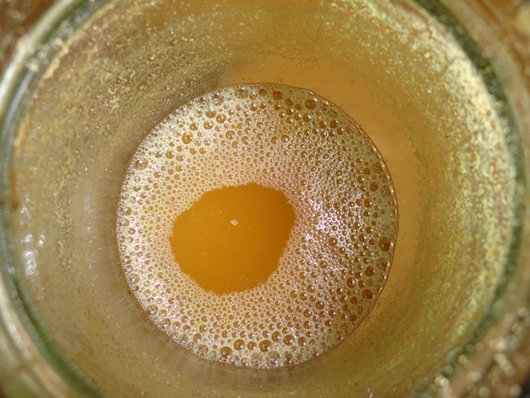
We had a nice supply of ginger beer going over Christmas. It's a delicious soft drink for young and old, although there is an alcoholic version that can be made with a slight variation on the recipe. Ginger beer is a naturally fermented drink that is easy to make - with ginger beer you make a starter called a ginger beer plant and after it has fermented, you add that to sweet water and lemon juice. Like sourdough, it must ferment to give it that sharp fizz. To make a ginger beer plant you'll need ginger - either the powdered dry variety or fresh ginger, sugar, rainwater or tap water that has stood for 24 hours to allow the chlorine to evaporate off. You'll also need clean plastic bottles that have been scrubbed with soap, hot water and a bottle brush and then rinsed with hot water. I never sterilise my bottles and I haven't had any problems. If you intend to keep the ginger beer for a long time, I'd suggest you sterilise your bottles. MAKING THE STARTER In a...
Image

NOT the last post

This will be my last post here.  I've been writing my blog for 18 years and now is the time to step back. I’ve stopped writing the blog and come back a couple of times because so many people wanted it, but that won’t happen again, I won’t be back.  I’ll continue on instagram to remain connected but I don’t know how frequent that will be. I know some of you will be interested to know the blog's statistics. 
Image

How to make cold process soap

I'm sure many of you are wondering: "Why make soap when I can buy it cheaply at the supermarket?" My cold process soap is made with vegetable oils and when it is made and cured, it contains no harsh chemicals or dyes. Often commercial soap is made with tallow (animal fat) and contains synthetic fragrance and dye and retains almost no glycerin. Glycerin is a natural emollient that helps with the lather and moisturises the skin. The makers of commercial soaps extract the glycerin and sell it as a separate product as it's more valuable than the soap. Then they add chemicals to make the soap lather. Crazy. Making your own soap allows you to add whatever you want to add. If you want a plain and pure soap, as I do, you can have that, or you can start with the plain soap and add colour, herbs and fragrance. The choice is yours. I want to add a little about animal and bird fat. I know Kirsty makes her soap with duck fat and I think that's great. I think t...
Image

Preserving food in a traditional way - pickling beetroot

I've had a number of emails from readers who want to start preserving food in jars but don't know where to start or what equipment to buy.  Leading on from yesterday's post, let's just say up front - don't buy any equipment. Once you know what you're doing and that you enjoy preserving, then you can decide whether or not to buy extra equipment. Food is preserved effectively without refrigeration by a variety of different methods. A few of the traditional methods are drying, fermentation, smoking, salting or by adding vinegar and sugar to the food - pickling. This last method is what we're talking about today. Vinegar and sugar are natural preservatives and adding one or both to food sets up an environment that bacteria and yeasts can't grow in. If you make the vinegar and sugar mix palatable, you can put up jars of vegetables or fruit that enhance the flavour of the food and can be stored in a cupboard or fridge for months. Other traditional w...
Image

Cleaning mould from walls and fabrics

With all this rain around we've developed a mould problem in our home. Usually we have the front and back doors open and that good ventilation stops most moulds from establishing. However, with the house locked up for the past week, the high humidity and the rain, mould is now growing on the wooden walls near our front door and on the lower parts of cupboards in the kitchen. Most of us will find mould growing in our homes at some point. Either in the bathroom or, in humid climates, on the walls, like we have now. You'll need a safe and effective remedy at some point, so I hope one of these methods works well for you. Mould is not only ugly to look at, it can cause health problems so if you see mould growing, do something about it straight away. The longer you leave the problem, the harder it will be to get rid of it effectively. If you have asthma or any allergies, you should do this type of cleaning with a face mask on so you don't breathe in any spores. Many peopl...
Image

Five minute bread

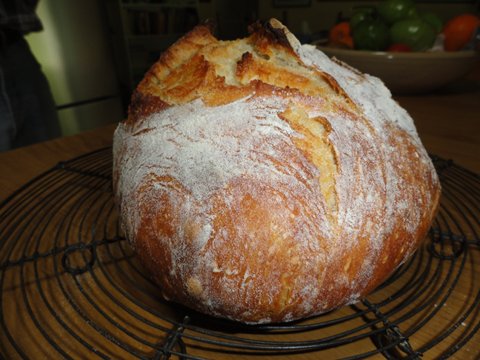
Bread is one of those foods that, when made with your own hands, gives a great deal of satisfaction and delight. It's only flour and water but it symbolises so much. I bake bread most days and use a variety of flours that I buy in bulk. Often I make a sandwich loaf because we use most of our bread for lunchtime sandwiches and for toast. Every so often I branch out to make a different type of loaf. I have tried sour dough in the past but I've not been happy with any of them. I'll continue to experiment with sour dough because I like the idea of using wild yeasts and saving the starter over a number of years to develop the flavour and become a part of the family. However, the loaf I've been branching out to most often is just a plain old five minute bread. By five minutes I mean it takes about five minutes actual work to prepare but it's the easiest of all bread to make and to get consistently good loaves from. If you're having people around for lunch or...
Image

This is my last post.

I have known for a while that this post was coming, but I didn't know when. This is my last post. I'm closing my blog, for good, and I'm not coming back like I have in the past.  I've been writing here for 16 years and my blog has been many things to me. It helped me change my life, it introduced me to so many good people, it became a wonderful record of my family life, it helped me get a book contract with Penguin, and monthly columns with The Australian Women's Weekly and Burke's Backyard . But in the past few months, it's become a burden. In April, I'll be 75 years old and I hope I've got another ten years ahead. However, each year I'll probably get weaker and although I'm fairly healthy, I do have a benign brain tumour and that could start growing. There are so many things I want to do and with time running out, leaving the blog behind gives me time to do the things that give me pleasure. On the day the blog started I felt a wonderful, h...
Image

What is the role of the homemaker in later years?

An email came from a US reader, Abby, who asked about being a homemaker in later years. This is part of what she wrote: "I am a stay-at-home mum to 4 children, ages 9-16. I do have a variety of "odd jobs" that I enjoy - I run a small "before-school" morning drop-off daycare from my home, I am a writing tutor, and I work a few hours a week at a local children's bookstore. But mostly, I cherish my blissful days at home - cooking, cleaning (with homemade cleaners), taking care of our children and chickens and goats, baking, meal-planning, etc. This "career" at home is not at all what I imagined during my ambitious years at university, but it is far more enriching. I notice, though, that my day is often planned around the needs of my family members. Of course, with 4 active kids and a husband, this is natural. I do the shopping, plan my meals, cook dinner - generally in anticipation of my family reconnecting in the evening.  I can't h...
Image

Every morning at home

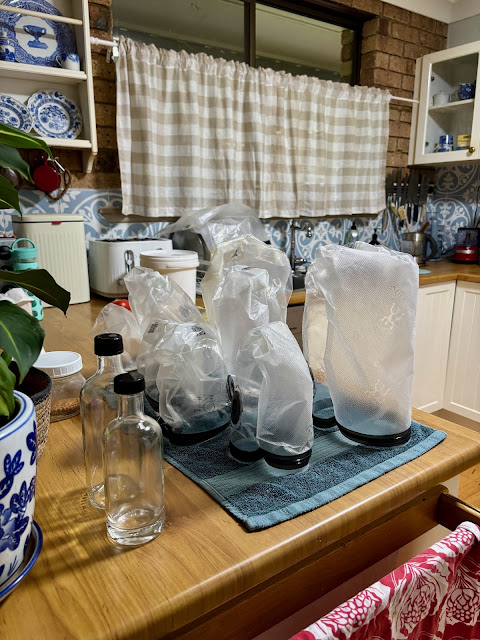
Every morning when I walk into my kitchen it looks tidy and ready for a day's work. Not so on this morning (above), I saw this when I walked in. Late the previous afternoon when I was looking for something, I came across my rolled up Zwilling vacuum bags and decided they had to be washed and dried. So I did that and although I usually put them outside on the verandah to dry it was dark by then. I turned the just-washed bags inside out and left them like this on a towel. It worked well and now the bags are ready to use when I bring home root vegetables, cabbages or whatever I buy that I want to last four or five weeks.
Image

You’ll save money by going back to basics

When I was doing the workshops and solo sessions, I had a couple of people whose main focus was on creating the fastest way to set up a simple life. You can't create a simple life fast, it's the opposite of that It's not one single thing either - it's a number of smaller, simpler activities that combine to create a life that reflects your values; and that takes a long to come together. When I first started living simply I took an entire year to work out our food - buying it, storing it, cooking it, preserving, baking, freezing, and growing it in the backyard. This is change that will transform how you live and it can't be rushed.  
Image


Trending Articles

NOT the last post

This will be my last post here.  I've been writing my blog for 18 years and now is the time to step back. I’ve stopped writing the blog and come back a couple of times because so many people wanted it, but that won’t happen again, I won’t be back.  I’ll continue on instagram to remain connected but I don’t know how frequent that will be. I know some of you will be interested to know the blog's statistics. 
Image

Every morning at home

Every morning when I walk into my kitchen it looks tidy and ready for a day's work. Not so on this morning (above), I saw this when I walked in. Late the previous afternoon when I was looking for something, I came across my rolled up Zwilling vacuum bags and decided they had to be washed and dried. So I did that and although I usually put them outside on the verandah to dry it was dark by then. I turned the just-washed bags inside out and left them like this on a towel. It worked well and now the bags are ready to use when I bring home root vegetables, cabbages or whatever I buy that I want to last four or five weeks.
Image

You’ll save money by going back to basics

When I was doing the workshops and solo sessions, I had a couple of people whose main focus was on creating the fastest way to set up a simple life. You can't create a simple life fast, it's the opposite of that It's not one single thing either - it's a number of smaller, simpler activities that combine to create a life that reflects your values; and that takes a long to come together. When I first started living simply I took an entire year to work out our food - buying it, storing it, cooking it, preserving, baking, freezing, and growing it in the backyard. This is change that will transform how you live and it can't be rushed.  
Image

Creating a home you'll love forever

Living simply is the answer to just about everything. It reduces the cost of living; it keeps you focused on being careful with resources such as water and electricity; it reminds you to not waste food; it encourages you to store food so you don't waste it and doing all those things brings routine and rhythm to your daily life. Consciously connecting every day with the activities and tasks that create simple life reminds you to look for the meaning and beauty that normal daily life holds.  It's all there in your home if you look for it. Seemingly mundane tasks like cleaning and cooking help you with that connection for without those tasks, the home you want to live in won't exist in the way you want it to.  Creating a home you love will make you happy and satisfied.
Image

Time changes everything

I've been spending time in the backyard lately creating a contained herb and vegetable garden. My aim is to develop a comfortable place to spend time, relax, increase biodiversity and encourage more animals, birds and insects to live here or visit. Of course I'd prefer my old garden which was put together by Hanno with ease and German precision. Together, we created a space bursting at the seams with herbs, vegetables and fruity goodness ready to eat and share throughout the year. But time changes everything. What I'm planning on doing now, is a brilliant opportunity for an almost 80 year old with balance issues. In my new garden I'll be able to do a wide range of challenging or easy work, depending on how I feel each day. It’s a daily opportunity to push myself or sit back, watch what's happening around me and be captivated by memories or the scope of what's yet to come.
Image

It's the old ways I love the most

I'm a practical woman who lives in a 1980’s brick slab house. There are verandahs front and back so I have places to sit outside when it's hot or cold. Those verandahs tend to make the house darker than it would be but they're been a great investment over time because they made the house more liveable. My home is not a romantic cottage, nor a minimalist modern home, it's a 1980’s brick slab house. And yet when people visit me here they tell me how warm and cosy my home is and that they feel comforted by being here. I've thought about that over the years and I'm convinced now that the style of a home isn't what appeals to people. What they love is the feeling within that home and whether it's nurturing the people who live there.
Image

Making ginger beer from scratch

We had a nice supply of ginger beer going over Christmas. It's a delicious soft drink for young and old, although there is an alcoholic version that can be made with a slight variation on the recipe. Ginger beer is a naturally fermented drink that is easy to make - with ginger beer you make a starter called a ginger beer plant and after it has fermented, you add that to sweet water and lemon juice. Like sourdough, it must ferment to give it that sharp fizz. To make a ginger beer plant you'll need ginger - either the powdered dry variety or fresh ginger, sugar, rainwater or tap water that has stood for 24 hours to allow the chlorine to evaporate off. You'll also need clean plastic bottles that have been scrubbed with soap, hot water and a bottle brush and then rinsed with hot water. I never sterilise my bottles and I haven't had any problems. If you intend to keep the ginger beer for a long time, I'd suggest you sterilise your bottles. MAKING THE STARTER In a...
Image

An authentic look at daily life here — unstaged and real

Most days Hanno was outside happily working in the fresh air. It may surprise you to know that I started reading my book,  Down to Earth , yesterday - the first time since I wrote it 13 years ago.  I had lent it to my neighbor, and when she returned it, I started reading, expecting to find surprises. Instead, I realised the words were still familiar—as if they were etched into my memory. As I flipped through the pages, I was reminded of how important it was for me to share that knowledge with others. The principles in Down to Earth changed my life, and I truly believed they could do the same for others. After just 30 minutes of reading, I put the book down, reassured that its message still holds true: we can slow down and reshape our lives, one step at a time.
Image