down to earth

  • Home
  • About Us
  • Down To Earth Book
  • Privacy Policy


Vegetables - celery, beans and capsicum picked just before I cooked them last night.

It was late October when I wrote about the Nourishing Traditions book and adding meat back to our diet so I thought you might like a follow-up on how that is working for us. We are six weeks into it and we've eaten meat four times - one beef casserole and three beef casseroles with marrow bone. It's not really the time of year to be enjoying these types of meals but we have both enjoyed them and feel fine. I chose this type of meat because it's slow cooked and in doing that the sinews in the meat dissolve and release the natural gelatine. I want to eat more gelatine as it helps my damaged knee.


Beef casserole with mashed potato.

Hanno visited a few local butchers to find one who sells local grass fed meat. We found one close by who is quite happy to include the bone in or out of the meat we buy. He told Hanno to phone early in the week to order the meat and he'll make sure he prepares what we need. It's good service, isn't it, but you tend to get that from traders who are passionate about supplying local products.

Our intention is not to follow the Nourishing Traditions book to the letter but to add the things that make sense to us while we continue to eat the food we produce ourselves, supplemented by what we buy.


Our main drink now is filtered water - luckily we have a filter on our kitchen tap so that didn't mean any extra expense. I keep a glass jug of filtered water in the fridge, so it's ready to quench our thirst day or night. We have two cups of tea a day (breakfast and morning tea) made on filtered water and Hanno sometimes has a cup of coffee later in the day. I have been squeezing oranges for juice, although the book advises not to have too much juice, I won't give this up as it's my favourite drink. I never drink store bought juice. It's usually full of preservatives and colourings, or pasturised (heated), which removes a lot of the vitamins and minerals.

Last night's dinner was curried prawns cooked in coconut milk, with vegetables and brown rice. It was very tasty, even if I do say so myself.


This is a very quick and simple meal. I added a small cup of rice to water, brought it to the boil and then turned down the heat. It simmered for one hour, brown rice takes longer to cook than white rice. Just before that hour was up, I chopped the vegetables, you can use any combination of vegetables you like, mine were all green yesterday but I generally have an assortment of colours. I fried the vegetables in a little olive oil, added two tablespoons of yellow curry paste, some pure sea salt and pepper and when they were almost cooked, added green prawns.


Add about a cup of coconut milk and let the meal simmer for about 3 minutes. Don't overcook it as it will make the prawns rubbery. If you like a thicker sauce, add a tablespoon of cornflour (cornstarch) to a some water in a cup, mix it, then add to the prawns. Cook this for another minute. Delicious!


Yellow curry paste from Aldi, added for Gail.

We've stopped eating whole grains and now eat rye or wholemeal bread. Whole grains are difficult to digest unless they've been soaked overnight before cooking. When I use barley or oats now, I pre-soak them. You don't need to pre-soak rice, but when you eat rice, try to make it brown rice as it's much more nutritious than white rice. Oh, and while we still eat sprouted seeds, we've stopped eating alfalfa sprouts. Apparently they aren't good if you have an infammatory disease like arthritis or lupus.

So that's it! It's been a painless transition to a new way of eating. Many of the things we were already doing are recommended in the book so there haven't been any major upheavals, but we're both feeling good. And for Cathy, Alice is good too and she says "woof".

ADDITION: Sew Mama Sew is having a giveaway day, (some of them are not for international postage) so hurry over and check out all the blogs involved in this.

I meant to include this link in my earlier post - Small Town Living Magazine has the Dec/Jan edition out now and it's well worth a read. As usual you can download the current edition free of cost. Thank you Tina and Paul!

There are some really good stories but, of course, I gravitated to the swiffer covers written about in The Gypsy's Daughter. Further on there is an article about natural cleaners. As usual Small Town Living is a treasure trove of good information.
I've forgotten who asked, and can't find the comment, but someone wanted more information about how to use diatomaceous earth (DE). We use it on our chickens when they have lice. This doesn't happen often but you can bet your bottom dollar, when we bring new chooks in, they will have a few lice, and they spread. To apply the powder, we catch the chook and rub the DE all over the bird, making sure we cover under the wings and around the vent. And that's it! Make sure you don't breathe in too much of the powder and make sure you buy natural DE, not the one they use in swimming pools filters.

For cockroaches, just sprinkle the dust behind the fridge, or wherever you've seen the cockroaches running around. Don't expect them to die immediately. It takes a couple of weeks. Soon after they have contact with the DE they search more for water, so you might see them more often just after you put the DE down. It's harmless to humans, dogs and cats, except if they frequently breathe the dust in.

On benches, where I don't want DE spread around, I place upturned jar lids to which half and half borax and white sugar is added. The cockroaches eat this and die a few days later. You can hide these little traps behind your bread bin or canisters. This also works for ants, but I replace the sugar for honey if I'm trapping ants.

A couple of readers wanted the recipe for tuna loaf - it's just like a meat loaf, using fish instead of meat. I write about it in July so the recipe and photos are here.

Thank you all for the lovely comments on yesterday's post. Newcomers to simple living will read those and think they might make a start, I'm sure it was a great encouragement.

Sorry for the quick post today. I'm in a hurry for something. See you all tomorrow!


The question I am asked more than any other in emails is "how do I start living simply?' Unfortunately there is not a simple answer to that question, but I'll have a go at answering it.

I started living simply before I knew there was a name for it. I'd been a "greenie" most of my life and had periods back in the 70s and 80s when I grew vegetables, kept chooks and stockpiled but it never felt like a way forward or even a cohesive lifestyle then. Now I believe that money is the key to a simple life - not in the accumulation of wealth, but in paying off debt and being frugal. When you do that, many things come together and it feels right. Being frugal spills over in to many other areas and tends to modify the way you live.

I wrote this sentence in my book the other day and it's worth repeating here: " Whether you like it or not, if you want to live simply you must reduce your spending; it's part of the territory. You will get away with not growing your own food, you don't have to keep chickens or goats, make soap, bake bread, sew or knit, you can live in the city or the country, you can work or not, you can be young or older, but the one thing everyone has to do is to reduce their spending."

But if that seems too big a hurdle for you right now, and I'm not blaming anyone if that is that case - things are what they are and I judge no one, there are other things you can do first. A wonderful thing happens when you decide to change - one thing leads to another and things start to flow. For instance, if you decide your first step will be to cook healthier food from scratch, that will open up a lot of things for you. You'll look around for new recipes, you'll buy different food, you may shop at different places to get that food - like farmers' markets, the bulk food store and organic co-ops. You may decide to stockpile to cut down your costs and save time. If you decide to stockpile, that may trigger you to reorganise your kitchen, or garage, or wherever it is you decide to store your stockpile. That may show you it's time to declutter, and so it goes.

One thing leads to another.

And what if your first step is to use green cleaners in your home? You find recipes you want to try, buy the ingredients and start using your new cleansers. They work well! So you decide to add more of them, and you make your own soap too ... and then laundry detergent. Etcetera.

These strategies will probably be cheaper options than those you were using in the past so you'll notice you're spending less on your groceries and food each week. That may give you hope that there is a way to save and start paying off debt. Maybe, just maybe, you'll start thinking about the "B" word - budget.

What I'm saying is that taking small steps is the way to a brighter and simple future. Small steps are easier and less scary than grand gestures and if you make a mistake, it doesn't matter, you just fix it and move on. But the great thing about small steps is they lead to other things. They open up possibilities and show you that change is achievable. And if you follow the path those small steps open up for you, you'll turn a corner one day and know you're living simply.

Other small steps you might like to consider are: slowing down and taking time for yourself - even it's in little bits and pieces; growing some of your own food; baking from scratch - bread, rolls, sourdough, cakes, muffins etc.; reading your electricity or water meters; cleaning your teeth with salt or bicarb; shampooing your hair with bicarb; using a cotton shopping bag; making your own shopping bag; using cloth table napkins; keeping chickens; decluttering your home; making do with what you have; taking shorter showers; talking to your children about conservation - ask them what they know, they might surprise you; using a Diva cup, homemade pads or non disposable nappies/diapers; reusing; repairing; recycling; smiling, opening your windows (in warm weather); opening up your heart (all the time); talking to your neighbours; supporting local growers and traders; spending time with your family and friends; learning how to knit and sew; cutting back on what you spend at Christmas; growing herbs or fruit; and making a commitment to change and live the life you want instead of what is expected of you by your family, friends and neighbours.

One thing leads to another.

Once you've started along the road to simplicity you'll notice that every time you take one of these small steps, it changes you. Each small step will help you move further away from your old way of doing things and closer to your goal of living well.

So I guess the simple answer to the question is that it starts with one small step. It's that simple, but it's not easy - nothing important ever is. Where that first step takes you is up to you. All our paths will be different, but my hope for you is that you make interesting and significant discoveries about yourself and your world along the way and that when you land on your target, the landing will be a soft one.


We have declared war on fruit fly, that summer pest we get here in Queensland but from recent reports has moved south to Melbourne. Those of you who have been reading here for a long time will know that we had a problem with fruit fly in the peaches and nectarines last summer, well, they returned worse than ever. We tried exclusion bags and saved quite a bit of our last season fruit; this year we have four peaches - everything else went to the chooks. Late last week we started finding fruit fly larvae in the tomatoes, cucumbers and zucchinis and a few capsicums (peppers).

We (meaning Hanno) cut down both trees. Now we've decided to delay planting any more soft fruit plants - like tomatoes and cucumbers etc. until we are sure the fruit fly problem is under control. To do less would be an exercise in futility.

Our second line of defence is to pour boiling water around the areas the two trees were planted - fruit fly larvae develop in the ground. If the trees were still there with fruit on the ground, we would put the chooks in there to clean up the area, but the ground is clear and looks clean. Hopefully the boiling water will kill any unseen eggs or larvae. Next we'll establish bait stations using Eco-Naturalure Fruit Fly Bait. It's very expensive but if it works, it will be worth it. I will buy a small container when I go to work today.


The above photo is of last night's dinner. Everything, except the tuna (from Aldi) and the flour that made the bread that made the breadcrumbs, was produced in our backyard. That includes the eggs in the tuna loaf, the Dutch cream potatoes, leeks, corn and herbs. We will not allow fruit fly to stop us eating organic vegetables. Luckily there are quite a few things not affected by this terrible pest - everything on that plate is immune.

It will be a real pain buying tomatoes that don't taste like tomato and watery cucumbers but we'll have to do it until we win the war. When you plant a vegetable garden you have to be prepared for those times when things don't go as planned. Things are always changing in the garden, sometimes, like now, those changes happen faster than you want them to. But not doing anything is not an option, that would only make the problem worse by allowing the fruit fry to multiply in the ground until next season.

Generally I'm a calm and peace loving pacifist but this is war!

Over the weekend we reached another milestone here - 700,000 visitors! That is amazing. I'm not quite sure why my blog is popular but I'd like to thank you all for reading, and a special thank you to all those readers who have been here for a long time. Knowing you're all there, reading the comments and developing friendships with some of you has made this a sweet, warm and rewarding part of my days. I appreciate your comments and thoughts and I hope you all stick around for a while yet. I still have a lot to say. (That last bit will be no surprise to Hanno.) LOL


I often get emails asking what blogs I read, so here are some I would like to share with you:

Free Money Finance - I found this blog through my agent and I now read it whenever I have the chance. I'm catching up on past posts too. Read today's post and this post, they both relate to living simply.

Soule Mama has a Paper Princess giveaway today. There are also some gorgeous photos of baby Harper.

Suse at Pea Soup writes about everything from the Blogger verification words to circus skills, and much more. She shares her knitting and sewing projects and her view of life from Melbourne Australia.

Check out the beautiful Christmas card over at Knot Garden.

I have been enjoying six and a half stitches for a little while now. It's well written, creative and warm.

Over at Nini Makes there is some Christmas embroidery and many other delights, including some great tutorials.

At The Long Thread I found these delightful felted Christmas trees. This is such a good idea and I'm hoping to make a couple before Christmas. Have a look around this blog because, if you're a crafty person, there are many treasures to be found.

The Purl Bee - gift bundles for people who sew would be a great help for those looking for gift ideas. For me, well, I just loved reading through what was in each bundle. I would really love the Zakka Sewing book, that would be just my cup of tea. :- )

I've just found this Links for Good Reading and Resources list on Small Notebook - well, I'm on it too, but there are many others worthy of your time.

And finally, I promise, Emily commented here this morning. I've checked out her blogs and it's wonderful. She writes Remodeling This Life.


Strawberries picked in the backyard two days ago.


I have no idea what I'm going to write about today. Generally, I have a vague notion because I've taken some photos, but today, nothing.

I do hope all my American friends are enjoying Thanksgiving. As I write this it's 4.30 am here, 10.30am in San Francisco and 1.30pm in New York so I have visions of turkey and stuffing either being eaten or still in the oven. Whatever you're doing, whom ever you are with, I hope you have a lovely day.

It's been a very quiet week here. I rise at 4, write my blog, feed the animals, have breakfast, tidy up and then lock myself in the sewing room with the laptop to write most of the day. I look out to the garden, and often see Hanno working out there, but I remain seated, clicking away on the keys, sorting through notes and, sometimes, fighting the inclination to go outside. I have found over the years that writing is a brain function you have to work up to. When I first started, it was very difficult to concentrate, I would think about what I'd just finished or what I was going to do later. Now that I have built a routine around it, it's easier to sit and stay focused, but I still have to fight the urge to leave when I see Hanno outside working in the cool shade, checking pumpkins, pouring water on plants or talking to Alice.

We live a charmed life. Gone are the days of regular routines, having to do laundry every day, working for others, and being ruled by a clock. Our days here are often a duplicate of the day before but each day seems fresh and new. The familiarity of it all allows us to glide through our days with ease, tweaking this, mending that, planting, harvesting, planning and living well. Each day we piece together another part of our life's patchwork - a gentle jumble of doing what we have to do and doing what we want to do.

I didn't know this kind of contentment was freely available to those who persevered with the ups and downs of ordinary life. When I was younger and my family, my job and my housework drained all strength from me, I didn't know there was a reward waiting. But here I am, living the reward, and I am here to remind you of it too. There are seasons in our lives that we all must go through to reach the next stage. Some seasons, especially those in young married life when a mortgage is being paid and children are being raised, are so intense they sometimes blur the rewards of the work. But when you come out the other end and your children set out on their own lives, you set out on yours again too. Oh, it's sad to see them go, but you soon realise it's just another stage and new activities and tasks will soon consume you, while you build your life around the newness of it all.

So on this day of thanksgiving, no matter at what stage of life you're at, I hope you understand that if you're going through hard times or good times, they are the extremes of life. Most of it is just plain old life, nothing fancy, it's just breathing in and breathing out, and if you're smart, you'll see the worth of ordinary life and make every day count.


Continuing on with the theme of getting harmful chemicals out of your home, I want to focus on airborne compounds today. They seem so innocent, don't they. Advertisements that tell us about the "natural" mist of lemon fragrance or to wake up to the smell of meadow. And because it seems so innocent, we fail to question their safety and we spray them, light them or plug them in believing that we are contributing to the wellbeing of our families.

I was absolutely gob smacked recently when I saw an advert for a well known Australian brand of insecticide telling us about their new "natural automatic insect control system". You mount the product on the wall and every 13 minutes it automatically releases a spray of insecticide, or as they call it - a spray of insect control. Every 13 minutes a blast of poison capable of killing an insect! Am I the only one who thinks that is insane? I have no doubt that stuff is selling like hot cakes. And I also have no doubt that if people thought about it, they'd realise the potential danger.

Air fresheners are another area of concern for me. Many synthetic fragrances are produced using petroleum and other harmful compounds you do not want in your home. Those air fresheners that are plugged in or that automatically blast the fragrance at preset times, are, in my opinion, best left on the supermarket shelves. If you want to add fragrance to your home, use essential oil in a burner. They are supposed to be harmless, but again, I never use them. Fresh air is the only 'fragrance' I want to smell. I open the doors and windows every chance I get and let the air in from the rainforest. No doubt airborne pollution gets in when I do that but I'd rather that than being in a closed up house with synthetic fragrance or insecticide.

I have no idea how insects are dealt with in other countries but here airborne insect sprays are commonly used, so are surface sprays. But have no doubt, my friends, even though they are called "spray" or "insect control system" what you are spraying is poison. They may be low grade poison or "pyrethrum-based" but consistent use of anything like that may have the potential for harm.

And you should remember that most insects are harmless and life on earth as we know it would be impossible without them.

Now you all know I'm an old granny from way back, so you won't be surprised to know I use a fly swatter for flies and mosquitoes, and for the occasional spider. (While I am writing this a huntsman spider is crawling on the wall in front of me. They are harmless and they eat other spiders and insects.) It is common practice in Australia to have homes routinely sprayed for spiders and other insects. We don't have this done. I would rather live with spiders than poison. We've lived here for 11 years (as of today!) and we don't have a problem with spiders, ants or any other insect. We have insect screens and doors and if something gets in, we either live with it, as in the case of some spiders, or kill it with the swatter.

I use the exclusion method for pantry moths, weevils and those insects we get in grains and cereals. I freeze flour, grains and cereals when I bring them home from the shop to kill any larvae they may develop and infest the pantry or stockpile. After freezing, the food is put into airtight containers. I wipe the pantry shelves frequently.

If the dog, cat or chooks have fleas or lice, we use diatomaceous earth which is available from garden or produce stores. It works every time.

Be aware that every time you smell something in the air, and even when you don't, there may be chemical compounds around you - especially in a new home or car. That new car smell - that's chemicals. New carpets, plastics, some benchtops, some paints all give off airborne chemicals. Here is a recipe for milk paint, a better alternative to many commercial paints.

I know there will be times that you might have to use some form of poison in your home but I hope that you know the risks associated with whatever you use. Even seemingly harmless things like deodorants, hairspray, makeup and new clothing may contain compounds that may cause harm. Be aware, read labels, do research and know what you're bringing into your home. Your family's health depends on it.

ADDITIONAL READING
Chemical exposure
Btoxic free
Human Toxome Project
Pyrethrum and pyrethrins

Graphic from Allposters

When I started simplifying, natural cleaning was one of the first things I went to. I used up all the chemical cleaners I had in the house and used bicarb, white vinegar, salt, washing soda, water and elbow grease instead. I'd forgotten how easy if was to clean without harsh chemicals but the thing that amazed me was that I'd been hoodwinked into thinking I needed a different cleaner for a whole lot of different things. Wrong! I was born in the 1940s, well before the onslaught of all those products commonly used now. Having lived in both camps, let me tell you that natural cleaning is better for you, your family, your wallet and your environment.

I've written about green cleaning before and have a post with recipes here. Today I want to write about the most basic of cleaning methods - soaking and cleaning with water and rags.


A good cleaning kit - a bucket of water, rags, soap and white vinegar (which looks yellow in this photo for some reason), you supply the elbow grease.

The laundry detergent listed in those green recipes will serve you well for most of your clothes but as we all know there are those times when we need a bit more of a punch to get rid of stains. You can either use the heavy duty laundry detergent or you can soak your clothes. Soaking was something that was routinely done when I was a girl. You would either fill the laundry tub if you had a lot of things to soak, or a bucket for a small amount. Then wet the stained article, rub in a good amount of laundry soap, making sure you rub over the entire stain properly, then just put it in the water to soak. Generally these clothes would be soaked overnight and then washed in the machine the following morning.

Oxygen bleach - the powder bleach - is one of the few chemical cleaners I still buy, but I use it sparingly. If I want to whiten up yellowing cotton or linen, or remove a stubborn stain, I soak it overnight in hot water to which two tablespoons of oxygen bleach has been added. Again, the following morning, the clothing is washed, as normal, in the washing machine.


But clothing isn't the only thing that will benefit from this treatment. I remove grease on my stove top with plain water and a little soap on a rag. Before I am ready to clean the stove, I pour about half a cup of warm or cold water over the dirty areas and let it sit there soaking until I'm ready to clean. Then I get a clean terry cloth rag, dip it in water and soap it up. I wipe the stove top with that soapy rag, over spills and grease that have been softened by the soaking water, and everything is easily removed - without harsh chemicals. If there is something still stuck on, I rub it with a luffa, a luffa and soap is a powerful ally. Usually I rinse out the rag a few times and repeat the cleaning and when it's clean, I wipe over with a clean and dry rag. I never leave wet surfaces, I always dry them with clean rags. Leaving a wet surface to dry usually gives you streak marks, so it's best to dry it off. You'll find this will finish off your cleaning properly, giving a bit of a polish.

I'm sure many of you already have an efficient green cleaning routine, but if you haven't cleaned like this before, try it, it works. So now, all that is left to do is to remind you to put on your apron before you clean and remember to have a cup of tea or coffee when you finish. :- )

ADDITIONAL READING - BLEACH
Oxygen bleach
Chlorine bleach

ALTERNATIVE TO COMMERCIAL DISHWASHER POWDER
Bicarb in the detergent holder and white vinegar in the rinse aide holder.


I'm not sure what causes it to happen, but every so often we get an influx of new readers. Now is one of those times so I welcome all the new comers, I hope you find information here you can use in your life.


We had a really busy day at the Centre yesterday. I was tired just driving home so when I got here I took a walk through the garden to sharpen myself up. Hanno was still outside pouring buckets of water on plants and generally fine tuning things. We had some wild weather in the past week and it's taken a toll on the garden. Nothing's ruined but there are torn leaves and general wind damage, my large potted elephant ears on the front verandah has fallen off its stake which snapped in the wind.


One of the big changes that has happened since I took you through the garden is that Hanno stripped the tomato bushes growing on the lattice, and then removed the bushes. They were past their prime so they've been replaced with new compost in the soil and new sultana white grape vines. We put the lattice up to help protect our bedroom wall and windows from the harsh western summer sun, the tomatoes were only in for a quick crop before we planted the shade vines. We only plant food or useful plants now so a grape vine that will give us shade and grapes in the summer, and drop its leaves in winter to let in the warm sun is just what we wanted. In the middle of the two grape vines is a yellow banana passionfruit vine that will twirl its way through the grapes. It will be cut back when the grapes lose their leaves.


Replacement tomatoes were planted out a few weeks ago in the vegetable garden, so in this home, where fresh tomatoes are eaten every day, we will not be short of a tomato all through the summer. These are Grosse Lisse, not my favourite tomato, but mighty tasty just the same.


One of the victims of the windy weather was the corn. It's ready to pick now but you can see here that the leaves have been damaged. I'll pick some of this later in the week to have for dinner. Corn is one of those vegetables, peas are the same, that should be eaten as soon as it's picked. The sugars in corn start turning into starch as soon as its picked, so if you want sweet corn, make sure you pick it at the last minute, and have your water boiling when you walk back inside with your corn. If you can't do this, or if you have a lot of corn, blanching and freezing it is the best option. Store it in plastic bags or containers suitable for your family size. Can you see eyes and beaks behind the corn?


My girls came over to see what I was doing! LOL


Out in the front garden, where we planted rosellas last summer, golden nugget pumpkin are growing. These are just the right size for Hanno and I, although that's not the reason we are growing this type of pumpkin. Hanno can't stand pumpkin vines rambling all over the garden, I love that mad aspect of pumpkins. I love that they're untamed and wild and go wherever they want to go. But as I don't mow the lawn and have to cope with mad pumpkins, Hanno didn't want to grow pumpkins again. We compromised with the golden nuggets as they are a bush variety and are well contained within their garden. No mad pumpkins = happy Hanno. Fresh pumpkins from the garden = happy Rhonda. Win/Win.


On the far eastern side of the garden, in full sun, we're now growing luffas. We'll use these in the house for showering and cleaning later in the year and if, as I expect, we have an abundance, I'll sell some with my soap. I've written about a previous crop of luffas and how to clean them here.


Right next to the luffas we are growing bananas. We let the chooks out to free range every day and this, my friends, is what they do to the bananas almost every day. We use the old banana leaves as a mulch and the chooks love to get in there and scratch it out. Hanno, ever patient, rakes it all back in when they go back to their coop.


And for those of you wondering about the lone pineapple, here it is as of yesterday. It's still growing slowly, I doubt now that it will be a Christmas day treat for us. But whenever it's ready to eat, we'll be grateful for it and pleased we planted it.

In the rest of the garden, we have removed the zucchinis and button squash and replaced them with lettuce, bok choi and beans. Beets have been harvested, along with many kilos of tomatoes, capsicum (peppers), leeks, chard, lettuce, radishes, cucumbers and herbs. Ours is a year long garden so there is always work to be done and harvests to gather but eating organic vegetables fresh from the backyard every day makes it all worthwhile.


Newer Posts Older Posts Home


My books were all published by Pengiun, and are available at Amazon US, Amazon UK and Amazon Au

Search here

Total Pageviews

Translate


I'm Rhonda Hetzel and I've been writing my Down to Earth blog since 2007. Although I write the occasional philosophical post, my main topics include home cooking, happiness and gardening as well as budgeting, baking, ageing, generosity, mending and handmade crafts. I hope you enjoy your time here.

MY FAVOURITE PLACES

  • Grandma Donna's Place
  • Grandma Donna's YouTube
  • Grandma Donna's Instagram
  • This Simple Day
  • Nicole's Instagram

Give More

Give More

Popular posts last year

Making ginger beer from scratch

We had a nice supply of ginger beer going over Christmas. It's a delicious soft drink for young and old, although there is an alcoholic version that can be made with a slight variation on the recipe. Ginger beer is a naturally fermented drink that is easy to make - with ginger beer you make a starter called a ginger beer plant and after it has fermented, you add that to sweet water and lemon juice. Like sourdough, it must ferment to give it that sharp fizz. To make a ginger beer plant you'll need ginger - either the powdered dry variety or fresh ginger, sugar, rainwater or tap water that has stood for 24 hours to allow the chlorine to evaporate off. You'll also need clean plastic bottles that have been scrubbed with soap, hot water and a bottle brush and then rinsed with hot water. I never sterilise my bottles and I haven't had any problems. If you intend to keep the ginger beer for a long time, I'd suggest you sterilise your bottles. MAKING THE STARTER In a...
Image

NOT the last post

This will be my last post here.  I've been writing my blog for 18 years and now is the time to step back. I’ve stopped writing the blog and come back a couple of times because so many people wanted it, but that won’t happen again, I won’t be back.  I’ll continue on instagram to remain connected but I don’t know how frequent that will be. I know some of you will be interested to know the blog's statistics. 
Image

How to make cold process soap

I'm sure many of you are wondering: "Why make soap when I can buy it cheaply at the supermarket?" My cold process soap is made with vegetable oils and when it is made and cured, it contains no harsh chemicals or dyes. Often commercial soap is made with tallow (animal fat) and contains synthetic fragrance and dye and retains almost no glycerin. Glycerin is a natural emollient that helps with the lather and moisturises the skin. The makers of commercial soaps extract the glycerin and sell it as a separate product as it's more valuable than the soap. Then they add chemicals to make the soap lather. Crazy. Making your own soap allows you to add whatever you want to add. If you want a plain and pure soap, as I do, you can have that, or you can start with the plain soap and add colour, herbs and fragrance. The choice is yours. I want to add a little about animal and bird fat. I know Kirsty makes her soap with duck fat and I think that's great. I think t...
Image

Preserving food in a traditional way - pickling beetroot

I've had a number of emails from readers who want to start preserving food in jars but don't know where to start or what equipment to buy.  Leading on from yesterday's post, let's just say up front - don't buy any equipment. Once you know what you're doing and that you enjoy preserving, then you can decide whether or not to buy extra equipment. Food is preserved effectively without refrigeration by a variety of different methods. A few of the traditional methods are drying, fermentation, smoking, salting or by adding vinegar and sugar to the food - pickling. This last method is what we're talking about today. Vinegar and sugar are natural preservatives and adding one or both to food sets up an environment that bacteria and yeasts can't grow in. If you make the vinegar and sugar mix palatable, you can put up jars of vegetables or fruit that enhance the flavour of the food and can be stored in a cupboard or fridge for months. Other traditional w...
Image

Cleaning mould from walls and fabrics

With all this rain around we've developed a mould problem in our home. Usually we have the front and back doors open and that good ventilation stops most moulds from establishing. However, with the house locked up for the past week, the high humidity and the rain, mould is now growing on the wooden walls near our front door and on the lower parts of cupboards in the kitchen. Most of us will find mould growing in our homes at some point. Either in the bathroom or, in humid climates, on the walls, like we have now. You'll need a safe and effective remedy at some point, so I hope one of these methods works well for you. Mould is not only ugly to look at, it can cause health problems so if you see mould growing, do something about it straight away. The longer you leave the problem, the harder it will be to get rid of it effectively. If you have asthma or any allergies, you should do this type of cleaning with a face mask on so you don't breathe in any spores. Many peopl...
Image

Five minute bread

Bread is one of those foods that, when made with your own hands, gives a great deal of satisfaction and delight. It's only flour and water but it symbolises so much. I bake bread most days and use a variety of flours that I buy in bulk. Often I make a sandwich loaf because we use most of our bread for lunchtime sandwiches and for toast. Every so often I branch out to make a different type of loaf. I have tried sour dough in the past but I've not been happy with any of them. I'll continue to experiment with sour dough because I like the idea of using wild yeasts and saving the starter over a number of years to develop the flavour and become a part of the family. However, the loaf I've been branching out to most often is just a plain old five minute bread. By five minutes I mean it takes about five minutes actual work to prepare but it's the easiest of all bread to make and to get consistently good loaves from. If you're having people around for lunch or...
Image

This is my last post.

I have known for a while that this post was coming, but I didn't know when. This is my last post. I'm closing my blog, for good, and I'm not coming back like I have in the past.  I've been writing here for 16 years and my blog has been many things to me. It helped me change my life, it introduced me to so many good people, it became a wonderful record of my family life, it helped me get a book contract with Penguin, and monthly columns with The Australian Women's Weekly and Burke's Backyard . But in the past few months, it's become a burden. In April, I'll be 75 years old and I hope I've got another ten years ahead. However, each year I'll probably get weaker and although I'm fairly healthy, I do have a benign brain tumour and that could start growing. There are so many things I want to do and with time running out, leaving the blog behind gives me time to do the things that give me pleasure. On the day the blog started I felt a wonderful, h...
Image

What is the role of the homemaker in later years?

An email came from a US reader, Abby, who asked about being a homemaker in later years. This is part of what she wrote: "I am a stay-at-home mum to 4 children, ages 9-16. I do have a variety of "odd jobs" that I enjoy - I run a small "before-school" morning drop-off daycare from my home, I am a writing tutor, and I work a few hours a week at a local children's bookstore. But mostly, I cherish my blissful days at home - cooking, cleaning (with homemade cleaners), taking care of our children and chickens and goats, baking, meal-planning, etc. This "career" at home is not at all what I imagined during my ambitious years at university, but it is far more enriching. I notice, though, that my day is often planned around the needs of my family members. Of course, with 4 active kids and a husband, this is natural. I do the shopping, plan my meals, cook dinner - generally in anticipation of my family reconnecting in the evening.  I can't h...
Image

Every morning at home

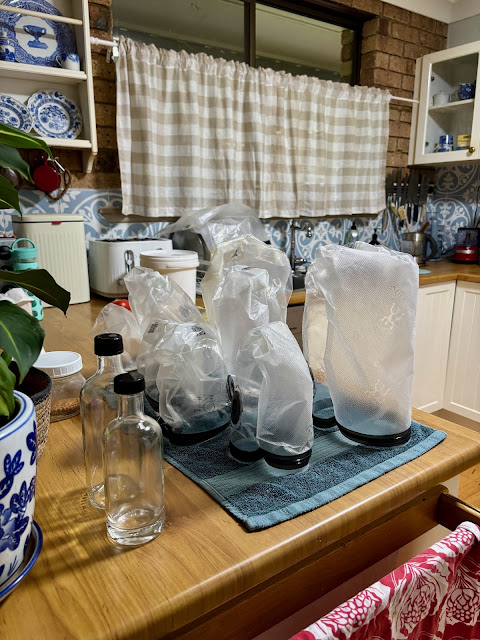
Every morning when I walk into my kitchen it looks tidy and ready for a day's work. Not so on this morning (above), I saw this when I walked in. Late the previous afternoon when I was looking for something, I came across my rolled up Zwilling vacuum bags and decided they had to be washed and dried. So I did that and although I usually put them outside on the verandah to dry it was dark by then. I turned the just-washed bags inside out and left them like this on a towel. It worked well and now the bags are ready to use when I bring home root vegetables, cabbages or whatever I buy that I want to last four or five weeks.
Image

You’ll save money by going back to basics

When I was doing the workshops and solo sessions, I had a couple of people whose main focus was on creating the fastest way to set up a simple life. You can't create a simple life fast, it's the opposite of that It's not one single thing either - it's a number of smaller, simpler activities that combine to create a life that reflects your values; and that takes a long to come together. When I first started living simply I took an entire year to work out our food - buying it, storing it, cooking it, preserving, baking, freezing, and growing it in the backyard. This is change that will transform how you live and it can't be rushed.  
Image


Trending Articles

NOT the last post

This will be my last post here.  I've been writing my blog for 18 years and now is the time to step back. I’ve stopped writing the blog and come back a couple of times because so many people wanted it, but that won’t happen again, I won’t be back.  I’ll continue on instagram to remain connected but I don’t know how frequent that will be. I know some of you will be interested to know the blog's statistics. 
Image

Every morning at home

Every morning when I walk into my kitchen it looks tidy and ready for a day's work. Not so on this morning (above), I saw this when I walked in. Late the previous afternoon when I was looking for something, I came across my rolled up Zwilling vacuum bags and decided they had to be washed and dried. So I did that and although I usually put them outside on the verandah to dry it was dark by then. I turned the just-washed bags inside out and left them like this on a towel. It worked well and now the bags are ready to use when I bring home root vegetables, cabbages or whatever I buy that I want to last four or five weeks.
Image

You’ll save money by going back to basics

When I was doing the workshops and solo sessions, I had a couple of people whose main focus was on creating the fastest way to set up a simple life. You can't create a simple life fast, it's the opposite of that It's not one single thing either - it's a number of smaller, simpler activities that combine to create a life that reflects your values; and that takes a long to come together. When I first started living simply I took an entire year to work out our food - buying it, storing it, cooking it, preserving, baking, freezing, and growing it in the backyard. This is change that will transform how you live and it can't be rushed.  
Image

Creating a home you'll love forever

Living simply is the answer to just about everything. It reduces the cost of living; it keeps you focused on being careful with resources such as water and electricity; it reminds you to not waste food; it encourages you to store food so you don't waste it and doing all those things brings routine and rhythm to your daily life. Consciously connecting every day with the activities and tasks that create simple life reminds you to look for the meaning and beauty that normal daily life holds.  It's all there in your home if you look for it. Seemingly mundane tasks like cleaning and cooking help you with that connection for without those tasks, the home you want to live in won't exist in the way you want it to.  Creating a home you love will make you happy and satisfied.
Image

Time changes everything

I've been spending time in the backyard lately creating a contained herb and vegetable garden. My aim is to develop a comfortable place to spend time, relax, increase biodiversity and encourage more animals, birds and insects to live here or visit. Of course I'd prefer my old garden which was put together by Hanno with ease and German precision. Together, we created a space bursting at the seams with herbs, vegetables and fruity goodness ready to eat and share throughout the year. But time changes everything. What I'm planning on doing now, is a brilliant opportunity for an almost 80 year old with balance issues. In my new garden I'll be able to do a wide range of challenging or easy work, depending on how I feel each day. It’s a daily opportunity to push myself or sit back, watch what's happening around me and be captivated by memories or the scope of what's yet to come.
Image

It's the old ways I love the most

I'm a practical woman who lives in a 1980’s brick slab house. There are verandahs front and back so I have places to sit outside when it's hot or cold. Those verandahs tend to make the house darker than it would be but they're been a great investment over time because they made the house more liveable. My home is not a romantic cottage, nor a minimalist modern home, it's a 1980’s brick slab house. And yet when people visit me here they tell me how warm and cosy my home is and that they feel comforted by being here. I've thought about that over the years and I'm convinced now that the style of a home isn't what appeals to people. What they love is the feeling within that home and whether it's nurturing the people who live there.
Image

Making ginger beer from scratch

We had a nice supply of ginger beer going over Christmas. It's a delicious soft drink for young and old, although there is an alcoholic version that can be made with a slight variation on the recipe. Ginger beer is a naturally fermented drink that is easy to make - with ginger beer you make a starter called a ginger beer plant and after it has fermented, you add that to sweet water and lemon juice. Like sourdough, it must ferment to give it that sharp fizz. To make a ginger beer plant you'll need ginger - either the powdered dry variety or fresh ginger, sugar, rainwater or tap water that has stood for 24 hours to allow the chlorine to evaporate off. You'll also need clean plastic bottles that have been scrubbed with soap, hot water and a bottle brush and then rinsed with hot water. I never sterilise my bottles and I haven't had any problems. If you intend to keep the ginger beer for a long time, I'd suggest you sterilise your bottles. MAKING THE STARTER In a...
Image

An authentic look at daily life here — unstaged and real

Most days Hanno was outside happily working in the fresh air. It may surprise you to know that I started reading my book,  Down to Earth , yesterday - the first time since I wrote it 13 years ago.  I had lent it to my neighbor, and when she returned it, I started reading, expecting to find surprises. Instead, I realised the words were still familiar—as if they were etched into my memory. As I flipped through the pages, I was reminded of how important it was for me to share that knowledge with others. The principles in Down to Earth changed my life, and I truly believed they could do the same for others. After just 30 minutes of reading, I put the book down, reassured that its message still holds true: we can slow down and reshape our lives, one step at a time.
Image