down to earth
  • Home
  • About Us
  • Down To Earth Book
  • Privacy Policy

This will be my last post here.  I've been writing my blog for 18 years and now is the time to step back. I’ve stopped writing the blog and come back a couple of times because so many people wanted it, but that won’t happen again, I won’t be back.  I’ll continue on instagram to remain connected but I don’t know how frequent that will be.

I know some of you will be interested to know the blog's statistics. 

I've been spending time in the backyard lately creating a contained herb and vegetable garden. My aim is to develop a comfortable place to spend time, relax, increase biodiversity and encourage more animals, birds and insects to live here or visit. Of course I'd prefer my old garden which was put together by Hanno with ease and German precision. Together, we created a space bursting at the seams with herbs, vegetables and fruity goodness ready to eat and share throughout the year. But time changes everything. What I'm planning on doing now, is a brilliant opportunity for an almost 80 year old with balance issues. In my new garden I'll be able to do a wide range of challenging or easy work, depending on how I feel each day. It’s a daily opportunity to push myself or sit back, watch what's happening around me and be captivated by memories or the scope of what's yet to come.


I'm a practical woman who lives in a 1980’s brick slab house. There are verandahs front and back so I have places to sit outside when it's hot or cold. Those verandahs tend to make the house darker than it would be but they're been a great investment over time because they made the house more liveable. My home is not a romantic cottage, nor a minimalist modern home, it's a 1980’s brick slab house. And yet when people visit me here they tell me how warm and cosy my home is and that they feel comforted by being here. I've thought about that over the years and I'm convinced now that the style of a home isn't what appeals to people. What they love is the feeling within that home and whether it's nurturing the people who live there.

Living simply is the answer to just about everything. It reduces the cost of living; it keeps you focused on being careful with resources such as water and electricity; it reminds you to not waste food; it encourages you to store food so you don't waste it and doing all those things brings routine and rhythm to your daily life. Consciously connecting every day with the activities and tasks that create simple life reminds you to look for the meaning and beauty that normal daily life holds.  It's all there in your home if you look for it. Seemingly mundane tasks like cleaning and cooking help you with that connection for without those tasks, the home you want to live in won't exist in the way you want it to.  Creating a home you love will make you happy and satisfied.


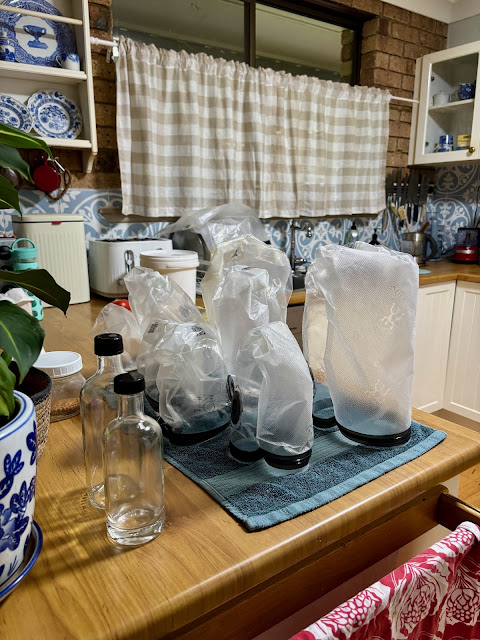
Every morning when I walk into my kitchen it looks tidy and ready for a day's work. Not so on this morning (above), I saw this when I walked in. Late the previous afternoon when I was looking for something, I came across my rolled up Zwilling vacuum bags and decided they had to be washed and dried. So I did that and although I usually put them outside on the verandah to dry it was dark by then. I turned the just-washed bags inside out and left them like this on a towel. It worked well and now the bags are ready to use when I bring home root vegetables, cabbages or whatever I buy that I want to last four or five weeks.
When I was doing the workshops and solo sessions, I had a couple of people whose main focus was on creating the fastest way to set up a simple life. You can't create a simple life fast, it's the opposite of that It's not one single thing either - it's a number of smaller, simpler activities that combine to create a life that reflects your values; and that takes a long to come together. When I first started living simply I took an entire year to work out our food - buying it, storing it, cooking it, preserving, baking, freezing, and growing it in the backyard. This is change that will transform how you live and it can't be rushed.


This photo shows what the weather's been like here.  That's steam coming off my neighbours shed roof after a brief downpour of rain. 

I hope we’re getting closer to organising these workshops. I didn’t explain this clearly enough: Group 1 is four workshops, Group 2 is four workshops. Out of those eight workshops I thought we probably end up doing three or four.


I've added more topics to the list.

This post is for those readers who expressed interest in doing online Zoom workshops or who want to register now. The topics haven't been chosen yet but potential topics are: 

  • vegetable gardening and composting;
  • starting a vegetable garden and choosing vegetables suitable for a beginner; 
  • cutting costs in the home, housework and routines;
  • homemade laundry liquid and powder, soaking, stain removal and washing clothes and household linens;
  • cooking from scratch and building your pantry to help you do it;
  • homemade bread - white, rye, wholemeal and ancient grains. I'm not doing sourdough;
  • living on less than you earn and developing a frugal mindset.
Most days Hanno was outside happily working in the fresh air.

It may surprise you to know that I started reading my book, Down to Earth, yesterday - the first time since I wrote it 13 years ago.  I had lent it to my neighbor, and when she returned it, I started reading, expecting to find surprises. Instead, I realised the words were still familiar—as if they were etched into my memory. As I flipped through the pages, I was reminded of how important it was for me to share that knowledge with others. The principles in Down to Earth changed my life, and I truly believed they could do the same for others. After just 30 minutes of reading, I put the book down, reassured that its message still holds true: we can slow down and reshape our lives, one step at a time.


Hello! I've come here today to wish you happiness over the Christmas season. Whatever you're doing, I hope you enjoy yourself, take time to review the year you've just had, and plan for the year ahead. Something has changed in me over the year, I'm not sure what but I've changed and I think I've come out of my period of grief. I can't remember the past two Christmases although my photos tell me I spent it with my family. This year, I'm much more settled and I have a sense of acceptance and joy as I look to the future.

I haven't written a day in my life post for a long time so today is the perfect day for it. This was yesterday, it was a busy day because I'm doing a few extra things each day to prepare for Christmas. The worst thing about Christmas for me is the rushing to get things done but if I start early, it gets done and enjoy it too.


This all happened on Sunday ...
Making some basics at home can cut costs and reduce many additives in food and cleaners. I make sauce mixes, drinks, laundry liquid, spray cleaners and I dry herbs and spices to use later. I love knowing what I'm using in my home and I can change my recipes according to taste or strength when I need to.


Lemon juice ice blocks, gravy mix, and flavoured vinegars are three things I make several times a year that help me save money and steer clear of preservatives and other potentially harmful chemicals. It shows how simple, homemade solutions can lead to small but lasting savings—and they’re healthier. Commercial lemon juice in a plastic bottle for instance, often contains preservatives like sodium metabisulfite, which some people can be sensitive to. Lemon juice is a natural deterrent to bacteria and by freezing fresh lemon juice, you’re not only cutting out preservatives but also ensuring you always have a natural antibacterial option on hand.

I use my gravy/brown sauce recipe with roast meats, in casseroles and, with mushrooms added, make mushroom sauce for steak. You can customise with herbs or spices for different dishes. It’s such an easy way to avoid the lengthy ingredient lists in store-bought sauces, which can contain fillers and preservatives. I make up a jar of this and leave it with my seasonings next to the stove. It saves going to the pantry and taking the ingredients out each time and then putting them back in.


Simple Gravy/Sauce Mix
I make a very simple mix of plain flour, salt, pepper and paprika. I also make one for roast lamb to which I add dried rosemary and one for roast chicken with dried sage - the paprika helps the sauce brown.  When added to pan juices, it makes an excellent gravy or sauce. I make up about a cup of the simple mix at a time and that lasts a month or so. I use one or two tablespoons stirred into pan juices with enough water to make up the sauce. It's easier healthier and cheaper than Gravox or one of those packet mixes and it tastes much better.

Simple Gravy Mix - customise this to your own taste but start off with:
  • 1 cup plain/all purpose flour
  • 2 tablespoons paprika
  • 1 teaspoon salt
  • 1 teaspoon pepper
You can also make a spicier mix by adding a spoon full of chilli flakes, or a curry version by adding a tablespoon of curry powder.

Chilli Flakes
Wash and dry the chillies and only use those without rot or damage. Cut the top stem off and slice the chillies in half straight down. Place them on a baking tray covered with baking paper in the oven on about 40 - 60C. Dry in the oven until they feel dry, but not burnt - it will take a few hours. You'll have to watch them because some pieces will be smaller and will dry faster. Take small amounts out if you see that they've dried enough. When they're all dry, wait till they're completely cold and then blitz them in a food processor for a few seconds, until they're small flakes. Store in a airtight jar.


You can make chilli jam using fresh chillies or chilli flakes. Here is my recipe for that. How to make Chilli Jam


Sweet lemon/lime slices
This one makes sense particularly if you grow your own lemons or limes. I always have a jar of lemons or limes in the fridge over summer. When I have a drink I can add a slice of sweetened lemon to the iced water. It's suitable for iced tap water or carbonated water from a Soda Stream but also delicious in hot tea. When you get to the end of the slices, add the syrup to your drinks too, by then it will have a wonderful sharp lemon taste. A one litre jar will take three large lemons.

All you need to do is to add sugar syrup to your lemon slices. Sugar syrup is usually equal parts water to sugar. However, I use light syrup which is 2 cups water to 1 cup white sugar. Mix together in a saucepan and heat it on the stove. As soon as the sugar dissolves, cool it then add it to the sliced lemons, seal and store in the fridge.


Flavoured vinegar
Flavoured vinegar is another great idea, especially if, like me, you don’t like oil in your salad dressings. Infusing vinegar with your choice of spices and herbs adds layers of natural flavour. Store-bought salad dressings can be pricey and contain a surprising number of ingredients, so making your own is a healthier and cost-effective alternative. The effort is minimal, and the results are rewarding.

But vinegar is a good cleaner too. This is the spray I make up regularly that does a really good job and costs a few cents, not a few dollars like the supermarket version.

Surface Spray Cleaner
  • 1 cup white vinegar
  • 1 cup water
  • ¼ teaspoon washing up liquid

Mix all ingredients together and then add to a spray bottle. You can clean hard surface areas with this - bench tops, fridge doors, glass stove tops, cupboard doors etc.  Be careful if you have stone bench tops. 

Creamy Scrubber
To make a product similar to Gumption take a small container - about 500 mls/1 pint and add one cup of laundry liquid. Then add enough bicarbonate soda to make a paste. Mix with a spoon until it's mixed well.  If you use a stained spoon to do that, your spoon will be sparkling when you finish. 


This mix will dry out if you make too much. I make enough for about a month, then make a new batch.  I use it to clean the shower, bath, ceramic and stainless steel sinks.

Don’t stop at these, there will be plenty of things you use in your home that, if you think about it, you can make up at home for a fraction of the cost of the supermarket version.

I enjoy housework because I love my home and want it to support me and help me live the life I've chosen for myself. A house is not an inconvenience, it's a home and safe haven, and possibly the largest investment you'll make in your entire life. So I believe the time we spend on house maintenance and cleaning as a good way of protecting what we worked hard for. And that, my friend, is a very good investment in the future.

Thanks for visiting me today. I hope everything is going well for you and your family. 😀


Very early on in my blogging life I wrote a post detailing a lot of green cleaners. It was ridiculous really, I was doing what the supermarkets do - having a different cleaner for each individual cleaning purpose.  Over the years, practicality and good sense kicked in and the variety of my own green cleaners shrank to a handful of cleaners that would clean a lot of different areas and surfaces. It saved me time because I had fewer cleaners to make and it saved money.  As the internet grew with householders offering advice, instead of the choice of cleaners decreasing, many homemakers developed their own recipes and choices increased, a lot! You don't need them. Forget the supermarket models where you shop for different products for every area to be cleaned, common sense and your grandma will tell you that a cleaner is a cleaner and if it suits the area, it will probably suit similar areas and surfaces in your home.


With the current cost of living crisis, now is the time to try making some of your cleaners instead of buying the pre-made products.  They’re easy to make - laundry liquid will take about 10- 15 minutes but you only make an batch every few months.

The foundation recipe of most of my cleaners is laundry liquid. Not only will it clean your clothes with three ingredients, you can add to it to make a creamy scrubber similar to Gumption, you can use it as a stain remover or on greasy kitchen areas such as your stove top, range hood and sink. 

I wanted to add the ingredients list from supermarket products such as Dynamo or Cold Power here but they don't have the ingredients list on their products anymore (hmmm, I wonder why 🧐) They refer you to their websites - but they aren't on the Cold Power site and you have to fill in forms to reach the Dynamo info but no matter what I did, I never found it.  It's interesting that now, when people are much more interested in using less toxic products on their clothing, bed linen and skin, the ingredients lists to help them choose their products have gone.

Here are the recipes:

Laundry Liquid

I put this first because as well as being a laundry liquid, general surface cleaner and stain remover, it's also the foundation of another handy cleaner, similar to Gumption.


You should be able to buy the ingredients for all these cleaners at your local supermarket and on Amazon au if you can’t find them locally. Please note that washing soda is different to baking soda. Sometimes there are two types of washing soda on sale - washing soda crystals and washing soda powder Buy the powder, it's easier to dissolve.


When I make up a new batch of laundry liquid, I always make it up in a 10 litre bucket with lid that I use for laundry and various cleaning tasks around the home. It’s a cleaner that is perfect for cleaning metal - including stainless steel, porcelain baths and sinks, and spot cleaning on painted walls. It does a good job on appliances - like fridges, food processors and painted cupboards. 

HOMEMADE CLEANING RECIPES

LAUNDRY LIQUID
Makes 10 litres - use ¼ cup per laundry load

You may add any essential oil of your choice to these homemade cleaners. Oils like tea tree, eucalyptus, lavender or rose are useful but are not an essential ingredient and will add to the cost.

Ingredients
  • 1 - 2 litres water
  • 1 bar Sunlight or generic laundry soap or any similar pure laundry soap, grated on a cheese grater OR 1 cup of Lux flakes which are now called Softly flakes.
  • ½ cup washing soda – NOT baking soda or bicarb soda
  • ½ cup borax
Tools
  • Saucepan
  • 10 litre bucket
  • Slotted spoon or wooden spoon for mixing

The ingredients are measured into a saucepan containing one to two litres/quarts of water. Add one cup of soap flakes, half a cup of borax and half a cup of washing soda. Turn on the heat and stir. Bring the mix to the boil, stirring as it heats, and by the time the mixture is boiling, ALL the ingredients should be dissolved.

So, you've nearly finished and it's only taken less than ten minutes so far. When you're sure the ingredients are completely dissolved, pour the mixture into your bucket then fill to the top with water from the hot tap and stir it together thoroughly. You've made laundry liquid. And it's cost you about $3 Australian. Ten litres of laundry liquid at an Australian supermarket costs about $120! When you take into account the making, pouring and storing, it's taken about 15 minutes. I make this about once every three months. If you have a large family, you might make it every two months. And it will save you about $100 every time you make it. How long would you have to work to earn $100? Saving it is much easier and much better for the environment.

Once you have the laundry liquid in your bucket, stir it around again, then start filling your containers. Be aware that the liquid will split when it's cold - see the photos below.  There's nothing wrong with it, it just needs re-mixing or shaking before you use it.


Above is the laundry liquid after it's been sitting for 24 hours. It's clearly separated into layers - the top layer is gel-like, the bottom layer is watery. You need space in your container to shake and mix before you use it.  Or, do what I do and get your stick blender and give it a good mix. That will emulsify it and it's more likely to stay like that.

Don't think you've done anything wrong if your mixture separates, it's fine, it just needs a re-mix. This is safe in septic tanks but not for grey water. The borax in the mix might build up as boron in the garden and that is harmful to plants. If you want to use your grey water, don't add the borax.

This laundry liquid will not make suds and that's perfectly okay. The ingredients loosen the dirt and grime in the clothes and the agitation of the washing machine will clean them.

Sometimes you don't have time to make up the liquid, so here is the powder version:

LAUNDRY POWDER 
  • 4 cups grated laundry or homemade soap or soap flakes (Lux)
  • 2 cups borax
  • 2 cups washing soda
Mix all the ingredients thoroughly and store in a plastic container with a lid. Use 2 tablespoons per wash. This powder will not make suds and again, it's perfectly okay.

Soaking
Soaking is a very good habit to get into with your clothes (and washing up in the sink). In the past, most people soaked their clothes before washing. If you have a top loader, just fill the machine and add the laundry liquid, let it run for a minute then turn the machine off and let everything soak for about an hour, or overnight. Then turn the machine back on and carry on as normal. If you have a front loader, you can set your washer to run for a minute, then turn it off for an hour or overnight and re-start your wash. Or you could pick out the very soiled items and soak them in a tub before washing.

Stain remover
I use laundry liquid and rub it on the stain, leave it for an hour and then add to the washing machine and wash as normal.

Surface Spray Cleaner

  • 1 cup white vinegar
  • 1 cup water
  • ¼ teaspoon washing up liquid

Mix all ingredients together and then add to a spray bottle. You can clean all hard surface areas with this - bench tops, fridge doors, glass stove tops, cupboard doors etc.  If your stove top is very dirty, use the creamy scrubber. Just spread some creamy scrubber on the stove surface, let it sit for a couple of minutes then clean off with hot water on a clean rag. Dry the surface with a dry tea towel to finish.

Creamy Scrubber

To make a product similar to Gumption take a small container - about 500 mls/1 pint and add one cup of laundry liquid. Then add enough bicarbonate soda to make a paste. Mix with a spoon until it's mixed well.  If you use a stained spoon to do that, your spoon will be sparkling when you finish. 

This mix will dry out if you make too much. I make enough for about a month, then make a new batch.  I use it to clean the shower, bath, ceramic and stainless steel sinks.

Glass cleaner

Half bucket of water with ½ cup of vinegar added. Use newspaper or clean soft rags to clean and dry the glass.

Washing up Liquid

I've never been able to make a homemade washing up detergent that I was happy with. I use a combination of Ecostore - $4.80 and Earth Choice - $3.50


Cleaners shopping list

I thought I'd make a quick comparison here of the price of the homemade cleaners and all supermarket products.  See what you think.  🤔

HOMEMADE INGREDIENTS

Washing soda - $5.00
Borax - $4.10
Soap that you grate or soap flakes that you buy. I use the soap flakes. If you make your own soap, grate it and use that. - $7.50
White vinegar - $3.00
Bicarb soda - $2.70
Vanish Napisan oxyclean bleach - This is a safe bleach which uses peroxide instead of chlorine bleach. It's much safer and easy to use. If your homemade stain remover doesn't work, this would be your next option. - $17.00 or buy it on half price special. It's on sale frequently.

TOTAL $235.80 - I estimated I would buy these six times a year (approx)

SUPERMARKEY PRODUCTS

Ajax Spray and Wipe spray cleaner - $3.50
Ajax Spray and Wipe glass cleaner - $3.50
Duck Deep Action Gel toilet cleaner - $7.00
OzKleen Shower Power Bathroom and Shower cleaner - $7.35
Earth Choice floor cleaner - $3.35
Gumption multi-purpose paste - $5.40
Elbow Grease air fryer cleaner - $5.00 (I laughed when I saw this. It didn't take long for air fryers to get their own cleaner.)
Cerapol Ceramic Glass and Induction Cooktop Cleaner - $6.45
Dynamo Laundry Liquid - $12.00
Pinoclean Disinfectant - $8.00
Vanish Napisan oxyclean bleach - This is a safe bleach which uses peroxide instead of chlorine bleach. It's much safer and easy to use.

TOTAL $615.50 - I estimated I would buy these 10 times a year (approx)

The difference is $379.70 a year. So in ten years of grocery buying, that would be a saving of $3790.00. 

Who knows what the health benefits would be.


I’ve spent many hours recently thinking about living here in my home. I’m reading Wendell Berry’s inspirational and powerful book, The World-Ending Fire, about living in ‘his place’ in Kentucky. Wendell - one of America’s most thought-provoking writers, never bought a computer, a mobile phone, or even an answering machine. He wrote all his books with a pencil and notebook, and with his wife, maintained fields with horse and plow, grew his own vegetables and meat, preserved food, collected water and became content and settled because of it.


This is the tastiest tomato I've ever grown. Medium in size and a flavour bomb.

I’m eight years younger than Wendell but I strongly hold on to “my place’ too. In fact, now I recognise that it’s one of the things that’s made me who I am and which has given me a solid starting point every day.


Homemade laundry liquid costs $2 - $3 to make 10 litres. It does an excellent job with three simple ingredients and none of the chemicals in the supermarket products.


These flowers are native Iris. 


Gracie, doing her daily rounds.

When I was much younger, Hanno and I lived in Germany for two years. We travelled there so I could meet his family and intended staying for two months. But we ended up staying two years and towards the end of our stay, I was yearning to return to Australia. We returned married and with our first baby. When I stepped on my homeland again, I told myself I’d never leave again. And I haven’t.


One of my new linen aprons.

But as it turned out, it wasn’t the wide brown land of Australia I was yearning for. It was this specific parcel of land at the end of a dead-end, one-lane street in the hinterland of the Sunshine Coast. When I walked onto this land, I knew I was home. We bought the house and land and moved here a few years later when I was 49 years old. I’ve lived here longer than I’ve ever lived anywhere else. I know every inch of this land and I am part of it. This week, when I brought in my bins from the street, I stopped to close the gate behind me and a local butcher bird, a bird I see every day, flew towards me, circled me and flew towards a baby bird already sitting in the closest tree. I hadn’t seen it until the mother bird introduced me to the baby. But, as I walked away from that wonderful encounter, I realised I’m part of the nature of this place and I have no doubt that on that day, the baby bird was introduced to many other living creatures who live on this land.


Everlasting spinach.

When I first set foot here in 1994, I didn’t understand that I had discovered my true path and I was walking towards the mother load of happiness and contentment. I recognised a feeling of excitement but I didn’t know why I was excited. The house was a drab slab house with absolutely no other features. I loved the creek and the remnant rainforest in the backyard immediately but there were no fences, gardens, tanks, or verandas. All that was still ahead of us and, as it turned out, would help shape the people we became.


I will stay here until I die and my sons will inherit my home. It will then be sold and another family will come to live here. I hope they see how special it is and how it can help them slow down and live well. Not everyone can see those things, but in the words of Wendell: “Slow down, Pay Attention, Do good work, Love your neighbours, Love your place, Stay in your place, Settle for less and enjoy it more.”  We created a life like no other here - it was a new way of living, an example for us and others of what could be done with work, attention, fewer expectations and reaping the ample benefits of happiness and contentment.


I’m pleased with the familiar way every day unfolds here. I grow the same foods, I cook the same meals, I talk to the same people and I never crave for new, better or more - I want fewer choices not more of them. I want old and familiar. Especially in these unstable times it suits me to be in my place with the gate shut, picking roses for the house, staking foxgloves, reading, writing and getting to know the baby birds.


In our fast-paced, consumer-driven world, we are constantly bombarded with the idea that convenience is key. The allure of shiny, ready-made products - quickly purchased with a swipe or click - seduces us. And yet, there is a deeper, more fulfilling way to live: making things at home rather than buying them. It’s an act of defiance against waste, excess, and the relentless push of consumerism. But more than that, it's a reclaiming of control, a celebration of simplicity, and a mindful exercise in frugality and time management.

At first glance, making things at home seems daunting. "Who has the time?" some might ask. "It's so much easier to buy." These thoughts are born from a culture that equates ease with value. But what if we flipped that equation? What if, instead of measuring value by the time saved, we measure it by the skill earned, the money conserved, and the creativity sparked?


Frugality is often misunderstood as deprivation, but in truth, it’s the art of stretching resources without sacrificing quality of life. It’s not about skimping, but about finding alternatives that enrich your day-to-day existence without spending. Making things at home allows for this kind of smart economy.


The weekly grocery bill can easily spiral out of control if we rely on pre-packaged, pre-made meals. But when we return to the basics, learning to cook from scratch, we find the key to living well within a budget. A loaf of bread, fresh from your own oven, costs a fraction of what you’d pay for a plastic-wrapped loaf, and its aroma fills your kitchen with warmth that no store-bought loaf could deliver. A simple stew, simmered slowly with seasonal vegetables and leftover cuts of meat, stretches ingredients far beyond the limits of fast food.

The same can be said for cleaning products. Store shelves overflow with specialised sprays, powders, and wipes, each promising miraculous results for a price. Yet, with a few household staples like vinegar, baking soda, and essential oils, you can create a multipurpose cleaner that costs pennies, is free of harsh chemicals, and is just as effective.


This is the hemp I used to use for my dish cloths. It was great to knit with but it didn't suit dishcloths - the knives easily cut it.  My go-to yarn is organic cotton. That is easy to knit, it dries quickly and it's soft to the touch.


The satisfaction I feel when I make something for my home far outstrips the feeling I used to get when I bought everything I needed. What I make suits my home better than most commercial products and as a bonus, I feel the warm embrace of self-reliance when I make them. I know it can be difficult to disconnect from the ease of buying pre-made everything but once you settle into to it, home production, moderation and self-reliance delivers long-term, constant contentment.


These are my organic cotton dishcloths.

Making things at home requires an upfront investment of time but it also encourages mindfulness and creativity. When we dedicate time to preparing a meal, mending a piece of clothing, or knitting a dishcloth, we are fully present in the moment. These acts become meditative, pulling us away from the frenzy of daily life and into a slower, more grounded rhythm.

One of the most significant benefits of making things at home is that the skills you develop compound over time. The first loaf of bread may feel like a laborious task, but by the tenth, you’ll have refined your technique and cut the time in half. You may begin by knitting simple scarves, but soon you’ll move on to sweaters, hats, and mittens. The satisfaction that comes from honing a craft and mastering a skill is unmatched by the fleeting joy of purchasing something ready-made.


There’s a profound shift that occurs when you start making things at home. When you’ve invested your time and effort into making something, it holds greater value. You care for it differently, knowing the energy that went into its creation.


In this way, making things at home is a practice in gratitude. It teaches you to honor the resources you have - time, money, and skill - and to use them wisely. It’s a path towards simplicity, sustainability, and self-reliance, where the things you surround yourself with are not just objects, but symbols of care, creativity, and intention.

In the end, making things at home is not just about frugality or time management. It’s about living with purpose, finding joy in the process and crafting a life that values quality over quantity, creativity over consumption, and mindfulness over convenience.

What do you regularly make to use in your home?


I eat my main meal at lunchtime. This is last week's lunch - corned beef with mashed potatoes, salad and homemade relish.

Although I seem to be moving further away from meat meals, I've had a craving for corned beef lately. It's a reminder of my youth because corned beef, mashed potatoes, cabbage and relish/pickles was a popular meal in Australia's suburbia in the 1950s/60/70s. My main problem with it is that the pieces of corned beef on sale at the supermarket are quite big and I don't want to waste what I buy. So when I see a small piece, I grab it, and at home, divide it in two and have a more reasonable size to cook and eat in the following days. I also use corned beef as a cold cut for sandwiches and when I make meatloaf, I divide that in two as well, eat one half for a couple of days and freeze the rest.


These meals are egg-based - above: asparagus quiche with filo pastry, below: tinned red salmon   with boiled eggs and salad.


Another thing I've been thinking about recently is how the increasing cost of living is impacting people all around the world, and how we can respond to it in a common sense way. First of all let me put my hand up and acknowledge that it's been fairly easy for me to keep my food costs to a reasonable level. I don't have to consider other family members who want their steak or leg of lamb meals and don't want to think about balancing the budget. This week at my local Woolworth's supermarket a leg of lamb large enough for a family roast (1.8kg - 2.8kg) is $42. Buying a leg that size will give you leftovers for meals the following day as well as cold cuts for sandwiches in the lunchboxes. Other popular meats include T-bone steak - $30 kg, Scotch fillet steak - $41.50 kg and eye fillet - $52.00 kg. If you buy eye fillet from the butcher, it costs around $70 kg. 😳 Cheap sausages are $5.90 for 550g, Angus beef sausages are $9.00 for six sausages. If you're going to serve your steaks with a salad, one iceberg lettuce is $3.00, 500 grams tomatoes is $5.00, a cucumber is $3.50, red onions are 68 cents each, so two = $1.36. I think you probably have the makings of salad dressing at home (olive oil/vinegar) but if you have to buy the processed dressing, it will cost you $3.00. You'll get 6 bread rolls for $2.85. To buy a steak/sausages and salad for four people for ONE meal will cost around $66!

There are a few delicious meat meals made using the cheaper cuts of beef - skirt steak, gravy beef, blade steak are just some of them. If you slow cook them as a casserole, stew or soup, they'll provide a wonderful meal that your family will enjoy. They're also suitable for freezing, so store your leftovers in the freezer for backup meals in the following days.


Meatballs, cabbage and boiled potatoes.


Beef casserole, using the cheaper cuts of gravy beef or skirt steak, with herb dumplings.


Leftovers - pasta with bolognese sauce.

I wouldn't pay that because I could make something delicious that would be much cheaper and nutritious for less. Everytime someone pays those prices it tells the supermarkets that we're willing to pay those inflated prices. And if you just buy the salad it's still $12.86. Instead of salad, you could do a potato bake - that would cost you $4.50 for 2 kg potatoes, one onions is 68 cents, a small jar of cream is $3.75, pack of pre-grated Parmesan cheese - $2 and your electricity to bake it would be around 50 cents. That option would cost $9.43.  Remember, theoretically, I'm cooking for a 4 person family.

Egg and bacon pie.


Making shortcrust pastry. It's easy but if you need a quicker option, buy a pack of filo pastry and use that instead.

OR you could make a quiche from scratch. That would cost $5.70 for 12 eggs (you'd have 6 leftover for breakfast), small jar of cream $3.75, garlic and onion about 85 cents, 500g bacon $6.75, and cheese $7.70. The homemade pastry would be $1.40 for 1kg of plain flour, $7.00 for 500 g butter (you'd have almost ¾ of the butter left over), the rest is just salt and water. There's a recipe for pie crust on Grandma Donna's blog here. This option would cost around $24.75 to make the quiche and you'd have eggs and butter leftover for another day and probably have quiche left over for lunches the following day. Add the salad at $12.86 and this meal would be $37.61. Both are reasonably healthy options but one meal is almost half the price of the other.


I buy frozen Australian peas and grow the greens and herbs I eat every week; they're really easy to grow, even in pots. My list includes parsley, chives, basil, cucumbers, radishes, rainbow chard, perpetual spinach, lettuce, chillies and green onions. I grow the lettuce in the shade of the bush house/verandah, the rest grow in the sun in the old sandbox. All of them are easy to grow from seed. I sprinkle seeds on the top of good potting mix in pots and grow in the shade. It requires water every second day and it will grow fast. I let the plants grow for about 4 weeks and while they're still small, I harvest a quarter of the pot with scissors and add them to my salads. The lettuce continues to grow after harvesting so I just give them a drink of Seasol to keep them healthy and they'll be ready to harvest again in 4 weeks. Setting yourself up to grow some of your own food will cost around $40, for seeds, potting mix and Seasol, but that should keep you going for a few months.

If I were to buy fresh parsley, chives, basil - all $3.20 a bunch, and rainbow chard - $4.70, spinach - $3.90, lettuce - $2.50. I woudln't buy all of them every week but most weeks herbs and green would cost me $10 if I didn't grow them myself.  I think this is an excellent chore for one of the kids to take on. They'd learn to produce food and give the family the FRESHEST herbs and vegies every week. But even if you do it yourself like I do, it's well worth it.

Here is a list of some of the many vegetables, legumes and nuts that contain protein.

What I'm getting at here is that there are always options and protein doesn't have to be meat, chicken or fish. You don't have to choose the thing you've always chosen. Be wise and think of what you can do with different ingredients and when this cost of living crisis is over, and it will end, you'll be proud of how you got your family through it by changing what you eat and adjusting what you spend.

Homemade potato and curried mince pies - no pastry.

Vegetable frittata - which is just a fancy way of saying eggs with whatever vegetables are in your fridge.

The main problem moving away from meal, chicken or fish meals is that they all deliver the protein we all need.  However, that doesn't mean there's no substitute for meat, fish or chicken. Egg, milk, cheese, yoghurt, legumes and pulses such as chick peas, split peas and lentils are all high in protein and they're all cheap, healthier than meat and better for the environment.  If you have some tried and true meat-less, or almost meatless, meals, please share them with us. And don't forget tinned fish such as tuna and salmon. Boths are cheaper than meat and very nutritious.

Mostly meat-free egg recipes

45 reasons to have eggs for dinner

Delicious RecipeTin Eats meals

Let's think about unit prices, generic brands and being flexible with our choice of brands. 

Unit prices are generally displayed under the product price on supermarket shelves. Checking the unit price gives us a more accurate understanding of the value for money of each item - even if something is "on special". So make your selections based on the unit prices, not the product price.

Generic brands can help you make ends meet in times like these. Supermarkets are retailers, not manufacturers so the generic brands are made by the same manufacturers that make the branded products you know well. There are no factories set up to make inferior generic brands - so manufacturers making flour, butter, tea, sugar etc. for the supermarkets just change the packaging and produce the generic brands you see on the shelves. And they're all cheaper than the well known brands. 

Being flexible - this is good advice all through life. Flexibility helps us cope with difficult times and situations. We can all switch to generic brands when we need to but we can also substitute ingredients so we don't have to buy something we might use in just one recipe. If a recipe you want to try suggests something you don't have in your pantry, look up one of the websites below to find a substitute for it.

Allrecipes

Food Network

Food52

Baking for the grandkids - cup cakes and sausage rolls.

And finally, use your common sense and go with your instinct. Often your instinct will guide you in cooking. Back yourself in everything you do. You might have to stop and change your mind when it doesn't work but every time you do something new, it will teach you something. Open up your memory bank and store everything you learn for another time when you need it.

If you want the recipe for anything above, please use the search bar on the right hand side.

Newer Posts Older Posts Home

ABOUT ME

Down to Earth is a blog by Rhonda Hetzel, dedicated to simple, intentional living — from home cooking and gardening to frugal budgeting and handmade crafts. It’s a space for gentle inspiration and everyday wisdom on creating a life that feels real, balanced, and deeply fulfilling.

Down To Earth Book

Down To Earth Book
My books are all published by Penguin. Down to Earth, The Simple Life and The Simple Home have been in book shops since they were published in 2012, 2014 and 2016, respectively. On 20 October 2020, Down to Earth was published as a paperback.

MY FAVOURITE PLACES

  • Grandma Donna's Place
  • Grandma Donna's YouTube
  • Grandma Donna's Instagram
  • This Simple Day
  • Nicole's Instagram

Popular Post of All Times

Making ginger beer from scratch

We had a nice supply of ginger beer going over Christmas. It's a delicious soft drink for young and old, although there is an alcoholic version that can be made with a slight variation on the recipe. Ginger beer is a naturally fermented drink that is easy to make - with ginger beer you make a starter called a ginger beer plant and after it has fermented, you add that to sweet water and lemon juice. Like sourdough, it must ferment to give it that sharp fizz. To make a ginger beer plant you'll need ginger - either the powdered dry variety or fresh ginger, sugar, rainwater or tap water that has stood for 24 hours to allow the chlorine to evaporate off. You'll also need clean plastic bottles that have been scrubbed with soap, hot water and a bottle brush and then rinsed with hot water. I never sterilise my bottles and I haven't had any problems. If you intend to keep the ginger beer for a long time, I'd suggest you sterilise your bottles. MAKING THE STARTER In a...
Image

The last post

This will be my last post here.  I've been writing my blog for 18 years and now is the time to step back. I’ve stopped writing the blog and come back a couple of times because so many people wanted it, but that won’t happen again, I won’t be back.  I’ll continue on instagram to remain connected but I don’t know how frequent that will be. I know some of you will be interested to know the blog's statistics. 
Image

How to make cold process soap

I'm sure many of you are wondering: "Why make soap when I can buy it cheaply at the supermarket?" My cold process soap is made with vegetable oils and when it is made and cured, it contains no harsh chemicals or dyes. Often commercial soap is made with tallow (animal fat) and contains synthetic fragrance and dye and retains almost no glycerin. Glycerin is a natural emollient that helps with the lather and moisturises the skin. The makers of commercial soaps extract the glycerin and sell it as a separate product as it's more valuable than the soap. Then they add chemicals to make the soap lather. Crazy. Making your own soap allows you to add whatever you want to add. If you want a plain and pure soap, as I do, you can have that, or you can start with the plain soap and add colour, herbs and fragrance. The choice is yours. I want to add a little about animal and bird fat. I know Kirsty makes her soap with duck fat and I think that's great. I think t...
Image

Preserving food in a traditional way - pickling beetroot

I've had a number of emails from readers who want to start preserving food in jars but don't know where to start or what equipment to buy.  Leading on from yesterday's post, let's just say up front - don't buy any equipment. Once you know what you're doing and that you enjoy preserving, then you can decide whether or not to buy extra equipment. Food is preserved effectively without refrigeration by a variety of different methods. A few of the traditional methods are drying, fermentation, smoking, salting or by adding vinegar and sugar to the food - pickling. This last method is what we're talking about today. Vinegar and sugar are natural preservatives and adding one or both to food sets up an environment that bacteria and yeasts can't grow in. If you make the vinegar and sugar mix palatable, you can put up jars of vegetables or fruit that enhance the flavour of the food and can be stored in a cupboard or fridge for months. Other traditional w...
Image

Cleaning mould from walls and fabrics

With all this rain around we've developed a mould problem in our home. Usually we have the front and back doors open and that good ventilation stops most moulds from establishing. However, with the house locked up for the past week, the high humidity and the rain, mould is now growing on the wooden walls near our front door and on the lower parts of cupboards in the kitchen. Most of us will find mould growing in our homes at some point. Either in the bathroom or, in humid climates, on the walls, like we have now. You'll need a safe and effective remedy at some point, so I hope one of these methods works well for you. Mould is not only ugly to look at, it can cause health problems so if you see mould growing, do something about it straight away. The longer you leave the problem, the harder it will be to get rid of it effectively. If you have asthma or any allergies, you should do this type of cleaning with a face mask on so you don't breathe in any spores. Many peopl...
Image

Five minute bread

Bread is one of those foods that, when made with your own hands, gives a great deal of satisfaction and delight. It's only flour and water but it symbolises so much. I bake bread most days and use a variety of flours that I buy in bulk. Often I make a sandwich loaf because we use most of our bread for lunchtime sandwiches and for toast. Every so often I branch out to make a different type of loaf. I have tried sour dough in the past but I've not been happy with any of them. I'll continue to experiment with sour dough because I like the idea of using wild yeasts and saving the starter over a number of years to develop the flavour and become a part of the family. However, the loaf I've been branching out to most often is just a plain old five minute bread. By five minutes I mean it takes about five minutes actual work to prepare but it's the easiest of all bread to make and to get consistently good loaves from. If you're having people around for lunch or...
Image

This is my last post.

I have known for a while that this post was coming, but I didn't know when. This is my last post. I'm closing my blog, for good, and I'm not coming back like I have in the past.  I've been writing here for 16 years and my blog has been many things to me. It helped me change my life, it introduced me to so many good people, it became a wonderful record of my family life, it helped me get a book contract with Penguin, and monthly columns with The Australian Women's Weekly and Burke's Backyard . But in the past few months, it's become a burden. In April, I'll be 75 years old and I hope I've got another ten years ahead. However, each year I'll probably get weaker and although I'm fairly healthy, I do have a benign brain tumour and that could start growing. There are so many things I want to do and with time running out, leaving the blog behind gives me time to do the things that give me pleasure. On the day the blog started I felt a wonderful, h...
Image

What is the role of the homemaker in later years?

An email came from a US reader, Abby, who asked about being a homemaker in later years. This is part of what she wrote: "I am a stay-at-home mum to 4 children, ages 9-16. I do have a variety of "odd jobs" that I enjoy - I run a small "before-school" morning drop-off daycare from my home, I am a writing tutor, and I work a few hours a week at a local children's bookstore. But mostly, I cherish my blissful days at home - cooking, cleaning (with homemade cleaners), taking care of our children and chickens and goats, baking, meal-planning, etc. This "career" at home is not at all what I imagined during my ambitious years at university, but it is far more enriching. I notice, though, that my day is often planned around the needs of my family members. Of course, with 4 active kids and a husband, this is natural. I do the shopping, plan my meals, cook dinner - generally in anticipation of my family reconnecting in the evening.  I can't h...
Image

Every morning at home

Every morning when I walk into my kitchen it looks tidy and ready for a day's work. Not so on this morning (above), I saw this when I walked in. Late the previous afternoon when I was looking for something, I came across my rolled up Zwilling vacuum bags and decided they had to be washed and dried. So I did that and although I usually put them outside on the verandah to dry it was dark by then. I turned the just-washed bags inside out and left them like this on a towel. It worked well and now the bags are ready to use when I bring home root vegetables, cabbages or whatever I buy that I want to last four or five weeks.
Image

You’ll save money by going back to basics

When I was doing the workshops and solo sessions, I had a couple of people whose main focus was on creating the fastest way to set up a simple life. You can't create a simple life fast, it's the opposite of that It's not one single thing either - it's a number of smaller, simpler activities that combine to create a life that reflects your values; and that takes a long to come together. When I first started living simply I took an entire year to work out our food - buying it, storing it, cooking it, preserving, baking, freezing, and growing it in the backyard. This is change that will transform how you live and it can't be rushed.  
Image

Categories

  • Backyard 244
  • Being Organised 257
  • Books 9
  • Budgeting 142
  • Chickens 42
  • Community life 289
  • Family 269
  • From Scratch 63
  • Grandmothering 69
  • Home 296
  • Individuality 185
  • Mentoring 55
  • My books 49
  • Organic Gardening 348
  • Preserving 97
  • Recycling 22
  • Retirement 22
  • Self Reliance 160
  • Simple Living 777
  • Sustainability 308
  • This blog 107
  • Weekend reading 362
  • Writing 4

Followers

Trending Articles

The last post

This will be my last post here.  I've been writing my blog for 18 years and now is the time to step back. I’ve stopped writing the blog and come back a couple of times because so many people wanted it, but that won’t happen again, I won’t be back.  I’ll continue on instagram to remain connected but I don’t know how frequent that will be. I know some of you will be interested to know the blog's statistics. 
Image

Making ginger beer from scratch

We had a nice supply of ginger beer going over Christmas. It's a delicious soft drink for young and old, although there is an alcoholic version that can be made with a slight variation on the recipe. Ginger beer is a naturally fermented drink that is easy to make - with ginger beer you make a starter called a ginger beer plant and after it has fermented, you add that to sweet water and lemon juice. Like sourdough, it must ferment to give it that sharp fizz. To make a ginger beer plant you'll need ginger - either the powdered dry variety or fresh ginger, sugar, rainwater or tap water that has stood for 24 hours to allow the chlorine to evaporate off. You'll also need clean plastic bottles that have been scrubbed with soap, hot water and a bottle brush and then rinsed with hot water. I never sterilise my bottles and I haven't had any problems. If you intend to keep the ginger beer for a long time, I'd suggest you sterilise your bottles. MAKING THE STARTER In a...
Image

Time changes everything

I've been spending time in the backyard lately creating a contained herb and vegetable garden. My aim is to develop a comfortable place to spend time, relax, increase biodiversity and encourage more animals, birds and insects to live here or visit. Of course I'd prefer my old garden which was put together by Hanno with ease and German precision. Together, we created a space bursting at the seams with herbs, vegetables and fruity goodness ready to eat and share throughout the year. But time changes everything. What I'm planning on doing now, is a brilliant opportunity for an almost 80 year old with balance issues. In my new garden I'll be able to do a wide range of challenging or easy work, depending on how I feel each day. It’s a daily opportunity to push myself or sit back, watch what's happening around me and be captivated by memories or the scope of what's yet to come.
Image

The most wonderful news

This post will give me more joy to write than anything else I could think of today.  I told you  there are a few exciting things happening here at the moment, well, I am now able to tell you the most exciting one of them.  Our son Kerry and his beautiful partner Sunny are having a baby!  Hanno and I will be grandparents in late March.  I can barely believe my eyes when I read what I have just written.  This is one of my original stitchery patterns. This wasn't planned but it's welcomed wholeheartedly by all of us.  Both Kerry and Sunny are hard workers and now that they have a baby to love and care for, they've decided it's time to buy an apartment together.  Sunny is going home to Korea to tell her family and when she comes back again, the search will start to find their first home together.  We are all so excited!  My knitting has taken on a life of its own and when I think of all the projects I could start, my head spins.  Thi...
Image

About Blog


Down to Earth is a blog by Rhonda Hetzel, dedicated to simple, intentional living — from home cooking and gardening to frugal budgeting and handmade crafts. It’s a space for gentle inspiration and everyday wisdom on creating a life that feels real, balanced, and deeply fulfilling.

Last Year's Popular Posts

The last post

This will be my last post here.  I've been writing my blog for 18 years and now is the time to step back. I’ve stopped writing the blog and come back a couple of times because so many people wanted it, but that won’t happen again, I won’t be back.  I’ll continue on instagram to remain connected but I don’t know how frequent that will be. I know some of you will be interested to know the blog's statistics. 
Image

Every morning at home

Every morning when I walk into my kitchen it looks tidy and ready for a day's work. Not so on this morning (above), I saw this when I walked in. Late the previous afternoon when I was looking for something, I came across my rolled up Zwilling vacuum bags and decided they had to be washed and dried. So I did that and although I usually put them outside on the verandah to dry it was dark by then. I turned the just-washed bags inside out and left them like this on a towel. It worked well and now the bags are ready to use when I bring home root vegetables, cabbages or whatever I buy that I want to last four or five weeks.
Image

You’ll save money by going back to basics

When I was doing the workshops and solo sessions, I had a couple of people whose main focus was on creating the fastest way to set up a simple life. You can't create a simple life fast, it's the opposite of that It's not one single thing either - it's a number of smaller, simpler activities that combine to create a life that reflects your values; and that takes a long to come together. When I first started living simply I took an entire year to work out our food - buying it, storing it, cooking it, preserving, baking, freezing, and growing it in the backyard. This is change that will transform how you live and it can't be rushed.  
Image

Workshops update

  This photo shows what the weather's been like here.  That's steam coming off my neighbours shed roof after a brief downpour of rain.  I hope we’re getting closer to organising these workshops. I didn’t explain this clearly enough: Group 1 is four workshops, Group 2 is four workshops. Out of those eight workshops I thought we probably end up doing three or four.
Image

Creating a home you'll love forever

Living simply is the answer to just about everything. It reduces the cost of living; it keeps you focused on being careful with resources such as water and electricity; it reminds you to not waste food; it encourages you to store food so you don't waste it and doing all those things brings routine and rhythm to your daily life. Consciously connecting every day with the activities and tasks that create simple life reminds you to look for the meaning and beauty that normal daily life holds.  It's all there in your home if you look for it. Seemingly mundane tasks like cleaning and cooking help you with that connection for without those tasks, the home you want to live in won't exist in the way you want it to.  Creating a home you love will make you happy and satisfied.
Image

Time changes everything

I've been spending time in the backyard lately creating a contained herb and vegetable garden. My aim is to develop a comfortable place to spend time, relax, increase biodiversity and encourage more animals, birds and insects to live here or visit. Of course I'd prefer my old garden which was put together by Hanno with ease and German precision. Together, we created a space bursting at the seams with herbs, vegetables and fruity goodness ready to eat and share throughout the year. But time changes everything. What I'm planning on doing now, is a brilliant opportunity for an almost 80 year old with balance issues. In my new garden I'll be able to do a wide range of challenging or easy work, depending on how I feel each day. It’s a daily opportunity to push myself or sit back, watch what's happening around me and be captivated by memories or the scope of what's yet to come.
Image

Simple life workshops on Zoom UPDATED

I've added more topics to the list. This post is for those readers who expressed interest in doing online Zoom workshops or who want to register now. The topics haven't been chosen yet but potential topics are:  vegetable gardening and composting; starting a vegetable garden and choosing vegetables suitable for a beginner;  cutting costs in the home, housework and routines; homemade laundry liquid and powder, soaking, stain removal and washing clothes and household linens; cooking from scratch and building your pantry to help you do it; homemade bread - white, rye, wholemeal and ancient grains. I'm not doing sourdough; living on less than you earn and developing a frugal mindset.
Image

Labels

  • Bartering
  • Chickens
  • Community life
  • Food security
  • From Scratch
  • Home Maintenance
  • Homemaking
  • Mentoring
  • My favourite place
  • Recipes - savoury
  • Reminders of what is important to us
  • Simple Living
  • The Simple Home - June
  • The Simple Home - May
  • Utilities
  • Wise Economy

Copyright © Down To Earth. Designed by OddThemes