down to earth

  • Home
  • About Us
  • Down To Earth Book
  • Privacy Policy
It getting towards that time of year when things start getting very busy. I spent some time on the weekend working on my Christmas gifts but I'm not sure my ambitious plans will result in me finishing everything on time. Despite the extra work, I love this time of year, especially now that my boys are happily settled with their girls and our expanding family gives us more reasons to celebrate.

We had a visit from Shane and Sarndra yesterday, Kerry and Sunny will drop in today. Sarndra is a real family girl. She is happily connected to her own family and is making a real effort to get to know all of us now. She looked gorgeous yesterday in her blue summery dress - she usually wears dresses or skirts (just like me). She is an absolute joy to me. Sunny is a shy girl with us and not confident with her English but she really is a good fit with our family. She is a beautiful girl, an excellent cook and is very close to her mother. That's a good sign! I am truly blessed to have these two girls in my life now.

Sarndra is teaching herself to sew and knit. It's quite the thing now apparently. No longer seen as the domain of us oldies, sewing and knitting are cool again. Thankfully these things go in cycles and each time they come around new techniques, as well as the traditional methods, are discovered by new eyes. And what a wonderful world it opens up - being able to make beautiful and unique items for yourself, your home and to give to friends. You can always pick the home of a crafter - you'll find things there that you won't find anywhere else. These homes stand out as warm and inviting because they are decorated with the simple finery of a creative mind.

This is what I was working on this weekend. It's a tea cosy knitted with organic cotton, topped with pure wool felt flowers. It's a very simple project that I started knitting last weekend and almost finished yesterday. Actually I thought I had finished but when I put the cosy on the teapot, I realised it need more flowers. So that will be completed later in the week, but you'll get the idea from these photos.


I didn't have a pattern, I just cast on enough stitches to cover half my tea pot. It was 40 stitches for each half. I just measure it as I knitted and half way up, I started knitting two together to reduce the size of the top. Then I cast off and sewed the two sides together with a wool needle and more of the organic cotton, making sure I left the appropriate holes for the spout and handle.


Next came the felt flowers. I cut strips of felt, then cut them into squares, and the squares into circles with wavy edges. Then it was simply a matter of curling the felt up so it resembled a flower.


Each flower was sewn onto the cosy with embroidery floss in a colour matching the felt.


In no time I had what I thought were enough flowers, but when I tried it on the tea pot, I realised I still need probably another three flowers over the top of the spout.


I wonder how many of you are working on handmade projects at the moment. If you're new to all this, I would love you to tell me what you're working on and how you feel about your work. And for those who haven't yet taken up the needles, and for those who have, here are a few sewing projects that are suitable for a beginner or as a second or third project. If you have some photos of your projects you'd like to share with me, please post them at the forum. I'd be delighted to see what you're working on.

It gives me great pleasure to be able to encourage you in your needlework. In days gone by, women always did this. They encouraged each other, taught the younger girls and they socialised with their crafts in sewing circles and quilting bees. We might not be close enough to walk to each others homes, but we are creating a world-wide sewing circle here, and we can see each other's projects and talk about them. You will be enriched by the time you spend on hand made items and it's more than likely that you'll delight the person you give a handmade gift to. All it needs is for you to start.

SIMPLE PROJECT TUTORIALS
Machine sewing
Crochet roll
Patchwork sewing machine cover
iPod or camera case

Hand sewing
Queen Anne's Lace pillow slip
Snowflake pendant or Xmas decoration
Felt tea cosy
Apple hoop picture

Buying a sewing machine
I see things differently now. Gone are the days when I wanted to live to be 110 and I thought illness was a weakness – not in others but in myself. All my life I’ve been lucky enough to be healthy, optimistic and forward thinking and now, while still retaining those characteristics, I see times when age has caught up with me and bending over the wrong way or carrying something too heavy for me will make me suffer.

I see the strong and capable man I married, who has always prided himself on providing well for his family and done more than enough for us, hobbling around with painful joints and being frustrated at his own inability to work as he would like. Oh, he still climbs trees, much to his doctor’s annoyance, still thinks he can take on the world but age has a way of letting us remember past glories and not current reality. He pays the price if he works hard all day, so do I, and often I don’t even try to do it any more.

But on the flip side, I love being my age. From the time when I was about 15 until about 55, I felt young, strong and invincible. Now I feel mellow and wise, and strong, but in a different way. Is it okay to call yourself wise? I’m not sure. I feel I know things now that I knew before, but now I see them differently. If that's not the accumulated wisdom of the decades I’ve lived, it’s close to it. People look at us oldies differently and if they don't, we're invisible. I refuse to be invisible and make myself heard as much as possible. Often older people are seen as weak or not knowing much. That shallow view belies what being an elder is. What some see as weakness is really acceptance. I understand a lot more now about what makes us tick and when I see others make the same mistakes I made when I was younger, I just shrug and accept it as being human. I still know all I knew when I was younger, and more, but it's not as important to me now to let everyone know it.

In addition to seeing my own and Hanno’s decline, I am also witnessing the illness of my close friend Bernadette. She's a fiery old bird and as tough as they come, but she’s been laid low with cancer and all the treatments and psychological drama that go with it. Hanno and I are walking this road with Bernadette, wherever it takes us, and whether it’s a good day or a bad one, we usually find something to have a laugh about. And out of the ashes of all that Bernadette has been through these past few months, comes hope and and belief in the future. She bought herself a puppy! Just before she was diagnosed, Bernadette’s old dog Iona died. So after a lot of thought, and a promise from Hanno and I to look after her puppy if anything happens to her, she picked up her cute little Shih Tzu a few days ago. That, my friends, is the wisdom that age brings.


Is there anything more optimistic and hopeful than a puppy? Introducing Flora McDonald.


I've come full circle. I started off my dish cleaning duties as a young girl when my sister and I had to dry when mum washed up. I grew up doing that and now I recall it fondly as a time of family conversations, pushing my sister (she reads my blog and she'll probably add more to that) and sometimes, only sometimes, pretending to be sick to get out of wiping up. It's a nice memory to have. So now I'm back at the sink, this time as the washer, with no dryers and no electric dishwasher. That is sitting outside the back door waiting to be sold. It feels good to have made the decision to get rid of it - yet another thing we've simplified.


Position vacant: where the dishwasher once stood. This space is waiting patiently for Hanno to be well enough to make some shelves. I will make a little curtain to cover it and it will hold some of my recycled jars and bottles.

When my mother did the washing up, although I remember a bar of yellow laundry soap being there over the years, she used detergent probably from the mid-1950s. So from then until now, I've usually used detergent. In the past couple of years, I've had periods when I used my homemade soap, but there was always a bottle of detergent around. We still have a couple of bottles of detergent in the cupboard and I will use them, but when they're gone, that's it - we are a detergent-free zone.

You need to use more liquid soap than you would with a concentrated detergent. I'm using about two tablespoons of soap in my washing up sink. I'm also equipped with two washing racks, a draining board on which one of them sits (generally we only have enough for one drainer), a handmade dishcloth, a cotton washing up mop and some steel wool. I usually use one of those steel wire scrubbers that lasts me at least three months, with disinfecting every so often. But Hanno bought steel wool recently, so I'm using that. I don't like it, although it does a good job.


Liquid soap just added.

The warm water starts off with a lather when the soap is added but the bubbles don't last as long as detergent bubbles do. We've been scammed into thinking - both with washing dishes and clothes - that we need bubbles. It's not so, bubbles do nothing. I'm very happy with the dishes washed with this liquid soap. They are as clean as when washed with detergent, the time I spend washing up is the same but I'm much happier because I'm not using petro-chemicals. I always had a niggling doubt that there was a residue on the plates and cups, even though I rinse them well.


At the end of the washing - dirty water and few bubbles.

This soap may also be used as a handwash - you can dilute it 20 percent soap to 80 percent water and store it in a dispenser. I've washed pure wool with it and was very happy with the result. I've washed my hair with it and it was shiny and soft and, just like with homemade hard soap, didn't need hair conditioner. You can use it as a shaving soap - it's mild and contains glycerin so it leaves the skin smooth. Rubbing a few drops of this soap into a stain and putting it in with the normal wash usually removes the stain. It makes an excellent natural horticultural soap that will help control aphids, mealybugs, whitefly, scale and red spider mites. It doesn't kill them as a poison would, it suffocates them.


I foresee a time when I will be washing up with my daughters-in-law drying for me, all of us talking about our lives while the menfolk are outside picking vegetables to be taken home. Maybe over the years, smaller drying hands will be added to this productive group. :- ) It's a fond and comfortable vision I have made just out of this one adjustment to our lives, but standing at the sink with my hands in warm water makes for those tender scenes in my head. It seems like such a good idea to me.

ADDITIONAL READING:
I have no problem using borax but I know there are some who doubt whether it is a good idea. When I was growing up it was quite common to use borax eye wash, and it is still a recommended homoeopathic treatment. Here is some extra information about it.
Borax information
Green Living
How borax works


Well ladies and gentlemen, I've made my own liquid soap, tested it for a few weeks, and now I'm happy to recommend it to you. I've tried several versions of homemade grated soap, I added glycerin to it, boiled it, and tried every which way but it was always horrible to use. Slimy, ugh. What I was after was a liquid soap that could be easily poured from a bottle, that I could use for washing up, as a shampoo, stain remover, handwash, for washing pure wool by hand, and as a horticultural soap. I have all those things, and more - Hanno used it to wash Quince, one of our chickens.


I used this recipe and tutorial and found it to be a very good reference. The only thing I changed was the sunflower oil - I used rice bran oil because I have a lot of it. This soap is made in a crockpot and you'll need a stick blender. My finished product turned out darker than I expected but I think I added too much borax and over processed it at the end. I won't repeat the tutorial here, I'll just add some of my photos and comment on what I did. Be guided by David's tutorial for the recipe and the method.

Making liquid soap is more difficult and takes more time than cold pressed soap. It uses a different form of lye - Potassium Hydroxide. You'll have to find a soapmaker near you who sells this because, at least in Australia, it cannot be sent through the post. You cannot buy this stuff at the supermarket or hardware.


Potassium Hydroxide flakes.

When you have assembled all your ingredients, make sure you remember all your safety precautions for making soap - they apply here as well.

When you add water to the potassium hydroxide, it makes a noise. Like groaning! Don't be alarmed, it's normal.

When you have everything mixed together and you've stirred for what seems like hours, you cook the mixture in the crockpot. It turns the mix into a big batch of goo.


The entire process takes a long time so it's good to know that when the paste has been diluted (stage 6 of the tutorial), you can leave it and continue on the following day.


The photo above shows the solution being tested for clarity at stage 5 of the online process. Notice how clear it is. The finished product isn't as clear as this.


This is my soap being sequestered - stage 9 of the process.

Making liquid soap is not something you should try if you haven't made some other kind of soap. I found it complicated and time consuming and when I finished I thought I wouldn't make it again. But since then I've used it and I really love it. It's a multi-purpose product, it does as good a job as detergent when I'm washing up - but it doesn't contain anything harmful, like petro-chemicals. The saponification process turns it into a healthy soap that can be used for a wide range of household tasks as well as personal hygiene. This soap, although it takes a long time to make, is definitely part of my homemaker's armoury now. I'm doing to include it in some gifts as well. Tomorrow I'll write about washing up and using the soap for other projects in the home and garden.

Sharon has started a crochet-along over at the forum. If you've wanted to learn how to crochet, or would like to crochet a jug cover, similar to those I use for my ginger beer and sourdough, click here for Sharon's instructions. She is an experienced crocheter so if you have any problems, simply post to the thread and Sharon, or one of the other ladies, will help you.

There is a lot of satisfaction to be gained working on ordinary tasks in the home. Gone are the days when homemakers were at the bottom of the pile. Now we have taken control of our homes, we see one of our jobs as managing the home budget and saving as much money as we can, we have stepped up to recycling and repairing, we are living frugally and green and we are enriched by that. Our lives are happily home made. All over the world handmade is making a comeback, showing us that what we produce with our own hands generally satisfies us more than what we buy at the store. We are making unique homes to our own taste full of soft cottons and linens, cutting down on the world's waste and showing our children that both the beautiful and the practical can be make at home.


I read somewhere this past week, maybe it was at the forum, that some feel guilty when they work on their craft projects at home. The idea being that if they enjoy it and look forward to it - be it quilting, sewing, knitting, soap making or whatever, it is entertainment and joy rather than work. I have never felt that way and I have never considered my knitting, sewing and soapmaking as anything but part of my housework. I don't see these things as separate crafts. To me, they are part of my everyday work.

I grew up in a time when dresses, shirts, children's clothes, soft furnishings and knitwear were homemade. If you needed a new quilt or skirt, there was no huge store where you could buy something cheap from China - you made what you needed. Store bought clothes were bought for special occasions. Most homes had piles of fabric and balls of wool waiting to be made into what was needed in everyday life. There was no other option and homemakers did that work as part of their daily tasks.


So for me, I don't hope there will be time available for me to sit down and sew or knit. I plan those tasks in with my normal everyday chores. I usually do my hand work in the afternoon and the more strenuous work in the morning. Knitting for the family and for gifts is part of my housework, sewing a new tablecloth, napkins, aprons or curtains are as much a part of my work as washing up and sweeping the floor. It all goes into the good of my home and even if I love doing it and look forward to it, it's still a household task.


I hope that you get some enjoyment out of most of the things you do in your home. Of course there are some things you won't like doing as much, but if you enjoy sewing and knitting and making whatever it is you need for your home, that is your pay-off for the tasks you don't like so much. Joy is lurking in your home, it is one of your daily tasks to find it.

If you haven't thought about your work in this way, take some time soon to look at what you do and think about the nature of your work. Plan your craft type work in with your normal housework. Never ever feel guilty for doing what you love and as long as you plan your handwork in with your more strenuous housework, you'll have time and energy for all of it.

Steel Kitten is having a wonderful giveaway to celebrate her 300th post. But that is not the only reason to visit her. Her blog is full of interesting posts and great photos and you have to see the fingerless gloves she knitted! Click here to visit.

Also, we are having a competition at the Down to Earth Forum. To be eligible to win, simply write a post and tell us about your simple life - what is working, what isn't working, what you love, what you don't love and what you hope to be doing this time next year. The winner may have been living this way for years or have just started. We are looking for the most interesting and engaging post. Everyone may enter.

The winner will receive two 50 gram balls of beautiful Australian grown and spun, pure, machine washable wool - Cleckheatons Country Naturals, and a pattern for fingerless gloves and a man's wool hat. I will post internationally.

If you have not joined the forum yet, click here to register and you can go straight in.


Two girls fighting over one baby, an enemy is identified and killed on sight, a mutant lurking in the shadows! Am I on the set of a Hollywood movie? No, it's more exciting than that - it's my backyard where life and death meet on a daily basis and all the strangeness is real. Come with me, I'll show you ...


Click on each photo to enlarge.

I've been spending some time in the garden in the early morning lately. Since Hanno had his knee operation, I've taken on his garden tasks. I like to do that early, before the sun gets too hot. So at about 5am I collect the eggs, let the girls out to free range for the day, start watering the plants and checking to see that all is as it should be. Wild geese honk as they fly over on their migratory path and realise that the pond they always relied on has been filled in by the person who lives over the back. Yet another natural place taken away by "development". It's quite, it seems like nothing much happens, but that belies the truth. It's a jungle out there!


We've been growing two types of sunflowers this season - Mexicans and giant Russians. The first of the Mexicans has flowered and I'm looking forward to the time when I can pick a bunch of them and have them inside on the kitchen table. The Giant Russians are for the chooks and wild King parrots. As soon as they see the massive yellow heads they'll send out the call and every King in the vicinity will come and feast on them.


Look carefully, a stranger approaches. These caterpillars eat into the centre of sunflowers and stop them flowering. I picked it off the leaf and squashed it under my Croc. Life and death in the vegetable garden, it's tough.


These look like ruby silverbeet but they are beetroot, from the same family. You can eat the leaves and the roots. We've been eating a lot of raw beets lately, grated with salads. I've also given some to my friend Bernadette who is using them as an organic juice.


The Marketmore cucumbers are growing well and have been fruiting for about a month. They'll soon be replaced by a follow up crop of these Lebanese cucumbers (below) that have been grown at the end of the Giant Russian sunflower rows.


There is an empty patch here that I'm sure Hanno has plans for and on the edge, a new crop of celery just starting to come up. I've been picking some of the baby celery leaves for our salads - they're crisp and tender but haven't yet developed the strong celery flavour that I love.


And what's this? A mutant! A white cucumber flower when they should all be yellow. Very interesting. I had a good look and it's the only white flower. All the others are as they should be. But it's growing a cucumber, so I'll just have to watch it and see if it's different in any other way. This is how new types are found - natural mutation. They are called sports. It may be something, it may not be. We'll wait and see.


Around the corner from the mutant, corn is growing sweet and strong. We've had a few feeds from these, have a few more to go and we have follow ups growing in the next bed. Further along this row are Chinese greens that we grow for the chooks. It's not that we don't like them, it's just that they grow faster than any other green and therefore we can keep up the supply of them for our hungry chickens.


Nestled in between the giant Russians and the Washington Navel orange, looking towards the parsley and eggplants. I harvested the first two eggplants and added them to my basket.


The first of the sweet potatoes are sprouting. Like any good Permaculture plant, they'll perform at least two roles. We'll eat them and the mass of vines they produce will help shade the chook house during the hottest summer months.


And while I stood there looking at the sweet potatoes and giving them a good soaking with the hose, a real hullabaloo broke out beside me. I had collected the eggs earlier and one of the broodies came back to find her eggs gone. She tried to take over the nest of her sister, who has been sitting on one egg for about two weeks. They both stood up, fought on the little ladder, both changed nests, then changed back again and all the time making enough noise to have me locked up. I hosed them to calm them down and they ran off. But the one who had been sitting on the one egg, soon rushed back and is still now sitting on that egg. We'll throw it away when we finally get it out from under her.


My harvest basket, minus the tomatoes I picked and the eggs collected earlier. It made a fine meal for us that night.


A prawn salad - with local prawns from Caloundra, and everything on the plate, except the potatoes, white onion and the prawns, grown out the back, in that jungle out there.
After two hectic days of work at the Centre, I'm working at home today. Gone are the days when I would have looked forward to relaxing, shopping and going out to visit friends. Now, settling back into the routine of washing up, sweeping, making beds and baking brings me back to myself and reminds me that my home is the place where I am put right again.


I work in the welfare sector and it's a very tough job sometimes. I don't counsel anyone, I manage the Centre I work at, and I guess I act as a surrogate mother and dish out kindness with cups of tea and encouragement along with advice about getting a job or looking after the family.

I had never worked in welfare before - had never even been in a neighbourhood centre until I wandered in there to ask if they needed any help, but working here in my home prepared me for working there. I teach my The Frugal Home workshop and stretch the slim budget there until I hear those pennies scream, but my preparation for that job is more than those obvious practical things. Since I have have taken control of my home and made it the place I want it to be, I feel empowered to take on many more things.


If someone were to see me working here at home they might believe that I am "just a housewife". How many times have we all used that phrase to describe ourselves? Well I am "just a housewife" who has taken back control of my own life. No longer am I a slave to fashion and advertising, I am not just filling in time by doing my daily tasks. What I do here now is a part of me, it makes me who I am and enables me to do the things I do.

Never undersell yourself or your role of homemaker. Running a home is similar to running a business. You need to work to a budget, manage people, make hard decisions, work to a schedule, delegate tasks, work long hours and make sure those you work with are productive and content. In fact, while all those elements describe the running of both a home and a business, at home you have extras - your work never stops and you raise children. Raising the next generation is not only an important part of family life, it's important for the nation too.


Family photos. The first one is of my sons Shane and Kerry when they were about nine and ten, with their friend Gavin in the middle.

Taking control of the home, while sounding harsh, is, I think, the key to success. You need to take charge, delegate, have routines, get family members working for the good of the family and while that is happening, model the bahaviour you want to see in your children. A tough call, I know, but it pays off if you get it right. I know that we homemakers are looked down upon by many people but don't you ever believe they are right. What we do is the most important job; what we do makes the nation strong.

If you have to describe what you do, proudly name yourself "homemaker", or if you work outside the home as well - "homemaker/teacher", "homemaker/retail assistant" or whatever it is you do. Don't fall in with the rest of them and try to make us invisible. Let everyone know what we do, that we are an important part of our society and that we are proud of the work we do. I am an ordinary woman, there is nothing special about me, but because I have the attitude I have, people listen to me. I got the confidence to be the me I am now from my home - by taking control here and making it productive and alive.

You can do the same thing.

For those of you around Geelong, today I'll be interviewed on your local radio station at around 9.30am. Tomorrow I'll be on a few stations in northern Tasmania at 7.40am. Those are Queensland times, not local time, so you'll have to add an hour.

The headlines will read: Homemaker speaks, the nation listens. ; - )

Newer Posts Older Posts Home

Search here

Total Pageviews

Translate


I'm Rhonda Hetzel and I've been writing my Down to Earth blog since 2007. Although I write the occasional philosophical post, my main topics include home cooking, happiness and gardening as well as budgeting, baking, ageing, generosity, mending and handmade crafts. I hope you enjoy your time here.

MY FAVOURITE PLACES

  • Grandma Donna's Place
  • Grandma Donna's YouTube
  • Grandma Donna's Instagram
  • This Simple Day
  • Nicole's Instagram

Give More

Give More

Popular posts last year

Making ginger beer from scratch

We had a nice supply of ginger beer going over Christmas. It's a delicious soft drink for young and old, although there is an alcoholic version that can be made with a slight variation on the recipe. Ginger beer is a naturally fermented drink that is easy to make - with ginger beer you make a starter called a ginger beer plant and after it has fermented, you add that to sweet water and lemon juice. Like sourdough, it must ferment to give it that sharp fizz. To make a ginger beer plant you'll need ginger - either the powdered dry variety or fresh ginger, sugar, rainwater or tap water that has stood for 24 hours to allow the chlorine to evaporate off. You'll also need clean plastic bottles that have been scrubbed with soap, hot water and a bottle brush and then rinsed with hot water. I never sterilise my bottles and I haven't had any problems. If you intend to keep the ginger beer for a long time, I'd suggest you sterilise your bottles. MAKING THE STARTER In a...
Image

NOT the last post

This will be my last post here.  I've been writing my blog for 18 years and now is the time to step back. I’ve stopped writing the blog and come back a couple of times because so many people wanted it, but that won’t happen again, I won’t be back.  I’ll continue on instagram to remain connected but I don’t know how frequent that will be. I know some of you will be interested to know the blog's statistics. 
Image

How to make cold process soap

I'm sure many of you are wondering: "Why make soap when I can buy it cheaply at the supermarket?" My cold process soap is made with vegetable oils and when it is made and cured, it contains no harsh chemicals or dyes. Often commercial soap is made with tallow (animal fat) and contains synthetic fragrance and dye and retains almost no glycerin. Glycerin is a natural emollient that helps with the lather and moisturises the skin. The makers of commercial soaps extract the glycerin and sell it as a separate product as it's more valuable than the soap. Then they add chemicals to make the soap lather. Crazy. Making your own soap allows you to add whatever you want to add. If you want a plain and pure soap, as I do, you can have that, or you can start with the plain soap and add colour, herbs and fragrance. The choice is yours. I want to add a little about animal and bird fat. I know Kirsty makes her soap with duck fat and I think that's great. I think t...
Image

Preserving food in a traditional way - pickling beetroot

I've had a number of emails from readers who want to start preserving food in jars but don't know where to start or what equipment to buy.  Leading on from yesterday's post, let's just say up front - don't buy any equipment. Once you know what you're doing and that you enjoy preserving, then you can decide whether or not to buy extra equipment. Food is preserved effectively without refrigeration by a variety of different methods. A few of the traditional methods are drying, fermentation, smoking, salting or by adding vinegar and sugar to the food - pickling. This last method is what we're talking about today. Vinegar and sugar are natural preservatives and adding one or both to food sets up an environment that bacteria and yeasts can't grow in. If you make the vinegar and sugar mix palatable, you can put up jars of vegetables or fruit that enhance the flavour of the food and can be stored in a cupboard or fridge for months. Other traditional w...
Image

Cleaning mould from walls and fabrics

With all this rain around we've developed a mould problem in our home. Usually we have the front and back doors open and that good ventilation stops most moulds from establishing. However, with the house locked up for the past week, the high humidity and the rain, mould is now growing on the wooden walls near our front door and on the lower parts of cupboards in the kitchen. Most of us will find mould growing in our homes at some point. Either in the bathroom or, in humid climates, on the walls, like we have now. You'll need a safe and effective remedy at some point, so I hope one of these methods works well for you. Mould is not only ugly to look at, it can cause health problems so if you see mould growing, do something about it straight away. The longer you leave the problem, the harder it will be to get rid of it effectively. If you have asthma or any allergies, you should do this type of cleaning with a face mask on so you don't breathe in any spores. Many peopl...
Image

Five minute bread

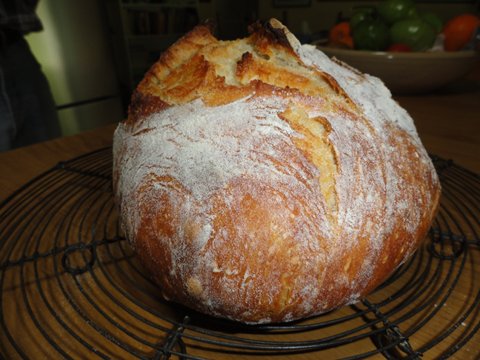
Bread is one of those foods that, when made with your own hands, gives a great deal of satisfaction and delight. It's only flour and water but it symbolises so much. I bake bread most days and use a variety of flours that I buy in bulk. Often I make a sandwich loaf because we use most of our bread for lunchtime sandwiches and for toast. Every so often I branch out to make a different type of loaf. I have tried sour dough in the past but I've not been happy with any of them. I'll continue to experiment with sour dough because I like the idea of using wild yeasts and saving the starter over a number of years to develop the flavour and become a part of the family. However, the loaf I've been branching out to most often is just a plain old five minute bread. By five minutes I mean it takes about five minutes actual work to prepare but it's the easiest of all bread to make and to get consistently good loaves from. If you're having people around for lunch or...
Image

This is my last post.

I have known for a while that this post was coming, but I didn't know when. This is my last post. I'm closing my blog, for good, and I'm not coming back like I have in the past.  I've been writing here for 16 years and my blog has been many things to me. It helped me change my life, it introduced me to so many good people, it became a wonderful record of my family life, it helped me get a book contract with Penguin, and monthly columns with The Australian Women's Weekly and Burke's Backyard . But in the past few months, it's become a burden. In April, I'll be 75 years old and I hope I've got another ten years ahead. However, each year I'll probably get weaker and although I'm fairly healthy, I do have a benign brain tumour and that could start growing. There are so many things I want to do and with time running out, leaving the blog behind gives me time to do the things that give me pleasure. On the day the blog started I felt a wonderful, h...
Image

What is the role of the homemaker in later years?

An email came from a US reader, Abby, who asked about being a homemaker in later years. This is part of what she wrote: "I am a stay-at-home mum to 4 children, ages 9-16. I do have a variety of "odd jobs" that I enjoy - I run a small "before-school" morning drop-off daycare from my home, I am a writing tutor, and I work a few hours a week at a local children's bookstore. But mostly, I cherish my blissful days at home - cooking, cleaning (with homemade cleaners), taking care of our children and chickens and goats, baking, meal-planning, etc. This "career" at home is not at all what I imagined during my ambitious years at university, but it is far more enriching. I notice, though, that my day is often planned around the needs of my family members. Of course, with 4 active kids and a husband, this is natural. I do the shopping, plan my meals, cook dinner - generally in anticipation of my family reconnecting in the evening.  I can't h...
Image

Every morning at home

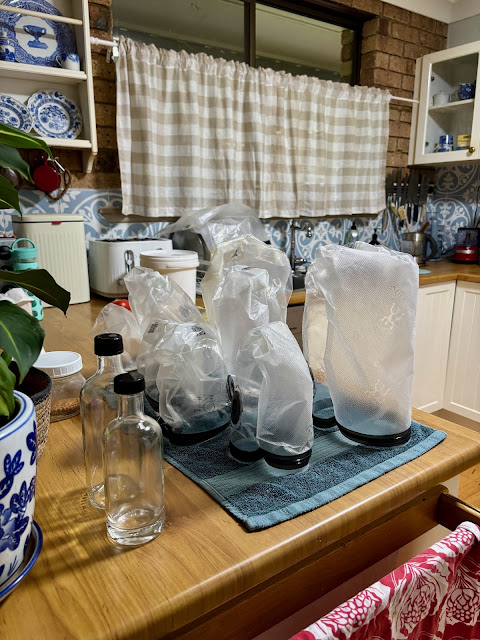
Every morning when I walk into my kitchen it looks tidy and ready for a day's work. Not so on this morning (above), I saw this when I walked in. Late the previous afternoon when I was looking for something, I came across my rolled up Zwilling vacuum bags and decided they had to be washed and dried. So I did that and although I usually put them outside on the verandah to dry it was dark by then. I turned the just-washed bags inside out and left them like this on a towel. It worked well and now the bags are ready to use when I bring home root vegetables, cabbages or whatever I buy that I want to last four or five weeks.
Image

You’ll save money by going back to basics

When I was doing the workshops and solo sessions, I had a couple of people whose main focus was on creating the fastest way to set up a simple life. You can't create a simple life fast, it's the opposite of that It's not one single thing either - it's a number of smaller, simpler activities that combine to create a life that reflects your values; and that takes a long to come together. When I first started living simply I took an entire year to work out our food - buying it, storing it, cooking it, preserving, baking, freezing, and growing it in the backyard. This is change that will transform how you live and it can't be rushed.  
Image


Trending Articles

NOT the last post

This will be my last post here.  I've been writing my blog for 18 years and now is the time to step back. I’ve stopped writing the blog and come back a couple of times because so many people wanted it, but that won’t happen again, I won’t be back.  I’ll continue on instagram to remain connected but I don’t know how frequent that will be. I know some of you will be interested to know the blog's statistics. 
Image

Every morning at home

Every morning when I walk into my kitchen it looks tidy and ready for a day's work. Not so on this morning (above), I saw this when I walked in. Late the previous afternoon when I was looking for something, I came across my rolled up Zwilling vacuum bags and decided they had to be washed and dried. So I did that and although I usually put them outside on the verandah to dry it was dark by then. I turned the just-washed bags inside out and left them like this on a towel. It worked well and now the bags are ready to use when I bring home root vegetables, cabbages or whatever I buy that I want to last four or five weeks.
Image

You’ll save money by going back to basics

When I was doing the workshops and solo sessions, I had a couple of people whose main focus was on creating the fastest way to set up a simple life. You can't create a simple life fast, it's the opposite of that It's not one single thing either - it's a number of smaller, simpler activities that combine to create a life that reflects your values; and that takes a long to come together. When I first started living simply I took an entire year to work out our food - buying it, storing it, cooking it, preserving, baking, freezing, and growing it in the backyard. This is change that will transform how you live and it can't be rushed.  
Image

Creating a home you'll love forever

Living simply is the answer to just about everything. It reduces the cost of living; it keeps you focused on being careful with resources such as water and electricity; it reminds you to not waste food; it encourages you to store food so you don't waste it and doing all those things brings routine and rhythm to your daily life. Consciously connecting every day with the activities and tasks that create simple life reminds you to look for the meaning and beauty that normal daily life holds.  It's all there in your home if you look for it. Seemingly mundane tasks like cleaning and cooking help you with that connection for without those tasks, the home you want to live in won't exist in the way you want it to.  Creating a home you love will make you happy and satisfied.
Image