down to earth

  • Home
  • About Us
  • Down To Earth Book
  • Privacy Policy
I'm sure you all know by now that I love knitting - dishcloths being a favourite subject of my affection. Well, I was reading a knitting book last week and came across a new (to me) pattern that I thought would make up a very nice dishcloth. I worked it over the weekend and have just taken a photo for you.


It has got a fair bit of texture so it will scrub well but the holes make it lighter than the average dishcloth. And the good bit it, it's a good pattern for a beginner. It uses mainly knit rows, with one purl row and one that will introduce two new techniques to you. It's called the Ridged Ribbon Eyelet pattern.

Your two new techniques are K2tog and yo. K2tog means knit two together and it means exactly that. Instead of doing your normal knit stitch you do it exactly as you normally would but you put your needle through two stitches, instead of one. Then knit as you would if you were doing your normal stitch. Watch this video to see how to K2tog.

Yo means yarn over.
That's it! It's a way of increasing one stitch (to replace the one you decreased with your k2tog) and will help make a hole. You'll only see the hole properly when you knit on and do another row. To do a yo - simply wind your yarn around your right needle - from back to front, you make a loop instead of a real stitch. Watch this video to see how to yo.


I used size 9 needles and Lions 100% cotton. The blue band is a bamboo and cotton blend. Cast on an uneven number of stitches, I cast on 31 but if you wanted a large cloth, go up to 39 or 41. Then:
Row one: Knit
Row two: Purl
Row three: Knit
Row four: Knit
Row five: *K2tog. yo; repeat from * to last stitch, K1. <- this means knit two together, then yarn over for the entire row, your last stitch is one plain knit stitch.
Row six: Knit

Repeat the sequence until you have the length you want.

When you do the two next rows after your k2tog row, you'll see the pattern forming. This is a really good pattern to introduce you to two new stitches. I hope that if you are one of my new knitters, you'll try this as well. Let me know how you're going with your knitting and if you're enjoying it. If you have a photo of your knitting to send to me, please send it.

Here is Paula's recipe for Cheap and Easy Biscuits from the forum. I misread it - it makes almost 100 biscuits from this one recipe. BTW Paula, I gave this recipe to my friend Meryl yesterday. Meryl is the chief baker and fundraiser at our Centre, she is older than I am and very experienced with fete and stall cooking, she's never heard of this recipe either, but she loves it too. Thanks for sharing.

Originally Posted by paula hewitt on Down to Earth Forum
I bake all our biscuits, cakes and bread, so I am always on the lookout for recipes which are quick and easy. I thought I would share one of my favourite biscuit (cookie) recipes. It is easy, quick, cheap and it makes 7 or 8 dozen biscuits, which keep well. The dough and cooked biscuits keep well in the freezer. I use butter and wholemeal flour, but white flour and margarine can be substituted. I have only ever used tinned sweetened condensed milk in this recipe, but i imagine that Rhonda Jean's homemade condensed milk would work just as well.

makes 7-8 dozen, cook 10 min at 180C

500 grams butter (approx 1.1 lb)
1 can condensed milk (390-400 gram)
1 cup sugar
5 cups wholemeal self raising flour (or plain flour and baking powder)
toppings like choc chips, smarties, jam, cinnamon and sugar

cream butter and sugar, add condensed milk. stir in flour. roll into balls and flatten. top with choc chips etc, or thumbprint and add jam for jam drops.

bake at 180C for approx 10 min until golden brown. cool on racks


I love finding a recipe that I know I'll use in the years to come. I found such a recipe a couple of weeks ago and was delighted with the results. It came from the Down to Earth forum, submitted by Paula Hewitt and she calls them Easy and Cheap Biscuits (cookies).


The great thing abut this recipe is that it uses only four ingredients. Paula says the recipe makes 70 - 80 biscuits. I made up one lot of about 40, another batch of 25 a week later and I still have one batch frozen as a log in the freezer.


I had two rolls of dough to freeze.

Makes 7-8 dozen, cook 10 min at 180C

500 grams butter (approx 1.1 lb)
1 can condensed milk (390-400 gram)
1 cup sugar
5 cups wholemeal self raising flour (or plain flour and baking powder)
toppings like choc chips, smarties, jam, cinnamon and sugar

Cream butter and sugar, add condensed milk. stir in flour. roll into balls and flatten. top with choc chips etc, or thumbprint and add jam for jam drops.

Bake at 180C for approx 10 min until golden brown. cool on racks.

I topped some of mine with jam and marmalade. Others with chocolate sprinkles and choc chips. All of them were delicious and they kept well in a sealed container.


I turned some into jam drops.

I'm going to share this recipe with our fundraisers at work. I reckon a little tray of these biscuits would sell at our stall for about $4 which would make us just over $50 per batch. I estimate the cost of ingredient to be just under $10 if we buy condensed milk, and less if we make our own. Definitely a handy recipe for charity fundraising.


But here at home it's a good one to make up and have in the freezer for unexpected guests. You could defrost the dough and have them cooked in under an hour. I've written the recipe inside the cover of my Feast cookbook, I'm sure Nigella would approve. This is definitely a keeper.

You'll notice I've put up some Amazon ads for the USA, Canada and the UK. The UK Amazon is now offering free postage to UK buyers from now until January 1, 2010. There is no minimum purchase needed. I will use any money I make on these ads to finance the set up and ongoing costs of the forum.

The start of another week and I'm back to working Mondays and Tuesdays from today. Hasn't this year gone fast! I guess you're all working on your Christmas gifts. I have discovered a new favourite dishcloth pattern. I'll show it to you tomorrow. I hope you have a beautiful week.


I'm happy to report that it all went very well with Hanno's surgery yesterday. He went in at 1pm, I popped down to Spotlight to check out a sale then spent a couple of hours in the waiting room, knitting, and he hobbled out at 5.30pm. We got home around 6pm. He had no pain, didn't need crutches and he slept fairly well last night. Today and tomorrow will be the test, the doctor said he must allow the knee to heal but he also needs to exercise it. His idea of rest, and mine, are entirely different so we'll see what happens today. My guess is he'll sit on the couch and on the front verandah until he reads everything he wants to read, then he'll want to wander around. Thank you all for your kind thoughts and prayers.


A week's work from Allposters.

I was going to write about biscuits today but that can wait for another time because I'm going to carry on from yesterday. My post on "perfection" seemed to hit a cord with a few of you so let's expand on that.

I was saddened to read some of yesterday's comments. I know it's difficult to overcome something you've live with in childhood but as adults we have the choice to live as we wish. Examine your fears, think about what you believe perfection to be and develop the strength to toss out old ideas and work on new ones. Oh, and examine your fears in the bright light of day, not at 3am lying silently in the darkness when everything seems hopeless. If trying to be perfect just isn't working for you then replace that need with doing your best.

When elite athletes train for the Olympics they don't try to beat world records, they try to beat their own personal best. And that is a helpful tactic here too. Just do your best on any given day, you can't ask for more than that. I know that as I go through my week, some days I feel I can take on the world, and some days I just want to write, drink tea and rest. NO ONE, has the capacity to work perfectly every day. Not every day will be perfect - in fact very few are.

If you're expecting perfection you're setting yourself up for disappointment. You're hoping for something that rarely happens. Don't do that to yourself. Instead, today, this very minute, say to yourself that you're replacing the expectation of perfection with doing your best. And in the days that follow this one, try your best in every thing you do. Slow down and concentrate on what it is you're doing - don't rush through your work trying to get it done - and do your best. Some days your best will be spectacular and some days it won't be but as long as you can go to bed each day thinking that you did the best you could do on that day, that will stand you in good stead. Hopefully over the course of a few months, you'll replace your mother's voice in your head, insisting on perfection, with: I'm proud that I did the best I could.

I have touched on this subject before here: The best

I hope today is a good one for you and that whatever you do, you'll do your best and be happy with it. And remember, happiness is not one huge reward you find one day. It's tiny fragments that are collected every day and added to your basket. Never stop looking for whatever happiness you can find. It maybe in the passage of a book, it may be lurking in your garden or on the faces of your children. Take note of every happy moment, add them to your basket and be enriched by the thought of them as you go through your day.


It doesn't take much, just one good night's sleep and I'm ready to take on the world again. Thank you for your good wishes and prayers for Hanno, we both appreciate them. We'll go in later this morning and be home late this afternoon; no doubt there will be news to write about tomorrow.


A recent shared lunch at the Centre I work at.

But today I want to talk about perfection. I don't talk about it much, mainly because I don't believe many things are perfect, I rarely seek perfection and I tend to feel a bit uneasy when things look too good. I prefer to live in a slightly wobbly, less than perfect world. It suits my nature, I don't have to constantly measure myself against some "perfect" ideal and I learn so much when I make mistakes. Don't mistake perfection for happiness, they are two entirely different things.

If you were to ask me how I discovered how to do what I do I would probably tell you that my mistakes have taught me well. My mentors are books and the fading memories of the many things my mother and grandmother taught me. I also have the remarkable benefit of having grown up in a time when people did for themselves. But the mistakes I made along the way have taught me things I will never forget. When I first left home I tried to forget what I knew because I wanted to be modern, eat convenience foods and live more outside my home than in it. When I reversed that trend I found I still remembered much of what I was taught and saw but still, my main teacher were the mistakes I made.


Even with fresh seeds, not all seeds will germinate.

There is nothing better for making you remember a sequence, a recipe, a method, than putting time into something and then realising you have to start again. A mistake, that perfect teacher, makes you undo stitches, give food to the chooks and make a skirt into an apron, all because you did something wrong. But do you ever make that same mistake again - I don't, I learn from what I did wrong and redoing it cements it into my brain.


It doesn't have to match. Our old couch sits happily beside our new couch.

If you're starting off with knitting, sewing, crochet, soap making, homemaking or marriage, be kind to yourself when you make a mistake. See it as a gift. You won't waste too much of your project if you unpick and redo, and the process of doing it will be your teacher. Don't look for perfection, except if you are seeking a warm sunny day, a five out of five nest of new hatchlings, or the first glimpse of your new baby. They will all be perfect, most other things rarely are.

I applaud you if you set delicious meals on the table every night, if you never drop a stitch, or if you produce batch upon batch of perfect soap. But when you do make a mistake, don't beat yourself up about it. Be kind to yourself, let yourself enjoy all this life has to give you - even the mistakes. See a mistake for what it is - an opportunity to teach yourself. I remember the first time I tried to knit a headband. I unpicked that thing about 10 times before I got the tension and size right, and then it turned into a hat! But I learnt so much from that hat. It still shines as a bright beacon for me because it taught me not only how to knit hats and headbands, it taught me that wasting time on perfection sometimes gets in the way of what I want and need.


My own less than perfect day today will include taking my husband in for surgery, knitting, thinking about whether to replace a broken dishwasher, cooking, updating my diary and mapping out what I'm doing from now till Christmas, including deadlines (I really don't want to do that) and reading. There will be parts of today I don't like but overall it is a day just like all others to be mined for all the enjoyment I can find in it.

I wonder what you're doing on this less than perfect day.


After a busy day at work yesterday, I'm worn out. I over-slept this morning and as I have to do a few things before going to work soon, this will be a short post. There are times in my past when I worked much harder and longer than I did yesterday but now it does me in. I have another work day today and tomorrow Hanno goes in for his knee operation and I want to be in top form for that. I'm taking it easy and letting myself recover so I have the energy to cope with the rest of the week.

I'm sorry that I haven't had time to answer questions in the comments and emails or spend much time at the forum, but I'll get back there later in the week.

And just a quick word about advertising. I've added Amazon ads to my blog to help pay for the forum which cost a few hundred dollars to set up. I like the Amazon ads, I think they are good value for money and they feature products most of us use. Clicking on the ads will give you more information. I appreciate any help you might be able to give me.

I saved this blog address earlier this week and hoped I would have a chance to share it with you. It's the blog of Jessica Watson, a young lady who lives in my region. Jessica is 16 years old and is sailing solo, unassisted and non-stop around the world. I doubt I would have allowed my children to do what she is doing at that age, but I admire her so much. I've watched a couple of interviews and her videos and she seems a very mature and intelligent girl. We so rarely find real adventurers in our lives now but Jessica is one and I really hope she achieves her goals. I think following her journey would be a wonderful project for homeschoolers. She is in her second week now and has just passed Norfolk Island. Soon she will head south, over open ocean, towards South America. Scary! The route she is taking is written about here.

See you tomorrow. I hope you have a lovely day.
I love knitting. I'm not particularly good at it, but I get by. There is something about winding a long piece of wool or cotton around sticks that is very appealing. I relax when I knit and I feel connected to all my grandmas who would have sat by a fire knitting clothes for the family. Knitting is a gift I give myself. As well as the relaxation, it exercises my brain, makes me feel productive, even when I'm sitting down, and it produces beautiful items that I happily use in my home or give as gifts. Knitting is part of my day to day life and I believe it should be part of everyone's. If you're not knitting for the productive rewards it gives, then do it to relax.


I still get emails from readers who like the idea of knitting but don't have anyone to teach them. This post is to encourage new knitters, and those who have yet to take up their needles, to start on simple projects and not give up. Knitters are very much like gardeners. I am convinced that if you see a knitter or a gardener anywhere and ask about what they're doing, they'd be pleased to tell you.

Knitting looks complicated but as soon as you learn how to hold your needles and realise that almost all knitting is just casting on, knit, purl, casting off, it seems doable. Learning a few extras like slip stitch, knit two together, yarn forward etc., will give you some lovely pieces that you can't buy at the shops. The thing that really appeals to me is that you can choose your own wool or cotton, and there are some beautiful yarns on the market now. A preknit cardigan from China just doesn't cut it for me anymore.


I noticed a thread over at the forum yesterday about casting on and untidy loose edges. A few techniques were offered and here is mine, I don't know what it's called. I do the normal, for Australia, cast on, then on my first knit row, I knit into the back of the stitch, not the front. It gives me a beautiful firm and tidy edge. The photo above shows where to place the needle, otherwise it's just a normal knit stitch. I find the American way of casting on quite complicated and always use the UK/Irish method taught to me by my mother.

I have looked for what I think are good sites for you to learn from. Remember, it is up to you to put the time in, overcome frustration and keep going. Whether it be knitting, sewing, cooking, growing or anything else in this simple life, don't give up if you don't get it straight away. These are crafts - skills to learn, you have to rediscover how to hold your hands and techniques that, although once commonplace, now are not. That takes a little time. Give yourself that, be patient, and it will come to you.


Look here.

That learning aspect of knitting is why I encourage new knitters to knit dishcloths. They are the ideal project to learn the stitches as well as cast on, cast off, and you can experiment with fancy patterns if you feel like it. It doesn't matter if you don't do a perfect job, it is the practise that counts, and you get something at the end that can be used in the home. So start off with dishcloths and then progress to other small projects. There are some in the links below.


Set yourself up properly. It's not expensive. Buy or barter some good cotton or wool, I never knit with acrylic but there are many ladies who do. I think if you're putting the time in to knit, it should be the best yarn you can afford. For me, that means watching out for sales, or buying online occasionally. You'll need needles, I think aluminium are the easiest to knit with, just get one pair to start, maybe size 7 or 8. So when you have your needles and either wool or cotton, find a bag to put them in. You'll need to protect your work and if you intend taking it with you when you go out, a bag will keep it all together for you. I use an old flour sack made of calico. I gave a similar kit of cotton, needles and a flour sack to my friend Fifi at work. She is now madly knitting away on her first dishcloths, and loving it.

I hope I've encouraged you to try, or re-try knitting. If you get stuck, go to the knitting ladies over at the forum, post your question and someone will help you. Don't give up on it, or yourself, and have fun!

ONLINE RESOURCES
UK how to cast on
This is a beautiful and simple, ideal for your first double pointed needles project
Dishcloths with patterns
A knitting glossary with videos
Explaination of yarn weights and needles
Free patterns
Lots of free patterns, including wearables and household knitting.
Chickens are creatures of habit, they are practical and they like climbing, so it should not have been a great surprise when I looked out the window from where I am sitting right now to find this looking back.


Quentin wanted to be close to someone and she wanted to rest while watching her friend, the half blind Quince. I think she'll make this one of her permanent perching places unless we move them on.


We bought Quentin and Quince about a month ago and since then Hanno has patiently nursed Quince through a nasty eye infection. She looks to be recovered now but she's blind in that eye and a little undernourished but I think she'll be fine in the long run. Generally new chickens would be well and truly integrated into the flock by now but Hanno separated Quince from the other girls when he noticed her bad eye, and Quentin, voluntarily, followed her. Even now she will fly over the fence, away from the other hens, to be with Quince. There is a loyalty there that is touching and quite fascinating.


Hanno washing Quince.

During the time when Quince's eye was badly infected, her feathers became matted around her head and neck. Hanno washed her a couple of times and gently dried her in the sun. If she could talk, I'm sure she would have thanked him. With all this handling, these two little Sussex hens have become very tame and don't mind at all being picked up, which Hanno often does. He has such a soft heart when it comes to animals. I've seen him many times just sitting on the back verandah, smiling, and watching the two Qs.


And drying her in the sun.

But soon the time will come when they will have to join their coop sisters and free range in the backyard. They're fenced off from the flock now, living on the back verandah, and so Quentin can perch on a bench close to my computer and she can watch over Quince as she scratches for food. People say that chickens are dumb critters and I have certainly found that to be so with some, but like people, there are all types - some funny, some sullen, some smart and some not so. Quentin is a leader, so I'm glad we named her for our first female governor general.

I think Hanno will move them out to join the flock today. Their little wooden fruit box full of straw will go with them and they'll have to roost in the coop, instead of on the rungs of the old chair standing near our bedroom. It's been lovely having two baby chicks peeping at the back door but the time has come for them to move on. I think they'll stay together out there and I think Quentin will always help Quince find the water container and scatterings of grain.


Cocobelle and Heather.

If you take the time to know them, you will see character differences in all your chooks. Lucy, our Old English Game chook is bossy, highly strung and a rebel - she took it upon herself to build her nest in the next door neighbours yard instead of taking to the coop nests when the rest of her broody sisters did. Hanno found her there with five eggs. Cocobelle is our prima donna, Martha is a slow and gentle mother, Heather is the individual with her feathered pants and puffy face, and she is as game as Ned Kelly. I have never seen our chooks just as egg producers, although that is their primary function. They also entertain us, eat every bug they find and teach us that birds of a feather do not always flock together.

There are certain areas in every home where clusters of chemicals sit. The laundry is one such place and is a great place to start walking the green path. There are many recipes for laundry powder and liquid on the net. I have my own here, but it doesn't matter which you use, just start using one of them, it's a very good way to start simplifying. You can also throw out that softener. Get used to the feel of normal clothes on your skin; clean cloth with no additives is a healthier option that clothes with softener added. Read the labels on the products you're using and if what you read disturbs you, get rid of them, do some research, start making your own and be better off for it.


One of the best ways to be greener with your laundry is to line dry your clothes. I am amazed to read that in the USA, the land of the free, that line drying clothes is banned in many areas. Some claim it's unsightly, it lowers the standards of the neighbourhood, or that clothes hanging on a line indicates "poor" people are living there! I'm not sure what kind of fantasy land people who make these statements are living in but how can clean clothing hanging in the sunshine be unsightly. Clothes hanging out to dry indicates clean clothes, clean sheets and towels all smelling of sunshine. And if "poor" people live there, so what? If you came to Australia you'd think we are all "poor" because there is washing hanging outside all over the country here. It's normal, and always has been.


And while we're about it, what about the regulations that ban home owners from keeping chickens! That's another stupid rule that needs overturning. I think it's about time these ridiculous regulations are seen for what they really are - a way for local authorities to interfere in our lives. Let them regulate parking rules and where shopping malls are built but they can stay out of my backyard, thank you very much. What happens there is my business and no one else's.


If you are affected by these unfair restrictions, start making a noise about it. These are not radical things, our grandparents and theirs kept chickens and hung laundry outside to dry. Why have those simply rights been taken away? It's just another way to control us. Write to your local politicians and your newspapers and demand the right to line dry and keep chickens. These are your decisions to make, they should not be made for you.

And now I'll step down from my soap box. :- ) I hope you have a beautiful day.

Project Laundry

New York Times article.
Treehugger
Planetgreen
Newer Posts Older Posts Home

Search here

Total Pageviews

Translate


I'm Rhonda Hetzel and I've been writing my Down to Earth blog since 2007. Although I write the occasional philosophical post, my main topics include home cooking, happiness and gardening as well as budgeting, baking, ageing, generosity, mending and handmade crafts. I hope you enjoy your time here.

MY FAVOURITE PLACES

  • Grandma Donna's Place
  • Grandma Donna's YouTube
  • Grandma Donna's Instagram
  • This Simple Day
  • Nicole's Instagram

Give More

Give More

Popular posts last year

Making ginger beer from scratch

We had a nice supply of ginger beer going over Christmas. It's a delicious soft drink for young and old, although there is an alcoholic version that can be made with a slight variation on the recipe. Ginger beer is a naturally fermented drink that is easy to make - with ginger beer you make a starter called a ginger beer plant and after it has fermented, you add that to sweet water and lemon juice. Like sourdough, it must ferment to give it that sharp fizz. To make a ginger beer plant you'll need ginger - either the powdered dry variety or fresh ginger, sugar, rainwater or tap water that has stood for 24 hours to allow the chlorine to evaporate off. You'll also need clean plastic bottles that have been scrubbed with soap, hot water and a bottle brush and then rinsed with hot water. I never sterilise my bottles and I haven't had any problems. If you intend to keep the ginger beer for a long time, I'd suggest you sterilise your bottles. MAKING THE STARTER In a...
Image

NOT the last post

This will be my last post here.  I've been writing my blog for 18 years and now is the time to step back. I’ve stopped writing the blog and come back a couple of times because so many people wanted it, but that won’t happen again, I won’t be back.  I’ll continue on instagram to remain connected but I don’t know how frequent that will be. I know some of you will be interested to know the blog's statistics. 
Image

How to make cold process soap

I'm sure many of you are wondering: "Why make soap when I can buy it cheaply at the supermarket?" My cold process soap is made with vegetable oils and when it is made and cured, it contains no harsh chemicals or dyes. Often commercial soap is made with tallow (animal fat) and contains synthetic fragrance and dye and retains almost no glycerin. Glycerin is a natural emollient that helps with the lather and moisturises the skin. The makers of commercial soaps extract the glycerin and sell it as a separate product as it's more valuable than the soap. Then they add chemicals to make the soap lather. Crazy. Making your own soap allows you to add whatever you want to add. If you want a plain and pure soap, as I do, you can have that, or you can start with the plain soap and add colour, herbs and fragrance. The choice is yours. I want to add a little about animal and bird fat. I know Kirsty makes her soap with duck fat and I think that's great. I think t...
Image

Preserving food in a traditional way - pickling beetroot

I've had a number of emails from readers who want to start preserving food in jars but don't know where to start or what equipment to buy.  Leading on from yesterday's post, let's just say up front - don't buy any equipment. Once you know what you're doing and that you enjoy preserving, then you can decide whether or not to buy extra equipment. Food is preserved effectively without refrigeration by a variety of different methods. A few of the traditional methods are drying, fermentation, smoking, salting or by adding vinegar and sugar to the food - pickling. This last method is what we're talking about today. Vinegar and sugar are natural preservatives and adding one or both to food sets up an environment that bacteria and yeasts can't grow in. If you make the vinegar and sugar mix palatable, you can put up jars of vegetables or fruit that enhance the flavour of the food and can be stored in a cupboard or fridge for months. Other traditional w...
Image

Cleaning mould from walls and fabrics

With all this rain around we've developed a mould problem in our home. Usually we have the front and back doors open and that good ventilation stops most moulds from establishing. However, with the house locked up for the past week, the high humidity and the rain, mould is now growing on the wooden walls near our front door and on the lower parts of cupboards in the kitchen. Most of us will find mould growing in our homes at some point. Either in the bathroom or, in humid climates, on the walls, like we have now. You'll need a safe and effective remedy at some point, so I hope one of these methods works well for you. Mould is not only ugly to look at, it can cause health problems so if you see mould growing, do something about it straight away. The longer you leave the problem, the harder it will be to get rid of it effectively. If you have asthma or any allergies, you should do this type of cleaning with a face mask on so you don't breathe in any spores. Many peopl...
Image

Five minute bread

Bread is one of those foods that, when made with your own hands, gives a great deal of satisfaction and delight. It's only flour and water but it symbolises so much. I bake bread most days and use a variety of flours that I buy in bulk. Often I make a sandwich loaf because we use most of our bread for lunchtime sandwiches and for toast. Every so often I branch out to make a different type of loaf. I have tried sour dough in the past but I've not been happy with any of them. I'll continue to experiment with sour dough because I like the idea of using wild yeasts and saving the starter over a number of years to develop the flavour and become a part of the family. However, the loaf I've been branching out to most often is just a plain old five minute bread. By five minutes I mean it takes about five minutes actual work to prepare but it's the easiest of all bread to make and to get consistently good loaves from. If you're having people around for lunch or...
Image

This is my last post.

I have known for a while that this post was coming, but I didn't know when. This is my last post. I'm closing my blog, for good, and I'm not coming back like I have in the past.  I've been writing here for 16 years and my blog has been many things to me. It helped me change my life, it introduced me to so many good people, it became a wonderful record of my family life, it helped me get a book contract with Penguin, and monthly columns with The Australian Women's Weekly and Burke's Backyard . But in the past few months, it's become a burden. In April, I'll be 75 years old and I hope I've got another ten years ahead. However, each year I'll probably get weaker and although I'm fairly healthy, I do have a benign brain tumour and that could start growing. There are so many things I want to do and with time running out, leaving the blog behind gives me time to do the things that give me pleasure. On the day the blog started I felt a wonderful, h...
Image

What is the role of the homemaker in later years?

An email came from a US reader, Abby, who asked about being a homemaker in later years. This is part of what she wrote: "I am a stay-at-home mum to 4 children, ages 9-16. I do have a variety of "odd jobs" that I enjoy - I run a small "before-school" morning drop-off daycare from my home, I am a writing tutor, and I work a few hours a week at a local children's bookstore. But mostly, I cherish my blissful days at home - cooking, cleaning (with homemade cleaners), taking care of our children and chickens and goats, baking, meal-planning, etc. This "career" at home is not at all what I imagined during my ambitious years at university, but it is far more enriching. I notice, though, that my day is often planned around the needs of my family members. Of course, with 4 active kids and a husband, this is natural. I do the shopping, plan my meals, cook dinner - generally in anticipation of my family reconnecting in the evening.  I can't h...
Image

Every morning at home

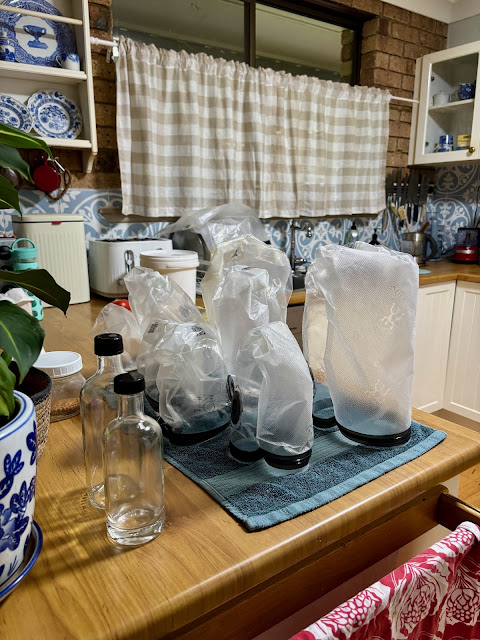
Every morning when I walk into my kitchen it looks tidy and ready for a day's work. Not so on this morning (above), I saw this when I walked in. Late the previous afternoon when I was looking for something, I came across my rolled up Zwilling vacuum bags and decided they had to be washed and dried. So I did that and although I usually put them outside on the verandah to dry it was dark by then. I turned the just-washed bags inside out and left them like this on a towel. It worked well and now the bags are ready to use when I bring home root vegetables, cabbages or whatever I buy that I want to last four or five weeks.
Image

You’ll save money by going back to basics

When I was doing the workshops and solo sessions, I had a couple of people whose main focus was on creating the fastest way to set up a simple life. You can't create a simple life fast, it's the opposite of that It's not one single thing either - it's a number of smaller, simpler activities that combine to create a life that reflects your values; and that takes a long to come together. When I first started living simply I took an entire year to work out our food - buying it, storing it, cooking it, preserving, baking, freezing, and growing it in the backyard. This is change that will transform how you live and it can't be rushed.  
Image


Trending Articles

NOT the last post

This will be my last post here.  I've been writing my blog for 18 years and now is the time to step back. I’ve stopped writing the blog and come back a couple of times because so many people wanted it, but that won’t happen again, I won’t be back.  I’ll continue on instagram to remain connected but I don’t know how frequent that will be. I know some of you will be interested to know the blog's statistics. 
Image

Every morning at home

Every morning when I walk into my kitchen it looks tidy and ready for a day's work. Not so on this morning (above), I saw this when I walked in. Late the previous afternoon when I was looking for something, I came across my rolled up Zwilling vacuum bags and decided they had to be washed and dried. So I did that and although I usually put them outside on the verandah to dry it was dark by then. I turned the just-washed bags inside out and left them like this on a towel. It worked well and now the bags are ready to use when I bring home root vegetables, cabbages or whatever I buy that I want to last four or five weeks.
Image

You’ll save money by going back to basics

When I was doing the workshops and solo sessions, I had a couple of people whose main focus was on creating the fastest way to set up a simple life. You can't create a simple life fast, it's the opposite of that It's not one single thing either - it's a number of smaller, simpler activities that combine to create a life that reflects your values; and that takes a long to come together. When I first started living simply I took an entire year to work out our food - buying it, storing it, cooking it, preserving, baking, freezing, and growing it in the backyard. This is change that will transform how you live and it can't be rushed.  
Image

Creating a home you'll love forever

Living simply is the answer to just about everything. It reduces the cost of living; it keeps you focused on being careful with resources such as water and electricity; it reminds you to not waste food; it encourages you to store food so you don't waste it and doing all those things brings routine and rhythm to your daily life. Consciously connecting every day with the activities and tasks that create simple life reminds you to look for the meaning and beauty that normal daily life holds.  It's all there in your home if you look for it. Seemingly mundane tasks like cleaning and cooking help you with that connection for without those tasks, the home you want to live in won't exist in the way you want it to.  Creating a home you love will make you happy and satisfied.
Image