down to earth

  • Home
  • About Us
  • Down To Earth Book
  • Privacy Policy
I love jars. I do store some things in plastic, but if it will fit in a jar, that is where it goes. This is my jar cupboard. Many of the jars in here are recycled jars, but there are also some Fowlers Vacola preserving jars, Italian Mason jars, old glass vinegar bottles, and some plastic soft drink bottles. Believe it or not, the plastic drink bottles are the ones I find hardest to get. I use them for my lemon cordial and ginger beer.

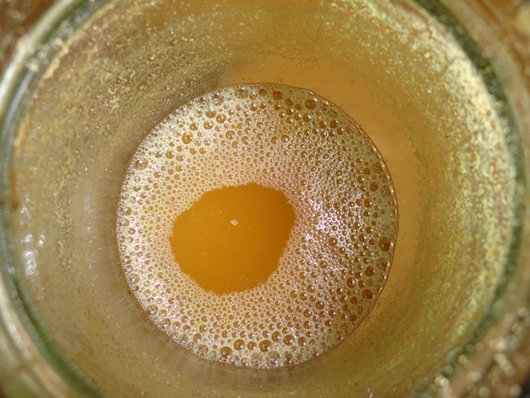
I went looking for a preserving jar yesterday afternoon to start off the ginger beer plant and was reminded again of the wonderful collection of jars in my cupboard. I've used a Fowlers jar for the ginger beer and placed an open weave milk jug cover over it. That is to allow the wild yeasts to enter the mix which will give me a good depth of flavour to the drink.

Below are the jars I like using when I'm preserving. Fowlers jars are nice to look at and evoke those days when grandma did her bottling, but I find them fiddly and expensive. If I'd know how great the Italian Mason jars were when I bought my jars, I would have only bought them. They're freely available in most department stores and the last time I shopped at Woolworths (three years ago), they were in the supermarket too. You can buy new lids for them here (Australia) and here (US). The French jars and rubber rings (at the front) are also freely available at department stores and are excellent for preserving.

The jars below are all recycled - the three at the back are jam jars, the other one is a Golden Circle baby food jar. Recycled jars are great to have in the home as you can use them for your homemade jams and relishes, and giving them away to family and friends isn't a problem. I still ask for the jar to be returned. : ) LOL Most of the time people are happy to do that.

The jar below is a French jam jar. They are my all time favourite jars as they have a wide mouth, they're really easy to fill, the glass is good quality and you can boil them to sterilise, and the lids last a few boilings. They also look good. I use them to store buttons and odd and ends in as well.

I'm sure many of you will already be recycling your jars and have a good collection of them. If you're not doing this, why not try a small collection and see how you go with them. Even if you're not preserving anything, they're useful for small amounts in your pantry cupboard - things like spices, seeds and nuts or in the fridge for the whey you pour off your yoghurt or cream. Don't ever throw out a fancy bottle as you can easily make up some flavoured spicy vinegar or cordial for gifts.

Most people like receiving homemade produce in recycled jars and bottles. It brings back memories or older days when everyone's mum or grandma made things to store in glass jars.

I'm feeling much better this afternoon. It's almost 4 o'clock and I've had the most blissfully lazy day. I even had a sleep, yes duckie, a nanna nap. ; ) I told Hanno I was having a lie down at 9am! The last thing I remember was watching the curtain blowing in the breeze and then I was sound asleep for two hours. I made some fresh juice when I woke up, then drew my second curtain pattern and started stitching. This slow and loopy day has been just what I needed. I think we forget sometimes that we need to take a break from our chores. Working as we do here at home we don't really have days off. The work isn't what you'd call hard work, but it's consistent.

I've just been out to the garden to pick lettuce, radishes, beans, cucumber, parsley and onion for our dinner tonight. I've boiled some eggs and will make some potato salad too. I also cut up a pineapple, added four peeled oranges and water to it and processed it in the blender. That's now in a glass jug, sitting in the freezer, and we'll drink the fresh juice icy cold with our meal.

And now I'm going to start a ginger beer plant so I can make some ginger beer next week. We've no lemons on the tree right now and all the frozen juice has been used, so water and ginger beer will cool us down on those hot days coming soon.

Thank you all for stopping by today. I love my little blog community. : ) I hope you all enjoy the weekend.
There have been many times in my life when I've felt like giving up, but being the queen of stubborness, I refuse to do it. Once I've made a commitment to something, I usually do it. That's not a wonderful virtue, it's just plain mule stubborness. I'm changing that because today, even though I have work to do, I'm not doing it. I'm really tired, so today I'm looking after Rhonda Jean.

I guess the two weeks with my sister here and some extra work I've been doing have taken their toll. I came home from a work meeting at 6.30pm yesterday and I felt as if the life force had been drained out of me. I don't feel any better this morning after a good night's sleep. I feel like falling down in a heap. I need rest. I don't need more sleep, I just need to rest and not do anything. My mind needs a break. Today I will do nothing.

I intend to make breakfast, look around the garden then sit on the front verandah and either read or stitch. I have my second curtain to do and I don't see that as work - it's pure pleasure. All thoughts of what we're having for dinner, ironing, gardening or cleaning, are all being thrown out the door today. Today I will clear my mind, gather my strength, rest and be mindful of the sweet nurturing I'm laying on myself.
This is what I was going to do. Mend a skirt and a little cardigan that has come away from the edging. They're sitting in my sewing room silently awaiting their repairs.
And I was going to sort through this basket of fabric that Tricia brought with her. There is a lot of good fabric in here that will go towards two quilts I want to make for the guest rooms. It won't run away. I'll do it next week. : )

As most of your know Hanno and I took the plunge a few years ago and stopped working. We now use the hours we used to sell to others on ourselves, making an interesting life on our own little patch of Australian earth. I sometimes get emails from younger readers asking about living simply while working for a living. I've said many times that you can live simply anywhere at any time. Simple living has little to do with location, income or age, it's primarily a state of mind.

I want to emphasise first that your simple life isn't a cookie cutter version of my life, or someone else's life you've read about. Every single one of us creates our own version of what our life is. If you were intending to live forever in an un-simple world, you know your life would differ at many points to your friends and neighbours' lives. The same applies to your simple life. There will be points of similarity and points of difference but I hope that many of the new things you incorporate into your life will be environmentally sound.

I believe the best start to any simple life is to decide what it is you want your life to be, write that down and make that the focus of your new life. Know where you're headed but then work with what you have right now. If you feel like your life is a bit out of control, start with small steps towards the life you want - all those small steps will add up to make a big difference.

Work on one goal at a time, you'll probably find that whatever you work on will lead on to other things. For instance, if you want to change the way you shop for groceries, focus on that. You'll find that when you get into it, you might want to plan your menus, you might decide to stockpile, and to declutter to make a space for your stockpile. You might start cooking from scratch, so that will involve learning how to do it and finding recipes your family enjoy. The same will apply if you decide to grow vegetables. You'll learn all you can about gardening, but that might lead you to worm farms, compost heaps, chickens and preserving.

Forget all the grand gestures - small things matter. Make your lunch when you go to work, take a thermos flask of coffee or tea, always take a bottle of water with you when you go out. Your water bottle should be one that is reused many times. Stop buying water unless you absolutely have to. Add the money you would have spent to a change jar. When it's built up, pay it off your credit card debt, or pay an extra mortgage payment. If you have no debt, start a savings account to help you buy your own home, or donate your savings to your local homeless shelter or neighbourhood centre.

Say NO. Make your time your own, stop giving it away to insignificant things and people. Make sure the time you spend away from your own home and family is spent in the most worthwhile way. Time is really all we have. Use the time you have wisely. Stop shopping for junk, stop going to shopping malls - they will create a need to spend, if you habitually watch TV, stop. It all wastes your time. When you have some spare time, do something you love. Write down what you value and make sure you spend your time in line with those values. Now that you're living in a new way, you'll shed a few things that you used to do but now get in the way of living the life you want. Stop multi-tasking, stop living on auto-pilot. When you decide to spend your time doing something - be mindful of what you are doing. Concentrate on your tasks, think about them, make sure they matter and do them well.

Find beauty in your own life. That might be through obvious things that everyone would recognise as beautiful, but it might also encompass a passion for bee keeping, teaching yourself how to speak a foreign language or volunteering your time to a local cause that means a lot to you. Create a new standard of quality for yourself. Make sure you do everything to the best of your ability.

Learn to be frugal. Reuse, repair, recycle and make do with what you have.

There will probably be a long period of time when you feel like you're using simple living strategies but not really living simply. But you will come to the point when you feel it all falls into place and that you've built your version of a simple life. And when you do that, when you reach a point when you feel comfortable with your life, you know you're growing stronger and what you're doing is significant, you will begin to thrive and then no other way of living will be good enough for you.
My sister started her long drive home this morning after two weeks of merriment, sharing, eating, remembering and sewing together. I sent her off with a small comfort pack of spinach pie, leftover from our dinner last night, three yoghurt pikelets and a bottle of water. She will have to stop for a cup of tea. Thank you all for your kind words and good wishes for both of us while Tricia was here. We had a really good time together.

I will announce the swap soon and intend to have swap partners contact each other. The contact won't happen through me again as last time there were so many people, it became very unsimple and drove me - and Sharon who helped me, a bit crazy. Sharon has offered to help again, she lives in the US. As I have equal numbers of readers in Australia and the US, I'd also like an Australian to help too. You need to have the time to do it, so if you're working or have young children, it might be a bit of a stretch. If you live in Oz and can help with the next swap, please email me. Thanks everyone.

Oh, and the swap will be for the symbol of this simple
life - aprons!
I'd like to start a new swap next week but I want all swappers to have their napkins before we go on to another swap. Please comment if you have NOT received your napkins yet, include the name of your swap partner and let me know if you've made contact to see what the problem is.

Thanks everyone.

These photos were all taken this morning. Early morning, before the sun hits the vegetables, is the best time to walk around looking for bugs or potential problems. Observation is the key to growing good vegies. You need to know what's happening out there and help the plants along if you notice something going wrong.

I had to buy tomatoes yesterday. We had some of our own and some from my step son's garden but with three avid tomato eaters here at the moment, the time came to go to the store to buy them. Yikes! $5 a kilo for plain old tasteless tomatoes, $10 kg for the "vine ripened" ones. I had a look around at the other vegies - $7/kilo for capsicums (peppers), $4 for a lettuce, $3.50 for a bunch of radishes and the long cucumbers were $3.80 each. It would have cost about $20 just for a couple of salads. I hate to think what the same vegetables would cost if I was buying organic produce. Luckily I only had to buy the tomatoes, we had everything else.

French radishes. These are $3.50 at the store, but are easily grown fresh and organic in the back yard for the price of the seeds and a bit of work planting and watering.

That's the great benefit of growing your own, not only are they organic, they're also fresher, tastier and you're protected from the spikes in prices when there's been a drought, storms or cyclones.

Zucchini. We have just planted the follow ups to these - yellow zucchini. By the time the yellows are ready, these will be pulled out.

I've written about starting a new vegetable garden here so I won't go over that again. I want to give those of you who have started your first vegie gardens, or who are about to, a few tips that I hope will help you grow your vegetables.

Nectarines ripening in the warm sun. No fruit you buy will ever taste as good as that from your own backyard.

Almost all uncontaminated soil will grow food, but with a bit of help, the soil in your back yard will produce very good crops instead of mediocre ones. The one thing that will make the biggest difference is to add aged manure to the soil. Your aim should be to add as much organic matter as possible, but if you can only add one thing, let it be old manure. If you can add compost with the manure you're on your way to good soil, and good soil will give good crops. If you're lucky enough to have your own animals, when you buy manure, or if it is given to you, make sure the animals have not recently been wormed. Manure from wormed animals will kill the worms in your soil. You want to encourage worms, they enrich your soil. At the same time you're developing your vegetable garden you should also start a compost pile or bin. The two go hand-in-hand.

These are Richmond green apple cucumbers which were a popular variety of cucumber in Australia in the 1950s. You can't buy these at the supermarket now, they are only available in seed form to grow in your own vegie garden. The taste is sensational.

And the follow ups to the Richmond cucumbers - Lebanese cucumbers that will be picked small and crunchy in about 8 weeks time.

Think of your soil as a cake. Sure, you can make a cake from a packet and you have a cake. But you can also make a cake using organic flour, backyard eggs, good butter, homegrown carrots, walnuts and spices and you get healthy, delicious cake that everyone will enjoy. The packet cake will fill you but the homemade cake will not only fill your belly, it will add to your nutrition.

A variety of lettuces - red, Cos, butter and frilly. All fresh and waiting to be picked for a salad.

So let's imagine you've added some aged horse or cow manure to your soil, along with your homemade compost. You dig it in (my preferred way) or you add it to your layers in a no dig garden bed. If you can afford to buy a good organic fertiliser, do so, if you can't, buy some blood and bone and sulphate of potash and use them. The blood and bone will add nitrogen, calcium and phosphorus - all necessary for good plant growth and the potash will induce flowering. The ratio is one handful of potash to 10kg of blood and bone. Sprinkle that over your new garden and dig in, along with the manure and compost.

Green lake beans. Hanno loves these cooked - either hot or in a salad. I like them eaten raw straight from the vine.

Now you're ready to plant your seeds or seedlings. You're planting into good soil, so you want to give your plants the best chance to thrive. Get yourself some seaweed concentrate. I use Natrakelp when I can afford it and Seasol when I can't. There is some good info here about organic fertilisers, including Natrakelp. Seaweed concentrate, properly diluted, will help your seedlings over the shock of transplanting. I water my plants with a weak solution of seaweed concentrate every couple of weeks to keep everything healthy. A good trick is to pour some diluted seaweed into a small container before you plant your seedlings. Allow the seedlings to sit in the seaweed for about 30 minutes before you plant. Then plant out and water in. Then pour on some more seaweed to settle the plant in nicely.

The follow ups to the tomatoes. We have tomatoes in large pots, sweet bites and tommy toes in various places in the garden and quite a few planted in the aquaponics garden. One of these is a yellow pear tomatoes, I'm not sure what the others are. In the pots we have Armish paste, beefsteaks and brandywines, in the aquaponics we have dwarf pear, sweet bites and beefsteaks.

Now a word of warning. Never over fertilise your plants. If you start your garden in a similar way to the outline above, you won't need to fertilise much at all. I make up a liquid comfrey fertiliser or worm juice for the leafy greens and apply that every two weeks. Things like tomatoes, peppers and beans, I just plant into rich soil and keep watered. The rule of thumb is you give nitrogen to the leafy greens and a small amount of potash (when planting) to the fruiting plants like tomatoes, beans, zucchinis etc. Give a good deep watering maybe twice a week, depending on your climate, and three times a week in the heat of summer. Try to water your plants in the early morning as this will help you avoid the diseases of humidity like powdery mildew.
There are many reasons to start growing your own food. It's really enjoyable, you can grow organic food for a minimal price, it's as fresh as it can possibly be when you eat it and it has no pesticides or herbicides. But now it will also save you money and ensure your supply of vegetables when the supply might be a bit tight at the shop.

It never occurred to me when I was a spender that I was actually giving away my independence. I thought the opposite. I believed I was the queen of my realm and the more I had and the more dollars I spent, the more power, strength and independence I had. When I stopped spending I realised how pathetically wrong that was.

What I was doing was working in a job I didn't like so I had enough money to pay for a lifestyle I didn't want to live. I was shopping for clothes and shoes to make me look like everyone else, I was buying things for my home to make me feel comfortable in a place I didn't take the time to feel comfortable in, and I was buying foods to comfort and nurture because I didn't feel at ease in my life and I didn't have the time or energy to cook the foods I liked. And the strangest thing is that when I was doing that, I didn't think about the sadness I was feeling, I didn't realise I was unsatisfied and I didn't see the need for change.

I only realised that need when I took myself out of the shopping frenzy and sat alone on my verandah and thought about what I was doing and how far from my ideal life I really was. When I stopped shopping, I saw it in a brighter light and when I saw its ugly side, I didn't want to go back there.

I realised that I could do all those things I used to spend my money on. I could make clothes, I could cook well, I could do my own housework, but when I started doing those things I found that I'd lost many of the skills I grew up with. I'd forgotten how to sew and knit because I paid someone else to make my clothes, I'd forgotten how to cook well because I'd been buying all sorts of foods that didn't require me to exercise my mind and spend my energy on making my truly favourite dishes. When it came to housework, all I knew was to get the Chux and Mr Sheen from the cupboard and wipe. I was really pathetic - a grown woman who didn't know how to look after myself or my family properly; I'd forgotten the skills that all my great grandmothers had passed on to me - I, my friends, was a modern woman - I was dependent on others to help me live.

You don't have to be a genius to shop, you need limited skills to be good at it - all you need is money, or credit, and time. All that time to spend walking through shopping malls searching for something made (usually) in a foreign land by people who are probably underpaid, producing millions of products exactly the same as the previous million, and the million that will follow.

On the other hand, not shopping requires a multifaceted strategy. You need to know how to create, cook, clean and sew, you need to make do with what you have, to reuse, recycle and repair, you need to barter, grow food, preserve, and you need to love doing it. You have to discover for yourself the true beauty of being able to look after yourself, your family and your home with a minimum of outside help. The beauty of it is there if you look.
I am much richer now than I've ever been in my life. I know how to live now. I have the skills to survive a crisis, I have the strength and knowledge to produce my own food and to store it. I can clothe myself and others. All these are real life-engaging and self-empowering skills. But the real skill here is to do it and love doing it. Relearning those lost skills, and then loving the doing of them, is an act of subversion because you're not doing what women and men in our times are supposed to be doing. Nurturing your family and yourself with cooking, gardening, housekeeping, dress making, knitting, making soap, baskets, shawls and jam, and all the other things you learn to do in your post-consumerist life, not only enriches your spirit but it makes you an independent force. Ladies and gentlemen, may the force be with you.

Graphic from allposters.com

I read the following quote for the first time on Jewel's blog. It really sums up, in an eloquent way, how I feel about my home.

If you wanted to gather up all tender memories, all lights and shadows of the heart, all banquetings and reunions, all filial, fraternal, paternal, conjugal affections, and had only four letters with which to spell out the height and depth and length, and breadth and magnitude and eternity of meaning, you would write it all out with these four capital letters: H-O-M-E.
Thomas DeWitt Talmage

My home is such a joy to me nowadays that I fret when I'm away from it. When we went to Brisbane on the weekend, looking for, and not finding, our kitchen appliances, I said more than once, "let's go home". And I meant it. I don't like what I find when I go out. Generally, people are more social but less socialised. There is pushing, rudeness and a "me first" attitude.

I am content at
home. I know each and every inch; all the trees, smells and breezes. I know the length and breadth of this place and nowhere else is as comfortable to me as my home. And as the quoted paragraph above says, all tender memories and eternity of meaning are bound up here. It's my important place. It's where I've buried my soul and where I will live until I cease to be.

I spent Sunday afternoon relaxing and stitching on the front verandah. Hanno was out, Tricia went to visit our cousin, and I was well content to stay in my place. I'm enjoying making these curtains for the kitchen. It seems to me that stitching something functional, something that will serve for its usefulness rather than it's beauty, is more rewarding than a merely decorative piece. With each stitch I feel I connect with my female antecedents as I am sure they did similar work at many points in their lives. All the sounds I hear while stitching, all the bird song, the children at play, the wind rustling leaves and a rooster crowing in the distance are all sounds my great great grandmothers, and their great great grandmothers, might have heard while they sat stitching. There is a connection there, made only because I sit at home and stitch. I am privileged to feel that connection.

A friend asked me the other day why I bothered stitching because it was so slow. She thought I should buy fabric already patterned or curtains already made. I mumbled something about enjoying the sewing then we talked about something else. I thought about that again later and one of the main reasons I like stitching by hand is that it is slow. That slow, rhythmic repetition is part of the charm of it. How many solitary active things do we do now that slow us down enough to allow concentration and mindfulness. Not many.

Maybe the world is being divided into shoppers and stitchers. If it is, I think the shoppers will win all the battles, but the stitchers will have beautiful curtains. : )
Here are the curtains Tricia made. I'm really pleased with them, they feel fresh and make the kitchen look bigger. I noticed that Hanno has installed one pull back hook higher than the other. : \ We'll have to adjust that. I have to buy a few hooks for the top of the curtains as there are a few missing, but when they're all fixed, I'll happily live with these curtains for many years. The curtains I'm stitching will take another couple of weeks but I'll post a photo when they're finished.


Tricia saw my other pottery crock when I featured it on the blog a while back so she bought up this much bigger crock for me to use. This one has a water filter inside it but if you take it out, the crock would hold about 10 litres (2.6 gallons). It will be just perfect for making lemon cordial and ginger beer. I mix the drinks up in the crock , then fill bottles from the little tap.


Tricia also found this vintage linen tea towel she thought would fit nicely into my new colour scheme. Isn't it pretty!
I've been honoured with two awards. The first was one given a while back by Linda at Somewhere in Time. Linda has presented me with a You Make Me Smile Award. Thank you Linda, you make me smile too. : )
Tami at Joyful Noise has honoured me with a Thinking Blogger Award. Thank you Tami. When I first started blogging it was my hope that I would help a few people think about their lives in a different way. I also wanted to be influenced and challenged by the lives of other bloggers, so I really appreciate this award.
Hanno and I went to the scratch and dent sale yesterday and the prices were still so high we walked out without even talking to anyone. Such a pity. The sale prices on these appliances were $2000 and above. So today we have our last lead - we're going to a shop here on the Sunshine Coast where we hope to find a bargain. If not, all the old appliances will be going back in when the new benchtop is installed.
I hope you are all having a lovely weekend. Thank you for stopping by today.
Newer Posts Older Posts Home

MY BOOKS

MY BOOKS


My books were all published by Pengiun, and are available at Amazon US, Amazon UK and Amazon Au

Search here

Total Pageviews

Translate


I'm Rhonda Hetzel and I've been writing my Down to Earth blog since 2007. Although I write the occasional philosophical post, my main topics include home cooking, happiness and gardening as well as budgeting, baking, ageing, generosity, mending and handmade crafts. I hope you enjoy your time here.

MY FAVOURITE PLACES

  • Grandma Donna's Place
  • Grandma Donna's YouTube
  • Grandma Donna's Instagram
  • This Simple Day
  • Nicole's Instagram

Give More

Give More

Popular posts last year

Making ginger beer from scratch

We had a nice supply of ginger beer going over Christmas. It's a delicious soft drink for young and old, although there is an alcoholic version that can be made with a slight variation on the recipe. Ginger beer is a naturally fermented drink that is easy to make - with ginger beer you make a starter called a ginger beer plant and after it has fermented, you add that to sweet water and lemon juice. Like sourdough, it must ferment to give it that sharp fizz. To make a ginger beer plant you'll need ginger - either the powdered dry variety or fresh ginger, sugar, rainwater or tap water that has stood for 24 hours to allow the chlorine to evaporate off. You'll also need clean plastic bottles that have been scrubbed with soap, hot water and a bottle brush and then rinsed with hot water. I never sterilise my bottles and I haven't had any problems. If you intend to keep the ginger beer for a long time, I'd suggest you sterilise your bottles. MAKING THE STARTER In a...
Image

NOT the last post

This will be my last post here.  I've been writing my blog for 18 years and now is the time to step back. I’ve stopped writing the blog and come back a couple of times because so many people wanted it, but that won’t happen again, I won’t be back.  I’ll continue on instagram to remain connected but I don’t know how frequent that will be. I know some of you will be interested to know the blog's statistics. 
Image

How to make cold process soap

I'm sure many of you are wondering: "Why make soap when I can buy it cheaply at the supermarket?" My cold process soap is made with vegetable oils and when it is made and cured, it contains no harsh chemicals or dyes. Often commercial soap is made with tallow (animal fat) and contains synthetic fragrance and dye and retains almost no glycerin. Glycerin is a natural emollient that helps with the lather and moisturises the skin. The makers of commercial soaps extract the glycerin and sell it as a separate product as it's more valuable than the soap. Then they add chemicals to make the soap lather. Crazy. Making your own soap allows you to add whatever you want to add. If you want a plain and pure soap, as I do, you can have that, or you can start with the plain soap and add colour, herbs and fragrance. The choice is yours. I want to add a little about animal and bird fat. I know Kirsty makes her soap with duck fat and I think that's great. I think t...
Image

Preserving food in a traditional way - pickling beetroot

I've had a number of emails from readers who want to start preserving food in jars but don't know where to start or what equipment to buy.  Leading on from yesterday's post, let's just say up front - don't buy any equipment. Once you know what you're doing and that you enjoy preserving, then you can decide whether or not to buy extra equipment. Food is preserved effectively without refrigeration by a variety of different methods. A few of the traditional methods are drying, fermentation, smoking, salting or by adding vinegar and sugar to the food - pickling. This last method is what we're talking about today. Vinegar and sugar are natural preservatives and adding one or both to food sets up an environment that bacteria and yeasts can't grow in. If you make the vinegar and sugar mix palatable, you can put up jars of vegetables or fruit that enhance the flavour of the food and can be stored in a cupboard or fridge for months. Other traditional w...
Image

Cleaning mould from walls and fabrics

With all this rain around we've developed a mould problem in our home. Usually we have the front and back doors open and that good ventilation stops most moulds from establishing. However, with the house locked up for the past week, the high humidity and the rain, mould is now growing on the wooden walls near our front door and on the lower parts of cupboards in the kitchen. Most of us will find mould growing in our homes at some point. Either in the bathroom or, in humid climates, on the walls, like we have now. You'll need a safe and effective remedy at some point, so I hope one of these methods works well for you. Mould is not only ugly to look at, it can cause health problems so if you see mould growing, do something about it straight away. The longer you leave the problem, the harder it will be to get rid of it effectively. If you have asthma or any allergies, you should do this type of cleaning with a face mask on so you don't breathe in any spores. Many peopl...
Image

Five minute bread

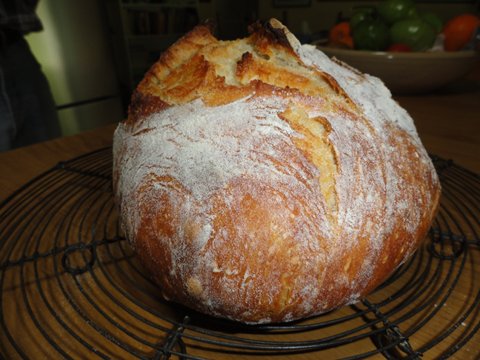
Bread is one of those foods that, when made with your own hands, gives a great deal of satisfaction and delight. It's only flour and water but it symbolises so much. I bake bread most days and use a variety of flours that I buy in bulk. Often I make a sandwich loaf because we use most of our bread for lunchtime sandwiches and for toast. Every so often I branch out to make a different type of loaf. I have tried sour dough in the past but I've not been happy with any of them. I'll continue to experiment with sour dough because I like the idea of using wild yeasts and saving the starter over a number of years to develop the flavour and become a part of the family. However, the loaf I've been branching out to most often is just a plain old five minute bread. By five minutes I mean it takes about five minutes actual work to prepare but it's the easiest of all bread to make and to get consistently good loaves from. If you're having people around for lunch or...
Image

This is my last post.

I have known for a while that this post was coming, but I didn't know when. This is my last post. I'm closing my blog, for good, and I'm not coming back like I have in the past.  I've been writing here for 16 years and my blog has been many things to me. It helped me change my life, it introduced me to so many good people, it became a wonderful record of my family life, it helped me get a book contract with Penguin, and monthly columns with The Australian Women's Weekly and Burke's Backyard . But in the past few months, it's become a burden. In April, I'll be 75 years old and I hope I've got another ten years ahead. However, each year I'll probably get weaker and although I'm fairly healthy, I do have a benign brain tumour and that could start growing. There are so many things I want to do and with time running out, leaving the blog behind gives me time to do the things that give me pleasure. On the day the blog started I felt a wonderful, h...
Image

What is the role of the homemaker in later years?

An email came from a US reader, Abby, who asked about being a homemaker in later years. This is part of what she wrote: "I am a stay-at-home mum to 4 children, ages 9-16. I do have a variety of "odd jobs" that I enjoy - I run a small "before-school" morning drop-off daycare from my home, I am a writing tutor, and I work a few hours a week at a local children's bookstore. But mostly, I cherish my blissful days at home - cooking, cleaning (with homemade cleaners), taking care of our children and chickens and goats, baking, meal-planning, etc. This "career" at home is not at all what I imagined during my ambitious years at university, but it is far more enriching. I notice, though, that my day is often planned around the needs of my family members. Of course, with 4 active kids and a husband, this is natural. I do the shopping, plan my meals, cook dinner - generally in anticipation of my family reconnecting in the evening.  I can't h...
Image

Every morning at home

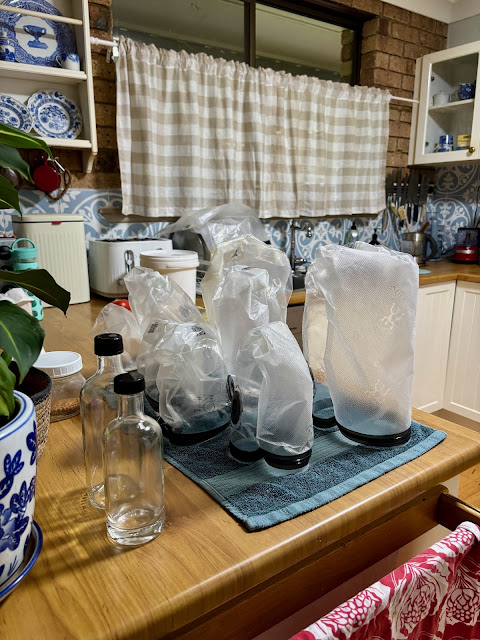
Every morning when I walk into my kitchen it looks tidy and ready for a day's work. Not so on this morning (above), I saw this when I walked in. Late the previous afternoon when I was looking for something, I came across my rolled up Zwilling vacuum bags and decided they had to be washed and dried. So I did that and although I usually put them outside on the verandah to dry it was dark by then. I turned the just-washed bags inside out and left them like this on a towel. It worked well and now the bags are ready to use when I bring home root vegetables, cabbages or whatever I buy that I want to last four or five weeks.
Image

You’ll save money by going back to basics

When I was doing the workshops and solo sessions, I had a couple of people whose main focus was on creating the fastest way to set up a simple life. You can't create a simple life fast, it's the opposite of that It's not one single thing either - it's a number of smaller, simpler activities that combine to create a life that reflects your values; and that takes a long to come together. When I first started living simply I took an entire year to work out our food - buying it, storing it, cooking it, preserving, baking, freezing, and growing it in the backyard. This is change that will transform how you live and it can't be rushed.  
Image


Trending Articles

NOT the last post

This will be my last post here.  I've been writing my blog for 18 years and now is the time to step back. I’ve stopped writing the blog and come back a couple of times because so many people wanted it, but that won’t happen again, I won’t be back.  I’ll continue on instagram to remain connected but I don’t know how frequent that will be. I know some of you will be interested to know the blog's statistics. 
Image

Every morning at home

Every morning when I walk into my kitchen it looks tidy and ready for a day's work. Not so on this morning (above), I saw this when I walked in. Late the previous afternoon when I was looking for something, I came across my rolled up Zwilling vacuum bags and decided they had to be washed and dried. So I did that and although I usually put them outside on the verandah to dry it was dark by then. I turned the just-washed bags inside out and left them like this on a towel. It worked well and now the bags are ready to use when I bring home root vegetables, cabbages or whatever I buy that I want to last four or five weeks.
Image

You’ll save money by going back to basics

When I was doing the workshops and solo sessions, I had a couple of people whose main focus was on creating the fastest way to set up a simple life. You can't create a simple life fast, it's the opposite of that It's not one single thing either - it's a number of smaller, simpler activities that combine to create a life that reflects your values; and that takes a long to come together. When I first started living simply I took an entire year to work out our food - buying it, storing it, cooking it, preserving, baking, freezing, and growing it in the backyard. This is change that will transform how you live and it can't be rushed.  
Image

Creating a home you'll love forever

Living simply is the answer to just about everything. It reduces the cost of living; it keeps you focused on being careful with resources such as water and electricity; it reminds you to not waste food; it encourages you to store food so you don't waste it and doing all those things brings routine and rhythm to your daily life. Consciously connecting every day with the activities and tasks that create simple life reminds you to look for the meaning and beauty that normal daily life holds.  It's all there in your home if you look for it. Seemingly mundane tasks like cleaning and cooking help you with that connection for without those tasks, the home you want to live in won't exist in the way you want it to.  Creating a home you love will make you happy and satisfied.
Image

Time changes everything

I've been spending time in the backyard lately creating a contained herb and vegetable garden. My aim is to develop a comfortable place to spend time, relax, increase biodiversity and encourage more animals, birds and insects to live here or visit. Of course I'd prefer my old garden which was put together by Hanno with ease and German precision. Together, we created a space bursting at the seams with herbs, vegetables and fruity goodness ready to eat and share throughout the year. But time changes everything. What I'm planning on doing now, is a brilliant opportunity for an almost 80 year old with balance issues. In my new garden I'll be able to do a wide range of challenging or easy work, depending on how I feel each day. It’s a daily opportunity to push myself or sit back, watch what's happening around me and be captivated by memories or the scope of what's yet to come.
Image

It's the old ways I love the most

I'm a practical woman who lives in a 1980’s brick slab house. There are verandahs front and back so I have places to sit outside when it's hot or cold. Those verandahs tend to make the house darker than it would be but they're been a great investment over time because they made the house more liveable. My home is not a romantic cottage, nor a minimalist modern home, it's a 1980’s brick slab house. And yet when people visit me here they tell me how warm and cosy my home is and that they feel comforted by being here. I've thought about that over the years and I'm convinced now that the style of a home isn't what appeals to people. What they love is the feeling within that home and whether it's nurturing the people who live there.
Image

Making ginger beer from scratch

We had a nice supply of ginger beer going over Christmas. It's a delicious soft drink for young and old, although there is an alcoholic version that can be made with a slight variation on the recipe. Ginger beer is a naturally fermented drink that is easy to make - with ginger beer you make a starter called a ginger beer plant and after it has fermented, you add that to sweet water and lemon juice. Like sourdough, it must ferment to give it that sharp fizz. To make a ginger beer plant you'll need ginger - either the powdered dry variety or fresh ginger, sugar, rainwater or tap water that has stood for 24 hours to allow the chlorine to evaporate off. You'll also need clean plastic bottles that have been scrubbed with soap, hot water and a bottle brush and then rinsed with hot water. I never sterilise my bottles and I haven't had any problems. If you intend to keep the ginger beer for a long time, I'd suggest you sterilise your bottles. MAKING THE STARTER In a...
Image

Back where we belong

Surprise! I'm back ... for good this time. Instagram became an impossible place for me. They kept sending me messages asking if I'd make my page available for advertisers! Of course, I said no but that didn't stop them. It's such a change from what Instagram started as. But enough of that, the important part of this post is to explain why I returned here instead of taking my writing offline for good. For a few years Grandma Donna and I have talked online face-to-face and it's been such a pleasure for me to get to know her. We have a lot in common. We both feel a responsibility to share what we know with others. With the cost of living crisis, learning how to cook from scratch, appreciate the work we do in our homes, shop to a budget and pay off debt will help people grow stronger. The best place to do that is our blogs because we have no advertising police harassing us, the space is unlimited, we can put up tons of photos when we want to and, well, it just feels li...
Image