down to earth

  • Home
  • About Us
  • Down To Earth Book
  • Privacy Policy
I want to thank all those who took the time to add a comment yesterday. I am sure they will help the men and women who read them and find something that will fit their circumstance and make sense to them. It is a wonderful thing to get well intentioned advice from people who have been in the same situation, and it is enriching to offer that advice with an open heart.

This is an important topic and there are a few points I want to continue with today.

Anne made a good point that I want to comment on, she said:
When budgeting and cutting back, it is too easy for me to start feeling cold, hungry and destitute, before even beginning! But when I start looking at all that we already have: food in the cupboards, clothes in the closets, more "entertainment" items than anybody needs, a roof and walls to keep out the elements, plenty of blankets and comforters, I start feeling rich rather than deprived. Then I am able to be objective about what items are truly necessities, and spend or not spend accordingly.

Yesterday at my voluntary job I was asked by one of our clients to accompany him to the police station. He'd been bashed on the weekend and had to make a statement to the police. He wanted me with him when he did it. He was walking with the aid of crutches so we hopped in my car and drove up town. During the course of the statement, he said that he thought he'd lost his phone during the attack but someone had given it back to him later. He said that phone meant more to him than his wallet because it contained ALL his personal things. It held his photos, his address book and it was his only safety device. This man is homeless and having dealt with him for a few months I know his only possessions are a canvass bag he carries with him, a tent we gave him, some blankets and a swag, a small stove, plate, cup, knife and fork that he bought, and his clothes and hat. He comes to the neighbourhood centre most mornings to have a shower, he washes his clothes every second day in our washer. While we were waiting to be seen, I asked him if there was anything he needed. He said he wanted a new hat because his was ripped, but he added, "I don't need a new hat but I'd like one."

When I meet people like this it makes me feel shame for every time in my old life when I wanted something and complained like a seven year old when I couldn't have it.


A few people recommended Dave Ramsey and I want to echo that. I've written about him a couple of times but if you're struggling with debt, or even if you want to stay on track, reading his website will help, I'm sure. Dave is in the US. If you're in the UK, there is another helpful site called moneysavingexpert.com They offer sound advice and have a very helpful forum where you can ask questions or just read through hundreds of pages about people recovering from debt and how they did it. If you're in Australia, you can find no better place than Lisa's fabulous thread on the Down to earth forum. Every two months Lisa and her group set a financial goal for themselves and then work towards it. During the course of the past year, Lisa goal was to save $10,000 - she did it and tells how on the thread. Lisa will start a new thread doing the same thing in the new year, so if you can't, or don't want to, join now, what better time than the new year! Michelle just gave us this link for our New Zealand readers - living off the smell of an oily rag. I've checked it out and it looks like a real winner.

One of the readers sent an email about this yesterday and I want to share part of it with you. It's about budgeting and small children and it's great advice, thanks Lisa. Lisa says:

What I wanted to share is that it is so important not to scare the kids, but to make them part of the discussions even at this young age because then they feel they are making a difference and not just being denied all the time. This might help other families that might be wanting to shield their children from "ADULT" worries. To us it has helped enormously to share not the burden but the fun of finding other ways to live and to make it a choice for us all and not just something we are imposing on the kids from our poor choices earlier. There are still times when it is hard on them and they really want something, but now if I say I just don't have the money for that this week, they understand and don't have a melt down in the store. I try to also sacrifice something I true want so they can have something next week to make up. It will be a very small thing, but it is still a treat and they appreciate their treats so much more now. I give up a coffee I am really craving when I am out (a very rare thing these days for me to purchase) and I gain a lovely smile from my children when I can give them a lollie or a mango.

And finally I wanted to add something that a couple of readers mentioned - that it's easy to feel deprived when you're paying off debt, but you can choose to see it as something really positive. Sure it's nice to have a new dress, you might even think you deserve it, but you deserve to live deft-free and without worry more than you deserve a dress. You might be longing to give your children the game they really want but giving them a life without arguments over money and parents who are financially sound is much better for them.


There will never be a better time than now to decide that you're going to follow a different path and start to get serious about your debt. Another thing that worked for Hanno and I was to give each other pocket money so we felt we had our own money if we wanted to buy something. For us it is $10 a week, but it should be only what you can afford. Betweenbabies, that might work for you and your husband. That $10 can be saved up to buy something more expensive, or spent each week just to buy bits and pieces when we're out. It can mean the difference between success and failure for some people who have a problem when starting to save.

Again, if you have any sound advice about paying off debt or living frugally, please add it here. I'd like to hear from readers who might have been convinced they should start cutting back, drawing up a budget and paying off debt. Do you need any more information about getting started on that road? If so, let me know.

Thanks again everyone. You've shown me once again what a thoughtful and wonderful community of readers we have here.

The economic crisis seems to be lingering longer than anyone predicted. We see various indicators starting to predict slow improvement but people are still losing jobs, the housing market, particularly in the US is shaky and in Australia grocery prices are going through the roof. Last year in the UK, one fifth of families, in homes of working age people, had no one working. I continue to get emails from people who are at the point of giving up, they've lost their job or just don't seem to be able to make any headway in paying off debt.

The answer to this problem never changes, in good times or in bad - stop spending, write up a budget, save an emergency fund and get rid of credit cards. It sounds simple, but I know it isn't. It's one of the most difficult things to work at and it is an ongoing battle, but the payoffs are enormous and significant.


So what is the first step toward long term financial health? Well, I'm no financial wizard but I think saving for an emergency fund, and a sound budget, should go hand in hand as the first step towards a sound future. A budget is like a map you draw yourself so that you'll know how much money you have each week, how much you need to spend on living and expenses, and how to pay off your debts in the most effective way. Once you have that map, you need a safety net, one that will allow you to work, pay off debt and enjoy your life without the threat of falling back into debt. Enter the emergency fund.

Don't rely on credit cards to keep you out of trouble. They only give you more debt to pay back. You end up paying the original cost, plus interest. The less interest you pay during your life, the better off you'll be. Do yourself a favour and retire the credit cards. Keep one for emergencies. Pay off all your credit cards and take great pleasure in snipping them up with a pair of scissors. Old ones of course.


Once you've got the basics in hand - you've stopped unnecessary spending, you've made up a workable budget, you're paying off your debts and saving for an emergency fund, the thing that will help you more than anything else is to keep working and set about saving as much money as possible. How you do that will differ with everyone of us but cutting back on non-essential services like mobile phones, cable TV and long distance holidays is an excellent start. Then it's the small things like the frugal use of electricity, water, gas and fuel, learning to shop for grocery bargains, shopping at thrift shops for clothing, blankets, household goods and craft items. You'll save even more money if you cut out fast food and convenience food and start cooking from scratch. Stop shopping the cleaning aisle at the supermarket and start cleaning with bicarb, vinegar, soap and water and that will keep more of your money in your pocket and less in the coffers of the multinationals.


There are so many ways to save money in the home. Hanno and I live on a fraction of what we used to spend and we are happier now than we've ever been. Paying off debt and being in control of your own life has more rewards than anything you'll buy on a whim or the fanciest meal you dine out on. But it's not easy. Especially when you start. It seems like you're standing at the bottom of a cliff face and you need to start climbing.

If you're in the situation where you have a lot of debt and don't know what to do, there are three alternatives - do nothing and pretend it will go away (it won't, it will get worse), keep spending and dig a deeper hole, or draw a line in the sand and promise yourself you'll start working towards a better future, today. If you do either of the first two options, you'll face an uphill battle your whole life, or at least until you can get your debt under control, but if you take the last option, you'll slowly but surely work towards a better future. It will be a future where you will be in control, you won't worry every day about what you can or can't afford, you'll even get to the point when you can decide whether to work part time or keep going full time - you'll give yourself that choice.

I know there are a lot of people here who've been smart savers for many years, there are also a lot who need help and who want to start moving towards a more frugal future. If you've got some smart ways of saving money, please share your tips with us. You never know, the ideas you contribute here today might help someone in dire straits, so please take a few moments and give us your best advice.


It's taken a while but I finally feel like I'm back in my daily homemaker's rhythm. When Hanno was in Germany those five weeks, then when he came home with the flu and we were both sick, the basics were done and maybe a few extras, but not much else. Now we're both back to good health, jobs are being completed again, we both feel on top of everything and right back on track.

My version of chicken, leek and oats soup from the fabulous The Real Food Companion cook book.

I have been writing every chance I get and taking short breaks away from it to get bread on the rise, pick vegetables from the garden, make the bed, sweep the floor, wash up and do the laundry - all the general things we all do in the course of our day. We had a new water saving toilet installed by the plumber the other day. It uses 3 litres or 4½ litres per flush which is a big improvement on our old system. There are always improvements we can make and when they're done we start looking for what else would better serve us with a few modifications. It's surprising how many we find.

Water conservation is important to us, as I'm sure it is to many of you. We live in the driest habitable continent on earth so it's our collective responsibility as Australians to save water whenever we can. We've installed rainwater tanks and can store up to 15,000 litres/quarts. That water is used to grow our fruit and vegetables, for the chooks and animals and for all out door cleaning. We use much less than average water in the house and now with our new toilet, we should cut that back a little more. If you live in a dry area of Australia or overseas - like Texas, New Mexico (hi Sharon!), Arizona or Spain or Portugal, I'd love to know how you cope during arid spells and how you save water. I am an old dog but I love to learn new tricks if you have any to show me.

I've packed away my sewing machine and doubt I'll have time for sewing until late next year. I know I'll miss sewing this and that but I'm still knitting and when I have a break I take to the needles and get a few rows done on my current project. I'm currently knitting black merino wool, which is such a lovely yarn to touch, I'm enjoying every stitch of it.

For all our long term readers, Sharon is on the mend and is very slowly returning to good health. She was very ill for a long time so it's a slow recovery, but week by week, she gets better. I'd like to thank her husband Claude who has continued in Sharon's stead working behind the scenes at the simple, green frugal co-op getting the writer's rosters out for me. You've been such a great help Claude, thank you. Take care, Sharon. We all send our love and best wishes.

Whole grain bread rolls topped with oats and corn meal.

It's been quiet here in our home over the weekend. I've been tapping away on the keys while Hanno works outside cleaning the car, washing the dogs (Flora McDonald, Bernadette's dog, now owned by my god daughter Casey, is here too) and every so often I hear an electric saw or hammering so house maintenance is being carried out as well.

Yesterday, that icon of old Australia - the lamb roast, was cooking away in the oven for our dinner. It's THE Sunday meal of my childhood and as we hadn't had a roast for a while, we both enjoyed it very much. It was the best way to wind down on a Sunday evening. Just being here together, with the gate closed, quietly going about our set tasks. It seems like everything is right again - back in our rhythm, working away quietly. I haven't asked Hanno if he feels the same, but I bet he does, there are some things I just know to be true.
What could be better on a cool and rainy Spring day than to have the aroma of delicious food baking in the oven for the evening meal. I made our two course dinner by cherry picking from the stockpile, fridge and garden: pizza with caramelised onions and bocconcini accompanied by a dessert of raspberry jam roly-poly; a real old fashioned favourite.

Being able to cook day in and day out from what is already on hand in the kitchen and garden is one of the invaluable simple skills that improve the longer you do it. This might be simple food but it's delicious and healthy and it fills us up. As an added bonus, it doesn't cost much in dollars or time.


PIZZA BASE WITH WHATEVER ON TOP

Made in the bread maker. This will make three bases.

This pizza base dough is almost the same as my white bread dough, with the addition of olive oil to make it more pliable. You don't have to use white flour, it can be made with wholemeal, wholegrain, corn and barley or rye flour. Use whatever you have on hand and what your family enjoys.

4 cups bread flour
2 teaspoons dry yeast
½ teaspoon sugar
1 teaspoon salt
¼ cup olive oil
1 cup warm water, plus some more - depending on the weather and your flour.

Put all the dry ingredients and the oil into the bread maker and add one cup of water. Turn on to the pizza dough setting and start. Stay with the machine, keep the lid open and watch. Get a half cup of water and add a little at a time, wait until it's incorporated into the mix and if the dough is still too dry, add some more. You might have to add the half cup, you may add a quarter. Flours and weather all differ and they made a difference to how much water your flour needs. Watch the mix and use your common sense. When you have a dough that has come together nicely, close the lid and go on to something else, like cooking the onions.

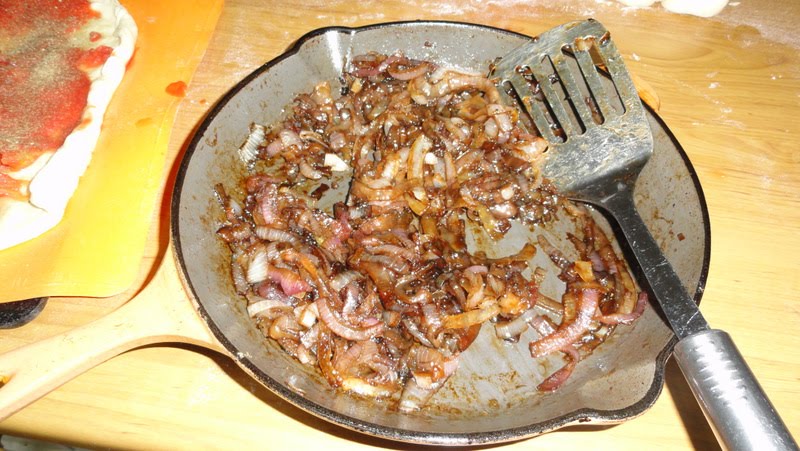
CARAMELISED ONIONS
a version of Annabel Langbein's recipe from here.


Cut four medium onions into circles and add them to a lightly oiled pan over medium heat. Add salt and pepper to taste and stir the onions as they start to cook. Break up the onion rings a little with your spoon. When the onions are cooking, add 1 tablespoon balsamic vinegar and one tablespoon of brown sugar and stir in. Finally add about a cup of water and bring to the boil. When it's boiling, turn the heat down to a simmer and let it cook slowly for about an hour. Watch it carefully in the last 15 minutes because all the water will have evaporated off and now you'll need to stir it every couple of minutes. You'll notice a sticky brown gooeyness on the bottom of the pan. That is your concentrated flavour. Stir it in and don't let it burn. When you're happy with the taste, turn off the heat and let the onions cool.

You can also make caramelised onions by slowly frying them in a little oil but I usually burn them when I do it that way. This method will allow you to go on with other things while it develops it's deep rich flavour, with little chance of burning.


When the dough is kneaded, remove it from the machine and divide it into three. Two portions can be frozen if you don't need to use them straight away. With your hands or your rolling pin, flatten the dough into a rectangle or a circle, depending on the shape of your baking tray. Now the fun begins, start adding your topping. I used caramelised onions, bocconcini, strips of ham, diced red capsicum/pepper and finely grated parmesan, but any topping you like is fine.

JAM ROLY-POLY
This is an old favourite from my childhood. My grandma made it using suet, I use butter instead. It's very similar to a scone dough.

2 cups self raising flour OR plain/all purpose flour with two teaspoons of baking powder sifted in
2 tablespoons room temperature butter
Pinch salt
2 tablespoons sugar
Enough milk to make a firm dough


Add all the dry ingredients to a mixing bowl and mix to combine. Using your finger tips, rub the butter into the flour. When it's combined, add the milk and mix in. You want your dough to look like the following photo.


When it's mixed, cover the dough with plastic wrap and place it in the fridge to firm up. About 30 minutes should do it.


Onto a lightly floured board or bench, roll out the dough into a rectangle. Cut off any bits that poke out too far so you have a neat shape. Cover the dough with raspberry jam (or any jam of your liking) and carefully roll the dough into a sausage shape. You might need the help of a pallet knife or egg lifter. Brush with egg wash and place into an oven proof baking dish. You can curl it around to fit the dish. You need a dish with sides because this will spread out if cooked on a flat tray.

Cook at 180C/350F for about 30 minutes or until golden and bubbly. Serve with warm custard or, like I did, with the cream from the top of the milk. Delicious!

I hope you have a beautiful weekend with people you love. Thank you visiting me this week.
Well, it's a week and a half since I said I was cleaning and reorganising my work room. This was an important task for me. It's the one room I let get completely chaotic before I fix it, and it's the space I am writing the book in. To write well, I need a calm, quiet space. When you see the photos of what it looked like, you'll agree, it was well and truly in need of some attention and care. But now, 1½ weeks later, and taking into account that I was down with a cold for some of that time, here I am to reveal the before and after photos. I am ashamed to show some of these photos but we're in the business of telling it straight, so here they are.

Here is the full extent of the mess. The result of two women (my sister and I) using one room in which to sew, and to write in.

I started folding and sorting out the fabrics first.

While piles started forming ...

there was still so much more to do.

Believe it or not, this is a photo of progress and moving forward.
~~~~~~~~~~~~~

It took me about three days of slowly folding, sorting, cleaning and rearranging before I could start seeing an end in sight. I took a few days off with my cold, then back to finish up. And here it is now, where I am sitting right now writing this.

I started work on the book again yesterday and expect it to take up most of my time for the next few months. I have a wonderful editor at Penguin called Jo who is working with me and I am confident we will produce a book that will help us all move forward towards more simple and self reliant lives.


The sewing machine and overlocker/serger are in the cupboard and I doubt they'll be used for anything other than urgent repairs until next year.

Right next to the cupboard I have this little unit that holds genealogy papers and my knitting supplies.

I am delighted I took on this task and persevered until it was finished. It feels so good to be sitting here right now knowing that everything is where it should be and that I can function well here. Having a clean and organised work area will support the work I have ahead of me.

I know a lot of you joined in this challenge and the thread over at the forum is now running 15 - 16 pages. It's been very encouraging to work alongside other women with us all focused on the same goals. I hope you'll all be finished your tasks soon and be as happy as I am that it's finished.
As you probably know, Hanno arrived home from Germany with a cold, and, of course, I've got it now. I was going to report on the organisation of my work room today but my head is fuzzy, and the new camera still confuses me, so I'll carry on with the new normal posts. This time we're in the kitchen.


When we moved here 13 years ago:
  • We removed the old kitchen and put in one that was better for working in.
  • Installed a range hood to take stale air from the kitchen into the roof space where the whirlybirds we installed would remove it and all hot air from the roof space.
  • Installed a sink top water purifier so we could drink filtered water and fill our stainless steel bottles to take when we went out.
  • Removed the carpet from all areas except the bedrooms.
  • Skylight installed in the kitchen roof to avoid electric light being used on overcast days.

In the following years we:
  • Completely reorganised the kitchen to support the work being done there. Tea, coffee and tea kettle were placed near the tea and coffee cup cupboard, baking supplies were all in one space to make bread baking as easy as possible, a pantry and separate stockpile cupboard were established.
  • The dishwasher was removed and given away. I'm washing up by hand now and prefer it to having to use the harsh caustic chemicals used in dishwashers which eventually flow into our waterways. I now store recycled and canning jars in the space that used to hold the dishwasher.
  • Bought a Coolgardie safe to hold food that doesn't need to be refrigerated but is safely away from flies and other insects.
  • Cook several things at the same time in the oven. For instance, cooking a roast in the oven, you also cook the vegetables in the pan around the meat and in the last 15 minutes, add your greens in an oven-proof dish with a foil lid. Or cakes or biscuits baking at the same time bread is in the oven.
  • Wash vegetables in bowls, not under running water.
  • Use vegetable and fruit peelings and scraps in the compost or worm bin.
  • Gave away our Teflon cookware and use only stainless steel and cast iron now.
  • Fell in love with slow cooking and now cook from scratch exclusively.
  • Taught myself to develop flavour in cooked food with various cooking methods, spices and herbs instead of adding soup or packets of flavourings.
  • Make stocks.
  • Bake bread almost everyday.
  • Taught myself ways to combine garden produce with stockpile items to produce delicious meals.
  • Make yoghurt and fresh cheese.
  • Buy local unhomogenised jersey milk and skim the cream to make butter.
  • Make ice cream.
  • Clean using home-made cleaners.
  • Make and use knitted cotton dishcloths.
  • Make ginger beer and fruit cordials.
  • Make jams, sauces and chutneys and preserve them.
  • Realised the difference between quantity and quality.
  • Make sure we eat food in season and grown as close to home as possible.
  • Loose tea instead of tea bags.
  • Went from being vegetarian to a meat eater and got to know my butcher.
This list could be longer but I'll finish with this instead. Being as sustainable as we can be isn't easy or quick. It makes us slow down and be mindful of what we're doing. It makes us more selective and if there is a choice between local strawberries at $4 and strawberries from interstate at $3, we choose the local ones. We aren't perfect. We slip back and have to recover again, we want to be better at this than we are. But this is our lifelong journey now - it's always changing and we're always trying to do our best. There are two things I know I'll never buy again, one is bottled water, the other coffee in a takeaway cup. I see people walking along with coffee and plastic water bottles in there hands and it makes me cringe. All that waste is not sustainable. We have turned our backs on all things disposable, we've returned to china cups, setting the table, sitting down and eating with knives and forks. It's a beautiful thing to do and it beats coffee in a cardboard cup anytime.
Almost all through history, each generation has benefited from the one that has gone before it. What was left behind was built upon by the new generation and in doing that, improvement was constant. But it looks like that will stop, that our grandchildren will be paying for our excesses and that they will inherit a world quite different to that we grew up in. There is a call now for all of us to consciously strive towards a more sustainable future and there is much more emphasis now on green technology, conservation and environmental management. But unless all of us work towards a sustainable future, and change our mindset to be conservers instead of consumers, progress will be slow.


Switching to a more simple way of life will naturally incorporate sustainability. Living simply will make you greener, more frugal, sustainable and healthier if you let it. And if you reap the benefits of frugality and pay off your debts, the banks will have to pass back the keys to your life and you'll be in the driver's seat.

If we all become more sustainable - in every aspect of our lives, we will help lessen the burden our grandchildren will inherit. Sustainable living shouldn't be that difficult, it's many small steps, new ways of understanding and behaving, and supporting our family and friends in their own efforts towards what I hope will become the new normal. Over the next week or two, I thought it would be helpful to go through the home, room by room, and list what has become commonplace as well as what we'd like to incorporate. Please add your own lists to the comments. I think it will be extremely interesting to see just what has already happened, and what is planned in the near future. Reading the lists may also give all of us ideas for what is possible.

Let's start outside first - that place of production and growth - the backyard, or farmland, or balcony, or front steps. Whatever it is you call your outside area, let us know what you've changed there to be more sustainable.

This is us:
When we first moved here 13 years ago, we:
  • Installed a water tank.
  • Installed solar hot water.
  • Put in a vegetable garden.
  • Planted fruit trees.
  • Made a compost bay.
  • Bought our newest flock of chickens - five little beauties.
In the following years we:
  • Built a worm farm.
  • Use only organic methods.
  • Made our own fertilisers.
  • Bought more chickens and made sure they were heritage breeds.
  • Grew feed for the chickens.
  • Grew heirloom, open pollinated seeds and saved seed for the following crops.
  • Built shade tunnels for summer growing.
  • Put up fences - not only on the boundary line but also in the backyard around the garden and to enclose the area close to the backdoor to keep the chickens away.
  • Continued our vegetable garden almost all year through every year. We improved our soil from the original clay to the dark rich soil we now enjoy. That garden gave us organic vegetables when we rarely would have been able to buy them.
  • Built, and then sold, an aquaponics system that grew fish and vegetables in the same system.
  • Installed another, larger, water tank giving us the capacity to store 15,000 litres of rainwater. We cut our water consumption in half, then in half again.
  • Learned to recognised the birds that visit our garden.
  • Recorded rainfall.
  • Put out birdbaths full of fresh water for the visiting birds.
All these actions required hard work and a commitment to sustainability - we wanted to live out our lives here in the way we started out. We still do! But there is still important work to be done here, this is ongoing, this is our new normal. In the near future, we want to install solar panels on the roof to reduce our use of grid electricity and we want to continue growing our own food for all long as we can.

And that is where I believe the important part of sustainability comes in for all of us. This is not an exercise on self congratulations. We don't sit back satisfied with what we've already done, we keep working towards new and better ways, we keep improving what we do, we keep doing it ourselves as well as encouraging others; we do as much as we can for as long as we can. And yes that is a lot of hard work at times but doing nothing is no longer a viable alternative.

What have you been working on?
Well, Hanno has been home two days now and everything is beginning to feel right again. Cups of tea are being made, there are meals for two again instead of egg on toast for one, Alice has stopped moping around; slowly we're getting back into our rhythm. We went grocery shopping this morning and went early to get in and out before the crowds. Well, that was the plan but the crowds always seem to be around now and the shop was full. That once sleepy fishing and holiday town is now full of high rise buildings, tourists, and shoppers. And so many people are rude! Talking on a mobile phone in the lift, parking the 4x4 at the front entrance and blocking cars on one side, so he could pack his groceries in the shade. There were people pushing and shoving and what I thought might be a fairly pleasant and slow stroll down the supermarket aisles turned into a nightmare that I wanted to wake up from. I was so pleased to head for home!

There is something about it - that turn of the wheel into our own driveway that makes me feel good every time. Home again, thank goodness!

Hanno still isn't feeling the best so he went back to bed for a rest when we came home. I came into my workroom to continue sorting and folding fabric. I am still strongly committed to getting my work room in order before I dive head first into writing. I know this work will pay off in increased productivity because I will not be surrounded by chaos and remnants of projects waiting to be completed. I know that if I want calm and intelligent writing, that must come from a calm and supportive space. Almost all the fabrics Tricia left behind are folded and today I'll move most of the fabric, wool and cotton yarns into the cupboard Hanno is clearing out for me. We're nearly there!

Our homes are the one true place we can modify, change, rearrange, and organise to completely suit ourselves and our families. And while I cannot go up to the man who thoughtlessly parked his car in the shade and tell him to MOVE! I can move things around in my own home to make it a place that encourages creative hours and productive work. I might not be able to take that mobile phone from the woman in the lift and tell her to stop being so rude but I can sit quietly, look out the window and appreciate the flowering garden and the sound of birds.

Here I can do anything, and everything. Soon, another day will dawn, bread will be on the rise, breakfasts made, animals fed and the workings of our home will start again. I'll forget the trip to the supermarket and maybe even that the little fishing town where we shop is a tourist city now, forever changed to better suit the machinations of modern life and not the soft memories of an aging woman. Life changes, I get that, and I'm fine with it, because here in my home time is not as important as production, comfort and the cultivation of happiness.

I just wanted to mention that I'm really pleased with the number of people who have joined in the organisation challenge. Over on the forum, where we're all writing about our own particular challenge, there have been 100 posts in a thread that's expanded over 11 pages. It's so motivating and interesting to read how everyone is working towards their own version of clean, tidy and organised. And it's not over yet. Some of these projects, like mine, will go on for some time. Come and join us if you're organising or want to but can't get started. Just reading some of those posts makes you want to get up and start looking for your apron and cleaning rags.

I hope you have a lovely weekend. Thank you for your visits this week.
When Tricia was here and madly hand stitching her red quilt, a number of readers asked to see the quilt. Well, I'm slow but I generally get there. No quilt looks as good in a photo as it does having it right before you, but you can see the work that's gone into it. This quilt started off with the supper cloth in the centre. Tricia attached the various shapes, then added borders to that and worked outwards. There are many pieces of appliqué on the large borders, my favourites being the two rabbits and the many pieces of old lace I remember from our childhood. On all four corners, she's hand stitched each of her sons' names.


There are many forms of patchwork, this one is, I think, a memory quilt. If you're new to sewing and would like to try your hand at patchwork, don't think you have to stick with the traditional patchwork patterns, there are many other forms as well. I didn't "get" patchwork for many years and wondered why Tricia bothered with it. I remember her husband saying that she was cutting up pieces of fabric and then sewing them back together again. Well, of course, that is what patchwork is, but it's much more, there is a greater significance in this simple craft. I see it now as a beautiful and meaningful way to put off-cuts and left over fabric to good use. There is something about providing a meal to a hungry family and providing warmth with scraps of fabric, that fills me up. It must be one of our primitive instincts to provide food and warmth for our family and I feel it most when cooking from scratch and piecing together random pieces of fabric. I love how it starts as nothing more than scraps but ends up being a beautiful object, often holding memories of clothing made, or the people who wore those fabrics.


The other quilt featured here is another one Tricia made with French fabrics. She brought it with her to have it machine quilted by my DIL Cathy. Cathy ended up not doing this quilt but handed it over to one of her friends. Tricia was really thrilled with the quilting, which is called stippling. Both these quilts might be featured in a magazine soon. I think it's part of the Homespun group, called Country Collections. They were at Tricia's home yesterday taking photos.


If you want to try your hand at patchwork and hope to make a quilt, start off with a smaller project, work out your techniques, then move on to a bigger project. Basically, you would cut up all your shapes, sew the shapes into long strips, then sew the strips together. But look here at these links, there are some very good instructions here.


When you have made the top of the quilt, you layer the top to some warm wadding and attach them both to a backing. The backing can be any large piece of material that suits the top or provides additional warmth. When you have your three layers, you quilt them together. In the old days every quilt was hand stitched, now there are sewing machines that can handle quilting. The quilt above was quilted on one of those specialist quilting machines Tricia's red quilt is hand stitched. If you're never sewn anything like this before, using recycled fabric or scraps, I hope I've inspired you to give it a try. Let me know if you give it a go and remember to start small and work up to a larger project.

Happy sewing everyone!
I've been thinking about the one thing that helps the most in keeping us on track here. I know my DIL Sarndra will love this, because that one true thing, is organisation. She thrives on it, she's a natural, she knows instinctively where to place things, how to effectively store almost anything and how to arrange household goods to best suit their efficient usage. By doing those things, Sarndra knows where everything is, she works efficiently and she has enough time to do what she wants to do when she's finished. I'm a bit more challenged in that direction. and when I'm really busy I let things go, even though I know in the long run it will create extra work. I let my sewing/work room get into a real mess before I fix it, and I tend to do the most important things and leave those less noticeable. When I stick to my routines I'm fine but at the moment with Hanno away and being so busy with various things, I'm not doing all I should and I know it will be a real push to put it all to rights again.


I have a quite a few small tasks that need doing right now. My plan is to go through all of them in the next few days, and then stay on top of everything in the coming months when I'll be well and truly pressed for time while I'm writing the rest of my book. If I don't do that, I'll feel I've let myself down and that my home is not what it should be. I love that feeling when I can sail through my home and know everything that needs doing has been done and that I can relax and enjoy being there. And let me remind you here, I'm not aiming for perfection, mainly because it doesn't exist, but also because I want a functional, warm and inviting home, not a show piece.

Today, Monday 25 October, marks that day for me where I draw the line and declare that I will fix everything, stay on top of it all, carry out my routines properly every day and have my mind free to concentrate on the writing. Organisation is the key for me. If I can organise myself and my work I'll be able to do everything else that needs doing. So I'm seeing this as a gift for me that only requires a bit of work, sticking to my routines and making the most of the time I have to do my work and to write. I can't concentrate properly if the house isn't right and writing what I need to put in the book would be dishonest and foolish if I was writing one thing and living in another way. So this is it.

Line drawn.


Who will join me? Who needs to do this too? I am going to start a thread at the forum to monitor this and to keep me on track. I challenge you all to join me, to make your own organising challenge that will help you live to your potential in your own home. With many of us doing it and with the support and encouragement that will give us, I know we'll do it. So, who is stepping forward beside me?

The link to the forum thread is here. If you're a member of the forum, you'll go straight there. If you're not yet a member, you'll need to register first. It's free and easy, so take the plunge.

Newer Posts Older Posts Home

MY BOOKS

MY BOOKS


My books were all published by Pengiun, and are available at Amazon US, Amazon UK and Amazon Au

Search here

Total Pageviews

Translate


I'm Rhonda Hetzel and I've been writing my Down to Earth blog since 2007. Although I write the occasional philosophical post, my main topics include home cooking, happiness and gardening as well as budgeting, baking, ageing, generosity, mending and handmade crafts. I hope you enjoy your time here.

MY FAVOURITE PLACES

  • Grandma Donna's Place
  • Grandma Donna's YouTube
  • Grandma Donna's Instagram
  • This Simple Day
  • Nicole's Instagram

Give More

Give More

Popular posts last year

Making ginger beer from scratch

We had a nice supply of ginger beer going over Christmas. It's a delicious soft drink for young and old, although there is an alcoholic version that can be made with a slight variation on the recipe. Ginger beer is a naturally fermented drink that is easy to make - with ginger beer you make a starter called a ginger beer plant and after it has fermented, you add that to sweet water and lemon juice. Like sourdough, it must ferment to give it that sharp fizz. To make a ginger beer plant you'll need ginger - either the powdered dry variety or fresh ginger, sugar, rainwater or tap water that has stood for 24 hours to allow the chlorine to evaporate off. You'll also need clean plastic bottles that have been scrubbed with soap, hot water and a bottle brush and then rinsed with hot water. I never sterilise my bottles and I haven't had any problems. If you intend to keep the ginger beer for a long time, I'd suggest you sterilise your bottles. MAKING THE STARTER In a...
Image

NOT the last post

This will be my last post here.  I've been writing my blog for 18 years and now is the time to step back. I’ve stopped writing the blog and come back a couple of times because so many people wanted it, but that won’t happen again, I won’t be back.  I’ll continue on instagram to remain connected but I don’t know how frequent that will be. I know some of you will be interested to know the blog's statistics. 
Image

How to make cold process soap

I'm sure many of you are wondering: "Why make soap when I can buy it cheaply at the supermarket?" My cold process soap is made with vegetable oils and when it is made and cured, it contains no harsh chemicals or dyes. Often commercial soap is made with tallow (animal fat) and contains synthetic fragrance and dye and retains almost no glycerin. Glycerin is a natural emollient that helps with the lather and moisturises the skin. The makers of commercial soaps extract the glycerin and sell it as a separate product as it's more valuable than the soap. Then they add chemicals to make the soap lather. Crazy. Making your own soap allows you to add whatever you want to add. If you want a plain and pure soap, as I do, you can have that, or you can start with the plain soap and add colour, herbs and fragrance. The choice is yours. I want to add a little about animal and bird fat. I know Kirsty makes her soap with duck fat and I think that's great. I think t...
Image

Preserving food in a traditional way - pickling beetroot

I've had a number of emails from readers who want to start preserving food in jars but don't know where to start or what equipment to buy.  Leading on from yesterday's post, let's just say up front - don't buy any equipment. Once you know what you're doing and that you enjoy preserving, then you can decide whether or not to buy extra equipment. Food is preserved effectively without refrigeration by a variety of different methods. A few of the traditional methods are drying, fermentation, smoking, salting or by adding vinegar and sugar to the food - pickling. This last method is what we're talking about today. Vinegar and sugar are natural preservatives and adding one or both to food sets up an environment that bacteria and yeasts can't grow in. If you make the vinegar and sugar mix palatable, you can put up jars of vegetables or fruit that enhance the flavour of the food and can be stored in a cupboard or fridge for months. Other traditional w...
Image

Cleaning mould from walls and fabrics

With all this rain around we've developed a mould problem in our home. Usually we have the front and back doors open and that good ventilation stops most moulds from establishing. However, with the house locked up for the past week, the high humidity and the rain, mould is now growing on the wooden walls near our front door and on the lower parts of cupboards in the kitchen. Most of us will find mould growing in our homes at some point. Either in the bathroom or, in humid climates, on the walls, like we have now. You'll need a safe and effective remedy at some point, so I hope one of these methods works well for you. Mould is not only ugly to look at, it can cause health problems so if you see mould growing, do something about it straight away. The longer you leave the problem, the harder it will be to get rid of it effectively. If you have asthma or any allergies, you should do this type of cleaning with a face mask on so you don't breathe in any spores. Many peopl...
Image

Five minute bread

Bread is one of those foods that, when made with your own hands, gives a great deal of satisfaction and delight. It's only flour and water but it symbolises so much. I bake bread most days and use a variety of flours that I buy in bulk. Often I make a sandwich loaf because we use most of our bread for lunchtime sandwiches and for toast. Every so often I branch out to make a different type of loaf. I have tried sour dough in the past but I've not been happy with any of them. I'll continue to experiment with sour dough because I like the idea of using wild yeasts and saving the starter over a number of years to develop the flavour and become a part of the family. However, the loaf I've been branching out to most often is just a plain old five minute bread. By five minutes I mean it takes about five minutes actual work to prepare but it's the easiest of all bread to make and to get consistently good loaves from. If you're having people around for lunch or...
Image

This is my last post.

I have known for a while that this post was coming, but I didn't know when. This is my last post. I'm closing my blog, for good, and I'm not coming back like I have in the past.  I've been writing here for 16 years and my blog has been many things to me. It helped me change my life, it introduced me to so many good people, it became a wonderful record of my family life, it helped me get a book contract with Penguin, and monthly columns with The Australian Women's Weekly and Burke's Backyard . But in the past few months, it's become a burden. In April, I'll be 75 years old and I hope I've got another ten years ahead. However, each year I'll probably get weaker and although I'm fairly healthy, I do have a benign brain tumour and that could start growing. There are so many things I want to do and with time running out, leaving the blog behind gives me time to do the things that give me pleasure. On the day the blog started I felt a wonderful, h...
Image

What is the role of the homemaker in later years?

An email came from a US reader, Abby, who asked about being a homemaker in later years. This is part of what she wrote: "I am a stay-at-home mum to 4 children, ages 9-16. I do have a variety of "odd jobs" that I enjoy - I run a small "before-school" morning drop-off daycare from my home, I am a writing tutor, and I work a few hours a week at a local children's bookstore. But mostly, I cherish my blissful days at home - cooking, cleaning (with homemade cleaners), taking care of our children and chickens and goats, baking, meal-planning, etc. This "career" at home is not at all what I imagined during my ambitious years at university, but it is far more enriching. I notice, though, that my day is often planned around the needs of my family members. Of course, with 4 active kids and a husband, this is natural. I do the shopping, plan my meals, cook dinner - generally in anticipation of my family reconnecting in the evening.  I can't h...
Image

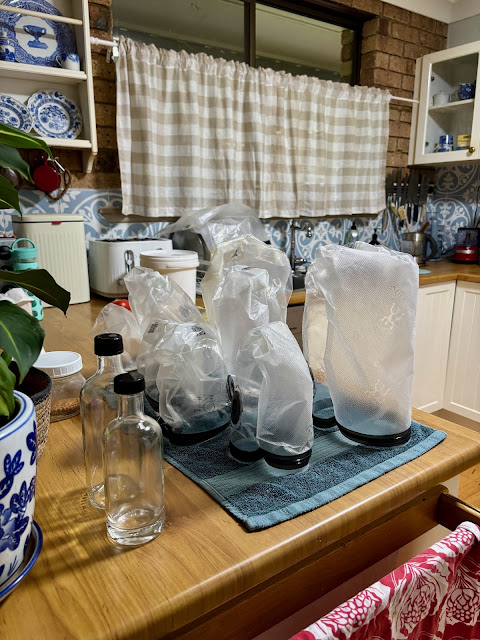
Every morning at home

Every morning when I walk into my kitchen it looks tidy and ready for a day's work. Not so on this morning (above), I saw this when I walked in. Late the previous afternoon when I was looking for something, I came across my rolled up Zwilling vacuum bags and decided they had to be washed and dried. So I did that and although I usually put them outside on the verandah to dry it was dark by then. I turned the just-washed bags inside out and left them like this on a towel. It worked well and now the bags are ready to use when I bring home root vegetables, cabbages or whatever I buy that I want to last four or five weeks.
Image

You’ll save money by going back to basics

When I was doing the workshops and solo sessions, I had a couple of people whose main focus was on creating the fastest way to set up a simple life. You can't create a simple life fast, it's the opposite of that It's not one single thing either - it's a number of smaller, simpler activities that combine to create a life that reflects your values; and that takes a long to come together. When I first started living simply I took an entire year to work out our food - buying it, storing it, cooking it, preserving, baking, freezing, and growing it in the backyard. This is change that will transform how you live and it can't be rushed.  
Image

All previous blog posts

  • 2026 3
    • February 3
      • Workshops starting 1 March
      • Planting vegetable seeds and new workshops
      • Back where we belong
  • 2025 7
    • July 1
    • June 2
    • May 1
    • April 2
    • February 1
  • 2024 25
    • December 2
    • November 1
    • October 2
    • September 3
    • August 1
    • July 3
    • June 1
    • May 3
    • April 2
    • March 3
    • February 2
    • January 2
  • 2023 13
    • December 1
    • November 2
    • October 1
    • September 3
    • August 2
    • February 2
    • January 2
  • 2022 17
    • November 3
    • October 4
    • September 3
    • August 2
    • July 3
    • June 2
  • 2021 50
    • December 1
    • November 6
    • October 7
    • September 5
    • August 4
    • July 5
    • June 2
    • May 2
    • April 6
    • March 4
    • February 4
    • January 4
  • 2020 68
    • December 3
    • November 5
    • October 4
    • September 4
    • August 4
    • July 4
    • June 4
    • May 8
    • April 7
    • March 8
    • February 8
    • January 9
  • 2019 66
    • December 2
    • November 4
    • October 5
    • August 3
    • July 4
    • June 6
    • May 8
    • April 8
    • March 8
    • February 11
    • January 7
  • 2018 82
    • December 1
    • September 2
    • August 10
    • July 4
    • June 11
    • May 9
    • April 12
    • March 10
    • February 10
    • January 13
  • 2017 129
    • December 7
    • November 10
    • October 6
    • September 13
    • August 11
    • July 13
    • June 12
    • May 9
    • April 9
    • March 14
    • February 11
    • January 14
  • 2016 125
    • December 7
    • November 13
    • October 10
    • September 11
    • August 11
    • July 8
    • June 9
    • May 9
    • April 12
    • March 10
    • February 13
    • January 12
  • 2015 184
    • December 7
    • November 15
    • October 20
    • September 18
    • August 19
    • July 18
    • June 12
    • May 15
    • April 12
    • March 21
    • February 13
    • January 14
  • 2014 203
    • December 11
    • November 8
    • October 17
    • September 20
    • August 17
    • July 19
    • June 17
    • May 17
    • April 23
    • March 15
    • February 18
    • January 21
  • 2013 225
    • December 13
    • November 17
    • October 17
    • September 17
    • August 21
    • July 24
    • June 20
    • May 19
    • April 17
    • March 22
    • February 17
    • January 21
  • 2012 245
    • December 17
    • November 20
    • October 20
    • September 18
    • August 15
    • July 24
    • June 21
    • May 26
    • April 23
    • March 23
    • February 19
    • January 19
  • 2011 257
    • December 18
    • November 24
    • October 27
    • September 23
    • August 24
    • July 21
    • June 24
    • May 24
    • April 16
    • March 22
    • February 14
    • January 20
  • 2010 283
    • December 20
    • November 18
    • October 18
    • September 19
    • August 25
    • July 24
    • June 25
    • May 26
    • April 25
    • March 22
    • February 29
    • January 32
  • 2009 293
    • December 29
    • November 18
    • October 23
    • September 25
    • August 22
    • July 28
    • June 22
    • May 21
    • April 27
    • March 26
    • February 24
    • January 28
  • 2008 387
    • December 24
    • November 23
    • October 25
    • September 26
    • August 27
    • July 27
    • June 37
    • May 34
    • April 44
    • March 53
    • February 32
    • January 35
  • 2007 372
    • December 37
    • November 40
    • October 55
    • September 51
    • August 49
    • July 63
    • June 49
    • May 28


Trending Articles

NOT the last post

This will be my last post here.  I've been writing my blog for 18 years and now is the time to step back. I’ve stopped writing the blog and come back a couple of times because so many people wanted it, but that won’t happen again, I won’t be back.  I’ll continue on instagram to remain connected but I don’t know how frequent that will be. I know some of you will be interested to know the blog's statistics. 
Image

Every morning at home

Every morning when I walk into my kitchen it looks tidy and ready for a day's work. Not so on this morning (above), I saw this when I walked in. Late the previous afternoon when I was looking for something, I came across my rolled up Zwilling vacuum bags and decided they had to be washed and dried. So I did that and although I usually put them outside on the verandah to dry it was dark by then. I turned the just-washed bags inside out and left them like this on a towel. It worked well and now the bags are ready to use when I bring home root vegetables, cabbages or whatever I buy that I want to last four or five weeks.
Image

You’ll save money by going back to basics

When I was doing the workshops and solo sessions, I had a couple of people whose main focus was on creating the fastest way to set up a simple life. You can't create a simple life fast, it's the opposite of that It's not one single thing either - it's a number of smaller, simpler activities that combine to create a life that reflects your values; and that takes a long to come together. When I first started living simply I took an entire year to work out our food - buying it, storing it, cooking it, preserving, baking, freezing, and growing it in the backyard. This is change that will transform how you live and it can't be rushed.  
Image

Creating a home you'll love forever

Living simply is the answer to just about everything. It reduces the cost of living; it keeps you focused on being careful with resources such as water and electricity; it reminds you to not waste food; it encourages you to store food so you don't waste it and doing all those things brings routine and rhythm to your daily life. Consciously connecting every day with the activities and tasks that create simple life reminds you to look for the meaning and beauty that normal daily life holds.  It's all there in your home if you look for it. Seemingly mundane tasks like cleaning and cooking help you with that connection for without those tasks, the home you want to live in won't exist in the way you want it to.  Creating a home you love will make you happy and satisfied.
Image

Time changes everything

I've been spending time in the backyard lately creating a contained herb and vegetable garden. My aim is to develop a comfortable place to spend time, relax, increase biodiversity and encourage more animals, birds and insects to live here or visit. Of course I'd prefer my old garden which was put together by Hanno with ease and German precision. Together, we created a space bursting at the seams with herbs, vegetables and fruity goodness ready to eat and share throughout the year. But time changes everything. What I'm planning on doing now, is a brilliant opportunity for an almost 80 year old with balance issues. In my new garden I'll be able to do a wide range of challenging or easy work, depending on how I feel each day. It’s a daily opportunity to push myself or sit back, watch what's happening around me and be captivated by memories or the scope of what's yet to come.
Image

It's the old ways I love the most

I'm a practical woman who lives in a 1980’s brick slab house. There are verandahs front and back so I have places to sit outside when it's hot or cold. Those verandahs tend to make the house darker than it would be but they're been a great investment over time because they made the house more liveable. My home is not a romantic cottage, nor a minimalist modern home, it's a 1980’s brick slab house. And yet when people visit me here they tell me how warm and cosy my home is and that they feel comforted by being here. I've thought about that over the years and I'm convinced now that the style of a home isn't what appeals to people. What they love is the feeling within that home and whether it's nurturing the people who live there.
Image

Back where we belong

Surprise! I'm back ... for good this time. Instagram became an impossible place for me. They kept sending me messages asking if I'd make my page available for advertisers! Of course, I said no but that didn't stop them. It's such a change from what Instagram started as. But enough of that, the important part of this post is to explain why I returned here instead of taking my writing offline for good. For a few years Grandma Donna and I have talked online face-to-face and it's been such a pleasure for me to get to know her. We have a lot in common. We both feel a responsibility to share what we know with others. With the cost of living crisis, learning how to cook from scratch, appreciate the work we do in our homes, shop to a budget and pay off debt will help people grow stronger. The best place to do that is our blogs because we have no advertising police harassing us, the space is unlimited, we can put up tons of photos when we want to and, well, it just feels li...
Image

Making ginger beer from scratch

We had a nice supply of ginger beer going over Christmas. It's a delicious soft drink for young and old, although there is an alcoholic version that can be made with a slight variation on the recipe. Ginger beer is a naturally fermented drink that is easy to make - with ginger beer you make a starter called a ginger beer plant and after it has fermented, you add that to sweet water and lemon juice. Like sourdough, it must ferment to give it that sharp fizz. To make a ginger beer plant you'll need ginger - either the powdered dry variety or fresh ginger, sugar, rainwater or tap water that has stood for 24 hours to allow the chlorine to evaporate off. You'll also need clean plastic bottles that have been scrubbed with soap, hot water and a bottle brush and then rinsed with hot water. I never sterilise my bottles and I haven't had any problems. If you intend to keep the ginger beer for a long time, I'd suggest you sterilise your bottles. MAKING THE STARTER In a...
Image