down to earth

  • Home
  • About Us
  • Down To Earth Book
  • Privacy Policy
I am a firm supporter of my local Landcare group - Barung Landcare. This week in Australia is Landcare week and they've asked me to highlight this backyard monitoring program. I am happy to recommend this program to all my fellow Australians. Please get involved if you can.

Landcare Australia is giving every Australian the opportunity to help scientists across the globe study the impact of
climate change on our ecosystems by monitoring, collecting and recording data from their own backyards.

Australian Prime Minister Julia Gillard was the first person in Australia to register with the ClimateWatch.
People can register to become citizen scientists as part of this free activity which takes place during Landcare Week,which runs from 6th to 13th September. Participants will observe and record what is happening in their own environment such as when frogs are calling, what birds are migrating and what plants are flowering. The data gathered will then help scientists understand what seasonal variations are occurring around Australia with our animals and plants.

“All around Australia, Landcare groups and their volunteers are already making observations about species and animals habitats and the impact of climate change in their local communities. This September we are appealing to all Australians to get their hands dirty and volunteer to become citizen scientists. Help Landcare groups celebrate Landcare Week,” said Landcare Australia CEO, Heather Campbell.

Earthwatch Australia Executive Director, Richard Gilmore said: “Climate change is affecting rainfall and temperature across Australia and as a consequence flowering times, breeding cycles and migration movements are changing. Scientists have identified an urgent need for large‐scale data gathering to assess how biological systems are responding to climate change. By partnering with Landcare Australia, we hope to significantly increase the amount of data available for scientists to apply to their research."

As Landcare ClimateWatchers people will have the opportunity to become part of a community of citizen scientists who are making a positive contribution to their local environment from work, school and home.

To register to be a Landcare ClimateWatcher or for more information about Landcare Week events in your local community, visit www.landcareonline.com.au

I'll see you all again tomorrow when I get back to my simple living topics.

Today I am featuring the last of the 'this is where I work" photos and travel to Laura Jeanne's home in Canada to see just what it is she is getting up to there. I'm pleased we are finishing on the work spaces of a woman who seems to be a true worker, making do with what she has right now and working for the good of the family unit.

Laura Jeanne writes:
My name is Laura Jeanne and I live with my husband and three children in Southern Ontario, Canada. We are trying to move towards the simple life, and dream of living in the country--but right now we are living in a townhouse in the city. I wanted to share pictures of my workspace because this is the first time in my life I've had a place just for work, and I'm enjoying it.

My work space is the other half of our laundry room/storage room. We used to use this area as a room for movies and video games--but as our values have changed, this room has gradually morphed into something quite different. In the first picture, you can see the area where I wrap up packages for our business--natural wooden toys that my husband makes in our garage. The toys and boxes are stored above on shelves my husband made, my "table" is a chest freezer which we bought used a while ago in an effort to live more frugally by stocking up on sale items. To the left you can see the solid wood storage shelves my husband built, which now hold my new growing collection of canned goods. Come to think of it, he also built the bookshelf in the centre of the picture that's holding all the packing supplies, and the little shelf next to that which is holding my canning supplies. Above the cans of jam is a little hand-cranked radio which I use to listen to classical music while I work.

The other picture shows my new sewing area. I've been wanting to start sewing for so long now, but I am intimidated by the machine, which always seems to tangle the thread no matter what I do. I am determined now though to just do it. Scattered around the machine (which is sitting on a desk which is also homemade) are various projects I'm going to finish over the next little while--altering a slip, making some new hankies, and adding a panel to cover the slit in a jean skirt. That lovely blue and red fabric on the side table came from my grandmother's stash, and I'm going to use it to sew a cape for my youngest's second birthday. At least, I hope to sew a cape--I've never constructed an actual garment before so I'm a bit nervous about it.

This room looks out over the small backyard, which houses my favourite work space--my tiny garden. This year is the first that we are trying to grow some of our own food. You can read about our efforts to live more simply and self-sufficiently at http://gettingthere.typepad.com

~~~~~~~~~~~~~~~~~~

I'd like to thank everyone who has sent work space and kitchen sink photos. I really enjoyed seeing where a lot of you spend your time. We'll do something similar in the future, but for now, we'll give it a rest.


I am alone at the moment. It's 5.35am, Sunday. Hanno has gone to the farmers' market to buy a few seedlings and fruit, it's quiet. Outside, rain is falling. I have a cup of tea, there is washing in the machine and soon I'll watch Martin Clunes Horsepower that I recorded last night. It's such a fine program, I'm not sure how long it goes, but this is the second episode I've watched. I love horses and will watch any intelligent program about them. This examines the relationship between people and horses and how horses have shaped and supported our world.

8.00am I hung out two of the Centre's table cloths that I had soaking, then washed. The bad thing about white table cloths is that they show every stain. The good thing about white table cloths is that soaking in oxybleach removes every stain, even tea and coffee. I often buy plain white linens simply because they're so easy to care for. I have the bed linen in the washer now and Hanno's black alpaca jumper to wash by hand. I'll be back soon.

I must remember my hand cream.

8.32am I just took the photos of Hanno in the garden planting up the new seedlings. The air is heavy with the scent orange blossoms and once again, the orange tree has far too many flowers and is shedding them. It isn't big enough yet for too many oranges but I like its optimism, and its common sense. It will grow to be a fine tree. There is a white cloak of blossoms around the base of the tree, I'll pull more off in the coming weeks.

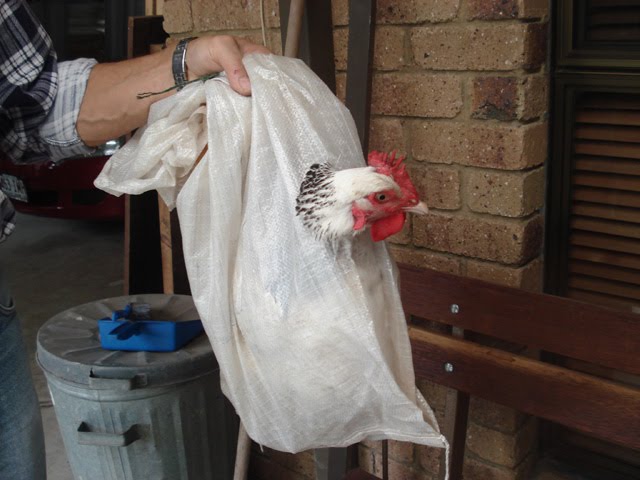
8.35am Quentin packs her bags and moves out. Our Light Sussex chook Quentin has been pecking our little Faverolles, Heather. Heather is pictured in the right side bar. She is the little whitish girl with feather pants. Quentin is twice Heather's size and is causing her a lot of distress. We asked Jens and Cathy if they wanted to add Quentin to their flock. They agreed, so Quentin will live with them now. Bye bye Quentin.

9.30am Cleaned the kitchen, washed up and swept the floor.

10am Morning tea, date scone and knitting.

10.10am Shane rang to say Happy Father's Day to Hanno but he's still out. I tell him to call back later and that I'll call Sarndra to have a chat this afternoon, he is off to work now.

10.15am Continue knitting. I'm knitting black mittens for a friend's birthday.

12.30pm Banana for lunch.

1.15pm Phoned Sarndra for a chat. I love my DIL dearly. She's smart and funny, creative and a hard worker. Most of all, she makes Shane very happy and that alone is worth its weight. ♥

2.05 pm I have just sorted through some notes for the new soap making workshop I'm putting together for the Centre. I need to do a touch more research and add some soap calculators and recipes. I wrap some of my soap for Hanno's sister and niece in Hamburg.

2.30pm Made the bed with clean sheets. Started to think about dinner. We're having soup again, the pea and ham soup I made last night. Hanno said it was too salty so I'm adding more water. If that doesn't fix it I'll add a couple of potatoes to soak up the salt. Dessert will be fresh strawberries.

It's still raining and overcast.

3pm Phone calls from Shane and to a friend and then I sit with my knitting listening to the rain fall. It is such a soothing sound, I know its doing the garden good and my thoughts start to focus on work this week. I'm starting to think very seriously about my Living Skills workshops. It's a series of classes I want to give on cooking, baking, soap making, gardening and making green cleaners, in addition to The Frugal Home workshop I've been running for over a year. I think it would be a very worthwhile exercise to get our community cooking from scratch, baking bread and growing their own food. I feel really good about being in a position to offer these workshops, to have a venue in which to do it and the support of a committee who think it's a great idea. Our clients are mainly low income people and I'd rather share some life skills with them than apply patch ups later on. I hope the classes turn out close to the vision I have in my head. If so, they'll be a real community builder.


Late in the afternoon, I heat the soup up and clean and cut the strawberries ready for eating. Dinner over, Hanno puts the chooks to bed, feeds Alice and Hettie and we both start winding down. Another quiet Sunday to prepare us for the coming week.

The last thing I hear as I drift into sleep is rain falling on the roof.

I hope you have a productive week and that the next seven days are kind to us all.


My friends at Radio National's Future Tense sent this link to their program on The Slow Movement. It's an interesting broadcast about slow living, including slow food. Listen right to the end for the discussion about the commercialisation of slow and simple. Very interesting, and reflective of the posts I've made recently on "the change".

I hope you have a beautiful weekend.
I often write here about building up our stockpiles, creating gardens full of fresh vegetables and making, rather than buying, many of the requirements of a simple home. One thing we also have to be mindful of, and this is one of the most significant parts of our lives, is to nurture and support our families, and be the kind of person you want them to be. We have to build our families too.


My children are now 29 and 30 years old. Both have settled down with beautiful, caring partners, both are ambitious and have good jobs and both are the kindest and gentlest men you would ever care to meet. They make me one very proud mother. The past week of reading about nappies/diapers, and how to wash them, made me realise that a lot has changed in the 30 years since I was a young mother. But I am happy being at this end of child rearing, seeing my boys fully grown, out in the world, functioning extremely well in a competitive and sometimes hostile world. I'm not saying that we were perfect parents, but we did enough right to get a wonderful result, twice.

I think children learn a lot when they gather with the family around the dinner table. This is the one part of the day when everyone can sit and relax, talk about what happened that day, and listen to what everyone else did. This is the time when we show, rather than tell, what our family values are. It's important. If you don't take the time to reconnect everyday, children drift off in their own world. We need that time to let them know they're an important part of the family, you support them and if they need help, you're there. It needs to start early, from the time they're eating from a tiny bowl, and continue right through until they leave home. Each stage has its own unique lessons, each stage prepares for the next. There will be requests to sit in front of the TV and to eat in their room, but the answer to that should always be no. They don't understand the significance of the family gathering until they're older. No phones or iPods at the table. No disruptions. This family time comes first, no exceptions, all else can wait. That 30 minutes can make or break a family.


I think I was quite a strict mother, but in some ways I wasn't. I had rules for TV, movies and books - I had to approve them all, and there were time limits. I was involved in their school, was on the P&C, I knew their teachers, and let their teachers know I was involved. I knew their friends and welcomed them into our home, but was very careful about where they went in return. We took them travelling a lot, we went camping and on road trips most school holidays when Hanno could get away from work. I never threatened something I wasn't prepared to carry out. I surprised them with some freedoms they didn't expect and angered them by not letting them do other things. All the time, they knew they were loved and supported in their interests. During their teenage years, when all the normal drink and drug issues emerge, we got through them and came out the other side, stronger and closer. Even now, we have a very strong relationship and they talk to me about all manner of things. I'm not sure what the key is. I guess it's love and being strong through the tough times, while knowing when to lighten up and loosen the controls, and always, always, being there to listen with an open heart.


Remember that you have to change as a parent along the way. You will get nowhere fast if you try to parent a 13 year old in the same way you parent a nine year old, or if you expect a three year old to behave like a 7 year old. And time is important too, theirs and yours. Don't over schedule them, running around to after-school activities most days of the week will tire everyone, including you. Children need a lot of time when they can just play and use their own imagination. Structured events and activities block that from happening. Give them the gift of free afternoons when they can make a fort out of a sheet or hike in the National Park with their friends when they're teenagers.

As I get older I understand how undeniably crucial the family unit is. It's not only important that we build strong families of decent, competent, intelligent people for our own family's sake, we need to do it for our country's well being too. Children who have been nurtured by a loving family and have seen active parents working towards a greener and simpler future have a better chance of doing that themselves.

And while it takes a fair amount of money to raise children, they don't need to see that money but they do need to feel loved and appreciated. There are many things a child can do without, and you don't have to fret if you can't, or don't want to, supply iPods, phones, fashions and computers, but never be ungenerous with the love. Children want their parents' love and attention more than anything else. Acceptance, kindness and love delivered in full measure, consistently, over the years, builds character and confidence in a way no product ever can. The trick is to start early and never stop.
You all know I love Winter but it's the second day of Spring today and we're in those transition days from cool to warm.  It's an absolute joy now to walk in the garden, looking, picking, tying back, clipping and even weeding.  My favourite times in the garden all through the year are very early in the morning at first light, and late in the afternoon when the trees on the neighbouring property shade our garden.  Hanno was out all day yesterday driving a group of ladies around the thrift shops.  I was in charge of the garden.  :- )  We're going out of our main growing season now and heading towards a time when we'll harvest a lot of tomatoes.  In november or December, Hanno will stop planting and although we'll continue harvesting over summer, no new plants will go in.  

This is what it looks like now.

These are the new tomatoes Hanno planted outside the garden.  Hettie, our cat, lays in the straw almost all day, sleeping.

There are a few types of Chinese greens here including bok choy, tatsoi and minuba.

Frilly lettuce is planted next to the Chinese greens and in between those crops we have a lush crop of chickweed.  I tend to think of that as a crop because we use it to feed the chooks.  They love it.

The elderberry is flowering.  I am going to take some cuttings and propagate this to give us enough berries to make champagne each Christmas.  We won't do it this year, but from next year we should be right.


Tomatoes and lettuce.

Garlic and zucchini.

New bok choi, tomatoes in the background, leeks in the top left corner and new cucumbers on the climbing frame.

In the next garden over, a big clump of parsley in the foreground, more lettuce, silverbeet (swiss chard) and the white flowering coriander/cilantro.

The same garden taken from the other end.  Here you can see Welsh onions and climbing green beans, just starting to attach themselves to their frame.

Same garden, looking back into the main garden.

Yarrow in the foreground, celeriac, silverbeet/swiss chard, kale and snow peas.  I will harvest all that silverbeet today and have it frozen by early afternoon.

Looking back onto the Chinese greens again, this time with the orange tree, bay tree (cut back) and passionfruit vines in the background.

And while I wandered around, watering and checking, eyes were upon me.  Notably those of Quentin, our Light Sussex chook.  She is upset that I am in there and she isn't.  Potatoes will soon be planted in that bare patch near the chook fence.

Our garden isn't big.  It's divided up into six beds, with herbs growing in pots near the bird baths.  Outside the fenced garden we have a lemon tree, which grows in the chook run, as well as passionfruit vines, bananas, mandarin, pink grapefruit, avocados and loquat trees.  This is more than enough food for us, and to share with family and friends.  I hope all of you who are starting gardens now or who are thinking about it, dive right in to the world of home grown vegetables and fruit.  The difference in freshness and the superb taste of backyard vegetables and fruit, is enough to keep you going year after year.  Happy gardening everyone!

There are changes happening all over the world now that I think will benefit us all in the long term. Many of us are thinking more about how our behaviour impacts our environment, we are checking food labels before we buy our food, we're getting rid of harmful substances and cleaning with simple things like vinegar and baking soda. In general, we're thinking about how we can save money rather than spend it. We know that the decisions we make need to be sensible because when we look around us now we see the results of so many bad decisions. Jobs and homes being lost and people on the brink of losing it all. I believe common sense is making a come back.

I have made many changes in my own life in the past decade. I am not the same person I was back then, my decision to stop spending on "wants" changed me for good. I've been wondering what are the five things I know deep down to my bones, I will not go back to. Five things that used to be common in my life that will never be in my life again. I thought it would be easy to come up with five. It's not, because I want to be sure this is a forever decision, and that's a tough one. For example, I immediately thought of air travel. I've not taken an air trip for the past eight years, even though I've travelled interstate and have been offered a free trip to another country. I'm definitely not going to be a frequent flyer again, and that is for reasons other than the cost of air travel, but never? There may be a time I have to fly, so that's not on my list.

Here are five I've given up for good. Five things I know will never be part of my life again. I want to see yours too and while I expect there to be a common theme, I reckon it will be a diverse list that will make us all think. In no particular order:
  • Acrylic fabric and yarn.
  • Fat-free or low fat food.
  • Fly spray.
  • New cars.
  • Magazines, newspapers, music CDs.
I'm really interested in seeing what you list. Remember, you must be totally convinced that you'll never buy it again.


I usually receive a few emails every week asking for more from scratch recipes. I cook every day, so there is no shortage of recipes. On this past weekend, I made beef curry, a very frugal beef mince (ground beef) and potato pie, lemon curd, lemon curd ice cream, apple pikelets, and more. I never use tins of soup or artificial additives in our food because one of the reasons we like eating home cooked food is we know what's in it and there are no preservatives. And to tell you the truth, this is how I learnt to cook, it's delicious and easy and I've never seen a reason to change. I never follow recipes. If I see a recipe I like, I always change it in someway to suit us. I see recipes as a starting point and if you're a good cook, you'll be able to change any recipe to better suit your family, or at those times when you don't have the exact ingredients to hand.

The only way you can change recipes is to understand what you're cooking. Don't just cook according to the book, experiment, think about your ingredients and methods and wonder about things like: What if I used double that amount? What would happen if I left that out? I don't have that, I'll use this. Will it work? Take it easy when you start, you don't want to waste any food. But cooking like that will help you develop your skills and will lead you to create you're own recipes. In the meantime, here are a couple of mine. Please feel free to modify them.

Beef mince and potato pie (with no pastry)
This will feed at least 6 people, or two old codgers for three days.

One night with peas.

Ingredients
1kg (2.2 lbs) good quality beef mince. I always buy the low fat or best quality one.
2 medium onions, chopped
2 medium carrots, sliced
2 stalks of celery, chopped
1 clove garlic
1 tablespoon paprika
2 tablespoons plain flour or corn flour/cornstarch
salt and pepper
water

for the topping
6 medium potatoes, or potato and pumpkin, or sweet potato, or any combination thereof boiled and mashed.

Another night with silverbeet.

Into a hot frying pan or cast iron pot (one you can put into the oven), place half the meat and brown it. When it has some good brown colour, remove it and do the next half. Don't skimp on this step. This is here you'll develop a lot of the flavour. All those dark brown bits on the bottom of the pan are your natural flavours. Remove the meat and add the vegetables, but not the garlic. Cook them until they develop a bit of brown colouring as well. When the vegetables are ready, add the meat back to the pan as well as the garlic.

Add the flour, paprika, salt and pepper and stir through thoroughly. Then add enough water so you can see water below the ingredients but it's not covering them. Allow that to come to the boil and stir so it thickens without catching and burning. When the mix has thickened, dollop on the mashed potato to completely cover the top. Place in the oven at 200C/395F and cook until the potato is golden brown.

This is a must have winter meal that both Hanno and I love.

Lemon curd ice cream


My recipe for lemon curd/butter is here. When you've made it, whip 300 mls/half a pint of cream to soft peak stage. Add a cup of lemon butter and stir through. Add to a bowl, cover tightly, and put it in the freezer for 24 hours. That's it! It's delicious. Hanno and I had one scoop each in martini glasses last night. What decadence. Sorry, I forgot to take a photo. Maybe tonight. ;- )

I continue to receive emails asking how to cut down on spending and if there is one good way to do it. Well, no, there isn't, it's always small things, done consistently, and never thinking anything is too small be included in our savings plans. The trick to saving grocery money is to keep those small savings coming because over the course of a year, they add up to large amounts. Laundry liquid and laundry powder are good examples of this so I did a price comparison to illustrate that point. BTW, I know that many of you already make your own laundry and cleaning products but there are new comers here and those who are yet to be convinced.

Next week and the week after, I'm doing a soap making workshop at my local Centre. Yesterday, I started preparing for the workshop by making laundry liquid and writing some notes. I haven't made laundry liquid for a couple of years because I usually use laundry powder - it's easier and quicker to make but I know it doesn't work in everyone's washing machine, so I'll be showing everyone how to make both the liquid and the powder, as well as bar soap.

The recipe I used for this is the one that's freely available on the net.
  • 1 cup soap - grated or flaked (I used Lux Flakes),
  • ½ cup washing soda (the powder not the crystals)
  • ½ cup borax.
I bought my supplies from IGA but have checked that they're also available at Woolworths. If you're in another country and can't find washing soda or borax, try your supermarket, hardware store or brewing suppliers. If you have no luck, look on the web.

My products cost:
  • Lux Flakes 700 grams $6.65.
  • Washing Soda 1 kg $3.40
  • Borax 500 grams $3.48
I weighed everything on my electronic scale to get accurate costings.
  • 700 grams of Lux is 9.3 cups | 1 cup Lux 75 grams
  • 1kg of washing soda is 3.9 cups | 1 cup washing soda 255 grams
  • 500 grams of borax is 2.6 cups | 1 cup borax 190 grams
COST OF INGREDIENTS
  • 1 cup Lux Flakes = 72 cents
  • ½ cup washing soda = 44 cents
  • ½ cup borax = 59 cents
COST IN TOTAL = $1.75 FOR TEN LITRES

To make a comparison, Dynamo, one of the leading laundry liquids here, costs (at Woolworths) $8.27 for a one litre refill pouch. So 10 litres of Dynamo would cost $82.70 Making your own saves you $80.95! I would imagine that 10 litre of laundry detergent would be enough for the average family for a year. So on this one product, over the course of a year, you'll save over $80 if you make it yourself. AND! you'll have enough of your ingredients to make it several times.

Some people notice their whites getting a little greyish after using the homemade powder or liquid for a while. I think that variation is the result of having either soft or hard water. I use a scoop of Napisan - an oxygen bleach - every so often and that fixes the greying problem. You can add Napisan (or the Aldi equivalent) to your liquid or powder if you want to. Even adding that won't alter the excellent value for money you get. The cheapest Napisan I found was $11.70 for 2 kg, you could add a scoop to any load you needed it for. Dynamo with Sard (an oxy bleach) costs $10.64 a litre. I use homemade laundry products in my front loader, have never had any problems with it and always get a good result.

If you use your grey water on your garden, leave the borax out. Borax is a whitener and deodoriser, so add the oxy-bleach instead. If borax builds up in your garden, it will damage your plants. If you can't use oxy-bleach either, make sure you hang your clothes in the sun to dry. That has a slight bleaching effect.

When you finish making the liquid and have mopped up with your rag, put the rag in the washing machine. It will probably contain a fair bit of liquid and you won't need to use as much laundry liquid in that next wash.

So, how do you make it? Take 1 cup soap - either flakes or grated, ½ cup washing soda, ½ cup borax and add it to 1 ½ litres/quarts of water in a saucepan. Put the saucepan on the stove and heat the mixture. Stir until all the ingredients are completely dissolved and remove it from the heat. I do all that in the kitchen, then take the saucepan to the laundry.

Get a large container - a bucket or tub that holds at least 10 litres/quarts, and measure in about 8 litres/quarts of cold water. Add the hot soapy mixture and stir. That's it! As it cools, the mixture will turn to gel. You can add fragrance at this point if you want to but I prefer to keep things as free from additives as I can. Gather some containers and pour it in. Please note: the gel gets quite thick, so make sure you use a wide mouthed container or leave enough room in the container to allow you to shake it well before you use it.

Add about ¼ cup of this liquid to your machine for a good wash. It's fine in a cold water wash.


This is the mixture after it's been mixed with the water. Both here and in the following photo, you can see that it's starting to gel up.


You will notice that the container with the red top has plenty of room in it to shake the contents well before use.

I'm going to make a small test batch of washing liquid using my homemade liquid soap instead of Lux. I doubt there will be much of a difference, but I want to be sure. BTW, when I get the time, I'm going to make another batch of liquid soap that I want to be a bit thicker. The liquid soap I have now is as thin as water and when I use it in a soap dispenser, I waste a lot.

Making your own laundry liquid or powder at home is just one of the many ways you can save money. Add this to the savings from stockpiling, shopping for bargains, making your own green cleaners, jams, cordials and baked goods, cooking from scratch, and being as thrifty as possible with everything you use, and you'll see the savings come in. I am sure that once you've worked out ways to modify the way you shop and use your products, you'll notice the difference. And isn't it better to have those dollars in your pocket, or paying off your debt, than in the hands of big business? All it takes is a deisre to do it, some organisation on your part and the work to make the products. You've got the information, now it's over to you.

ADDIT: If anyone has accurate costings for laundry liquid in other countries, please send them to me so I can add them to the post. Thanks!

This is a costing for our Canadian friends from Melissa at empress of dirt blog. Thanks Melissa.

I have done the calculations for making laundry liquid in Ontario, Canada. Our prices here are pretty close to yours.

I use chopped up pure bar soap (6 bars/$7.00), washing soda (3kg/$8.99), and borax (2kg/$6.59).
Based on these prices in Canadian dollars,

1 cup soap = $1.16
1/2 cup soda = 38 cents
1/2 cup borax = 33 cents
Total = $1.87 for ten litres.

COMMENTS ARE CLOSED ON THIS POST

As most of you know, I will be a first time grandmother early next year. I want to help prepare for the birth and supply some of the many things a new baby needs. I'd like to hear from Australian producers of modern cloth nappies. I am hoping we may be able to barter nappies for advertising space on my blog.

If you produce baby needs, or work for someone who does, please contact me rhondahetzel@gmail.com
We all seem to be on the same page when it comes to retirement and we all know that if your 20 or 70, simple living will help you live well all through your life. I'm guessing you've made a decision to be more proactive with your reskilling and debt payments, or you're already on that road, so what now? Well, I think you should examine your own home, and life, and work out what skills you need to do what you want to do. One of the wonderful things about living simply is that it suits everyone - those with money and those without it, younger and older, and those in the city or country. So taking that diverse range of people and circumstances it stands to reason that there is no formula that suits everyone. But this is about independence, we don't want to be fed formulas, we want to work out, for ourselves, what is needed in our own home. Some people will already know how to cook but not how to bake, some will sew, some will have to learn how, some will know how to farm their backyards, others will have to learn about container gardening, some will have water tanks rigged up, others will still be wondering if they need to harvest rain. The time has come for you to decide how you want your own home to function, what it is you need now and in the future, know to the last cent where your money is and how it is being used and when you have a list that will customise and simplify your life, work out what skills you need to develop so you can carry out your plan.

Too many beans - some need to be put aside for eating later. I always blanch the vegetables I freeze. It kills enzymes that sometimes lead to spoilage.

I did a series on simply life skills called the Biggest Kitchen Table that might help you with this. If you go to my blog archives, they start July 2, 2009. I hope some of the information there will help you identify what you need to do right now.

Six little packs of beans for two.

I hope you find, like I did, that even the normal tasks of the everyday will gently move you towards your goals. Washing up, sweeping the floor and baking bread sets the rhythm to my days that carries me through my tasks as if I have always lived like this and I was born to do it. Learning how to stockpile saved me time and money and that time was spent more effectively out in the garden, or sewing. The money saved helped pay for straw for mulch or canning jars or worms to be farmed. Simple living is an organic system in that all areas overflow to other areas, each task leads naturally on to other tasks, and most of the time it's like a domino effect - one small thing will lead on to many others. For instance, when I decided to start grocery stockpile, I had to find the space, which lead to decluttering an area, with lead to budgeting in a different way. Eventually, when the stockpile was set, I had to learn different recipes to utilise what was in the stockpile and marry that with our garden produce. Recipes were developed which lead to a Home Management Journal to keep them all. There are not many things in our lives now that aren't seamlessly connected to just about everything else here. It's simple and easy, and I hope that type of home develops for you too.

Now waiting in the freezer, next to the butter, to be used.

And just a tiny piece of friendly advice, don't compare what you're doing to what anyone else is doing. You and your family are unique and you'll set your own systems. Don't think that everything we do here in our home is something you should aspire to - we are two people just trying to do our best and make ourselves happy with what we have. You must do the same. We are all different and that difference is just one of the things to be celebrated in living this way. Be kind to yourself and to others. Forget perfection. It's over rated and it will burst your balloon every time. Treat everyone as you want to be treated yourself. Smile. Expect to make mistakes, you will learn more from a gigantic mistake than from anything else. And draw your family and friends close - that little circle of people will be your shelter in bad times and celebrate the good times with you. Honour and respect all of them and try to be a role model, even when no one is looking.

I'd love to know what your plans are now. If you have time, please share.
I'm not sure about other countries but in Australia now, if you're in paid work, you'll pay into a compulsory superannuation/retirement scheme. Your employer will pay nine percent into your superannuation account and over the course of your lifetime, it is estimated that money will be enough to see you through your old age when no government pensions are paid. That superannuation is put into managed investments that are usually reliant on healthy real estate, insurance and financial markets to slowly build funds. My late friend Bernadette lived on her superannuation but when the global economic crisis (GEC) hit, she lost a lot of money.

Cutting up a retired bed sheet for cleaning rags. We'll use the elastic from the fitted sheet as tomato ties.

Although Australia has gone through the GEC better than most countries there is still a lot of pain here, jobs and homes have been lost and businesses have closed down. Unfortunately, we are not out of the GEC woods yet. Just this morning I saw on the news that the American housing market crashed in last month to the lowest on record. And that is not the worst of the American problems, the current American debt is $13 trillion! This is from moneycnn.com: When anyone talks about U.S. debt, they typically refer to two numbers. The first is the debt held by the public. That's money owed to those who have bought U.S. Treasurys, most notably big bond mutual funds and foreign governments. Debt held by the public today is roughly $8 trillion and rising.
The second number is the money the federal government owes to government trust funds, such as those for Medicare and Social Security. The government has used revenue collected for those programs to cover other outlays. Currently, the debt to the trust funds is approaching $5 trillion.
I doubt I'll be the only person very worried by that second paragraph, but it's no good thanking your lucky stars you don't live in America because if America crashes, we all crash.

I remember the 1970s quite well and although it's only 30 years ago, that 1970s world is a completely different place to what we have now. Look 30 years into the future, you may be preparing to stop work, but what amount of money should you have? What will you need to support you through the rest of your life? How can you prepare now for a world you have no idea about? Is paying into a government backed investment fund the best idea? I don't know the answer to those questions, and I doubt anyone would, but I believe the answer, no matter what the retirement question, is to pay off debt and live simply. BTW, I do agree with a couple of commentators yesterday who advised not to invest extra money in retirement funds. Whatever investments you make that are not compulsory, should be in your control - buying land seems to be a good investment to me.

This is my knitting (and napping) chair. It's usually like this - surrounded by knitting, yarn and patterns.

The key to living on less is to change to a more frugal mindset. If you can't do that, you'll be miserable because you'll be wishing you could buy THE shoes or THE iPod that will make you "happy". You have to know, deep down to your bones, that being frugal and having less than you did before, does not make you miserable or cheap, it's the open road to a sustainable future. It will get you off the consumer merry go round, where working to buy "stuff", holidays and everything new will keep you strapped to the grindstone to pay for extras, on top of paying to live. Changing your expectations is crucial. Forget about having the "best" house in the street, aim instead for the most productive house.

I hope every single one of you will be able to retire when you feel like it and live as Hanno and I do. I loved working, I always had good jobs and I think I gave value for money, but as you age, you change and you want to give value to yourself rather than to your employer, no matter how much they pay you or how good your job is. You'll probably find, like I did, that you'll still be incredibly ambitious at 50 but by the time you're 55, you'll be questioning your role at work and wanting to slow down. By 60, I just wanted to be me, here now, with no paid deadlines to meet, and with hours to spend as I wished. I wanted to smell the roses before it was too late and I wanted to draw my family close, and even though they'd grown up and left home to make their own lives, I wanted them to know I was here, whenever they needed me, to support them. Now don't get me wrong, I still wanted to work, but I wanted the work that I did to mean something and to be primarily in my home for the benefit of my family. Most of us will work all our lives, but hopefully, part of that work will be for yourself, making a life that is slow, comfortable and meaningful.

Recently Deborah, a reader, kindly sent a large ball of Bendigo pure wool in a beautiful maize colour. Our new baby will be wearing this next year.

Apparently the amount recommended for a retired Australian couple of live on now is around $50,000 a year. Hanno and I live on half of that and we could further reduce that if we needed to. I firmly believe that work is an important part of life. It helps shape us, it can give us a sense of self confidence and pride and it keeps us active and alert. But work doesn't have to be paid work. Work can also be the daily activities that, when combined, produce the makings of a simple and less dependent existence. Let me say this loud and clear, we can cut out the middle man, buy only the raw ingredients, the needs of life and not the wants, and we can produce as much as we can at home. This cuts the cost of living to something that is manageable and gives you healthier products that don't need preservatives so they can sit on a shelf till sold.

There is no doubt that the most important things we need to do in our quest for an independent and sustainable old age is to buy a home, pay it off as quickly as possible, and to control our spending. If you can reach your ideal retirement age, whatever that is, with no mortgage or any other debt, you'll be in the driver's seat. If you've paid into a superannuation/retirement fund while you worked, if you've put extra money into additional investments such as land, if you've developed a frugal mindset, if you've skilled yourself in how to live simply you should be able to sail gently into your later life with few worries. But the key to all this, is NO debt, being skilled enough to look after yourself and to produce as much as you can at home.

Hanno planted tomatoes outside the garden this year. This photo was taken about 10 days ago, the bushes are full of flowers now.

We are all caught up in this grey tsunami. The time has come to step up and own our lives. We need to define what it is we intend to do, accurately assess how much debt we have, work out a plan to pay it off quickly, think about what skills we need to develop and then step off confidently in that direction. We are all in this together. We need each other to learn from and for support. We may not have an over the back fence relationship but we are all easily contactable via our computers and that, my friends, may be the making of us. WE hold the knowledge, the desire and the power to change. Let's put on our aprons and do it.

Newer Posts Older Posts Home

MY BOOKS

MY BOOKS


My books were all published by Pengiun, and are available at Amazon US, Amazon UK and Amazon Au

Search here

Total Pageviews

Translate


I'm Rhonda Hetzel and I've been writing my Down to Earth blog since 2007. Although I write the occasional philosophical post, my main topics include home cooking, happiness and gardening as well as budgeting, baking, ageing, generosity, mending and handmade crafts. I hope you enjoy your time here.

MY FAVOURITE PLACES

  • Grandma Donna's Place
  • Grandma Donna's YouTube
  • Grandma Donna's Instagram
  • This Simple Day
  • Nicole's Instagram

Give More

Give More

Popular posts last year

Making ginger beer from scratch

We had a nice supply of ginger beer going over Christmas. It's a delicious soft drink for young and old, although there is an alcoholic version that can be made with a slight variation on the recipe. Ginger beer is a naturally fermented drink that is easy to make - with ginger beer you make a starter called a ginger beer plant and after it has fermented, you add that to sweet water and lemon juice. Like sourdough, it must ferment to give it that sharp fizz. To make a ginger beer plant you'll need ginger - either the powdered dry variety or fresh ginger, sugar, rainwater or tap water that has stood for 24 hours to allow the chlorine to evaporate off. You'll also need clean plastic bottles that have been scrubbed with soap, hot water and a bottle brush and then rinsed with hot water. I never sterilise my bottles and I haven't had any problems. If you intend to keep the ginger beer for a long time, I'd suggest you sterilise your bottles. MAKING THE STARTER In a...
Image

NOT the last post

This will be my last post here.  I've been writing my blog for 18 years and now is the time to step back. I’ve stopped writing the blog and come back a couple of times because so many people wanted it, but that won’t happen again, I won’t be back.  I’ll continue on instagram to remain connected but I don’t know how frequent that will be. I know some of you will be interested to know the blog's statistics. 
Image

How to make cold process soap

I'm sure many of you are wondering: "Why make soap when I can buy it cheaply at the supermarket?" My cold process soap is made with vegetable oils and when it is made and cured, it contains no harsh chemicals or dyes. Often commercial soap is made with tallow (animal fat) and contains synthetic fragrance and dye and retains almost no glycerin. Glycerin is a natural emollient that helps with the lather and moisturises the skin. The makers of commercial soaps extract the glycerin and sell it as a separate product as it's more valuable than the soap. Then they add chemicals to make the soap lather. Crazy. Making your own soap allows you to add whatever you want to add. If you want a plain and pure soap, as I do, you can have that, or you can start with the plain soap and add colour, herbs and fragrance. The choice is yours. I want to add a little about animal and bird fat. I know Kirsty makes her soap with duck fat and I think that's great. I think t...
Image

Preserving food in a traditional way - pickling beetroot

I've had a number of emails from readers who want to start preserving food in jars but don't know where to start or what equipment to buy.  Leading on from yesterday's post, let's just say up front - don't buy any equipment. Once you know what you're doing and that you enjoy preserving, then you can decide whether or not to buy extra equipment. Food is preserved effectively without refrigeration by a variety of different methods. A few of the traditional methods are drying, fermentation, smoking, salting or by adding vinegar and sugar to the food - pickling. This last method is what we're talking about today. Vinegar and sugar are natural preservatives and adding one or both to food sets up an environment that bacteria and yeasts can't grow in. If you make the vinegar and sugar mix palatable, you can put up jars of vegetables or fruit that enhance the flavour of the food and can be stored in a cupboard or fridge for months. Other traditional w...
Image

Cleaning mould from walls and fabrics

With all this rain around we've developed a mould problem in our home. Usually we have the front and back doors open and that good ventilation stops most moulds from establishing. However, with the house locked up for the past week, the high humidity and the rain, mould is now growing on the wooden walls near our front door and on the lower parts of cupboards in the kitchen. Most of us will find mould growing in our homes at some point. Either in the bathroom or, in humid climates, on the walls, like we have now. You'll need a safe and effective remedy at some point, so I hope one of these methods works well for you. Mould is not only ugly to look at, it can cause health problems so if you see mould growing, do something about it straight away. The longer you leave the problem, the harder it will be to get rid of it effectively. If you have asthma or any allergies, you should do this type of cleaning with a face mask on so you don't breathe in any spores. Many peopl...
Image

Five minute bread

Bread is one of those foods that, when made with your own hands, gives a great deal of satisfaction and delight. It's only flour and water but it symbolises so much. I bake bread most days and use a variety of flours that I buy in bulk. Often I make a sandwich loaf because we use most of our bread for lunchtime sandwiches and for toast. Every so often I branch out to make a different type of loaf. I have tried sour dough in the past but I've not been happy with any of them. I'll continue to experiment with sour dough because I like the idea of using wild yeasts and saving the starter over a number of years to develop the flavour and become a part of the family. However, the loaf I've been branching out to most often is just a plain old five minute bread. By five minutes I mean it takes about five minutes actual work to prepare but it's the easiest of all bread to make and to get consistently good loaves from. If you're having people around for lunch or...
Image

This is my last post.

I have known for a while that this post was coming, but I didn't know when. This is my last post. I'm closing my blog, for good, and I'm not coming back like I have in the past.  I've been writing here for 16 years and my blog has been many things to me. It helped me change my life, it introduced me to so many good people, it became a wonderful record of my family life, it helped me get a book contract with Penguin, and monthly columns with The Australian Women's Weekly and Burke's Backyard . But in the past few months, it's become a burden. In April, I'll be 75 years old and I hope I've got another ten years ahead. However, each year I'll probably get weaker and although I'm fairly healthy, I do have a benign brain tumour and that could start growing. There are so many things I want to do and with time running out, leaving the blog behind gives me time to do the things that give me pleasure. On the day the blog started I felt a wonderful, h...
Image

What is the role of the homemaker in later years?

An email came from a US reader, Abby, who asked about being a homemaker in later years. This is part of what she wrote: "I am a stay-at-home mum to 4 children, ages 9-16. I do have a variety of "odd jobs" that I enjoy - I run a small "before-school" morning drop-off daycare from my home, I am a writing tutor, and I work a few hours a week at a local children's bookstore. But mostly, I cherish my blissful days at home - cooking, cleaning (with homemade cleaners), taking care of our children and chickens and goats, baking, meal-planning, etc. This "career" at home is not at all what I imagined during my ambitious years at university, but it is far more enriching. I notice, though, that my day is often planned around the needs of my family members. Of course, with 4 active kids and a husband, this is natural. I do the shopping, plan my meals, cook dinner - generally in anticipation of my family reconnecting in the evening.  I can't h...
Image

Every morning at home

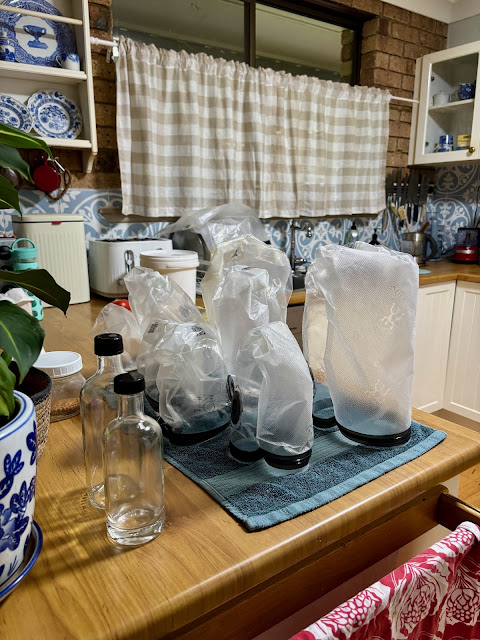
Every morning when I walk into my kitchen it looks tidy and ready for a day's work. Not so on this morning (above), I saw this when I walked in. Late the previous afternoon when I was looking for something, I came across my rolled up Zwilling vacuum bags and decided they had to be washed and dried. So I did that and although I usually put them outside on the verandah to dry it was dark by then. I turned the just-washed bags inside out and left them like this on a towel. It worked well and now the bags are ready to use when I bring home root vegetables, cabbages or whatever I buy that I want to last four or five weeks.
Image

You’ll save money by going back to basics

When I was doing the workshops and solo sessions, I had a couple of people whose main focus was on creating the fastest way to set up a simple life. You can't create a simple life fast, it's the opposite of that It's not one single thing either - it's a number of smaller, simpler activities that combine to create a life that reflects your values; and that takes a long to come together. When I first started living simply I took an entire year to work out our food - buying it, storing it, cooking it, preserving, baking, freezing, and growing it in the backyard. This is change that will transform how you live and it can't be rushed.  
Image

All previous blog posts

  • 2026 3
    • February 3
      • Workshops starting 1 March
      • Planting vegetable seeds and new workshops
      • Back where we belong
  • 2025 7
    • July 1
    • June 2
    • May 1
    • April 2
    • February 1
  • 2024 25
    • December 2
    • November 1
    • October 2
    • September 3
    • August 1
    • July 3
    • June 1
    • May 3
    • April 2
    • March 3
    • February 2
    • January 2
  • 2023 13
    • December 1
    • November 2
    • October 1
    • September 3
    • August 2
    • February 2
    • January 2
  • 2022 17
    • November 3
    • October 4
    • September 3
    • August 2
    • July 3
    • June 2
  • 2021 50
    • December 1
    • November 6
    • October 7
    • September 5
    • August 4
    • July 5
    • June 2
    • May 2
    • April 6
    • March 4
    • February 4
    • January 4
  • 2020 68
    • December 3
    • November 5
    • October 4
    • September 4
    • August 4
    • July 4
    • June 4
    • May 8
    • April 7
    • March 8
    • February 8
    • January 9
  • 2019 66
    • December 2
    • November 4
    • October 5
    • August 3
    • July 4
    • June 6
    • May 8
    • April 8
    • March 8
    • February 11
    • January 7
  • 2018 82
    • December 1
    • September 2
    • August 10
    • July 4
    • June 11
    • May 9
    • April 12
    • March 10
    • February 10
    • January 13
  • 2017 129
    • December 7
    • November 10
    • October 6
    • September 13
    • August 11
    • July 13
    • June 12
    • May 9
    • April 9
    • March 14
    • February 11
    • January 14
  • 2016 125
    • December 7
    • November 13
    • October 10
    • September 11
    • August 11
    • July 8
    • June 9
    • May 9
    • April 12
    • March 10
    • February 13
    • January 12
  • 2015 184
    • December 7
    • November 15
    • October 20
    • September 18
    • August 19
    • July 18
    • June 12
    • May 15
    • April 12
    • March 21
    • February 13
    • January 14
  • 2014 203
    • December 11
    • November 8
    • October 17
    • September 20
    • August 17
    • July 19
    • June 17
    • May 17
    • April 23
    • March 15
    • February 18
    • January 21
  • 2013 225
    • December 13
    • November 17
    • October 17
    • September 17
    • August 21
    • July 24
    • June 20
    • May 19
    • April 17
    • March 22
    • February 17
    • January 21
  • 2012 245
    • December 17
    • November 20
    • October 20
    • September 18
    • August 15
    • July 24
    • June 21
    • May 26
    • April 23
    • March 23
    • February 19
    • January 19
  • 2011 257
    • December 18
    • November 24
    • October 27
    • September 23
    • August 24
    • July 21
    • June 24
    • May 24
    • April 16
    • March 22
    • February 14
    • January 20
  • 2010 283
    • December 20
    • November 18
    • October 18
    • September 19
    • August 25
    • July 24
    • June 25
    • May 26
    • April 25
    • March 22
    • February 29
    • January 32
  • 2009 293
    • December 29
    • November 18
    • October 23
    • September 25
    • August 22
    • July 28
    • June 22
    • May 21
    • April 27
    • March 26
    • February 24
    • January 28
  • 2008 387
    • December 24
    • November 23
    • October 25
    • September 26
    • August 27
    • July 27
    • June 37
    • May 34
    • April 44
    • March 53
    • February 32
    • January 35
  • 2007 372
    • December 37
    • November 40
    • October 55
    • September 51
    • August 49
    • July 63
    • June 49
    • May 28


Trending Articles

NOT the last post

This will be my last post here.  I've been writing my blog for 18 years and now is the time to step back. I’ve stopped writing the blog and come back a couple of times because so many people wanted it, but that won’t happen again, I won’t be back.  I’ll continue on instagram to remain connected but I don’t know how frequent that will be. I know some of you will be interested to know the blog's statistics. 
Image

Every morning at home

Every morning when I walk into my kitchen it looks tidy and ready for a day's work. Not so on this morning (above), I saw this when I walked in. Late the previous afternoon when I was looking for something, I came across my rolled up Zwilling vacuum bags and decided they had to be washed and dried. So I did that and although I usually put them outside on the verandah to dry it was dark by then. I turned the just-washed bags inside out and left them like this on a towel. It worked well and now the bags are ready to use when I bring home root vegetables, cabbages or whatever I buy that I want to last four or five weeks.
Image

You’ll save money by going back to basics

When I was doing the workshops and solo sessions, I had a couple of people whose main focus was on creating the fastest way to set up a simple life. You can't create a simple life fast, it's the opposite of that It's not one single thing either - it's a number of smaller, simpler activities that combine to create a life that reflects your values; and that takes a long to come together. When I first started living simply I took an entire year to work out our food - buying it, storing it, cooking it, preserving, baking, freezing, and growing it in the backyard. This is change that will transform how you live and it can't be rushed.  
Image

Creating a home you'll love forever

Living simply is the answer to just about everything. It reduces the cost of living; it keeps you focused on being careful with resources such as water and electricity; it reminds you to not waste food; it encourages you to store food so you don't waste it and doing all those things brings routine and rhythm to your daily life. Consciously connecting every day with the activities and tasks that create simple life reminds you to look for the meaning and beauty that normal daily life holds.  It's all there in your home if you look for it. Seemingly mundane tasks like cleaning and cooking help you with that connection for without those tasks, the home you want to live in won't exist in the way you want it to.  Creating a home you love will make you happy and satisfied.
Image

Time changes everything

I've been spending time in the backyard lately creating a contained herb and vegetable garden. My aim is to develop a comfortable place to spend time, relax, increase biodiversity and encourage more animals, birds and insects to live here or visit. Of course I'd prefer my old garden which was put together by Hanno with ease and German precision. Together, we created a space bursting at the seams with herbs, vegetables and fruity goodness ready to eat and share throughout the year. But time changes everything. What I'm planning on doing now, is a brilliant opportunity for an almost 80 year old with balance issues. In my new garden I'll be able to do a wide range of challenging or easy work, depending on how I feel each day. It’s a daily opportunity to push myself or sit back, watch what's happening around me and be captivated by memories or the scope of what's yet to come.
Image

It's the old ways I love the most

I'm a practical woman who lives in a 1980’s brick slab house. There are verandahs front and back so I have places to sit outside when it's hot or cold. Those verandahs tend to make the house darker than it would be but they're been a great investment over time because they made the house more liveable. My home is not a romantic cottage, nor a minimalist modern home, it's a 1980’s brick slab house. And yet when people visit me here they tell me how warm and cosy my home is and that they feel comforted by being here. I've thought about that over the years and I'm convinced now that the style of a home isn't what appeals to people. What they love is the feeling within that home and whether it's nurturing the people who live there.
Image

Back where we belong

Surprise! I'm back ... for good this time. Instagram became an impossible place for me. They kept sending me messages asking if I'd make my page available for advertisers! Of course, I said no but that didn't stop them. It's such a change from what Instagram started as. But enough of that, the important part of this post is to explain why I returned here instead of taking my writing offline for good. For a few years Grandma Donna and I have talked online face-to-face and it's been such a pleasure for me to get to know her. We have a lot in common. We both feel a responsibility to share what we know with others. With the cost of living crisis, learning how to cook from scratch, appreciate the work we do in our homes, shop to a budget and pay off debt will help people grow stronger. The best place to do that is our blogs because we have no advertising police harassing us, the space is unlimited, we can put up tons of photos when we want to and, well, it just feels li...
Image

Making ginger beer from scratch

We had a nice supply of ginger beer going over Christmas. It's a delicious soft drink for young and old, although there is an alcoholic version that can be made with a slight variation on the recipe. Ginger beer is a naturally fermented drink that is easy to make - with ginger beer you make a starter called a ginger beer plant and after it has fermented, you add that to sweet water and lemon juice. Like sourdough, it must ferment to give it that sharp fizz. To make a ginger beer plant you'll need ginger - either the powdered dry variety or fresh ginger, sugar, rainwater or tap water that has stood for 24 hours to allow the chlorine to evaporate off. You'll also need clean plastic bottles that have been scrubbed with soap, hot water and a bottle brush and then rinsed with hot water. I never sterilise my bottles and I haven't had any problems. If you intend to keep the ginger beer for a long time, I'd suggest you sterilise your bottles. MAKING THE STARTER In a...
Image